Key takeaways
- Crypto wallet development costs typically range between $25,000 and $500,000+, depending on wallet complexity, blockchain support, compliance requirements, and security infrastructure.
- Security and compliance can consume 20–30% of the total wallet development budget, especially for custodial wallets, DeFi integrations, and enterprise-grade platforms.
- Flutter-based crypto wallet app development can reduce engineering costs by nearly 30–40% compared to maintaining separate native apps for iOS and Android.
- Enterprise crypto wallet development projects often take 8–12 months or longer because of infrastructure setup, multi-chain integration, security audits, and deployment complexity.
Thecrypto wallet market is projected to reach $100.77 billion by 2033, according to Grand View Research, growing at a CAGR of 26.3% from 2025 to 2033.
Businesses that want a piece of that market are getting in. But when they don't have a clear picture of what crypto wallet development actually costs and which decisions lock in long-term expenses, the project can quietly go sideways.
This guide covers all of that. Cost structures, deployment options, tech stacks, wallet architectures, and how to evaluate a crypto wallet development company without getting burned.
Looking for the right crypto wallet development company for your project? Goodfirms helps businesses compare verified reviews, technology expertise, pricing models, and service capabilities across leading blockchain development firms. Explore the top-rated crypto wallet development companies and shortlist the right partner for your business goals.
What Does Crypto Wallet Development Actually Cost?
The crypto wallet development costs around $25,000 to $500,000, depending on what you're building.
That is quite a range. But the difference comes from genuinely different product categories. A basic single-chain hot wallet is structurally simpler than a multi-chain MPC-based enterprise custody solution. They are not different versions of the same product. So treating them the same way is where most budget conversations go wrong.
Here's a practical breakdown:
Crypto Wallet Development Cost by Complexity
| Wallet Tier | Description | Estimated Cost | Timeline |
|---|---|---|---|
| Basic MVP | Single chain, send/receive, basic UI | $25,000–$50,000 | 2-3 months |
| Advanced | Multi-chain, NFT support, swaps | $80,000–$180,000 | 4-7 months |
| Enterprise | MPC custody, full DeFi, KYC/AML, audit trails | $200,000–$500,000+ | 8–12 months |
Security and compliance usually consume 20–30% of the total budget in any serious crypto wallet development project.
Geographic location also plays a major role in overall costs. Companies in the USA and UK often face higher blockchain engineering salaries, which is why many businesses choose to outsource to specialized development firms and reduce expenses by 40% to 60%.
Certain regions also offer regulatory advantages. Dubai’s DIFC and Abu Dhabi Global Market zones, for instance, have crypto-friendly frameworks that can help lower compliance engineering costs during wallet development.
Hidden Costs Businesses Frequently Miss
Most businesses focus heavily on the initial crypto wallet development cost. Design, development, deployment, that part gets all the attention. The ongoing costs usually show up later.
Infrastructure and cloud hosting
Wallet platforms need stable uptime and reliable transaction processing. As usage grows, so do expenses tied to servers, storage, bandwidth, and backup systems.
Third-party integrations
Most wallets depend on external services for KYC verification, blockchain data, live pricing, and payment processing. These integrations often come with recurring monthly fees.
Compliance updates
Crypto regulations continue evolving across different markets. Businesses may need to update monitoring systems, reporting workflows, and compliance processes regularly to stay aligned with new requirements.
Security audits
Security testing is not a one-time process. Regular audits, penetration testing, and vulnerability assessments help identify weaknesses before they become serious problems.
Ongoing maintenance
Wallet infrastructure requires continuous updates after launch. Performance tuning, bug fixes, version upgrades, and security patches all become part of long-term operational costs.
Customer support systems
Users expect quick support when transactions fail or delays happen. Strong support infrastructure helps maintain trust and prevents operational issues from turning into reputation problems.
Wallet Types: Which Architecture Fits Your Business?
The type of wallet a business chooses affects everything. Security, compliance, user experience, recovery systems, and even long-term operating costs.
Some wallets prioritize convenience. Others focus heavily on asset protection. The right choice usually depends on how the business plans to use crypto.
Before you finalize any, thoroughly review the top crypto wallets. Studying them will help you avoid the mistakes they made in their earlier stages.
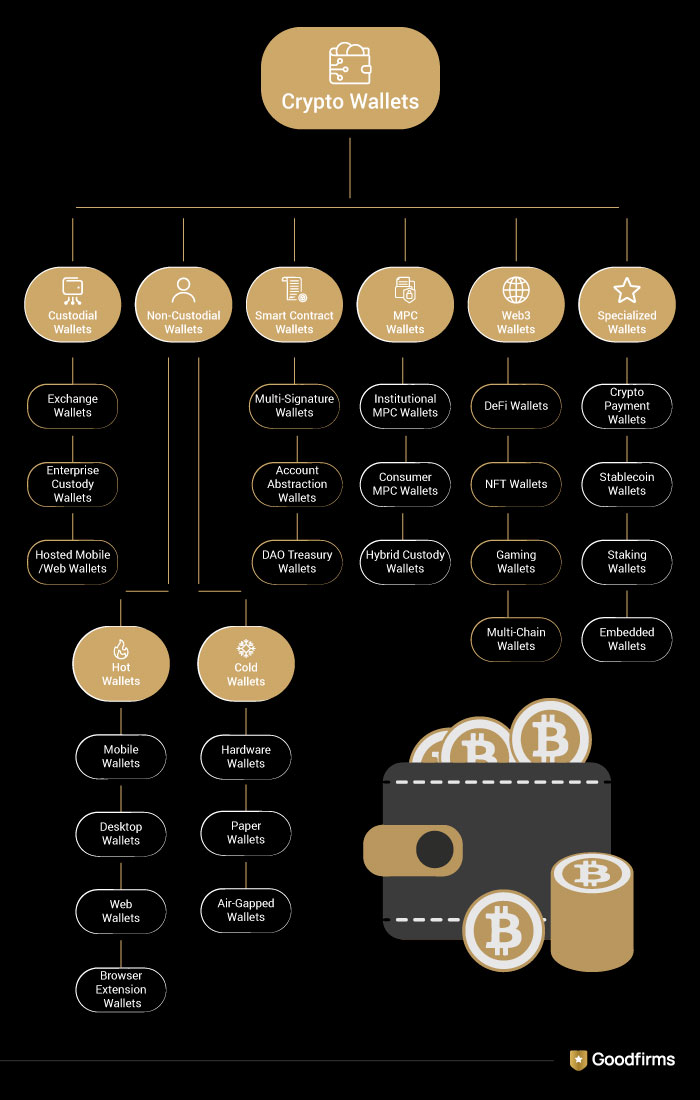
Custodial Wallets
Custodial wallets store private keys on behalf of users. Most crypto exchanges and fintech platforms use this model because it simplifies onboarding and account recovery.
Users can reset passwords and recover access more easily, which makes custodial systems more familiar for mainstream audiences. The tradeoff is responsibility. Businesses handling custody also take on greater security and compliance obligations.
Custodial wallets are commonly used for:
- Crypto exchanges
- Trading platforms
- Payment apps
- Enterprise treasury systems
Non-Custodial Wallets
Non-custodial wallets give users complete control over their private keys and digital assets. No central authority manages access.
This model is widely used by Web3 crypto wallet development companies because it aligns with decentralized ecosystems and DeFi applications.
The biggest advantage here is the ownership. Users maintain direct control of funds. The downside is recovery. If private keys or seed phrases are lost, restoring access becomes difficult.
Non-custodial wallets are common in:
- DeFi platforms
- NFT ecosystems
- Web3 applications
- Blockchain gaming platforms
Hot Wallets
Hot wallets remain connected to the internet, which makes transactions fast and convenient.
Most mobile wallets, browser wallets, and web wallets fall into this category. Businesses building customer-facing crypto products often rely on hot wallets because they support real-time payments and seamless user experiences.
The convenience comes with higher exposure to cyber threats, which is why hot wallets usually require stronger monitoring and security controls.
Cold Wallets
Cold wallets stay offline and are designed for long-term asset storage.
They are commonly used to secure large crypto reserves because they reduce exposure to online attacks. Many enterprises use a combination of hot and cold wallets, keeping smaller operational balances online while storing larger holdings offline.
Hardware wallets and air-gapped systems are common examples of cold wallet infrastructure.
Read more on cold wallets and why they are the safest bet in this blog.
MPC Wallets
Multi-Party Computation has become one of the fastest-growing areas in crypto wallet development.
Instead of storing a complete private key in one place, MPC wallets split cryptographic control across multiple parties or devices. This reduces the risk of a single point of failure.
Institutional platforms increasingly prefer MPC wallets because they improve security without creating the friction associated with traditional cold storage systems.
Web3 Wallets
Web3 wallets are designed for interacting with decentralized applications, smart contracts, NFTs, and blockchain ecosystems beyond simple payments.
These wallets often support:
- DeFi integrations
- NFT storage
- Multi-chain asset management
- Token swapping
- dApp connectivity
Modern crypto wallet app development companies increasingly focuses on Web3 compatibility because users expect wallets to function across multiple blockchain ecosystems instead of remaining tied to a single network.
Tech Stack for Crypto Wallet Development
The technology underneath a wallet shapes its security, scalability, and long-term maintenance cost. Here's what a modern production stack looks like:
| Layer | Technologies |
|---|---|
| Frontend | React Native, Flutter, Swift, Kotlin |
| Backend | Node.js, Go, Python |
| Blockchain | BNB Chain, Polygon, Bitcoin, Solana, Ethereum |
| APIs & SDKs | WalletConnect, Web3.js, Ethers.js |
| Database | PostgreSQL (transactions), Redis (session/cache), MongoDB |
| Node Providers | Alchemy, Infura, QuickNode, self-hosted Geth |
Flutter has become a preferred framework for many crypto wallet development projects because it supports both iOS and Android apps through a single codebase while still delivering near-native performance. This often helps businesses reduce engineering costs by around 30% to 40% compared to building separate native applications. For companies targeting markets like the UAE and Canada, infrastructure decisions matter too. Choosing blockchain node providers with regional data center availability can improve transaction latency and create a smoother user experience.
Crypto Wallet Deployment Models
Deployment decisions shape how secure, scalable, and reliable a crypto wallet becomes after launch. Many businesses focus heavily on development, but infrastructure planning usually determines how stable the platform feels under real transaction volume.
| Deployment Model | Best For | Main Advantage | Main Challenge |
|---|---|---|---|
| Cloud Deployment | Startups, fintech apps, Web3 wallets | Faster scaling and lower setup complexity | Shared infrastructure exposure |
| Hybrid Deployment | Exchanges and regulated platforms | Better key security and infrastructure flexibility | More operational complexity |
| Self-Hosted Deployment | Institutional custody and enterprise systems | Maximum infrastructure control | Higher maintenance responsibility |
Cloud Deployment
Cloud infrastructure remains the most common choice in crypto wallet development because it allows businesses to launch faster and scale more easily.
Platforms like AWS, Google Cloud, and Azure support wallet APIs, transaction processing, monitoring systems, and backup infrastructure without requiring companies to manage physical servers internally.
This model will work for:
- Consumer wallet apps
- Crypto payment platforms
- NFT wallets
- Web3 applications
Many businesses also use cloud-based key management services for encryption and access control.
Hybrid Deployment
Hybrid deployments combine cloud infrastructure with dedicated security layers like Hardware Security Modules (HSMs) or isolated signing systems.
This setup is common in exchanges and enterprise-grade wallet platforms handling large transaction volumes or institutional assets. Sensitive cryptographic operations stay separated from the main application environment, which improves security without sacrificing scalability.
Hybrid infrastructure also helps businesses operating in regulated markets where custody controls are stricter.
Self-Hosted Deployment
Some enterprises prefer fully self-hosted wallet infrastructure to maintain direct control over blockchain nodes, APIs, databases, and security systems.
This model offers stronger operational ownership, but it also increases responsibility significantly. Internal teams must handle uptime monitoring, failover systems, patch management, and infrastructure maintenance continuously.
Self-hosted environments are usually chosen for:
- Institutional custody platforms
- Enterprise treasury systems
- High-security financial applications
Blockchain Node Infrastructure
Blockchain node management becomes critical as wallet platforms grow.
Businesses can either run dedicated nodes internally or rely on providers like Infura, Alchemy, or QuickNode for blockchain access. Managed node providers simplify deployment and reduce operational overhead, especially for multi-chain wallet development.
If a single RPC provider experiences downtime, wallet functionality can get disrupted. Many production-grade wallet systems now use fallback node providers to improve resilience during outages.
Goodfirms Insight:
Multi-chain support may attract users initially, but long-term trust comes from stability. Businesses building crypto wallets in 2026 are being evaluated less on features and more on how reliably the platform performs during outages, congestion, and security incidents.
Key Management and Security
Private key infrastructure sits at the center of crypto wallet deployment. Custodial wallets often use HSMs, MPC infrastructure, or multi-signature systems to protect cryptographic operations.
Non-custodial wallets typically rely on secure enclave storage, encrypted backups, and seed phrase management systems.
Weak key management architecture creates long-term security risks that become expensive to fix later.
Post-Deployment Operations
Deployment is not the final stage of crypto wallet development. Wallet infrastructure requires continuous monitoring, chain upgrades, performance optimization, and security patching after launch.
Transaction patterns change over time, blockchain protocols evolve, and compliance requirements continue shifting across different markets. This is why ongoing maintenance planning matters just as much as the initial deployment itself.
How to Choose a Crypto Wallet Development Company
This decision determines project success more than any technical choice.
Questions to Ask Before Signing
Technical depth:
- Have you built MPC or multi-sig wallets before?
- How do you handle private key backup and recovery?
- What blockchain node infrastructure do you recommend and why?
- How do you approach smart contract audit readiness?
Security practices:
- What's your process for code security review?
- Have your wallets undergone third-party security audits?
- How do you handle vulnerability disclosure post-launch?
Compliance readiness:
- Have you integrated KYC/AML providers before?
- Do you have experience building for regulated jurisdictions?
- How do you handle OFAC screening?
Commercial terms:
- Do we own the IP and source code?
- What does post-launch support and maintenance include?
- How are scope changes handled and priced?
Vendor Evaluation Checklist
[ ] Verifiable portfolio of shipped wallet products (not mockups)
[ ] Named references from past wallet clients
[ ] Clear security and audit process documented
[ ] Blockchain-specific engineering team
[ ] Experience with your target chain(s)
[ ] Compliance experience in your jurisdiction
[ ] Code ownership and IP transfer clauses in contract
[ ] Post-launch support SLA defined
FAQs
How long does crypto wallet development usually take?
A basic MVP wallet with single-chain support and standard send/receive functionality typically takes around 2 to 3 months to develop. Advanced wallets with multi-chain support, NFT functionality, and token swaps often require 4 to 7 months. Enterprise-grade wallet platforms using MPC custody, DeFi integrations, KYC/AML systems, and audit trails can take anywhere between 8 and 12 months or longer due to infrastructure complexity and security testing.
Should businesses build a crypto wallet from scratch or use white-label solutions?
White-label crypto wallet development works well for businesses that want faster market entry and lower upfront investment. Custom wallet development makes more sense when security customization, unique features, or institutional-scale infrastructure are important. Many startups begin with white-label solutions and later migrate toward custom wallet architecture as transaction volume and product complexity increase.
What blockchains should a crypto wallet support in 2026?
Most businesses now prioritize multi-chain wallet development instead of supporting a single blockchain. Ethereum, Bitcoin, Solana, Polygon, and BNB Chain remain among the most commonly integrated ecosystems because they support large user communities, DeFi activity, NFTs, and stablecoin transactions. The right blockchain mix usually depends on the wallet’s target audience and business model.
Why do crypto wallet projects exceed their original budget?
Crypto wallet development projects often expand because security, compliance, and infrastructure requirements become clearer during development. Businesses may initially plan for a basic wallet, then later add multi-chain support, KYC systems, staking, DeFi integrations, or enterprise custody features. Ongoing infrastructure costs and third-party integrations also increase long-term spending beyond the original estimate.
What should businesses check before hiring a crypto wallet development company?
Businesses should evaluate a crypto wallet development company based on blockchain expertise, security architecture experience, deployment capabilities, and post-launch support. It is also important to review previous wallet projects, compliance understanding, and experience with technologies like MPC wallets, HSM infrastructure, and multi-chain systems. Comparing verified reviews and company profiles on Goodfirms can help businesses shortlist more reliable development partners.
Crypto Wallets are Becoming Financial Infrastructure
Most businesses that run into trouble with crypto wallet projects do not fail at the product level. They fail at the infrastructure level because the custody model was chosen too hastily, the node strategy was not planned for multi-chain scale, and compliance requirements were scoped too late in the build.
The wallets that hold up under real conditions share a few things in common: a custody architecture that was decided before the first line of code was written, a key management system that was stress-tested before launch, and a maintenance plan that accounted for how fast blockchain protocols and compliance requirements actually move.
That is not a long list. But it is the list that separates wallet platforms still operating reliably two years after launch from the ones that required expensive rebuilds.
The market is large and growing. The real constraint is finding a development partner with the infrastructure depth to match your business requirements. Goodfirms helps businesses compare verified company profiles, blockchain expertise, client reviews, and deployment experience across leading crypto wallet development firms, so you can make that decision with real information rather than sales decks.