Key takeaways
- Not every "99% uptime" promise is equal — 99.9% still allows almost 9 hours of downtime a year, while 99.99% cuts that to under an hour. Ask how it's measured, not just the number.
- The advertised price is rarely the real price — extra charges for certain calls, multipliers, and overage fees can quietly add up. Estimate your actual usage before comparing plans on price alone.
- Few providers combine strong certifications (SOC 2 Type II, ISO 27001) with a 99.99%+ uptime guarantee — and sticking to standard methods rather than proprietary tools makes switching providers later easy.
A blockchain infrastructure provider gives developers managed access to nodes, APIs, validators, and blockchain data needed to run apps on networks such as Ethereum, Solana, Polygon, and Avalanche — without having to build or maintain that infrastructure in-house. For many Web3 development companies, infrastructure providers serve as the backbone, connecting decentralized applications to blockchain networks.
At first, selecting a blockchain infrastructure provider doesn't seem risky. The landing pages all say the same things — unlimited scale, near-perfect uptime, and pricing that looks reasonable on a calculator.
Then congestion hits the mainnet. A node falls behind. A trading bot keeps firing off trades on data that's already stale. That's usually the moment it becomes clear — this was never really about spec sheets. It's about what happens once something actually breaks.
Part of what makes these failures hard to diagnose is that modern blockchain infrastructure isn't one system — it's a stack. Wallets depend on RPC providers, and RPC providers depend on cloud infrastructure. Any single layer can fail while the rest keep running.
Want to see how providers stack up? Explore blockchain network infrastructure software on Goodfirms before you shortlist.
This blog walks through how blockchain infrastructure providers actually differ, the mistakes that quietly cost teams the most in 2026, and a practical way to evaluate your options before you sign anything. Let's start with the basics.
What Is a Blockchain Infrastructure Provider? A blockchain infrastructure provider handles the technical groundwork a blockchain app needs to run — nodes, RPC endpoints, validators, indexing, and APIs — so developers don't have to build and maintain any of it themselves.
Knowing the definition is the easy part. The harder part — and the one that actually determines whether a provider holds up in production — is knowing what to check before you commit to one.
What to check before you commit
A handful of factors separate a provider that holds up under real production load from one that only looks good in a sales demo.
- Uptime and SLA definitions: A stated uptime number means little without knowing how it's measured. Is it per endpoint, per region, or global? A provider can reach 99.9% globally while a single region is fully down.
- Latency benchmarks: p50, p95, and p99 latency figures vary by provider and region, so test with your actual workload rather than relying on marketing benchmarks. This matters more than it looks — for a workload making 20 sequential RPC calls, the odds of hitting at least one slow P99 response climb to roughly 18%, and in a 100-call chain, that rises to nearly 63%, according to Chainstack's engineering team.
- Archive node access and pricing: Archive queries are often billed at twice the standard rate, so factor this in if your use case involves historical data, compliance audits, or transaction replay.
- Compliance certifications: For regulated or enterprise use cases, SOC 2 Type II and ISO 27001 certifications are the current baseline signals of a mature security posture.
Chainstack's own enterprise infrastructure guide frames these certifications as table stakes rather than a competitive edge — the baseline a vendor needs just to be considered, not something that sets one apart from another.
Source: Chainstack
- Penalty structure in the SLA: Credible enterprise agreements include tiered service credits, for example, a percentage credit for availability dipping between 99.5 and 99.9%, and contract termination rights if it falls further. An SLA without financial consequences is a marketing claim, not a guarantee.
- Chain and network coverage: Coverage varies significantly by provider — some focus on a narrower set of major EVM chains, while others like Dwellir support 140+ networks under a single account. Broader coverage matters more for multi-chain teams than single-chain builders.
Even teams that know what to look for still get it wrong sometimes. Here's where that usually happens.
The Costly Mistakes Teams Keep Making
Most of the expensive mistakes in this space aren't dramatic outages. They're slow-building decisions that only show their cost months later.
- Choosing on sticker price alone, without modeling your actual call mix against method-weight multipliers and overage charges.
- Assuming the uptime number applies consistently across all regions and endpoints, rather than checking how it's actually measured.
- Not budgeting for archive node and debug calls, which providers typically bill at a premium over standard requests.
- Getting stuck with a provider because proprietary tools or extensions make switching later too costly.
- Skipping the fine print on SLA penalties leaves no real recourse when a provider fails to meet its commitments.
- Treating free or shared-tier endpoints as production-ready, when they typically carry hard rate limits and no SLA at all.
Most of these mistakes trace back to a lack of full understanding of what a provider is actually doing behind the endpoint. That's worth unpacking before going further.
What Blockchain Infrastructure Providers Actually Do
Blockchain infrastructure providers give businesses and developers access to the underlying plumbing a blockchain network needs to function, without requiring them to run and maintain that plumbing themselves. That includes RPC and API access to nodes, validator and staking setups, data indexing, and archive storage for historical chain state. Instead of standing up your own servers, syncing a node from Genesis, and monitoring it around the clock, you connect to a provider's managed endpoint and let them handle uptime, scaling, and security in the background.
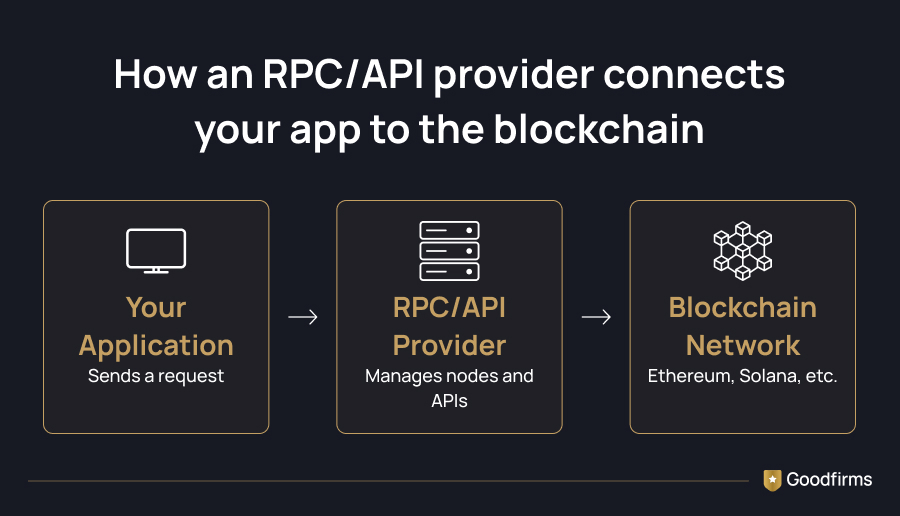
If you're building on Ethereum, Solana, or any other active chain, this decision isn't really optional. Running node infrastructure at production scale takes real engineering hours — enough that even well-resourced teams often decide it's not worth building in-house when a managed option is readily available.
That trade-off, building it yourself versus letting someone else manage it, is worth seeing side by side
Self-hosted Node vs. Infrastructure Provider
Most teams have two options: operate their own blockchain nodes or use a managed infrastructure provider. The table below highlights the key differences.
|
Self-hosted Node |
Infrastructure Provider |
|---|---|
|
Full operational control |
Managed infrastructure |
|
Requires DevOps expertise |
Minimal setup |
|
High maintenance |
Provider handles updates |
|
Better for specialized workloads |
Better for most production apps |
For most teams, that table makes the decision look simple. In practice, what's riding on that choice has gotten a lot bigger.
Why choosing the Right Blockchain Infrastructure Providers matters more in 2026
The stakes have gone up. Infrastructure and protocols now account for the largest share of blockchain technology spending — 61.1% of market revenue in 2025, according to Grand View Research. More production systems are built on this layer now, from DeFi protocols to enterprise settlement platforms, which means a bad infrastructure choice doesn't just cause a headache anymore. It can show up as stale price feeds during a volatile swing, failed transactions mid-token-launch, or a compliance gap you only discover once the audit's already started.
The market's actually gotten more fragmented, not less. New entrants, regional providers, and specialized node operators are all competing for the same workloads now — more choice, sure, but also a much wider spread in what "reliable" even means from one provider to the next.
Before you can evaluate any provider against these stakes, it helps to know exactly what you're comparing.
The Main Types of Blockchain Infrastructure and Node Services
Before comparing providers, it helps to know what you're actually shopping for. Most offerings fall into a few core categories:
- RPC and API node access: The most common entry point, giving applications a way to read from and write to a blockchain without running a node.
- Validator and staking infrastructure: Setup and management of nodes that participate in network consensus and earn staking rewards.
- Indexing and data services: On-chain data structured for analytics, compliance work, and application logic — usually streamed straight into a database.
- Archive, full, and light nodes: Archive nodes store a chain's complete historical state, useful for compliance and analytics. Full nodes hold the recent state. Light nodes verify data without storing the full chain, trading completeness for speed.
Knowing the categories is only half the picture. The other half is knowing whether your specific use case actually needs them.
Who uses Blockchain Infrastructure Providers?
Blockchain infrastructure providers aren't just for large enterprises. Any team building on-chain at any scale eventually needs reliable access to node data, and building that in-house rarely makes sense until it's necessary.
Teams that rely on this kind of infrastructure include:
- DeFi protocols — real-time price feeds, transaction execution, and liquidation monitoring, where a delay or outage costs users money directly. These protocols typically rely on the expertise of smart contract development companies and on reliable node infrastructure to ensure the secure execution of on-chain transactions.
- NFT marketplaces — to track minting activity, ownership transfers, and metadata across multiple chains
- Crypto wallets — to fetch balances, transaction history, and gas estimates without running their own nodes for every supported chain. Teams building wallet products often partner with specialized cryptocurrency wallet development companies to leverage the deep technical expertise required for wallet development.
- Blockchain games — for fast, reliable in-game transactions and asset ownership verification at scale
- Exchanges — for deposit and withdrawal monitoring, wallet reconciliation, and compliance-grade transaction tracing
- Enterprise blockchain applications — for supply chain tracking, tokenization, and settlement systems that need predictable uptime and audit trails. Teams building these applications often work with specialized blockchain development companies to architect and deploy production-ready blockchain solutions.
- Analytics platforms — to index and query historical chain data for research, compliance, and reporting without maintaining their own archive nodes
Each of these use cases has a different tolerance for downtime and different node requirements, which is exactly why the evaluation criteria covered earlier in this guide — uptime measurement, latency, and chain coverage — matter more for some teams than others.
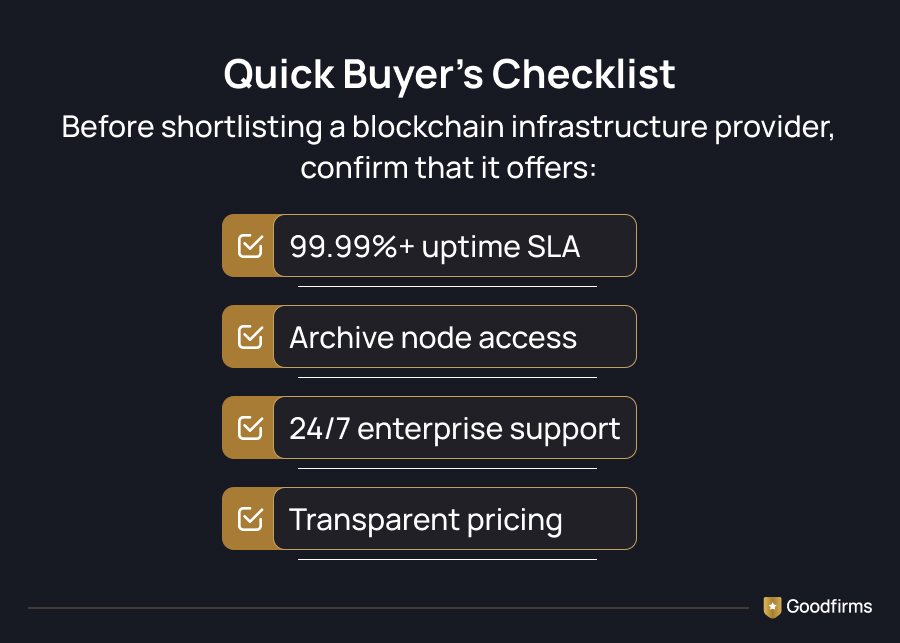
With that checklist in hand and the evaluation criteria already covered, what's left is understanding how providers actually differ under the hood — starting with the centralized-versus-decentralized trade-off that underlies many of these decisions.
Centralized versus Decentralized Infrastructure: The Trade-off
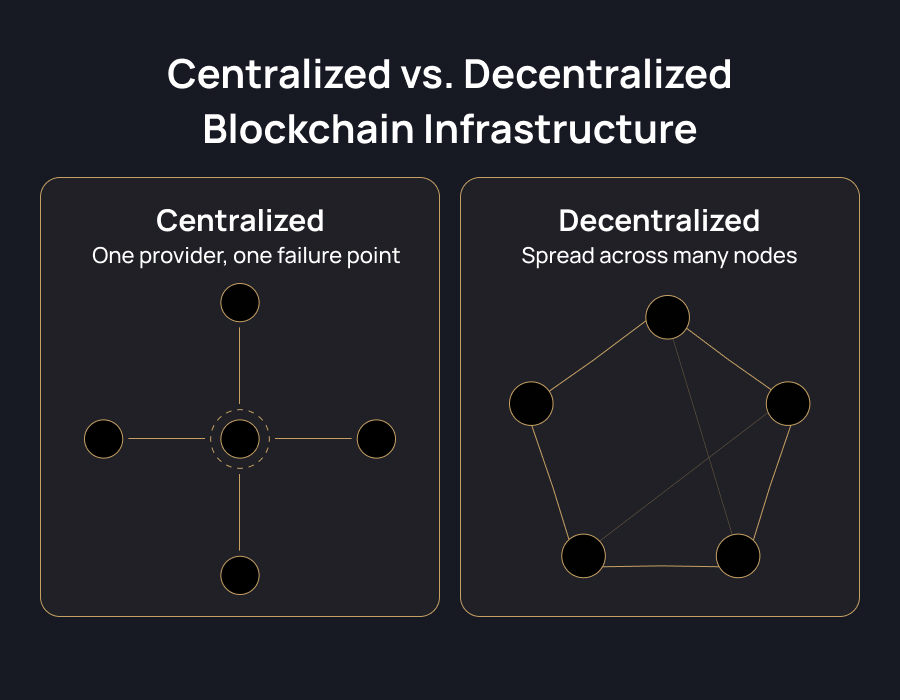
Centralized providers — the big managed RPC platforms — make onboarding easier and come with predictable pricing and dedicated support. Go decentralized or self-hosted instead, and you give some of that up in exchange for censorship resistance and less reliance on any one vendor. Most production teams end up somewhere in the middle: a managed provider handling the primary endpoint, with a self-hosted or secondary provider standing by as a failover. No single point of failure, and you're not stuck running the whole stack yourself.
Running a primary provider alongside a secondary failover isn't a cost optimization — it's a design requirement. If a single endpoint outage can take your application offline, the architecture is incomplete, regardless of how reliable that one provider claims to be.
Wherever you land on that trade-off, cost is usually the deciding factor. And this is where pricing gets more complicated than a headline number suggests.
How much do Blockchain Infrastructure Providers Cost?
Prices tend to follow the same curve no matter the provider. There's a free tier to test it out, then costs climb as usage grows. Providers with flat-tier pricing typically start at $42–$50 a month at the entry level — Alchemy is the exception, since it charges usage on a pay-as-you-go basis rather than a flat entry fee. Once a team scales up, mid-tier plans range from roughly $212 to $499. Enterprise pricing jumps fast from there — $849 a month or more, sometimes a custom quote if volume's high enough. Dwellir's comparison across providers lines up with this.
Not every plan works off a flat quota, though. Some providers bill by request or compute unit instead. In that case, your actual cost and the throughput you get depend on how often you call the API, not on which tier you signed up for. Helius is included here too — it's Solana-specific rather than multi-chain, but it's reviewed on Goodfirms with published tier pricing, just like QuickNode and Chainstack, so it's a useful direct cost comparison, even though its throughput and chain coverage aren't apples-to-apples with the rest.
|
Provider |
Chain Coverage |
Free Tier |
Entry |
Mid-Tier |
Enterprise |
Throughput (Free → Enterprise) |
|---|---|---|---|---|---|---|
|
Alchemy |
Multi-chain |
30M CUs/mo |
Pay-as-you-go |
Pay-as-you-go |
Custom |
5 req/s → 700+ req/s |
|
Infura |
Multi-chain |
6M credits/day |
$50/mo |
$225/mo |
Custom |
2,000 → 40,000 credits/sec |
|
QuickNode |
Multi-chain |
$0/mo, 30-day trial |
$42/mo |
$212–$424/mo |
$849+/mo |
15 → 500 RPS |
|
Chainstack |
Multi-chain |
3M requests |
$49/mo |
$199–$349/mo |
$990+/mo |
25 → 1,200 RPS |
|
Dwellir |
Multi-chain |
100K responses/day |
$49/mo |
$299/mo |
$999/mo |
20 → 5,000 RPS (bursts to 10,000) |
|
Helius |
Multi-chain |
$0/mo |
$24.50/mo |
$499/mo |
— |
Not published |
Keep in mind not to compare headline numbers only. You need to compare your actual call volume and throughput needs against each provider's pricing structure. A plan can look cheap by credit count, but the provider will start restricting your traffic — slowing your app down or causing failed calls — even though you're paying for it, if your RPS outgrows the tier.
Given how much pricing varies provider to provider, it's worth running through one checklist before signing anything.
A Practical Checklist before You Sign
- Confirm which chains and networks are supported today, and whether new ones are added on a predictable schedule.
- Ask how uptime is actually measured and whether the SLA carries financial penalties at specific thresholds.
- Get latency benchmarks for your target regions — global averages won't tell you much.
- Map your expected call volume, archive and debug methods included, against what the provider actually charges for it.
- Check for SOC 2, ISO 27001, or equivalent certifications if your use case involves regulated data or enterprise procurement.
- Ask what a failover or incident response actually looks like, including who you contact and how fast they respond.
- Review the contract for lock-in risks, including proprietary tooling or data formats that would make switching providers later difficult.
Work through that list with any provider you're considering, and one thing quickly becomes clear.
Final Thoughts
The right blockchain infrastructure provider rarely announces itself through a flashy feature list. It shows up in how clearly they define uptime, how transparently they price archive and debug calls, and what actually happens when something goes wrong at 2 a.m. before a settlement window. Spend time up front modeling your real workload against a provider's actual terms, and the costly mistakes in this guide become far easier to avoid.
A few specific questions come up often enough on this topic that they warrant direct answers.
FAQs - Blockchain Infrastructure Providers
What is a blockchain infrastructure provider?
It gives businesses managed access to blockchain nodes, data, and related services — RPC endpoints, validator setups, and indexing — so they don't have to build and maintain that infrastructure themselves.
How much does blockchain node infrastructure cost?
It varies quite a bit. Free tiers are fine for testing. Paid plans typically start around $49–$50 a month at the entry level. Enterprise plans — dedicated nodes, higher throughput, compliance certifications — run into the thousands or need a custom quote.
What's the difference between a full node and an archive node?
A full node holds the recent blockchain state, which covers most day-to-day needs. An archive node keeps the full history at every block height — you'll need that for compliance audits, historical balance checks, or replaying past transactions.
Is a 99.9% uptime SLA good enough for blockchain infrastructure?
Depends on what you're running. 99.9% still allows about 8.7 hours of downtime per year, while 99.99% reduces that to roughly 52 minutes. For trading bots, DeFi protocols, or anything latency-sensitive, that gap can matter a lot.
How do I avoid vendor lock-in with blockchain infrastructure providers?
Stick to providers that use standard JSON-RPC methods rather than proprietary extensions—it keeps your options open. Check upfront that your data and configs can actually be exported. And it's worth running a secondary provider as a failover, so if you ever do switch, it's not a scramble to rebuild everything overnight.
Where to compare blockchain infrastructure providers?
Going from landing page to landing page is slow, and the differences that actually matter — how uptime's measured, how pricing is structured, what compliance posture looks like — only surface once you get past the marketing copy. Goodfirms brings verified client reviews, service focus areas, and company details together in one place for blockchain infrastructure software, so you can check options against your own list instead of starting from scratch.
Which blockchain infrastructure provider is best?
There isn't a single "best" provider — it depends on what you're optimizing for. Coverage needs vary a lot from team to team. If you're running across dozens of chains, look at platforms that support 100+ networks. If compliance is the bigger concern, SOC 2 Type II and ISO 27001 certifications matter more than raw network count. The right pick depends on your chain mix, your budget, and how much downtime you can actually tolerate — a list ranking is a starting point, not an answer.
Do I need my own blockchain node?
Most teams don't bother. Syncing, storage, security patches, uptime monitoring — run your own node, and all of that lands on you, and at any real scale, it burns through engineering hours fast. Managed providers exist for exactly this reason. It still makes sense to self-host in a few cases, though: if you're bound by strict data sovereignty rules, need unusual customization, or have high enough request volume that DIY actually costs less than a managed plan.
Can I switch blockchain infrastructure providers?
Yes, though it depends on how the provider was set up in the first place. Switching is straightforward if you've stuck to standard JSON-RPC methods and avoided proprietary extensions or tooling. It gets harder if your application has been built around a specific provider's non-standard features, custom data formats, or unique APIs. This is why checking for lock-in risk before signing, not after, is one of the practical checklist items covered earlier in this guide.
What is an RPC provider?
An RPC (Remote Procedure Call) provider gives applications a way to communicate with a blockchain network, such as reading balances, submitting transactions, or querying smart contract data, without requiring the application to run its own node. It serves as a managed gateway between your application and the blockchain.
What is the difference between RPC and API?
RPC is a specific communication protocol for calling functions on a remote system, in this case, a blockchain node, using a standardized format such as JSON-RPC. API is a broad term for any interface that allows software systems to communicate. In practice, most blockchain "APIs" are built on top of the JSON-RPC protocol, so an RPC endpoint is a type of API rather than a separate, competing concept.