Key takeaways
- Crypto banking software development in 2026 demands a crypto wallet with real-time compliance tools.
- Most active DeFi wallets held assets on two or more chains. Users are already using cross-chain. Your platform needs to be too, or it will bridge out to one that provides multi-chain interoperability.
- The right tech stack directly impacts your platform's speed, security, and scalability.
- Development costs range from $60,000 to $1,000,000+, depending on features, team, and geography.
- AI-powered fraud detection is the single biggest differentiator in modern crypto banking platforms.
- Partnering with an experienced crypto banking development company cuts your time-to-market by up to 40%.
Crypto banking software development is becoming a strategic priority for startups, neobanks, and financial institutions looking to bridge traditional banking with digital assets.
A bunch of crypto neobanks tried to launch but failed before they even hit the market—not because people were not interested, but because they focused on the wrong things and got the order all wrong.
Here's the version that survives.
Crypto banking software development is quickly moving from an emerging opportunity to a business necessity for fintech startups, neobanks, and financial institutions. If you are building a fintech startup, starting a neobank that’s diving into crypto, or you are an enterprise dipping its toes into blockchain finance, you are in a race. The space moves quickly, regulators are finally paying attention, and customers expect way more now. So, what actually goes into building crypto banking software? This guide lays it out: which features are worth your time and money, the tech that actually works at scale, and what you really need to budget for.
Ready to Build a Crypto Banking Platform? Explore and compare leading crypto banking platforms on Goodfirms to accelerate your launch with confidence.
So, What Exactly is Crypto Banking Software, and Why Does It Matter by 2026?
Think of it as a digital bank that does everything your regular bank does—holding accounts, transferring money, payments—but with crypto built right in. You get wallets for Bitcoin, and Ethereum tools for handling tokens, earning through staking, and hooking into DeFi. It’s like a regular bank account, except it handles both dollars and euros alongside your favorite cryptocurrencies. That’s where banking is headed, and it’s coming fast.
In 2026, this matters because:
- Global cryptocurrency ownership reached 741 million in 2025 — a 12.4% increase from 659 million in 2024, driven by organizational adoption and encouraging regulatory policies.
- The blockchain in the banking market is valued at $14.72 billion in 2026 and projected to reach $220.43 billion by 2033, growing at a 47.2% CAGR.
- Regulatory clarity in the EU (MiCA), UAE, and parts of Asia is making institutional uptake real
- Users no longer want two separate apps — they want one platform that handles both fiat and crypto
Goodfirm Insight: If you are a service seeker trying to build a crypto banking solution, you are entering the market at the right time, but only if you build it right with the latest features and tech stack.
How Much Does Crypto Banking Software Development Cost in 2026?
Well, the range for crypto banking software development does not remain static. The price really depends on how complex you want your platform to be, what kind of security features and compliance you need, and what blockchain integrations you want to implement.
Cost Breakdown of Crypto Banking Software Development in 2026
The total investment required to build a crypto banking platform depends on the expertise you hire, the scope of features, and the region where your development team is located. Specialized blockchain and compliance talent typically costs significantly more than traditional software development resources.
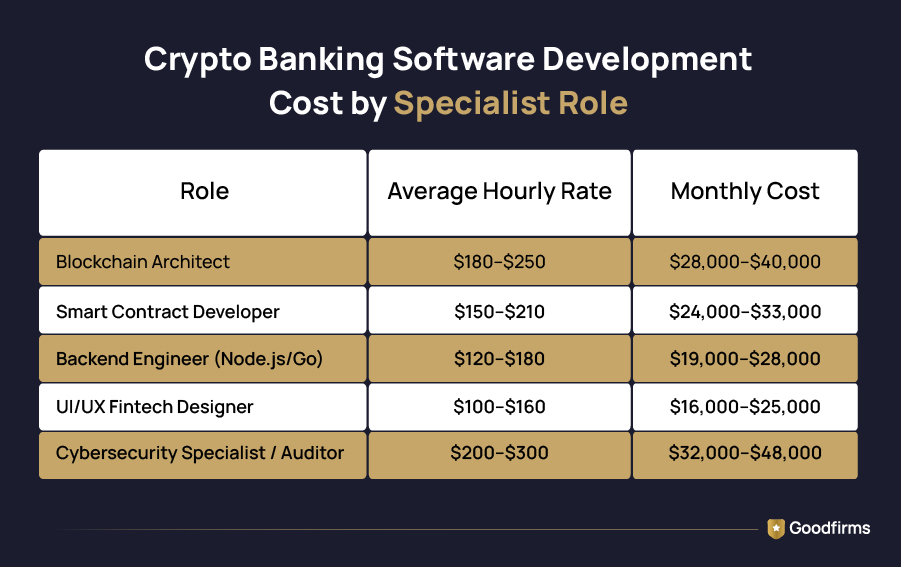
Let’s check out how much budget goes into hiring a specialist:
Crypto Banking Software Development Cost by Specialist Role
Crypto banking projects require a crew with different skill sets: blockchain engineers to handle the core tech, security experts, solid backend developers, and designers who understand fintech. These roles generally command a 20–30% premium over standard software development positions.
Now, let’s move to the development stage to understand how much time it takes and what the estimated cost is.
Crypto Banking Software Development Cost by Development Stage
Development budgets are typically distributed across several phases, from planning and regulatory preparation to deployment and continuing infrastructure management.
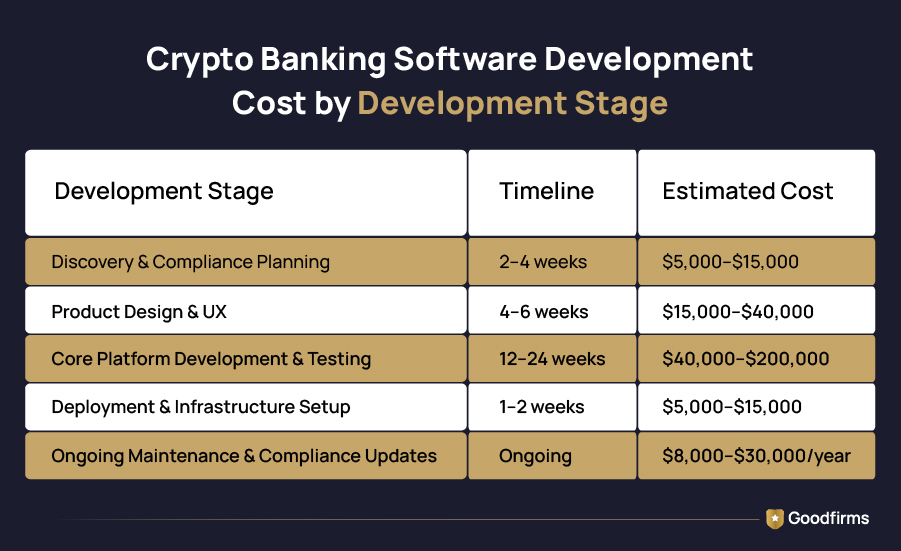
Note: Crypto banking projects may require additional investment in blockchain infrastructure, smart contracts, compliance tooling, and security reviews.
While development stages explain how costs are distributed over time, now let's check how the platform complexity influences overall project costs:
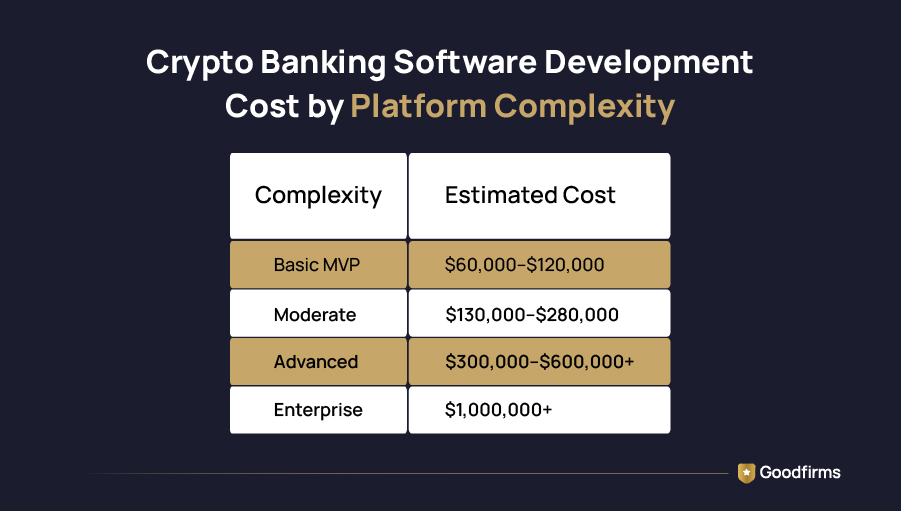
Crypto Banking Software Development Cost by Platform Complexity
The more advanced the platform, the greater the investment required for integrations, security controls, compliance tooling, and expandability.
The following comparison highlights how regional pricing differs across major development hubs:
Crypto Banking Software Development Costs by Region
Many crypto startups reduce development costs by combining onshore product leadership with offshore engineering teams. Hourly rates differ substantially by geography.
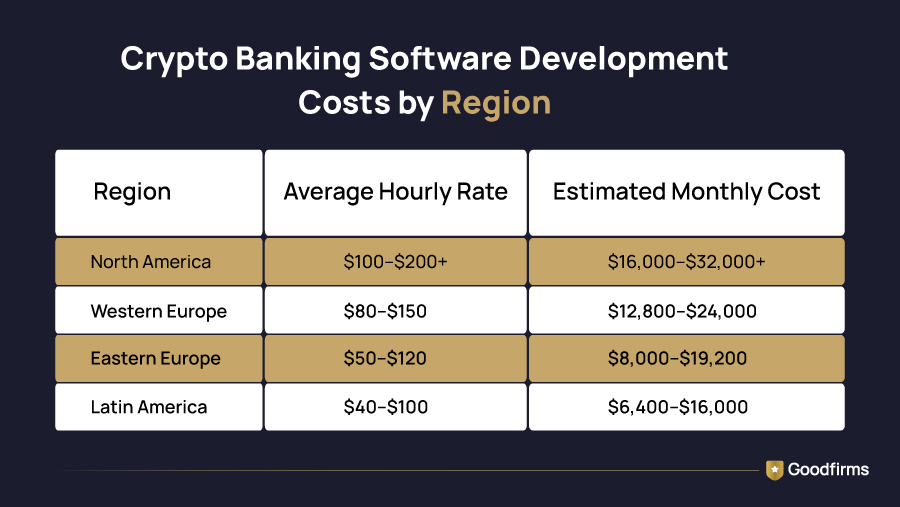
It is not necessary to have the largest budgets to create the most successful crypto banking projects, but it's vital to allocate resources strategically. Security, compliance, and core banking functionality should be prioritized before investing in advanced features such as DeFi integrations, AI automation, or custom blockchain infrastructure.
Key Features Your Crypto Banking Platform Needs in 2026
Choosing the right features is the biggest factor that makes or breaks successful launches. Not every platform needs every feature, but the following are what modern users expect from a serious crypto banking product.
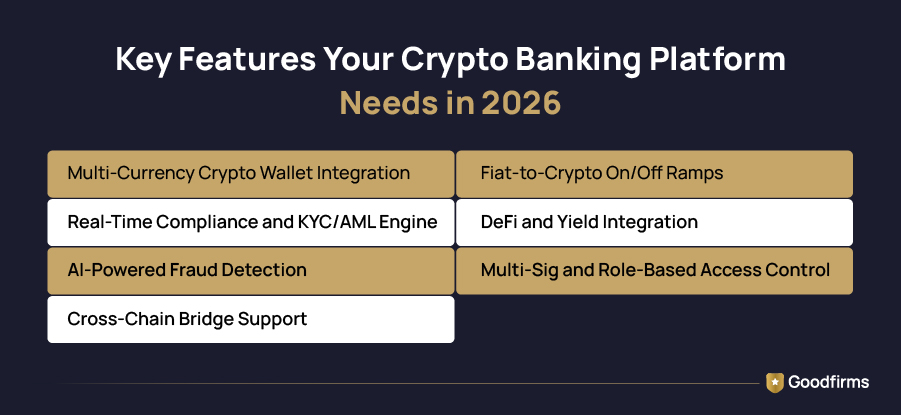
Multi-Currency Crypto Wallet Integration
Your platform must support multiple blockchains such as Bitcoin, Ethereum, Solana, and BNB Chain. It should also increasingly support Layer 2 networks like Arbitrum and Base. Using this, you can provide your users with a single wallet dashboard instead of 12 browser extensions.
A strong wallet system also includes HD (hierarchical deterministic) wallet architecture, non-custodial or hybrid custody options, and clear transaction history across chains. Crypto wallet development costs range from $25,000 to over $500,000+ in 2026, making cost transparency essential before committing resources to any project.
Fiat-to-Crypto On/Off Ramps
This is the bridge between the old financial world and the new one. Without a reliable crypto on/off ramps, a fiat gateway for supporting bank transfers, debit cards, and even UPI in markets like India, your platform remains an island.
In 2026, users expect near-instant conversions with minimal fees. Integrating with providers likeMoonPay, Transak, or building a proprietary gateway is a key cost and strategy decision.
Real-Time Compliance and KYC/AML Engine
If you have ever had a banking partner pull out at the last minute because your KYC stack was not audit-ready. Regulators are watching. A crypto banking platform without automated KYC (Know Your Customer) and AML (Anti-Money Laundering) checks is a liability, not a product.
Modern compliance engines use AI to verify documents in seconds, flag suspicious patterns, and generate audit-ready reports. This isn't simply a legal checkbox — Enterprise clients and banking partners require audit-ready compliance reports before they sign. This is the documentation your KYC engine must be able to produce. Leading providers in this space include Sumsub, Onfido, and Chainalysis for on-chain transaction monitoring.
DeFi and Yield Integration
Users sitting on idle crypto assets want yield. Integrating DeFi protocols — lending, staking, liquidity pools — directly into the banking interface turns your platform from a storage product into an earning product.
Goodfirms Insight: Users are not coming to our platform for the range of assets we list. They come because they can stake ETH and see the yield hit their account dashboard in real time, in the same place they check their balance. The DeFi layer is not a feature. It's the reason they stay.
You can explore top blockchain development companies on Goodfirms that specialize in DeFi integration to find verified partners with proven track records.
AI-Powered Fraud Detection
Fraudulent transactions in crypto are irreversible. That makes real-time fraud detection more valuable and essential.
By 2026, top platforms are relying on machine learning to catch fraud in the moment. They watch how fast transactions move, track how users behave, look at unique device details, and keep a check on wallet history on the blockchain to flag anomalies before funds move. Beyond fraud mitigation, banks are investing in blockchain to accelerate cross-border payments, automate compliance processes, improve digital identity management, and make every transaction more transparent. The BFSI blockchain market is projected to grow from $2.1 billion in 2024 to $59 billion by 2033, driven by demand for more secure and effective financial systems.
Multi-Sig and Role-Based Access Control
Now, for business and institutional accounts especially, there’s no room for shortcuts on security. Multi-signature wallets and granular permission systems are non-negotiable. These features prevent single points of failure and help compliance teams keep a clear audit trail.
Cross-Chain Bridge Support
Multi-chain interoperability has become a baseline expectation. Ethereum-to-Solana bridge shows a major shift in 2025. Your users are already moving assets across chains. If you’re not offering this inside your platform, they are getting it from somewhere else.
The Tech Stack Behind Crypto Banking Software in 2026
The right crypto banking tech stack in 2026 is React/Next.js on the frontend, Node.js or Go on the backend, write smart contracts in Solidity or Rust, and store your data in PostgreSQL with Redis for fast caching. Each piece plays a role in performance, security, and flexibility—because the right tech can make or break your crypto banking product.
Here's a practical breakdown:
Frontend: React.js or Next.js for web; React Native or Flutter for mobile. These give you performance, developer availability, and cross-platform reach.
Backend: Node.js (for speed and async handling) or Go (for high-throughput financial operations). Python is commonly used for AI/ML microservices running the fraud and compliance engines.
Blockchain Layer: Ethers.js if you are working with Ethereum interaction, and Solana goes with web3.js. Solana also has its own custom SDKs for BNB Chain and other networks. Smart contracts are written in Solidity (Ethereum/EVM-compatible chains) or Rust (Solana).
Database: Data storage is the backbone—PostgreSQL handles your standard banking data, Redis for real-time caching, and if you need storage for decentralized documents, go with IPFS or Arweave, where compliance permits.
KYC/AML: Sumsub, Onfido, or Jumio for identity verification; Chainalysis or Elliptic for blockchain transaction monitoring.
Cloud Infrastructure: Your platform has to run reliably and scale up during market spikes, so AWS or Google Cloud gets the job done, but only if you set it up for multi-region. Kubernetes ensures that your platform scales and runs without downtime during peak trading hours.
Security: HSMs (Hardware Security Modules) for key storage, end-to-end encryption, and regular third-party smart contract audits from firms.
The right tech stack decision happens before you start building — getting it wrong means costly rewrites six months down the line. Compare verified fintech development companies on Goodfirms by tech stack and client reviews.
How to Choose the Right Crypto Banking Software Development Company
This is the decision that matters most. The right partner doesn't just write code — they understand financial regulations, blockchain architecture, and product strategy.
What to look for:
- A portfolio that includes live, audited blockchain or fintech products (not just mockups)
- In-house expertise in smart contract development and security auditing
- Familiarity with KYC/AML compliance requirements in your target market
- Clear communication process — crypto projects that go silent for two weeks tend to go wrong
- Post-launch support and maintenance capacity
Questions worth asking every vendor:
- Have you built a product that went through a regulatory review?
- Can you show me a smart contract audit report from a previous client?
- What's your process when a critical security issue is found post-launch?
If a vendor can't answer those clearly, keep looking.
You can explore verified crypto banking development companies on Goodfirms — where 80,000+ verified reviews help you make a confident vendor decision. You can also compare shortlisted vendors using the Goodfirms blockchain company listings to check ratings, portfolio depth, and client feedback side by side.
Common Mistakes to Avoid When Building Crypto Banking Software
Skipping the security audit. Every platform that skips this has eventually regretted it. Smart contract vulnerabilities have cost platforms hundreds of millions in documented losses. Budget for a third-party audit from cybersecurity providers from day one.
Building without a compliance-first mindset: Adding KYC/AML after the fact is far more expensive than designing it in. Know your target markets before you write a single line of code. The EU's MiCA regulation creates a unified EU regulatory framework for crypto firms, covering licensing, compliance, and customer protection.
Underestimating the cost of multi-chain support: Each new chain you add is essentially a new integration project. Prioritize chains based on your actual user base, not hype.
Choosing a generalist dev agency over a crypto specialist: Crypto banking has unique requirements — key management, blockchain node infrastructure, real-time compliance — that general software shops simply don't know well enough.
Is 2026 the Right Time to Build a Crypto Banking Platform?
Yes, 2026 is the right time to build a crypto banking platform, and here's why: the window between "too early" and "too crowded" is open right now.
Regulatory systems are settling as end-user trust is rebuilding after 2022–2023's turbulence. Institutional inflows and improving market conditions fueled a DeFi resurgence in 2025, with the DefiLlama TVL dashboard: DeFi total value locked (TVL) rising more than +40.2% during the market recovery, driven by innovation in smart contracts and growing user demand. The platforms that ship in 2026 will be the ones that define the next wave of crypto-native banking.
But timing only matters if the product is built correctly. A platform with weak security, poor compliance, or a clunky user experience won't survive in a market where users have genuine alternatives.
FAQs - Crypto Banking Software Development
What is crypto banking software development?
Crypto banking software development is the process of designing and building a digital financial platform that combines conventional banking services — like accounts, payments, and transfers — with blockchain-based features such as crypto wallets, DeFi integration, and token management.
How much does it cost to build a crypto banking app in 2026?
Crypto banking software development costs may start around $60,000, fully customized crypto banking ecosystems with KYC/AML compliance, wallet management, and DeFi capabilities often require investments of $300,000 to $1 million+. The Cost of Crypto banking software varies significantly based on feature depth, regulatory requirements, security infrastructure, and integrations.
How long does crypto banking software development take?
A basic MVP typically takes 4–6 months. A fully featured platform with compliance tools, DeFi integration, and mobile apps takes 10–18 months.
What blockchain should I use for a crypto banking platform?
Ethereum and its Layer 2 networks are the most widely supported. Solana is preferred for high-speed, low-cost transactions. Many platforms build multi-chain from the start to avoid lock-in. You can explore top blockchain development companies on Goodfirms to find teams experienced across multiple chains.
Do I need a license to launch a crypto banking platform?
Yes, in most jurisdictions, launching a crypto banking platform requires regulatory approval or licensing. Requirements vary by region—for example, the EU's MiCA framework imposes licensing, governance, and consumer protection obligations, while other countries have their own registration and compliance requirements.
How do I find a reliable crypto banking software development company?
Search for companies with audited blockchain product portfolios, KYC/AML expertise, and verifiable client reviews. Goodfirms lists vetted development companies with detailed ratings and client feedback to help you evaluate options confidently.
Conclusion
Crypto banking in 2026 is a real shot if you come prepared. Figure out what your users genuinely want, pick a stack that’s actually built for scale. Budget properly, using the verified cost benchmarks, and work with a partner who's already done this production.
The vendors worth hiring have one thing in common: they show you a smart contract audit report before you sign the form, either as a sample or a template. Ensure you ask to see a report from a project they delivered, right on your first call. If they hesitate, it tells you everything. You can simply go to Goodfirms and browse verified blockchain development companies to start your shortlist and pick the reliable partner for building your crypto banking software.