Key takeaways
- Regulatory uncertainty continues to hold back crypto and stablecoin adoption among CFOs.
- Crypto treasury software helps companies manage assets, liquidity, transactions, controls, and accounting in a single platform.
- Spreadsheets and traditional tools can become difficult to manage as your crypto operations grow.
- CFOs should evaluate crypto treasury software based on security, controls, accounting integration, auditability, liquidity management, and scalability.
CFOs are still waiting for greater certainty around crypto adoption.
According to PYMNTS Intelligence's 2026 Certainty Project , based on a survey of 60 U.S. middle-market CFOs:
- 77% cite regulatory or compliance uncertainty as a barrier to using cryptocurrency for payments or treasury functions; 67% say the same about stablecoins
- 70% say their firms haven't discussed or considered using cryptocurrencies at all; 58% say the same for stablecoins
- Only 13% currently use stablecoins, and just 5% use cryptocurrencies
- 45% say integration with major banking providers would make stablecoins more meaningful in payment flows; 40% cite regulatory clarity as the deciding factor
- Even among firms that do use stablecoins, 88% of the payments received are converted to U.S. dollars immediately
Managing digital assets looks simple from the outside. A company receives crypto, stores it in a wallet, moves funds when needed, and records the transactions. But as soon as the volume increases, the finance team quickly discovers that crypto treasury management involves much more than just knowing a wallet balance.
Crypto treasury management software brings these moving pieces into one controlled environment, reducing reliance on spreadsheets, exchange statements, wallet interfaces, and disconnected accounting tools.
Ready to compare providers? Explore and compare leading crypto treasury management software on Goodfirms to find the right fit for your finance team.
This guide gives you a clear framework for evaluating and selecting the right crypto treasury solution. Let’s start with what crypto treasury management covers.
What Is Crypto Treasury Management?
Crypto treasury management is the practice of overseeing your company's digital assets — including their custody, liquidity, transactions, controls, accounting, risk, and reporting — with the same financial discipline you apply to cash and fiat holdings.
Traditional treasury management is about handling a company's cash, liquidity, investments, funding, financial risk, and ability to meet its obligations. Crypto treasury management applies the same financial discipline to an environment where some or all of those activities involve digital assets.
The difference becomes obvious when you consider how a company might actually use crypto.
You might hold Bitcoin as a treasury asset, keep stablecoins available for operational payments — often through dedicated stablecoin infrastructure software — receive customer payments in digital assets through cryptocurrency payment gateways software, use an exchange to convert crypto into fiat, maintain several wallets for different purposes, and use an institutional custodian for higher-value holdings.
Each activity creates financial data. Each also creates a control requirement.

Digital assets have arrived at the CFO's desk, and the question has shifted from whether to engage to how to do so without disrupting existing operations.
Your treasury team needs to know where the assets are, who has access to them, what they're worth, how liquid they are, and whether transactions have been authorized. Your accounting team needs to know what happened and how it should be recorded. As CFO, you need a reliable view of your company's exposure and liquidity. Yourauditors need evidence supporting the numbers.
That is why crypto treasury is better understood as a financial operating function rather than a crypto portfolio.
The diagram below makes it simpler to understand.
.jpg)
If you have two wallets and a handful of monthly transactions, you can manage your treasury manually. If you have dozens of wallets, multiple counterparties, several entities, and thousands of transactions, you have a very different problem.
At that point, the question is no longer whether your finance team can track the assets. It is whether they can track them accurately, consistently, and with appropriate controls.
And that’s only just the beginning. Next, you need to know what the crypto treasury management software covers.
What Does Crypto Treasury Management Software Actually Do?
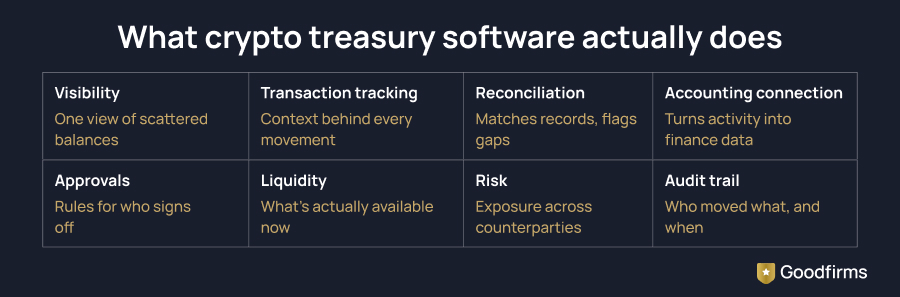
Crypto treasury management software acts as a central system for managing digital-asset finances. However, the features and capabilities vary by provider. Some platforms focus primarily on custody and transaction approvals, while others look after accounting, reporting, and financial data management. Then others combine treasury, payments, liquidity, and asset management.
For a CFO, the important thing is understanding how those capabilities translate into day-to-day finance work.
1. Bringing scattered assets into one view
Your digital assets can sit in different wallets, exchanges, custodians, and blockchain environments. Without a central system, your finance team may need to visit several platforms just to establish the company's current position. You can manage this at low volume, but it becomes challenging as your account count increases.
A treasury platform can consolidate your balances, giving your finance team a clearer picture of the company's digital-asset position. Instead of asking an employee to manually collect balances, you can view the information in one place. It also becomes easier to separate your operational funds from long-term holdings.
For example, you may decide that one wallet is used for vendor payments while another contains strategic reserves. A centralized system can make those distinctions visible to the people responsible for your treasury oversight.
2. Give transactions a business context.
A balance tells you where you are. Transaction history tells you how you got there.
Your crypto transactions can include purchases, sales, transfers, payments, exchange activity, fees, conversions, and movements between company-controlled wallets. On-chain data can confirm that an asset moved, but the raw transaction does not necessarily provide the business context your finance team needs. This is where treasury software steps in.
Finance teams are not simply interested in blockchain events. They need to understand the economic event behind them.
A transfer from one corporate wallet to another is different from selling an asset. A payment to a supplier is different from moving funds to an exchange. A network fee is different from the principal amount of a transaction.
Good software should help your finance teams distinguish those events rather than forcing someone to interpret every transaction manually.
3. Make reconciliation more manageable
Suppose you have assets on three exchanges, four operational wallets, two custodians, and several blockchain networks. Your finance team also maintains a general ledger and bank accounts.
The balances in those systems have to align. If they do not, someone needs to investigate the difference.
A treasury platform can help you match transactions, identify transfers between company-controlled accounts, flag discrepancies, and organize unresolved activity. The goal is not merely to save time. It is to create a repeatable process that your finance team can rely on during the month-end and year-end close.
You don’t want reconciliation to depend on one employee remembering how a particular wallet transaction was handled six months earlier.
4. Connect digital assets to accounting
Your treasury and accounting are closely connected, but they are not identical.
Treasury is concerned with your company’s financial position, liquidity, movements, risk, and controls. Accounting is concerned with how those activities are recognized, classified, valued, and reported.
The software should help the two functions communicate.
Depending on the platform, this may involve accounting integrations, ERP connections, transaction classification, journal entry support, reporting exports, or other financial workflows.
The key question is simple: Can the system turn your blockchain activity into finance-ready information?
If the answer is no, you may still have to maintain a manual process between its crypto infrastructure and the general ledger.
5. Manage approvals and permissions
Since crypto transactions are irreversible, authorization is crucial.
A treasury platform enables you to set rules around who can initiate, approve, and execute a transaction. One employee might prepare a payment, while someone else has to sign off before it goes out. You can route larger transactions through multiple approvers and limit access to specific wallets to certain members of your finance team.
This is not something new to finance departments — segregation of duties and approval hierarchies have existed long before crypto. What treasury software does is extend those same controls to your blockchain transactions and digital-asset workflows.
6. Monitor liquidity
Just because you have a large amount of crypto does not mean it has sufficient operating liquidity.
Your treasury team needs to understand which assets are readily available, where they are held, and how quickly they can be converted or deployed, particularly when you have upcoming payroll, vendor, tax, debt, or other financial obligations.
Treasury software can provide you with a more consolidated view of liquidity and help you understand how much capital is available across your different accounts and asset types.
7. Support risk management
Risk in your crypto treasury goes well beyond price volatility. You can face counterparty risk if a partner or exchange fails to deliver, custody risk if a wallet or custodian is compromised, operational risk from internal errors, liquidity risk if assets can't be converted when needed, cybersecurity risk from hacks and phishing, concentration risk from too much exposure sitting in one place, and regulatory risk as rules around digital assets continue to shift.
A treasury platform can't eliminate any of this. Rather, it provides your treasury team with visibility into where assets are held and how much exposure exists across specific wallets, exchanges, and custodians, enabling them to manage risk through dedicated risk management software.
8. Create a reliable audit trail
Eventually, someone will ask who moved the funds, who approved the transaction, and how it was recorded. A strong treasury platform should make those questions easy to answer. Transaction histories, user activity, approval records, wallet information, and reporting data together form an audit trail that supports your financial controls and external review. This is one of the less glamorous but more valuable features a platform can offer. For a broader look at the category, see dedicated audit software and management solutions for 2026.
But why can't you simply extend your existing treasury tools to cover crypto?
Why Traditional Treasury Tools Are Not Always Enough for Crypto
Traditional treasury software is built around familiar financial infrastructure. Banks provide account statements. Payment systems have established workflows. Currency movements follow recognized rails. Financial institutions act as intermediaries.
Crypto changes that structure.
You may transact directly from one wallet to another without a traditional intermediary. Your assets can move across different blockchain networks. Your exchanges and custodians may expose different data formats. Markets operate continuously rather than following banking hours.
|
Dimension |
Traditional Treasury |
Crypto Treasury |
|---|---|---|
|
Market availability |
Many markets and banking processes follow established business or settlement cycles |
Digital-asset markets generally operate continuously |
|
Asset custody |
Assets are typically held through banks, brokers, custodians, or other regulated intermediaries |
Companies may use self-custody, exchanges, institutional custodians, or a combination |
|
Price volatility |
Many traditional treasury assets have relatively stable values |
Digital assets can experience significant price movements, depending on the asset |
|
Regulatory environment |
Mature regulatory and accounting frameworks exist across many traditional activities |
Requirements can vary significantly by asset, jurisdiction, and use case |
|
Liquidity |
Established markets and banking relationships provide familiar liquidity mechanisms |
Liquidity can vary significantly by asset, venue, and market conditions |
|
Infrastructure |
Mature systems and standardized financial data are widely available |
Wallet, blockchain, custody, and transaction data can be fragmented across providers |
|
Operating model |
Processes tend to change incrementally |
Technology, market infrastructure, and regulatory requirements can evolve quickly |
The result is as much a data problem as a financial one. Your finance team may end up working across wallet interfaces, exchange reports, blockchain explorers, spreadsheets, and accounting software — each useful on its own, but rarely agreeing with one another.
This is why simply adding a crypto portfolio tracker to your existing treasury process may not solve the underlying issue.
A tracker answers, "How much do we own?" Treasury management asks broader questions: where is it, who controls it, was it authorized, how should it be recorded, and can you prove the numbers if asked?
That distinction sets up what to actually look for when evaluating tools.
What Features Should CFOs Look for in Crypto Treasury Management Software?
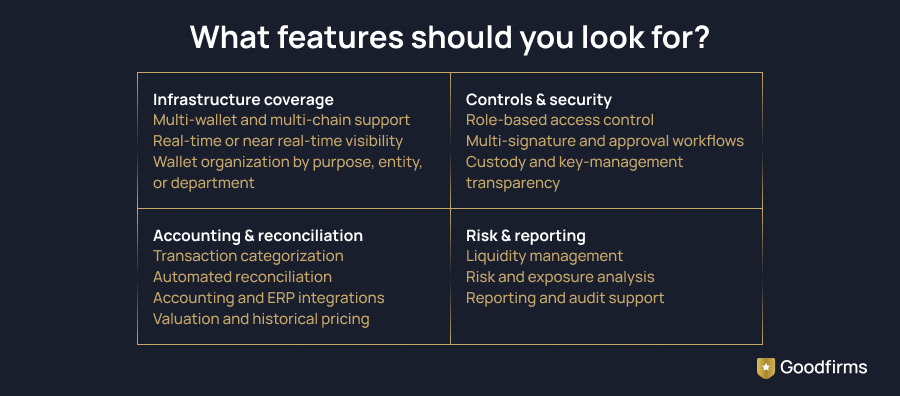
There is no universal list of features that every company needs. Still, bear in mind the capabilities mentioned below during your evaluation.
1. Infrastructure Coverage
Multi-wallet and multi-chain support — Start with your existing environment: which wallets, blockchain networks, assets, exchanges, and custodians are you actually using? Don't get swayed by a vendor that supports hundreds of networks if your business uses only a handful — what matters is reliable management of your current infrastructure, with room to grow. Check how quickly new networks are supported as ecosystems change, and whether the platform can distinguish wallets by purpose, entity, or department.
Real-time or near-real-time visibility — Crypto markets don't run on a nine-to-five schedule, so you shouldn't have to wait until the next business day for the company's digital-asset position. Look for timely balance and transaction data with a clear timestamp on when it was last updated — especially important if you’re actively managing liquidity.
2. Controls & Security
Custody model and key control — Know where private keys are held, who controls transactions, and what happens if credentials are compromised. Also, clarify the difference between treasury software and custody: some platforms connect to a third-party custodian, others integrate custody directly.
Role-based access control — Not everyone needs the same access. Your controller may need reporting access; your treasury manager, transaction permissions; you as CFO, approval authority; and your administrator, user management without unrestricted transaction rights. The system should have distinctions between them.
Multi-signature and approval workflows — For higher-risk transactions, requiring multiple approvals adds a layer of control, so no major financial decision depends on one person. A single compromised login or a single person acting in error shouldn't be enough to move your company's funds — multisig approval spreads that authority across multiple sets of hands.
3. Accounting & Reconciliation
Transaction categorization — Raw blockchain data isn't financial data. The system should classify transactions by economic purpose so your finance team doesn't have to manually interpret the same transaction type each time. Test this with real examples: internal transfers, fees, exchange movements, payments, and unusual transactions.
Automated reconciliation — It is necessary to find out how the system matches transactions and handles discrepancies. Also, what happens when it can't confidently classify one? A platform that makes guesses is a red flag, not one that flags the item for review.
Accounting and ERP integrations — The platform should fit your existing finance stack. You need to ask what "integration" actually means for this vendor — native, API-based, or file-based — since that answer determines how much manual work remains after data reaches your accounting system.
Valuation and pricing — It is equally important to confirm where pricing data comes from, how historical values are maintained, and how you can review them later. Historical pricing matters when the finance team needs to explain a past balance. A price isn't automatically the right valuation for every reporting purpose.
4. Risk & Reporting
Liquidity management — A large token balance isn't the same as accessible operating cash. The tools should separate liquid operating assets from strategic holdings — the more complex your treasury, the more this distinction matters.
Risk and exposure analysis — You need to assess concentration: how much is held with a single counterparty, asset, or platform. A dashboard showing only the total portfolio value can hide concentration risk, which becomes more important as your balances grow.
Reporting and audit support — Reports should serve different audiences without rebuilding each time — transaction-level detail for your treasury manager, reconciliation reports for the controller, liquidity and exposure for you as CFO, and a concise summary for the board.
That's a lot of ground to cover, and not every item on it carries equal weight. A handful of these deserve to be treated as deal-breakers rather than preferences.
What Are the Non-Negotiables When Choosing Crypto Treasury Software?
Once you've identified the features your business needs, narrow your shortlist by establishing a few non-negotiable requirements.
These will vary by company, but several areas deserve particular attention.
1. Direct accounting and ERP connectivity
An ERP integration is only useful if it reduces your manual work.
Ask whether the platform supports a native or API-based connection, how journal entries are generated, and how exceptions are handled. A vendor that relies primarily on recurring CSV exports may leave the finance team with a significant reconciliation burden.
2. Fair-value accounting support
If your company is subject to U.S. GAAP under FASB ASU 2023-08, you have to measure qualifying crypto assets at fair value. Changes in fair value must be reported in net income. The amendments are in effect for fiscal years beginning after December 15, 2024.
The important point for you as a software buyer is not simply whether a platform displays a current market price. The platform should support your accounting and reporting requirements applicable to your company's assets and reporting framework.
3. Cost-basis and lot-level tracking
The platform should support the cost basis and lot selection methods relevant to the company's accounting and tax requirements.
It should also retain sufficient transaction- and lot-level detail to explain how gains or losses are calculated when assets are sold, exchanged, or otherwise disposed of.
4. Security and independent controls reporting
It is essential to request current independent assurance reports, such as SOC 1 or SOC 2 Type 2, where relevant. Also, review their scope, rather than relying on a badge on a vendor's website.
SOC 1 reports address controls relevant to user entities' internal control over financial reporting, while SOC 2 examinations address controls related to areas such as security, availability, processing integrity, confidentiality, and privacy.
Those reports are only one part of your assessment. You should also evaluate key management, access controls, approval workflows, incident response, and segregation of duties.
5. Multi-entity support
If your company operates across subsidiaries, funds, or jurisdictions, multi-wallet and multi-chain support is only part of the requirements.
The platform should allow your assets and transactions to be associated with the appropriate legal entity and support entity-level reporting, accounting, and controls.
6. A complete, traceable audit trail
Every material transaction, approval, adjustment, and user action should be traceable to the person or system that performed it and the time it occurred.
Ask how historical records are protected from unauthorized alteration and whether you can export the audit history for internal or external review.
These requirements should serve as your starting point for evaluating vendors. Your next step is to assess how well each vendor fits your company’s broader operational needs.
How to Compare Crypto Treasury Software Vendors
A common mistake is to begin your selection process by booking demonstrations with every vendor in the category. That can create more confusion than clarity.
Instead, start internally.
1. Start with the current state.
Map your full digital-asset environment. Identify the wallets, exchanges, custodians, bank accounts, assets, entities, transaction volumes, accounting systems, and people involved in treasury operations.
Then map the flow of money.
- Where does crypto enter your business?
- Where does it go?
- Where is it converted?
- Who approves it?
- Where does the accounting record come from?
This exercise often reveals process gaps before you even speak to a vendor.
2. Define must-have requirements
Separate requirements into three groups: essential, desirable, and future requirements.
For example, accounting integration may be essential today. A particular blockchain integration may be desirable. Multi-entity support may become essential if international expansion is planned.
This prevents the procurement team from treating every feature as equally important.
3. Evaluate the operating model, not just the product
Ask how the software will actually fit your finance department.
- Who will use it every day?
- Who will administer it?
- Who will approve transactions?
- Who will reconcile the data?
- Who will respond when something fails?
A platform can have excellent functionality and still be a poor choice if nobody internally owns the workflow.
4. Test with real transactions
A product demo is usually the vendor's best-case scenario. Your evaluation should include your worst-case scenarios.
Ask the vendor to walk through an internal wallet transfer, a payment, an exchange withdrawal, a failed transaction, a transaction with an unusual fee, and a month-end reconciliation.
If the platform cannot handle your real workflow comfortably, it is better to discover that before signing the contract.
That comparison framework raises a related question: how treasury and accounting software actually differ.
What is the Difference between Crypto Treasury and Crypto Accounting Software?
While crypto treasury and accounting software can overlap, they serve different purposes.
|
Feature |
Crypto Treasury Software |
Crypto Accounting Software |
|---|---|---|
|
Primary focus |
Operational management of digital assets |
Recording and reporting digital-asset activity |
|
Core job |
Custody, liquidity, payments, approvals, risk |
Transaction classification, valuation, tax reporting |
|
Typical users |
Treasury manager, CFO |
Controller, accounting team |
|
Handles wallet/custody management |
Yes |
Rarely |
|
Handles transaction approvals |
Yes |
No |
|
Handles liquidity monitoring |
Yes |
No |
|
Feeds the general ledger |
Sometimes (via integration) |
Yes, directly |
|
Best suited for |
Companies are actively moving and controlling assets |
Companies needing clean books and tax-ready records |
Crypto accounting software primarily focuses on converting digital-asset activity into accounting information, including transaction classification, valuation, reconciliation, reporting, and tax-related data. Crypto tax software may work alongside it for tax-specific workflows.
Crypto treasury software plays a broader operational role, encompassing liquidity, custody, payments, approvals, wallet management, and risk management. Some platforms combine treasury and accounting capabilities, which can reduce the need for integrations but require careful evaluation.
If your company needs both, focus on how well the two functions work together rather than assuming one platform automatically covers everything.
Crypto Treasury Management Software vs Portfolio Tracking Tools
Portfolio tracking tools focus on visibility, while treasury platforms help you manage digital assets. The differences become clearer when you compare their core capabilities.
|
Capability |
Treasury Management Software |
Portfolio Tracking Tools |
|---|---|---|
|
What it answers |
Where is it, who controls it, can we move it, and is it accounted for |
How much do we own, and how is it performing |
|
Includes controls/approvals |
Yes |
No |
|
Includes liquidity management |
Yes |
No |
|
Includes reconciliation |
Yes |
No |
|
Includes accounting connection |
Often |
Rarely |
|
Includes audit trail |
Yes |
No |
|
Best suited for |
Managing money — active financial operations |
Observing money — investment visibility |
A portfolio tracker gives you investment visibility by showing the value and performance of your assets across wallets and accounts.
But treasury management goes further. Your treasury team needs to manage money, not simply observe it, which means controls, approvals, liquidity, payments, reconciliation, counterparties, and auditability all become relevant.
A portfolio tracker may show you that your company holds $10 million in digital assets. Treasury software goes further by showing you where those assets are held, how much is available for operations, who has access to them, what transactions have occurred, and how those activities are reflected in your company’s financial records.
Once that distinction is clear, run any platform you're considering through this checklist before you commit.
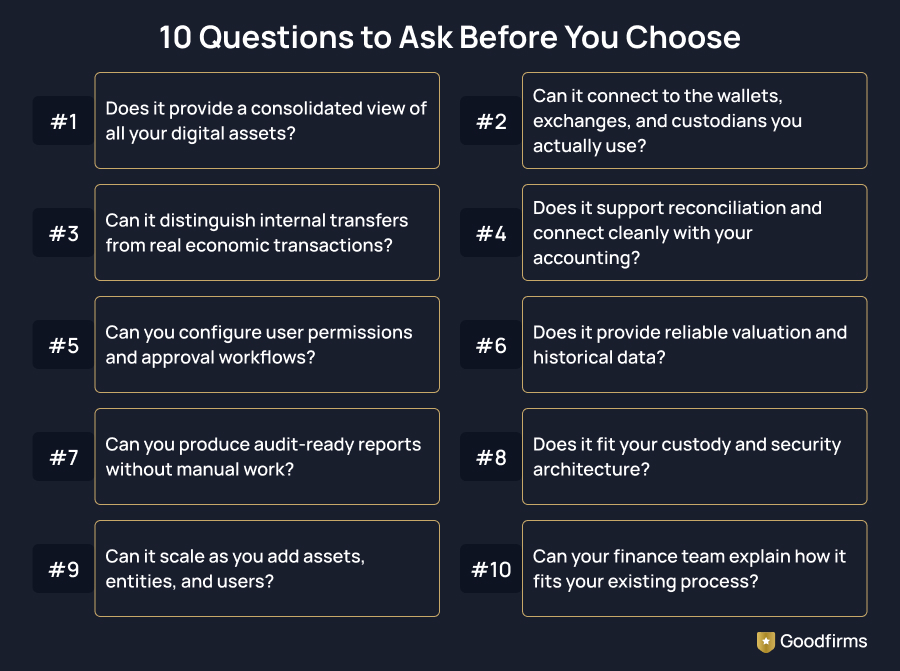
A Final Checklist for Choosing Crypto Treasury Software
Before selecting a platform, you and your finance team should be able to answer each of these with confidence — whether from your own research or from a conversation with a vendor.
Once every box is checked with confidence, your decision comes down to a simple idea.
Final Thoughts
Crypto treasury management comes down to control — knowing what you own, where it sits, who can move it, and whether your records hold up under scrutiny. The right software doesn't just check features; it fits how your business actually works, and scales alongside your company’s growth.
Simply put, choose a software for governance, not for the longest feature list.
A few questions come up often enough during this process that they're worth answering directly.
FAQs- Right Crypto Treasury Management
What is crypto treasury management?
Crypto treasury management is the process of managing a company's digital assets, liquidity, transactions, custody, risk, controls, accounting, and reporting.
Who needs crypto treasury software?
Businesses that regularly hold, receive, send, or manage significant digital assets can benefit from specialized treasury software, particularly crypto companies, Web3 businesses, fintechs, and enterprises with growing digital-asset operations.
What should CFOs look for in crypto treasury software
CFOs should focus on security, wallet and exchange connectivity, reconciliation, accounting integrations, approval controls, valuation, reporting, and scalability.
Is crypto treasury software the same as crypto accounting software?
No. Accounting software primarily focuses on recording and reporting transactions, while treasury software can also cover liquidity, custody, payments, approvals, risk, and asset management.
How do you choose crypto treasury software?
Start by documenting your assets, wallets, counterparties, transaction flows, accounting systems, and control requirements. Then compare vendors against those needs and test them using real-world transaction scenarios.