Key takeaways
- AI fraud detection has become a must-have in 2026, not a nice-to-have, as fraud tactics evolve faster than traditional rule-based systems can handle.
- The right tool depends on your industry; there's no universal solution, whether you're a bank, fintech, eCommerce store, or small business.
- AI systems don't just detect more fraud; they also block fewer real customers, making them better for both security and user experience.
- High detection rates matter, but so does the false positive rate; the best platforms catch real fraud without blocking legitimate customers.
- Several strong options like SEON, IPQualityScore, and Covery offer free trials or tiers, so businesses can test before committing to a contract.
A deepfake attempt hits a business every five minutes. According to Business Wire, digital document forgeries surged 244% in a single year. And in the US alone, fraud losses hit $12.5 billion in 2024, up 25% year-over-year, according to the FTC.
Shocking news headlines, right? But these aren't just sensational news; this is the new-age reality for many online businesses.
So where's the good news? The new AI fraud detection software doesn't just play with traditional rules; they think, adapts, and flags threats in real time before any damage is done.
In this guide, we have reviewed and compared the best AI fraud detection software 2026.
Fraudsters are using AI. Businesses should too. Start with the top AI fraud detection software leading the fight in 2026
Best AI Fraud Detection Software in 2026
|
Software |
Best For |
Estimated Pricing |
AI Features |
Free Trial |
|---|---|---|---|---|
|
Sardine |
Fintech / AML |
~$1,500–$3,000/mo (custom) |
Yes |
No |
|
Feedzai |
Banks / Payments |
~$50,000–$200,000+/yr |
Yes |
No |
|
Unit21 |
Compliance teams |
~$2,000–$8,000/mo (custom) |
Yes |
No |
|
NICE Actimize |
Global enterprises |
~$100,000–$500,000+/yr |
Yes |
No |
|
SEON |
eCommerce / SMB |
From $599/mo |
Yes |
Yes |
|
Hawk |
AML / Banking |
~$2,500–$5,000/mo (custom) |
Yes |
No |
|
Fraud.net |
Enterprise |
From ~$1,000/mo |
Yes |
Yes (30 days) |
|
Covery |
Mid-market |
From ~$500/mo |
Yes |
Yes (30 days) |
|
ThreatMetrix |
Enterprise / Lending |
~$50,000–$150,000+/yr |
Yes |
No |
|
Shufti Pro |
Identity fraud |
From $0.75/verification |
Yes |
Yes |
|
Sumsub |
Crypto / Gaming |
From $149/mo |
Yes |
Yes |
|
IPQualityScore |
Developers / SMB |
Free – $499/mo |
Partial |
Yes (Free tier) |
|
Facctum |
AML / Compliance |
~$2,000–$6,000/mo (custom) |
Yes |
No |
Online fraud has become a daily operational challenge for businesses processing digital payments, customer accounts, and identity verification workflows. Whether you run an ecommerce store, a fintech startup, or a large bank, fraudsters are actively targeting your transactions, customer accounts, and identity systems every single day.
After some deep research and users' feedback, we have gathered some of the best AI fraud detection software for you, and now it is your job to find the right fit for your business.
1. Sardine - Best AI Fraud Detection Software for Fintech and Compliance
Best for: Fintech companies, neobanks, crypto platforms, payment providers.
Sardine is one of the most advanced AI fraud detection software platforms available in 2026. It combines device intelligence, behavioral biometrics, transaction monitoring, fraud prevention, AML compliance, and credit risk assessment into a single platform. Instead of relying on static rules, Sardine continuously learns from user behavior and risk patterns to identify fraud in real time.
Key Features
- AI-powered fraud detection and risk scoring
- Device fingerprinting and behavioral analytics
- AML transaction monitoring
- KYC and identity verification
- Chargeback prevention tools
Pros
- Comprehensive fraud and compliance coverage
- Real-time fraud detection
- Strong support for fintech and crypto businesses
- Easy API integrations
Cons
- Pricing is not publicly available
- Advanced functionality may be excessive for small businesses
Why It Stands Out in 2026
Sardine covers the entire customer journey, from onboarding to transactions, making it one of the best AI fraud detection software for businesses operating in fintech, banking, payments, and other regulated industries.
2. Feedzai - Best AI Fraud Detection Software for Banks
Best for: Banks, payment processors, financial institutions
Feedzai is an AI-native risk management platform trusted by some of the world's largest banks. Its machine learning models continuously analyze customer behavior, transaction patterns, and account activity to detect suspicious behavior before fraud occurs.
Key Features
- Real-time transaction monitoring
- TrustScore risk engine
- Behavioral analytics
- Explainable AI decision-making
- AML compliance monitoring
Pros
- Built for high-volume financial environments
- Strong regulatory compliance support
- Highly accurate fraud detection models
- Transparent audit trails
Cons
- Enterprise-focused pricing
- Requires implementation resources
Why It Stands Out in 2026
Feedzai is one of the strongest AI fraud detection software for banks, handling millions of daily transactions while maintaining regulatory compliance.
3. Unit21 - Best No-Code AI Fraud Detection Platform
Best for: Fintech startups, digital banks, compliance teams
Unit21 allows risk and compliance teams to build fraud detection workflows without coding. Organizations can create, test, and deploy fraud detection rules while combining machine learning with custom business logic.
Key Features
- No-code fraud management platform
- Transaction monitoring
- Case management system
- Suspicious activity reporting
- Rule testing and shadow mode deployment
Pros
- Easy to customize
- No engineering dependency
- Fast deployment
- Excellent compliance tools
Cons
- Smaller ecosystem than enterprise competitors
- Limited international brand recognition
Why It Stands Out in 2026
Unit21 gives compliance teams direct control over threat mitigation workflows without relying heavily on developers, successfully bridging the gap between internal engineering and traditional risk management tools.
4. NICE Actimize - Best Enterprise AI Fraud Detection Software
Best for: Global banks, financial institutions, large enterprises
NICE Actimize is one of the most established names in financial crime prevention. The platform uses artificial intelligence and machine learning to identify suspicious activity across banking, payments, digital channels, and financial transactions.
Key Features
- Financial crime detection
- AML monitoring
- Fraud investigation tools
- Transaction surveillance
- Cross-channel fraud prevention
Pros
- Trusted by major financial institutions
- Extensive compliance capabilities
- Global deployment support
- Strong analytics
Cons
- Complex implementation
- High enterprise cost
Why It Stands Out in 2026
NICE Actimize remains one of the most comprehensive AI fraud prevention software solutions for large organizations.
5. SEON -Best AI Fraud Detection Software for eCommerce
Best for: eCommerce stores, marketplaces, gaming companies
SEON helps businesses prevent fraud before transactions are approved. It uses device intelligence, email analysis, phone verification, and behavioral signals to create accurate risk profiles.
Key Features
- Email intelligence
- Phone number analysis
- Device fingerprinting
- Behavioral risk scoring
- Chargeback prevention
Pros
- Transparent pricing
- Easy implementation
- Strong fraud prevention capabilities
- Free plan available
Cons
- Less suitable for highly regulated banking environments
- Advanced features require premium plans
Why It Stands Out in 2026
SEON is among the leading ecommerce fraud prevention tools for modern digital storefronts and online marketplaces seeking affordable, real-time risk mitigation.
6. Hawk - Best AI Fraud Detection Software for AML Monitoring
Best for: Banks, fintechs, regulated financial institutions
Hawk combines machine learning, explainable AI, and transaction monitoring to help organizations identify financial crime while reducing false positives.
Key Features
- AML transaction monitoring
- Fraud detection
- Explainable AI models
- Real-time risk scoring
- Compliance reporting
Pros
- Strong AML capabilities
- Easy integration with existing systems
- Reduces manual review workloads
- Explainable decisions
Cons
- Banking-focused
- Pricing not publicly available
Why It Stands Out in 2026
Hawk offers one of the strongest AI-powered AML and fraud monitoring solutions available today.
7. Fraud.net - Best AI Fraud Detection Platform for Enterprises
Best for: Financial services, insurance, travel, ecommerce
Fraud.net combines artificial intelligence, machine learning, rules engines, and identity intelligence to help businesses detect fraud across multiple channels.
Key Features
- AI risk scoring
- Identity verification
- Transaction monitoring
- Case management
- Visual analytics dashboard
Pros
- Highly customizable
- Strong enterprise capabilities
- Real-time fraud alerts
- Multiple deployment options
Cons
- Enterprise-oriented platform
- Learning curve for new users
Why It Stands Out in 2026
Fraud.net delivers a unified fraud management ecosystem that supports multiple industries.
8. Covery - Best End-to-End Fraud and Risk Management Software
Best for: Fintechs, lenders, payment providers
Covery works amazingly for fraud prevention, AML compliance, customer risk assessment, and transaction monitoring in a single cloud-based platform.
Key Features
- Fraud risk management
- AML screening
- Customer monitoring
- Transaction analysis
- Global sanctions screening
Pros
- All-in-one platform
- Quick implementation
- Strong compliance support
- Flexible workflows
Cons
- Smaller market presence
- Limited third-party reviews
Why It Stands Out in 2026
Covery provides an excellent balance between fraud detection, compliance, and risk management.
9. ThreatMetrix - Best for Device Intelligence and Identity Fraud Detection
Best for: Lenders, insurers, enterprises, online platforms
ThreatMetrix, part of LexisNexis Risk Solutions, uses one of the world's largest digital identity networks to identify fraud and suspicious behavior in real time.
Key Features
- Digital identity intelligence
- Device fingerprinting
- AI risk scoring
- Behavioral analytics
- Identity network analysis
Pros
- Massive identity network
- Fast risk decisions
- Strong fraud prevention accuracy
- Enterprise-grade reliability
Cons
- Primarily enterprise-focused
- Pricing unavailable publicly
Why It Stands Out in 2026
ThreatMetrix excels at detecting account takeover, identity fraud, and synthetic identity attacks.
10. Shufti Pro - Best for AI-Powered Identity Verification
Best for: Businesses with KYC and onboarding requirements
Shufti Pro focuses on identity verification, biometric authentication, and AML screening to prevent fraud at the onboarding stage.
Key Features
- Facial verification
- Document verification
- AML screening
- Biometric authentication
- Global identity checks
Pros
- Fast onboarding verification
- Global coverage
- Easy integration
- Strong compliance support
Cons
- More focused on identity fraud than transaction fraud
- Additional services increase costs
Why It Stands Out in 2026
Shufti Pro helps businesses stop fraudulent users before they enter the system.
11. Sumsub - Best for Global KYC and Onboarding Fraud Prevention
Best for: Fintech, crypto, gaming, marketplaces
Sumsub is a leading identity verification and compliance platform that uses AI to automate KYC, KYB, AML, and fraud prevention processes.
Key Features
- Identity verification
- Business verification
- AML screening
- Fraud monitoring
- Mobile SDKs
Pros
- Strong global coverage
- Easy onboarding experience
- Scalable pricing
- Fast verification speeds
Cons
- Focused primarily on onboarding fraud
- Less emphasis on transaction fraud
Why It Stands Out in 2026
Sumsub is one of the best AI fraud detection software solutions for businesses fighting onboarding fraud.
12. IPQualityScore - Best Affordable Fraud Scoring API
Best for: Developers, startups, small businesses
IPQualityScore provides fraud intelligence APIs that analyze IP addresses, emails, phone numbers, and devices to generate risk scores.
Key Features
- Fraud scoring API
- IP reputation analysis
- Device fingerprinting
- Email validation
- Phone verification
Pros
- Affordable
- Developer-friendly APIs
- Free plan available
- Fast deployment
Cons
- Not a full fraud management platform
- Limited workflow automation
Why It Stands Out in 2026
IPQualityScore stands out as one of the most accessible, developer-friendly fraud monitoring APIs for smaller businesses, independent platforms, and tech startups.
13. Facctum - Best for AML Watchlist and Compliance Screening
Best for: Banks, financial institutions, compliance teams
Facctum specializes in watchlist screening, sanctions monitoring, and adverse media checks. While not a full fraud prevention platform, it plays a critical role in preventing compliance-related fraud risks.
Key Features
- Watchlist screening
- Sanctions monitoring
- PEP checks
- Adverse media monitoring
- Customer risk assessment
Pros
- Strong AML compliance support
- Global screening databases
- Easy integration
- Reduces compliance risks
Cons
- Not a complete fraud detection platform
- Requires integration with other fraud tools
Why It Stands Out in 2026
Facctum is a strong addition to any AML fraud detection software stack where compliance is a top priority.
Why AI Fraud Detection Software Matters in 2026
Traditional rule-based systems are fighting 2026 threats with 2019 logic, real customers get blocked, real fraud gets approved, and your business pays the cost. AI fraud detection software changes this: instead of fixed rules, it learns from millions of transactions in real time, adapting to new threats before your team spots them, with detection rates above 95% and false positives cut by 60%.
Fraud tactics have changed more than ever, and businesses are having a hard time keeping up with them. Here is what all teams are dealing with right now:
Old systems work on fixed logic: " Block all transactions above $500 from a new account." In this case, fraudsters learn these rules quickly and find ways around them.
Modern fraud detection platforms take a completely new approch. Instead of applying fixed rules, they learn from patterns across millions of transactions and adapt in real time. The result is immediate fraud losses, fewer false positives that block real customers, and a defense that evolves alongside the threats.
For businesses in the US, this is especially urgent. Fraud losses in the US have exceeded $10 billion in recent years, with card-not-present fraud, ACH scams, and identity theft leading the way. If your business handles online payments or customer onboarding, this is no longer a nice-to-have; it is a must-have.
Businesses looking for AI fraud detection software in US should prioritize platforms with strong regulatory support, ACH fraud monitoring, identity verification, and AML software capabilities. Here we have listed some of the top AI fraud detection software.
How Does AI Fraud Detection Software Work?
This is one of the most common questions businesses ask before investing in a platform. Here is a simple breakdown.
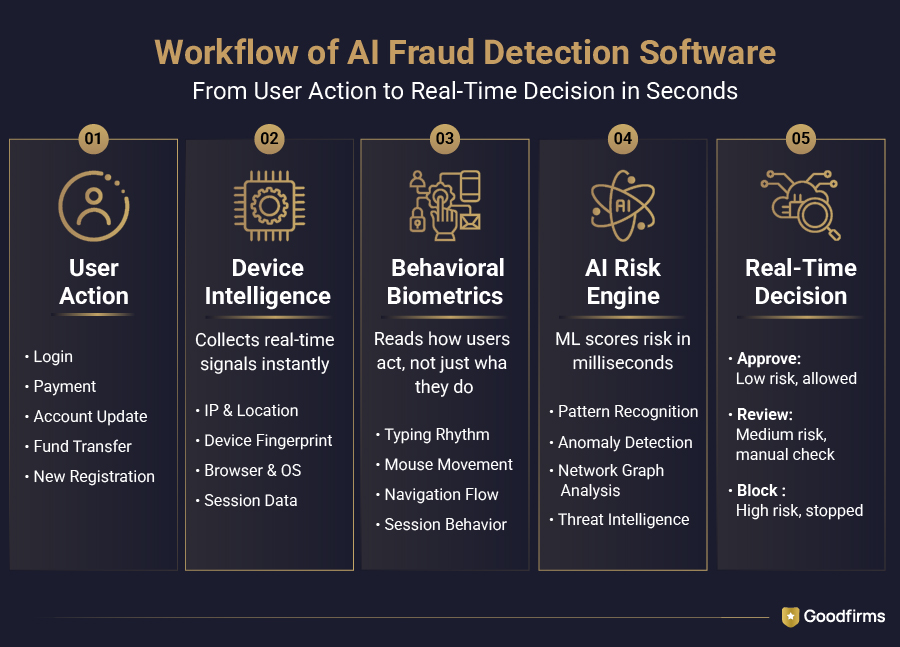
Machine Learning Models - The software is trained on millions of past transactions, both fraudulent and legitimate. Over time, it learns what normal looks like for your specific business and automatically flags anything that falls outside that pattern.
Behavioral Biometrics - The platform watches how users interact, the typing speed, mouse movement, how they scroll, and also what kind of device they use, mobile or desktop. A fraudster using stolen credentials will behave differently from real account owners, and AI smartly picks that up.
Device Intelligence - Every device has a digital fingerprint. These tools detect VPNs, emulators, device spoofing, and suspicious IP activity that suggest someone is hiding their identity.
Network Graph Analysis - By connecting accounts, devices, and transactions, histories across a shared network, AI surfaces coordinated fraud rings, groups of fake accounts working together, that would look completely legitimate in isolation.
Real - Time Risk Scoring - All of this happens in milliseconds. Every action gets a risk score, and the team gets instant alerts when something looks off. This is what separates real-time fraud detection software from slower, batch-based legacy tools.
Unlike rule-based systems, the AI does not manually update each time fraudsters change tactics. It learns continuously, which is the core advantage. Teams that invest in proper installation and deployment testing, before making it live, make sure the fraud detection platforms perform as expected from day one.
AI Fraud Detection Implementation Challenges
Deploying AI fraud detection software is not without hurdles.
- Integration with legacy banking systems can be complex and time-consuming, often requiring dedicated engineering resources.
- Teams also face a cold-start problem; models need sufficient transaction data to learn accurate baselines, meaning early performance may be inconsistent.
- Striking the right balance between fraud sensitivity and false positive rates requires ongoing tuning.
- Staff training, regulatory alignment, and cross-department coordination add further friction.
Businesses that plan for these challenges upfront, prioritizing phased rollouts and sandbox testing before going live, typically see faster ROI and fewer operational disruptions post-deployment.
How Accurate Is AI Fraud Detection Software?
This is a fair question, and the honest answer is that today's leading platforms are remarkably accurate, but the number that matters most is not just the detection rate.
Here is what the data shows:
- Top platforms report fraud detection rates above 95% in real-world deployments.
- AI-powered systems reduce false positives by up to 60% compared to rule-based systems, meaning fewer legitimate customers get blocked unnecessarily.
- Document-focused AI systems like Onfido's Atlas model use over 10,000 micro-models analyzing documents at the pixel level, reportedly detecting 50% more document fraud than generic alternatives.
The critical metric to watch is the false positive rate, which is how often the system blocks a real, legitimate customer by mistake. A system that catches fraud but frustrates genuine users creates a different kind of business problem.
The best platforms balance both: high detection accuracy for threats, low friction for real users.
How to Choose the Right AI Fraud Detection Tool
With this many strong options, the right choice comes down to matching the platform to your specific situation. Here is a simple framework:
Know your fraud surface area. Where are you most exposed? Account takeover? Payment fraud? Identity fraud at onboarding? Different tools excel at different threat types, so start by naming your biggest risk.
Match the platform to your industry.
- Banking and regulated finance → NICE Actimize, Feedzai, Hawk
- Fintech and crypto → Sardine, Unit21, Sumsub
- eCommerce → SEON, Fraud.net, ThreatMetrix
- Small businesses → SEON (free tier), IPQualityScore, Covery
Check integration speed - How fast do you need to go live? Platforms like SEON and IPQualityScore have fast API integrations. Enterprise platforms like NICE Actimize take longer to implement but offer far deeper coverage.
Prioritize explainability - For regulated industries, every fraud decision needs a clear audit trail. Make sure the platform can explain its risk scores, not just deliver a black-box outcome.
Start with a free trial - SEON, Fraud.net, Covery, Shufti Pro, and IPQualityScore all offer free tiers or trial periods. Test in your own environment before you commit to a contract.
Conclusion
Fraud is not slowing down, and in 2026, neither is the technology built to stop it. The platforms in this guide represent the best AI fraud detection software available today, covering everything from enterprise-grade systems for global banks to accessible tools for growing businesses.
The right platform depends on where your fraud risk lives, how fast you need to deploy, and how much customization your team requires. But with AI doing the heavy lifting, even smaller businesses now have access to protection that was once reserved for the largest financial institutions.
FAQs - AI Fraud Detection Software
1. What is the best AI fraud detection software in 2026?
It depends on your industry and use case. For banks and large enterprises, NICE Actimize and Feedzai are top-tier. For ecommerce, SEON and Fraud.net lead the pack. For fintech and crypto, Sardine and Unit21 are the strongest options.
2. How does AI fraud detection software work?
It uses machine learning, behavioral biometrics, device intelligence, and real-time risk scoring to evaluate every transaction or user action as it happens, adapting automatically to new fraud patterns without needing manual rule updates.
3. How accurate is AI fraud detection software?
Leading platforms achieve detection rates above 95%, with false positive rates significantly lower than traditional systems. Accuracy improves the more data the AI processes over time.
4. Is there fraud detection software with a free trial?
Yes, there are many amazing AI fraud detection software like SEON, Fraud.net, Covery, Shufti Pro, and IPQualityScore, all of which offer free tiers or trial periods.
5. What is the best AI fraud detection software for US businesses?
NICE Actimize (BSA/AML compliance), Sardine (widely used by US fintechs), SEON (popular with US ecommerce businesses), and ThreatMetrix (trusted by large US enterprises and lenders) are the strongest picks for the US market.
6. What is AML fraud detection software?
AML (Anti-Money Laundering) software helps businesses detect suspicious financial activity linked to money laundering, sanctions violations, and financial crime. Strong AML-focused platforms include NICE Actimize, Feedzai, Hawk, Sardine, and Facctum.