Key takeaways
- Stablecoin infrastructure covers six layers: issuance, custody, orchestration, treasury, institutional infrastructure, and payment acceptance. Most businesses only need one or two of these, not the full stack.
- Transak, Brale, Cobo, Mesh, and NOWPayments lead the Goodfirms-listed market in 2026, each built for a different layer of the stack.
- Pricing models differ a lot across providers. Some charge per transaction, some take a percentage, and enterprise deals are usually custom quoted.
- The right provider depends on your actual workflow, whether that's payouts, custody, treasury movement, or merchant acceptance, not on how many blockchains it supports.
Stablecoins moved 33 trillion dollars in transaction volume in 2025, and B2B payments already account for over 226 billion dollars of that in 2026. Yet picking the right stablecoin infrastructure provider still feels confusing. That's because issuers, custodians, and orchestrators all call themselves "infrastructure," even though they solve entirely different problems. This guide breaks down the best stablecoin infrastructure providers worth shortlisting, what each one does well, where it falls short, and how pricing works once you're past the sales pitch.
Want to compare providers side by side before you read further? Browse stablecoin infrastructure software companies with pricing and verified reviews.
Before going further, it's worth pinning down what "stablecoin infrastructure" even means, since that word gets stretched to cover a lot of ground.
What is Stablecoin Infrastructure?
Stablecoin infrastructure is the set of tools, APIs, and regulatory frameworks that let a business issue, move, custody, or accept stablecoins without building blockchain systems from scratch. It sits inside the broader blockchain infrastructure software category and handles wallet management, compliance checks, settlement, and reserve backing behind the scenes. Most companies only need one or two layers of this stack, not the whole thing.
Stablecoin Infrastructure Providers Comparison
Before you go section by section, here's a quick side-by-side view. Match a provider's primary layer to your actual workflow first; the rest of the decision gets a lot easier after that.
|
Provider |
Primary Layer |
Best For |
Notable Feature |
|---|---|---|---|
|
Transak |
Onboarding and orchestration |
Fiat-to-crypto onboarding |
Compliant bridge supporting USDC, USDT, and PYUSD |
|
Brale |
Issuance |
Branded stablecoin issuance |
Unified legal, banking, compliance, and engineering stack |
|
Cobo |
Custody |
Institutional wallet and custody |
Unified multi-chain API access |
|
Mesh |
Orchestration |
Enterprise settlement orchestration |
Single API for multi-chain stablecoin settlement |
|
NOWPayments |
Payments |
E-commerce and business payment acceptance |
Bypasses traditional banking networks |
|
Utila |
Treasury |
Fintech and bank treasury operations |
MPC cryptography with programmable institutional controls |
|
Anchorage Digital |
Custody |
US-regulated institutional custody |
Federally chartered digital asset bank |
|
Taurus |
Institutional infrastructure |
Banks and Tier-1 institutions |
Unified custody, tokenization, and interbank settlement |
Goodfirms Insight: Most buyers we come across overspend by comparing providers on chain count instead of workflow fit. A platform that supports fifty blockchains is wasted money if your actual use case only ever touches two or three.
Best Stablecoin Infrastructure Providers in 2026
Here's the deeper breakdown. Each of these eight solves a different job in the stack, so weigh the "good for" line against your own workflow before a long feature list talks you into the wrong pick.
1. Transak
Transak is a Web3 onboarding and stablecoin infrastructure provider that operates as a compliant, global digital asset payment rail. It gives businesses, developers, and financial platforms the technical and regulatory groundwork to bring stablecoins like USDC, USDT, and PYUSD into their own apps, whether that's a wallet, exchange, neobank, remittance platform, or payroll system.
- Good for: Platforms that need a ready-made fiat-to-crypto bridge instead of building one
- Not ideal for: Teams that already have on-ramp infrastructure and just need custody or settlement
- Best use case: Wallets, exchanges, and neobanks adding stablecoin onboarding without the regulatory overhead
- Key features: Compliant fiat-to-crypto bridge, support for USDC, USDT, and PYUSD, integration across wallets and payroll networks
- Pricing: Quote-based, contact the vendor directly for enterprise terms
Transak also pairs naturally with on-ramp and off-ramp solutions, since onboarding is its core function.
2. Brale
Brale runs an enterprise-grade operating system for launching and managing fiat-backed stablecoins, built for payment platforms, fintechs, tokenization teams, and financial institutions. Instead of stitching together separate vendors for legal, banking, compliance, and blockchain engineering, Brale bundles all of it into one API-first stack.
- Good for: Companies that want to issue their own branded stablecoin without assembling five different vendors
- Not ideal for: Teams that only need to accept existing stablecoins, not issue new ones
- Best use case: Fintechs and tokenization teams launching a fiat-backed digital asset from scratch
- Key features: Unified legal, banking, compliance, and engineering stack, API-first issuance
- Pricing: Tiered flat rate, starting free on the Business plan, 10 dollars a month on Mini, and 500 dollars a month on Pro
Brale also connects well with a crypto licensing services listing for teams that need help navigating the legal side of issuing a stablecoin.
3. Cobo
Cobo provides an institutional-grade wallet and payment infrastructure built to handle stablecoin flows end-to-end across the blockchain ecosystem. It leans on strong security and compliance foundations to cut the operational friction that usually comes with managing digital assets at scale.
- Good for: Teams that need unified custody and multi-chain wallet access without stitching together separate integrations
- Not ideal for: Businesses only looking for a basic payment gateway, not full custody infrastructure
- Best use case: Institutions managing stablecoin custody and transfers across multiple blockchains from one dashboard
- Key features: Unified multi-chain API access, institutional-grade security, wallet and custody management
- Pricing: Flat rate, starting at 299 dollars a month on Starter and 999 dollars a month on Standard, with a 14-day free trial
Cobo also works well alongside crypto wallet development for teams building custom wallet products on top.
4. Mesh
Mesh simplifies the issuance, management, and real-time settlement of digital fiat tokens through one financial infrastructure platform. It works as a universal stablecoin orchestration layer, letting businesses connect through a single API instead of managing separate integrations for each chain or partner.
- Good for: Enterprises and PSPs that want one integration to handle multiple stablecoin flows
- Not ideal for: Small teams that don't need orchestration across multiple rails
- Best use case: Payment service providers routing stablecoin settlement across several chains from a single API
- Key features: Real-time settlement processing, single API integration, orchestration layer built for enterprises and PSPs
- Pricing: Flat rate, contact the vendor for exact package details.
Mesh fits naturally alongside a cryptocurrency exchange platform built especially for teams that need settlement and liquidity, working together from day one.
5. NOWPayments
NOWPayments offers a stablecoin infrastructure solution built for global businesses, e-commerce brands, and enterprises that want to bypass traditional banking networks entirely. It turns dollar-pegged assets into fast, predictable payment rails without the price swings that come with native cryptocurrencies.
- Good for: Businesses that want to accept stablecoin payments without touching banking rails at all
- Not ideal for: Companies that need deep institutional custody or branded stablecoin issuance
- Best use case: E-commerce brands and global businesses adding stablecoin checkout as a payment option
- Key features: Multi-chain support, bypasses traditional banking networks, scalable payment rail architecture
- Pricing: Quote-based, with a free version available
NOWPayments is a strong fit alongside a cryptocurrency payment gateway for businesses that need both card and stablecoin acceptance.
6. Utila
Utila builds modular stablecoin infrastructure aimed at fintechs, payment service providers, and banks that need to build, manage, and scale stablecoin operations securely. It combines multi-party computation cryptography with programmable institutional controls, positioning itself as a core engine for high-volume payments and treasury work.
- Good for: Fintechs and PSPs that need MPC-grade security built into treasury operations
- Not ideal for: Teams that just need a simple payment acceptance tool, not treasury infrastructure
- Best use case: Banks and PSPs managing high-volume stablecoin pay-ins and treasury movement
- Key features: MPC cryptography, programmable institutional controls, smart attribution for pay-ins
- Pricing: Flat rate, starting at 499 dollars a month on the Starter plan
Utila also fits well for treasury teams researching crypto treasury management software alongside embedded trading infrastructure.
7. Anchorage Digital
Anchorage Digital is a global crypto platform that lets institutions participate in digital assets through custody, staking, trading, governance, and settlement. It's home to Anchorage Digital Bank N.A., the first federally chartered crypto bank in the US, and also operates in Singapore under MAS licensing.
- Good for: US institutions that want a federally chartered custody partner
- Not ideal for: International businesses outside its regulatory footprint
- Best use case: Institutional custody with staking and governance participation built in
- Key features: Federally chartered bank status, custody, staking, governance, and settlement infrastructure
- Pricing: Quote-based, contact the vendor for enterprise terms
8. Taurus
Taurus runs an enterprise-grade institutional digital asset platform built specifically for banks, Tier-1 financial institutions, and regulated entities. It handles issuing, managing, storing, and settling digital currencies, including stablecoins, tokenized deposits, and central bank digital currencies, all inside one unified environment.
- Good for: Banks and regulated financial institutions that need a single platform across multiple digital asset types
- Not ideal for: Startups or smaller fintechs without a Tier-1 institutional compliance need
- Best use case: Banks issuing or settling stablecoins, tokenized deposits, or CBDCs under one roof
- Key features: Secure custody, tokenization logic, and an interbank settlement ecosystem
- Pricing: Quote-based, contact the vendor directly
Taurus also sits well alongside a custody management software listing for institutions comparing multiple custody-first vendors side by side.
How to Choose the Right Stablecoin Infrastructure Provider
Work bottom-up, not top-down. Decide the workflow first, whether that's supplier payouts, merchant acceptance, treasury movement, or custody, and match it to the right layer of the stack instead of picking an app and hoping it covers everything underneath.
- Licensing and jurisdiction coverage: Confirm MiCA, GENIUS Act alignment, or state licenses for every market you operate in
- Custody model: Decide whether you need self-custody, MPC wallets, or a fully custodial relationship
- Corridor and chain coverage: Check which blockchains and payment corridors the provider actually supports in production, not on a roadmap
- Pricing transparency: Per-transaction fees, percentage-based pricing, and enterprise quotes all behave differently at scale.
- Developer experience: Sandbox access and public documentation matter if your team is building on the API directly
- Reserve and audit practices: Ask for attestation frequency and reserve composition before committing to an issuer
Suppose you are weighing a custom build against buying infrastructure outright. A crypto payment gateway build guide walks through that decision before you lock in a vendor.
Best Stablecoin Infrastructure by Use Case
There isn't one best stablecoin infrastructure provider for every business. The right choice depends on whether you need to issue stablecoins, manage custody, orchestrate settlement, move treasury funds, or accept stablecoin payments.
|
Use case |
Best-fit provider |
Why |
|---|---|---|
|
Stablecoin issuance |
Brale |
Handles legal, banking, compliance, and issuance infrastructure |
|
Fiat-to-stablecoin onboarding |
Transak |
Provides a ready-made fiat-to-crypto on-ramp |
|
Institutional custody |
Cobo |
Multi-chain wallet and custody infrastructure |
|
Regulated US custody |
Anchorage Digital |
Federally chartered digital asset bank |
|
Stablecoin settlement orchestration |
Mesh |
Single API for multi-chain settlement |
|
Stablecoin treasury operations |
Utila |
MPC security and institutional treasury controls |
|
Merchant stablecoin payments |
NOWPayments |
Stablecoin payment acceptance for businesses and e-commerce |
|
Bank and institutional digital assets |
Taurus |
Custody, tokenization, and settlement infrastructure |
1. Best Stablecoin Infrastructure for Issuance
Brale is the strongest fit among the providers covered here for businesses that want to launch a branded, fiat-backed stablecoin without assembling separate legal, banking, compliance, and technical vendors.
2. Best Stablecoin Infrastructure for Custody
Cobo and Anchorage Digital are better suited to institutional custody requirements, although their regulatory positioning and operating models differ.
3. Best Stablecoin Infrastructure for Payments
NOWPayments is geared toward businesses that primarily want to accept stablecoin payments, while Mesh is better suited to organizations that need broader settlement orchestration.
4. Best Stablecoin Infrastructure for Treasury
Utila is a better fit for fintechs, PSPs, and financial institutions managing stablecoin treasury operations and high-volume transfers.
5. Best Stablecoin Infrastructure for Banks
Taurus and Anchorage Digital are worth considering when regulatory requirements, institutional controls, custody, and broader digital-asset infrastructure are central to the project.
Stablecoin Infrastructure Pricing: What to Expect
Pricing in this market isn't standardized, which is exactly why comparison shopping matters. Here's roughly where the published numbers land as of mid-2026:
|
Provider |
Pricing Model |
Entry-Level Price |
Notes |
|---|---|---|---|
|
Cobo |
Flat rate, tiered |
299 dollars a month (Starter), 999 dollars a month (Standard) |
14-day free trial available |
|
Utila |
Flat rate |
499 dollars a month (Starter) |
Monthly billing only |
|
Brale |
Flat rate, tiered |
Free (Business), 10 dollars a month (Mini), 500 dollars a month (Pro) |
Free tier available |
|
NOWPayments |
Quote based |
Contact vendor |
Free version available |
|
Transak, Anchorage Digital, Taurus, Mesh |
Quote based |
Contact vendor |
No free version |
For context, traditional cross-border payments through correspondent banking typically cost 1.5% to 3.5%, while stablecoin rails tend to land between 0.5% and 2%, based on 2026 industry analysis aimed at finance teams. That gap is a big reason CFOs are paying attention now instead of treating this as a side experiment.
Issuance platforms sometimes share reserve yield back with clients, too, which can offset infrastructure costs at scale. Custody-first providers like Cobo and Anchorage Digital price based on assets under custody and transaction volume rather than a flat subscription. Budget for integration time and compliance overhead as well, not just the headline rate.
Goodfirms Insight: Ask every vendor for their worst-case, high-volume pricing tier, not just the entry rate they lead with. That's usually where budgets go sideways six months into a rollout.
Why Businesses are Adopting Stablecoin Infrastructure
B2B adoption picked up fast because stablecoins remove the price volatility objection that used to keep crypto payments out of serious conversations. Settlement in seconds instead of days, lower cross-border fees, and auditable on-chain records are pushing more finance teams to take this seriously in 2026.
Businesses exploring cryptocurrency adoption in B2B payments are increasingly starting with stablecoins specifically, since they convert cleanly to fiat and don't put clients on the hook for crypto price risk.
Teams communicating this shift to customers can also check a crypto marketing strategy guide for positioning stablecoin acceptance to non-crypto buyers. Mid-sized fintechs and marketplaces are catching on too, mostly for supplier payouts and international payroll, now that more providers ship developer-ready APIs instead of requiring a custom blockchain build.
Conclusion
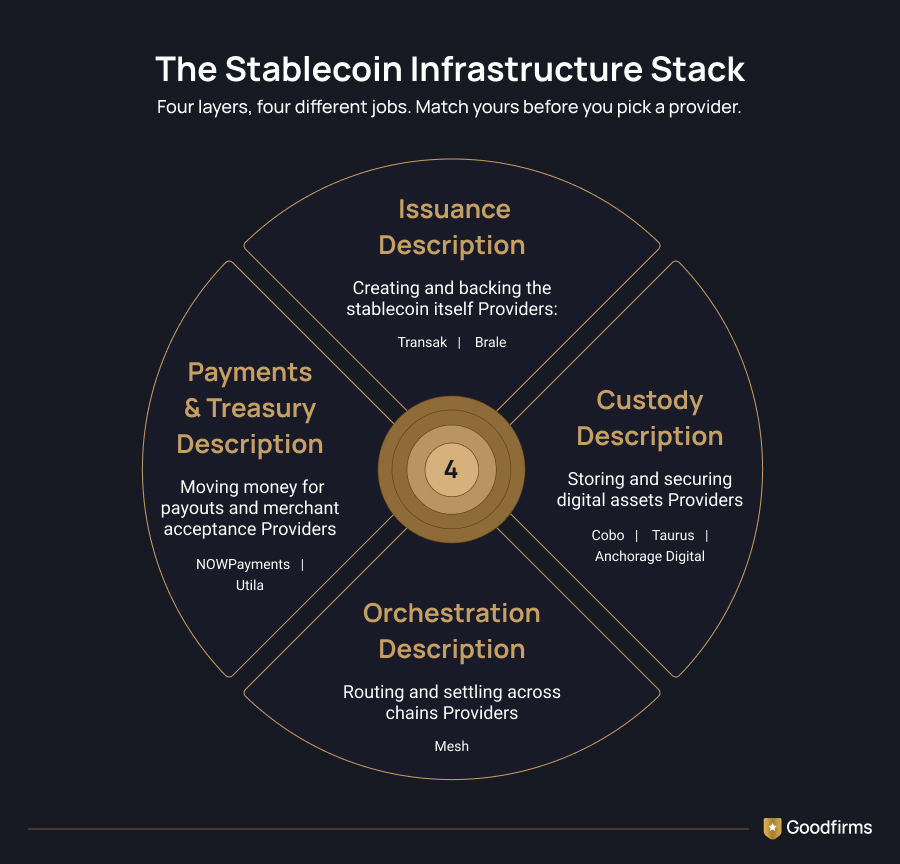
Stablecoin infrastructure covers four different jobs: issuance, custody, orchestration, and payments, and among the best stablecoin infrastructure providers, most only do one or two of them well. Transak is strongest for fiat-to-crypto onboarding, while Brale focuses on stablecoin issuance. Cobo and Anchorage Digital are geared toward institutional custody, while Mesh, NOWPayments, and Utila address orchestration, payments, and treasury workflows. Where should you start? Not with the vendor that has the longest feature list. Start with your workflow. Once you know whether you need payouts, custody, or treasury movement, narrowing this list down gets a lot easier.
FAQs - Best Stablecoin Infrastructure Providers
1. What is stablecoin infrastructure?
Stablecoin infrastructure is the combination of APIs, custody tools, and compliance frameworks that let businesses issue, move, hold, and accept stablecoins without building blockchain systems from scratch. It covers four distinct layers: issuance, custody, orchestration, and payment acceptance. Most businesses only ever touch one or two of these layers directly.
2. How do I choose a stablecoin infrastructure provider?
Start with your actual workflow, whether it's payouts, custody, treasury movement, or merchant acceptance. From there, check licensing coverage for every market you serve, the custody model on offer, and how pricing behaves once your volume scales up. Vendors that look similar on paper often differ a lot once you get into production.
3. What is a stablecoin payment infrastructure?
It's the layer of stablecoin infrastructure focused specifically on moving money for payments, covering settlement, merchant acceptance, and cross-border payouts rather than issuance or custody. Providers like NOWPayments and Mesh sit in this category, while Transak and Brale operate a layer above it as issuers.
4. Why use stablecoin infrastructure instead of traditional payment rails?
Stablecoin rails settle in seconds instead of days and often cost less on cross-border transfers, sometimes by two or three percentage points compared to correspondent banking. They also leave an auditable, on-chain transaction record, which finance and compliance teams increasingly value for reconciliation.
5. Do all stablecoin infrastructure providers charge the same way?
No, and the differences are significant. Pricing ranges from per-transaction fees around 10 basis points to flat percentage charges near 1.5% to fully custom enterprise contracts with no public rate card at all. Confirm which model applies and how it scales with volume before signing anything.