Key takeaways
-
NYDFS extended its blockchain analytics guidance to New York banking organizations in September 2025.
-
Banks should assess crypto risks, including wallet exposure, fund origins, and suspicious transactions.
-
NYDFS does not mandate specific tools. Banks should choose vendors based on their risk and compliance needs.
-
Compare vendors on blockchain coverage, wallet screening, risk detection, integration, security, and cost.
-
Banks should document alert procedures, train staff, and regularly review vendor performance. The 90-day prior approval requirement for certain crypto activities still applies.
A crypto transaction reaches a bank account, but where did the money come from? Tracing its path through multiple wallets can reveal risks that ordinary banking checks may miss.
In September 2025, the New York State Department of Financial Services (NYDFS) issued guidance asking New York banking organizations to consider how blockchain analytics can help manage cryptocurrency-related risks.
The guidance doesn’t require banks to buy a specific tool. It does, however, make risk assessment and the effectiveness of existing controls important considerations.
This guide explains what NYDFS blockchain analytics guidance means for banks and how to evaluate vendors based on risk detection, wallet screening, integration, and auditability.
Comparing options? Explore the best blockchain analytics software on Goodfirms to find solutions that fit your bank’s needs.
What Does NYDFS Blockchain Analytics Guidance Mean for Banks?
NYDFS blockchain analytics guidance means New York banks that deal with crypto, directly or through their customers, should consider using blockchain analytics tools to screen wallets, trace funds, and manage money laundering and sanctions risk.
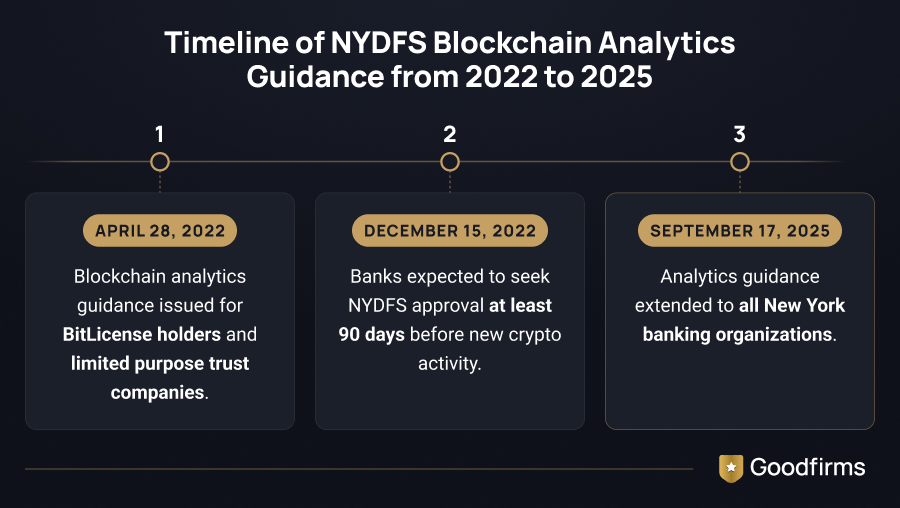
On September 17, 2025, the New York State Department of Financial Services issued an industry letter to all New York banking organizations. In the letter, NYDFS talked about extending the April 2022 blockchain analytics guidance, which until then applied only to BitLicense holders and limited purpose trust companies. NYDFS-licensed branches and agencies of foreign banks are covered as well.
The scope is wider than it first appears. The guidance applies to banks that are engaged in or planning virtual currency-related activity. That includes wallet services, crypto-backed lending, and stablecoin reserve services. It can also reach a bank that offers no crypto products but serves customers who use crypto.
The language is “consider,” so this is guidance rather than a rule. NYDFS expects each bank to tailor its controls to its business model, risk appetite, and operations, and to review its risk framework as new customer types and market entrants appear. Even so, a bank with crypto exposure and no analytics in place will have to show how else it identifies and manages that risk.
The 90-day prior approval requirement for any new or significantly different virtual currency activity still stands alongside this guidance.
What Does NYDFS Expect Banks to Assess With Blockchain Analytics?
NYDFS expects banks to use blockchain analytics to check customer wallets, trace where funds come from, review counterparty risk, and compare actual crypto activity with what they expect from each customer.
The NYDFS crypto guidance does not ask banks to build a separate process. It wants these checks added to the AML and sanctions controls they already run. The letter gives seven examples, and they come down to four things a bank should look at:
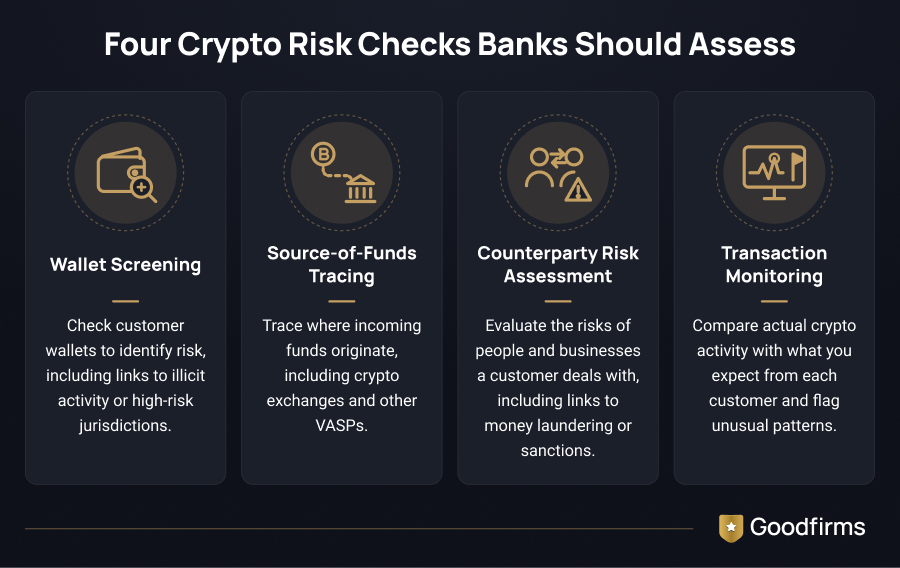
- The wallets of customers who deal in crypto. This is crypto wallet screening, and it shows how much risk sits behind a customer.
- Where money coming in from crypto exchanges and other virtual asset service providers (VASPs) really comes from.
- The risk of the people and businesses a customer deals with, including any link to money laundering or sanctions.
- Whether a customer’s crypto activity matches their profile and dollar limits. This is where blockchain transaction monitoring does most of its work.
NYDFS also wants banks to use what they learn to update their blockchain analytics risk assessment and to check the risks of a crypto product before they launch it.
The 2022 NYDFS virtual currency guidance adds more detail. Cryptocurrency transaction monitoring should look for red flags such as mixers, darknet markets, scams, ransomware, and high-risk countries. Blockchain sanctions screening should catch addresses tied to sanctioned parties. A wallet address does not always show who owns it, so banks still need their normal KYC checks.
In short, blockchain analytics for compliance and AML should give a bank findings it can record and explain to an examiner.
How Should Banks Turn NYDFS Guidance Into Vendor Requirements?
Banks should turn NYDFS guidance into vendor requirements by listing the checks they need to run, then asking each blockchain analytics vendor to show that its software can run them.
The NYDFS crypto guidance tells banks what to look at, but not which tool to buy. These four steps listed here will help you turn it into a clear vendor brief.
Build a Checklist
Take the examples in the letter and write them as questions. Can the platform screen customer wallets? Can it show where incoming funds started? Can it score counterparties and flag activity that doesn’t fit a customer’s profile? Every “yes” you need becomes a must-have in your blockchain analytics vendor selection.
Match Your Risk
NYDFS says controls should fit each bank’s risk appetite, so your requirements should too. A bank with a few crypto-linked customers needs lighter blockchain analytics tools than one that offers custody or holds stablecoin reserves.
Plan for Daily Use
Crypto AML compliance tools only help if alerts reach your analysts, connect to your case management, and leave a record an examiner can follow. If an outside vendor does the analysis, document how its results feed into your overall controls.
Review the Vendor
Treat the vendor like any other third party. Check its security, its track record with banks, and how it will support you over time. You can compare options on our list of the best blockchain analytics software.
How to Select Blockchain Analytics Vendors: 8 Criteria Banks Should Evaluate
Choosing a blockchain analytics vendor is not just about finding a platform that can trace cryptocurrency transactions. A bank needs to know whether the solution can identify risks relevant to its customers, fit into existing compliance processes, and provide enough evidence for investigators to understand why a transaction was flagged.
The selection process should start with the bank’s own risk profile. A bank serving crypto businesses may need deeper transaction tracing and counterparty analysis, while another may focus on screening customer wallets and reviewing incoming funds linked to virtual asset service providers (VASPs). The goal is to find a solution that addresses actual control gaps rather than paying for features the bank may never use.
Here are eight criteria to consider when evaluating blockchain analytics vendors.
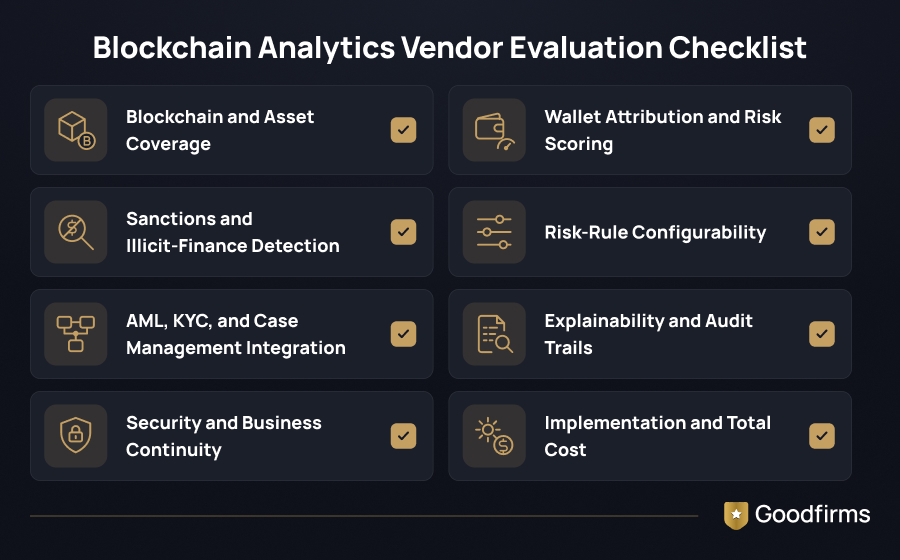
1. Blockchain, Token, and Stablecoin Coverage
Start by checking whether the vendor supports the blockchain networks and digital assets relevant to the bank’s customers. A platform may offer detailed tracing for popular networks but have limited visibility into other chains or tokens. That gap matters if customers transact across multiple networks.
Ask vendors for their supported-network list, known coverage limitations, and plans for adding new assets. Test a few representative transactions from the bank’s own risk scenarios rather than relying on a long list of supported chains.
2. Wallet Attribution, Risk Scoring, and Data Freshness
Crypto wallet screening is useful only when the information behind a result is reliable enough to guide further investigation. Banks should understand how vendors associate wallet addresses with exchanges, services, or potentially high-risk entities, and how frequently those associations are updated.
Ask how risk scores are calculated, what evidence supports a wallet attribution, and whether investigators can see the transaction history behind a flag. Wallet addresses are pseudonymous, so a vendor’s assessment should not be treated as confirmed proof of ownership or misconduct.
3. Sanctions Screening and Illicit-Finance Detection
A bank needs to know whether a platform can identify on-chain exposure to sanctioned entities and other activity relevant to its risk profile. This includes capabilities for blockchain sanctions screening, tracing funds through connected addresses, and detecting patterns associated with scams, ransomware, or other illicit activity.
Ask vendors to demonstrate how an alert is generated and how far investigators can trace the flow of funds. Also check whether detection rules can be adjusted to the bank’s own risk scenarios. Strong crypto AML compliance tools should support investigation and escalation, not simply produce a risk score.
4. Configurability to the Bank’s Risk Appetite
Not every bank faces the same crypto-related risks. One may need enhanced checks on customers transferring funds to exchanges; another may have more complex exposure through institutional clients and counterparties.
During blockchain analytics vendor selection, check whether the platform lets the bank configure risk thresholds, monitoring rules, and alert priorities. Ask whether the vendor can help map those settings to the bank’s existing policies. The aim is to support a tailored blockchain analytics risk assessment, not to apply the same rules to every customer.
5. Integration With AML, KYC, and Case Management Systems
Even accurate alerts can create problems if compliance teams must switch between disconnected systems to investigate them. Assess how easily a vendor’s platform connects with the bank’s existing customer due diligence, transaction monitoring, sanctions screening, and case management workflows.
Ask for a demonstration using a realistic investigation: can an analyst connect a wallet alert with customer information, review the transaction trail, record findings, and escalate the case without manually transferring data between several systems? Where custom integration is needed, establish the development effort and ongoing maintenance requirements before signing a contract.
6. Explainability, Audit Trails, and Examiner-Ready Evidence
An alert should tell investigators more than the fact that a transaction has been marked high risk. They need to understand the underlying activity, the evidence used, and the reasoning behind the result.
Evaluate whether the platform preserves transaction histories, alert details, risk-score explanations, analyst decisions, and case notes. Ask vendors to show how an investigation can be reconstructed months later. This is particularly important when blockchain analytics for compliance supports decisions about customer reviews, account restrictions, or suspicious activity escalation.
7. Vendor Security, Data Handling, and Business Continuity
Before sharing customer-related information with an external provider, assess how the vendor protects data and maintains its service. Review access controls, encryption, incident response, data retention, subcontractor arrangements, and disaster recovery procedures.
Also ask what happens if the service becomes unavailable or the vendor relationship ends. Can the bank retrieve its case records and relevant investigation data in a usable format? These checks should form part of the bank’s broader third-party risk review, alongside the vendor’s financial stability, contractual commitments, and ability to support the service over time.
Banks can compare these requirements with the controls used across their wider risk management stack, including solutions listed among the best risk management software.
8. Implementation, Support, Pricing, and Total Cost
The final decision should account for the work required to make a platform useful after purchase. Licensing fees are only one part of the cost. Data integration, configuration, staff training, alert review, and ongoing maintenance can also affect the budget.
Ask vendors for a breakdown of implementation fees, subscription tiers, usage limits, support arrangements, and charges for additional networks or features. Request a pilot with agreed success measures, such as relevant alert detection, false-positive rates, investigation time, and integration performance.
How to Compare Blockchain Analytics Platforms for Banking Use
Once a bank has defined its requirements, the next step is to compare shortlisted platforms against the same criteria. Rather than relying on vendor demonstrations or feature lists, evaluate how each solution performs in scenarios relevant to the bank’s customers and compliance risks.
- Blockchain coverage and tracing: Check which networks and digital assets each platform supports and whether it can trace transactions across relevant networks.
- Risk intelligence and screening: Compare wallet attribution, risk scoring, sanctions screening, and cryptocurrency transaction monitoring capabilities. Ask vendors to demonstrate how they identify and explain potential risks.
- Integration and usability: Assess how easily each blockchain analytics platform fits into existing AML, KYC, and case management workflows. Consider the impact on investigators’ workloads.
- Reporting and auditability: Check whether analysts can access transaction histories, understand alerts, document decisions, and retrieve investigation records when needed.
- Implementation and total cost: Compare setup time, licensing fees, support, integration expenses, and ongoing maintenance rather than looking at subscription prices alone.
Test Vendors With the Same Scenarios
Give each shortlisted vendor a consistent set of test cases, such as screening a customer wallet, tracing incoming funds, and investigating a transaction linked to a high-risk address. Record detection quality, false positives, investigation time, and the clarity of supporting evidence.
This approach helps banks compare blockchain analytics vendors on practical performance instead of marketing claims. For a broader view of the technical expertise available for blockchain integrations and custom solutions, explore Goodfirms’ top blockchain development companies. The final choice, however, should depend on how well each platform meets the bank’s compliance needs, risk profile, and operational requirements.
How Should Banks Implement and Govern a Blockchain Analytics Solution?
Banks should implement a blockchain analytics solution by getting approval first, setting clear roles for alerts, training staff, documenting how the vendor fits into their controls, and reviewing the setup regularly. The NYDFS crypto guidance cares as much about how the tool is run as about which tool is bought.
Get Approval First
A bank planning a new or significantly different crypto activity must tell NYDFS at least 90 days ahead, even if a third party provides the service. Build this into your rollout timeline. Banks that need help with licensing can look at our list of the best crypto licensing services.
Set Roles and Escalation
Decide who reviews alerts, who escalates them, and who makes the final call when something looks doubtful. The NYDFS blockchain analytics guidance expects these case management steps to be written down, with clear owners for each one.
Train Your Team
Everyone who touches the platform should understand what it does and where it falls short. That includes analysts, compliance leads, and the people who validate the tool. A wallet screening result is only useful if the person reading it knows how to act on it.
Document the Vendor Link
If the analysis comes from an outside provider, record how its results feed into your wider controls. Examiners expect to see how blockchain analytics software supports your AML program, not just a purchase order.
Review Regularly
Business models, customer types, and crypto products change quickly. NYDFS wants banks to revisit their risk frameworks often, so schedule reviews and update thresholds and rules as your crypto exposure grows.
What Mistakes Should Banks Avoid When Selecting Blockchain Analytics Tools?
Even a capable platform can fall short if it does not match the bank’s actual risk exposure or compliance processes. Banks should avoid these common mistakes when evaluating blockchain analytics tools:
- Choosing based on blockchain coverage alone: Supporting more networks does not automatically mean a platform can identify the risks most relevant to the bank. Evaluate tracing quality, wallet attribution, and alert accuracy alongside coverage.
- Treating risk scores as proof: A flagged wallet is a reason to investigate, not confirmation of illegal activity. Analysts should be able to review the underlying transactions and supporting evidence before making decisions.
- Ignoring integration requirements: A platform that operates separately from existing AML, KYC, and case management systems can create manual work and delay investigations. Test integrations before committing.
- Overlooking ongoing costs: Licensing is only part of the expense. Include implementation, training, maintenance, and alert-review workloads in the total cost.
- Failing to reassess performance: Blockchain activity and risk patterns evolve. Regularly review detection quality, false positives, vendor performance, and whether the solution still supports the bank’s risk appetite.
A sound blockchain analytics risk assessment should continue after implementation. Banks should document why a vendor was selected, monitor whether it delivers the expected results, and revisit requirements as their exposure changes.
FAQ - NYDFS Blockchain Analytics Guidance
Is NYDFS blockchain analytics guidance mandatory for banks?
The September 2025 NYDFS notice encourages covered banking organizations engaged in or considering virtual currency-related activity to assess the usefulness of blockchain analytics. It does not impose a blanket requirement for every bank to purchase a dedicated platform. Banks should evaluate their exposure, existing controls, and applicable compliance obligations before deciding what additional capabilities they need.
How does blockchain analytics support AML compliance?
Blockchain analytics for AML helps investigators trace cryptocurrency transactions, examine wallet connections, and identify potential exposure to suspicious activity. Combined with customer due diligence and conventional transaction monitoring, these insights can help compliance teams investigate unusual fund movements and assess whether further action is warranted. Analytics supports investigation; it does not establish wrongdoing on its own.
What should banks ask blockchain analytics vendors before signing a contract?
Banks should ask which blockchain networks the vendor supports, how wallet attribution and risk scores are generated, and how frequently intelligence is updated. They should also review integration options, audit trails, data security, implementation costs, and contractual rights to access investigation records. A pilot using realistic scenarios can reveal limitations that a standard product demonstration may not show.
Can banks use third-party crypto AML compliance tools instead of developing their own?
Yes. Banks can evaluate third-party blockchain analytics vendors or consider internally developed capabilities, depending on their requirements and resources. However, outsourcing does not remove the need for documented procedures, appropriate oversight, and integration with the bank’s broader compliance framework.
What is the difference between blockchain transaction monitoring and traditional transaction monitoring?
Traditional transaction monitoring generally examines activity recorded in financial accounts, while blockchain transaction monitoring traces activity recorded on supported public blockchain networks. Using both can give banks a more complete view of crypto-related fund movements, although wallet attribution and links to real-world identities may require additional verification.
How often should banks reassess their blockchain analytics risk assessment?
Banks should reassess their approach when material changes occur in their business model, customer activity, digital-asset exposure, or the threats they face. They should also review vendor performance periodically, including alert quality, false positives, and whether existing controls remain effective. The frequency should reflect the institution’s risk profile and internal governance requirements.
Conclusion: Turn NYDFS Blockchain Analytics Guidance Into a Defensible Vendor Decision
NYDFS blockchain analytics guidance does not force banks to buy a specific tool, but it does expect them to manage crypto risk with the right controls. The vendors you shortlist should be able to screen wallets, monitor transactions, and explain every alert to an examiner. Whichever one you choose, record how it fits into your AML program and review that setup regularly.
If your bank also plans to offer crypto wallet services, which NYDFS counts as virtual currency-related activity, you can compare the top cryptocurrency wallet development companies on Goodfirms before you build.