Key takeaways
- The crypto compliance and blockchain analytics market is expected to grow from $2.99 billion in 2025 to $17.8 billion by 2034, a 22% annual growth rate, underscoring how fast demand for these tools is rising.
- Blockchain analytics software turns raw on-chain data into clear insights for tracking wallets, transactions, and fund flows.
- The right tool depends on your goal—compliance teams need risk scoring and real-time monitoring, while traders need wallet behavior and market data.
- Leading platforms in 2026 include Chainalysis, Elliptic, TRM Labs, Nansen, Glassnode, Dune Analytics, Arkham Intelligence, Crystal Blockchain, Global Ledger, and Coinfirm, each built for different needs.
The crypto compliance and blockchain analytics market is projected to grow from $2.99 billion in 2025 to $17.8 billion by 2034 — a 22% annual growth rate, according to Market Intelo's 2025 report. That growth reflects a simple reality: crypto activity has outgrown what any team can track manually.
Businesses now need a real way to keep tabs on what's happening across these networks, and that's exactly the gap blockchain analytics software fills. With these tools, teams can trace transactions, flag risky wallets, stay on top of compliance, and spot patterns buried in millions of on-chain records — often in minutes rather than days.
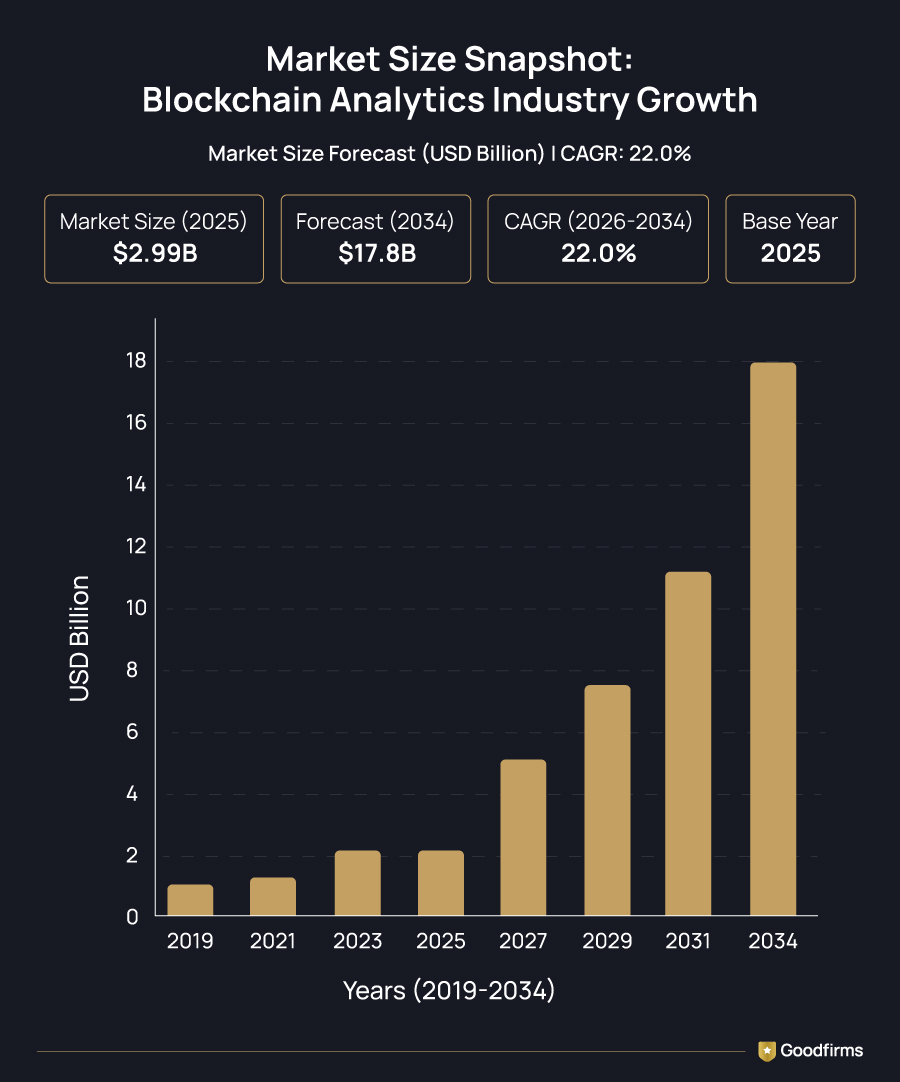
Source: Market Intelo
This post breaks down how blockchain analytics actually works, why it's become so essential across the crypto world, and which platforms are leading in 2026.
We will start by defining exactly what blockchain analytics is.
Most of these platforms look the same on paper. Compare blockchain analytics software on Goodfirms — verified reviews from real users.
What is Blockchain Analytics?
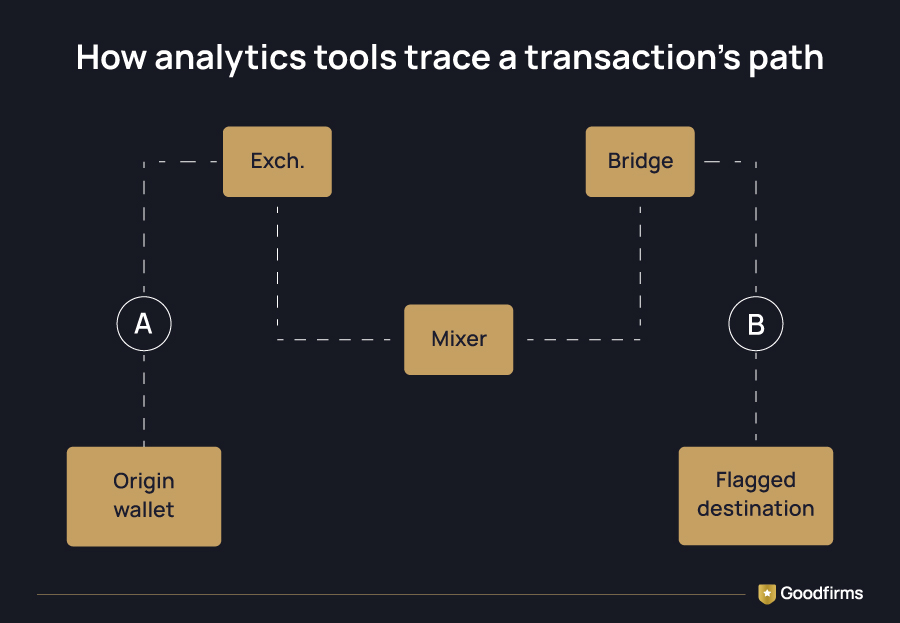
Every crypto transaction leaves a permanent, immutable trail on the blockchain—but that doesn't mean it's easy to understand. A single transaction can move through dozens of wallets, cross multiple chains, and interact with smart contracts along the way.
Blockchain analytics makes sense of this activity. It links transactions, traces how wallets relate to one another, and tracks where funds actually flow across networks. Think of it as a digital detective for crypto—digging up patterns that would otherwise stay buried. With it, organizations can figure out who's behind a given on-chain move and whether it's something to worry about, something worth acting on, or just something to keep watching.
That's why exchanges, regulators, investigators, and traders have all come to rely on it. It takes blockchain data—technically public, but practically unreadable to most people—and turns it into something teams can actually use.
But the need for blockchain analytics has grown well beyond basic transaction tracking, and a few industry shifts explain why.
Why does Blockchain Analytics Matter Right Now?
Not long ago, blockchain analytics was mostly a compliance and investigations tool. Today, exchanges, banks, traders, and DeFi teams all rely on some version of it.
Part of that comes down to regulation, and 2026 is the year several long-running deadlines finally land. The EU's MiCA transitional period ends July 1, 2026 — after which any crypto-asset service provider without full authorization must stop serving EU customers, no exceptions. Manual transaction monitoring simply can't meet that deadline.
Enforcement underscores the urgency: in H1 2025 alone, regulators issued 139 fines totaling $1.23 billion for AML, KYC, and sanctions violations, hitting major exchanges, not small operators.
Banks entering crypto want the same visibility they have in traditional finance — knowing where money came from and having audit-ready records. Investigators use the same tools to trace fraud across wallets and chains, while traders and funds mine the data for market signals that a price chart won't show.
Then there's fraud. Billions of dollars still move through crypto networks each year via hacks, scams, and laundering schemes. Investigators rely on blockchain analytics to figure out where it started and where it ended up.
Even traders, funds, and protocol teams use the same data for market intelligence to spot trends that a price chart alone won't show.
Yet the compliance gap remains wide: even with the FATF Travel Rule enforced in 99+ countries, only 29% of jurisdictions are actually compliant, and just 33% require virtual asset providers to be licensed. That gap is exactly why blockchain analytics matters — it's one of the few ways to verify compliance in practice, not just on paper.
With that gap in mind, the question becomes practical: which platform actually closes it for your specific use case?"
Which Blockchain Analytics Tool Fits Which Need? - Quick Glance
Before we get into the details, here's a fast side-by-side view of the platforms covered in this guide. Jump to full breakdowns below for what each one actually does well.
|
Tool |
Best For |
Key Strengths |
|---|---|---|
|
Chainalysis |
AML/KYC compliance at an institutional scale |
Regulatory workflows, audit-ready reporting |
|
Elliptic |
AML/KYC compliance at an institutional scale |
Regulatory workflows, audit-ready reporting |
|
TRM Labs |
Fund-flow tracing across many chains and assets |
Broad multi-chain and NFT/DeFi coverage |
|
Nansen |
Tracking smart-money wallets and trading signals |
Labeled wallet behavior, market intelligence |
|
Glassnode |
Fundamentals-driven, economically grounded metrics |
Popular with researchers and long-term holders |
|
Dune Analytics |
Flexible, low-cost, or free analysis |
SQL-based custom dashboards, open data warehouse |
|
Arkham Intelligence |
Deep wallet deanonymization for investigations |
AI-driven clustering, entity relationship mapping |
|
Crystal Blockchain |
Real-time AML transaction monitoring at scale |
Live transaction tracking, investigative tooling for law enforcement |
|
Global Ledger |
AML compliance under European/Swiss regulatory frameworks |
Broad address coverage, Swiss-based compliance focus |
|
Coinfirm |
Broad multi-chain AML coverage, now backed by Lukka's institutional data |
900K+ tokens across 45+ blockchains, audited data quality |
These categories are not strict, and most tools can handle a variety of tasks. Instead of choosing the most popular tool, think about the specific job you need to get done. This will help you create a shorter list of options and make it easier to find the right tool for your needs.
A Personal Note on Usability
Most of these tools are built by data scientists, for data scientists. I'm not one, so dashboards full of clustering scores and raw on-chain data just feel too much.
What I actually want is simple: tell me what's risky, why, and what to do next. If a transaction is marked as “high risk” but no reason is given, I have to figure out the problem on my own.
So I won’t go for the longest feature list—I will choose the one that makes decision-making easy without needing a SQL course first. Dune is great if you're technical. If you're not, it's a locked door. Chainalysis and Elliptic do that translation work for you, and that's probably why they've stuck around.
My filter when shortlisting: could someone non-technical on the team actually use this alone? That's mattered more than any feature list.
But usability only matters if the tool is solving the right problem in the first place. Before comparing platforms, it helps to know exactly what you're trying to accomplish.
What are the Key Use Cases for Blockchain Analytics Software?
Blockchain analytics software has become essential infrastructure for on-chain operations, supporting everything from compliance to market research.
1. Anti-Money Laundering and Compliance
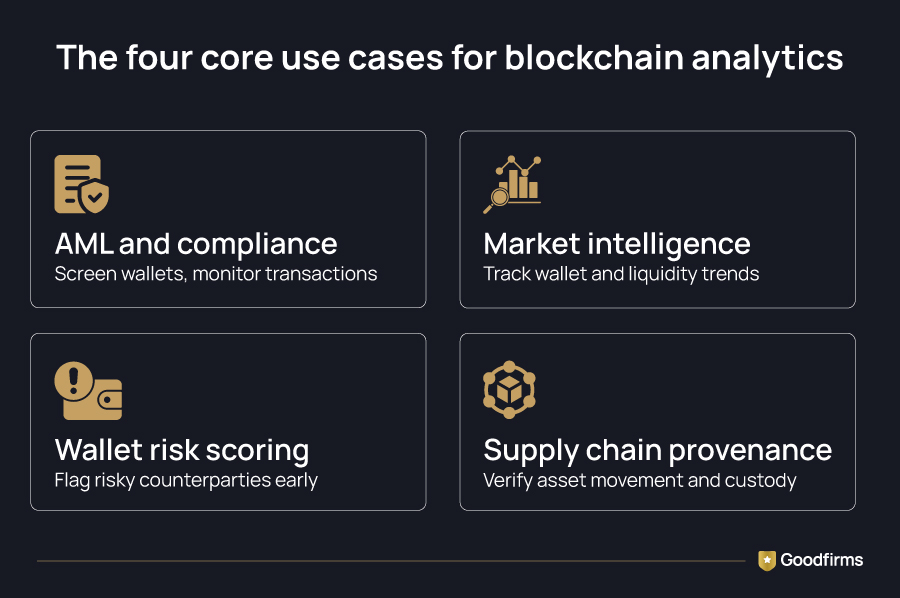
This is still the main use case for blockchain analytics software. Exchanges, custodians, and payment providers run it to screen new wallets the moment someone onboards, monitor transactions as they happen, and compile compliance reports that hold up under auditor scrutiny. Most solutions assign risk scores to wallets based on transaction history and known associations. Then automatically flags high-risk activity for review and reporting.
2. Wallet Risk Scoring and Due Diligence
Before interacting with any wallet, businesses want to know what they are dealing with. Blockchain analytics analyzes transaction patterns, groups related wallets, and checks for ties to sanctioned entities, darknet markets, or known fraudsters. What comes out the other end is a simple risk score, so your team can quickly approve or flag a wallet during onboarding. They do not have to look into transaction history under pressure when a transfer is already underway.
3. Market Intelligence and DeFi Research
Blockchain analytics software analyzes market data. Traders, funds, and DeFi protocols use it to track wallet behavior, liquidity movements, and token distribution, looking for real signs of demand and accumulation. Metrics like total value locked, realized price, and wallet activity often say more about what's happening in the market than a candlestick chart ever could.
4. Supply Chain and Asset Provenance
Supply chain tracking is gaining traction. Pharmaceutical companies, luxury brands, and logistics firms use these tools to track items as they move from manufacturer to distributor to retailer. The goal is to maintain a transparent, accountable chain of custody.
Before choosing a platform, keep these factors in mind.
What Should You Look for Before Buying Blockchain Analytics Software?
Blockchain analytics tools serve different purposes, so the right choice depends on what you're actually trying to do.
Chain and asset coverage
Some tools only track a few big networks. Others cover dozens of chains and thousands of coins. If your work spans multiple chains, gaps in coverage can leave you missing things.
Real-time versus retrospective monitoring
If you comply, you usually need alerts as transactions happen, not just a generated historical report you read after the fact.
Integration with the existing stack
Most teams already use a case management system, a CRM, or BI dashboards. Pick a tool that connects to those via an API, rather than one that forces your team to work in a separate window all day. Organizations often connect blockchain analytics platforms to broader business intelligence (BI) software to consolidate compliance, risk, and operational reporting.
Data visualization and reporting
Investigators and compliance staff have to explain what they found to people who weren't involved in the investigation. Clear transaction charts, wallet maps, and reports you can export make it that much easier than a spreadsheet full of numbers.
Security and certification
Especially for compliance work, check whether the provider has certifications such as SOC 2 or ISO 27001, and ask how they handle your data. This is essential because you're sending sensitive transaction data into these platforms.
With those factors in mind, here's where to start looking in 2026.
What is the Best Blockchain Analytics Software in 2026?
You've already seen how these stack up at a glance. Below is a rundown of the platforms shaping the space this year, loosely grouped by what each does best.
1. Chainalysis
Chainalysis is about as established as it gets in this space. Governments, banks, and crypto companies around the world rely on it to remain compliant, detect suspicious activity, and manage risk. It traces crypto transactions across the blockchain, helps detect fraud, and tracks down illicit activity such as money laundering and cyberattacks.
At its core, Chainalysis is trying to make crypto feel more trustworthy—bringing some structure and transparency to an industry that's still figuring out its regulatory footing.
2. Elliptic
Elliptic is a leading blockchain analytics platform that provides deep anti-money laundering (AML), compliance, and forensic investigation software for the cryptocurrency market. It helps banks, crypto exchanges, and law enforcement agencies screen transactions, track illicit funds, and prevent financial crimes across more than 50 supported blockchains, backed by over 100 billion data points.
3. TRM Labs
TRM Labs is a blockchain intelligence company that combines data, software, and AI-powered analytics into one platform. Governments, banks, and crypto businesses use it to catch and investigate digital asset fraud, money laundering, and other financial crime. The platform maps illicit activity across 100+ blockchains, backed by what TRM calls the industry's broadest set of commercial intelligence data. It's also one of the few in this space to hold FedRAMP High authorization, which matters a lot if you're a government agency with strict security requirements.
4. Nansen
Nansen is more focused on the market intelligence than on compliance. The platform tags and tracks upwards of 500 million wallets across major blockchains, enabling traders to follow "smart money" rather than run compliance checks. It's mainly known for two things — labeling wallets and tracking where the money actually goes. Hedge funds and institutional traders lean on it for exactly that reason: it flags new chains early, often before they're on anyone else's radar, and keeps tabs on wallets linked to well-known players. That early visibility is what keeps ecosystem analysts coming back to it, too.
5. Glassnode
Glassnode has been around long enough to earn a solid reputation in on-chain analytics. It digs into network health, liquidity flows, and investor behavior—things like realized losses, holder activity, and transaction trends. Traders and researchers who want a fundamentals-based read on what's actually happening on-chain, rather than just watching price candles, tend to gravitate toward it. It's worth noting that its real strength lies in Bitcoin and Ethereum, so it's less of a fit if you need broad coverage across dozens of smaller chains.
6. Dune Analytics
Dune is a powerful, community-driven on-chain data analytics platform where users build custom SQL dashboards on top of blockchain data. It is one of the best open-source options for on-chain analysis. Thus, it is suitable for technical teams who want flexibility beyond a pre-built dashboard. Basically, it works like an open-source data warehouse—anyone comfortable writing SQL can dig into DeFi protocols, NFTs, and wallet activity directly.
7. Arkham Intelligence
Arkham has made a name for itself in wallet deanonymization. It uses AI-powered clustering to determine how wallets connect—linking them to exchanges, funds, market makers, and other major players. That's why investigators and compliance teams who need more than a surface-level risk score tend to reach for it. Its alerts and wallet visualizer also come in handy when you're trying to keep up with big market moves as they happen.
8. Crystal Blockchain
Crystal Blockchain helps organizations monitor crypto transactions in real time. It does not look at reports after transactions have already occurred; instead, this approach allows exchanges and financial institutions to spot suspicious activity as it occurs. The platform supports a large number of cryptocurrencies. Law enforcement agencies and regulators use it to follow the movement of funds during active crypto investigations.
9. Global Ledger
Global Ledger is a Switzerland-based blockchain analytics platform. It offers tools for AML compliance, transaction monitoring, and crypto investigations. The platform covers more than 2,000 digital assets and has data on hundreds of millions of wallet addresses. Trusted by banks, fintech software development companies, regulators, and law enforcement agencies — including the UN and Europol — it's known for fast, real-time risk scoring rather than just retrospective reporting.
10. Coinfirm
Coinfirm has provided AML and compliance solutions for the crypto industry since 2016, and now operates as part of Lukka following a 2024 acquisition. The platform covers more than 900,000 tokens across 45+ blockchains, making it one of the broader coverage options in this list. It helps businesses identify risky transactions, monitor customer activity, and meet regulatory requirements without the higher costs typically associated with larger enterprise platforms.
These platforms offer different strengths, but many businesses still make avoidable mistakes when selecting one.
What Mistakes Do Businesses Make When Choosing a Blockchain Analytics Platform?
Many businesses make the same mistakes when selecting a blockchain analytics tool.
- Focusing only on current needs
A tool that works well today may not meet your needs as your business grows. For example, a startup managing a small number of digital assets might not need broad blockchain coverage right away. But if it later expands into new markets, the original solution may no longer serve its purpose. - Assuming all blockchain analytics tools do the same thing
While many platforms use similar blockchain data, they are designed for different purposes. A tool built for compliance and anti-money laundering (AML) checks may not be the best option for tracking DeFi activity or market trends. It's important to choose a platform that matches your specific goals. - Overlooking integration requirements
Viewing data in a dashboard is relatively simple. Connecting that data to your existing compliance systems, case management tools, or internal workflows can be much more complex. Understanding the integration work involved before signing a contract can save time and resources later.
Now let's look at where this technology is headed next.
Where is Blockchain Analytics Headed?
The blockchain analytics industry is evolving quickly, and two major trends are shaping its future.
1. AI-driven Analysis
Many platforms are using AI to improve their analysis of blockchain data. This helps businesses identify suspicious activity more accurately, reduce false alerts, group related wallets more quickly, and spot unusual transaction patterns across large volumes of data.
2. Coverage
Blockchain analytics now covers dozens of newer chains beyond Bitcoin and Ethereum. As new blockchains and digital assets continue to emerge, analytics platforms are expanding their coverage to keep up.
Businesses evaluating blockchain analytics tools should pay close attention to both AI capabilities and blockchain coverage, as these areas are likely to have the biggest impact on future performance and flexibility.
As these technologies continue to evolve, choosing the right analytics platform is critical.
Final Thoughts
Blockchain networks generate huge amounts of data, but that data is only useful if you can turn it into clear, actionable insights. Whether your goal is compliance monitoring, fraud investigation, or market analysis, choosing the right platform starts with understanding your needs and finding a tool that meets them.
As blockchain ecosystems continue to expand, analytics platforms are becoming more sophisticated and specialized. Organizations that choose tools aligned with their compliance, investigation, or market intelligence needs will be better positioned to manage risk and uncover opportunities in the evolving digital asset landscape.
FAQs - Blockchain Analytics
What is blockchain analytics software used for?
It's used to trace cryptocurrency transactions, identify wallet risk, support AML and KYC compliance, investigate fraud, and analyze on-chain market activity such as liquidity flows and wallet behavior.
Is blockchain analytics only for compliance teams?
No. While compliance is the most common use case, traders, researchers, and DeFi protocols also rely on blockchain analytics software for market intelligence, tracking smart-money wallets, and studying token holder behavior.
How does blockchain analytics software identify wallet owners?
It doesn't directly reveal identities. Instead, it clusters wallet addresses based on shared transaction patterns and links clusters to known entities (exchanges, sanctioned addresses, scam wallets) using a mix of heuristics, off-chain data, and, in some cases, AI-based pattern recognition.
What's the difference between blockchain analytics and blockchain analysis tools?
In practice, the terms are used interchangeably. Both refer to software that examines on-chain data to extract insights, whether for compliance, investigations, or market research.
How is blockchain analytics software typically priced?
Pricing varies widely by vendor and use case. Some platforms offer free or low-cost self-service plans, while enterprise-focused compliance tools typically rely on custom quotes.
For example, Dune Analytics offers a free tier, with paid plans starting at about $390/month and increasing to around $1,990/month for higher usage levels. Glassnode provides a free plan, an Advanced plan at $49/month, and a Professional plan starting at $999/month. Nansen offers a free tier alongside paid plans and API subscriptions that start at $49/month. In contrast, enterprise platforms such as Chainalysis, Elliptic, and TRM Labs generally do not publish pricing and instead provide customized quotes based on factors such as data volume, chain coverage, number of users, and compliance requirements.
Reviewing vendor listings on Goodfirms is a good way to get a general sense of pricing tiers before reaching out for a quote.
Which blockchain analytics software is best for a small business or startup?
It depends on the goal. Startups focused purely on compliance often start with a single-purpose AML screening tool. In contrast, those needing market data might start with a free tier of an on-chain analytics platform before scaling up to paid enterprise tools as their needs grow.