Key takeaways:
- Real estate tokenization splits a property's ownership into digital tokens on a blockchain, letting investors buy a fractional stake instead of the entire asset.
- Deloitte projects the market growing to nearly $4 trillion by 2035 at 27% CAGR.
- Compared to traditional property and REITs, tokenization offers lower investment minimums, faster settlement, and the potential for more liquidity through secondary trading.
- Platforms like RealT, Lofty, and Propy, plus the St. Regis Aspen Resort deal, show tokenization working across both retail and institutional real estate.
Real estate tokenization is the process of converting property ownership into digital blockchain tokens that investors can buy, sell, and trade. Instead of purchasing an entire property, investors can own fractional stakes, making real estate investing more accessible, transparent, and potentially more liquid.
The real estate industry is entering a new digital era. What was once considered an illiquid and paper-heavy asset class is now becoming part of the broader shift toward blockchain-based financial infrastructure. According to Deloitte, the value of tokenized real estate is expected to grow from less than $0.3 trillion in 2024 to nearly $4 trillion by 2035, representing a projected 27% compound annual growth rate (CAGR).
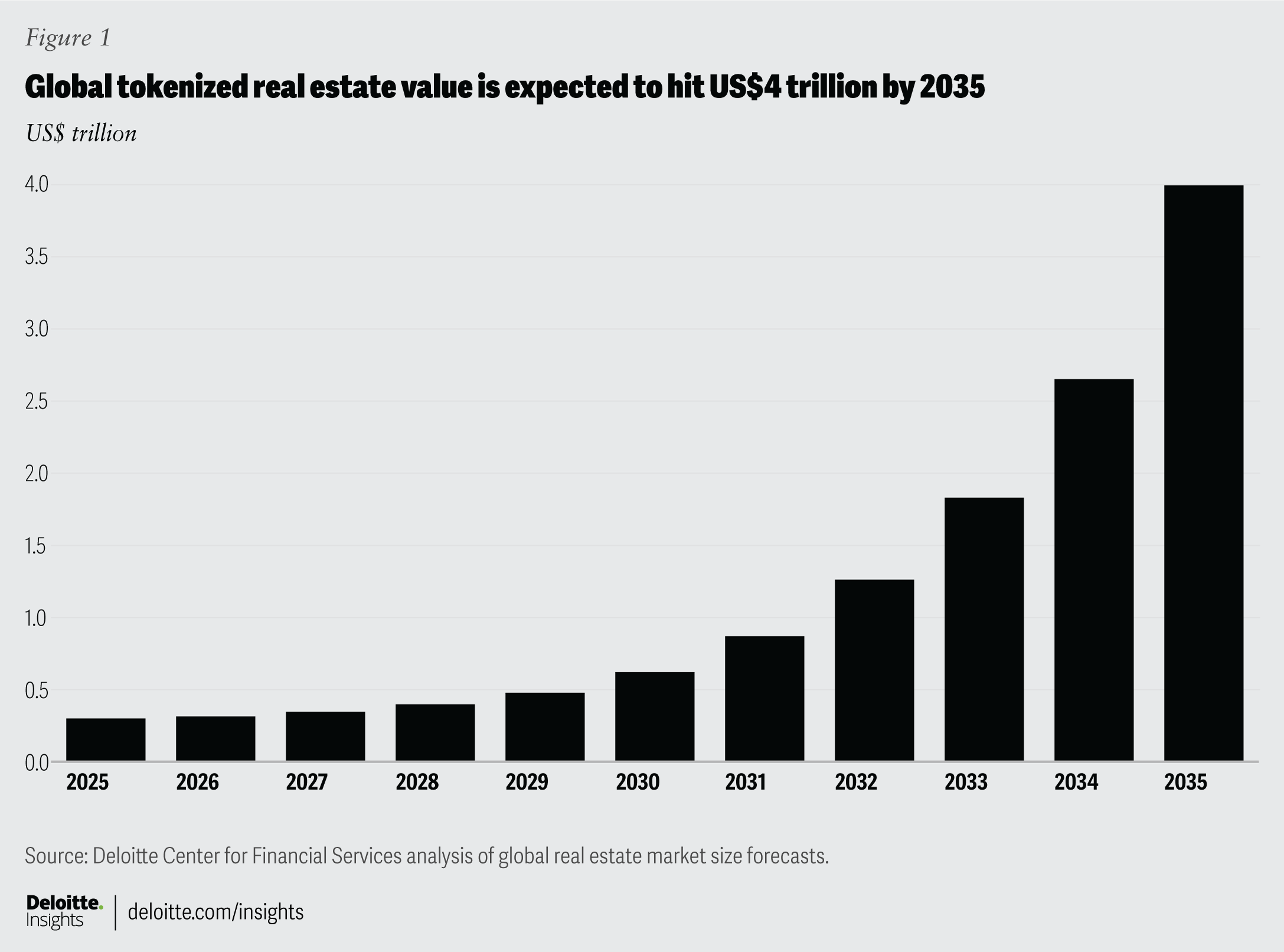
This rapid growth signals more than a technological trend. It reflects changing investor expectations, new fundraising models for property owners, and growing interest from businesses building blockchain-powered investment platforms. Understanding real estate tokenization is no longer optional for those looking to stay ahead. In this guide, we'll explain how it works, why it's gaining traction, and what businesses should know before entering this emerging market.
Thinking about building a real estate tokenization platform, or investing in one? Compare vetted real estate tokenization development companies on Goodfirms, backed by verified client reviews, before you commit to a partner.
What Is Real Estate Tokenization and How Does It Work?
Instead of selling a property as a single asset, its ownership is divided into thousands of digital tokens. Each token represents a small share of the property's value, allowing investors to own a fraction of the property rather than buying it outright.
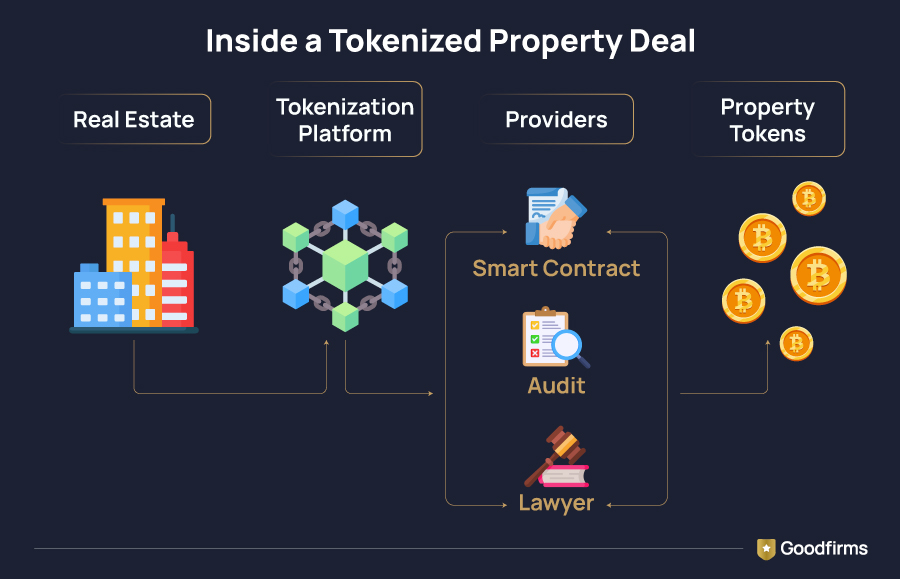
For example, a commercial building worth $10 million could be divided into 100,000 digital tokens. An investor who buys 1,000 tokens would own 1% of that property's value. This makes real estate investing more accessible because people can invest based on their budget instead of purchasing the entire property.
These ownership tokens are created and recorded on a blockchain, which acts as a secure digital ledger. Every transaction is recorded transparently, making ownership easier to verify and transfer.
In most cases, investors don't own the property deed directly. Instead, the property is held by a legal entity, such as a Special Purpose Vehicle (SPV), while the tokens represent ownership in that entity. If the property earns rental income or appreciates in value, investors receive returns based on the number of tokens they hold, subject to the platform's terms and applicable regulations.
Here's roughly how a deal comes together.
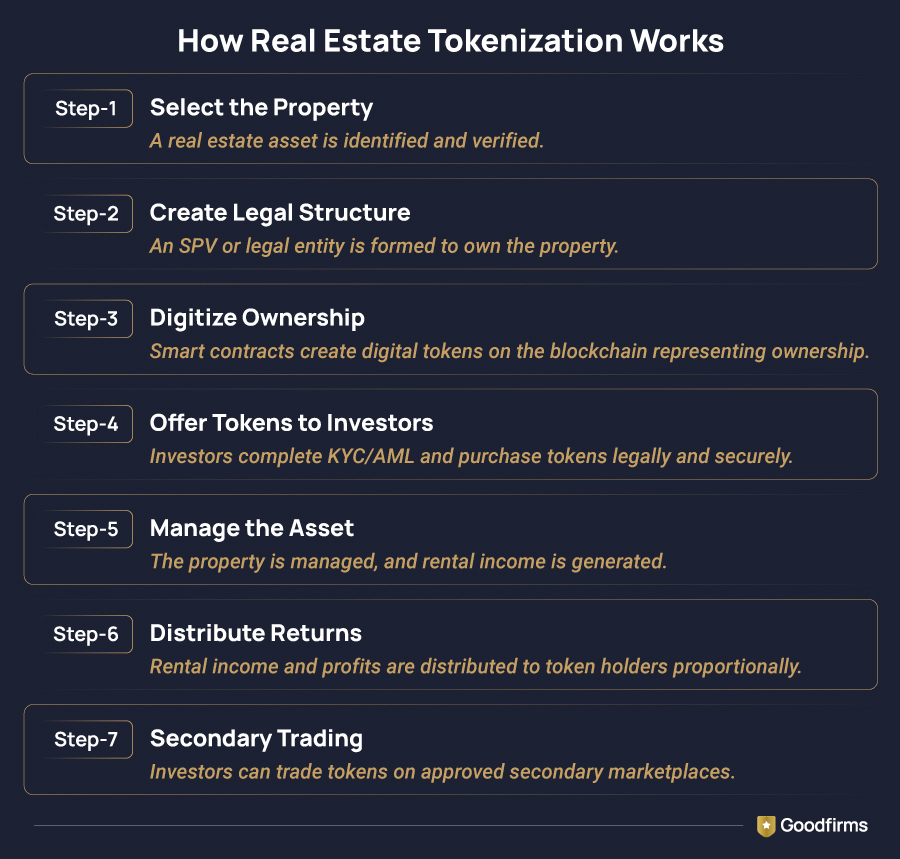
Step 1: Select the Property
The journey begins with a physical asset. This could be a residential building, commercial office, hotel, warehouse, shopping center, or even a portfolio of properties.
The property undergoes valuation and legal due diligence before moving to the next stage.
Step 2: Create a Legal Ownership Structure
Rather than issuing tokens against the property itself, developers usually establish an SPV or trust that legally owns the asset.
This creates a clear ownership framework and makes regulatory compliance easier.
Step 3: Digitize Ownership
Smart contracts are deployed on a blockchain such as Ethereum or Polygon. These self-executing programs define ownership rights, automate investor onboarding, distribute rental income, and enforce transaction rules without intermediaries. If you're planning to build a blockchain-powered investment platform, working with experienced smart contract development companies is essential for ensuring security, compliance, and reliability.
These contracts generate digital tokens that represent ownership interests in the SPV or asset.
Each token carries predefined rights, including ownership percentage, voting rights where applicable, and revenue distribution rules.
Step 4: Offer Tokens to Investors
After meeting legal and regulatory requirements, the tokens become available to eligible investors. Since real estate tokens are often treated as securities, businesses must comply with jurisdiction-specific regulations before launching an offering. Working with experienced regulatory compliance consulting firms can help streamline licensing, governance, KYC/AML processes, and ongoing compliance obligations.
Buyers complete identity verification through Know Your Customer (KYC) and Anti-Money Laundering (AML) checks before purchasing tokens.
Step 5: Manage the Asset
The property continues to operate like any traditional real estate investment.
Rental income, maintenance costs, taxes, and operational expenses are managed by the asset manager.
Step 6: Distribute Returns
Rental income or profits can be distributed to token holders according to their ownership percentage.
Smart contracts help automate these payouts, reducing administrative work and improving transparency.
Step 7: Secondary Trading
Depending on local regulations and platform capabilities, investors may sell their tokens through approved secondary marketplaces instead of waiting for the property to be sold.
This gives tokenized real estate the potential to be far more liquid than traditional property investments. Building a secure tokenization platform involves much more than issuing digital tokens. If you are evaluating technology partners, explore these top tokenization platform development companies to compare their expertise, client reviews, and industry experience.
Tokenized Real Estate vs REITs vs Traditional Property Investing
Not all property investments work the same way. While each option offers exposure to real estate, they differ in ownership, liquidity, accessibility, and control.
Traditional real estate gives investors complete ownership and control. The downside is that it requires significant capital and often takes months to buy or sell.
REITs solve the accessibility problem by allowing investors to buy shares in companies that own income-generating properties. However, investors own shares of the trust rather than a stake in a specific property.
Tokenized real estate sits somewhere in between. It combines fractional ownership with blockchain technology, giving investors exposure to individual assets while improving transparency and potentially increasing liquidity.
|
Feature |
Traditional Property |
REIT |
Tokenized Real Estate |
|---|---|---|---|
|
Minimum investment |
High |
Low |
Very low |
|
Ownership |
Direct |
Company shares |
Digital asset-backed tokens |
|
Liquidity |
Low |
High |
Moderate to high, depending on regulations |
|
Settlement time |
Days or weeks |
Minutes |
Potentially near real time |
|
Transparency |
Limited |
High |
High through blockchain records |
|
Ownership |
Direct title ownership of the physical asset |
Indirect ownership. |
Direct fractional ownership via digital tokens |
|
Cross-border participation |
Difficult |
Moderate |
Easier, subject to regulations |
Benefits of Real Estate Tokenization for Fractional Property Investing
Real estate tokenization is more than a new way to buy property. It addresses some of the biggest challenges in traditional real estate investing. Investors gain easier access to opportunities. Property owners unlock new funding options. Businesses can build entirely new investment platforms around tokenized assets. An EY survey backs this up: 76% of firms intend to invest in some form of tokenized asset by 2026.
Lower Barrier to Entry
For many people, the biggest obstacle to investing in real estate is the upfront cost. Buying a residential or commercial property often requires tens or hundreds of thousands of dollars.
Tokenization changes that equation. Instead of purchasing an entire asset, investors can buy tokens that represent a small ownership stake. Depending on the platform and local regulations, investments may start from a few hundred dollars. This makes property investment accessible to a much wider audience.
Better Portfolio Diversification
Putting all your money into a single property can be risky.
Tokenization allows investors to spread their capital across multiple assets. For example, someone with a $20,000 investment budget could own small stakes in an apartment complex, an office building, a warehouse, and a vacation rental instead of relying on the performance of one property.
Diversification helps reduce concentration risk while providing exposure to different markets and asset classes.
Improved Liquidity
Traditional real estate is one of the least liquid investments. Selling a property involves brokers, negotiations, legal paperwork, inspections, and lengthy closing periods.
Tokenized real estate has the potential to shorten this process.
Where regulations permit, investors can sell their tokens through secondary marketplaces instead of waiting for the entire property to be sold. Liquidity still depends on market demand and platform availability, but the process is generally more flexible than conventional real estate transactions.
Faster and More Transparent Transactions
Every transaction is recorded on the blockchain, creating an immutable record of ownership transfers.
This reduces paperwork, minimizes manual verification, and gives investors greater visibility into transaction history. Smart contracts can also automate ownership transfers after predefined conditions are met, reducing delays and administrative effort.
Access to Global Investment Opportunities
Traditional cross-border property investment is often expensive and legally complex.
Tokenization allows eligible investors to participate in opportunities beyond their local markets through compliant digital platforms. While regulations vary by country, blockchain technology makes international participation far more practical than traditional real estate transactions.
Automated Income Distribution
Managing rental income across hundreds or thousands of investors can become an operational headache.
Smart contracts simplify the process.
Instead of calculating and distributing payments manually, platforms can automate rental income distributions based on each investor's ownership percentage. This improves efficiency while reducing the risk of calculation errors.
Faster Capital Raising for Property Owners
The benefits aren't limited to investors. Developers and property owners can reach a larger pool of potential investors without relying entirely on banks or institutional financing.
Instead of selling an entire building to one buyer, they can tokenize the asset and raise capital from hundreds of investors. This creates additional funding options while retaining greater flexibility over ownership structures. Find a curated list of top asset tokenization development companies without the hustle.
Challenges and Risks of Tokenized Real Estate
- Regulatory Compliance: The US treats most real estate tokens as securities under SEC oversight. The EU has MiCA. Plenty of other regions have no clear framework at all. A token that's fully compliant in one country might be a legal gray area in another, which makes cross-border offerings genuinely complicated to structure.
- Land Registries and Blockchains: For a token to hold up legally, the blockchain record needs to match what's on the official property register. Most countries are still building that connection.
- Security Risk: Blockchain transactions are irreversible. A stolen private key or a smart contract bug can mean permanent loss, with no bank to call for a reversal. That's a different risk profile than what most property investors are used to.
- Legal Ambiguity Around What a Token Actually Represents: Is it equity? A revenue share? A claim against an SPV? Different platforms structure this differently, and until legislation catches up more broadly, investors need to read the fine print closely rather than assume all tokens work the same way.
- Tax Reporting: Someone holding tokens tied to five different properties across three countries is looking at a reporting burden that most retail investors underestimate. Some platforms now offer automated tax reports pulled from blockchain transaction data, but the accuracy still depends on the underlying transactions being categorized correctly, and investors are often the ones left holding that responsibility.
Top Real Estate Tokenization Companies in 2026
Real estate tokenization is no longer just a concept. Several companies have already launched platforms that allow investors to buy fractional ownership in real-world properties.
These examples show how different businesses are approaching the market.
RealT
RealT focuses on residential rental properties, primarily in the United States.
Investors purchase blockchain-based tokens that represent ownership interests in individual rental properties. Eligible token holders receive rental income based on the number of tokens they own, making it one of the most recognized examples of tokenized real estate.
Lofty
Lofty combines fractional ownership with a secondary marketplace.
Investors can buy shares in rental properties while earning a portion of the rental income. The platform also enables token trading among eligible users, providing more flexibility than traditional property ownership.
Propy
Propy takes a broader approach by using blockchain to simplify real estate transactions.
In addition to supporting tokenized property initiatives, the company has demonstrated how blockchain can streamline property transfers, ownership records, and transaction management.
St. Regis Aspen Resort
One of the most frequently cited examples of real estate tokenization is the St. Regis Aspen Resort in Colorado.
A portion of the luxury hotel's ownership was tokenized through a security token offering, demonstrating how premium commercial real estate could raise capital using blockchain technology.
These projects highlight that tokenization is no longer limited to startups. Institutional investors, hospitality companies, and commercial real estate firms are also exploring blockchain-based ownership models.
How to Choose a Real Estate Tokenization Development Partner
Picking a partner to build or launch a tokenization platform isn't a decision to rush. Get all these things through.
Regulatory Experience: Has the company actually structured a compliant offering before, or is this their first attempt at navigating securities law? Ask for specifics and relevant experience.
Smart Contract Security: Every contract should go through independent auditing before any real investor money is invested.
Track Record with SPVs and Legal Wrappers: A right partner will bring in or coordinate with legal counsel who understands securities frameworks in your target jurisdictions.
Post-launch Support: Investor onboarding, KYC, secondary market listing, and ongoing reporting all need to keep running after the initial token sale.
Choosing the right partner is just as important as choosing the right technology stack. Before making a decision, compare blockchain development companies on Goodfirms based on their experience with smart contracts, tokenization projects, security audits, client reviews, pricing, and industry expertise.
The Future of Real Estate Tokenization
Real estate tokenization is still in its early stages, but momentum is building.
Governments are gradually developing clearer regulations. Financial institutions are exploring tokenized real-world assets. Property developers are looking for more efficient ways to raise capital. Investors continue to seek accessible alternatives to traditional real estate investing.
Real estate is only one part of the broader real-world asset (RWA) tokenization movement. Businesses planning to tokenize assets such as real estate, commodities, invoices, or private equity can compare leading RWA tokenization development companies to find partners with experience across multiple asset classes.
Over the next few years, tokenization is likely to move beyond pilot projects into larger commercial deployments.
Several trends are expected to shape the market.
- Greater institutional participation
- Expansion of regulated digital asset exchanges
- AI-powered property management and compliance
- Cross-border investment opportunities
- Faster settlement through blockchain infrastructure
- Increased adoption of tokenized real-world assets beyond real estate
That doesn't mean every property transaction will move to blockchain overnight.
Traditional ownership models will continue to exist alongside tokenized investments. The real transformation lies in giving investors and property owners more choices rather than replacing existing systems.
For businesses, this creates an opportunity to build platforms that simplify investment, improve transparency, and connect global investors with high-quality real estate assets.
If you are planning to launch a real estate tokenization platform, partnering with an experienced blockchain development company can help you navigate the technical and legal complexities while building a solution that earns investor trust.
FAQs - Real Estate Tokenization
What is real estate tokenization in simple terms?
Real estate tokenization means splitting a property's ownership or income rights into digital tokens on a blockchain. Each token represents a fractional share, so instead of buying an entire building, an investor can buy a small piece of it, similar to buying shares in a company.
Is real estate tokenization legal?
Yes, but the rules for real estate tokenization depend on the country you are in. Before investing or launching a platform, it's worth checking the specific regulations in your jurisdiction.
Can tokenized real estate generate passive income?
Yes, tokenized real estate can generate passive income through automated rental payouts, daily revenue distribution, and fractional shares. Income depends on property performance, tenant occupancy, and platform fees.
What is the minimum investment in tokenized real estate?
It varies by platform, but minimums are far lower than traditional property investing. Some platforms, like RealT, price tokens around 50 dollars each. Research points to minimum investments as low as 1,000 dollars on other offerings, compared to the tens of thousands required to buy into a property the traditional way.
Is tokenized real estate a good investment?
It depends on your risk tolerance. Tokenization lowers the entry barrier and can improve liquidity, but secondary markets are still thin, regulation is inconsistent across regions, and blockchain-based assets carry security risks that traditional property doesn't. It's worth treating as an emerging asset class, not a guaranteed upgrade on traditional real estate investing.
What's the difference between real estate tokenization and a REIT?
A REIT gives you shares in a fund that owns a portfolio of properties. Tokenization usually gives you a direct claim tied to one specific property or a smaller pool of assets, often with more transparency into where your money actually sits, and in many cases with faster, more automated distributions through smart contracts.
Which blockchain is used for real estate tokenization?
There's no single standard. Ethereum is the most common choice because of its smart contract capabilities, but platforms also build on Hedera, the XRP Ledger, and other networks, depending on their compliance needs and transaction cost requirements.