Key takeaways
- Real estate tokenization platforms can cost $15,000 to $150,000+, depending on scope and complexity.
- White-label platforms can reduce development work, while custom builds offer more control.
- Development timelines can range from 4 weeks to 9 months, depending on the platform type.
- Compliance, KYC/AML, smart contracts, custody, payments, and reporting all affect the platform architecture and cost.
- Start with the legal and investment model before choosing the blockchain, token standard, and development approach.
Tokenizing a property is relatively easy to explain. Building the platform that can onboard investors, issue tokens, manage ownership, process transactions, and enforce compliance is where the real work begins.
The wider tokenization market is expanding. CoinGecko reported that tokenized real-world assets reached $19.32 billion. Deloitte projects that tokenized real estate could reach $4 trillion by 2035, compared with less than $0.3 trillion in 2024.
For businesses considering a real estate tokenization platform, the market forecast is positive. So, let's give you all the details you need to get your real estate tokenization platform up and running.
This decision will determine development cost, timeline, technology choices, compliance architecture, and whether a white-label product makes more sense than a custom build.
Turn your tokenization idea into a platform built around your investment model, compliance needs, and investor experience. Find the right real estate tokenization development partner with Goodfirms.
What drives real estate tokenization platform development cost?
There is no single price for building a real estate tokenization platform because vendors often define the scope differently.
|
Project |
Approx. Cost |
|---|---|
|
MVP |
$15,000 to $30,000 |
|
Mid-tier |
$30,000 to $70,000 |
|
Enterprise-grade |
$70,000 to $150,000+ |
Smart contract complexity: A simple token contract is very different from a system that requires transfer restrictions, investor-eligibility checks, distributions, redemptions, or other offering-specific rules.
Platform functionality: An investor portal, property listings, issuer dashboard, reporting, document management, and transaction workflows all add development work.
Compliance requirements: Affects both the application and smart contract architecture. KYC/AML, investor eligibility, transfer restrictions, and audit trails need to be considered before development begins.
Third-party integrations: A production platform may need connections to identity-verification providers, payment systems, custody infrastructure, property data, or accounting systems.
Secondary-market functionality: Increases the scope further because trading introduces additional transaction, liquidity, and compliance requirements.
The blockchain is therefore only one part of the product.
A real estate tokenization platform may need to connect property structures, investor identities, property information, payments, ownership records, compliance rules, and blockchain transactions. The development budget reflects all of those systems.
Consider Launch Cost Along With Development Cost
A development quote should also be separated from the total cost of launching a tokenized real estate offering.
Legal structuring, offering documentation, securities counsel, licensing, smart contract audits, KYC/AML services, custody, and ongoing compliance can sit outside the software development budget.
|
Component |
Cost Range |
|---|---|
|
Legal structuring (SPV, offering docs) |
$15,000 to $60,000 |
|
Smart contract development |
$20,000 to $80,000 |
|
Smart contract audit |
$15,000 to $50,000 |
|
KYC/AML integration |
$5,000 to $15,000 |
|
Token issuance platform (white label) |
$20,000 to $80,000 |
|
Secondary market integration |
$10,000 to $40,000 |
These are vendor estimates rather than fixed market prices. It is important to distinguish them from the development cost while calculating the overall or total cost of real estate tokenization platform development.
White-label or custom real estate tokenization platform?
This is one of the first decisions to make because it affects both the budget and the amount of control you have over the platform.
White-label platform
A white-label platform provides pre-built tokenization infrastructure that can be configured and branded for a business.
Depending on the provider, this may include token issuance, investor onboarding, KYC/AML integrations, an investor portal, and administration tools.
Estimated white-label development can cost around $50,000 to $150,000.
The difference reinforces an important point: White-label does not describe a single product. The amount of customization, integrations, compliance work, and infrastructure included can vary considerably.
White-label can make sense when:
- You want to validate the business model before funding a larger custom build.
- Your property and investor workflows fit an existing platform.
- The integrations you need are already supported.
- You want to reduce the amount of software built from scratch.
The trade-off is control. Your architecture, integrations, upgrade options, and infrastructure may remain dependent on the provider.
Custom platform
A custom real estate tokenization platform makes more sense when the product has requirements that an existing platform cannot support cleanly.
That could include proprietary investor workflows, unusual transfer restrictions, complex integrations, multiple asset types, or a secondary-market model built around your business.
A custom platform can cost around $200,000 to $500,000+. The estimates are not directly comparable because their scopes differ.
The better question is not simply which option costs less. It is whether the platform you are buying or building will support the business model you intend to operate.
How long does real estate tokenization platform development take?
Development timelines vary with the scope, but let's get a rough outline.
|
Project |
Estimated Timeline |
|---|---|
|
MVP |
6 to 10 weeks |
|
Mid-tier |
3 to 5 months |
|
Enterprise-grade platform |
6 to 9 months |
|
White-label solution |
4 to 8 weeks |
|
Custom development |
4 to 9 months |
A project moves through several stages. So you need to consider the time for that as well. The above table estimates the real estate platform development time.
Establish legal architecture
The team needs to establish what the token represents, how the property is held, who can invest, where the offering will operate, and what restrictions apply to token transfers.
This should happen before the smart contract architecture is finalized.
Smart contract development and audit
The development team creates the token contracts and associated logic, tests them, and sends them for independent security review.
Platform development
The application layer brings together the investor portal, administration dashboard, property-management tools, KYC/AML integrations, payment workflows, wallet infrastructure, reporting, and blockchain connectivity.
Testing and compliance review
The application, smart contracts, integrations, permissions, and transaction flows need to be tested together.
Production launch
After testing and review, the platform can move into production and begin onboarding properties and investors.
Real estate tokenization tech stack
The technology stack will define your business and compliance model.
Blockchain
Ethereum and EVM-compatible networks are common choices for tokenization because they offer established smart contract tooling and development infrastructure.
The right network still depends on transaction costs, custody support, liquidity, compliance tooling, and the target investor market.
Token standard
The token standard is an important architectural decision.
ERC-20 defines a standard interface for fungible tokens on Ethereum.
ERC-1400 is a family of standards designed around security-token functionality, including transfer restrictions, document management, issuance, and redemption.
ERC-3643 is designed for permissioned tokens and includes identity and compliance mechanisms for token transfers.
The choice should depend on the legal structure, investor eligibility requirements, transfer rules, and jurisdictions involved.
Backend and database
A backend framework such as Node.js can handle APIs and business logic, while a relational database can store investor information, property records, compliance data, transactions, and reporting information.
The database and blockchain serve different purposes.
The blockchain can record token ownership and transaction events, while the application database can manage investor profiles, documents, property information, KYC status, and operational records.
Frontend
React or Next.js can be used for the investor portal and administration interface.
The important consideration is the investor experience. Users should be able to register, complete verification, review an offering, invest, and monitor their holdings without having to understand the underlying blockchain infrastructure.
Wallet and custody
The platform also needs a clear wallet strategy.
Investors may manage their own wallets, or the platform may use custodial or embedded-wallet infrastructure. The right choice depends on the target audience, compliance model, user experience, and operational responsibilities.
Compliance and identity
KYC/AML software providers sit alongside the application and blockchain layers.
Depending on the architecture, investor eligibility can be checked before a transaction is submitted or enforced through token-level compliance logic.
Payment infrastructure
A platform may need bank-transfer support, fiat payment options, stablecoin transactions, or a combination of these.
Payment reconciliation matters as well. The system needs to connect the payment record with the corresponding investment, ownership, and token transaction.
Core features of a real estate tokenization platform
The feature list should follow the people and workflows the platform is intended to support.
Investor portal
Investors should be able to:
- Register and complete KYC/AML verification
- Browse properties and investment offerings
- Review property and offering documents
- Invest through supported payment methods
- View token holdings
- Track distributions and transaction history
- Access statements and reports
- Manage their account and wallet
Issuer and property management
Property owners and issuers need administration tools for:
- Property onboarding
- Offering creation
- Token supply and pricing
- Investor management
- Distribution schedules
- Ownership records
- Document management
- Reporting
Compliance and operations
The back office should also support:
- Investor eligibility checks
- Transfer restrictions
- KYC/AML status
- Audit logs
- Role-based access
- Ownership records
- Transaction monitoring
- Regulatory reporting
Secondary market
A secondary marketplace does not necessarily need to be part of the first release.
It adds trading, liquidity, compliance, and technical requirements. For a new platform, it may make more sense to establish primary issuance and investor-management workflows first and add secondary trading once there is a clear business case.
Compliance is part of the architecture
The platform needs to be designed around the applicable legal structure rather than assuming that every tokenized property follows the same regulatory model.
If only verified investors can hold a token, the system needs an eligibility mechanism. If transfers are restricted, the smart contract or application layer needs to enforce those restrictions. If investor information must remain private, sensitive identity and financial data should not simply be placed on a public blockchain.
The legal structure should therefore be established before the token architecture is finalized.
This is also why the cost of a real estate tokenization platform cannot be judged solely by the smart contract quote.
How to choose a real estate tokenization development company
Once you know the platform scope, choosing a development partner becomes easier.
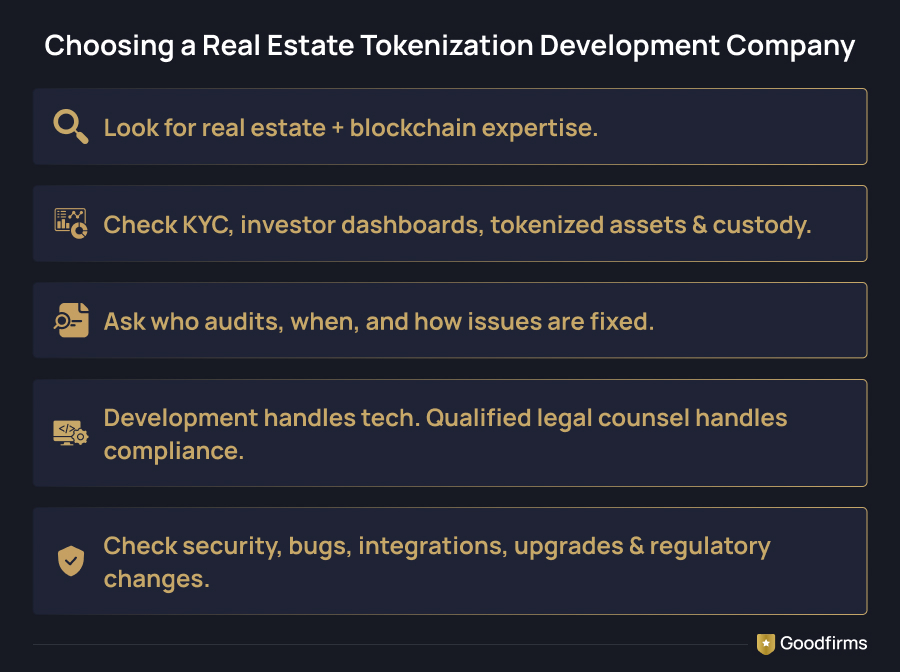
1. Look for tokenization experience
A team that has built NFT marketplaces or DeFi applications may understand smart contracts without understanding investor onboarding, securities workflows, property ownership structures, or compliance requirements.
2. Ask for relevant case studies
Look for projects involving KYC-enabled onboarding, investor dashboards, tokenized assets, custody, reporting, and administrative controls.
3. Ask who handles the smart contract audit
The development team should be able to explain when the audit takes place, what happens when vulnerabilities are found, and how remediation is handled.
4. Separate development from legal advice
A development company should understand the technical implications of your compliance structure. But you must have a qualified legal counsel.
5. Check post-launch support
Ask about security monitoring, infrastructure, bug fixes, third-party integrations, smart contract upgrades, and changes required when regulations or business requirements change.
For vendor research, Goodfirms' real estate tokenization development companies directory is a useful starting point.
You can also compare a wider pool through Goodfirms' blockchain development companies directory when you need a partner with broader blockchain or financial software experience.
What It Takes to Build a Real Estate Tokenization Platform
The biggest mistake in real estate tokenization platform development is treating token issuance as the product.
The token is only one piece.
The actual platform has to connect property structures, investor onboarding, compliance, payments, custody, ownership records, reporting, and blockchain transactions without making investors deal with the technical complexity underneath.
That is why two platforms that both "tokenize real estate" can have completely different budgets.
Start with the legal and investment model. Decide what investors need to do. Map the compliance rules around those workflows. Then choose the blockchain, token standard, integrations, and development approach.
That order makes the real estate tokenization development cost much easier to estimate and gives the development team something much more useful than a feature list to build from.
FAQs - Real Estate Tokenization Platform Development
How much does it cost to build a real estate tokenization platform?
The estimated cost for a real estate tokenization platform MVP is $15,000 to $30,000 for an MVP and $70,000 to $150,000+ for an enterprise-grade platform. The mid-tier is between these two. The estimated cost for a white-label platform is $50,000 to $150,000, and $200,000 to $500,000+ for a custom platform. Legal structuring, smart contract development, audits, KYC/AML, and secondary-market functionality may also add to the overall launch cost.
How long does real estate tokenization platform development take?
The real estate tokenization platform development takes 6 to 10 weeks for an MVP, 3 to 5 months for a mid-tier platform, and 6 to 9 months for an enterprise-grade platform. The white-label development takes 4 to 8 weeks, and custom development takes 4 to 9 months. Legal structuring, smart contract audits, testing, and compliance reviews should be included when planning the actual launch timeline.
Should I choose a white-label or custom platform?
Choose white-label when you want to reduce the amount of software built from scratch and your requirements fit an existing platform. Choose custom development when you need proprietary workflows, unusual compliance requirements, complex integrations, or greater control over the architecture.
Which blockchain should I use for real estate tokenization?
There is no universal best blockchain. Ethereum and EVM-compatible networks are common options, but the decision should also consider transaction costs, custody support, liquidity, compliance tooling, ecosystem maturity, and the target investor market.
Which token standard is best for real estate tokenization?
There is no single answer. ERC-20 defines a standard interface for fungible Ethereum tokens.ERC-1400 provides standards for security-token functionality.ERC-3643 is designed for permissioned tokens with identity and compliance mechanisms.The appropriate choice depends on the legal and operational structure of the offering.
Do investors need to understand blockchain?
No. The blockchain should largely operate behind the investor experience. Investors should be able to register, complete verification, review an offering, invest, and monitor their holdings through a familiar interface while the blockchain handles the underlying token transactions.
Is a secondary marketplace necessary?
Not necessarily. If the initial goal is to issue and manage tokenized real estate, secondary trading can be added later. Building a marketplace before there is a clear liquidity strategy can add cost and complexity without solving the underlying business problem.