Key takeaways
- Mobile app marketing starts before the app is even downloadable, with its preview loops and demo experiences doing the early convincing to the audience.
- A strong mobile app marketing strategy rests on four core pillars: ASO, creative execution, the right tools, and honest measurement.
- Frictionless onboarding and authentic, de-influenced content are two of the mobile app marketing techniques outperforming polished ad campaigns in 2026.
- Product-market fit and realistic budgeting matter more than a big launch splash.
- Scaling app growth usually means bringing in outside expertise once internal bandwidth runs out.
I've sat through enough app launches to know a great app with no marketing plan barely moves the needle. Mobile app marketing isn't a checklist you run once; it's ongoing work that starts before launch and never really stops. This guide breaks down what actually works in 2026: the strategy, the costs, the tools, and the numbers that prove it's paying off.
Need help putting this into action? Browse vetted mobile app marketing agencies ready to take it from here.
What Is Mobile App Marketing?
Mobile app marketing covers everything you do to get people to discover, download, and keep using your app. It includes app store visibility, paid and organic acquisition, onboarding, and the ongoing work of keeping users engaged after install.
The scope has widened over the past few years, mostly because how apps get built and shipped has changed just as fast as how they get marketed.
Goodfirms Research
A quick look at the evolution of mobile app development shows how closely the two have moved together, with global app spending now sitting at $333.93 billion and users averaging over 5 hours a day inside apps
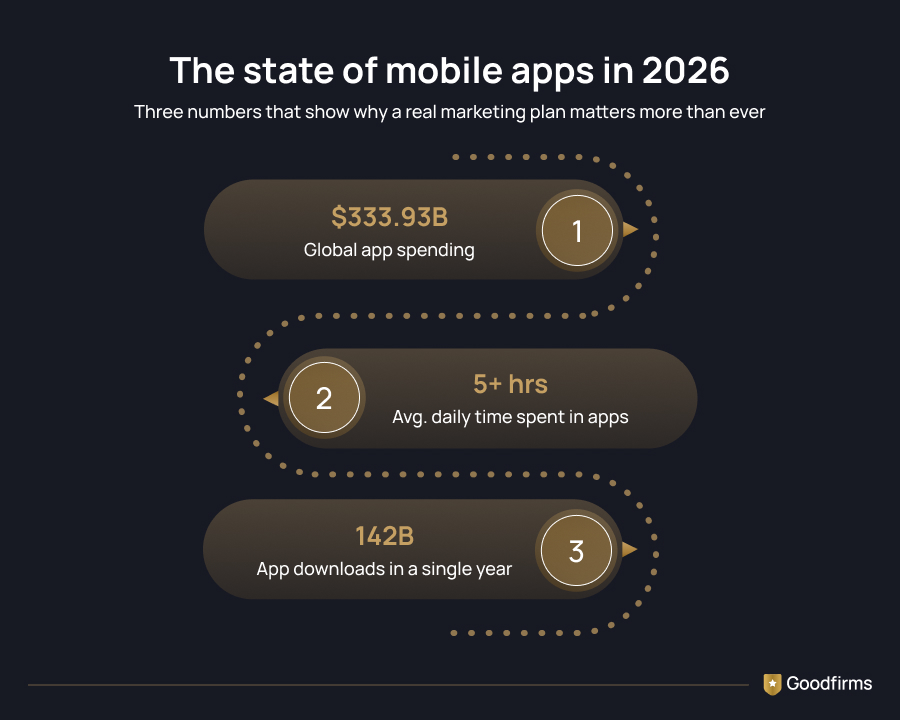
Marketing an app well means thinking about the full journey. That includes the moment someone first sees your listing, the first few minutes after install, and every touchpoint after that keeps them coming back. With 142 billion downloads recorded in a single year, standing out at any one of these touchpoints takes a deliberate plan, not luck.
It also helps to know where mobile app marketing ends and two related terms begin. Mobile marketing is the broader umbrella, covering anything promoted through a mobile device, including SMS and mobile web. App advertising is the narrowest slice, just the paid ads that point people toward your app. Mobile app marketing sits in between, covering every organic and paid effort built specifically around your app.
How to Build a Mobile App Marketing Strategy Before Launch
Most of the work that decides whether an app succeeds happens before it ever reaches the app store.
1. Offer a Preview Before the Download
Asking someone to commit to a full download based on a few screenshots is a big ask. A new strategy is that many apps are offering a taste of the experience upfront instead. Interactive demo ads, app clips, and lightweight web previews let people try the core feature before installing anything. This builds trust faster than a polished trailer, since people get to judge the product for themselves in a few seconds rather than take your word for it.
2. Confirm Product-Market Fit Before You Spend
No amount of marketing fixes an app that has not found its audience yet. Before scaling any campaign, check for real usage signals. Repeat sessions, referrals, and actual retention matter more than a spike in downloads.
Budgeting needs to be realistic, too. Marketing spend usually scales alongside development spend, so it helps to review a breakdown of app development costs before setting a marketing budget.
Goodfirms research on app development pricing found that hidden costs, marketing spend included, can add 25 to 35 percent on top of the original build cost, which is a number worth planning around rather than discovering later. This avoids the common mistake of overspending on acquisition for a product that is still finding its footing. A big launch splash rarely makes up for weak fundamentals underneath it.
3. Consider a Soft Launch First
Releasing your app to a small, often geographically limited group before the full rollout gives you a low-risk way to test everything at once. Onboarding, monetization, crash rates, and early retention all show up faster with real users than they ever would in internal testing. Any issues that surface can be fixed quietly before the wider audience ever sees them.
Mobile App Marketing Strategy: 4 Core Pillars for 2026
A mobile app marketing strategy holds up better when it is built around a few connected pillars, rather than a long list of disconnected tactics. Here are the four that matter most in 2026.
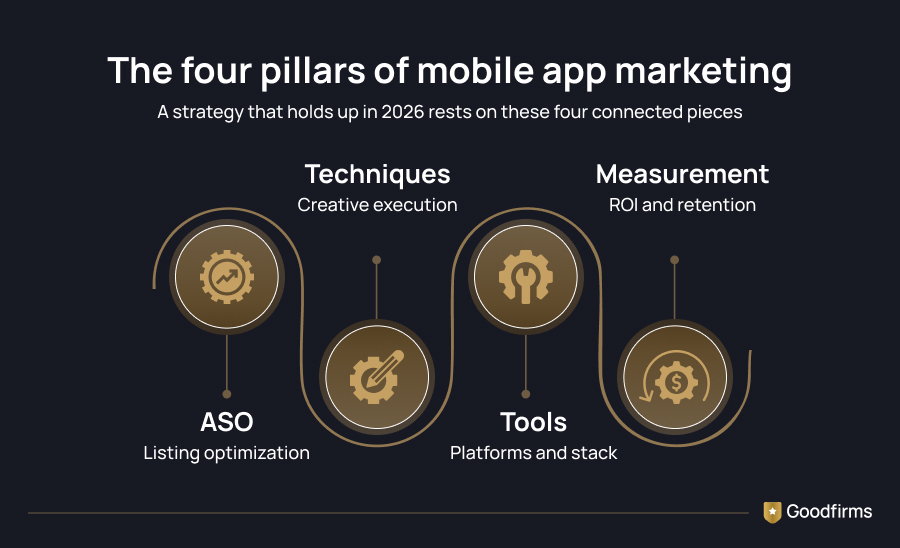
1. App Store Optimization (ASO)
ASO in the past used to mean picking the right keywords and calling it done. Well, in today's time, that is not enough. The current approach treats your app store listing like a landing page you keep testing, not a profile you set once and forget.
Icon variants, screenshot order, and preview video thumbnails all affect how many people convert once they land on your page. Running these as small, controlled experiments moves the needle more than adding a few extra keywords ever will. The app store optimization covers the keyword and metadata basics if you want to start there.
Goodfirms research on agency pricing puts typical ASO service costs between $2,000 & $8,000 a month, or $2 to $5 per download for performance-based engagements, which gives you a rough benchmark before requesting quotes.
2. Mobile App Marketing Techniques and Creative Ideas
A few techniques are standing out this year as some of the best mobile app marketing ideas worth testing.
- Frictionless onboarding. Social login, guest mode, and skipping signup fields you do not truly need all help someone reach the actual product faster. This connects directly to day-one retention, since every extra step is a chance for someone to drop off.
- De-influenced, authentic content. Raw, unpolished reviews and honest walkthroughs from real users are converting better than scripted influencer content. Audiences have gotten good at spotting a paid endorsement, and they respond better to something that does not feel like an ad.
- Mining your own reviews for messaging. App store reviews and support tickets show you exactly how people describe your app in their own words. That language almost always outperforms copy written internally, since it comes straight from the people you are trying to reach.
- Staying close to product trends. The broader app development trends shaping build decisions this year also shape what kind of creative and messaging actually lands with users. Two worth watching closely are privacy-first positioning, since trust now influences downloads as much as features do, and contextual push notifications tied to real triggers like location or in-app behavior, rather than generic reminders.
- Light gamification. Streaks, progress bars, and small milestone rewards give users a reason to open the app again, especially in the first couple of weeks when the habit is still forming.
- Referral incentives. Rewarding existing users for bringing in new ones turns your current base into an acquisition channel, usually at a lower cost than paid ads.
- Short-form video. Quick, native-feeling clips tend to hold attention better than static images or long-form content, particularly for showing the app in actual use.
Together, these seven are a big part of why frictionless onboarding and de-influenced content are outperforming polished ad campaigns this year. Users respond to what feels real and what removes effort, not to what looks the most produced.
|
A Real Example Duolingo is a good example of these ideas working together at scale. The app leaned into streaks, leaderboards, and daily reminders to build a habit loop, then let its mascot's cheeky, low-budget TikTok presence carry most of the brand's visibility instead of paid ads. That mix helped the app grow into one of the most downloaded education apps worldwide, with the majority of new users arriving organically rather than through paid acquisition. It is a clear case of gamification and authentic, personality-led content doing more for growth than a traditional ad budget ever could. |
3. Mobile App Marketing Tools and Platforms
The right stack depends on team size, but most strategies lean on a few categories working together:
- ASO platforms for keyword tracking and listing experiments.
- Attribution platforms to connect ad spend to real in-app behavior instead of just install counts.
- Messaging platforms for push and in-app notifications, ideally with behavior-based triggers rather than static blasts.
- Review monitoring tools to track sentiment and pull the customer language mentioned above.
- Deep linking tools send someone from an ad, email, or QR code straight into a specific in-app screen instead of a generic store page, which keeps the experience relevant from click to open.
Many mobile app marketing platforms now bundle several of these functions together. That makes it easier for smaller teams to run a full strategy without juggling five separate subscriptions.
4. How to Track Mobile App Marketing Success
Downloads are the easiest number to look at and the least useful one on its own. A fuller picture comes from tracking:
- Retention rate at day one, day seven, and day thirty.
- Cost per acquisition, broken down by channel.
- Lifetime value, compared against the acquisition cost.
- App store conversion rate, since a stronger listing lowers the cost of every other channel.
- Reactivation rate from win-back campaigns, which shows whether you are recovering users who had already drifted away.
Looking at these together, instead of chasing downloads alone, gives a far more honest read on whether a strategy is actually working.
Mobile App Marketing Channels to Use in 2026
Most successful campaigns pull from a mix of channels rather than betting on just one. Here's where the budget usually gets split:
- Paid social and search ads. Meta, TikTok, and Google Ads remain the fastest way to get in front of new users, though rising costs per install mean most teams now pair paid spend with at least one organic channel.
- App store optimization. Since ASO drives organic downloads without ongoing spend, it usually earns first priority in the channel mix, not last.
- Influencer and creator content. Smaller, niche creators tend to outperform big-name sponsorships, especially when paired with the de-influenced, unscripted style users respond to now.
- Email and push lifecycle marketing. These channels handle the retention work that acquisition channels can't, keeping existing users engaged long after the first session.
- Referral programs. Turning current users into an acquisition channel usually comes at a lower cost per install than any paid option.
- Content marketing and SEO. Blog content, comparison guides, and how-to resources bring in users who are already searching for a solution, which tends to convert better than cold ad traffic.
No single channel carries a mobile app marketing strategy on its own. The mix that works best usually pairs one paid channel with at least two organic ones, and for the ASO channel specifically, comparing App Store Optimization Agencies is a good way to see what that side of the mix actually costs.
How Much Does Mobile App Marketing Cost in 2026?
Costs vary a lot depending on which channels a team leans on, but a few benchmarks help with planning:
- ASO services typically run $2,000 to $8,000 a month, or $2 to $5 per download for performance-based work, based on the Goodfirms agency pricing research covered earlier in this guide.
- Paid user acquisition costs shift constantly by platform and category, but budgeting in the low single digits per install for utility apps, and higher for finance or gaming apps, is a reasonable starting point.
- Full-service agency retainers covering strategy, creative, and paid media typically start in the low thousands per month and scale with the ad spend being managed.
- Hidden costs matter too. Marketing spend, on top of the base build cost, can add 25 to 35 percent to a project's total budget, a number worth planning around rather than discovering after launch.
Setting a realistic number early avoids the common trap of underfunding marketing after most of the budget has already gone into development.
When to Bring in Mobile App Marketing Services
At some point, most teams hit a ceiling on what they can handle internally. That is usually when outside support starts to make more sense than stretching a small team thinner.
If the gap is on the product side, reviewing mobile app development companies can help close it before marketing spend increases. If the gap is on the marketing side and you need coverage beyond app-specific channels, looking at digital marketing companies with broader acquisition and retention experience is a reasonable next step.
Working with the best mobile app marketing companies does not mean handing over control. It means adding expertise at the right moment, once you already know where your gaps are. Scaling well is about timing that decision correctly, not about throwing more budget at a strategy that has not been tested yet.
Conclusion
If there is one thing I would want you to take from this, it is that mobile app marketing rewards patience and testing far more than it rewards a big launch moment. The apps that hold onto their users are usually the ones that got the small things right: a smoother first session, a listing that was actually tested, and messaging pulled from real customer words. Start with the foundation, build outward from there, and bring in help from one of the best mobile app marketing companies once you have a clear sense of where the gaps actually are.
FAQs - Mobile App Marketing
1. What is mobile app marketing?
Mobile app marketing is the process of promoting an app before and after launch to drive downloads, engagement, and retention. It includes app store optimization, paid and organic acquisition, and in-app messaging aimed at keeping users active over time. A good strategy also accounts for what happens after someone opens the app for the first time, not just how they found it, since early engagement often decides whether they stick around.
2. What are the best tools for mobile app marketing?
Most strategies rely on an ASO platform for keyword and listing optimization, an attribution platform to track campaign performance, a messaging platform for push and in-app notifications, and a review monitoring tool to track user sentiment. Many teams now use platforms that combine several of these functions, which makes it easier to manage everything without switching between separate dashboards.
3. How to track mobile app marketing success?
Success is best measured by combining retention rate, cost per acquisition, lifetime value, and app store conversion rate, rather than relying on downloads alone. Looking at these together also makes it easier to spot which channels are actually worth scaling and which ones just look good on paper.
4. How much do mobile app marketing services cost?
Costs vary widely based on scope, ranging from a few hundred dollars a month for ASO support to several thousand for full-service campaigns covering paid acquisition, retention, and creative production. Pricing usually depends on how many channels you need covered and whether the work is ongoing or tied to a single campaign.
5. How do you hire a mobile app marketing expert?
Start by defining whether you need help with a specific channel, such as ASO or paid acquisition, or full strategy support. From there, review agency portfolios, past client results, and pricing models before narrowing down a shortlist to interview. Asking for examples of apps in a similar category is usually a fast way to tell if their experience actually matches what you need.