Key takeaways
- The approximate cost of building an app is $15,000 to $500,000+, with timelines ranging from 3-18+ months depending on complexity, features, platform compatibility, and scalability required.
- eCommerce apps can cost around $40,000 to $250,000+, whereas fintech apps can cost almost 2x more as it demands high-end security, advanced features, and integrations.
- Cross-platform app development can cost around $35,000 to $420,000, which can prove to be more cost-effective than native dual-platform apps.
- Apps with integrated latest technologies like AI, Blockchain, IoT, AR/VR, etc., can cost from $50,000 to $400,000+
- Outsourcing can cost around $30,000 to $500,000+, and hiring a freelancer can cost around $5,000 to $200,000+
- Professional agencies charge around $75 to $250/hour, and freelancers charge $25-$150/hour based on developers’ experience level and geographical location.
- Hiring developers from India or Eastern Europe can reduce mobile app development costs by upto 60%
- Hidden costs such as Apple Store and Google fees, transaction charges, compliance costs, and marketing expenses can account for 25-35% of the total project cost.
- Having a clear scope definition, having an MVP-first approach, and using AI tools can help in saving upto 40% on total mobile app development costs.
The cost to develop an app in 2026 can typically range from $15,000 to $500,000+.
A simple app can cost you around $15,000, but a complex AI-powered app can go beyond $500,000. Besides app complexity, there are other factors too that impact its cost, like tech stack and platform chosen, app developer’s experience, geographic location, pricing, and hiring models you follow, and many more.
This research by Goodfirms covers every cost variable that would help you make smart decisions pertaining to your app development project, maintain the right balance between cost and quality, and plan a realistic budget without getting puzzled.
Goodfirms Research Methodology
This report is based on insights collected from 267 mobile app development companies, along with publicly available industry benchmarks and pricing studies from reputable technology research sources.
The data includes information related to:
- Mobile App Development Pricing Models
- Project Cost Estimates
- Hourly Developer Rates
- Technology Adoption Trends
The research covers companies operating across North America, Europe, and Asia, providing a broad overview of global mobile app development cost trends in 2026.
App Development Cost Breakdown by Complexity
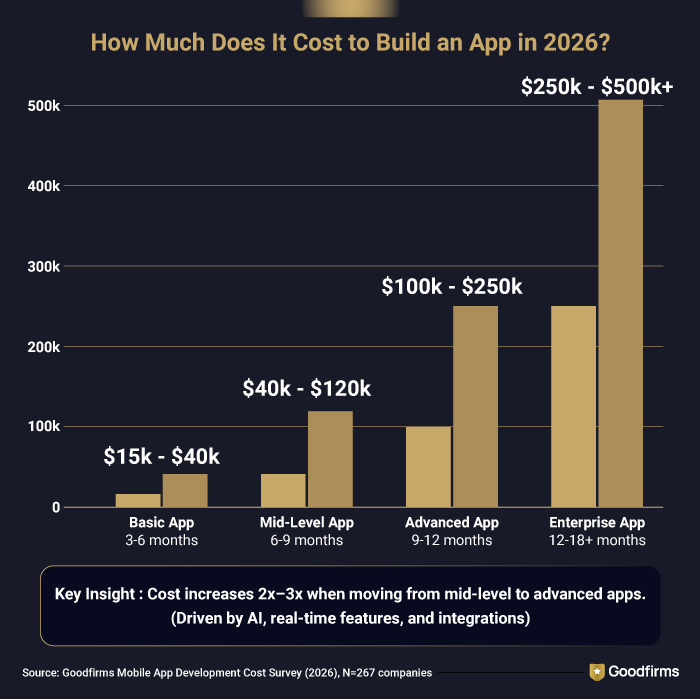
Based on information gathered from our research partners, the table below showcases an app development cost breakdown by complexity.
| Complexity Level | Features | Development Time | Approximate Cost |
| Basic App |
|
3 - 6 Months | $15,000 - $40,000 |
| Mid-Level App |
|
6 - 9 Months | $40,000 - $120,000 |
| Advanced App |
|
9 - 12 Months | $100,000 - $250,000+ |
| Enterprise-Level App |
|
12 - 18+ Months | $250,000-$500,000+ |
Key takeaway: The transition from mid-level to advanced apps results in a 2x–3x increase in cost, primarily driven by AI features, real-time systems, and multi-role architectures.
But here’s the catch: increasing app sophistication often brings unexpected cost revisions beyond the initial quote. Chris Kirksey explains that it’s smart to treat initial cost estimates as flexible rather than final.
 |
The beginning estimate that you receive from the vendor will be updated or changed multiple times before the development process is complete, so before you feel comfortable with the price you were originally quoted, you should plan on an additional 20-30%. - Chris Kirksey (Founder and CEO of Direction.com) |
But getting a fair price is only half the battle — knowing what that price actually buys you is the other half. Dan Haiem warns that the real cost of an app is not the invoice you sign today, but the one you face every time you need to change something tomorrow."
 |
A price tag tells you what an app costs to build. It does not tell you what you are actually buying. The real question behind every estimate is not what it costs today, but what your next year of changes will cost. (Dan Haiem, CEO of AppMakers USA) |
However, every mobile app project goes through several development phases, which consume a definite share of the total budget. Understanding which development phase costs you how much would help you spend smartly.
Cost of Application by Development Phase
Breaking down costs by development phase helps plan budgets more accurately:
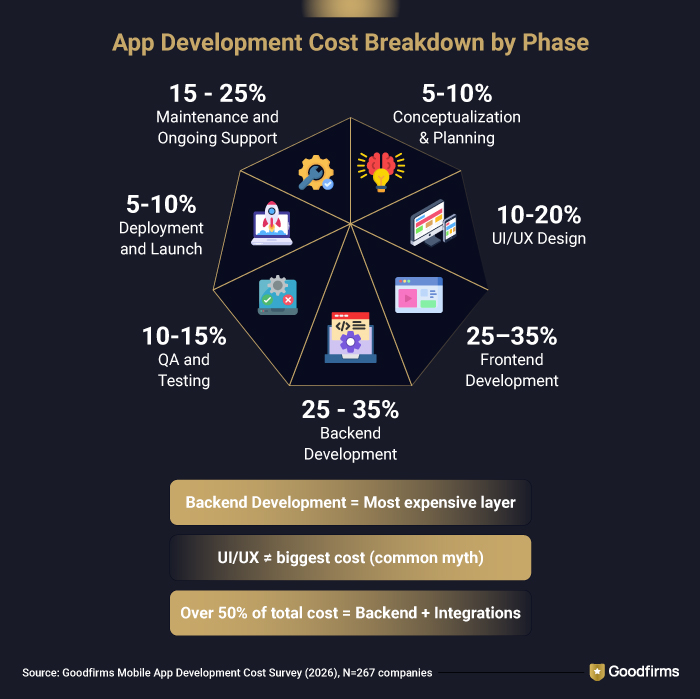
The table below provides details about the tasks included in every phase for better clarity.
| Development Phase | Share of the Total Budget | Approximate Cost |
|
Conceptualization & Planning This development phase covers feature requirements and gathering, preparing flow diagrams and wireframes, making decisions about tech stack, project timelines, and planning milestones. |
5-10% | $2,500 - $25,000 |
|
UI/UX Design Design costs can vary depending on whether you require custom design services from a professional UI/UX designer or use readymade templates for the same job. However, this development phase includes user research, prototyping, creating designs, and testing usability. |
10-20% | $5,000 - $50,000 |
|
Frontend Development The cost of frontend development is based on several factors, such as animation complexity, number of screens required, accessibility standards, and responsiveness. The frontend is what users first interact with, so quality standards are of utmost importance here. |
25-35% | $10,000 - $125,000 |
|
Backend Development Backend development is the stage where the complexity of the app is the biggest factor determining its cost. It includes coding, database management, API integrations, authentications, and more that power your app. |
25-35% | $10,000 - $150,000 |
|
QA and Testing At this development phase, you can fix bugs in the app before launching it. One of the most critical tasks is catching bugs before your users do. |
10-15% | $5,000 - $50,000 |
|
Deployment and Launch This is the stage where your app goes live, and for that, server configuration, app store submissions and setup, CI/CD pipeline setup, SSL certifications, analytics integration, and launch marketing efforts are required. |
5-10% | $5,000 - $25,000 |
|
Maintenance and Ongoing Support The cost of app development doesn’t end post-launch. It requires maintaining and updating the mobile app consistently to ensure that it stays relevant, secure, and up-to-date. This is an annual cost and needs to be considered while planning the budget for your mobile app development project. |
15-25% | $1,500 - $150,000 |
GoodFirms Insight: Contrary to common assumptions, UI/UX design typically consumes less budget than backend development, which becomes the most resource-intensive and expensive phase due to APIs, databases, and system logic.
While backend development may demand a larger share of the budget, experts like Thomas Oldham highlight that success ultimately depends on giving equal attention to every phase—from design and testing to post-launch improvements.
 |
Every development phase is equally important. Good design is an investment, not an expense. You must test your application well before its public release. Rushing to launch with bugs causes bad reviews and users leaving your product. Once the app is live, the work continues. You have to collect real user feedback. That information directs all your future updates and needed fixes, ensuring the app improves over time. - Thomas Oldham (Founder of WebMotion Media) |
The following real-world example can show how cost distribution across different development stages works.
Real-World App Development Cost Example
Example: Cost to Build a Food Delivery App
To understand how development costs work in practice, consider a mid-level food delivery application with features like user login, restaurant listings, online ordering, and real-time delivery tracking.
| Features | Estimated Cost |
| UI/UX Design | $8,000 – $15,000 |
| Frontend development | $20,000 – $40,000 |
| Backend development | $25,000 – $50,000 |
| Payment gateway integration | $5,000 – $10,000 |
| GPS Tracking Integration | $5,000 – $12,000 |
| Testing & QA | $8,000 – $15,000 |
| Estimated Total Cost | $70,000 – $140,000 |
| Development Timeline | 6-8 Months |
Key Finding: Even in mid-level apps, backend and integrations (payments, GPS, APIs) together account for over 50% of total development costs, reinforcing the importance of technical architecture decisions early on.
Now, we will have a detailed look at the price range of mobile app development based on different criteria like app type, platform compatibility, engagement, pricing models, and more.
Mobile App Development Cost Based on Type or Industry
The table below highlights the cost of app development based on its type or industry.
| App Type / Industry | Primary Features | Cost |
| Fintech App Development | Digital wallets, fraud detection, high-end security, analytics & reporting. | $80,000 – $500,000+ |
| eCommerce App Development | Product catalog, shopping card, payment gateway integration, inventory management, order tracking. | $40,000 – $250,000+ |
| On-Demand App Development | GPS tracking, real-time booking, payment integration, service provider dashboards. | $15,000 – $150,000+ |
| OTT App Development | Adaptive streaming, DRM & content protection, multi-device sync, personalized recommendations. | $60,000 – $500,000+ |
| Social Media App Development | User profiles, content sharing, chat/messaging, push notifications, real-time feeds | $50,000 – $300,000+ |
| Healthcare App Development | HIPAA compliance, telemedicine, patient and physicians' dashboard, secure messaging. | $50,000 – $300,000+ |
| Gaming App Development | Animations and graphics, in-app purchases, multiplayer support. | $50,000 – $500,000+ |
| Food Delivery App Development | Online ordering and payments, real-time tracking, restaurant listings. | $40,000 – $200,000+ |
| Travel Booking App Development | Map integration, payment gateway integration, itinerary management, and booking engines. | $50,000 – $250,000+ |
| eLearning App Development | Video tutorials, course management, discussion forums, progress tracking. | $40,000 – $200,000+ |
Key insight: Highly regulated industries like fintech and healthcare command higher development costs—not just due to features, but because of compliance, security, and data protection requirements, which can increase budgets by 30–50%.
Another major mobile app development cost determinant is platform compatibility—whether you build a native app or a cross-platform solution. Native app development means developing an app for iOS, Android, and the web separately, or a cross-platform app that works on multiple platforms and devices.
Native V/S. Cross-Platform App Development: Cost Comparison
The data below highlights how much your app development project would cost based on your platform choices.
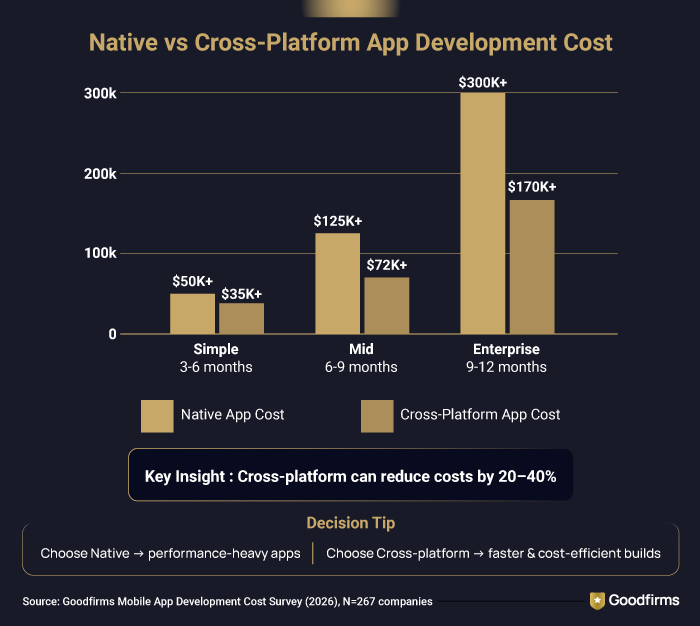
The chart above captures the big picture — native development consistently costs more than cross-platform across all complexity levels, with cross-platform solutions saving anywhere from 20–40%. The table below breaks this down further by specific frameworks, showing exactly where those savings come from — whether you're choosing React Native, Flutter, or the more budget-friendly FlutterFlow for your next build.
| Platform Compatibility Choice | Simple App | Mid-Level to Advanced App | Highly Complex (Enterprise) App |
| Native (iOS App Development) | $25,000 - $60,000 | $60,000 - $150,000 | $150,000 - $350,000 |
| Native (Android App Development) | $28,000 - $70,000 | $65,000 - $150,000 | $160,000 - $380,000 |
| Native (Separate App for iOS and Android) | $50,000 - $120,000 | $120,000 - $300,000 | $300,000 - $700,000+ |
| Cross-Platform (React Native App Development) | $35,000 - $85,000 | $72,000 - $185,000 | $170,000 - $420,000 |
| Cross-Platform (Flutter App Development) | $33,000 - $80,000 | $40,000 - $100,000 | $165,000 - $410,000 |
| Cross-Platform (FlutterFlow - Low-Code Platform) | $15,000 - $45,000 | $40,000 - $100,000 | $90,000 - $220,000 |
Goodfirms Insight: Cross-platform development can reduce initial costs by 20–40%, but native development may offer better long-term ROI for performance-intensive and highly scalable applications.
Hence, the choice between cross-platform and native development directly shapes your overall budget strategy; something industry experts like Denise Vong also emphasize when advising businesses on platform selection.
 |
Platform selection affects the budget severely. Building an app for both iOS and Android at the same time means two separate codebases, except to use cross-platform which has trade-offs of its own. From what I've seen, small businesses are generally better off starting with one platform and adding another after the idea has been proved. - Denise Vong (Founder and Owner of Inland Power Wash) |
The cost of mobile app development is also influenced by the latest technologies like AI, Blockchain, IoT, AR/VR, Metaverse, and more that are being integrated in apps these days for advanced functionalities.
Mobile App Development Cost Based on Latest Technologies
The following table outlines the cost based on the latest technologies
| Technology | Cost | Description |
| AI App Development | $50,000 – $300,000+ | Applied for predictive recommendations, chatbots, analytics, and more. |
| Blockchain App Development | $60,000 – $250,000+ | Used for decentralized architecture, contract development, and high security requirements. |
| AR/VR App Development | $40,000 – $200,000+ | Used for integrating 3D modeling, immersive experiences, real-time rendering in apps. |
| IoT App Development | $40,000 – $200,000+ | Used for real-time data transfer, data management systems, and hardware integration. |
| Metaverse App Development | $100,000 – $400,000+ | Used for creating 3D environments, avatars, and real-time interactions. |
Key insight: The integration of AI and automation is reshaping app development—while AI integration increases initial development costs, it can reduce long-term operational and maintenance costs by up to 40%.
However, the promise of AI-driven efficiency only holds true when applied with strategic intent. As Dmitry Nazarevich highlights, chasing innovation without practicality can quickly lead to costly, overengineered systems that are difficult to sustain.
 |
I’ve seen many cases where a cool project dies simply because stakeholders chased hype and approved an unnecessarily complicated technology stack with no thought as to whether or not that particular technology was practical or viable for a solution. Tech leads sometimes shove rare frameworks into a simple app, and the whole setup quickly turns into a total tech zoo. Finding specialists to untangle this Frankenstein monster later is next to impossible and extremely expensive. - Dmitry Nazarevich (CTO at Innowise). |
Besides all the factors discussed above that are influencing the cost of mobile app development, the engagement model you choose also has a significant impact on your app development project. Whether you are planning to outsource your app development project to a professional company or hire a freelancer, it can be a major price-determinant for your project cost.
Outsourcing V/S. Hiring: Engagement Models Impacting App Development Costs
The table below shows the mobile app development cost comparison based on your engagement model choices.
| Cost Variables | Outsourcing | Hiring |
| Average Hourly Rate | $75-$250 | $25-$150 |
| Basic Mobile App (Fixed Cost) | $30,000 – $75,000 | $5,000 – $30,000 |
| Mid-Level Mobile App (Fixed Cost) | $75,000 – $150,000 | $20,000 – $50,000 |
| Advanced Mobile App (Fixed Cost) | $150,000 – $400,000+ | $50,000 – $150,000+ |
| Enterprise-Level Mobile App (Fixed Cost) | $300,000 – $500,000+ | $100,000 – $200,000+ |
Key Finding: Businesses opting for agencies spend more upfront, but experience fewer post-launch issues and lower long-term maintenance costs vis-a-vis freelancer-led projects.
When to Outsource a Project to a Professional App Development Company?
- You need a one-stop solution for all your mobile app project needs, which means a full team of developers, designers, QA, and project managers.
- You need quality assurance costs included in the project cost.
- You need a systematic approach towards maintenance and updates of your app post-launch.
Best for - Scalable mid-level, advanced, and enterprise-grade applications with complex features.
When to Hire a Freelancer Mobile App Developer?
- You are a startup with a limited budget and want to develop a basic app or an MVP.
- You have enough time to handle project management tasks.
- You are ready to hire a designer and a QA separately.
- You have limited maintenance requirements.
Best for - Basic apps or MVPs with limited features and functionality.
So, now you know how the engagement model works when it comes to determining the cost of a mobile app development project. Besides that, the app development cost would also depend on the pricing model you prefer. Would you like to pay a fixed cost for your mobile app project or go for an hourly pricing model?
Fixed V/S.Hourly Cost: Pricing Models Impacting App Development Cost
Let’s first understand the difference between fixed and hourly pricing models, and then know how it impacts your app development cost.
What is a Fixed Pricing Model?
In a fixed pricing model, a mobile app development company quotes a specific price for an app development project based on the hours required to complete the project. This pricing model is best suited for small and medium-sized projects where you are specifically clear about the features of the app, tech stack to be used, and platforms you want your app to be compatible with.
This is exactly why many business leaders, including Don Poh, prefer fixed pricing—it brings predictability and ensures both scope and budget stay firmly on track from day one.
 |
Fixed pricing guarantees that the budget is safe. Personally, I like paying a flat rate for a specification document. That document is a contract which binds the developer to stick to agreed scope and timeline. - Don Poh (Group CEO at Lorna Whiston Schools) |
We have already discussed fixed app development costs based on several factors like app type & complexity, platform compatibility, and engagement models. Now, let’s have a look at what an hourly pricing model is, and how much app development would cost if you go with this pricing model.
What is the Hourly Pricing Model?
In the hourly pricing model, mobile app developers charge for the hours they work on your project. This hourly cost is based on several factors, such as developers’ experience level, geographical location, and more. Let’s have a look at how much a mobile app development project costs if you follow an hourly pricing model based on their experience level.
Mobile App Developer Hourly Cost: Experience, Platform Specialization, Geographical Location (Per Hour, In USD)
The comparison table below illustrates hourly cost based on experience, platform specialization, and geography.
| Country | Experience Level | iOS Developer (Swift) | Android Developer (Kotlin/Java) | Cross-Platform Developer (Flutter/React Native) | Hybrid (Ionic/Xamarin) |
| U.S. | Junior |
$50 – $80 |
$45 – $75 |
$40 – $70 |
$35 – $60 |
|
Mid-Level |
$80 – $130 |
$75 – $120 |
$70 – $110 |
$60 – $95 |
|
|
Senior |
$130 – $200+ |
$120 – $190+ |
$110 – $170+ |
$100 – $150+ |
|
| Canada |
Junior |
$45 – $70 |
$40 – $65 |
$35 – $60 |
$30 – $55 |
|
Mid-Level |
$70 – $120 |
$65 – $110 |
$60 – $100 |
$55 – $90 |
|
|
Senior |
$120 – $180+ |
$110 – $170+ |
$100 – $150+ |
$90 – $140+ |
|
| UK |
Junior |
$45 – $70 |
$40 – $65 |
$35 – $60 |
$30 – $50 |
|
Mid-Level |
$70 – $110 |
$65 – $105 |
$60 – $95 |
$55 – $85 |
|
|
Senior |
$110 – $170+ |
$100 – $160+ |
$90 – $140+ |
$80 – $130+ |
|
| Germany |
Junior |
$40 – $65 |
$35 – $60 |
$30 – $55 |
$30 – $50 |
|
Mid-Level |
$65 – $105 |
$60 – $100 |
$55 – $90 |
$50 – $80 |
|
|
Senior |
$100 – $160+ |
$95 – $150+ |
$85 – $130+ |
$75 – $120+ |
|
| Poland |
Junior |
$25 – $40 |
$20 – $35 |
$20 – $30 |
$18 – $28 |
|
Mid-Level |
$40 – $70 |
$35 – $60 |
$30 – $55 |
$28 – $45 |
|
|
Senior |
$70 – $100 |
$60 – $90 |
$55 – $80 |
$45 – $70 |
|
| Ukraine |
Junior |
$20 – $35 |
$18 – $30 |
$18 – $28 |
$15 – $25 |
|
Mid-Level |
$35 – $60 |
$30 – $55 |
$28 – $50 |
$25 – $40 |
|
|
Senior |
$60 – $90 |
$55 – $80 |
$50 – $70 |
$40 – $60 |
|
| Brazil |
Junior |
$20 – $30 |
$18 – $28 |
$18 – $25 |
$15 – $22 |
|
Mid-Level |
$30 – $55 |
$28 – $50 |
$25 – $45 |
$22 – $40 |
|
|
Senior |
$55 – $80 |
$50 – $75 |
$45 – $65 |
$40 – $60 |
|
| India |
Junior |
$10 – $20 |
$8 – $18 |
$10 – $18 |
$8 – $15 |
|
Mid-Level |
$20 – $40 |
$18 – $35 |
$18 – $30 |
$15 – $25 |
|
|
Senior |
$40 – $70 |
$35 – $60 |
$30 – $55 |
$25 – $45 |
|
| Philippines |
Junior |
$12 – $20 |
$10 – $18 |
$10 – $16 |
$8 – $15 |
|
Mid-Level |
$20 – $35 |
$18 – $30 |
$16 – $28 |
$15 – $25 |
|
|
Senior |
$35 – $60 |
$30 – $55 |
$28 – $45 |
$25 – $40 |
This table clearly shows that hiring mobile app developers in India can prove to be more cost-effective than hiring mobile app developers in the U.S., Canada, the UK, or Germany. So, instead of hiring a junior app developer from Germany, you can hire a senior app developer from Ukraine, Brazil, India, or Phiippines to get quality results at low prices.
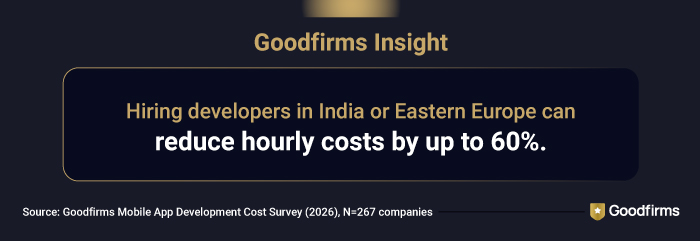
This cost advantage isn’t just theoretical—real-world examples, like the experience shared by Rafael Sarim Oezdemir, clearly show how outsourcing to regions like Eastern Europe can significantly cut expenses while still delivering high performance and reliability.
 |
For the backend development of the EZContacts mobile app, we partnered with a company based in Ukraine. This helped us reduce the development cost by 40% (from $150 per hour to $60 per hour). The result was an uptick in the app's reliability with an uptime of 99.9%. - Rafael Sarim Oezdemir (Head of Growth at EZContacts) |
On the other hand, you also need to consider mobile app developers’ skills. Developers with lacking skills and low hourly charges can prove to be expensive for you in the future. This is what the vice president of Doc Academic - Belize Hans Polloso said about how integral it is to hire skilled developers.
 |
I would always choose to work with more skilled developers even if their hourly rates are higher. Their efficiency and expertise save money over time by avoiding bugs and rewrites - Belize Hans Polloso (Vice President of Dog Academic). |
After going through fixed and hourly pricing models, the question that might be coming into your mind is which option would be better for you? Hourly pricing model or a fixed pricing model?
To know the answer to this question, first, let’s know how to calculate the total cost of a mobile app development project based on an hourly rate.
How to Calculate the Total Cost of a Mobile App Development Project Based on an Hourly Pricing Model?
Assuming that your project requires hiring a mobile app developer at $22/hour, a designer at $15/hour, a QA engineer at $12/hour, and a project manager at $40/hour, below would be the tentative cost of your app development project.
| Professional Hired | Hourly Cost | Number of Hours | Cost (Hourly Cost X Number of Hours) |
| Mobile App Developer |
$22 |
380 |
$8,360 |
| UI/UX Designer |
$15 |
150 |
$2,250 |
| QA Engineer |
$12 |
90 |
$1,080 |
| Project Manager |
$40 |
40 |
$1,600 |
| Total Cost | $13,290 | ||
This calculation is based on assumptions. However, you can calculate the exact cost after consulting mobile app development companies and asking for their hourly rates and the number of hours their professionals would work for your project specifically.
Also, you can ask several mobile app development companies to quote a fixed price for the same project and compare with your hourly cost calculation to know which pricing model would suit you the best.
In fact, comparing pricing models upfront can give you better control over costs and quality. Professionals like Ron Harper strongly advocate through structured fixed-price agreements and milestone-based payments.
 |
I never agree to hourly rates because I insist on a fixed-price contract with strict milestone payments. Quality often suffers when developers cut corners to meet a fixed price. My contracts feature a ten percent holdback fee that I only release after a thirty-day testing period. That strategy saved my firm approximately $15,000 on a recent client portal project - Ron Harper (Licensed Paralegal/Owner of OTD Ticket) |
From all the above pricing details, one thing is clear: several factors will impact the cost of your app development project. Let’s have a quick recap of the factors influencing the cost of mobile app development.
Factors Influencing the App Development Cost: A Quick Recap
-
App Complexity - Basic, Mid-Level, Advanced, Enterprise-Level
-
UI/UX Design - Readymade Template, Customization
-
Type of Application - eCommerce, Healthcare, Fintech / Banking, Social Media, etc.
-
App Security - Standard, High-end
-
Platform Selection - Native or Cross-Platform
-
Mobile App Development Company’s Geographic Location - U.S. UK, Germany, India, Philippines, etc.
-
Mobile App Developer’s Skills - Swift, React Native, Flutter, Xamarin, etc.
-
Mobile App Developer’s Experience Level - Junior, Mid-level, Experienced
-
Integrations Required - APIs, Payment Gateway, GPS, Social Media, Messaging, etc.
These factors drive most of that difference. Platform choice is the first big one because building separately for iOS and Android doubles your development hours. On top of that, feature count and developer location push the number further than most people plan for.
But beyond these upfront cost drivers, experts like Welly Mulia point out that the real financial impact often unfolds after launch, with ongoing maintenance and operational expenses adding significantly to the total cost of ownership.
 |
The part nobody warns you about is ongoing costs. Maintenance, bug fixes and server costs alone add 20% to 30% on top of your original build every year. Most teams budget for the build and completely forget what comes after - Welly Mulia (Founder and Software & Creator Advocate at CartMango) |
After considering all the factors that influence your mobile app development costs, there is a possibility of hidden costs arising that can disrupt your budget. Knowing these hidden costs is essential to planning the budget without getting last-minute expensive surprises.
Hidden Costs That Can Disrupt Your Mobile App Development Cost Budget
Below are some hidden costs that you need to consider while planning your budget for your app development project.
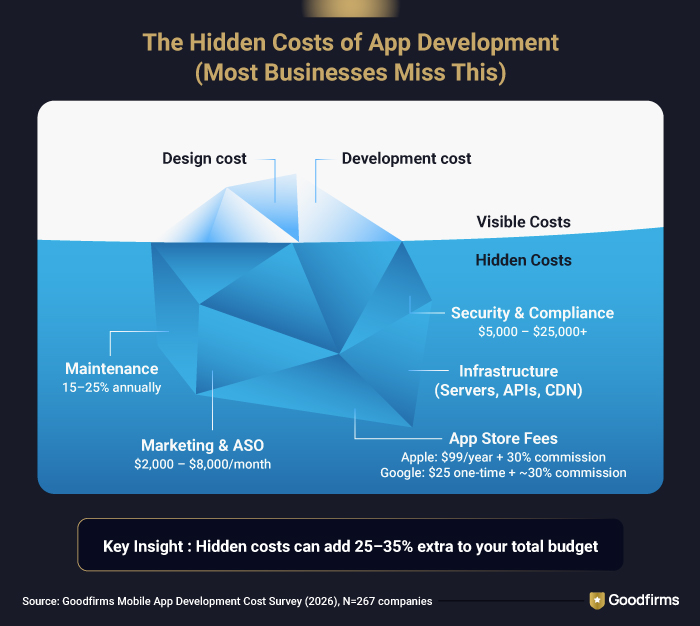
Let's have a detailed look at these hidden costs that you should not miss while planning your budget for mobile app development project.
App Infrastructure: Servers, Databases, Content Delivery Networks
Your app needs to have an infrastructure that includes servers, databases, and content delivery networks (CDNs). As the number of app users grows, the escalation of these services is also required. There are pay-as-you-go cloud services like AWS available that offer flexibility to pay for only the services that are used. Still, every data query and transaction is billed separately, which can add up to your mobile app development costs.
App Store Registration and Transaction Fees
App development is of no use if it is not globally available on the Apple App Store and Google Play Store. These app stores charge submission and transaction fees. Apple App Store requires a $99 annual developer membership and around 30% fee for every transaction done if your app is subscription-based or allows in-app purchases. Similarly, Google Play Store charges $25 as registration fee and around 30% of transaction fees.
Security Audits and Legal Compliance
To keep user data and intellectual property safe, it becomes mandatory for businesses to get a detailed privacy policy and terms and conditions drafted by a professional company. These services are mandatory to ensure compliance with regulations like HIPAA (in case of healthcare), GDPR, CCPA, and more. This can add up to around $5,000 to $25,000+, depending on your industry type and app complexity.
Digital Marketing and Promotion
Even an extremely useful app becomes useless if it is not downloaded by users. For that purpose, effective digital marketing and promotion services like App Store Optimization (ASO) and paid advertising are required. An ASO agency can charge around $2,000 to $8,000 per month and $2 to $5 per app download for their digital marketing and promotion services.
That’s exactly why industry experts like Sean Markey stress that marketing isn’t optional—it’s a critical investment that can rival your development costs in driving real app growth and visibility.
 |
I tell all our clients to set aside a real budget for marketing and promotion. A strong app that nobody knows about brings no earnings. You should expect to spend as much on marketing as you spent on the creation - Sean Markey (Founder at LocalSEO.net) |
Hence, it is always advisable to add 25-35% extra to your mobile app development budget to overcome the challenges arising from hidden costs and avoid cost overruns.
Also, to spend wisely is the key to maximizing ROI for your business. Therefore, knowing the cost-saving tips becomes integral to saving money without compromising the quality of the app.
App Development Cost Optimization Tips
Below are some mobile app development cost-saving tips to be considered to keep costs under control and gain profitable outcomes.
Define Scope Clearly
When feature requirements and technical specifications are not clearly defined, it can result in bugs and rework in the app in the end. Defining the scope of the mobile app clearly can help you save 30-40% on the total cost of mobile app development.
This is more than just a best practice. Here is a real-world experience, shared by Seun Osho, shows how unclear scope can quickly lead to costly delays, rework, and budget overruns.
 |
At one point, our fleet tracker went down while we were operational in live sessions, and our dashboard was no longer updated. The team spent 28 days hunting bugs in various systems as costs continued to rise. The finished build cost more than $120,000 - some 50 percent over budget because the scope was not clear. -Seun Osho (CEO and Founder of Unyield). |
Start with Building an MVP
Before you plan to build an advanced mobile app with many features, start with an MVP (Minimal Viable Product). This will help you get an idea about how your target audience responds to your app, and then you can scale when you get positive feedback.
This MVP-first approach isn’t just strategic in theory—it delivers real results, as demonstrated by Oleg Petryshyn, who highlights how starting lean can significantly cut costs while accelerating time to market.
 |
In one of our recent logistics MVP projects we saved ~40% on development by going with Flutter and skipping custom backend for the first version — the app launched in 3.5 months and brought first paying users within weeks. - Oleg Petryshyn (CTO at Lionwood.software) |
Choose the Right Mobile App Developer
Cheap may turn out to be quite expensive in the future. So, choose your mobile app development company wisely. Go through all the services the app development companies offer and choose the one that balances cost with quality.
This is exactly why experts like Eugene Leow emphasize choosing experience over low cost, as the right team can prevent expensive mistakes and ensure long-term value.
 |
Choose a team with a clear history of success. A cheaper less experienced team often makes errors that cost more to fix later. A proven team builds it right the first time. - Eugene Leow (Director at Marketing Agency Singapore) |
Go for Cross-Platform App Development
Getting a mobile app built separately for iOS and Android can be expensive. Cross-platform app development enables you to launch an app that is compatible with multiple platforms. This makes it easier to maximize your target audience reach at a low cost.
That’s where cross-platform development proves its value—something professionals like Ruth Jennifer Cruz highlight when discussing faster and more cost-effective app launches.
 |
Cross-platform tools help save hours and money because you build for two operating systems with one codebase. - Ruth Jennifer Cruz (Founder of Wolf King USA) |
Use Artificial Intelligence
AI in app development automates coding, testing, design, and maintenance, enabling many businesses to save their costs by 20-40% and at the same time improve quality and speed. Make sure that the mobile app developer you hire makes optimal use of AI to help you gain cost-effective results.
This isn’t just a trend—industry leaders such as Jason Hennessey show how AI can streamline development while maintaining high quality.
 |
We use AI driven testing and automation to reduce manual effort across development cycles. This allows us to maintain high quality standards without increasing team size or timelines. The result is a leaner build process that delivers strong output without unnecessary cost expansion. - Jason Hennessey (CEO of Hennessey Digital) |
Rely on Data and Not Assumptions
Research rigorously and find out which technical specifications and features in an app would best work for your app, depending on your industry type. Analyze competitors’ data and target audiences’ feedback on an initial basis only to build an app that turns out to be lucrative.
This is where data-driven decision-making becomes critical, as emphasized by Marc Bishop, who advocates prioritizing features based on real user behavior.
 |
We approach app cost control by aligning product scope with actual user behavior rather than assumptions. Many teams overspend on features that users rarely engage with after launch. We analyze real usage patterns from similar products and prioritize only high impact functionalities. - Marc Bishop (Director of Business Growth at Wytlabs). |
Now, when you know everything about how much a mobile app can cost, and relevant cost-saving tips, it's time for you to explore some leading players in this industry that can help you build your business app at the most cost-effective price in the market.
Goodfirms Insight: Companies that adopt an MVP-first approach combined with iterative scaling consistently achieve faster time-to-market and up to 40% cost savings.
Leading Players in App Development
Below are some leading app development firms that you might consider partnering with for your project.
| Featured App Partners | ||
| Utility |
Award-winning mobile app development company driven by strategy, design and technology. |
|
| SDLC Corp |
Empower your business with SDLC Corp’s end-to-end mobile app development services. |
|
| AppMakers USA |
Turn Your Vision Into a Market-Leading Product. |
|
| instinctools |
Technology solutions for scalable growth. |
|
| Closeloop Technologies |
Agentic AI-Driven Software Solutions. |
|
| OpenXcell |
Custom Mobile App Development Services for Scalable Growth. |
|
| Goji Labs |
A Digital Product Agency That Builds it Right. |
|
| Plavno |
Efficient Custom Mobile App Solutions by Experts. |
|
| Tallium Inc. |
Digitize your business processes or launch new products for web and mobile platforms. |
|
| GeekyAnts |
Product development studio with an AI-driven customer-centric approach. |
|
Conclusion: Ready to Discover Your App Development Cost?
In 2026, app development is no longer a one-time cost. Contrarily, it’s a continual investment shaped by scalability, integrations, and continuous optimization.
Businesses that prioritize clear scope, phased development, and scalable architecture will achieve better ROI than those that overinvest in features early on.
Whether building an MVP or an enterprise-grade application, success lies in aligning budget, technology choices, and long-term business goals right from the start.
- Ocotsglobal
- Cosmicostudios
- Appnexustech
- Clawstudios
- Ebizneeds
- Appinventiv
- Sandstream
- Soltech
- Iterative
- Bigdig
- Emorphis
- Digi-corp
- Mariusiordache
- Divami
- Moscreative
- Qualisage
- Kalgisoft
- Semaphoremobile
- Zaagsys
- Webbingstone
- Rossul
- Plexusstack
- Ideators
- Sosene
- Saaspartners
- Aoxapps
- Creationsquare
- Invezzatechnologies.com
- 2muchcoffee
- 3rd Digital
- Aalpha
- AddWeb Solution
- Adrobit Technologies
- Adz Globe Media
- Aims Technologies
- Akshar Concept
- AllianceTek
- Alphawizz Technologies Pvt Ltd
- AMgrade
- Appcods Innovation
- Appcrates
- Appello Software
- Appenza Studio
- Appiskey Inc.
- AppsChopper
- ArcTouch
- ArStudioz
- asap developers
- Aspire Software Solutions
- Astrolab
- BDIT Engineering DOO
- Belatrix Software
- Blue Shark Software Solutions
- Bluecast Technologies
- Bvblogic
- Cauri Softech Pvt. Ltd
- Cenit, Inc
- Chapter247 Infotech
- Cloudedots
- Clover Studio
- CodeCoda
- Coineption Technology
- ConsultingWhiz
- Cyber Infrastructure Inc.
- daddy cool technologies
- datarockets
- DevCom
- Diffco
- Digiadlab
- Digifutura Technologies
- Dropp Technologies Group
- Dynamic Online Technologies
- e-Legion
- Ebiz Media Solution
- echoinnovateit
- Ecreations
- Einfinite Solutions
- Ekahal
- EncureIT
- Ethernity
- Evalogical
- ExpertsFromIndia
- EXTERTEST
- Fingent
- Foonkie Monkey
- Gadgeon
- Ganesha Webtech Solutionz
- Gleecus TechLabs
- Globtier Infotech Inc
- Golpik Inc
- Gusify
- Hiteshi
- IeDigitals
- Internut
- IOTTIVE OPC PVT LTD
- iPath Solutions
- Iron Forge Development
- iTreeni
- jCor
- Jiratech
- Kadam Technologies Pvt. Ltd.
- KitRUM
- KNS Technologies
- Labrys
- Lava X
- LI Labs
- Lilac Infotech Pvt. Ltd.
- LinxHQ Pte Ltd
- Login2Tech
- Mantthan
- Max Vision Solutions
- Microkodes Information & Technologies Ltd
- Mifort
- Mindinventory
- Mob Inspire
- Mobcoder
- Mobikasa Inc,
- Mobile App Hero
- Moqod
- MOS Creative, Inc
- Narsun Studio
- NCrypted Technologies
- Neetable
- Netqom
- Neurony
- Nextly
- Nextsavy Technologies
- Nodesk
- Oracast
- Parikram IT Solutions Pvt Ltd
- Powercode
- Prime Holding JSC
- Rackron Technologies Pvt. Ltd
- RapidWebs IT Solutions
- Red C
- Rocoders
- Scalio
- ShivShakti Web Solutions & Services
- Smart IT
- Smart Minds World
- SmartTech
- Sneakers Agency
- Softpulse Infotech
- Softuvo Solutions Private Limited
- SoluteLabs
- SolveIt
- Split An Atom
- Srishta Technology Pvt. Ltd
- Star Knowledge
- Start Mobile
- STX Next
- Sunvera Software
- Synergy Way
- Sytepoint, Inc.
- TAGsoft
- Team Tweaks
- Tech pathway
- TechFlex Development
- TechNeed
- Techno Impact
- TechUnido
- Teclogiq
- TERRAFORM
- TGSane Technologies
- The Distance
- ThinkStart Private Limited
- Totalsoftware Latinoamerica
- TowerHouseStudio
- TTT Studios
- Ubicoapps Technologies
- UkrInSofT
- UPLOGIC TECHNOLOGIES
- Vipra Business
- Virtual Spirit Technology Sdn Bhd
- Volare Systems
- WASKO Software
- Weapplinse Technology
- Web Design Sun
- Webfusion Solutions Pvt. Ltd.
- WTT Solutions
- WYS Enterprise Solutions LTD
- XcelTec Interactive Private Limited
- Xcentric Services
- Xenber Sdn Bhd
- Xonest Technologies Private Limited
- Yaali Bizappln Solutions
- Yanpix
- Yashco Systems
- Yield Interactive
- Yugasa
- ZealousWeb Technologies Pvt. Ltd
- Zeeweesoft LLP
- Zeppelin Labs
- Zfort Group