Key takeaways
- Most SEO companies charge between $1,500 and $5,000 per month. Enterprise and regulated industries (legal, healthcare, finance, SaaS) frequently pay $5,000+/month.
- Most agencies raised prices in 2025–2026. The #1 reason could be adding AI optimization services (GEO/AEO), which are charged separately at an average of over $900/month.
- Under $1,500/month only makes sense for local businesses with limited competition. For competitive national or vertical markets, it's a red flag.
- Legal, healthcare, finance, SaaS, and ecommerce pay the most for SEO optimization.
At a Glance: 2026 SEO Pricing Benchmarks
Based on 300+ SEO agency responses collected globally in April–May 2026, here's what businesses actually pay, which pricing models dominate, and which industries spend the most.
|
Key Metric |
2026 Benchmark |
|---|---|
|
Typical Monthly Retainer |
$1,500–$5,000/month |
|
Local Business SEO |
$500–$1,500/month |
|
Enterprise SEO |
$5,000–$15,000+/month |
|
GEO/AEO Add-On |
~$900+/month |
|
Senior SEO Consultant |
$100–$200/hr |
|
Most Popular Pricing Model |
Monthly Retainer (78.2%) |
|
Fastest Growing Pricing Model |
Hybrid Retainer + Milestones |
|
Highest-Spending Industries |
Legal, Healthcare, Finance, SaaS |
To put these numbers in context, watch the video below for a quick breakdown of how SEO pricing actually plays out for businesses in 2026:
1. How Much Does SEO Cost Per Month in 2026?
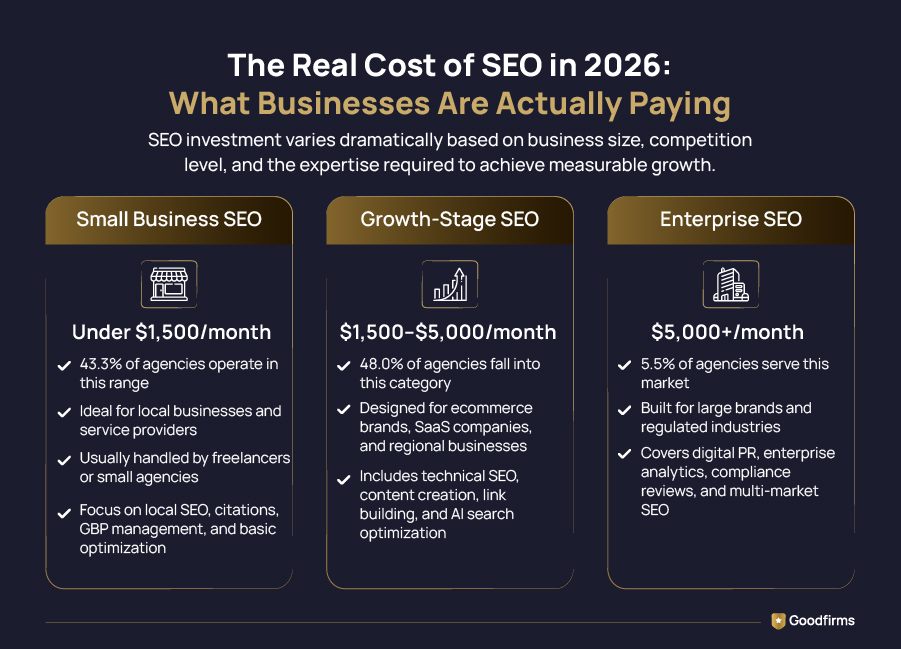
Based on 300+ agency responses collected globally in April–May 2026, the most common tier sits between $1,500 and $5,000 per month, where 48% of agencies operate. Another 43.3% charge under $1,500 per month, primarily serving local businesses, while only 5.5% charge more than $5,000 per month.
The full range runs wider — from under $500/month for basic local work to $15,000+/month for enterprise campaigns in regulated industries — because scope varies this much across business types.
|
Monthly Retainer Range |
Share of Agencies |
Business Size |
SEO Agencies Types |
What's Included |
|---|---|---|---|---|
|
Under $1,500 |
43.3% |
Small Business (Local businesses, trades, and small clinics) |
Freelancers, offshore, micro-agencies |
On-page basics, GBP management, local citations, simple reporting |
|
$1,500–$5,000 |
48.0% |
Growing Businesses(Regional companies, SaaS startups, and ecommerce |
Boutique agencies, growth consultancies |
Technical SEO, content, link building, AI search optimization, strategy oversight |
|
$5,000+ |
5.5% |
Enterprise Organizations (Large brands, YMYL sectors, and multinationals) |
Enterprise firms, specialized consultancies |
AI visibility infrastructure, digital PR, compliance review, enterprise analytics, multi-market ops |
The biggest factor pushing retainers upward is AI search optimization. Among the 54.3% of agencies that raised prices in 2025–2026, 37% cited GEO and AEO services — optimizing for visibility inside ChatGPT, Perplexity, and Google AI Overviews — as the primary reason, often charged separately at $900 or more per month.
While there isn't a universal SEO services price list, these survey benchmarks provide a realistic reference for evaluating whether an agency's proposed SEO price is competitive for your market and business size.
.jpg)
"Today, a large part of agency conversations revolves around justifying why quality work still costs what it does, despite AI being available. The challenge is not AI itself, but the perception that AI removes the need for expertise."
Looking for vetted SEO agencies to compare? Browse Goodfirms' directory of top SEO companies, filtered by industry, size, and location.
Local SEO Pricing vs. National SEO Pricing
For local businesses competing within a defined geographic area, a single city or region, the $500–$1,500/month bracket remains viable. Services at this level typically include Google Business Profile management, local citation building, basic on-page optimization, and simple rank tracking.
National campaigns targeting competitive keywords across broad geographic or demographic segments require significantly more resources: content production, technical depth, link acquisition, and increasingly, AI search optimization. Budgets under $1,500/month for national campaigns should be a red flag.
Here is how pricing breaks down across the three main tiers, and what each one actually delivers.
Under $1,500 per Month
This bracket primarily serves local businesses, trades, clinics, restaurants, and companies operating within limited geographic markets.
Typical services include:
- Local SEO
- Google Business Profile management
- Citation building
- Basic on-page optimization
- Monthly reporting
- Limited technical maintenance
For businesses facing minimal competition, this level of investment can produce strong results.
However, organizations competing nationally or in highly competitive industries often find that the available hours and resources within this budget are insufficient.
$1,500–$5,000 per Month
This represents the core of the professional SEO market.
Businesses in this range typically receive:
- Technical SEO management
- Content strategy
- Content production
- Link acquisition
- Competitor analysis
- Advanced reporting
- AI search optimization initiatives
Most growth-stage companies, ecommerce brands, regional organizations, and SaaS businesses operate within this bracket.
$5,000+ Per Month
Enterprise SEO programs frequently exceed $5,000 per month and may reach $15,000 or more depending on scope.
These engagements often include:
- Multi-market SEO
- Enterprise analytics
- Digital PR
- Compliance review
- Advanced technical architecture
- Large-scale content operations
- AI visibility infrastructure
Legal, healthcare, finance, SaaS, and enterprise ecommerce brands are the most common buyers at this level.

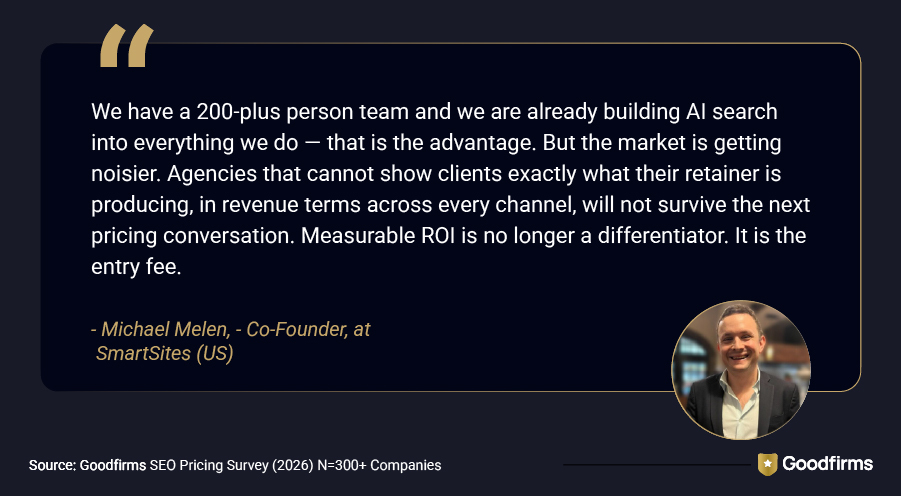
"Industries like healthcare, legal, real estate, SaaS, and ecommerce usually have the highest SEO retainers. Since results directly impact business growth, companies in these industries are more willing to invest in long-term SEO".
What Often Gets Charged Separately - Ask About These Before Signing
AI/GEO optimization now averages $900+/month as a standalone add-on — climbing to $2,500/month at the enterprise tier — and it's just one of six line items agencies commonly bill separately from the base retainer.
|
Add-On Service |
Typical Extra Cost |
What to Ask |
|---|---|---|
|
Link building |
$500–$3,000+/month |
How many links/month? What domain authority range? How are placements sourced? |
|
Content creation |
$100–$500+ per piece |
How many pieces/month? Who writes it? Is there an editorial review? |
|
AI/GEO optimization |
$900+ |
What's included? Which platforms? How is it measured? It could cost $2,500/month avg. for the enterprise tier. |
|
Local SEO / GBP management |
$200–$800/month |
Clarify upfront for multi-location businesses. |
|
Technical audits (full) |
$1,500–$5,000 project fee |
Is there a quarterly audit included in the retainer? |
|
Digital PR / link acquisition through media |
$2,000–$8,000+/month |
Is this included or a separate service line? |

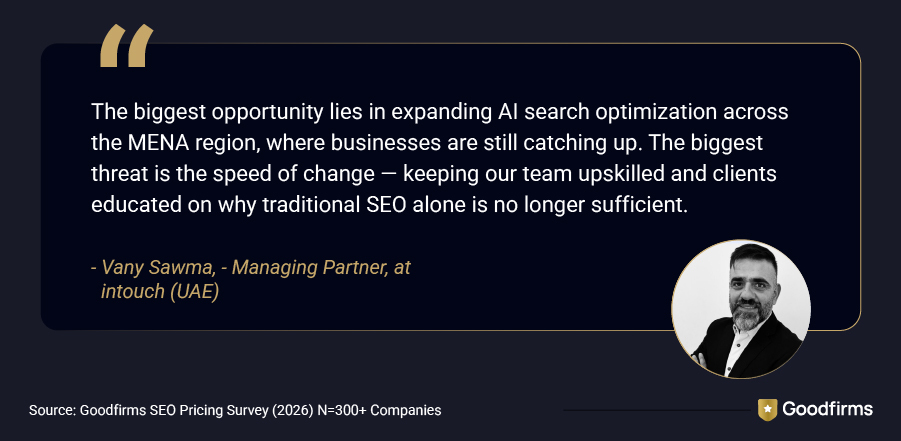
"The greatest threat is that we are not just looking to rank in the top 3 Google searches anymore; we now need to be seen and chosen by AI. This adds another level of work and responsibility to our clients."
2. SEO Pricing by Geography: Global Rate Differences Explained
Across the 35 countries represented in this survey, the gap is stark: North American agencies average $2,500–$10,000+/month versus $500–$2,000+/month in South Asia. That difference largely reflects labor costs, not expertise gaps.
Regional Hourly Rates Breakdown
Regional labor costs, competition, and market maturity explain why SEO company prices can vary significantly even when agencies offer similar services.
|
Region |
Typical Monthly Retainer |
Key Context |
|---|---|---|
|
North America (US, Canada) |
$2,500–$10,000+/month |
Higher labor costs; strong enterprise and YMYL demand. |
|
Western Europe (UK, Germany) |
$2,000–$8,000+/month |
Comparable expertise; slightly lower than US rates. |
|
Eastern Europe (Ukraine, Poland, Romania) |
$600–$7,000+/month |
Strong technical talent; growing strategic sophistication. |
|
South Asia (India, Bangladesh) |
$500–$2,000+/month |
Largest technical talent pool; quality varies significantly. |
|
Southeast Asia (Vietnam, Philippines, Singapore) |
$500–$2,000+/month |
Growing market; Singapore closer to Western rates. |
3. SEO Pricing Models: Which Structure Is Right for Your Business?
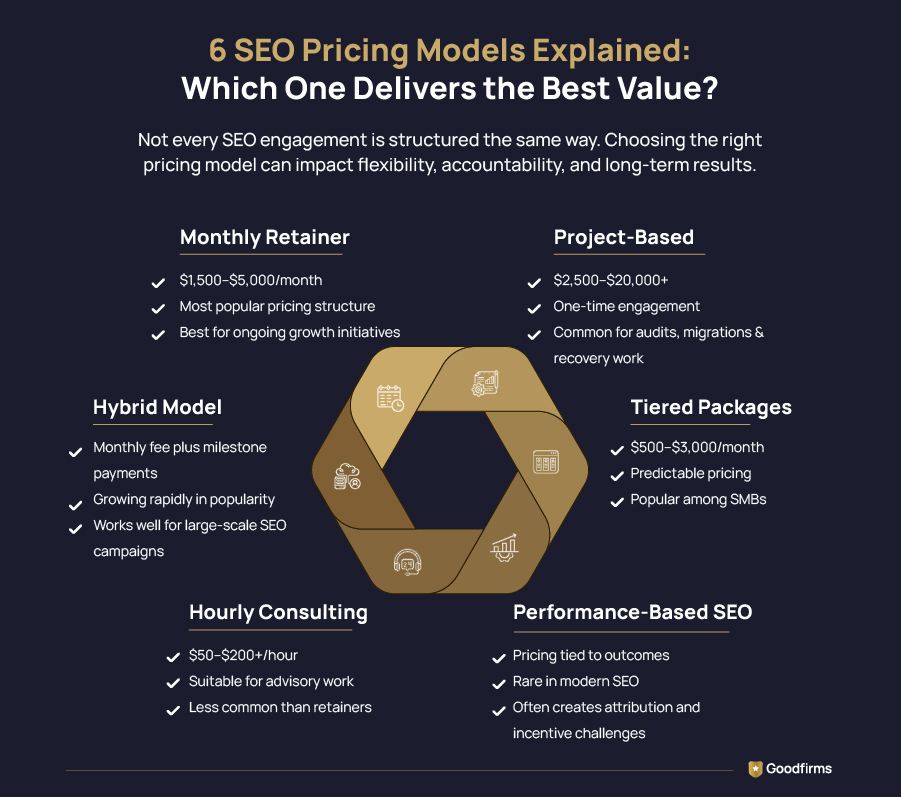
60.6% of agencies in this survey use monthly retainers as their primary pricing model, with project-based work a distant second at 16% — but the fastest-growing structure is a hybrid of the two, at 13.4% of respondents.
Comparing these models instead of choosing the cheapest quote helps you estimate the true long-term value of SEO investment. (For pricing across other marketing channels, see our Digital marketing pricing guide.)
|
Model |
Typical Price Range |
2026 Trend |
Best For |
|---|---|---|---|
|
Monthly Retainer |
$1,500–5,000 per month |
Dominant growing (61% of SEOs) |
Ongoing SEO partnerships; compounding results |
|
Project-Based |
$2,500–$20,000+ one-time |
Stable (16%) |
Site audits, migrations, penalty recovery |
|
Hybrid Retainer + Milestones |
$1,500–$5,000/month base + milestone fees |
Rapidly growing (13.4%) |
Ongoing SEO + large content campaigns or migrations |
|
Tiered / Fixed Packages |
$500–$3,000/month depending on tier |
Stable |
SMBs want a predictable scope |
|
Hourly |
$50–$200+/hr |
Declining (5.5%) |
One-off audits, consulting, advisory sessions |
|
Performance-Based |
Varies, tied to rankings/traffic milestones |
Rare and risky |
Avoid: misaligned incentives and attribution problems |
Why Monthly Retainers Dominate
60.6% of agencies in this survey use monthly retainers as their primary pricing model. The reason is structural: SEO compounds. Technical work completed in month two makes the content from month five rank faster. Links built in Q1 strengthen topical authority, driving AI citation inclusion by Q4. Monthly retainers create sustained engagement that enables compounding.
The Rise of Hybrid Pricing
13.4% of agencies now use a hybrid retainer-plus-milestone model — the fastest-growing pricing structure in this survey — pairing a stable monthly base for ongoing operations with milestone fees for major deliverables like site migrations, digital PR activations, and AI visibility infrastructure projects.
A Warning on Performance-Based SEO
Performance-based SEO sounds buyer-friendly. It isn't. Agencies optimizing for contracted metrics tend to chase low-competition seo keywords that are easy to rank but don't drive revenue. Attribution is nearly impossible to isolate when algorithm updates, seasonality, and competitor behavior all move traffic simultaneously. And performance contracts can create incentives for aggressive tactics, PBNs, and manipulative link schemes that produce short-term metrics and long-term penalties.
.jpg)
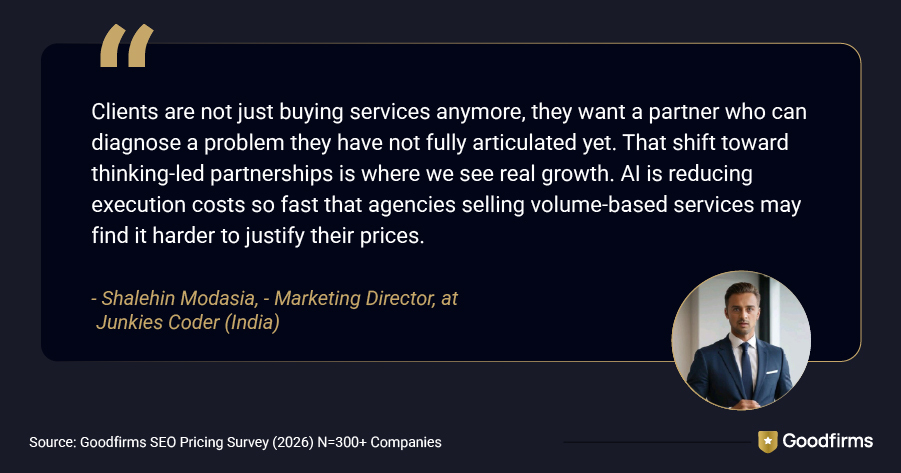
"The agencies that will struggle in the next 18 months are the ones selling outputs, posts, backlinks, and reports. The ones that survive and grow are selling outcomes and thinking."
4. SEO Hourly Rates: What Specialists and Consultants Charge
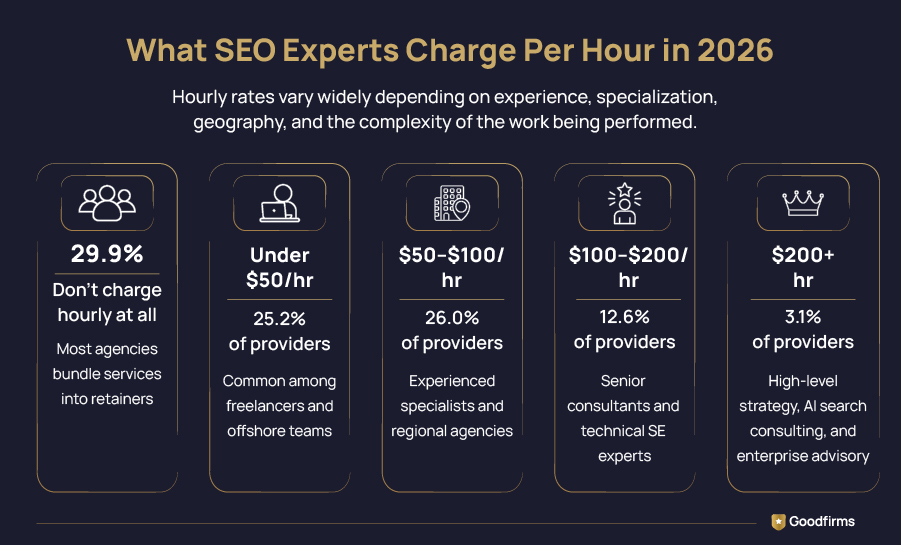
29.9% of the 300+ agencies in this survey don't charge hourly at all anymore — it's declining as a primary model, though it remains common for technical audits, platform migrations, penalty recovery, and AI search consulting.
|
Hourly Rate |
Share of Respondents |
Typical Provider / Use Case |
|---|---|---|
|
We do not charge hourly |
29.9% |
Retainer-only agencies; bundle all deliverables |
|
Under $50/hr |
25.2% |
Offshore/South Asia agencies; entry-level freelancers |
|
$50–$100/hr |
26.0% |
Regional agencies; experienced implementation specialists |
|
$100–$200/hr |
12.6% (16) |
Senior US/UK/AU technical specialists; established agencies |
|
Over $200/hr |
3.1% |
Elite AI search strategists; high-stakes advisory; top-tier consultants |
India, South Asia, Southeast Asia, and Eastern European SEO agencies charge between under $50 hr to $100 hr, while U.S, UK, and Western European SEO firms typically charge in between $100 - $200+
Interestingly, many senior practitioners are moving away from hourly billing altogether.
The reasoning is simple: An hour of strategic thinking can generate more value than 20 hours of execution.
Hourly billing penalizes strategic thinking and rewards volume. AI has accelerated this shift; keyword clustering, meta description generation, and basic content briefs can now be partially automated, making hourly billing for those tasks look like charging for machine time.
5. Why SEO Prices Increased in 2025–2026
54.3% of agencies in this survey increased their pricing during 2025–2026. Understanding why matters: buyers need to know whether higher quotes reflect genuine new capability or simply repricing the same service under a new language.
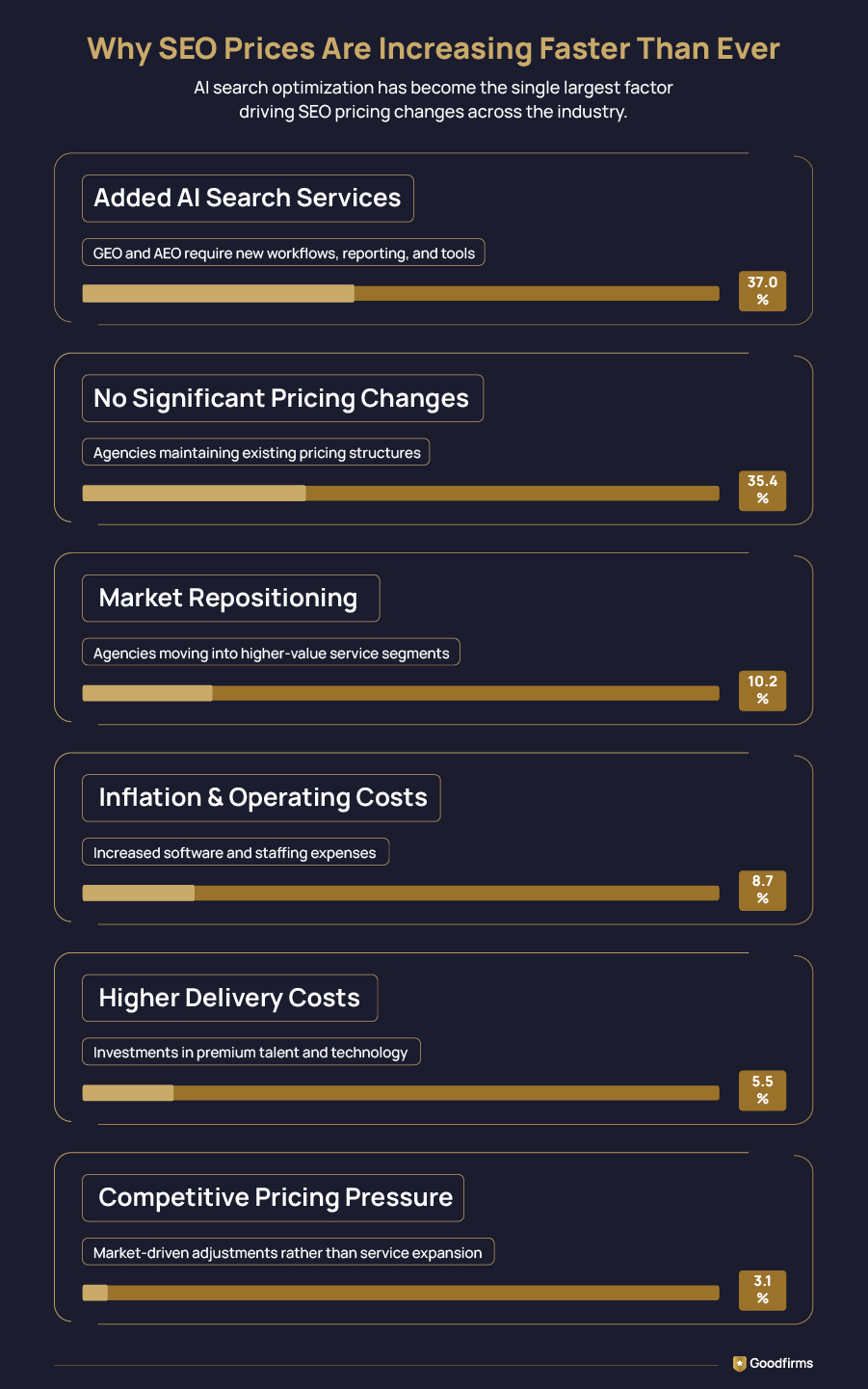
|
Primary Reason for Price Increase |
% of Agencies |
What This Means in Practice |
|---|---|---|
|
Added AI search services (GEO/AEO) |
37.0% |
New reporting, tooling, and workflow costs. Ask to see the AI search reporting before paying for it. |
|
No major pricing changes |
35.4% |
Pricing held stable — no increase in reason applicable |
|
Market demand/repositioning |
10.2% |
Agency moving upmarket; typically accompanied by scope changes |
|
Inflation/operating costs |
8.7% |
Cost of living and tooling costs affect agencies in high-cost markets |
|
Increased delivery costs |
5.5% |
AI visibility platforms, better tooling, senior hires |
|
Client budget pressure/competition |
3.1% |
Pricing change driven by market, not capability |
As agencies increasingly invest in AI optimization, businesses also need better ways to measure success. Our research on how marketers are tracking AI search visibility explores the metrics, tools, and reporting practices shaping AI search performance.
82 to 83% of agencies in this survey are now optimizing for AI-generated answers in some form, and 56% have introduced AI search as a formal service. But only 14% of respondents report tracking AI citation as their primary KPI. There is a clear gap between agencies that have operationalized AI optimization and those that have repriced without building the capability.
6. SEO Pricing by Industry: Which Sectors Pay the Most
Industry drives the widest swing in this survey: 23.6% of agencies serving Finance & Fintech clients charge $5,000+/month, versus just 9.1% serving Education. It's not about what the market will bear — it's the operational difference between ranking a local plumbing company and a national fintech platform."
This comparison also highlights why the average cost for SEO services varies dramatically between industries with different competition levels and regulatory requirements.
.jpg)
"Both finance and healthcare face strict YMYL scrutiny from Google, requiring deeper E-E-A-T investment, regulatory-compliant content, and aggressive link building."
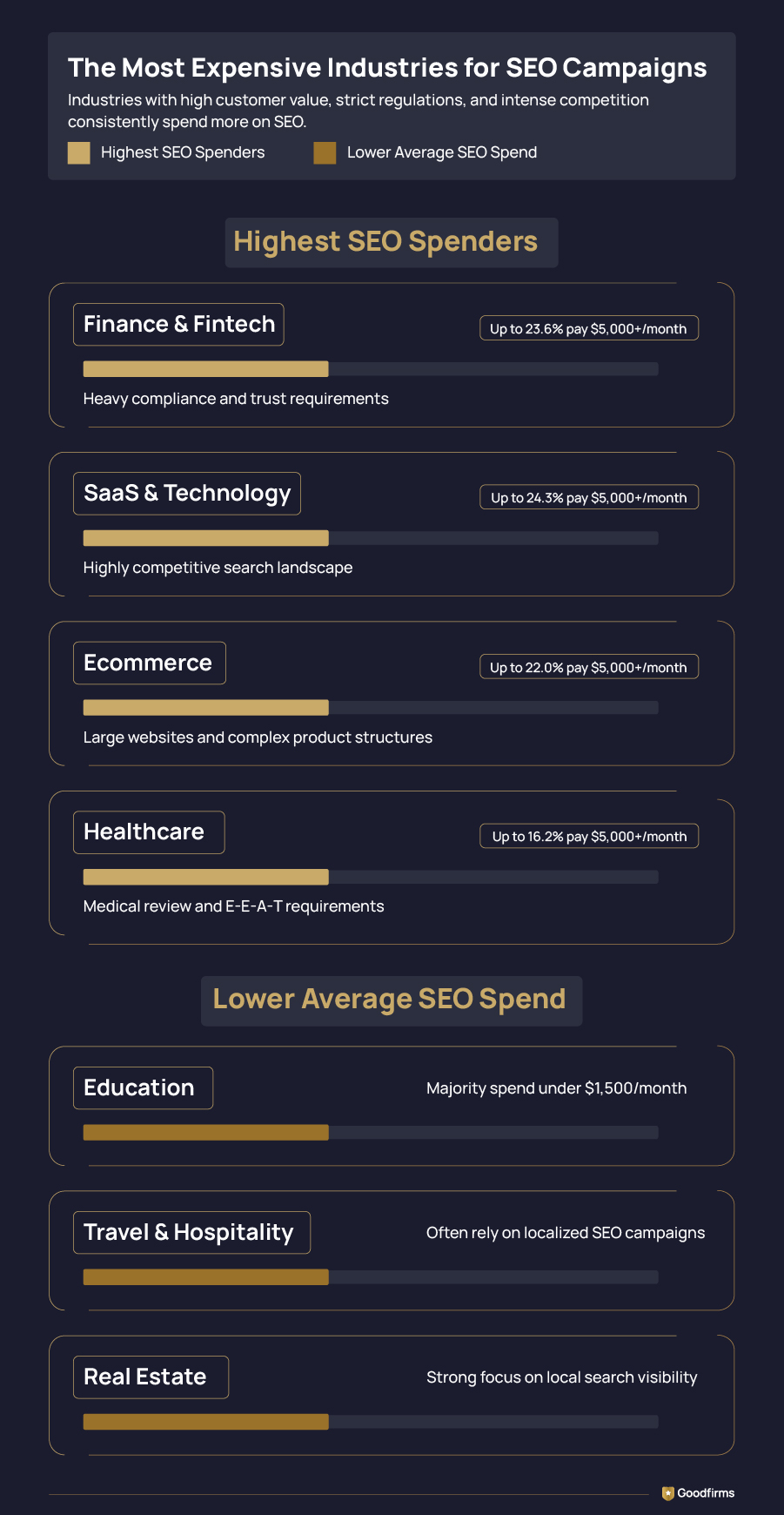
|
Industry |
Typical Monthly Retainer |
Higher end |
Primary Cost Drivers |
Why So Expensive? |
|---|---|---|---|---|
|
Legal Services |
$1,500–$5,000 monthly (50.5%) |
$5,000+ (9.0%) |
High CLV, intense competition, YMYL trust, AI-driven legal discovery |
Losing a case = tens of thousands lost. Visibility is revenue. |
|
Finance & Fintech |
$1,500–$5,000 monthly (51.7%) |
$5,000+ (23.6%) |
Regulatory pressure, compliance cycles, trust requirements, link difficulty |
Strict YMYL scrutiny requires specialist writers, compliance reviewers, and credible links. |
|
Healthcare & Medical |
$1,500–$5,000 monthly (44.8%) |
$5,000+ (16.2%) |
E-E-A-T standards, medical review workflows, compliance, hyper-local targeting |
Content requires medical review. A misranked clinic loses patients permanently. |
|
SaaS & Technology |
$1,500–$5,000 monthly (43.9%) |
$5,000+ (24.3%) |
Long buyer journeys, AI recommendation inclusion, international SEO |
50+ funded competitors per keyword. Every ranking gain takes sustained multi-layer effort. |
|
Ecommerce |
$1,500–$5,000 monthly (67.0% |
$5,000+ (22.0%) |
Scale complexity, thousands of product pages, technical debt, competitive SERPs |
50,000 SKUs = 50,000 SEO challenges. Architecture, schema, canonicals, crawl budget. |
|
Education |
Under $1,500/monthly (53.5%) |
$5,000+ (9.1%) |
Content credibility, authority requirements, long decision cycles |
E-E-A-T demands expertise-backed content; slow conversion cycle extends campaign timelines. |
|
Real Estate |
$1,500–$5,000 monthly 48.5% |
$5,000+ (10.1%) |
Local competition, AI Overviews for property search, review aggregation |
AI Overviews are disrupting local property searches; GBP and schema are now critical. |
|
Travel & Hospitality |
Under $1,500/monthly (45.5%) |
$5,000+ (11.1%) |
Geographic scope limits, lower keyword difficulty, GBP focus |
Limited geography means limited competition. Templated local SEO often works well. |
.jpg)
"E-commerce SEO is relentless. You're competing with Amazon and Walmart, not just other brands. But the bigger cost driver is structural — e-commerce sites have thousands of product and category pages, and organizing that architecture to perform in both traditional search and AI-powered experiences is genuinely complex."
For businesses in the US specifically, pricing expectations vary significantly by market. Browse top SEO companies in the USA to see how agencies position themselves by vertical and geography.
.jpg)
"Ecommerce clients command some of our highest retainers because the revenue opportunities are virtually endless. Large stores have thousands of products, creating opportunities to capture demand at every stage of the buyer's journey. Unlike most channels, SEO compounds over time, so even a modest increase in organic revenue can justify the investment many times over."
7. What Is GEO and AEO — And Why They Are Reshaping SEO Pricing
52.8% of agencies in this survey have introduced AI search optimization as a formal service this year — no trend appeared more consistently across responses.
GEO (Generative Engine Optimization): Optimizing content so AI systems, ChatGPT, Perplexity, Claude, Google AI Overviews, cite, reference, or summarize your brand when users ask relevant questions. Unlike traditional SEO, which targets a ranked position, GEO targets inclusion in AI-generated answers.
AEO (Answer Engine Optimization): Structuring content to directly answer specific questions, particularly those that trigger featured snippets and People Also Ask results. GEO and AEO overlap considerably; the tactics that make content machine-readable improve performance on both surfaces.
Why GEO and AEO Affect What You Pay
Many agencies now include AI optimization within their SEO service pricing, while others list it separately as an additional SEO optimization cost.
52.8% of agencies in this survey have introduced AI search optimization as a formal service, 31.5% bundle it into existing packages, and 21.3% offer it as a standalone billable service. A further 8.7% are currently evaluating. The share that has not introduced it at all is shrinking rapidly.
This matters for buyers because AI search is not optional for most competitive markets. 58.5% of Google searches in the US now end without a click (SparkToro/Datos, 2024). AI Overviews intercept 83% of queries before users reach organic results (Similarweb, 2025). A top-ranked result loses 58% of its click-through rate when an AI Overview is present (Ahrefs, December 2025).
.jpg)
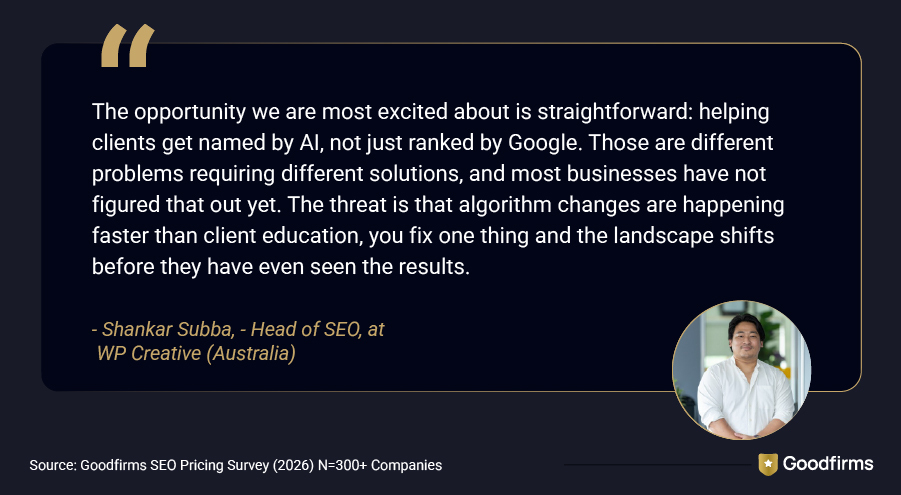
The growing demand for true AI search optimization expertise, most businesses know they need it, but very few know how to achieve it.
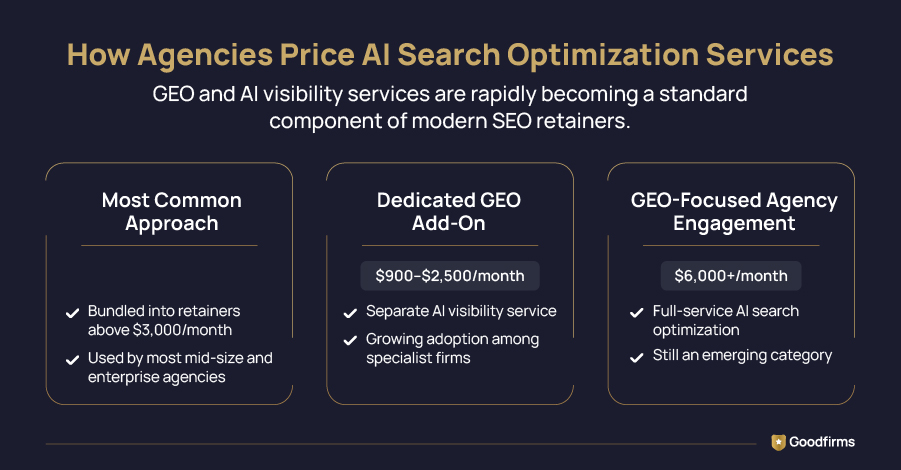
How AI Search Optimization Is Priced in Practice
|
Pricing Approach |
Typical Cost |
Who Uses It |
|---|---|---|
|
Bundled into retainers over $3,000/month |
Included |
Most mid-to-large agencies, the dominant approach |
|
Standalone AI/GEO add-on |
$900–$2,500/month |
Specialist firms; growing minority |
|
GEO-specialist dedicated firm |
$6,000+/month |
Emerging category; very few established players |
Before paying extra for AI search optimization, ask any agency three questions: Which specific platforms do you monitor? What tools do you use to track AI citation share? What does the reporting look like? Vague answers without named tools indicate the capability has been priced but not built.
The correct response isn't to avoid AI search optimization, it's to interrogate it. Ask any agency pitching GEO or AEO work: Which platforms do you monitor? What tools do you use? What does the reporting look like? If the answers are vague, the capability probably is too.
8. How AI-Powered Search Has Affected Organic Traffic in 2026
59.8% of the 300+ agencies in this survey report organic traffic increasing — not decreasing — despite AI search disruption, versus 24.4% reporting declines. That split, buried in the data below, is the most counterintuitive finding in this research.
|
Traffic Impact Category |
Share of Respondents |
Interpretation |
|---|---|---|
|
Significant increase |
32.3% |
Clients gaining visibility through AI citations and Overviews |
|
Moderate increase |
27.6% |
Positive directional trend; early AI optimisation paying off |
|
Moderate decline |
21.3% |
Click erosion from zero-click searches; informational traffic hit hardest |
|
Too early to measure |
8.7% |
Recent AI integration; outcomes not yet visible in data |
|
No noticeable change |
7.1% |
Largely local/niche clients less exposed to AI Overview disruption |
|
Significant decline |
3.1% |
Informational content-heavy; AI Overviews most disruptive here |
The split is instructive: 59.8% of agencies report traffic gains while 24.4% report declines. The difference largely comes down to content type. Informational, definitional content — the kind AI Overviews answer directly, is experiencing the most click erosion. Transactional, product, and local-intent queries still drive strong organic clicks, and brands appearing in AI Overviews for those queries see uplift.
The AI Citation Advantage
Brands cited inside AI Overviews receive approximately 35% more clicks than uncited brands at equivalent ranking positions (Seer Interactive, 2025). This makes appearing in AI-generated answers not just a visibility goal but a measurable traffic driver. The agencies that have operationalized AI citation monitoring, tracking which of their clients appear in ChatGPT, Perplexity, and Google AI Overviews, are the ones better positioned to demonstrate this value.
9. The Biggest AI-Related SEO Challenges Agencies Face in 2026
60.6% of agencies cite measuring AI services ROI as their biggest AI-related challenge — by far the most-cited problem, ahead of rapid algorithm changes (46.5%) and client education (45.7%).
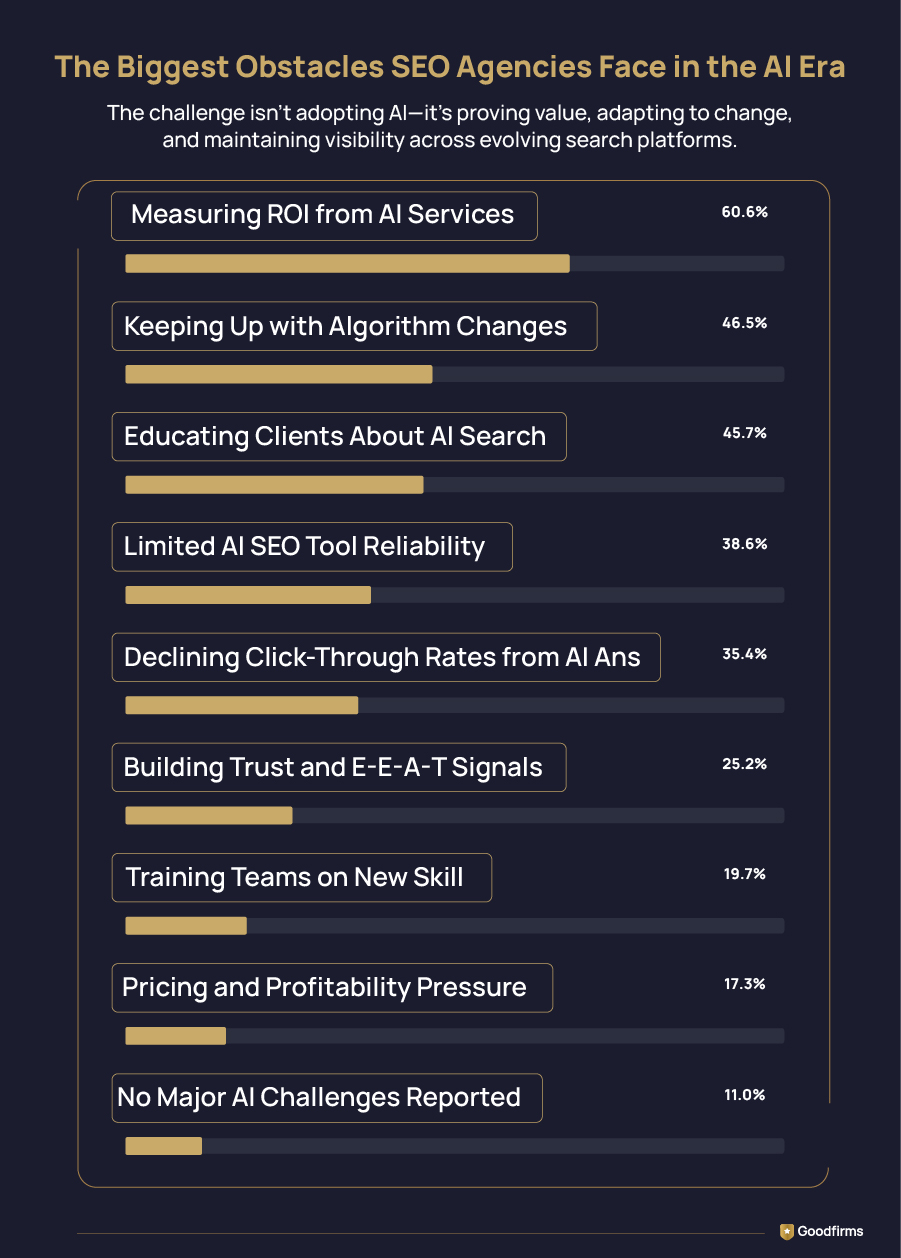
|
AI-Related SEO Challenge |
Percentage |
|---|---|
|
Measuring AI services ROI |
60.6% |
|
Rapid algorithm changes |
46.5% |
|
Client education |
45.7% |
|
Lack of reliable AI SEO tools |
38.6% |
|
Lower CTR from AI answers |
35.4% |
|
Content trust / E-E-A-T |
25.2% |
|
Team training/upskilling |
19.7% |
|
Pricing pressure |
17.3% |
|
No major AI-related challenges |
11.0% |
|
Challenges for SEO Agencies |
What Buyers Should Know |
|---|---|
|
Measuring AI services ROI |
Most cited challenge by far. If your agency cannot show you what AI visibility looks like in their reporting, push back. |
|
Lack of reliable AI SEO tools |
Monitoring tools for AI citation share (Otterly.ai, Peec AI, Promptmonitor) are still maturing. Absence of tooling is not an excuse to not track. |
|
Rapid algorithm changes |
Google's AI Overview rollout continues to evolve. Agencies need active monitoring, not quarterly check-ins. |
|
Client education |
A significant number of clients do not yet understand GEO, AEO, or what AI citation means for their business. Good agencies address this proactively. |
|
Lower CTR from AI answers |
Zero-click erosion is real for informational content. Strategy needs to shift toward transactional visibility and branded search growth. |
|
Content trust / E-E-A-T |
Google and AI systems both reward genuine expertise. Mass-produced AI content without editorial review is a liability, not an asset. |
|
Pricing pressure |
Clients perceive AI tools as commoditising SEO. Agencies with clear AI measurement capability have more pricing power. |
|
Team training/upskilling |
Keeping up with GEO, AEO, and AI Overview changes requires ongoing investment. Ask how frequently agency teams are trained. |
Most agencies in this survey have not yet formalized AI visibility reporting, either bundling it without measurable outputs or still evaluating what to track. Buyers paying for AI optimization today are largely doing so without a clear measurement framework in place.
.jpg)
"The biggest threat is the growing number of agencies rebranding basic SEO services as 'AI SEO' without real expertise. This can create market confusion, unrealistic expectations, and pricing pressure as competition increases."
10. SEO Agency Size vs. Price: Solo, Boutique, Mid-Market, and Enterprise
42% of agencies in this survey report reclaiming 5–10 billable hours weekly through AI tools — gains that are largely passing through to clients as faster delivery and broader scope. That's compressing the advantage bigger agencies used to hold: a bigger agency does not automatically mean better results.
|
Agency Size |
Monthly Range |
Strengths |
Limitations |
|---|---|---|---|
|
Solo Consultants |
$500–$1,500 |
Direct access, low overhead, specialized expertise, AI-efficiency |
Bandwidth ceiling can't scale large campaigns |
|
Boutique (2–5 people) |
$1,500–$3,500 |
Agile, personalized, founder involvement |
Limited specialist depth, one gap matters more |
|
Small Agency (6–15) |
$2,000–$5,000 |
Dedicated roles, good mid-market fit |
Some process overhead account load can rise |
|
Mid Market Agency (16–50) |
$3,000–$7,500 |
Full-service capability, SEO + AI bundled |
More layers between strategy and execution |
|
Enterprise (50+) |
$7,500–$15,000+ |
Enterprise infrastructure, international scale |
High overhead cost is embedded in the retainer you pay for the structure |

"I find myself well fit as a freelancer. I am doing as much work now alone as I did with 14 employees back in 2019. Grossing around $80–100k a month."
AI tooling is genuinely compressing the operational advantages that larger agencies previously held. 42% of agencies reported reclaiming 5–10 billable hours weekly through AI tools (AgencyAnalytics State of the Agency Survey, 2025). The efficiency gains are largely passing through to clients as faster delivery and broader scope.
What this means for buyers: expertise increasingly matters more than headcount. A mid-market agency with a senior strategist who deeply understands your industry will almost always outperform a larger agency where your account is handled by a junior team following a template. The right-size question isn't 'bigger or smaller', it's 'does this agency's capacity match my actual scope?'
11. The Best AI SEO Tools and Platforms Agencies Are Actually Using in 2026
Ahrefs, SEMrush, Google Search Console, and GA4 are near-universal across the 300+ agencies surveyed — but Claude Pro, not ChatGPT alone, is the second most-cited AI tool in their stack. For buyers evaluating agency sophistication, that tool mix is a reasonable proxy.
|
Tool / Platform |
Survey Adoption |
Starting Price (2026) |
Primary Use |
|---|---|---|---|
|
Ahrefs |
Near-universal |
$29/month (Starter); most agencies use $129/month (Lite) |
Keyword research, backlink analysis, rank tracking |
|
SEMrush |
Near-universal |
$139.95/month (Pro) |
SEO, competitive research, rank tracking, site audits |
|
Google Search Console |
Universal |
Free |
Search performance, indexing, technical monitoring |
|
Google Analytics 4 |
Universal |
Free |
Traffic, conversion, and user behavior analysis |
|
Screaming Frog SEO Spider |
Common |
Free (500 URLs) or $279/user/year (~$23/month equivalent) |
Technical SEO audits and crawling |
|
SurferSEO |
Common |
$79/month |
Content optimization and NLP recommendations |
|
SE Ranking |
Common |
$65/month |
Rank tracking, audits, competitor research |
|
ChatGPT Plus |
Near-universal |
$20/month |
Content creation, research, briefs, automation |
|
Claude Pro |
Second most cited |
$20/month |
Writing, strategy, content review |
|
Gemini Advanced |
Third most cited |
$19.99/month |
Research, multimodal analysis, content assistance |
|
Jasper |
Moderate |
$49/month |
AI content generation and workflows |
|
Frase |
Moderate |
$45/month |
Content briefs and optimization |
|
Clearscope |
Moderate |
$189/month |
Enterprise-grade content optimization |
|
Otterly.ai |
Emerging (GEO leaders) |
$29/month |
AI citation and AI search visibility monitoring |
|
Peec AI |
Emerging (GEO leaders) |
$89/month |
AI visibility and brand mention tracking |
|
Promptmonitor |
Emerging (GEO leaders) |
$49/month |
AI answer monitoring and GEO tracking |
|
MarketMuse |
Specialist |
$99/month |
Topic authority and content planning |
|
AthenaHQ |
Specialist |
Custom pricing (typically agency/enterprise plans) |
GEO visibility and AI search analytics |
The Conductor 2026 GEO Benchmarks Report (13,770 domains, 100M+ AI citations) found that ChatGPT drives 87.4% of all traffic from AI search tools. Understanding how ChatGPT selects citations is now a core operational competency, not an optional add-on.
The breadth of AI tools matters less than whether an agency has a coherent workflow for using them. An agency generating bulk content with ChatGPT and publishing without editorial review isn't deploying AI; it's deploying risk.
Investing in premium SEO platforms has also become a contributing factor behind rising SEO agency prices, particularly for agencies offering advanced AI search optimization.

"AI is rapidly making execution cheap and accessible. Basic SEO tasks like keyword research, content generation, and even technical audits are getting automated. This reduces the perceived value of agencies that rely only on tactics. The real shift is from execution to intelligence."
The evolution of AI-driven SEO tools is also changing how agencies pitch and price services. The LLM SEO services guide breaks down what's genuinely new versus what's repackaged.
12. SEO ROI: How Long Does It Take and What Should You Expect?
Retainer clients stay engaged for 56 months on average versus just 24 months for project-based clients (Focus Digital Client Retention Analysis, 2026) — the clearest evidence yet that SEO ROI timelines are the hardest conversation in any proposal, and the most important to set correctly before signing.
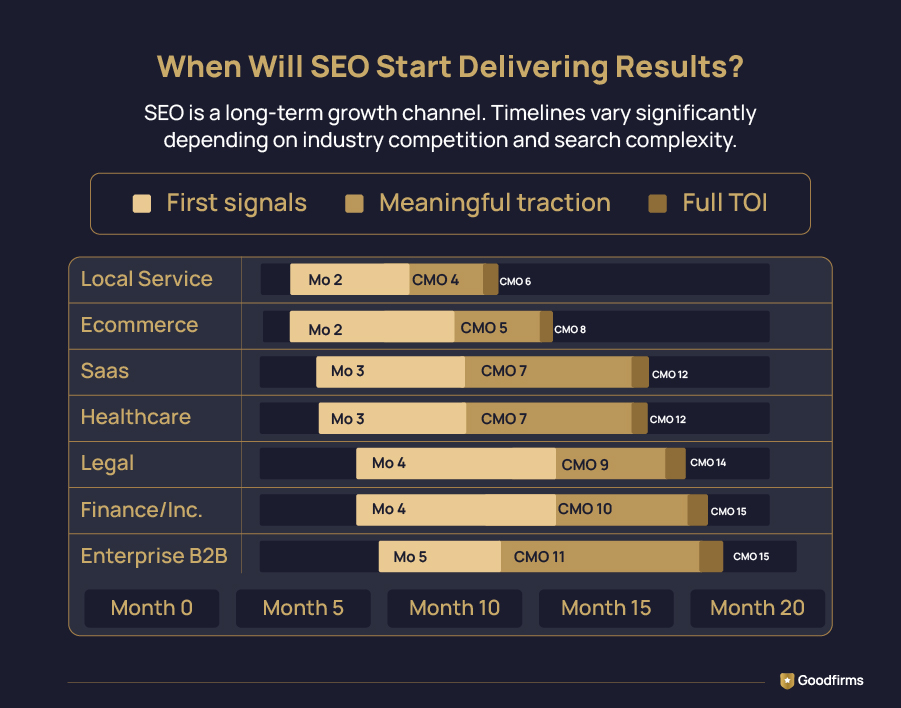
|
Industry |
First Signals |
Meaningful Traction |
Full ROI |
Primary Success Metric |
|---|---|---|---|---|
|
Local Services |
Month 2 |
Month 4 |
Month 6 |
Calls, map pack visibility, GBP traffic |
|
Ecommerce |
Month 2 |
Month 5 |
Month 8 |
Revenue growth, organic conversion rate |
|
SaaS |
Month 3 |
Month 7 |
Month 12 |
Demo requests, pipeline influence |
|
Healthcare |
Month 3 |
Month 7 |
Month 12 |
Appointment acquisition, branded search |
|
Legal |
Month 4 |
Month 9 |
Month 14 |
Qualified consultations, case inquiries |
|
Finance & Insurance |
Month 4 |
Month 10 |
Month 15 |
Lead quality, trust visibility, and AI citation share |
|
Enterprise B2B |
Month 5 |
Month 11 |
Month 18 |
Pipeline influence, multi-touch attribution |
SEO doesn't work in straight lines. Technical fixes from month two make the content from month five more effective. Editorial links built in Q1 strengthen topical authority that drives AI citation inclusion by Q4. Every layer of work makes the next layer perform better, which is why results look slow at first and then suddenly don't.
When a potential customer reads your content in an AI Overview and converts through a direct visit two weeks later, attribution is broken. The agencies measuring SEO value correctly in 2026 track branded search volume, AI citation share, Local Pack interactions, and multi-touch attribution alongside traditional organic sessions.
How Agencies Report Success: KPI Breakdown from This Survey
|
Primary KPI Reported to Clients |
Share of Agencies |
|---|---|
|
Combination of metrics |
37.8 |
|
Organic traffic |
18.9% |
|
Leads/conversions |
16.5% |
|
Revenue impact |
10.2% |
|
Keyword rankings |
9.4% |
|
AI search visibility |
3.1% |
The shift toward multi-metric reporting reflects the growing complexity of what SEO visibility means in 2026. Ranking alone tells you nothing about AI citation share. Traffic alone misses zero-click brand exposure. Revenue attribution across a twelve-month SEO campaign requires multi-touch modelling. Agencies reporting purely on keyword rankings in 2026 are measuring yesterday's metric.
13. Red Flags and Green Flags: A Buyer's Checklist
After reviewing 300+ agency responses, the signals that separate strong proposals from weak ones are consistent enough to be a checklist. Whether you're comparing freelancers, consultants, or agencies, understanding standard SEO agency pricing helps identify proposals that are unrealistically cheap or unnecessarily expensive.
Green Flags — What Good SEO Looks Like
|
Signal |
Why It Matters |
|---|---|
|
Detailed scope document — not vague 'SEO services' |
Accountability starts with specificity |
|
Reporting against leads and revenue, not just rankings |
They're thinking about your business, not their scorecard |
|
Industry-specific experience with verifiable work |
Generic SEO underperforms vertical SEO every time |
|
Clear AI search plan with named tools and metrics |
They've operationalized it, not just pitched it |
|
Transparent about what's included vs. billable separately |
Transparency before signing = fewer surprises after |
|
Senior strategist with manageable account load (10–15 accounts) |
Your account gets real strategic attention |
Red Flags — What to Avoid
|
Signal |
What It Usually Means |
|---|---|
|
Guaranteed first-page rankings |
Either dishonest or using risky tactics that lead to penalties |
|
Sub-$300/month 'comprehensive SEO' |
Automated, low-quality delivery, templated at best, spam at worst |
|
Vague 'proprietary methods' language |
Hiding automation or third-party outsourcing |
|
Hourly billing without scope caps |
Unpredictable costs; incentives favor output volume, not your results |
|
Can't explain your specific strategy clearly |
They don't have one, they have a template |
|
No AI search mention, or only buzzword-level mention |
Behind the market shift; can't help you with the fastest-growing search surface |
|
Large, frequent reports with no strategic interpretation |
Reporting theater, data without insight |
14. Five Questions to Ask Before Signing Any SEO Contract
1. How do you measure AI visibility and citation share?
The agency should name specific tools (Otterly.ai, Peec AI, Promptmonitor) and explain what the reporting looks like. Vague answers about 'monitoring AI' without specifics indicate they haven't operationalized it. If you want a deeper understanding of how ranking in AI search actually works before that conversation, the guide to ranking higher on Google AI Search is worth reading first.
2. Which tasks are automated versus manually reviewed?
AI automation is legitimate and efficient. Automation without human review is where quality collapses. You want to know the human oversight layer, especially for content published under your brand.
3. Can you show work from our specific industry?
Generic SEO underperforms vertical SEO. An agency that has served healthcare clients understands E-E-A-T requirements, medical review workflows, and compliance risks. One that hasn't is learning on your retainer.
4. What is the actual account load of the lead strategist on our account?
Senior strategists managing 30+ accounts are not senior strategists; they're account managers. Ask directly. A manageable account load is 10–15 clients for a dedicated senior strategist.
5. What result are you trying to achieve for us in 12 months, and how will you know if you're achieving it?
This question separates agencies that think about your business from those that report against their own scorecards. The answer should include revenue or lead-generation metrics, not just rankings and traffic.
Ultimately, the right SEO pricing isn't simply the lowest quote—it's the pricing structure that aligns with your business goals, competition, and expected return on investment.
The Bottom Line
SEO pricing in 2026 reflects something bigger than inflation or market dynamics. It reflects a fundamental transformation in what "search visibility" means.
The range from $500/month to $15,000/month doesn't represent a spectrum from bad to good. It represents a spectrum from small-scope local work to enterprise-level strategy in highly competitive markets, with every variation of scope, expertise, and AI readiness in between.
What you pay should reflect what your competitive situation actually requires, not what sounds affordable, and not what sounds impressive in a proposal.
The single most important reframe for buyers right now: SEO is no longer about where you rank in Google's blue links. It's about whether you appear, and appear favorably, across AI-generated discovery systems that are increasingly where your potential customers form their first impression of your business.
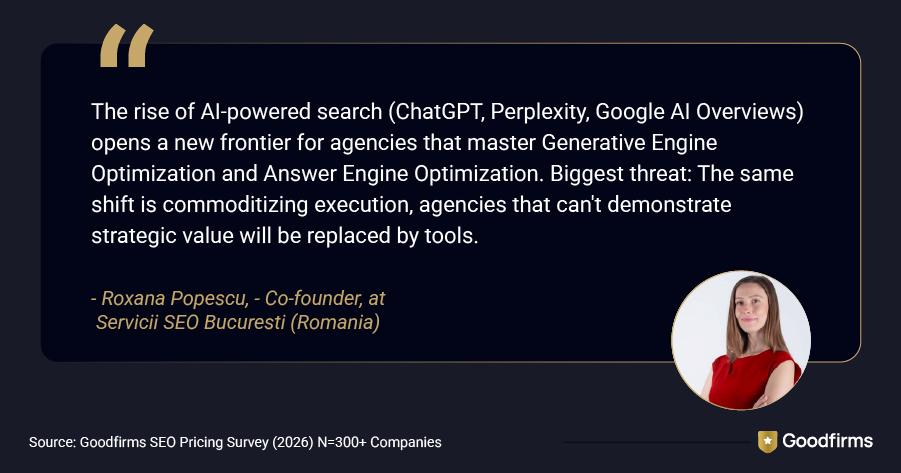
The agencies worth hiring in 2026 are the ones that understand this shift and have built real operational capability around it. The ones to avoid are selling yesterday's product at tomorrow's price.
Frequently Asked Questions
1. How much should a business budget for SEO in 2026?
SEO budgets depend on business size, competition, and growth goals. Local businesses typically budget between $500 and $1,500 per month, while growing companies often invest $1,500–$5,000 per month. Businesses in competitive industries such as SaaS, legal, healthcare, finance, and ecommerce frequently allocate $5,000+ per month to maintain visibility and compete effectively. Rather than choosing a budget first and then finding an agency to fit it, businesses should align SEO investment with revenue goals, customer lifetime value, and market competition.
2. Why are SEO prices increasing?
The largest driver is AI search optimization. Agencies now manage GEO, AEO, AI visibility tracking, schema systems, authority development, and conversational search discoverability alongside traditional SEO. The SE Ranking Agency Pricing Survey (February 2026, 170+ agencies) found 70% of agencies increased or planned to increase pricing, with AI services as the leading reason.
3. What is GEO, and why does it affect SEO pricing?
GEO (Generative Engine Optimization) is the practice of optimizing visibility inside AI-generated search systems, ChatGPT, Perplexity, and Google AI Overviews. With 58.5% of Google searches now ending without a click (SparkToro/Datos, 2024) and AI platforms like ChatGPT reaching 900 million weekly users as of February 2026 (TechCrunch), GEO has become a core component of modern search visibility.
4. What is AEO in SEO?
AEO (Answer Engine Optimization) focuses on structuring content to directly answer specific questions, the kind that trigger featured snippets, People Also Ask results, and AI-generated answers. GEO and AEO overlap significantly in practice.
5. How much does SEO cost for a small business?
Local businesses with limited competition can get results in the $500–$1,500/month range. For small businesses competing nationally or in competitive verticals, the realistic starting point is $1,500–$3,000/month. Extremely cheap SEO (sub-$300/month) typically relies on automation-heavy workflows with minimal strategic oversight.
6. How long does SEO take to work?
Most agencies report meaningful progress beginning at 4–6 months for local and ecommerce work, 6–12 months for SaaS and healthcare, and 9–18 months for enterprise B2B and highly competitive regulated sectors. SEO compounds, results from month three build on month one, and authority developed over 24 months continues producing results for years.
7. Is SEO worth it for a small business?
For local businesses with limited competition, yes, well-executed SEO at $800–$1,200/month can deliver clear ROI within 3–6 months. SEO compounds in a way that paid media doesn't. When a PPC campaign stops, traffic stops. SEO authority built over 24 months continues producing results for years.
8. Which industries spend the most on SEO?
Healthcare, legal services, finance and fintech, SaaS and enterprise technology, and large-scale ecommerce consistently command the highest retainers, typically $3,000–$10,000+/month. The common thread: high customer lifetime value, intense competition, and content that requires genuine expertise to produce.
9. What is a fair price for SEO services?
A fair price comes with a detailed scope document, clear KPIs tied to business outcomes (not just rankings), explicit AI search coverage if relevant to your market, and senior strategist involvement. Any agency that can't explain exactly what they'll do for your specific site in plain language, before you sign, is telling you something important.
10. Are monthly retainers better than hourly billing?
For most SEO engagements, yes. SEO value compounds over time and is non-linear; an hour of strategic thinking can drive more results than 20 hours of implementation. Monthly retainers create accountability for ongoing performance rather than task completion. Focus Digital Client Retention Analysis 2026 found that retainer client lifespan averages 56 months versus 24 months for project clients.
11. How do I get my brand cited in ChatGPT and AI Overviews?
The most reliable signals for AI citation are external brand mentions (correlation of 0.664 with AI Overview appearances, per Ahrefs 2026), domain authority, and content structure. Practices that increase citation likelihood: leading with clear definitions, including 5–7 data points, using plain language, structured comparison tables, and distributing content through third-party publications. Brands are 6.5x more likely to be cited through third-party sources than through their own domains (AirOps, 2025).
Methodology
Goodfirms conducted this research between April and May 2026. Survey responses were collected from 300+ SEO agency professionals across 20+ countries, including the United States, India, United Kingdom, Canada, UAE, Australia, Pakistan, Ukraine, Romania, Poland, Israel, Finland, Denmark, Vietnam, Indonesia, Singapore, Philippines, South Africa, Nigeria, Kenya, Bangladesh, Serbia, Cyprus, Ireland, Peru, Brazil, Egypt, Oman, Spain, Nepal, Armenia, and additional markets.
Respondent profile: Solo consultants, boutique SEO firms, mid-sized agencies, enterprise consultancies, full-service digital agencies, technical SEO specialists, and AI search optimization firms. Companies ranged from independent operators to organizations with more than 500 employees. Roles included founders, CEOs, managing directors, SEO managers, marketing executives, and senior SEO specialists.
Research approach: Quantitative survey analysis combined with qualitative agency insights, market trend interpretation, and expert commentary from industry leaders. All pricing ranges represent directional market observations rather than fixed universal benchmarks. Actual pricing varies significantly by industry competitiveness, geographic targeting, website complexity, compliance requirements, and AI optimization scope. We thank every participating agency and research partners for contributing valuable industry insights that made this study possible.
External data sources referenced:
- Ahrefs SEO Pricing Survey (439 professionals)
- SE Ranking Agency Pricing Survey (170+ agencies)
- SparkToro Zero-Click Search Study (2024)
- Focus Digital Client Retention Report 2026
- Conductor AEO/GEO Benchmarks Report 2026
- ZeroClick Labs AI Platform Study 2026
- EMARKETER GEO/AEO Forecast 2026
- Ahrefs AI Overviews CTR Study (December 2025)
- AgencyAnalytics State of the Agency 2025
- Similarweb AI Search Platform Data 2026