Key takeaways
- Fixed-price web development projects in 2026 range from $1,000 to $150,000+, with 63% of agencies quoting between $1,000 and $15,000.
- Basic websites and MVPs cost $1,000–$3,000 for 60% of agencies, with 71% delivering them in under four weeks.
- Enterprise builds show the widest spread — 36% quote $20,000–$50,000, while 7% go as high as $200,000–$500,000.
- 98% of surveyed agencies now use AI, yet complex builds have held their price or increased as client expectations have risen.
- Hourly rates split sharply by geography — South and Southeast Asia bill $10–$15, while the US, UK, and Canada sit at $50–$100.
- Monthly retainers fall between $500–$3,000 for nearly 58% of the market.
- AI builders deliver finished sites for under $1,500 in most cases, with nearly two-thirds completed within two weeks.
Website development in 2026 typically costs anywhere from $1,000 for a basic website to $150,000+ for a complex enterprise build. Costs vary significantly based on website type, features, technology, development location, and project complexity.
To understand what businesses are actually paying, Goodfirms surveyed 300+ web development companies across 31 countries, covering fixed-price projects, hourly rates, monthly retainers, timelines, hidden costs, and the factors that drive budgets higher.
This report breaks down the latest website development costs and pricing trends to help businesses estimate a realistic budget for their next project.
A Quick Answer to How Much Does a Website Cost?
|
Website Type |
Typical 2026 Cost |
Typical Timeline |
|---|---|---|
| Basic Website / MVP | $1K–$3K | 2–4 weeks |
| Mid-Sized Business Website | $5K–$20K | 4–8 weeks |
| CMS Website | $5K–$20K | 4–8 weeks |
| Ecommerce Website | $5K–$50K | 8–28 weeks |
| Custom Web Application | $20K–$50K | 8–16 weeks |
| Enterprise Website | $20K–$200K+ | 8–36+ weeks |
Note: These ranges reflect Goodfirms’ 2026 survey data. Actual website development costs vary depending on features, complexity, integrations, technology stack, development location, and post-launch requirements.
That variance is exactly why the numbers on a proposal rarely match the final invoice. The gap between the first invoice and the real cost isn't random — it's baked into decisions made before a single line of code is written, as Dan Haiem, CEO of App Makers USA, explains.

The first invoice is the smallest number in the project. Scope creep and third-party integrations are what actually blow a website budget, and both are decided before anyone writes code. We spec every screen and every integration up front, because an integration that reads like one line on a proposal turns into weeks of work once you hit the other system's rate limits and the edge cases nobody mapped. AI is the same trap in new clothes: treat it as one narrow, cost-capped feature and it saves money, but bolt it on to look modern and it raises the bill, because output that looks finished still has to be validated before you can trust it.
Before you dive into the detailed information about what your final web development cost might be, here's a quick video overview of what the survey found — covering price ranges, hourly rates, and the factors that most commonly push projects over budget.
For a full breakdown with country-level hourly rates, hidden costs, and AI's impact on pricing — the complete survey data follows below.
Browse top web development companies on Goodfirms — filtered by location, budget, and review score.
About This Research
Goodfirms surveyed 300+ web development firms across 31 countries to find out what the market genuinely charges in 2026, what pushes projects over budget, and how AI has changed the economics of web development.
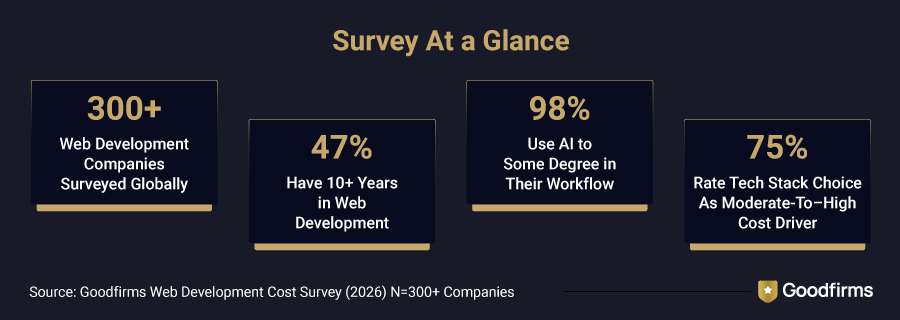
The responses are in. Here is where most fixed-price projects actually land across the market.
How Much Does a Website Cost? Estimates by Project Scope and Complexity (Fixed Pricing Model)
Website development costs $1,000 to $150,000+ in 2026, depending on the website's size, complexity, functionality, technology, and development team.
Goodfirms surveyed 300+ web development firms across 31 countries to find out what the market genuinely charges in 2026. The responses show a clear market concentration — 33% of agencies quote fixed-price projects between $1,000 and $5,000, with another 30% in the $5,000–$15,000 band. Together, these two brackets account for nearly two-thirds of the market. Budgets above $35,000 remain rare at under 7% combined, and around 10% of agencies don't offer fixed-price engagements at all, preferring time-and-materials or retainer structures instead.
But those headline ranges only tell you what the market charges on average. What you actually pay depends on what you're building. Here's how costs break down by project type:
|
Website Size & Complexity |
Most Common Cost Range |
Percentage of Companies |
Most Common Timeline |
Percentage of Companies |
|---|---|---|---|---|
|
Basic Website and MVPs |
$1,000-$3,000 |
59.9% |
2–4 weeks |
71% |
|
Mid-Sized Website |
$5,000 – $20,000 |
53.9% |
4–8 weeks |
50% |
|
Enterprise Level Website |
$20,000 – $200,000 |
36.2% |
8–28 weeks |
32.2% |
|
CMS Based Website |
$5,000 – $20,000 |
45.4% |
4–8 weeks |
36.18% |
|
Custom Web Application |
$20,000 – $50,000 |
35.5% |
8–16 weeks |
35.5% |
|
Web Portal |
$20,000 – $50,000 |
33.6% |
8–16 weeks |
31% |
Basic Websites and MVPs
60% of respondents estimated a basic site or MVP at $1,000–$3,000, with 71% agreeing the build takes 2–4 weeks. This is the tier most affected by AI tooling — templated scaffolding, automated content population, and drag-and-drop builders have genuinely compressed both timelines and price floors at this end of the market.
Mid-Sized Websites
54% of respondents estimate $5,000–$20,000 for a standard mid-sized site, a meaningful 25% push that estimate toward $20,000–$50,000 — a variance that reflects genuine scope differences across agencies. Timelines follow a similar split: half the respondents land on 4–8 weeks, while 32% say 8–16 weeks is more realistic. The divergence often comes down to custom design depth, integration count, and how rigorous the QA process is.
Enterprise Projects
Enterprise builds carry the widest range of any category, and the data makes that plain. The single most common estimate was $20,000–$50,000, cited by 36% of respondents. But 23% placed the cost at $75,000–$200,000, 13% at $50,000–$75,000, and 7% said $200,000–$500,000 is standard for their enterprise clients. Timelines similarly stretch: 32% estimated 8–16 weeks, 31% said 16–28 weeks, and nearly 19% indicated 28–36 weeks or longer. At this scale, the project's cost and risk are inseparable.
CMS Based Website
45% of respondents placed CMS-based website costs in the $5,000–$20,000 range, with another 15% citing $1,000–$3,000 for simpler builds. On timelines, 36% estimated delivery at 4–8 weeks. Platforms like WordPress and Webflow have matured considerably — theme ecosystems, plugin libraries, and visual editors mean less bespoke work, which keeps both budgets and delivery windows tighter than most clients expect.
Custom Web Application
35% of respondents quoted $20,000–$50,000 for a custom web application, with 19% pushing into the $50,000–$75,000 bracket. Timeline-wise, nearly 68% landed between 8 and 28 weeks. The spread reflects genuine scope variability — authentication layers, third-party API integrations, and custom business logic each add meaningful overhead that no template or low-code shortcut fully absorbs.
Not every website of the same size and features costs the same. The industry behind it matters — and in some verticals, it matters more as regulatory and technical demands add up.
59.9% of web development companies charge $1,000–$3,000 for basic websites.
Website Development Cost by Industry
Industry context changes the cost equation significantly. A healthcare website and a blog at the same complexity level carry very different price tags — compliance requirements, secure data handling, and third-party system integrations push certain verticals into higher brackets regardless of page count or visual design scope.
|
Industry Vertical |
Most Common Cost Range |
Percentage of Companies |
Most Common Timeline |
Percentage of Companies |
|---|---|---|---|---|
|
Personal / Blog Website |
$5,000 – $25,000 |
77% |
8–16 weeks |
81% |
|
Healthcare Website |
$5,000 – $50,000 |
48% |
8–28 weeks |
80% |
|
Fintech / Neobank |
$25,000 – $80,000 |
54% |
16–40 weeks |
62% |
|
Real Estate Website |
$5,000 – $50,000 |
73% |
8–28 weeks |
80% |
|
eCommerce Website |
$5,000 – $50,000 |
74% |
8–28 weeks |
86% |
|
SaaS-Based Website |
$25,000 – $80,000 |
61% |
16-40 weeks |
76% |
|
News / Media Website |
$5,000 – $50,000 |
68% |
8–28 weeks |
74% |
|
Education / eLearning |
$25,000 – $80,000 |
68% |
8–28 weeks |
70% |
These figures reflect an estimate of how much web development costs. You can cut down on these costs by using AI tools and low-code/no-code platforms. For businesses with leaner budgets or simpler scopes, AI builders and low-code/no-code platforms sit in an entirely different cost bracket — faster to launch, and far cheaper to start.
How Much Does an AI-Built Website Cost in 2026?
AI builders keep costs notably lean — 33.5% of respondents estimated $500–$1,500, with another 23% coming in below $500 altogether. Low-code/no-code platforms sit a tier higher: 34.7% quoted $1,500–$5,000 as their primary range. The gap reflects the trade-off between fully automated generation and platforms that still demand meaningful configuration and design decisions — which is why low code/no code development agencies tend to price their engagements closer to the custom development bracket than most clients anticipate.
| Cost |
AI Builders (Percentage of Companies) |
Low-Code/No-Code Platforms (Percentage of Companies) |
|---|---|---|
|
Below $500 |
23.7% |
16.5% |
|
$500-$1,500 |
33.5% |
26.9% |
|
$1,500-$5,000 |
27.7% |
34.7% |
|
$5,000-$10,000 |
9.8% |
16.5% |
|
$10,000+ |
5.2% |
6.5% |
Key Insight: AI builder projects cluster heavily below $1,500, while low-code platform costs spread more evenly across price tiers — peaking in the $1,500–$5,000 range.
How Long Does It Take to Build a Website With AI?
| Timeline | AI Builders (Percentage of Companies) | Low-Code/No-Code Platforms (Percentage of Companies) |
|---|---|---|
|
Less Than 1 Week |
29.9% |
11.2% |
|
1-2 Weeks |
39.5% |
42% |
|
2-4 Weeks |
19.2% |
29.6% |
|
More Than 4 Weeks |
11.4% |
17.2% |
Key Insight: Speed is where AI builders pull ahead most clearly — 29.9% of projects deliver in under a week, against just 11.2% for low-code platforms. Low-code timelines skew longer, with 46.8% of projects running beyond two weeks.
When it comes to the timeline to build websites using AI builders and low-code/no-code platforms, for AI builders, 39.5% of respondents estimated delivery in 1–2 weeks, with another 29.9% citing under a week, meaning nearly two-thirds expect a finished site within a fortnight. Low-code/no-code platforms run slightly longer: 42% land at 1–2 weeks, and 29.4% need 2–4 weeks, reflecting their comparatively heavier configuration requirements.
Now we know how much AI-powered web development can cost. What we need to know is how deeply AI has embedded itself in professional development workflows — and whether that shift is actually reducing what clients pay.
Does AI Actually Reduce Website Development Costs?
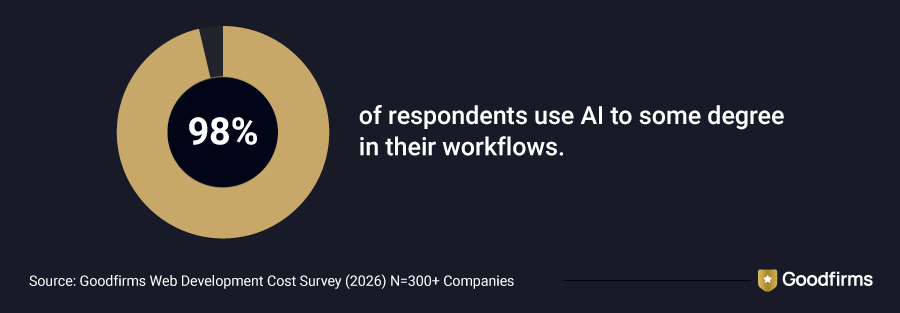
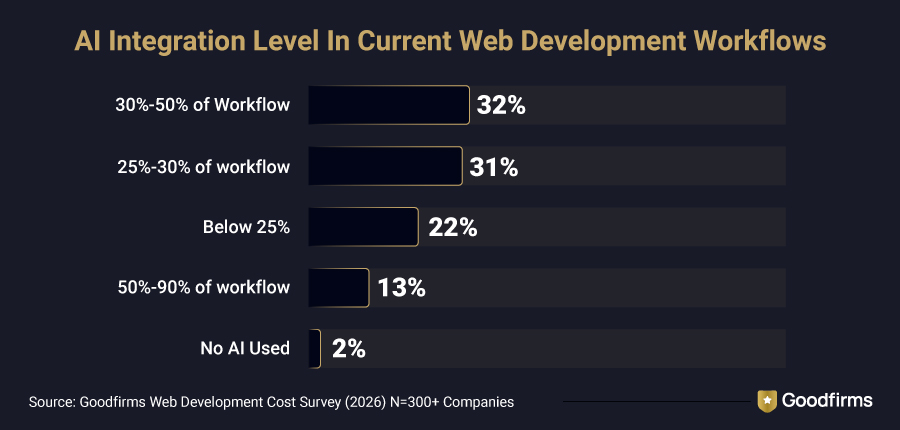
Of the 300+ agencies surveyed, 98% reported using AI, 32% report using it in 30–50% of their web development processes, and another 31% report using it in 25–30%. Thirteen percent have crossed the midpoint — AI is involved in more than half their workflow. For the web development agencies at that level, the productivity gains are concrete.
The consistent theme across the open-ended responses to this survey is that AI has split the market — it has not flattened it. Basic websites are cheaper and faster. At the same time, custom development, deep integrations, and AI-embedded product features have held their price or gotten more expensive as client expectations have risen alongside tool capability.
The survey respondents were direct about this split. Ivan Olin, CEO at UPlineSoft, captures it best:

AI pushed down prices for simple brochure sites and MVPs. Whereas demand and rates rose for AI-enabled features (recommendations, personalization, custom models). Also, costs for specialists (ML engineers, MLOps, prompt engineers) increased. Overall: lower entry prices for basic projects, and higher prices, wider spreads for projects with real AI/scale needs.
Brett Moore, Co-Founder at Brilliance, approaches the same shift from the client's side:

Generally, clients are getting a lot more for their dollar now. Projects are staying the same price, but clients are getting more for it due to the efficiency boost of AI. - at Brilliance, United States
The efficiency gains are real — but they have also reset client expectations upward. Virendra Sharma, Co-creator at Emizen Tech, captures what that means for pricing on complex projects:

AI has definitely changed web development pricing in 2026, especially for less complex websites. However, custom websites and web apps haven’t necessarily become cheaper. This is because businesses now seek smarter (AI-powered) features, better user experience, faster performance, and personalization. Therefore, where manual effort has decreased, the demand for experienced developers and strategic expertise has increased.
That pattern holds consistently across geographies — and the data from Europe puts precise numbers to it.
Valeriia Hrytsenko from Stubbs — a web development company in Ukraine — cited that their team sees AI speed up development 1.5x to 3x on greenfield projects, with closer to 30–50% improvement on legacy systems. Marat Nurhudin from Polytech Software, Ukraine, put it more starkly: AI has reduced costs for simple websites by 60–85% on average, but has had limited impact on complex systems where architecture, not typing speed, is the primary cost driver. That last point connects directly to what Vladislav Spița from HUGE Creative Agency, Estonia, said — "AI helps get jobs done faster, but the cost doesn't differ much, because in return we have the skill that we've invested time and resources into learning."
Muhammad Ali, Business Development Manager at Cubix - a web development company in the U.S., echoed the same finding from a different angle — that the "build" is now cheaper, but the "think" is not.

AI has shifted the focus toward building more complex, scalable, and feature-rich solutions within the same budget. In 2026, pricing is less about development time and more about problem complexity, system architecture, and long-term scalability.
The agencies applying AI in web development are handling this most effectively and have shifted their framing: they position AI as an efficiency multiplier that improves delivery speed and code quality, not a cost-reduction mechanism to be passed through as a discount. Several respondents noted that AI has actually allowed them to hold prices while delivering meaningfully more within those budgets, which represents a different kind of value than a lower invoice.

Clients increasingly expect AI-assisted development at reduced costs. I address this by separating speed gains from value delivery. Pricing is tied to outcomes, complexity, and accountability, not just effort.
Andrei Oprea, CEO atWPRiders in Romania handle it the same way — by being straight with clients about what AI actually does and doesn't replace in a real project.

Some clients do expect lower costs when AI is part of the workflow. We handle that by being transparent: AI can speed up parts of development, which can reduce time on certain tasks, but it does not replace planning, quality control, testing, or custom problem-solving. Our pricing reflects the value of the final result, not just the tools used to get there.
The agencies applying AI most effectively have shifted their framing — they position it as an efficiency multiplier, not a discount mechanism. Pratik Patel, Founder & CEO atWeDoWebApps from the United States puts it most directly.

The assumption is that if AI makes development faster, it should automatically make it cheaper. But that’s only partially true. We make it clear that AI can accelerate development, but it cannot replace architectural thinking, problem-solving, or accountability.
The consensus is clear — AI accelerates execution but does not replace judgment, and judgment is what agencies charge. Hourly rates are where that pricing becomes most visible, and geography remains the dominant variable.
What is the Hourly Cost of Hiring Web Developers?
The survey found a decisive majority — 57% of respondents — billing between $50 and $100 per hour, which represents the global mid-market. The $10–$15 bracket, cited by 30%, is almost entirely concentrated among the best web development companies in India, where operating costs and market dynamics support those rates. At the premium end, 11% of agencies charge $100–$150/hour, and 2% exceed a $200 per hour rate.
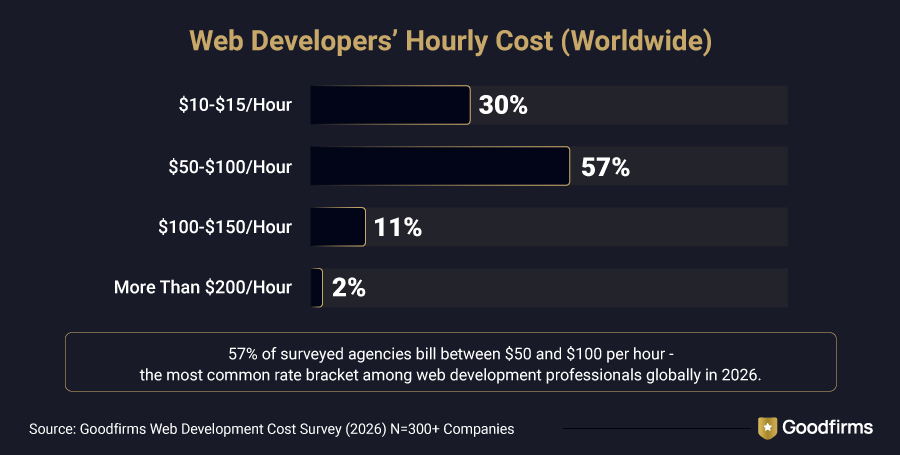
These hourly rates highly depend on the geographical location of the web development company you partner with. Below are the hourly rates that surveyed web developers in different regions charge for their services.
Web Development Cost: Hourly Rates of Hiring a Web Developer in Different Countries
Hourly rates don't follow a single global standard — they follow geography, market conditions, and the cost structures agencies operate within. The table below maps what web developers across the countries represented in this survey typically charge per hour.
|
Country |
Hourly Cost |
|---|---|
|
United States |
$50–100 |
|
United Kingdom |
$50–100 |
|
Canada |
$50–100 |
|
Australia |
$100–150 |
|
Germany |
$50–100 |
|
The Netherlands |
$100–150 |
|
Italy |
$100–150 |
|
Spain |
$50-100 |
|
Austria |
$50–100 |
|
Greece |
$50–100 |
|
Poland |
$50–100 |
|
Romania |
$50–100 |
|
Bulgaria |
$50–100 |
|
Estonia |
$50–100 |
|
Latvia |
$50–100 |
|
Slovenia |
$50–100 |
|
Czechia |
$50–100 |
|
Ukraine |
$50–100 |
|
India |
$10–15 |
|
Pakistan |
$10–15 |
|
Bangladesh |
$10–15 |
|
Nepal |
$10–15 |
|
Singapore |
$10–15 |
|
Vietnam |
$10–15 |
|
China |
$50–100 |
|
United Arab Emirates |
$50–100 |
|
Egypt |
$50–100 |
|
Tanzania |
$50–100 |
|
Uganda |
$10–15 |
|
Argentina |
$50–100 |
|
Peru |
$50–100 |
Geography determines the hourly rate tier more reliably than any other variable. Web development companies in Vietnam, India, Pakistan, Bangladesh, and other countries in South and Southeast Asia anchor the $10–$15 bracket, whereas web development companies in the U.S., UK, Canada, Germany, and more largely fall within $50–$100. The $100–$150 ceiling is reached only by web development firms in Australia, the Netherlands, and Italy.
Understanding hourly rates is useful for project scoping. For businesses that need continuous development support, maintenance, updates, feature releases, and ongoing technical oversight. On the other hand, many businesses prefer implementing the monthly retainer model, wherein they pay monthly to their web development partners for their ongoing projects. The survey data below shows what web development agencies charge for that kind of engagement.
Website Development Cost Based on Monthly Retainer Pricing Model
Nearly 30% of surveyed agencies price monthly retainers at $500–$1,500, with another 28% sitting in the $1,500–$3,000 band, together accounting for well over half the market. Retainers above $6,000 remain a smaller slice at around 10%, typically tied to enterprise-scale ongoing work.
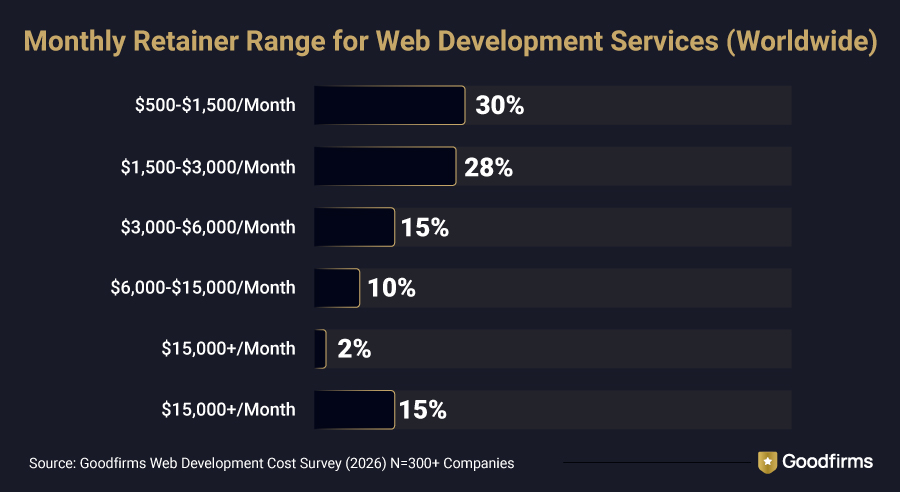
Key Insight: 30% of web development companies charge $500–$1,500 per month, and 28% charge $1,500–$3,000 — modest figures that often cover maintenance, content updates, and minor feature iteration rather than active builds.
Behind every retainer bracket is a salary figure. Developer compensation varies as sharply by country as hourly rates do — and the data below shows what web developers across the survey's key markets typically earn, adding another dimension to the web development costs.
Salaries of Web Developers in Different Countries
The table below shows the salaries of web developers across different countries, which can help you estimate web development costs if you are planning to implement a monthly retainer pricing model within your business.
|
Country |
Monthly Salary |
|---|---|
|
United States |
$5,000-$8,000 |
|
Canada |
$3,000-$4,500 |
|
UK |
$3,000-$5,000 |
|
The Netherlands |
$3,500-$5,000 |
|
Australia |
$4,000-$6,000 |
|
Italy |
$2,000-$3,000 |
|
Greece |
$1,000-$1,500 |
|
India |
$500-$1,000 |
|
Ukraine |
$2,000-$4,000 |
|
United Arab Emirates |
$1,000-$2,500 |
|
Pakistan |
$250-$500 |
|
Bangladesh |
$150-$300 |
|
Vietnam |
$350-$800 |
As you can see, the salary gap between markets is stark: a web developer in Bangladesh earns $150–$300 monthly, while a web developer in Canada takes home $3,000–$4,500 — a differential that sits at the foundation of every geographic pricing decision in this survey.
Those salary gaps explain a lot about why quotes from different markets look so different. What they don't explain is how firms decide to charge — and that comes down to the pricing models they work with.
How Do Web Development Firms Structure Their Pricing Models in 2026?
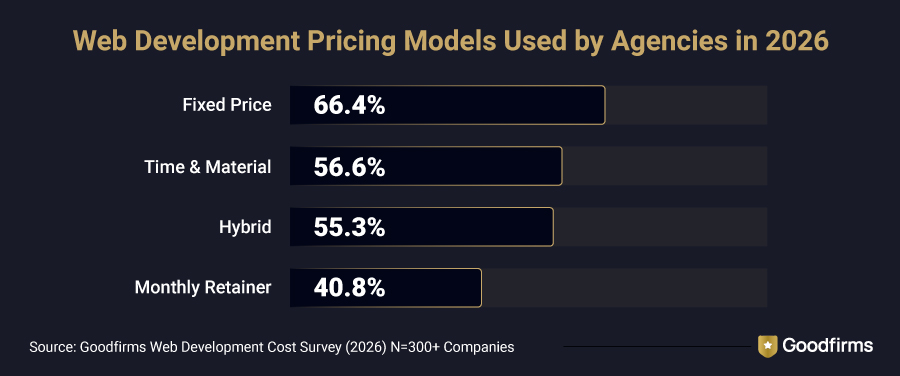
Fixed Pricing Model
66.4% of the web development agencies surveyed use a fixed pricing model. Under this model, a defined scope is agreed upon upfront, and a single project cost is set before work begins. It suits businesses that need cost certainty and well-scoped deliverables.
Time & Material Pricing Model
Cited by 56.6% of respondents, this pricing model is the second-most-used. Rather than locking in a cost at the outset, T&M billing tracks actual hours and resources consumed, with the client paying as the work progresses. It is the natural fit for projects where requirements are likely to evolve.
Monthly Retainer Pricing Model
Used by 40.8% of respondents, the monthly retainer pricing model requires businesses to pay their web development partner a recurring monthly fee for website development, content updates, maintenance, and strategic support.
Hybrid Pricing Model
55.3% surveyed agencies use a hybrid pricing model. A hybrid arrangement typically fixes pricing for clearly scoped phases (design, initial build) while leaving later phases open to T&M or retainer billing as requirements clarify.
Key Takeaway: Fixed price is the most widely adopted pricing model, but it is not a dominant choice, as T&M and hybrid models trail by only a narrow margin.
The four pricing models above capture how agencies bill today — but how agencies think about pricing is a different conversation entirely.
How the Industry Is Rethinking Website Development Cost in 2026
Across the survey, agencies flagged a growing client preference for outcomes over hours, and AI-assisted workflows are accelerating that transition faster than most pricing frameworks were designed to handle.
On the move toward value-based models:

We are also seeing a shift away from hourly pricing toward value-based or outcome-based pricing models. Clients are less interested in how many hours a project takes and more interested in measurable results and long-term efficiency gains.
On how AI is disrupting time-based billing:

Earlier, web development was priced based on time. Now in 2026, more agencies are shifting to feature-based pricing, speed-based delivery packages, and value or outcome-based pricing. AI is pushing this shift because the same project can take wildly different hours depending on how much AI is used in the workflow.
On balancing AI efficiency with technical complexity:

We’ve adjusted our pricing model to reflect AI-assisted efficiency on simpler projects while maintaining standard rates for complex builds that demand deep technical knowledge and experience.
On anchoring price to expertise rather than effort:

Pricing is based on business outcomes and expertise, not just development hours.
These quotes from four different agencies agree to the point that - hours no longer define value in web development.
Every project quote is a sum of smaller decisions — how much goes to design, how much to backend, how much to QA. This is how agencies allocate budget across the phases that take a website from brief to launch.
Where the Money Actually Goes: Budget by Project Phase
Where does the money actually go once a project kicks off? The survey asked agencies to break down budget allocation across six core phases — and the results challenge a common assumption that development swallows most of the budget.
|
Project Phase |
Most Common Allocation |
Percentage of Companies |
|---|---|---|
|
Discovery & Planning |
5%–10% |
53% |
|
Design |
10%–20% |
47% |
|
Front-End Development |
20%–30% |
53% |
|
Back-End Development |
30%–40% |
36% |
|
QA & Testing |
10%–20% |
48% |
|
Project Management |
5%–10% |
44% |
Back-end development takes the largest share of the budget, followed closely by front-end work. Together, development typically accounts for 50%–70% of the total project spend. Design — which many clients over-index on in early discussions — usually runs between 10% and 20%, while discovery and project management are each allocated 5%–10%, which is often too lean given how much scope clarity early on can prevent costly mid-project changes.
Considering a real-world scenario, if a web development firm has quoted you $50,000 for your web development project, this is where your money goes.
The $50,000 breakdown above is one scenario. Yours will be different, obviously — shaped by how broad the scope runs, which tech stack your agency works in, which CMS platform fits your content needs, what your industry demands from a compliance and performance standpoint, and how much AI capability you want built into the product. Each of those variables is covered in the sections below — starting with how project scope drives the first and largest cost decision.
Web Development Cost by CMS Platform: WordPress, Shopify, Webflow, and Beyond
Platform choice is inseparable from pricing — not because any CMS is inherently expensive, but because each one attracts a different tier of project complexity and a different caliber of developer.
|
CMS Platform |
Most Common Cost Range |
Percentage of Companies |
|---|---|---|
|
WordPress |
$3,000 – $40,000 |
81% |
|
Shopify |
$3,000 – $40,000 |
68% |
|
Webflow |
$3,000 – $40,000 |
55% |
|
Wix |
$3,000 – $10,000 |
30% |
|
Strapi |
$10,000 – $40,000 |
34% |
|
Drupal |
$3,000 – $120,000 |
40% |
|
Contentful |
$3,000 – $120,000 |
34% |
|
Sanity |
$3,000 – $120,000 |
36% |
WordPress's $3,000–$10,000 modal range reflects its versatility rather than its ceiling — complex builds handled by experienced WordPress development companies regularly reach $40,000+ when custom plugin development, multisite architecture, or advanced editorial workflows are involved. Shopify's wider range ($3,000–$40,000) mirrors the gulf between a straightforward product store and a DTC brand site with custom integrations, subscription logic, and warehouse API connections — the kind of work specialist Shopify developers price at the higher end of that bracket.
The numbers above show what each platform costs. What they don't show is how many firms are actually working with each one — and the split is more lopsided than most buyers expect.
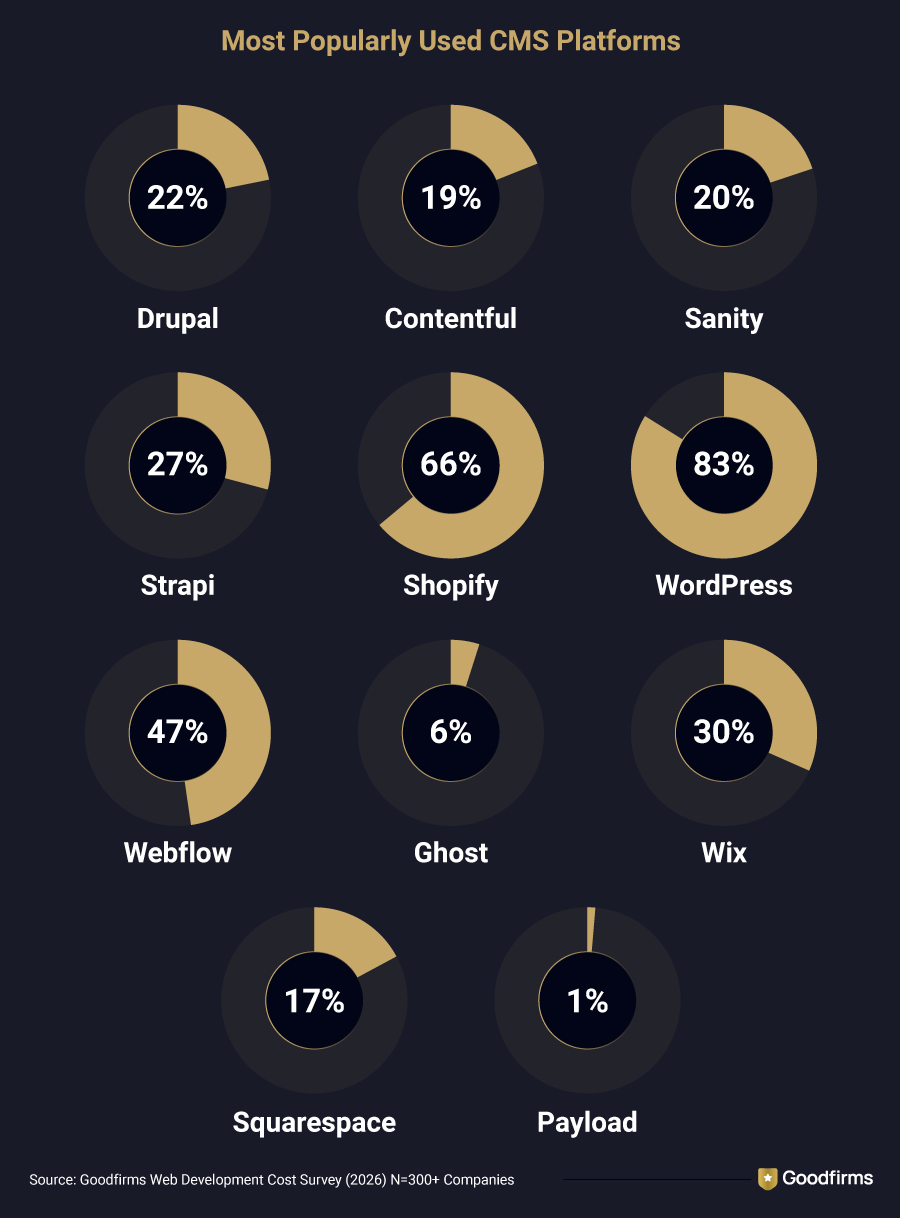
The survey found WordPress still dominates (83% of respondents build on it), while Shopify (66%), Webflow (47%), and Wix (30%) round out the most-used platforms. Headless options like Strapi (27%), Contentful (19%), and Sanity (20%) are gaining ground among agencies that serve enterprise and omnichannel clients.
Those are the platforms. Now look at what agencies are building with on the frontend — because framework choice moves the budget just as much as platform does.
Website Development Cost By Frontend Framework: React, Vue.js, Angular, and More
On the framework side, React and Next.js both center around $10,000–$40,000, reflecting their fitness for dynamic, state-heavy applications. Vue.js development companies follow a similar pattern, with the majority of projects landing in the same mid-range bracket. Angular tips toward premium pricing more often, with 25% of respondents placing it at $40,000–$120,000+, consistent with the enterprise front-end complexity that Angular development companies are typically brought in to handle.
|
Front-End / Cost Range |
$3K-$10K (Percentage of Companies) |
$10K-$40K (Percentage of Companies) |
$40K-$120K (Percentage of Companies) |
|---|---|---|---|
|
React |
42% |
48% |
11% |
|
Vue.JS |
37% |
53% |
10% |
|
Angular |
33% |
40% |
28% |
|
Svelte |
36% |
53% |
12% |
|
Next.js |
37% |
49% |
14% |
|
Nuxt |
37% |
53% |
10% |
|
Astro |
48% |
42% |
10% |
Key Findings: Across every frontend framework surveyed, the $10K–$40K bracket dominates — Vue.js, Svelte, and Nuxt each see 53% of projects land there, the highest concentration in the dataset. React follows the same pattern with 48%. The $40K–$120K tier remains a smaller slice across all frameworks, though Angular stands out with 28% of projects reaching that bracket — the highest among all seven frameworks surveyed, reflecting its enterprise adoption.
That covers the frontend. The backend is where the bigger cost decisions tend to sit — and the stack chosen there shifts the budget just as meaningfully.
How Much Does it Cost to Build a Website Based on the Backend Techstack Selected?
Laravel PHP sits in the $3,000–$10,000 range for 40% of respondents — a figure that reflects how Laravel development companies typically position the framework: capable enough for mid-complexity builds, accessible enough to keep budgets in check.
| Backend / Cost Range |
$3K-$10K (Percentage of Companies) |
$10K-$40K (Percentage of Companies) |
$40K-$120K (Percentage of Companies) |
|---|---|---|---|
|
Node.js + Express(Javascript) |
39% |
48% |
13% |
|
FastAPI (Python) |
33% |
53% |
13% |
|
Django(Python) |
29% |
54% |
18% |
|
Spring Boot (Java/Kotlin) |
25% |
41% |
34% |
|
Laravel (PHP) |
43% |
45% |
12% |
|
Ruby On Rails |
32% |
53% |
14% |
|
ASP.Net (C#) |
29% |
35% |
36% |
|
Go (Gin/Fiber) |
25% |
50% |
25% |
|
NestJS(TypeScript) |
34% |
50% |
16% |
Key Findings: Django leads the $10K–$40K bracket at 54%, with Ruby on Rails and FastAPI close behind at 53% each, making Python and Ruby stacks the most cost-concentrated in the mid-range. Laravel stands out at the higher end, with 43% of projects reaching the $40K–$120K bracket, the highest across all nine frameworks. NestJS follows at 16%. Spring Boot shows the most even distribution across all three tiers, reflecting its broad enterprise range.
Taken together, the frontend and backend data make a straightforward case: technology decisions made in week one of a project have a measurable effect on the invoice issued in the final week. The section below puts a precise figure on how much does technology choice influence web development project cost.
How Much Does Technology Choice Influence Your Project Cost?
The answer varies less than you might expect. Across 300+ companies surveyed by Goodfirms, 73.7% rated technology choice as having a moderate to very high impact on what a web development project ultimately costs.
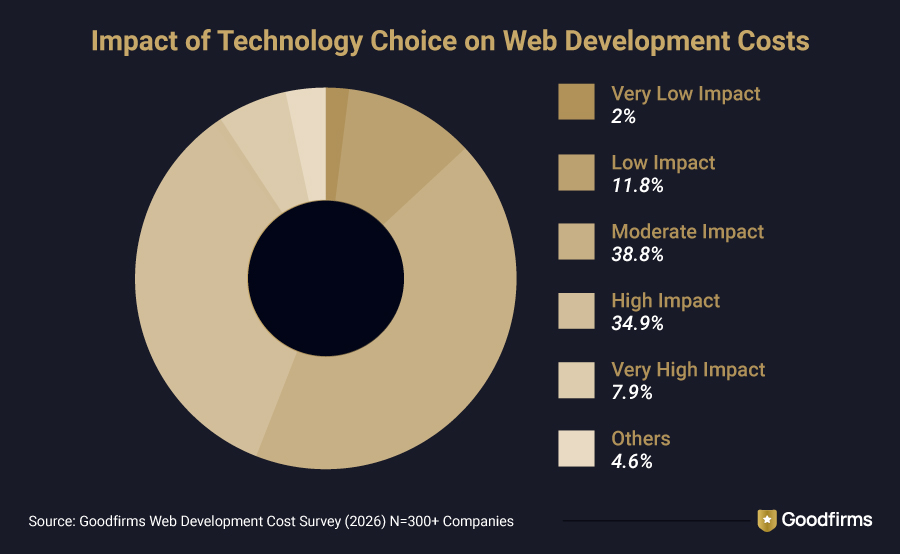
Key Findings: More than 75% of web development agencies rate technology stack choice as having moderate-to-high impact on project cost, considering that platform and framework decisions made early in scoping have lasting budget consequences.
That 75% figure raises a question the industry has been circling for the past two years: if AI builders and low-code platforms are genuinely compressing development timelines, are they also compressing costs — or simply shifting where those costs accumulate? The data below offers a direct answer.
Stack choice sets the foundation, but it does not determine the final bill. What happens during the project often matters more. The survey identified eight factors that consistently push costs beyond the original quote — regardless of platform or framework.
What Makes Web Development Expensive? The Eight Factors That Push Web Development Projects Over Budget
Every web development quote carries a number the client sees — and a dozen variables they don't. Scope shifts mid-project. A third-party API turns out to need a custom wrapper. The design looks clean in Figma, but demands three extra weeks of front-end work to actually behave that way in a browser. In this survey, web development companies have cited custom backend development, advanced UI/UX requirements, and third-party integrations as the three most prominent factors that consistently push project costs beyond the original estimate. Understanding what drives the price — before the project starts — can clearly help businesses access cost-effective web development services.
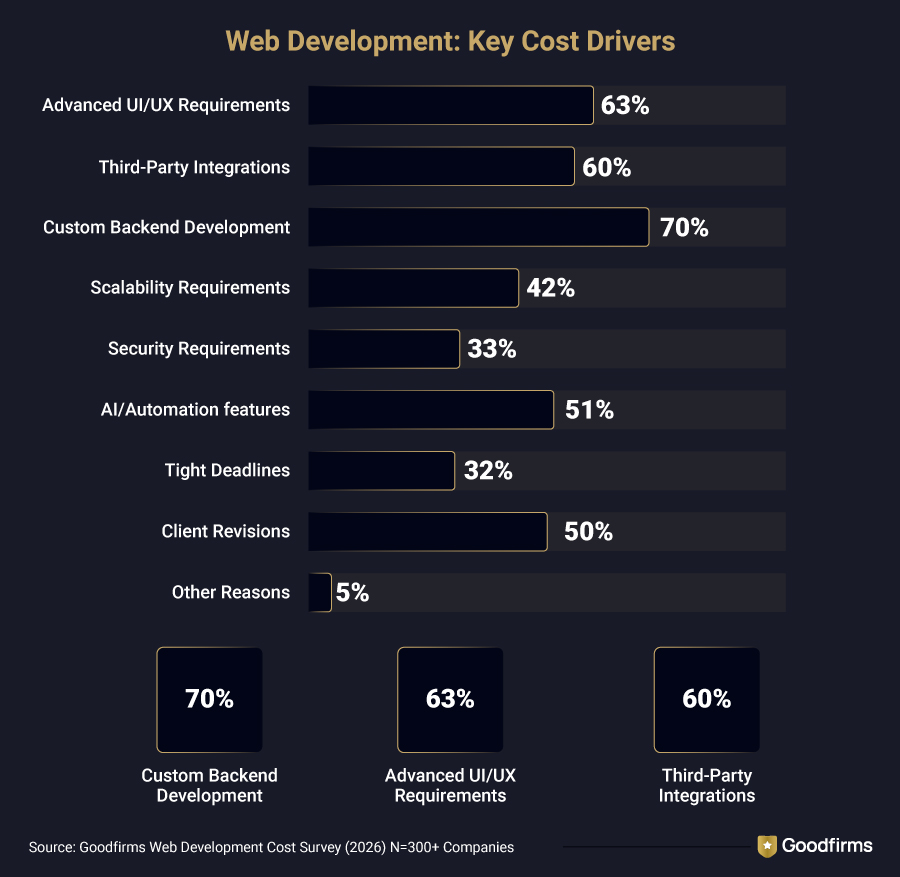
Custom back-end development leads by a considerable margin. That 70% figure is a reminder that original server-side engineering — writing business logic from scratch, designing data models, building APIs — is irreducibly human and time-intensive. It cannot be templated away, and AI tools that accelerate front-end scaffolding have limited leverage here.
The appearance of AI and automation features as one of the top cost drivers — cited by 51% of respondents — is one of the more striking findings in the survey. Adding genuine intelligence to a product (recommendation engines, automated workflows, LLM-powered interfaces, real-time personalization) demands data architecture, model selection, integration, testing, and ongoing maintenance that frequently rivals the cost of building the surrounding website itself.
Client revisions, at 49%, reflect a structural industry tension: the agencies most under cost pressure are often the ones with the least formal change-control processes. Those that have shifted toward retainer models or milestone-gated approval structures tend to absorb this cost rather than be blindsided by it.
The factors above explain why projects run over budget during delivery. What the survey captured next is a different problem — costs that don't inflate the build, but follow it. Line items that appear on the ledger after the contract has been signed, the site has launched, and the project has nominally closed.
Web Development Hidden Costs: The Line Items That Appear After the Contract Is Signed
The survey's open-ended questions on hidden costs produced the most consistent answers of any section. Across geographies, company sizes, and specializations, the same categories surfaced repeatedly — and they have been largely the same for years. What has changed in 2026 is the addition of costs relating to Artificial Intelligence in web development that barely appeared in equivalent surveys three years ago.

The highest hidden costs in web development are usually not the code itself, but unclear requirements, revisions, integrations, scalability, maintenance, and decision delays. In 2026, AI reduced development time, but the real cost is still in strategy, architecture, reliability, and making everything work smoothly at scale.
Scope Expansion
Scope expansion tops nearly every web development company's list of hidden costs. Projects that start as a 20-page marketing site quietly accumulate feature requests, revised information architecture, additional integrations, and extra review rounds until the scope has doubled and the timeline has stretched. The agencies with the most robust change-control processes — structured discovery phases, approval gates, documented change orders — absorb this better than those who treat early project conversations as informal agreements.

The hidden costs of a web development project often sit outside the visible scope of design and coding; they emerge in areas like integrating with legacy systems, preparing and cleaning data, migrating content, ensuring accessibility and responsiveness across devices, and planning for scalability so the platform can handle growth and new features. These elements don’t always appear in the initial estimate, but they can significantly impact timelines and budgets if not anticipated.
Third-party integrations
Third-party integrations routinely cost two to three times more than their initial estimates. Every integration that looks straightforward on paper — a CRM sync, a payment gateway, a booking system — carries its own documentation gaps, rate limits, authentication quirks, and edge cases that only reveal themselves during implementation.

People think of a website as a static thing, but it must be dynamic. It must integrate with various tools (CRM's, third party payment providers, analytics, etc). This is the highest hidden cost I've found. Many clients need to be educated on why these things are important and why they are an additional scope.
Content Delays
No development team can build what doesn't exist yet. Copy, images, legal disclaimers, product descriptions, and structured data all sit on the client side of the project — and they almost never arrive on schedule. The knock-on effect is predictable: timelines stretch at the back end, QA gets compressed, and launch windows slip. What began as a content delay quietly becomes a delivery problem, and the cost of that compression rarely shows up anywhere in the original project estimate.

Content delays are underestimated all the time. Missing copy, images, product data, legal texts, or translations can slow a project more than the technical work.
SEO and Digital Marketing
Most clients treat SEO and digital marketing as activities that begin after a site launches. Developers know better. Page architecture, canonical structures, schema markup, Core Web Vitals, and analytics event tracking are all build-phase decisions. Deferring them doesn't save money at the outset — it creates a remediation invoice shortly after go-live. Understanding what SEO services actually cost before the build begins is the more practical starting point.

Many businesses invest in building a website without clearly defining their positioning, target audience, and SEO structure. As a result, the website may look good, but it fails to generate traffic and leads. In our experience, the real cost is not building a website; it is building one that performs.
Security and Compliance
GDPR obligations, PCI-DSS requirements, penetration testing, and role-based access controls all sit at the intersection of legal necessity and engineering complexity. When they're treated as post-launch considerations rather than build-phase requirements, the cost of addressing them doesn't disappear — it compounds, arriving as unbudgeted work on a codebase that was never designed to accommodate it.

Compliance work. GDPR, cookie consent, accessibility (WCAG), and now EU AI Act obligations. Almost always gets pushed to "phase 2" and is almost always more expensive to bolt on later.
Post Launch Maintenance
The launch date feels like the finish line — but for the infrastructure supporting the site, it's closer to the starting gun. Hosting fees, SSL renewals, CMS and plugin updates, security patches, and dependency maintenance arrive on a rolling schedule that begins the moment the site goes live. Performance tuning and analytics configuration add further overhead that most initial budgets never account for. Across a typical engagement, these recurring costs can approach — and sometimes exceed — what was originally spent building the site itself.

One of the highest hidden costs is ongoing maintenance after the website is launched, which includes bug fixes, dependency updates, and security patches, which are rarely fully accounted for in initial quotes.
AI Augmentation
AI augmentation carries two costs that never appear on the original quote.
- Inference and compute expenses: This cost doesn’t appear on a project invoice; they appear on a monthly cloud bill that scales directly with how many users actually interact with AI features on your website.
- Meeting out-of-the-box standards: AI-generated code moves fast in prototyping but rarely meets production standards out of the box, requiring a second engineering pass that can exceed the original savings.
Both costs emerge after launch, when the architecture is already locked in — which is exactly what makes them so consequential.

Thinking that using AI will speed up the process, but usually it helps in the beginning ideation phase, and you can take the project to 80% fairly quickly using AI tools, but that last 20% is where you need to spend a lot more time to make it perfect.
The further a project pushes into custom AI territory, the more that final stretch expands — as The Frog Digital Agency in Spain has found firsthand.

Custom projects involving AI agents, RAG systems, or proprietary data models command higher fees due to the specialized engineering required.
Planning Guidance
The total two-year cost of a professionally built website typically runs 150–200% of the initial build invoice once hosting, maintenance, content updates, integration upkeep, and feature additions are included. Agencies that surface this reality during scoping — rather than leaving it for the client to discover post-launch — tend to maintain longer, more stable client relationships.
Scope changes, skipped compliance work, and post-launch maintenance are the reasons most web development projects go over budget. But the survey makes clear that most budget surprises are preventable. The FAQs below address the decisions and conversations that help in preventing them.
FAQs About Website Development Cost in 2026
How do I evaluate a web development quote before accepting it?
Ask for a phase-by-phase breakdown, not a single number. Confirm what's excluded — content, SEO setup, third-party licenses, and post-launch maintenance are the four items most commonly omitted from initial quotes.
Should I hire a freelancer or an agency for my web development project?
The decision hinges less on cost and more on how much project management you're prepared to handle yourself. Freelancers suit contained, well-scoped projects with lower budgets. Agencies bring process, accountability, and multi-disciplinary capacity for larger or more complex builds.
How much should I budget for web development maintenance annually?
Plan for 15–20% of your initial build cost per year. That typically covers hosting, security patches, CMS updates, and minor content changes — before any new feature development is considered.
What should a discovery phase include, and is it worth paying for separately?
A paid discovery phase should produce a defined scope, technical architecture recommendation, and project timeline. Skipping it is the single most reliable way to encounter scope expansion and budget overruns mid-project.
How do I reduce web development costs without compromising quality?
Prioritize a well-documented brief, limit revision rounds contractually, choose a CMS your team can manage independently post-launch, and defer non-essential features to phase two rather than building everything at once.
At what point should a business consider rebuilding rather than maintaining an existing website?
When annual maintenance costs exceed 30% of a rebuild estimate, or when the current architecture can no longer support business requirements, a rebuild typically delivers better long-term value than continued remediation work.
Research Conclusion: What This Survey Tells Buyers, Agencies, and the Market at Large
Web development costs in 2026 are shaped by more variables than any single benchmark can capture — geography, stack choice, project complexity, AI integration, and a category of hidden costs that most budgets still don't account for. What this survey of 300+ agencies across 31 countries makes clear is that predictable project outcomes are less about finding the lowest quote and more about understanding what drives the number behind it. Use this data as your benchmark — then find and shortlist web development companies on Goodfirms matched to your budget, region, and project type.
Methodology: This report is based on a Goodfirms survey of 300+ web development companies, agencies, and independent professionals conducted in April–May 2026. Respondents represent a cross-section of company sizes (freelancers through 200+ employee enterprises) and geographies (31 countries). All cost and timeline estimates reflect agency-reported ranges for typical project scenarios. Actual project costs vary based on scope, client requirements, geographic market, and specific technical choices. Percentage figures are rounded to one decimal place; totals may vary due to multi-select questions. All agency quotes are attributed to the responding organization. Individual respondent details are held on file per the Goodfirms survey consent agreement, April–May 2026. We sincerely thank our research partners for their valuable time, suggestions, and inputs.