ABSTRACT:
Large language models or LLMs are increasingly demonstrating their significant capabilities, which are impressive and working well across all industries. Their prominent application is seen today in content writing, search engine optimization, and marketing due to their deep learning and pre-trained data sets.
To learn more about LLMs and their transformative role in content generation, SEO, and marketing campaign design, Goodfirms conducted a survey titled, “LLM Applications in Content Writing, SEO, and Marketing Campaign Design.”
LLM Survey Summary : Key Takeaways:
- 100% businesses are familiar with Large Language Models (LLMs) like ChatGPT, Claude, or Gemini.
- 55% businesses have completely adopted LLMs for their marketing activities.
- 67% of small businesses are already aware of AI and automation.
- 96% businesses are already using Large Language Models (LLM) like OpenAI’s ChatGPT, Google Gemini, etc. for content creation (blogs, articles, product descriptions, emails, social media posts)
- 84% of the survey participants have taken advantage of LLMs for their SEO optimization tasks (keyword research, optimization, meta descriptions, clustering) -
- 81% of the businesses are using LLMs for Market Research & Insights
- 76% surveyees use LLMs for Campaign Design (creative copy, A/B testing, Image creation, ad variations, personalization)
- For 54% businesses, LLM has a huge role in Customer Engagement/ Service (chatbots, automated responses)
- Top benefits of using LLMs include; Faster content creation - 78%; Increased creativity & campaign ideas - 60% Cost savings - 42%; Improved SEO performance - 42%; Better personalization for target audiences - 26%; Faster image creation - 23%, and Competitive advantage - 22%.
- A few noted drawbacks of LLM applications are - Risk of plagiarism / duplicate content - 56%; Lower Accuracy & factual reliability - 51%; Inability to maintain brand voice & originality - 44%; SEO penalties for AI-generated content - 36%; Old references/No latest references - 36%; Dependence on external AI tools - 34%.
- 33% businesses indicate ethical or copyright concerns with LLMs.
- 17% participants are facing memorization traps with the LLMs.
- 16% have faced with instant switch/change under pressure with the LLMs
- 66% feel data privacy, data security, and confidentiality are the top risks of LLMs (which can be mitigated by mindful practices).
- 40% surveyees are ready to establish AI governance and 50% are ready to strengthen their AI team’s capabilities to handle LLMs.
- 3% businesses are still skeptical about using LLM applications. They believe this is going to disconnect users from a human touch.
LLM Survey Participants Summary:
.jpg)
The survey was made available from 10/09/2025 to 20/10/2025. There are 363 participants which includes 67% - Small Businesses / Startups, 28% - Medium-sized businesses, and 5% - Large Enterprises. The survey respondents are from 15+ Industries with 56% companies from the digital Marketing & Advertising industry; 36% from IT/Software services industry; 4% from the Ecommerce/Retail industry; and the rest 4% from other industries. Interestingly, 72% of respondents are CEOs/ Founders / Directors, and 18% are Digital Marketing Managers, 5% are SEO managers, and 5% Content managers.
The participants are from 25+ Countries - (USA - 31%; India - 30%; UK - 9%; Canada - 7%; UAE - 3%; Australia - 3%; Greece - 2%; 15% - rest of the world).
Awareness of Large Language Models (LLMs):
Large language models, or LLMs, work on AI technologies that employ machine learning. They handle vast amounts of data and immense computing power. Insufficient data and poor prompts can make it incapable. LLMs began gaining popularity in 2017, and within a few years, they have become a mainstream attraction for every organization today.
To understand the general awareness and exposure to LLMs or the modern AI technologies, Goodfirms began the survey by questioning the participants’ familiarity with widely used Large Language Models.
How familiar are you with Large Language Models (LLMs) like ChatGPT, Claude, or Gemini?
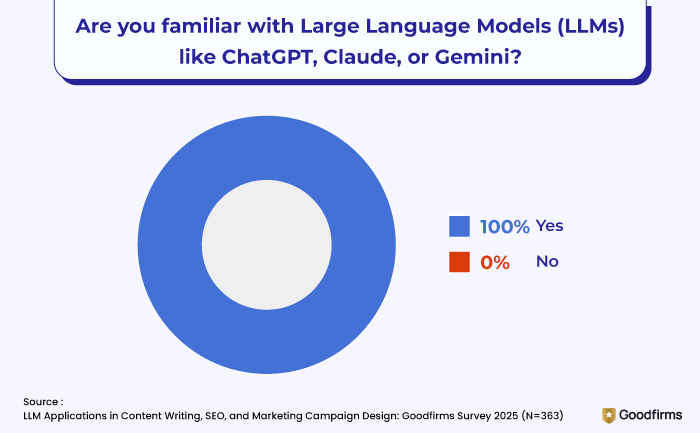
All participants (100%) reported that they are familiar with Large Language Models such as ChatGPT, Claude, and Gemini. This indicates a high level of awareness and exposure to generative AI tools among the surveyed group.
After gathering inputs about their familiarity with LLMs, the survey moved on to understand how actively organizations are integrating these models into their marketing workflows:
Has Your Company Adopted LLMs In Marketing Activities?
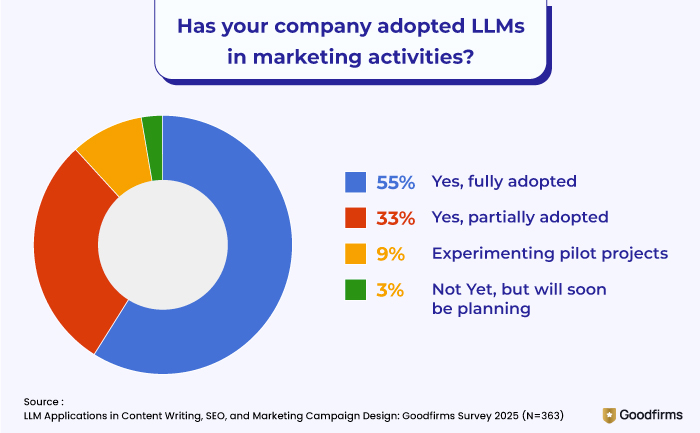
Significant participants indicated active adoption: 55% have fully integrated LLMs into their marketing processes, while 33% have partially adopted them. Another 9% are currently experimenting through pilot projects. Only 3% have not yet adopted LLMs but plan to do so soon. If you notice, 67% of our survey participants are small businesses or startups. This finidng indicates that more small businesses are adopting LLMs to leverage AI and automation. This reflects a strong and growing momentum toward AI-driven marketing across organizations.
In Which Areas Do You Use LLMs?
To assess the extent to which LLMs are integrated into digital marketing workflows, the survey further explored the specific applications[1] in which companies are leveraging these models. This question aimed to reveal the actual, and reasonable, day-to-day applications of LLMs across the marketing spectrum—from content creation and research to customer engagement, search engine optimization, and campaign development. By identifying these usage patterns, Goodfirms intended to gain clearer insights into which marketing areas are undergoing a genuine AI-driven transformation.
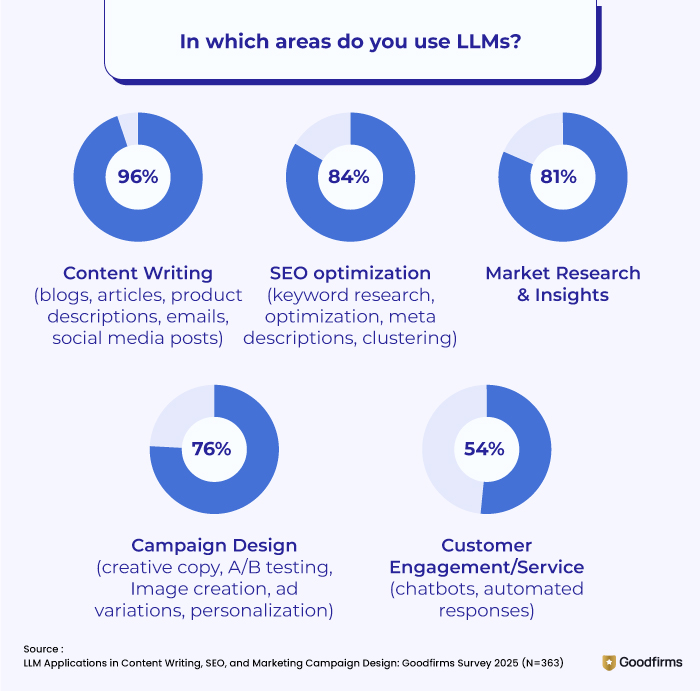
96% businesses are relying on LLMs for Content Writing
Content generation stands as the most dominant use case, with nearly all respondents relying on LLMs to produce blogs, articles, product descriptions, emails, and social media posts. This indicates that content creation is the first and most natural point of AI adoption due to its high volume, repetitive nature, and need for quick turnaround.
84% participants are using LLMs for SEO Optimization
A strong majority use LLMs for SEO tasks such as keyword research, meta descriptions, clustering, content optimization, and other ranking suggestions. However, as LLMs reshape how content gets discovered, how SERP visibility is measured is changing just as fast, and rankings alone no longer reflect the full picture of organic search performance. This shows that businesses increasingly trust AI for data-backed SEO and GEO insights and efficiency-driven optimization strategies.
81% use LLMs for Market Research & Insights
LLMs are widely used for synthesizing market data, analyzing trends, and generating quick insights. This high adoption suggests that companies value AI for speeding up research processes and making data interpretation more accessible across teams.
76% Survey Respondents use LLMs for Campaign Design
Over three-quarters of respondents use LLMs for campaign conceptualization, creative copy, A/B testing ideas, image prompts, and ad personalization. This highlights the growing role of AI in creative brainstorming and multivariate testing, which traditionally required more time and human resources.
54% use LLMs for Customer Engagement / Service
More than half use LLMs for chatbot interactions and automated responses. While the adoption for large language models is strong for customer engagement or service, it is comparatively lower than other areas—indicating that organizations may still be cautious about fully automating customer-facing interactions or are in the process of upgrading legacy systems.
What can we derive from the above responses?
The results clearly demonstrate that LLMs are now integrated across digital marketing processes. Adoption is highest in content-heavy and research-intensive areas, while customer service automation is growing steadily but at a measured pace. Usage of LLMs for search engine optimization is also strong. The data reflects a shift toward AI-assisted marketing operations, with companies increasingly relying on large language models (LLMs) to enhance creativity, speed, efficiency, and decision-making.
What Percentage Of Your Marketing Content Is AI-Assisted?
As AI continues to deliver a transformational change to the marketing landscape, businesses are increasingly integrating Large Language Models (LLMs) and other generative AI tools into their content creation workflows. To understand the extent of AI’s influence, the survey respondents were asked how much of their marketing content currently leverages AI assistance.
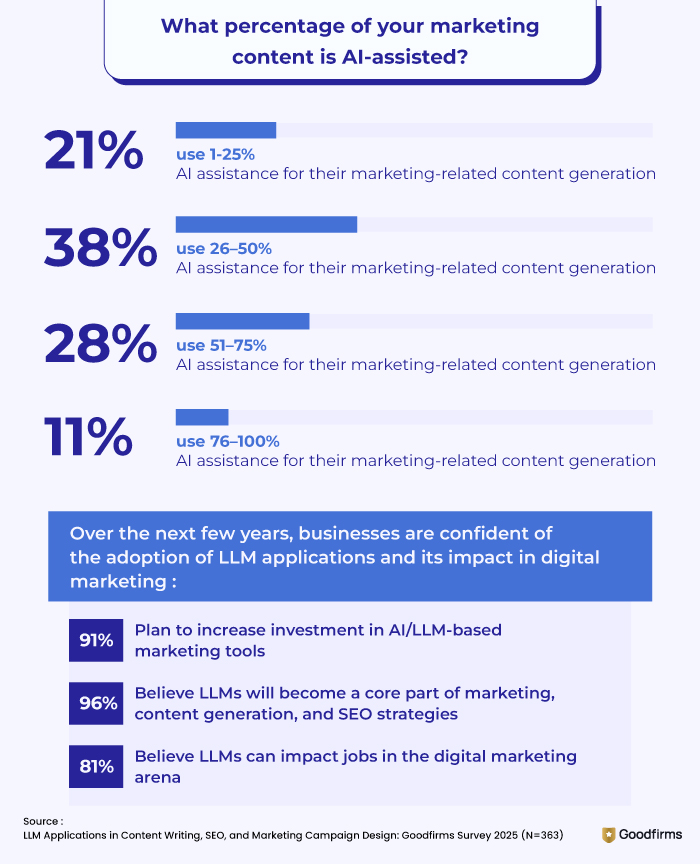
The responses indicate that AI has already found a strong foothold in content generation:
- 21% of respondents use 1–25% AI assistance — primarily for light content support such as ideation, outlines, or keyword suggestions.
- 38% use 26–50% AI assistance — integrating AI for tasks like content drafting, email creation, and SEO optimization.
- 28% rely on 51–75% AI involvement — suggesting partial automation and stronger dependence on LLMs for multi-channel marketing content.
- 11% report 76–100% AI-assisted content generation — indicating near-full adoption, often within highly digital or tech-forward organizations.
More than three-fourths (77%) of businesses now use AI for over a quarter of their marketing content, showing a clear trend toward deeper AI integration. This signals that AI tools have transitioned from experimental to essential across many marketing functions.
The respondents’ forward-looking data also underscores strong optimism toward AI’s role in marketing:
- 91% of respondents plan to increase investment in AI/LLM-based marketing tools in the coming years.
- 96% believe that LLMs will become a core part of marketing, content generation, and SEO strategies.
- 81% acknowledge that LLM adoption could impact jobs in the digital marketing sector — a sign that automation and efficiency gains are reshaping workforce dynamics.
What can we derive from the above responses?
The findings make it clear: AI has become a core strategic necessity in digital marketing, particularly in content generation. While enthusiasm for AI-driven strategies is high, businesses also recognize AI’s transformative impact on traditional marketing roles.
What are the Benefits of LLM Applications in Content Writing, SEO, and Marketing Campaigns?
By 2030, leading LLMs could perform tasks in just a minute that would take a human an entire month with around 50 percent reliability.[2]
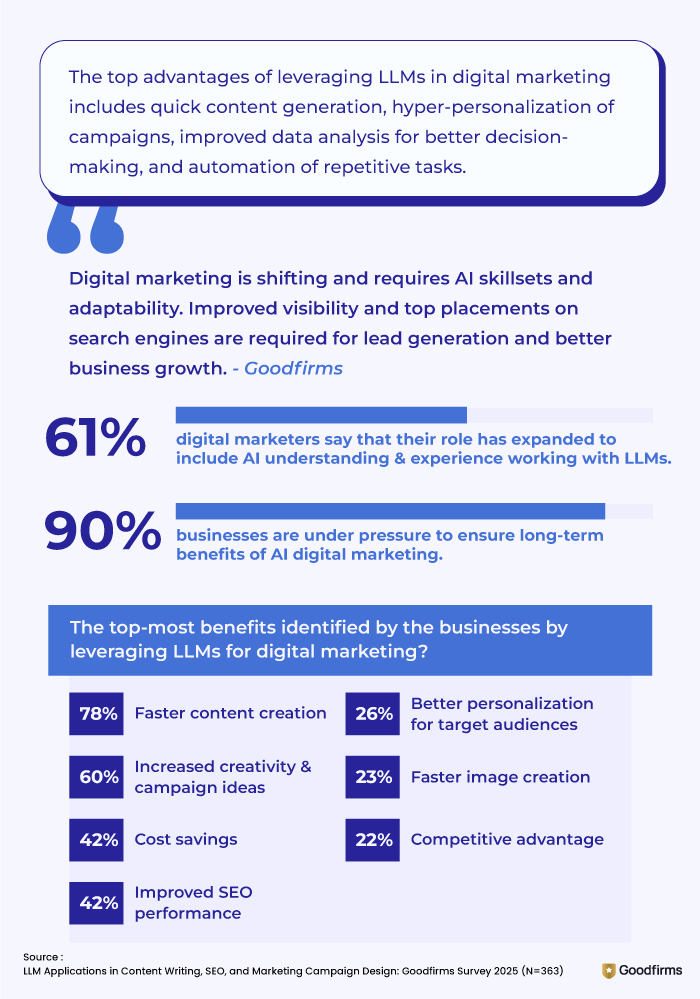
As organizations increasingly adopt AI and LLM-powered tools across marketing workflows, understanding the tangible benefits becomes essential to evaluating their long-term value. Respondents were asked to identify the top advantages they have experienced by integrating LLMs into their digital marketing strategies.
Key Benefits Reported by Businesses:
- Faster content creation – 78%
Speed remains the most cited benefit, with a majority acknowledging that LLMs significantly reduce turnaround time for blogs, social media posts, emails, and campaign copies. - Increased creativity & campaign ideas – 60%
Many businesses credit AI for helping them generate new concepts, creative directions, and campaign variations that enhance brainstorming efficiency. - Cost savings – 42%
By automating repetitive writing and optimization tasks, LLMs help teams operate with leaner resources and reduced external agency dependency. - Improved SEO performance – 42%
Marketers are using LLMs for keyword clustering, meta descriptions, and content optimization, leading to measurable SEO gains. - Better personalization for target audiences – 26%
AI tools enable marketers to segment audiences and tailor messages more effectively, enhancing engagement and conversion potential. - Faster image creation – 23%
With the rise of AI image generators, businesses are accelerating visual content production for campaigns and product promotions. - Competitive advantage – 22%
Early adopters believe AI adoption gives them a strategic edge through faster execution, data-driven decisions, and improved content performance.
61% digital marketers say that their role has expanded to include AI understanding and experience working with LLMs.
90% businesses are under pressure toensure long-term benefits of AI digital marketing.
What can we derive from the above responses?
The data clearly highlights the increasing adoption of LLMs. Top benefits include increased efficiency, creativity, and performance resulting from LLM adoption. While faster content creation and ideation currently dominate the benefits, the relatively lower percentages for personalization and competitive advantage suggest that these areas are still evolving as marketers learn to fine-tune AI outputs and integrate them into broader strategies.
AI adoption has moved from experimentation to a phase of accountability and strategic integration. Marketers are increasingly expected to experiment with prompts, analyze AI-generated insights, and apply LLM outputs. This clearly points out a key transition point in the digital marketing industry.
How Secure are LLM Applications?
Security in LLMs is crucial. For users, the impact is huge. Only privacy-first AI systems with differential security [3] will sustain in the future. When asked to identify the risks associated with using LLM applications in content writing, SEO, and marketing campaigns, most businesses (61% & 66%) indicated data privacy and security as the top threats.
“AI is definitely the technology trend driving the digital marketing transformation. From a mere testing phase, LLMs have moved into bigger adoption, requiring businesses to change their approach,” says Goodfirms.
For most participants, security remains one of the most pressing concerns when it comes to LLM adoption. Their answers were noteworthy.
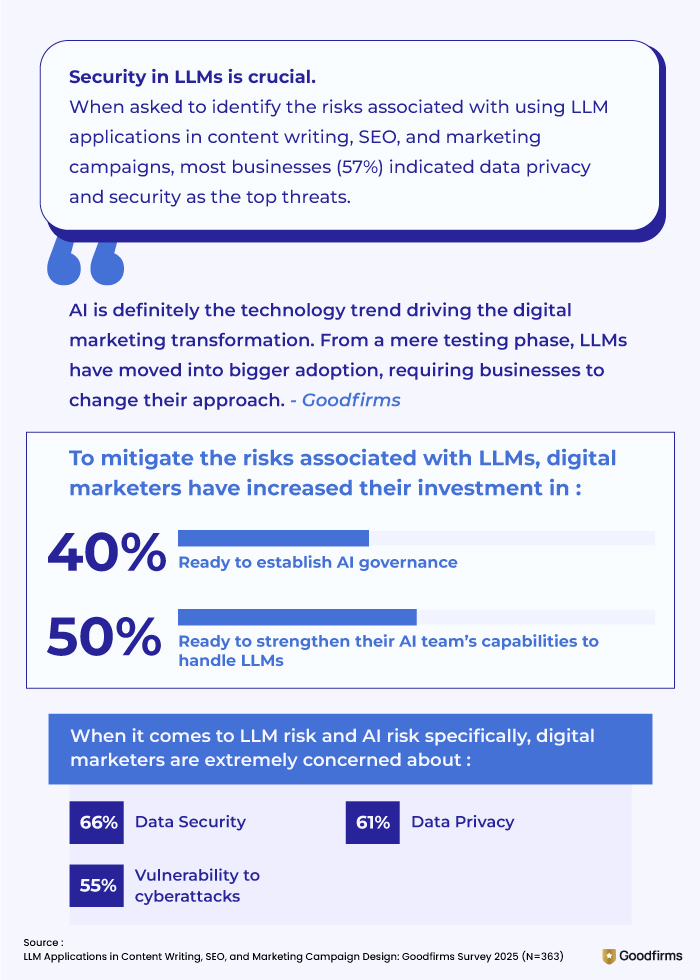
- 66% of respondents highlighted data security as their primary concern, taking into account their data exposure within AI systems.
- 61% cited data privacy issues, reflecting worries about how LLMs collect, store, and process user information, especially they are worried about data privacy compliance.
- 55% expressed concern over vulnerability to cyberattacks like model manipulation, prompt injection, and data poisoning, which can affect the outputs of LLM.To mitigate the risks associated with LLMs, digital marketers and businesses are taking proactive measures like;
- 50% of respondents mentioned that they are ready to strengthen and upskill their team’s capabilities to effectively handle the LLM systems. Employees are also more ready to embrace the change.[4]
- 40% are prepared to establish AI governance frameworks and compliance guidelines to manage AI safely and responsibly.
The Top Challenges of Using LLM Applications
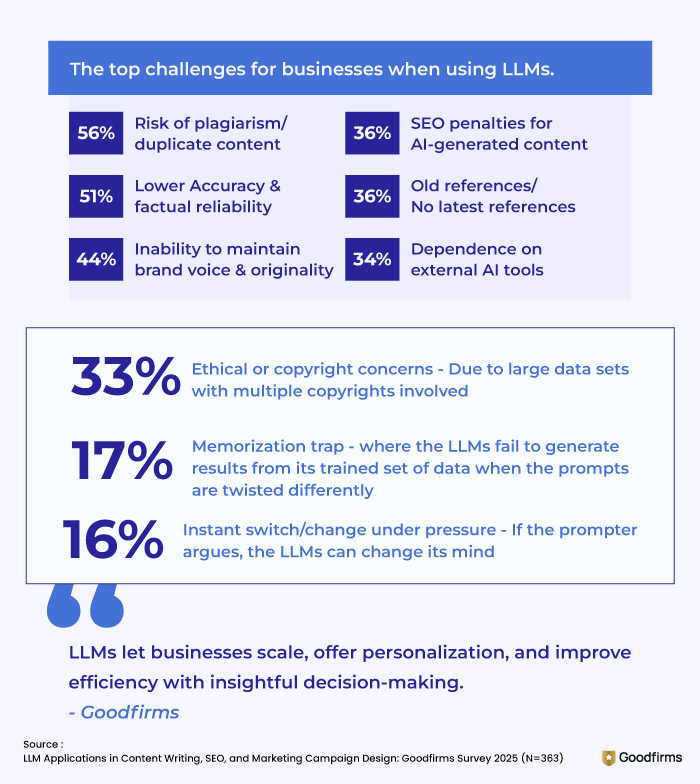
Top LLM Challenges Reported:
Risk of plagiarism or duplicate content: 56% indicated duplicate content as the most significant concern.
Organizations fear that the AI models that they use may unintentionally reproduce existing material, leading to copyright issues and reputational risks. It is critical to ensure originality, especially for businesses relying on content marketing and brand communication.
Lower accuracy and factual reliability: 51% ranked accuracy as the second biggest challenge.
Respondents noted that even the most evolved LLMs are still producing outdated facts, creating risks when generating technical, legal, or research-based content.
Inability to maintain brand voice and originality: 44% highlighted challenges in balancing efficiency and uniqueness with AI-generated content.
SEO penalties for AI-generated content: 36% reflect apprehension about search engine policies that may penalize low-quality or machine-generated content.
This concern emphasizes the need for human intervention, and quality assurance in AI-assisted publishing.
Old references or lack of latest data: 36% points to the limitations of pre-trained models, which may not have real-time access to current information.
This gap affects credibility, especially in fast-changing domains like technology, finance, and healthcare.
Dependence on external AI tools: 34% said they are worried about the reliance and limited control over proprietary AI systems.
The risks of depending on third-party tools for core operations is huge due to model reliability issues.
LLMs have issues working in static environments. Users add new inputs every time they login. Moreover, LLMs have limitations due to inflexible reasoning.[5]
AI has limitations in knowing and retaining its own information.[6]
While LLMs are capable of outshining humans, their sheer size, with innumerable parameters, limits its capacity on resource-constrained hardware like mobile devices.[7]
“LLMs let businesses scale, offer personalization, and improve efficiency with insightful decision-making, and automation.” Goodfirms
Future Outlook on LLM Adoption
Beyond quantitative findings, the survey respondents also shared their perspectives on policy concerns, future adoption trends, investment intentions, and workforce implications related to LLMs.
How concerned are you about Google’s policies on AI-generated content? Give your opinion.
“Not too concerned as long as human-in-the-loop remains active on our side” - Tepia
“My concern is less about the presence of AI and more about how clearly the rules are defined, since creators must keep adjusting to meet them” - PageTraffic Inc
“Use AI. Absolutely. It’s like adding NOS to your engine. But don’t rely on AI to "steer the car. And never forget. Great marketing isn’t about gaming Google. It’s about connecting with your ideal customer and answering the questions they’re already asking” - 95Visual
“Honestly, I'm a little worried about it. I'm concerned that their automatic systems might accidentally punish useful content just because it was made with AI. It also feels a bit unfair that they're pushing their own AI answers in search results while making rules for everyone else” - Digital Gravity
“We’re not concerned about Google’s stance on AI-assisted content” - DNA325
“Sudden policy shifts or algorithm updates could impact search visibility for AI-assisted content. To mitigate this, we ensure rigorous human editing, fact-checking, and brand voice alignment. We view AI as a supportive tool rather than a replacement for expert-driven, original content” - Enovista Digital Ltd
“Google's stance on this will have to change as the use of Ai will only increase with time” - Evolve Media
“We are not concerned about it because Google's policies are not against AI-Generated content. Policies are against low quality content” - FansGain
“What raises red flags isn’t the use of AI, but low-value, repetitive material that fails to serve users” - Fit Design
“I am nervous that they will penalize it more and more and that will ultimately hurt content strategy” - Gambix LLC
“The risk comes when AI is used to mass-produce low-value or duplicate content, which Google will downgrade” - Growwwise
“I’m not very concerned. Google’s policies focus on content quality, not whether it’s AI-generated” - Monk Outsourcing
“Our concern lies in ensuring that AI-assisted content always meets EEAT (Experience, Expertise, Authoritativeness, Trustworthiness) standards and avoids duplication or low-quality output” Nexa Growth
“I view Google’s stance as a warning, not a ban.” - SEO Resellers Canada
“Google doesn't have a clear policy on use of AI generated content especially after the launch of Gemini” - SEOValley Solutions Private Limited
“I think it's frustrating that Google is waffling on whether or not AI-generated content will be penalized; it's already hard enough to keep up with all of the changes in this sector” Sites by Sara
“We pay close attention to it” - SmashBrand
“I think Google’s policies on AI-generated content are important because they ensure quality, originality, and trustworthiness in search results” - TechStreet Solutions Pvt Ltd
“From an SEO perspective, the real risk is when AI is used to produce low-value, repetitive, or spammy content, which Google has consistently penalized” - Truenorth Digital
“I am not concerned about Google's policies, since it clearly mentions that your content must answer a user's search query” - Visium
“I believe Google’s policies on AI-generated content are reasonable and necessary to maintain content quality across the web” - TechUp Solutions (Pvt) Ltd. | WordPress Virtual Assistant
Do you believe LLMs will become a core part of marketing, content generation, and SEO strategies in the next 3 years? Give your opinion on this.
“It is a big yes, AI has already become an essential tool to us hence it will continue helping us years to come” - Bluxel Africa
“LLMs will absolutely be core to marketing and SEO within 3 years. But the winners won’t be the ones who just “let the AI write everything ”they’ll be the ones who blend AI efficiency with human creativity, originality, and strategy” - Crazy Web Studio Co.,Ltd.
“Most definitely YES, given the advantages of speed, scalability and research-based quality” - Digitalhound Ltd
“Yes, I believe LLMs will become a core part of marketing, content generation, and SEO strategies within the next 3 years. They offer speed, scalability, and data-driven insights, making them valuable tools for creating personalized, optimized content at scale” - Glad U Came
“Absolutely. LLMs will become go-to tools to streamline research, generate optimized content at scale, personalize messaging for target audiences, and analyze trends more quickly than traditional methods” - iMiMDesign™ Co.
“Absolutely, if you don't adopt it now, you are likely to get behind” - LanternSol
“Yes, it already is. We're experimenting with how to integrate LLMs further into our products and workflow to achieve competitive advantages in the marketplace” - Optiimus
“In many ways, this transformation is already well underway, as LLMs are actively redefining how brands create, optimize, and distribute content” - Optimized Webmedia Marketing
“No, without human intervention, storytelling is not possible” - Pixabulous Designs
“Yes. LLM's (AEO: Answer Engine Optimization) will take over traditional search (SEO) through more relevant and contextualized search” - RNO1
“Yes. LLMs are evolving, and businesses need to know how to use these AI models to generate content and figure out SEO gaps” - Sapphire SEO Solutions
“Absolutely. Whether it's on autopilot or its augmenting the marketing function - they're going to be critical in the next few years” - Searcht
“We’re already seeing them streamline keyword research, competitor analysis, and large-scale content production. The real power, though, will be in scalability and personalization” - SmartWeb Group
“I hope not. Content generation should be done by a human, not AI” - The WriteOne Creative Services
“Yes it is already there but will it remain” - Wicko
“This is the obvious direction for business considering the speed, accuracy and possibilities through LLM” - WooBrand
Does your company plan to increase investment in AI/LLM-based marketing tools over the next 2 years? Give reasons.
“Yes. We plan to increase investment in AI/LLM-based marketing tools over the next two years. These tools already save our team significant time in SEO research, content briefs, and campaign ideation. More importantly, they help us deliver faster results for clients while keeping quality high. As AI matures, it will become critical for scaling personalisation, optimising websites, and improving marketing ROI — all of which align with our growth strategy” - WP Creative
“Yes we must work on increasing our AI penetration in marketing to cope with the market and keep our competitive advantage on being dynamic” - Cool Digital Solutions
“Yes!! for saving time and expanding the work limit” - DianApps Technologies Pvt. Ltd.
“We have already integrated platforms such as LLMrefs to evaluate our performance in GEO and AEO, enabling us to refine content strategies and design approaches with measurable impact. These technologies have delivered substantial gains in qualified leads, brand recognition, and revenue for our clients” - eSEOspace
“Yes, we plan to increase investment. Our focus is on tools that accelerate keyword clustering, content ideation, campaign testing, and data insights, while maintaining full human oversight” - friends consulting
“Yes, we plan to increase investment in AI/LLM-based marketing tools over the next 2 years” - IPH Technologies Pvt Ltd
“Yes, we are planning. The efficiency and insights they provide are no longer optional they’re becoming essential and help stay competitive” - ISHIR
“Not really. As always, our focus remains on results and whatever it takes to achieve them. We do not intend to jump the gun on what increasingly looks like a “snake-oil” rush around AI and LLM-based ranking theories” - Lead Experts
“For optimization we're still using the best of the SEO tools like Semrush and Ahrefs, they cannot be replaced by Chat GPT, Perplexity, etc. AI will play its part in SEO but we'll not go 100% AI in marketing” - Maxlence Consulting
“Yes—investing more in AI/LLM marketing tools makes sense because they boost efficiency, create high-quality content quickly, enable hyper-personalization, and improve SEO performance” - Revolute X Digital
“It's all happening so fast, it's hard to imagine there won't be new tools worth investing in over the next 2 years” - SangFroid Web, LLC
“As competition grows and customer expectations rise, leveraging AI is no longer optional, it’s strategic” - SEO Villas Private Limited
“Our investment is not just in ready-made tools, it’s equally in developing internal knowledge, technical capability, and long-term experience” - Skouter Digital
“We are actively building our own tools to support specific areas of workflows” - The SEO Works
“Yes, we plan to invest more in AI/LLM marketing tools because they save time, cut costs, improve targeting, and keep us competitive” - TOAZ Solution
Do you think LLMs can impact jobs in the digital marketing arena?
“Absolutely, but impact does not just mean replacement. That said, it will create demand for new roles: AI fluent strategists, prompt engineers, content editors who know how to shape machine generated work, and data analysts who can interpret the insights these tools provide” - Colormatics
“Yes, it will have an impact, but we don't necessarily look at LLMs as replacing people. Instead, the jobs may shift. We view LLMs as tools to enhance the work of our subject matter experts and strategists” - Campfire Digital
“Yes, entry-level positions will be replaced and all teams are expected to utilize LLMs” - Efelle Creative
“LLM will impact jobs in the Digital Marketing arena. But at the beginner level” - Linea Digitech
“Yes, it already is. We've replaced our article writers” - Mammothic Films
“Roles won’t vanish — they’ll evolve” - ManekTech
“LLMs has already impacted the job topography in the digital marketing arena, the question is: How fast and dynamic the change would be in the next 3 to 5 years” - Nilecode
“Entry level job positions have gone already. They are totally going to change a lot”- SEO Kari Nieminen
“I think it is for the companies that prefer to cut costs. There will be companies who prefer a mix of both AI and human to find the correct balance” - Unrivaled Marketing
So, to summarize the subjective questions initiated by Goodfirms on LLMs, the survey respondents expressed moderate to high concern about Google’s policies on AI content, fearing potential impacts on their SEO. Most businesses believe that LLMs will become a core part of marketing, content generation, and SEO strategies within the next three years. Furthermore, a majority also plan to increase their investment in AI/LLM-based marketing tools in the near future. A few have already initiated their investments. While participants acknowledged that LLMs could automate certain digital marketing tasks, they largely view LLMs as enhancers rather than replacements for the human workforce, creating new opportunities for those who upskill and fit into creative and strategic roles.
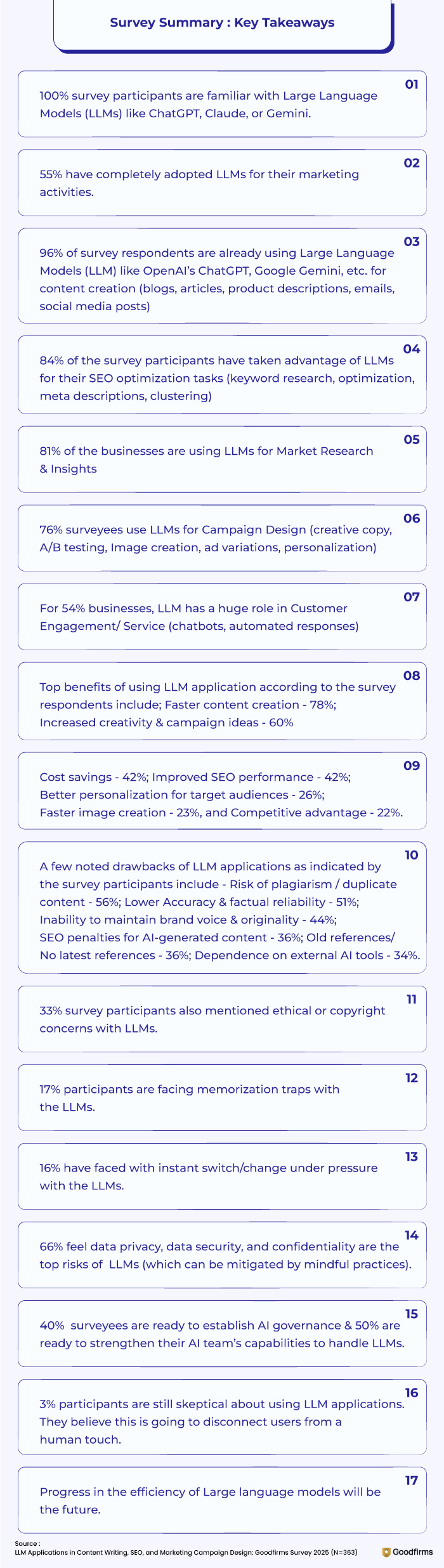
Summarizing the survey:
Conclusion:
Large Language Models (LLMs) are no longer just advanced technologies that need serious consideration. They have become a key factor in the transformation across digital marketing and business intelligence. LLMs allows users to ask questions, uncover insights, and make decisions seamlessly eliminating access barriers to information. The global large language models market size is projected to touch USD 35,434.4 million by 2030[8].
For future-focused businesses, this marks a shift from static data interpretation to dynamic, conversational intelligence. This change will improve efficiency, speed, productivity, and decision-making at every level in real-time. A few models may have uncertain mechanisms[9]. But, overall, as LLMs continue to mature, their role in digital marketing, content strategy, search engine optimization, and business operations will expand, not just as tools for automation, but as catalysts for creativity, efficiency, and innovation at a reduced cost. In 2026, the role of digital marketers will evolve, and several tasks will be automated bringing down manpower and restructuring workflows. Even SEO will evolve as GEO.[10]
The survey findings reaffirm one message: AI and LLMs are not just shaping the future of marketing — they are redefining how businesses can think, create, and compete in the digital era in the days to come. We sincerely thank our research partners for their valuable time, suggestions, and inputs.

References:
- https://www.hbs.edu/ris/Publication%20Files/23-062_6bfe7a5b-3ed9-4afd-a4c1-c91b60dd82e5.pdf
- https://spectrum.ieee.org/large-language-model-performance
- https://www.helpnetsecurity.com/2025/09/16/google-vaultgemma-private-llm-secure-data-handling/
- https://www.mckinsey.com/capabilities/tech-and-ai/our-insights/superagency-in-the-workplace-empowering-people-to-unlock-ais-full-potential-at-work
- https://news.mit.edu/2025/teaching-large-language-models-to-absorb-new-knowledge-1112
- https://dataconomy.com/2025/11/11/anthropic-study-finds-ai-has-limited-self-awareness-of-its-own-thoughts/
- https://www.nature.com/articles/s41598-025-22940-0
- https://www.grandviewresearch.com/industry-analysis/large-language-model-llm-market-report
- https://machinelearning.apple.com/research/the-super-weight
- https://www.goodfirms.co/seo-software/blog/follow-seo-aeo-geo