Key takeaways
- AI Boosts Efficiency:91% of companies leverage AI to reduce development costs by planning, coding, and testing projects.
- Software Development Costs: Small to mid-sized projects typically range from $30,000–$100,000, Large projects exceed $100,000; AI-powered small projects cost $50,000–$125,000.
- Hourly Rates Vary by Region and Project Size: $20–$50/hr – 56% of companies (mainly in Eastern Europe, Latin America, South/Southeast Asia), $50–$100/hr – mid-sized projects, $100–$250/hr – enterprise-grade builds
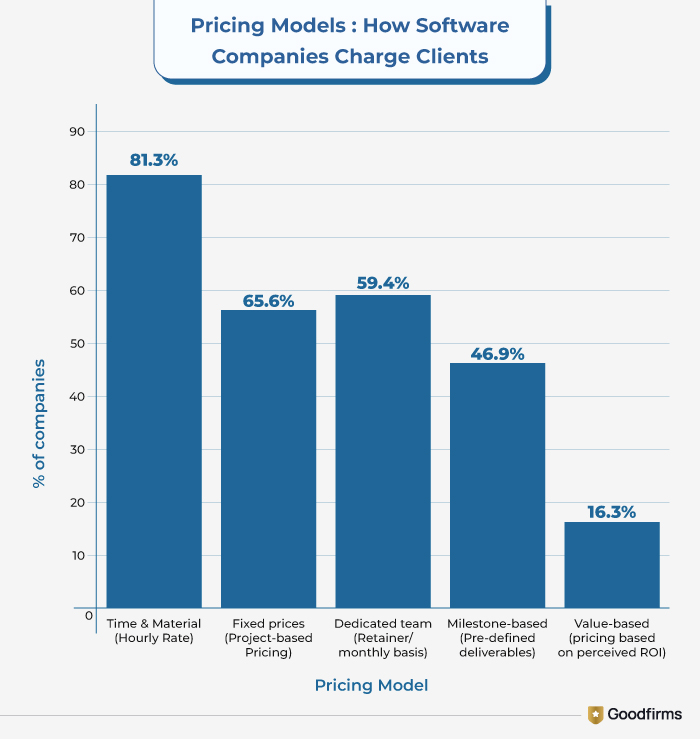
- Popular Pricing Models: Time & Material: 81%, Fixed Price: 66%, Dedicated Teams: 59%, Milestone-based: 47%, Value-based pricing is emerging: 16%
-
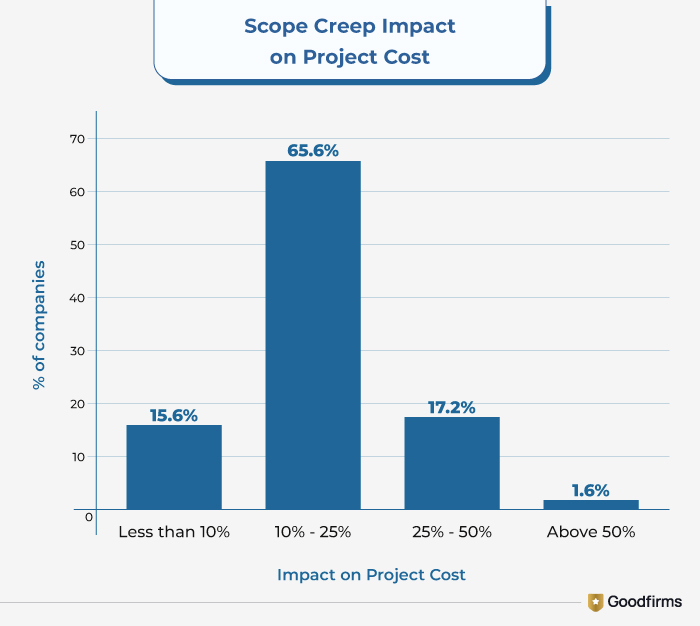
Impact of Scope Creep: Projects that experience scope creep see costs increase by 10–25%.
-
Primary Cost Drivers: Project complexity, AI and tech stack, scope creep, team composition, security requirements, time-to-market pressures, ongoing maintenance, and geographic location all significantly influence development costs.
Custom software development costs in 2026 range from $30,000 to $200,000—and AI is a key cost driver.
AI can both reduce and raise budgets.
Nearly 90.6% of the Goodfirms survey participants indicated they have adopted AI to reduce software development costs, using it to plan projects, code, and test, thereby significantly reducing the engineering hours.
But complex AI integrations can quickly inflate costs—so don’t add AI just because it's trending.
The Goodfirms 2026 Software Development Cost Research Survey, based on insights from 100+ global software companies, reveals what software actually costs in 2026.
How much does custom software development cost in 2026?
According to the Goodfirms 2026 Software Development Cost Survey, most custom software development projects cost between $30,000 and $100,000, while large-scale and enterprise software projects typically exceed $200,000, depending on complexity, team location, and AI adoption.
- Small-mid projects:$30,000–$100,000 (66% of companies)
- Large projects: $100,000+
- Enterprise builds: $200,000+
Let’s break down software development costs in 2026 by project size to see how scale, complexity, and AI adoption impact budgets.”
1. Detailed Cost Breakdown by Project Scale
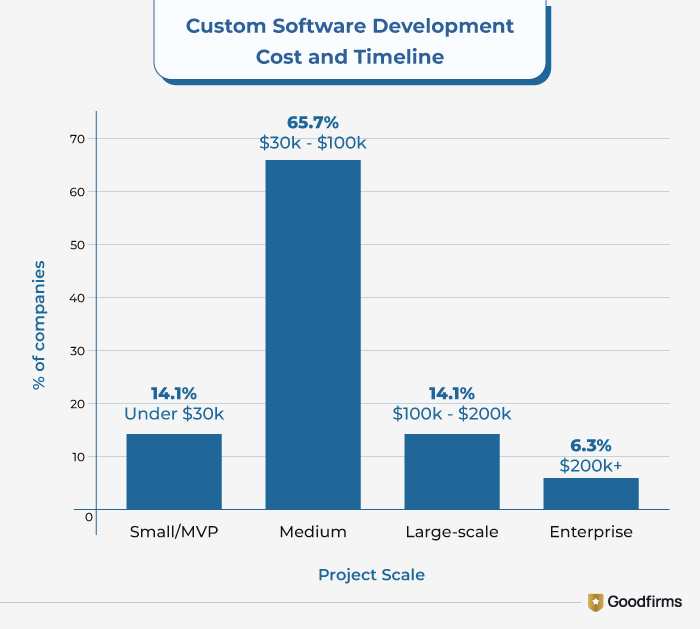
The Goodfirms custom software development cost survey for 2026 found that software development costs vary significantly by project size, with enterprise-level builds being far more likely to exceed six-figure budgets.
|
Project Scale |
Baseline Software Cost |
Delivery Timeline |
% of companies |
Key Observations |
|
Small/MVP |
Under $30,000 |
1-3 months |
14.1% |
Suitable for MVPs and early-stage startups; minimal upkeep |
|
Medium |
$30,000 - $100,000 |
3-6 months |
65.7% |
Growing businesses, higher functionality, moderate maintenance |
|
Large-scale projects |
$100,000 -$200,000 |
6-12 months |
14.1% |
Enterprise-grade apps, automation tools, or data-integrated systems |
|
Enterprise Projects |
$200,000+ |
12-24 months |
6.3% |
Long-term builds with continuous optimization, integrations, and AI/ML R&D. |
Key takeaway: Most software projects globally fall under $100,000, which means small to medium projects dominate the market.
FYI: Software costs would automatically escalate for medium-sized projects in Western markets, as they charge around $50,000 to $ 250,000, but enterprise-level projects are priced similarly across regions.
2. What is the Average Hourly Rate for Software Developers in 2026? (in USD)
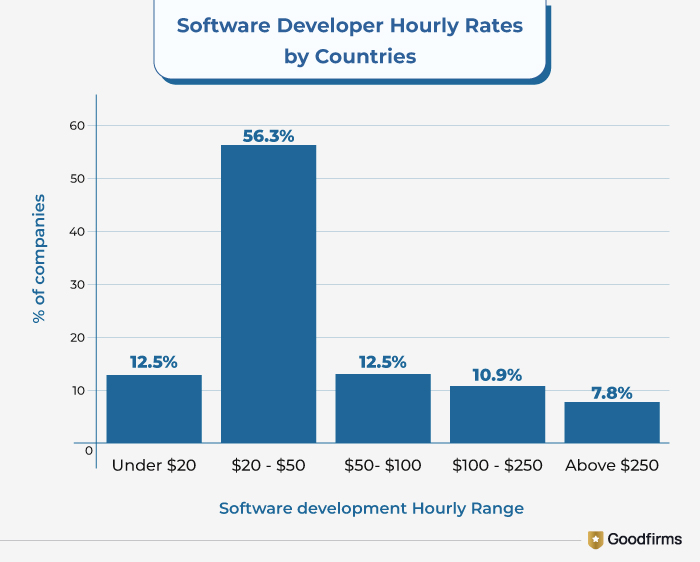
According to Goodfirms Software Development Cost Survey, nearly 56.3% of the surveyed companies offer software development within the $20-$50 hourly price range.
And surprisingly, a select few software companies in North America and Western Europe also operate at this rate. For instance, companies like UplineSoft, CML Team, Element Media, Biz4Group, Acropolium, Cyber Nest, Tessafold, and Talmatic offer software development services at $20-$50 per hour.
However, the majority of software providers operating in the $20-$50 hourly price range are concentrated in Eastern Europe, Latin America, and Southeast Asia, where labor costs are low, but quality is consistently high.
|
Software development Hourly Range |
% of Respondents |
Regions Offering these Prices |
Demand Context |
|
Under $20 |
12.5% |
✓South Asia (India, Bangladesh, Pakistan) ✓Africa (Nigeria, Kenya) ✓Smaller Eastern European Hubs |
✓Startups, ✓Solopreneurs, ✓Small businesses Typical Projects ✓ MVPs or experimental projects where cost matters more than quality& security. |
|
$20 - $50 |
56.3% |
✓South Asia ✓ Africa ✓Eastern Europe (Ukraine, Poland, Romania, Serbia) ✓Latin America (Brazil, Argentina, Mexico, Colombia) ✓ Southeast Asia (Vietnam, Philippines, Indonesia) |
✓SMEs & Enterprises seeking cost-effective solutions without sacrificing quality ✓Web apps, e-commerce platforms, mobile apps |
|
$50- $100 |
12.5% |
✓Central & Western Europe (Spain, Portugal, Czech Republic) ✓Parts of South America (Chile, Costa Rica)
|
✓Mid-sized companies,Funded startups, & Enterprises seeking specialized skills but not ready to pay premium US/Western Europe rates ✓ Cutting-edge web/mobile apps, custom software solutions |
|
$100 - $250 |
10.9% |
✓North America (US, Canada) ✓Western Europe (UK, Germany, France, Netherlands) |
✓ Enterprises and Scale-ups pursuing mission-critical projects ✓Projects that require accountability, high security, and domain-specific expertise. |
|
Above $250 |
7.8% |
✓United States (Silicon Valley, New York City, Boston) ✓Western Europe (Switzerland, Nordics) ✓Boutique firms or niche experts worldwide |
✓Fortune 500 companies, government contracts, and innovation-driven enterprises ✓Strategic consulting, cutting-edge solutions, and guaranteed quality |
Strategic Hiring Insights (Analysis & Recommendations)
Here’s the takeaway: If you’re a startup or solopreneur working on a limited budget, South Asia (India, Bangladesh, Pakistan) remains your go-to hub. Why? I suppose the answer is universally known: the cost of outsourcing is low here, not because of limited talent, but due to lower living costs.
Africa and smaller Eastern European hubs also fall into this cost bracket. Ideal for rapid prototyping or MVPs where you think security or long-term scalability can be traded for cost efficiency.
Next up: For SMEs and mid-level enterprises, the $20–$50/hour range is the safest bet, dominated by developers from Eastern Europe, Latin America, Asia, and Southeast Asia. The software developers here offer quality and scalability without stretching budgets.
Further, startups with deeper pockets and mid-sized firms can hire developers from Central and Western Europe (Spain, Portugal, the Czech Republic) or from North America’s secondary tech hubs (such as Chicago and Austin) for specialized skill sets at $50–$100/hour.
Now, for enterprises and scale-ups: The $100–$250/hour range is standard in North America (U.S. and Canada) and Western Europe, where teams are known to manage mission-critical and domain-specific projects with high accountability.
And finally, boutique firms and Fortune 500 consultants in Silicon Valley, New York, Boston, and Switzerland charge $ 250 or more per hour for innovation-driven engagements, delivering strategic consulting and guaranteed-quality services.
Expert voices back this up:
Ashley Durmo, CEO & Cofounder of Chalet, explains,
“North America is still the most expensive place to visit. Europe, on the other hand, has a good balance of price and quality. Asia is still a great spot for big jobs. In 2026, the change will be more than just price. It will also be about being honest and open. The best way for a business to get people to trust them is to show that AI cuts costs without cutting corners.”
Adam Young, Founder of BrandPeak.AI, adds:
“North America is the best option for compliance-heavy programs, Western Europe is more suitable for privacy-sensitive design, Eastern Europe has good platform engineering resources, and Latin America delivers collaboration that aligns with time zones and increases velocity by 15% percent. South and Southeast Asia still lead the scale of testing and well-specified delivery. By 2026, we expect development squads to be smaller, with four contributors instead of six, and supported by some automation.”
Bottom line: Software development cost can vary widely, but each price tier serves a distinct purpose. Figuring out where your business fits can make or break your outsourcing ROI.
- Under $20/hr → Great for MVPs and small experiments
- $20–$50/hr → Ideal for SMEs seeking balanced cost-quality
- $50–$100/hr → For mid-sized firms and funded startups
- $100–$250/hr → For enterprise-grade, high-security builds
- Above $250/hr → For Fortune 500s, consulting, and innovation-driven work
3. How much does AI-Powered Software Development Cost in 2026?
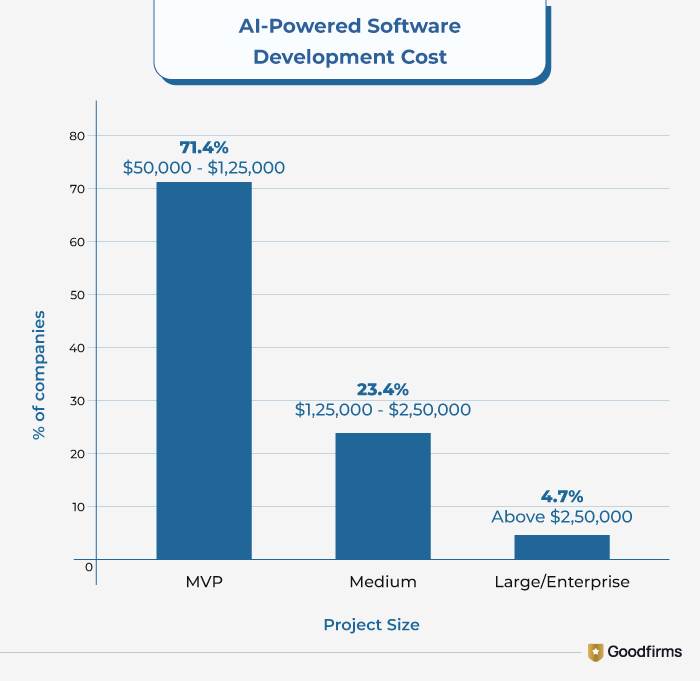
Goodfirms survey data indicate that 71.9% of AI companies charge between $50,000 and $125,000 for small to mid-scale AI builds.
The average cost to launch an AI-powered software is higher than that of a simple custom software, primarily due to the higher R&D intensity and complexity of these projects.
|
Project Size |
Cost Range (USD) |
% of Companies |
|
MVP |
$50,000 - $125,000 |
71.4% |
|
Medium Projects |
$125,000 - $250,000 |
23.4% |
|
Large/Enterprise Projects |
Above $250,000 |
4.7% |
Key Insight: Small AI projects start at $50000, which overlaps with the costs of mid-tier software projects ($30,000 - $100,000), indicating that AI can be a default inclusion in custom software development, and not a premium add-on.
Simply put, this shift isn’t just about cost—it’s about scope. As AI becomes more accessible, what used to be considered “advanced features” are now part of standard project budgets.
Vincent Schmalbach, Web Developer & AI Engineer, explains:
“The main thing that has changed is project scopes. Before AI, a client would have a budget, and some features would simply not be possible to fit in. They would be out of scope. With AI, those same features can now be added to the same budget. Instead of prices going down, projects are getting bigger for the same price.”
Only 4.7% of firms handle enterprise-grade AI projects; nonetheless, this field is expanding rapidly.
4. How Much Does Mobile App Development Cost in 2026?
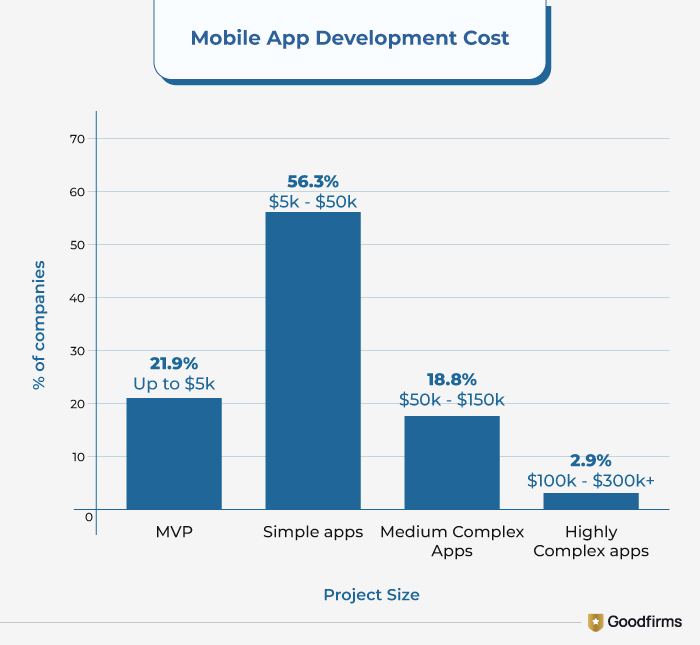
According to the Goodfirm survey findings, 78.2% of mobile app development companies charge up to $50,000 for MVPs to simple apps, with the majority of mobile app costs concentrated in the $5000-$50,000 range (56.3%).
|
Project Size |
Cost Range(USD) |
% of Companies |
|
MVP |
Up to $5,000 |
21.9% |
|
Simple apps |
$5,000 - $50,000 |
56.3% |
|
Medium Complex Apps |
$50,000 - $150,000 |
18.8% |
|
Highly Complex apps |
$100,000 - $300,000+ |
2.9% |
Only 21.8% of companies charge more than $50,000, indicating limited competition in enterprise-scale app development.
5. How Much Does Website Development Cost in 2026?
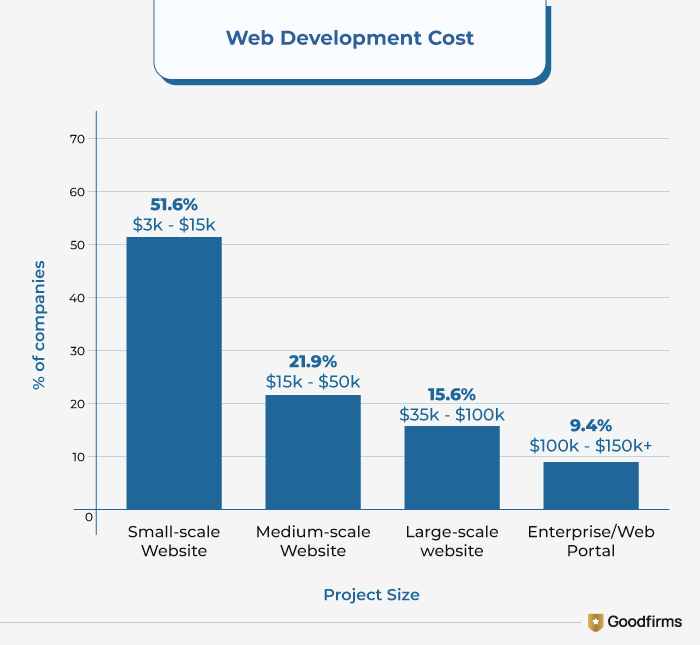
Goodfirms software survey indicates that small-scale projects dominate the majority of the web development market, with almost half of the web development agencies (51.6%) charging $3,000-$15,000
|
Project Size |
Cost Ranges (USD) |
Percentage of Companies |
|
Small-scale Website |
$3,000 - $15,000 |
51.6% |
|
Medium-scale Website |
$15,000 - $50,000 |
21.9% |
|
Large-scale website |
$35,000 - $100,000 |
15.6% |
|
Enterprise/Web Portal |
$100,000 - $150,000+ |
9.4% |
Key Insight: The web development market is heavily tilted toward small and mid-sized web projects. Only a select few firms cater to enterprise-level web platforms. Read this in-depth survey on website development cost to know the pricing of different website types.
6. What Pricing Models do Software Development Companies Use?
According to the Goodfirms survey, 81.3% of the software companies preferred Time & Material, and for a good reason. It satisfies the client’s need for accountability and flexibility, as they pay only for work done. Not a penny more, not a penny less.
|
Pricing Model |
% of Companies |
Key Insights |
|
Time & Material( Hourly Rate) |
81.3% |
The majority of software development companies bill clients on a Time & Material (hourly Rate) basis, as it provides flexibility and adaptability. Charges are based on the time spent and resources utilized, creating a win-win situation for both developers and their clients. |
|
Fixed prices ( Project-based Pricing) |
65.6% |
A significant percentage of companies offer fixed prices (Project-based Pricing), reflecting clients’ need for budget predictability for well-defined deliverables. Clients should opt for a fixed pricing model for MVPs and smaller projects. |
|
Dedicated team (Retainer/monthly basis) |
59.4% |
Almost half of the companies are willing to rent out their teams on a retainer basis, indicating a rising demand from clients for long-term partnerships and ongoing support for iterations and maintenance. |
|
Milestone-based (Pre-defined deliverables) |
46.9% |
Work is broken down into phases (milestones), and so are payments. This performance-based payment model employs a hybrid approach, utilizing both hourly and fixed pricing methods mainly for medium to large projects. |
|
Value-based (pricing based on perceived ROI) |
16.3% |
Emerging model, offered by a small percentage of software providers for premium services such as AI analytics and strategic consultancy |
Takeaways: The popularity of pricing models such as “Time & Material” and “Fixed Price” signals the market’s preference for transparency and flexibility.
Hybrid models, such as those involving Milestone and Dedicated teams, are also gaining traction due to their scalability and collaborative capabilities.
And, what’s next: Value-based pricing may soon step into the spotlight.
As Allen Liu, Tech Lead & Content Specialist @FreSound observes,
“Time-and-material pricing used to be the most common way to set prices, but more and more clients want prices based on results or goals. They want proof of something more than just hours worked. There is also a bigger change going on: buyers now want business value that is directly linked to growth, not just service.”
Even Durmo echoed a similar view:
“Clients want more than just hourly bills; they want clear results and to be responsible for the work as a whole. This is even more important when it comes to AI. If tools can cut development time in half, people won't pay for that time. They want to pay for what it does.”
7. What Payment Terms do Software Development Companies Offer?
Milestone-based billing dominates, mirroring the clients’ need for payments to be clearly structured around deliverables.
|
Payment Term |
% of Companies |
Key Insight |
|
Milestone-based Payments |
68.8% |
The dominant billing model honors the client’s need for performance-based pricing. Works well with agile and hybrid project management. |
|
Upfront Payment |
17.2% |
Primarily preferred by software firms that look for security before project kick-off. |
|
Subscription/Retainer Model |
14.1% |
Not very popular, but crucial for long-term SaaS projects, requiring maintenance, continuous iterations, and updates. |
Key takeaway: The Milestone-based model is the top choice among software development companies for payment terms, as it reflects industry preference for shared risk management and incremental delivery over fixed or hourly engagements.
Combined Insights: Pricing + Payment Correlation
- The Time & Material Pricing Model (81.3%) complements Milestone-based Payments (68.8%), reflecting that even while projects are run on an hourly rate model, payments are structured around deliverables (milestones). The arrangement meets the interests of both clients and developers. Accountability and minimal upfront risks for the client, while fair compensation and structured delivery cycles for the developer.
- Dedicated team retainers (59.4%) align with the subscription/retainer payment model, as it would be helpful in long-term development projects.
- Fixed-price projects can be paired with upfront payments, as they are typically smaller and lower-risk projects.
8. What Major Factors Increase Software Development Costs?
According to the Goodfirms survey, location is one of the significant cost escalators, given the well-documented rate differences, but that’s not the only factor. Other additional factors, such as complex integrations, evolving tech stack, increasing developer salaries, and scope creep, all these factors are quietly but steadily escalating software development costs.
Let’s look at the major cost factors that could be driving up your software development costs:
#1. Project Complexity (features, integrations, security layers)
Complexity and costs go together.
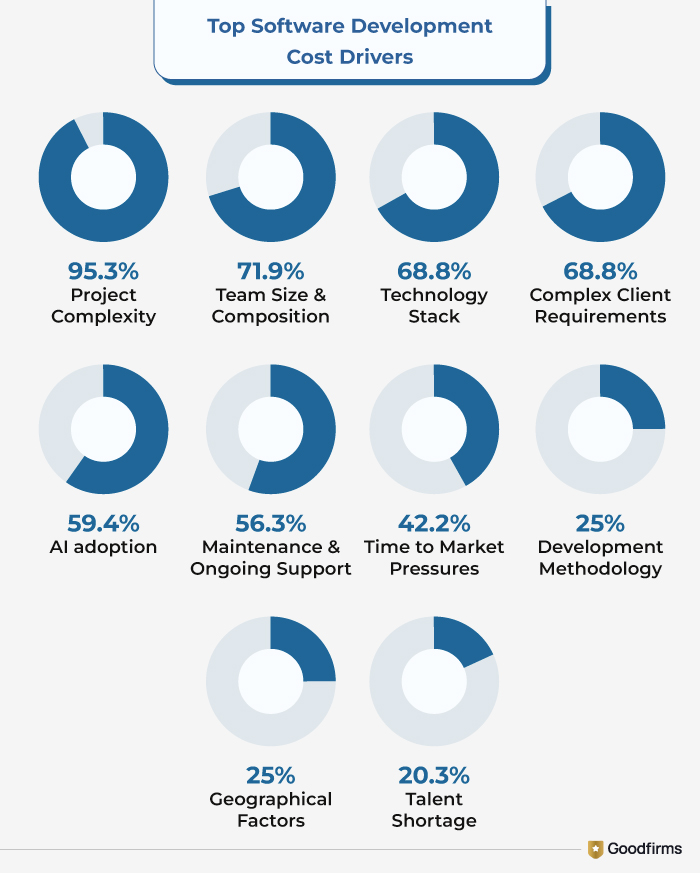
95.3% of the surveyed companies reported that the more complex the project, the higher the software development cost.
Integrating multi-module ERPs, AI, APIs, security layers, and other components all escalates expenses due to the depth in planning, testing, and technical debt management required. The result? Longer timelines and escalating budgets.
#2. Technology Stack (AI, Blockchain, Cloud, Microarchitecture)
Not all tech stack costs a premium.
But the one that involves AI, ML, blockchain, or cloud-native infrastructures calls for specialized developer expertise, resulting in significantly higher software development pricing. Almost 79% of the participants informed that the tech stack plays an uber role in escalating software cost.
When it comes to AI, despite AI wearing many hats, the upfront AI investment may cost a bomb. Features such as NLP, CV, and predictive analytics are huge cost escalators, and so are data quality, model training, and integration complexity.
As Nicola Onassis of Code Particle Inc explains:
“Clients often underestimate the hidden cost of AI features — data readiness, compliance (HIPAA, GDPR, SOC2), and model retraining are major long-term investments.”
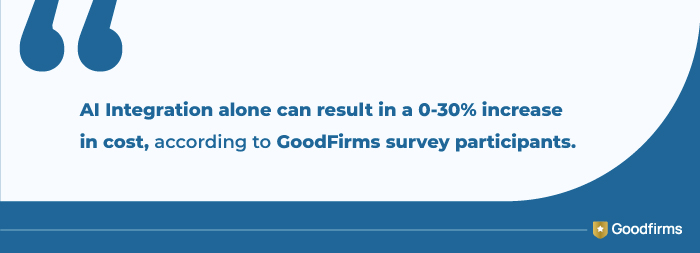
According to the majority of Goodfirms survey participants, AI Integration alone can result in a 0-30% increase in cost.
#3. Team Size & Composition
Here’s another big cost amplifier, according to nearly 72% of the Goodfirms surveyed participants- the people behind the product.
Senior-level talent and cross-functional teams are significant cost drivers, according to many of the surveyed participants, but at the same time, they admitted that they ensure higher quality and faster delivery.
As noted by Hitesh Matlani (Avid Brio) and Ketan Patel (CodesClue Technologies), nearly 50-70% of the total software development cost can be tied to developers, UX/UI designers, QA, and project managers. Skilled developers (backend, frontend, mobile, cloud) are the largest recurring expense, far higher than tools or servers, Patel further adds.
Ivan Olin (UplineSoft) and Veronika Nedashkovskaya (Rocketech) echo this.
“The biggest cost in software development typically comes from developer salaries. Skilled developers, especially those with expertise in sought-after technologies, command high salaries due to the demand for their skills.”
Simply put, talent costs, but then you cannot do without them.
#4. Complex Client Requirements (frequent scope changes, unclear specs)
65.6% of the survey respondents reported that scope creep typically increased project cost by 10-25%. 86% of the respondents cited that changing client needs was a recurring issue, despite having clearly defined goals.
As Kishan Verma of Bizople Solutions rightly points out:
”Even with precise initial requirements, clients often discover new features or integrations during development, making accurate upfront pricing difficult.”
According to the International Journal of Computer Applications, the impact of scope creep is greater in critical applications, such as healthcare, compared to non-critical applications, such as retail. (11)
A quick note: Most firms factor in a ‘scope buffer’ during the project planning phase, but it fails to prove effective in the face of evolving client needs. Even in mature development environments, scope management is not streamlined, resulting in cost risks.
The fix: Iterative client feedback loops and early-stage requirement validation to catch changes before they balloon into budget risks.
#5. Maintenance & Ongoing Support
Companies have to spend an average of 10–20% annually on post-launch maintenance, bug fixes, and updates. That’s your software’s upkeep cost to ensure performance, stability, and security.
#6. Time to Market (TTM) Pressures
TTM is again one of the leading cost drivers, according to 42.6% of the companies. Rapidly growing competition and evolving markets are acting as a trigger point for companies to act quickly, from ideation to implementation, when rolling out new products or features. The pressure mounts from the need to stay ahead of the competition and keep pace with changing customer needs. To manage TTM pressures, teams resort to agile methodologies and MVPs, then iterate based on user feedback.
#7. Development Methodology (Agile/ DevOps/ CI/CD)
Your development approach also affects cost.
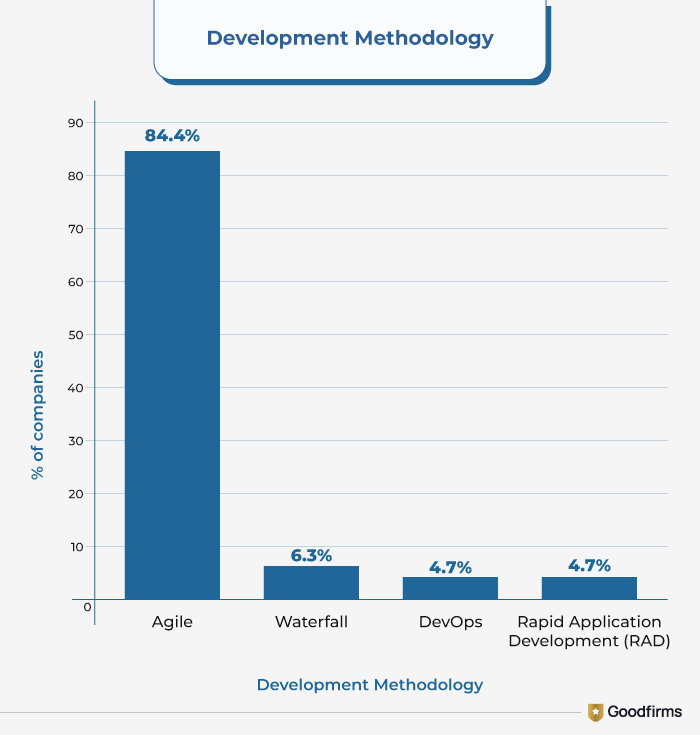
Agile means frequent sprints and iterations, leading to scope creep (10) and upfront operational costs more than the waterfall methodology (especially for fixed-price projects).
However, the trade-off of using Agile is reduced long-term risk and ensures better adaptability. No wonder 84.4% of participant companies rely on Agile for software development, as the risks are lower in the long run.
#8. Security Protocols
Constantly updating frameworks, tools, and compliance standards means more work for developers, as well as retraining costs and refactoring legacy systems.
#9. Talent Shortage
The shortages in AI, cybersecurity, and cloud engineering talent in North America and Western Europe have driven up hourly rates of software professionals. The trend is prompting many firms to adopt nearshoring and offshore outsourcing to manage their budgets.
#10. Geopolitical Factors (regulation, sanctions, compliance)
Geopolitics play a subtle but dominant role in software costs. Laws regarding data localization, cybersecurity compliance, and trade restrictions (e.g., AI export controls) result in additional administrative and integration costs.
Several factors can drive your software development costs, some of which are beyond your control, such as security protocols and geopolitical considerations. Still, the other reasons cited above, such as project complexity, scope creep, technology stack, and talent shortage, are issues that can be managed at the client’s end, whereby the custom software cost can be drastically reduced.
Here are a few expert-backed strategies that could help you reduce software development costs without affecting the quality of your software much.
How do you Calculate Custom Software Development Cost?
Project managers can use mathematical models to estimate software cost. The Function Point Analysis (FPA), COCOMO, and Delphi Method are widely popular cost estimation methodologies. ( COCOMO (Constructive Cost approach) uses several parameters to forecast the price of a software project, such as the size, complexity, and kind of software. Mathematical models apart, if you want to calculate how much your software will cost, here's the equation. (5)
Estimated Cost = Base Project Type Cost + (Feature Development Costs × Complexity Factor) + Integration Costs + UI/UX Design + Testing & QA Costs + Maintenance & Updates Costs.
Let’s break it down:
Base Project Cost: First,determine the initial cost of the software you want to build. Whether it's a mobile app, a web app, an enterprise software, or another type of application, each type of application has a different baseline, so this is where your calculations begin.
Feature Development Costs: Next up, the features. Consider user authentication, messaging system, payment gateway, etc. Each feature comes with its own price tag, time, and complexity, which collectively affect the overall cost.
Complexity Factor: It goes without saying that complexity is a cost multiplier (usually between 1x and 2x). A simple MVP might cost you 1X, while a full-fledged custom solution or enterprise-grade platform would cost more.
Integration Costs: Do you want your software to interact withCRMs, ERPs, third-party APIs, and databases? That’s where integration costs come into play. It often depends on the number of systems and the data flow between them.
UI/UX Design: Wireframes, mockups, and interactive prototypes help you set the stage for an interactive product. And, of course, great design adds cost, but at the same time boosts usability and retention.
Testing & QA Costs: Quality assurance ensures your software works as intended - through unit testing, integration testing, user acceptance testing (UAT), and bug fixes. Each layer adds cost, but omitting it entirely can actually be more costly.
Maintenance & Updates Costs: Nope, the software story doesn’t end after launch. Ongoing costs include fixing bugs, adding new features, updating the system, security patches, and general maintenance. Think of it as your software’s ongoing health plan.
How do you Cut Software Costs Without Compromising Quality?
Software development costs are skyrocketing, but they can be easily controlled if you know what to do and avoid inevitable mistakes from the start, such as having a clear roadmap for your software, using the MVP approach, reusing existing solutions, and more.
Here’s a list of expert-backed strategies to de-escalate software development costs:
#1. Have Clear Requirements and Planning
Let’s face it - Vague requirements are budget builders.
According to Robert Hartman of VioPixel, “Many projects overspend because requirements are vague or constantly changing.”
In other words, businesses should be crystal clear about what and why they are building something before writing a single line of code.
Khader Handal of Element Media LLC reinforces this:
“Getting clearer requirements from the client, analyzing the system, and building the roadmap clearly from the beginning would decrease the costs a lot because of the time saved.”
Harsh Makwana of Tripearltech Private Limited and Shafiul Hasan of Vivasoft Ltd echoed similar sentiments:
“Pre Execution Documentation and locking the customer requirements before starting the project reduces costs.”
Or as Devendra Singh of Biz4Group puts it succinctly:
“Plan clearly: lock scope early, validate with prototypes to avoid rework."
Bottom line: A carefully planned roadmap today ensures you stick to your goals and budget tomorrow.
#2. Focus on Agile, Lean, and MVP-First Approaches
Here’s the thing: Agility means efficiency.
Manoj Kumar ofUcodice Technologies Pvt. Ltd.advises:
“Adopt agile methodologies such as Scrum and Kanban to keep development lean and flexible.”
Kanban minimizes costs by limiting the number of work in progress (WIP) and visualizing tasks. Scrum reduces costs through short, fixed sprints, resulting in early feedback and improved quality, thereby preventing costly rework.
Additionally, launching an MVP (Minimum Viable Product), which involves building only the priority features first, helps validate concepts and prevents over-engineering.
Dennis Lenard of Creative Navy says it best:
“Don’t build a spaceship when your users just need a bicycle. Clear goals, early feedback, and ruthless simplicity keep quality high and budgets intact. In other words, discipline.”
EvenJulia of Gecko Dynamics agrees:
“Start from a minimal set of functionalities to test the efficiency-”
In short: Think MVP-first. Test and launch fast.
#3. Reuse Existing Solutions and Open-Source Tools
Why reinvent the wheel when you can stand on the shoulders of giants?
Reuse proven frameworks, components, open-source tools, and APIs to cut time and costs.
As Nedashkovskaya rightly puts it,
“Be a smart assembler, not a custom builder.”
Luke Chaffey of AIWise adds:
“Leverage what already exists. Pre-existing codebases, frameworks, and SaaS platforms can dramatically cut costs and delivery time, especially for SMEs. My approach is: don’t reinvent the wheel if a trusted provider or platform already solves 80% of the problem. That way, budget is spent on the last 20%, the customisation and integration that makes the solution unique and high-quality,rather than wasting resources duplicating infrastructure.”
And, don’t forget low-code/no-code platforms and cloud-native infrastructure - they are an integral part of the tech stack these days for faster, cheaper builds.
#4. Adopt Automation, CI/CD, and AI Adoption
Continuous Integration/Continuous Deployment (CI/CD) pipelines and AI tools are the backbone of testing, deployment, and documentation processes these days.
The Role of AI in Reducing Software Development Costs.
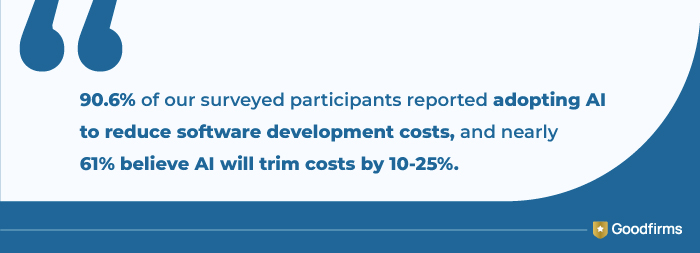
Almost 90.6% of the Goodfirms surveyed participants indicated they have adopted AI to reduce software development costs, and nearly 61% believe AI will trim costs by 10-25%.
Diana Babaeva, founder & CEO of twistly.ai, shares:
“AI tooling reduces normal engineering hours by about 15-30% on all my engagements, creating tighter estimates and movement towards value/outcome pricing.”
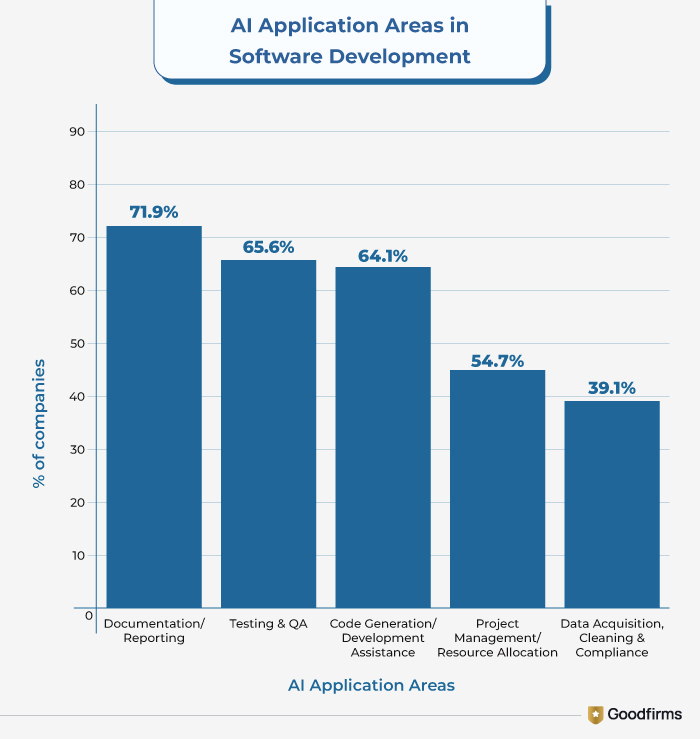
Here’s where Software Companies are using AI the most:
|
AI Application Areas |
Percentage of Companies (%) |
|
Documentation / Reporting |
71.9% |
|
Testing & QA |
65.6% |
|
Code Generation / Development Assistance |
64.1% |
|
Project Management / Resource Allocation |
54.7% |
|
Data Acquisition, Cleaning & Compliance |
39.1% |
According to the survey, software developers view AI tools as productivity boosters, not replacements.
As the CML Team aptly puts it:
“AI tools can help if you use them as a complement.”
#5. Optimal In-house Resource Allocation
Here’s where many companies mess up.
Illia of SYTOSS observes:
“In enterprise environments, the primary cost driver often stems from inefficient vendor management and suboptimal resource allocation, leading to inflated expenses across all stages of the development lifecycle.”
This means balancing team composition (pairing seniors with juniors), and assigning the right projects to the right teams, thus reducing rework and additional costs.
#6. Outsourcing and Remote Sourcing
Outsourcing, building remote teams, and automating repetitive tasks are tried and tested formulas to reduce costs.
So, it comes as no surprise when industry people echo similar sentiments.
Minkle Kalra of Mooglelabs advises:
“Outsourcing specialized tasks to expert partners while keeping critical IP in-house cut costs.
Likewise,Pham Thi Mai Huong of AgileTech Vietnam notes:
“We optimize costs through strategic resource allocation — keeping core development and architecture design in-house while selectively outsourcing non-core or repetitive tasks to trusted partners.”
George Fironov of Talmatic adds:
“By building flexible remote teams and automating repetitive tasks, companies can optimize resources without cutting quality.”
And, as Elisha Aywak, of Teknikali Tech, sums up:
“Even using distributed teams in regions with lower costs can help, provided strong communication and quality controls are in place.”
Rajesh of RisingPoint LLC wraps it up perfectly:
“Define requirements clearly from the start, build an MVP first, use open-source & pre-built components, automate testing & CI/CD, hire the right talent, not the most expensive, use agile methodologies (Scrum or Kanban), outsource non-core tasks, monitor & optimize cloud Infrastructure, and track & analyze development metrics.”
Wrapping Up
Software development cost will never be a stagnant affair. Market trends and emerging technologies are sure to impact the cost. However, since the money involved is substantial, it’s always better to scale as your project needs grow, rather than blindly following any latest trend or technology. And you might now agree as well that the developer location also matters a great deal. And now, with AI powering software development, the software scope will increase, as mentioned by one of our participants, rather than decrease, as a senior-level developer will be able to complete 20 jobs within the same time span with AI as they used to do with 5, which they previously did.
Research Methodology
The Goodfirms 2026 Software Development Cost Research Survey was conducted between September and October 2025, capturing responses from over 100 software development companies worldwide. The study combines quantitative (Google Form) and qualitative insights (expert interviews) to estimate average software pricing and identify influencing factors across global regions. Even a systematic literature review was conducted to ensure our pricing tiers are not off the mark. (4)
Survey Design and Data Collection
- Respondent Profile: Founders, CTOs, project managers, and business analysts.
- Regions Covered: North America, South America, Western and Eastern Europe, South Asia, Southeast Asia, and the Middle East.
- Company Sizes: Small, mid-sized, and enterprise-grade firms.
- Tools Used: Google Forms and expert interviews
A detailed breakdown of participating companies, including services offered, location, and size-based distribution.
Types of Services Offered by Software Companies
Nearly 91% of software companies offered Web Development services, followed closely by Enterprise Software (88.6%), Mobile App Development (79.5%), and AI-powered Software Development (79.5%).
82% of companies offered full-stack development (e.g., combining web, mobile, and AI solutions), enabling clients seeking multiple services to obtain discounts and, more importantly, ensuring smoother project management under one banner.
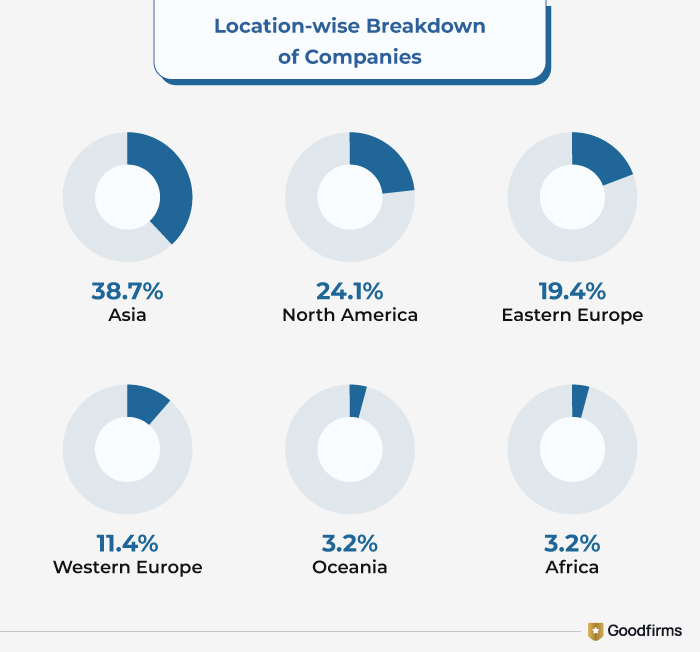
Location-Wise Breakdown of Companies
To ensure balanced cost comparisons, participants spanned multiple regions.
Here’s the breakdown: 38.7% of the survey respondents were from Asia. 24.1% from North America. 19.4% of the companies were from Eastern Europe, while 11.4% from Western Europe. Oceania and Africa each have a 3.2% share. This mix minimized regional bias that could inadvertently influence pricing interpretations.
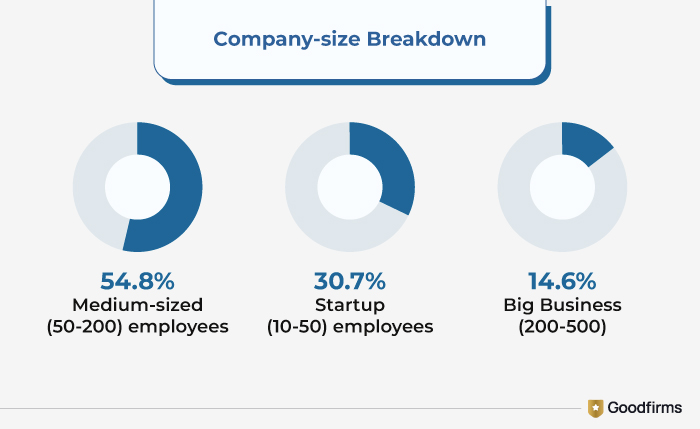
Company-Size Breakdown
Nearly 86% of the respondents were from start-ups to medium-sized companies. As these software companies price their software that’s within the reach of clients who run small and medium-scale businesses, we decided to target this cost survey at small and medium-scale companies.
We sincerely thank our research partners for their valuable insights.

Reference links...
4.https://distantjob.com/blog/offshore-software-development-rates-by-country-2025
5. https://ijisae.org/index.php/IJISAE/article/view/5043/3749
6. https://github.blog/news-insights/research/survey-ai-wave-grows/
11. https://ijca.phdfocus.com/archives/volume106/issue2/18490-9533
12. https://www.ijisrt.com/assets/upload/files/IJISRT25MAR1311.pdf