Top 20 Online Review Statistics - 2025-26: (Based on the survey conducted by Goodfirms)
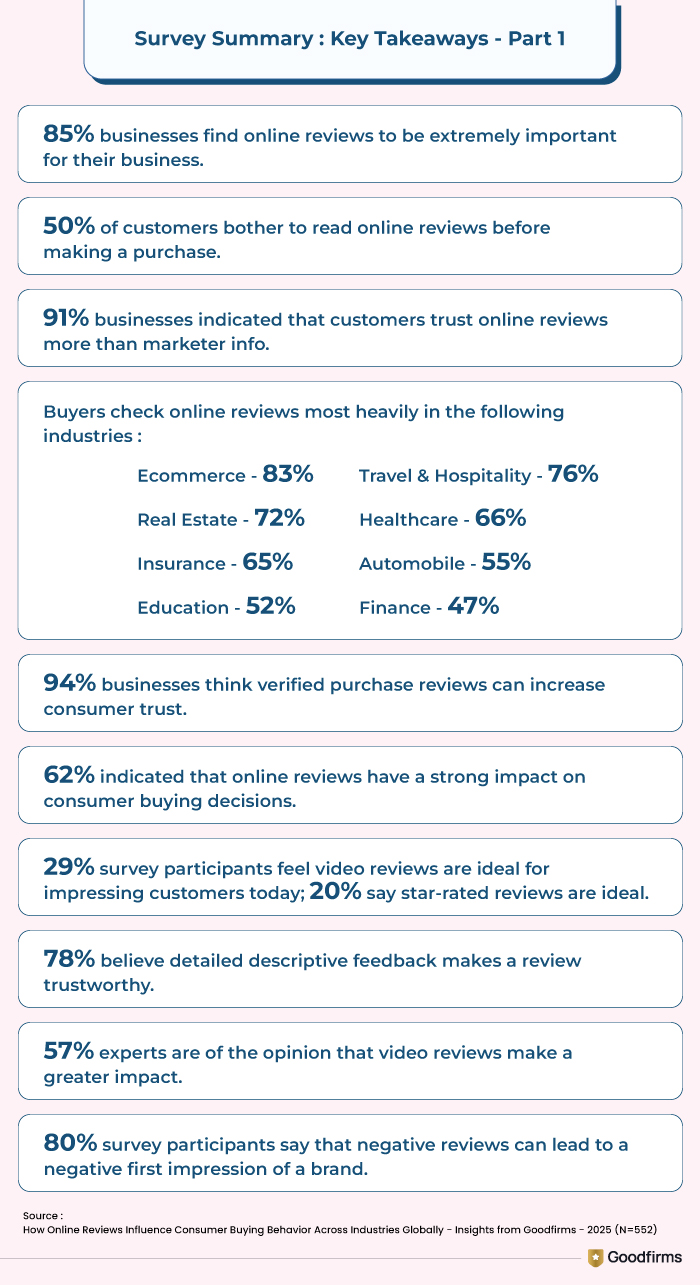
- 85% businesses find online reviews to be extremely important for their business.
- 50% of customers trust online reviews for making a purchase.
- 91% survey participants indicated that customers trust online reviews more than marketer info. Online reviews are becoming a key trust signal for AI search visibility across Google AI Overviews, ChatGPT, and Perplexity.
- Buyers check online reviews most heavily in the following industries: Ecommerce - 83%, Travel & Hospitality - 76%, Real Estate - 72%, Healthcare - 66%, Insurance - 65%, Automobile - 55%, Education - 52% and Finance - 47%
- 94% businesses think verified purchase reviews can increase consumer trust.
- 62% indicated that online reviews have a strong impact on consumer buying decisions.
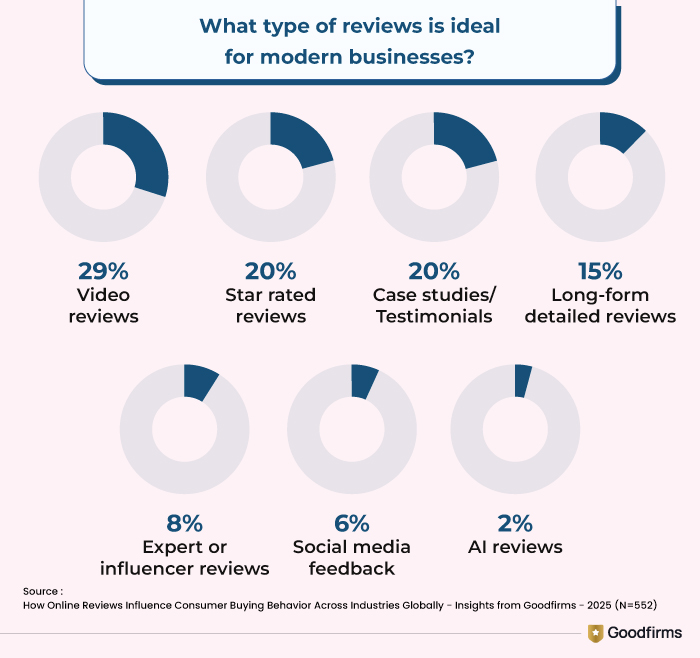
- 29% survey participants feel video reviews are ideal for impressing customers today; 20% say star-rated reviews are ideal.
- 78% believe detailed descriptive feedback makes a review trustworthy.
- 57% experts are of the opinion that video reviews make a greater impact.
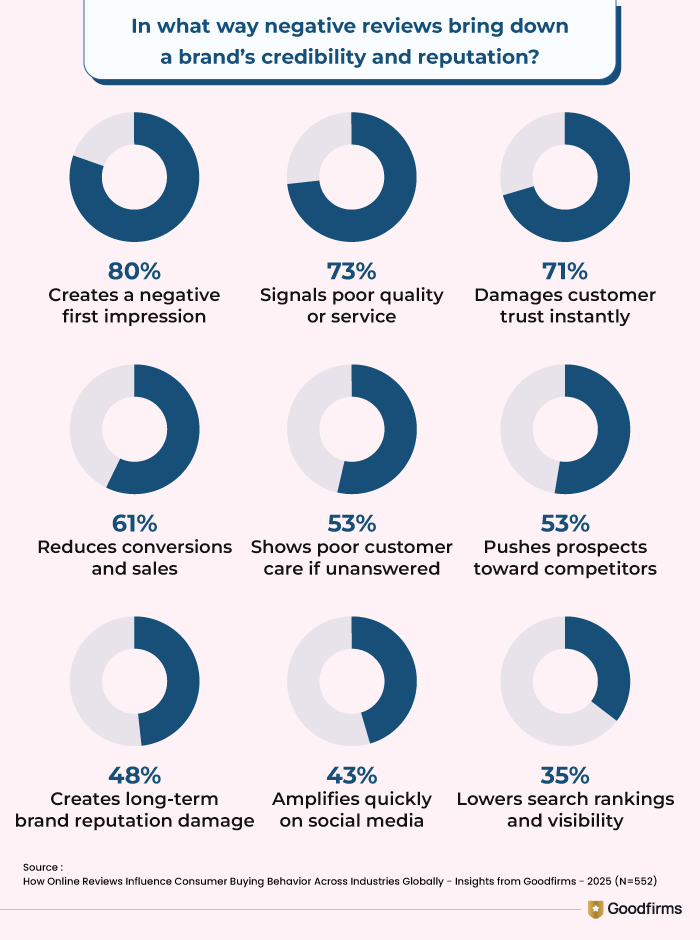
- 80% survey participants say that negative reviews can lead to a negative first impression of a brand.
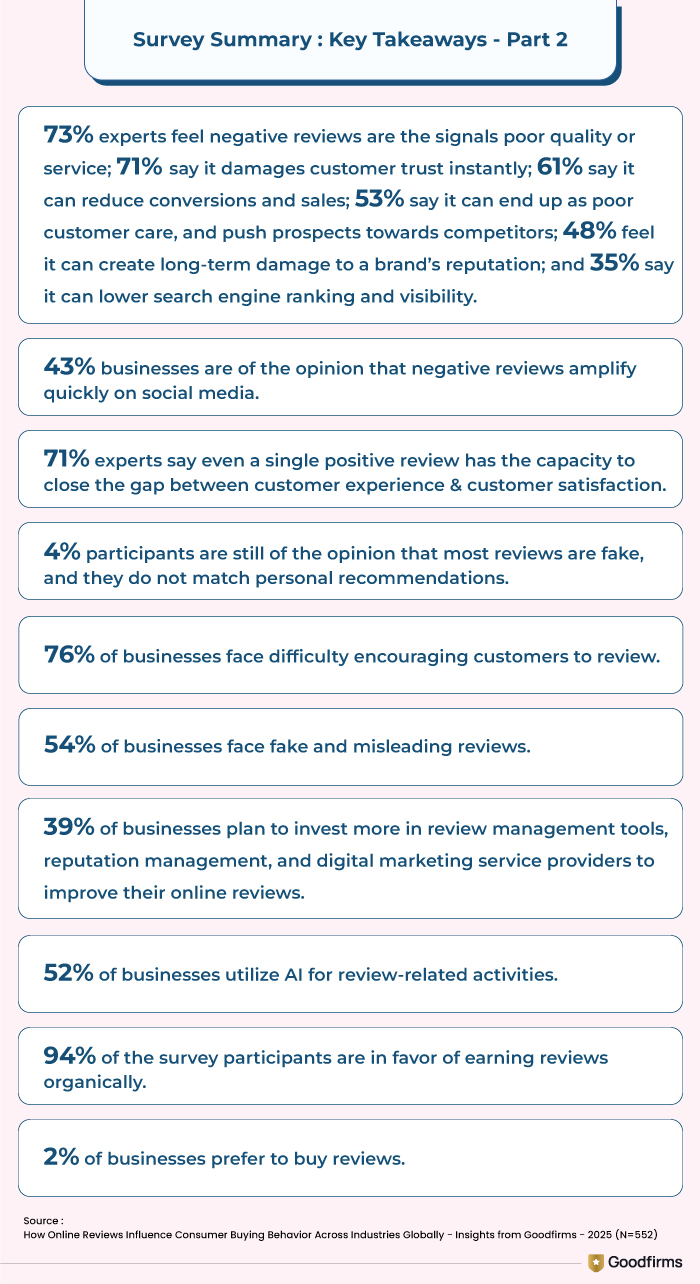
- 73% experts feel negative reviews are the signals poor quality or service; 71% say it damages customer trust instantly; 61% say it can reduce conversions and sales; 53% say it can end up as poor customer care, and push prospects towards competitors; 48% feel it can create long-term damage to a brand’s reputation; and 35% say it can lower search engine ranking and visibility.
- 43% businesses are of the opinion that negative reviews amplify quickly on social media.
- 71% experts say even a single positive review has the capacity to close the gap between customer experience and customer satisfaction.
- 4% participants are still of the opinion that most reviews are fake, and they do not match personal recommendations.
- 76% of businesses face difficulty encouraging customers to review.
- 54% of businesses face fake and misleading reviews.
- 39% of businesses plan to invest more in review management tools, reputation management, and digital marketing service providers to improve their online reviews.
- 52% of businesses utilize AI for review-related activities.
- 94% of the survey participants are in favor of earning reviews organically.
- 2% of businesses prefer to buy reviews.
How Online Reviews Influence Consumer Buying Decisions?
Whether a customer wants to buy a phone or software, the first instinct is to search for the best service providers online, along with reviews and ratings from actual users. Online reviews predominantly help users make their buying decisions. They act as recommendations. Reviews also have substantial value for a business. What customers like and dislike, what concerns are raised by the customers, etc., help businesses to analyze and improve. The credibility and trust that customers have in a brand directly impact the brand's online reputation. Sharing customer reviews is the best way for a brand to display authenticity. Online reviews can potentially deliver measurable benefits to both customers and businesses.
There is no denying that the consumption of online reviews is soaring today. To analyse the criticality of online reviews as part of the brand-customer experience, the challenges and threats of fake reviews, review suppressions, the dark side of negative reviews, and the impact of AI reviews, Goodfirms conducted a survey titled "How are Online Reviews Shaping Consumer Buying Behavior Across Industries Globally?" The responses are as highlighted in this article.
Survey Participants Summary
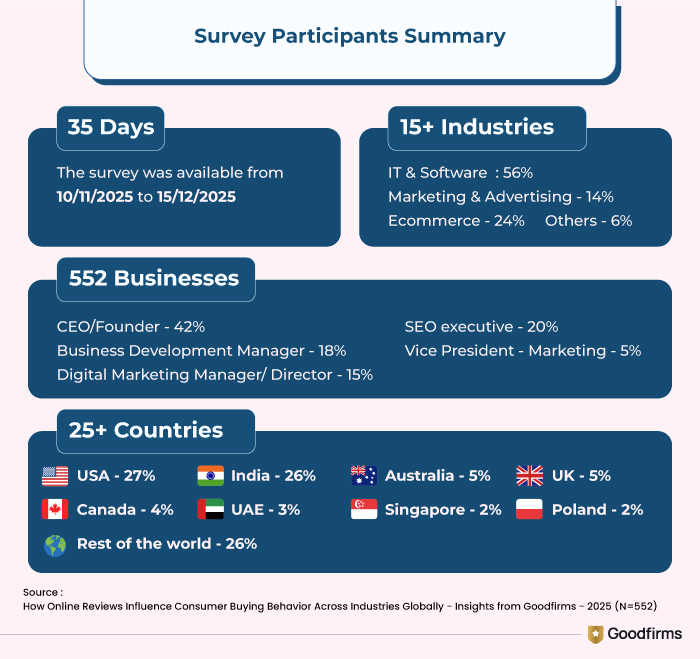
The survey was conducted over 35 days, from November 10 to December 15, 2025, and received responses from 552 participants. Respondents represented more than 15 industries, with the majority coming from Digital Marketing & Advertising (56%), followed by IT/Software Services (36%), Ecommerce/Retail (4%), and another 4% from various other sectors.
In terms of roles, the survey captured insights from a strong leadership and strategy-focused audience: 42% of respondents were CEOs, Founders, or Directors; 18% were Business Development Managers; 15% were Digital Marketing Managers; 20% were SEO Managers; and 5% held Vice President–Marketing positions.
Geographically, participants came from over 25 countries. The largest segments were from the USA (27%) and India (26%), followed by the UK (5%), Australia (5%), Canada (4%), the UAE (3%), Singapore (2%), and Poland (2%). The remaining 26% represented a diverse mix of regions across the rest of the world.
Awareness & Importance of Online Reviews
Businesses are always eager to know what propels their customers. Ever since online businesses began to prevail, several studies have been conducted to understand consumer buying behaviour and the factors that influence purchase decisions. Price, convenience, experience, and access are the top factors that impact online reviews. Online reviews drive buying decisions. They influence trust, credibility, and revenue at every stage of the customer journey. On the other hand, customers also value online reviews. Before making a purchase, most shoppers automatically glance at online reviews. Traditional reviews are different from online reviews. To initiate the survey, the first findings was about the importance of online reviews.
How Important Are Online Reviews For Your Business?
Key Finding: Online reviews are critical to business decision-making
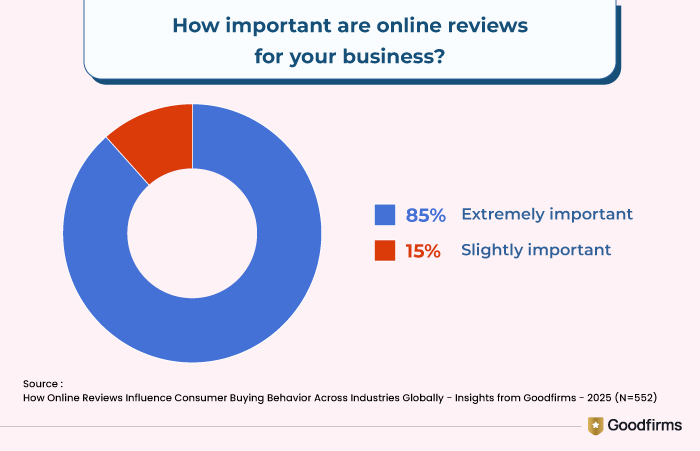
An overwhelming 85% of respondents reported that online reviews are “Extremely important” to their business, while the remaining 15% considered them “Slightly important.” Notably, no respondents indicated that reviews were unimportant, highlighting near-universal recognition of their value. This response suggests that businesses view online reviews as a primary mechanism influencing buying decisions and accelerates conversions. Data-backed review insights help brands optimize their offerings and close more deals.
Do Customers Bother To Read Or Give Online Reviews For Your Business?
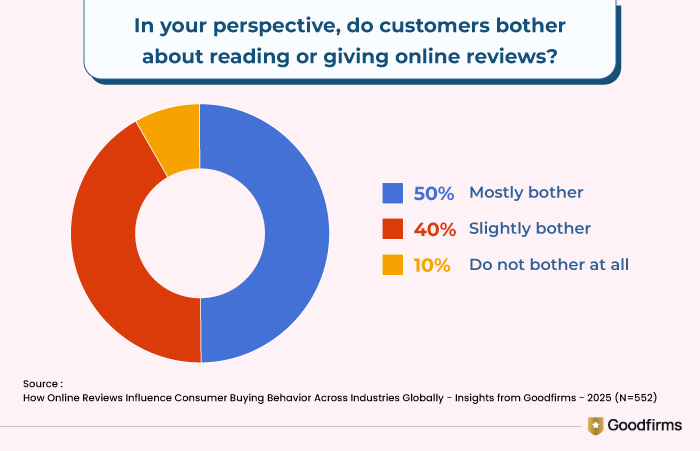
The survey findings show that customers predominantly pay attention to online reviews. Half of the respondents (50%) believe customers “mostly bother” to read or share reviews, indicating that reviews meaningfully shape purchasing decisions. Another 40% feel customers “slightly bother,” suggesting that while not every customer actively participates, reviews still influence awareness and consideration. Only 10% believe customers “do not bother at all,” reinforcing that indifference toward reviews is relatively uncommon.
Overall, the results highlight that online reviews remain an important part of the customer journey — influencing trust, research behavior, and final decisions.
Perception of Trust: Online Reviews vs. Marketer Information
Do You Think Online Reviews Are Trusted More Than Marketer Info?
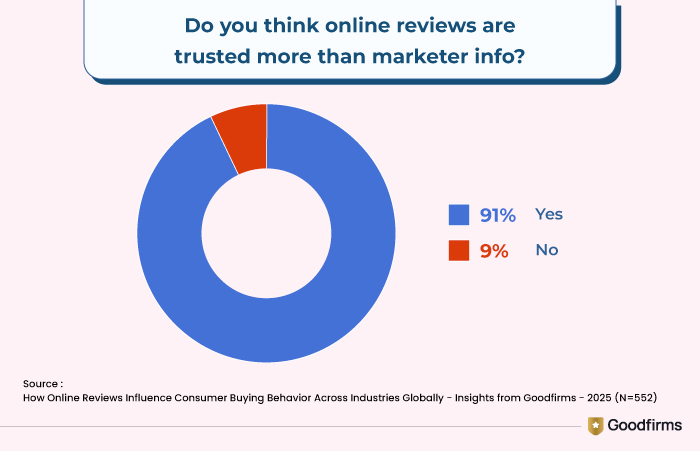
Responses: Yes — 91% | No — 9%
A striking 91% of respondents believe that online reviews are trusted more than information provided directly by marketers. Only 9% felt otherwise.
Brand trust is the confidence, respect, and loyalty that a business gathers from consumers. It basically escalates when the brand fulfills all the promises that it makes to its customers. It is also a known fact that consumers are ready to pay more for a product or service from a brand that they trust. (1) Humans tend to trust another human easily, and thus an online review from a customer who trusts a brand has more credibility. (2)
Delivering quality, brand consistency, ratings, reviews, customer service experience, brand reputation, security, and privacy are some of the most important factors that can enhance the trust of a customer in a brand.
For businesses, the takeaway is clear — authentic customer reviews now play a central role in credibility and conversions. Marketing efforts are most effective when supported by transparent, verified customer feedback and proactive review management.
As many as 91% customers rely on online reviews to make a purchase decision. Online reviews are a key factor in making a purchase decision.
How Online Reviews Influence AI Overviews and AI Search Visibility
Reviews are becoming a trust signal for AI-generated answers.
Goodfirms survey found that 91% of participants believe consumers trust online reviews more than marketer-created information, while 94% agree that verified purchase reviews increase consumer trust. These findings have implications beyond traditional buying decisions. As AI-powered search experiences such as Google AI Overviews, ChatGPT, Perplexity, and other answer engines increasingly summarize information from across the web, authentic customer reviews are becoming an important trust signal.
This shift is supported by broader industry data. According to BrightLocal's Local Consumer Review Survey 2025, 83% of consumers use Google to find local business reviews, underscoring the growing importance of review content in shaping online visibility and brand perception. Since AI search systems frequently draw insights from authoritative websites, review platforms, forums, and customer-generated content, businesses with stronger review profiles are more likely to establish the credibility signals that AI systems favor.
AI systems are designed to surface information that demonstrates credibility, real-world experience, and consensus. Large volumes of positive, verified, and descriptive customer reviews help establish a brand's authority and reputation, increasing the likelihood of being referenced across AI-generated answers and recommendation lists.
Businesses that actively collect authentic reviews, respond to customer feedback, and maintain strong ratings across trusted platforms may gain greater visibility not only in traditional search results but also in emerging AI search experiences.
What This Means for Businesses
- Strong online reviews improve consumer trust and conversion rates.
- Review sentiment contributes to overall brand authority.
- Verified reviews strengthen credibility signals that AI systems value.
- Detailed customer feedback provides content that AI models can reference and summarize.
- Reputation management is becoming an important component of AI search optimization strategies.
Key Takeaway: As AI search adoption accelerates, online reviews are evolving from a conversion asset into a visibility asset—helping businesses influence how both customers and AI systems perceive and surface their brand.
Top Industries Most Affected by Online Reviews:
Electronics, Fashion, Food & Beverage, Beauty, Home Goods, Groceries & Beverages, Digital Goods, Toys & Hobbies are a few categories that come under the Retail/Ecommerce industry. This industry is currently seeing the maximum number of online reviews. Consumers for these categories heavily rely on online reviews, and the related businesses see sales based on the influence of reviews. Consumers also heavily rely on online reviews in the travel and hospitality industry. Our experts were asked to give their opinion and the following inputs were gathered.
Buyers Check Online Reviews Most Heavily In Which Industries?
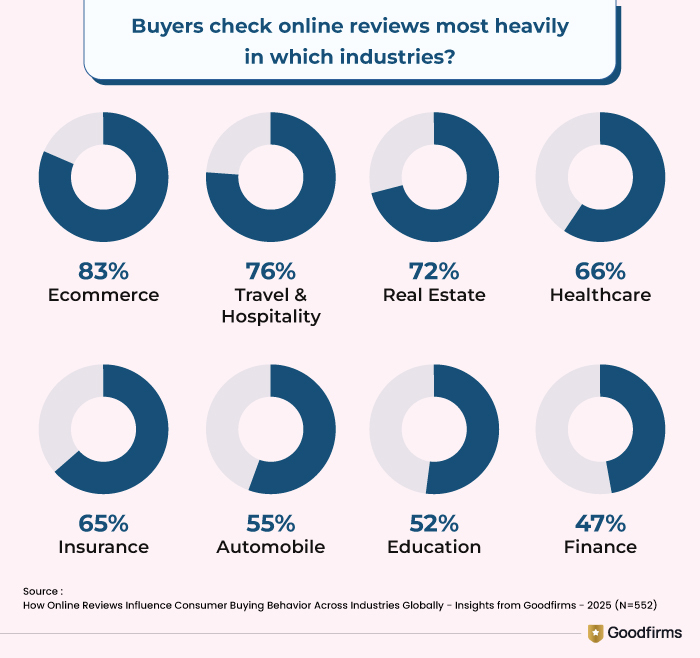
Ecommerce leads significantly, with 83% of buyers indicating they rely heavily on reviews before making a purchase. This is followed by Travel & Hospitality (76%) and Real Estate (72%), where trust and risk perception are high, making peer opinions crucial.
Industries tied to well-being and long-term commitments — such as Healthcare (66%) and Insurance (65%) — also see strong review dependency, highlighting how consumers increasingly validate service quality online before engaging.
Mid-tier reliance is seen in Automobile (55%) and Education (52%), where buyers research extensively but may still weigh offline recommendations or expert advice. Finally, Finance (47%) shows reliance, suggesting that brand trust, regulations, and direct consultations still play a strong role — though reviews are clearly gaining relevance.
Takeaway:
Across sectors, online reviews have become a core decision-making tool with the highest impact in digital-first and high-trust industries. Brands that actively manage, encourage, and respond to reviews are better positioned to influence buyer confidence and conversions.
How Trustworthy Are Online Reviews:
Several customers rely on online reviews to make a purchase. However, their trustworthiness is variable due to several factors, such as fake reviews, incentivization, AI reviews, and more. Goodfirms attempted to check with its research partners on their opinion about the credibility of online reviews.
Do You Think Verified Purchase Reviews Can Increase Consumer Trust?
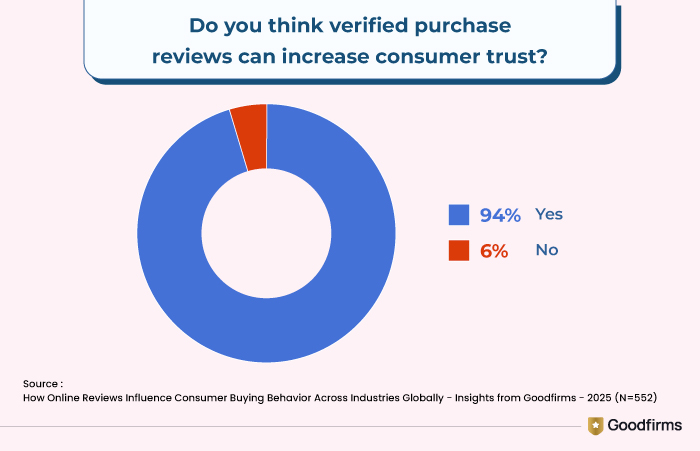
The survey findings clearly indicate that verified purchase reviews strongly enhance consumer trust. An overwhelming 94% of respondents believe that reviews labeled as “verified purchases” make them more confident in the authenticity of the feedback. This shows that consumers value transparency and proof that reviewers have actually used the product or service.
Only 6% felt that verification does not significantly affect their trust levels, suggesting that a small segment may rely more on personal research, brand reputation, or other signals.
What this means:
Verified purchase tags act as a credibility signal, helping brands reduce skepticism around fake or biased reviews. Businesses that emphasize verified reviews — and make review authenticity visible — are likely to build stronger trust, improve conversion rates, and reduce decision hesitation among buyers.
What According To You Is The Impact Of Online Reviews On Consumer Buying Decisions?
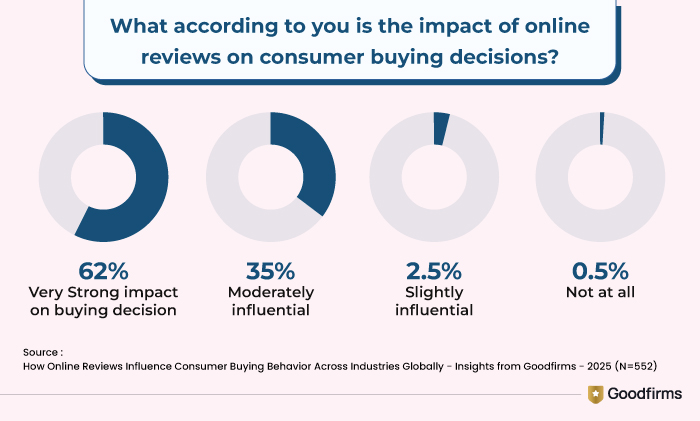
The survey findings show that online reviews play a critical role in shaping consumer behavior. A majority — 62% of respondents — reported that online reviews have a very strong impact on their buying decisions. Another 35% consider reviews moderately influential, meaning that together, 97% - nearly the entire sample acknowledges reviews as an important decision factor.
Only a small fraction view reviews as less impactful: 2.5% said reviews are only slightly influential, and just 0.5% believe reviews have no impact at all.
Takeaway:
Online reviews have moved from being a supplementary information source to a primary driver of purchase decisions. For businesses, this reinforces the importance of maintaining a credible, transparent, and actively managed review strategy.
What Type Of Reviews Is Ideal For Modern Businesses?
Customers are exposed to countless opinions before they decide whom to trust. Reviews have evolved from simple star ratings into richer, more interactive video reviews that can strongly influence buying behavior. This question explores which types of reviews businesses consider most effective today.
What Does This Data Suggest?
The results show a shift from text-heavy, static reviews toward richer, more authentic formats.
- Video reviews lead (29%), signaling that trust today is closely tied to seeing and hearing genuine experiences.
- Traditional review types (star ratings, testimonials) still matter, but they’re no longer enough on their own.
- AI-generated reviews rank last — clear evidence that automation in reviews is still viewed with skepticism.
Video Reviews - 29% (Top choice): Video reviews dominate because they feel real, and there is no room to fake it, increasing credibility. Businesses should actively encourage and simplify video submissions.
Star-Rated Reviews - 20%: Star ratings remain valuable because they’re simple, quick, and comparable. Moreover, they are crucial for search rankings and act as a quick reference before deeper research. This type of review instantly summarizes customer sentiment. But they can be incentivized, suppressed, and easily manipulated.
Case Studies / Testimonials - 20%: Case studies and testimonials hold equal weight with star ratings, which shows businesses still value proof-driven storytelling.
Long-Form Detailed Reviews - 15%: Such reviews matter a lot to serious buyers who would love to research in detail about what others feel about a brand. Such reviews can build long-term credibility. Yes, only a few customers take the time to read long reviews.
Expert / Influencer Reviews - 8%: Influencer-driven promotional reviews can be sponsored or often perceived as biased. Once guidelines and regulatory measures are implemented, these types of reviews can strategically work for both brands and customers.
Social Media Feedback - 6%: It may not appeal to many as the reviews are fragmented across platforms, often they are hard to verify.
AI-Generated Reviews - 2% (Lowest): AI can support moderation, summaries, or prompts, but it should not replace genuine human reviews. Consumers prefer to believe in human experiences.
What Factors Make A Review Trustworthy?
Online reviews have evolved from simple star ratings to video reviews. A real and honest review of a customer builds trust and a positive opinion about a brand. To understand what factors make a review trustworthy, Goodfirms initiated a discussion with its research partners. The following are the responses;
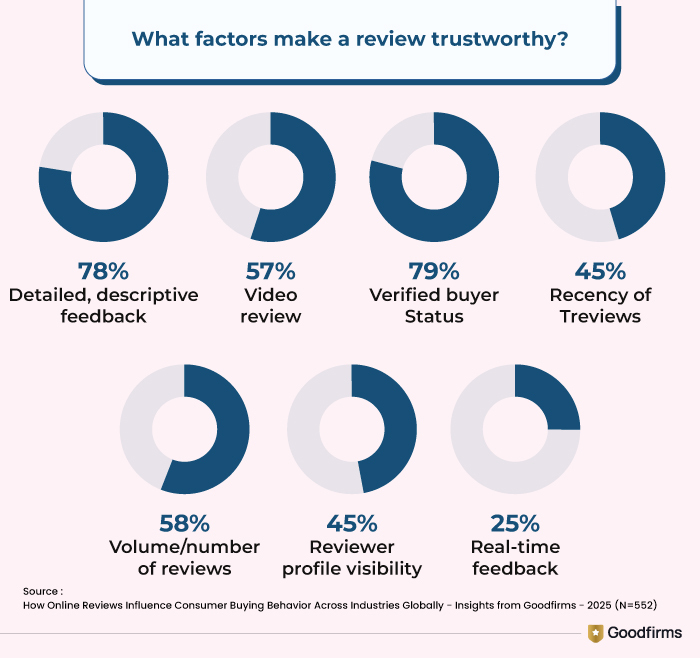
Detailed, descriptive feedback - 78% participants are of the opinion that a detailed and descriptive review can create a huge impact, as it will have concrete details, and independent suggestions building buyers in making informed decisions. A detailed review will always offer constructive criticism, pinpointing areas for improvement, and suggestions that can enhance the product or service.
Video review - 57% of the survey respondents mentioned that video reviews can be trustworthy as they are authentic, short, real, product-specific, and straight from the user. There is no scope to manipulate video reviews. Consumers also believe what they see and hear from original users.
Verified buyer status - 79% of the businesses that participated in Goodfirms’ survey feel that reviews with verified buyer status are more trustworthy. A verified buyer tag is crucial for credibility. The tag shows that the reviewer actually purchased the product or service, typically confirmed by the platform or retailer. Verified tags are the strongest trust signals. When a review is from a verified buyer, then it signifies that the review is not fake or incentivized.
Recency of reviews - 45% opted for this as a trust factor.This measures how up-to-date the reviews are usually prioritizing the most recent opinions. Fresh feedback signals relevance and can highlight current experiences.
Volume/number of reviews - 58% survey participants feel that more number of reviews about a product means more buyers, and it is safe to opt for such products. The volume of reviews typically indicates the number of customers communicating with a brand, anda broader sample of opinion to make the overall rating more statistically reliable, boosting confidence.
Reviewer profile visibility - 45% survey participants feel if the reviewer profile is made visible by the retailer or the platform, then the trust level will automatically increase. Transparency helps shoppers judge whether a reviewer is likely genuine. Profiles with a history of diverse, consistent reviews tend to be more credible than anonymous or first-time accounts.
Real-time feedback - 25% survey participants feel that real-time feedback, which has immediate responses or live updates, including interactive elements like responses from businesses, recent comments, or evolving threads, is more trustworthy.
Overall, this survey data shows that it is better to look for verified purchase tags for real buyer feedback; prioritize recent reviews; use volume as a confidence indicator, check reviewer profiles; and consider real-time interactions to gauge authenticity and responsiveness.
In What Ways Negative Reviews Bring Down A Brand’s Credibility And Reputation?
Most consumers rely on online reviews to make a buying decision. Some of the top online review platforms include Google Reviews, Facebook, Yelp, Amazon, and Goodfirms for B2B companies and product reviews and ratings.(3) It is a fact that negative reviews erode trust, performance metrics, and the bottom line of the business growth. A single negative review can cause significant damage, as consumers view online feedback as a direct signal of trust that influences their purchasing behavior and loyalty.
The following are the responses that Goodfirms got from its expert business participants:
1. Creates a negative first impression - 80%
A staggering 80%+ of consumers change their purchase intent after seeing negative information online. When prospects search your brand, negative reviews are often the first thing they see — shaping perceptions before a single interaction occurs.
First impressions are formed in seconds. Negative reviews immediately signal risk, causing potential customers to “sign out” before engaging further.
2. Signals poor quality or service - 73%
Consumers weigh negative reviews more heavily than positive ones. 73% feel that negative reviews signal poor quality of the product/brand, leading prospects to assume even before trying. However, it is also noteworthy that 5x more buyers look for negative reviews over positive ones for the purchase of goods and services. (4)
3. Damages customer trust instantly - 71%
A negative review has all the potential to damage customers’ trust in a specific brand or platform. Even the best of the brands face this. Ideally, quick responses to negative reviews can help brands to gain back the trust.
4. Reduces conversions and sales - 61%
Negative reviews have been proven to reduce conversion rates and overall business sales. 61% of our survey participants also vote for this. Even if your product is excellent, a portfolio of negative feedback stops buyers from making the payment. Conversion rates drop because prospects doubt value and reliability.
5. Shows poor customer care if unanswered - 53%
It is fine for a brand or a platform to receive negative feedback. But brands need to wisely and quickly address them to regain trust. If left unanswered, it only reflects poor customer care. Silence validates the negative sentiment.
6. Pushes prospects toward competitors - 53%
Negative reviews drive away potential customers, allowing competitors to steal them as it erodes trust. Buyers don’t stick around when trust erodes. 53% of the survey respondents agree completely on this. A competitor with better reputation credibility becomes the safe option even at higher price points.
7. Creates long-term brand reputation damage - 48%
Unlike advertisements, reviews remain permanently visible and influence future prospects over months or years. Even older negative reviews continue affecting brand sentiment even after they were posted. When negative reviews compound over time, they form a persistent perception problem.
8. Amplifies quickly on social media - 43%
Negative reviews uncover growth opportunities. They expose friction points and guide meaningful improvements. When shared via social media platforms, it spreads quickly. Response rate matters here to regain brand trust. Fast, empathetic responses boost reliability and signify the intention of a brand to value its customers.
9. Lowers search rankings and visibility - 35%
Search engines use reviews as signals for relevance and quality. Poor ratings and negative review volume can cause lower search rankings and reduced organic visibility. When search results drop, prospects also drop.
To sum up, customers form opinions early; negative sentiment before engagement means fewer conversions. Once perceived as low quality, even loyal customers hesitate to return. Search engines and social platforms prioritize brands with stronger reviews. Reputation is sticky, the damage lasts long and costs more to repair than protect.
It is important for the brands to check and respond to reviews, whether they are negative or positive. This is the key for a successful customer relationship and retention. Extreme care has to be taken to respond to negative reviews, learn, and be more accommodating. Embrace complaints, put haters to work for you, and turn bad news into good outcomes, says the famous book, “Hug your Haters” - by Jay Baer (5).
Can Positive Reviews Close The Gap Between Customer Experience And Customer Satisfaction?
The survey evaluates whether positive reviews can bridge the gap between a customer’s experience and their overall satisfaction level.
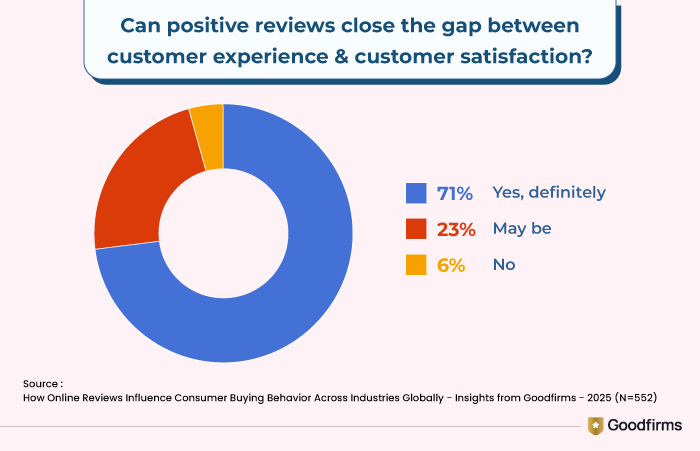
A significant majority (71%) believe that positive reviews definitely closes the gap between customer experience and customer satisfaction. This suggests that public sentiment in the form of positive reviews acts as a powerful booster that can elevate a customer's final assessment of a brand.
Nearly a quarter of respondents (23%) feel the impact is situational. For this group, reviews might soften a negative experience, but they don't necessarily guarantee satisfaction if the service fails to meet basic standards.
Only a small fraction (6%) believes reviews have no impact on the experience-satisfaction gap.
Are Online Reviews Equivalent To Personal Recommendations?
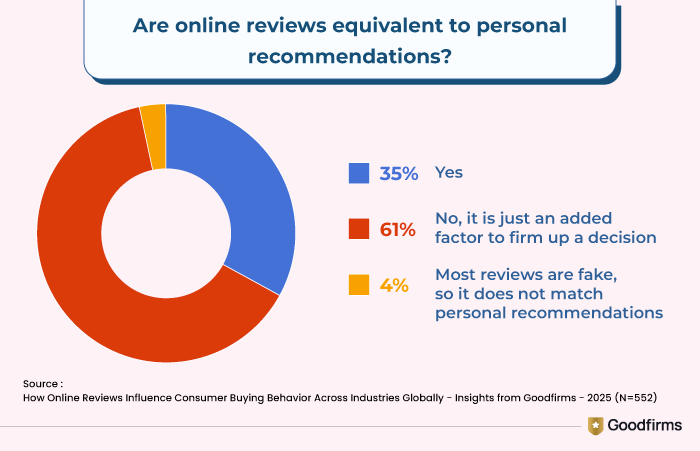
Most respondents see online reviews as equivalent to personal recommendations. A clear 35% believe reviews carry a strong weight. A clear majority 61% view reviews as helpful, but just an added factor that helps finalize a decision.
Meanwhile, 4% express deeper skepticism, saying many reviews feel fake reinforcing why personal recommendations still hold stronger emotional trust. Review bombing is another major activity where spammers publish numerous fake reviews about a brand/product/service, and contact the business for extortion demand (6)
What Challenges Do You Face In Managing Online Reviews?
Online businesses face multiple challenges in managing their online reviews. Both ignoring them and manipulating them can cause severe damage to your brand and business reputation. By adopting an efficient online review management system, businesses can quickly respond and build trust, and also manage reviews across multiple platforms. Here are a few inputs from our expert survey participants;
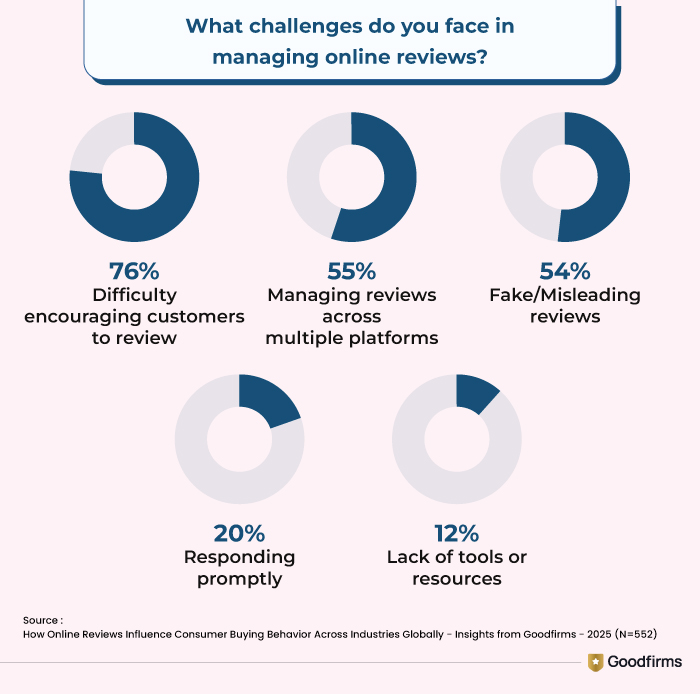
76% are facing difficulty encouraging their customers to review. The struggle to motivate satisfied customers to actually leave feedback is pretty high. Even happy customers fail to take time to share their review.
55% find managing reviews across multiple platforms as challenging. With reviews scattered across Google, social media, marketplaces, and niche portals, staying organized becomes challenging. Businesses often lack a unified view, which makes monitoring and responding slower and less consistent.
54% find managing fake or misleading reviews a bit challenging. In fact, more than half of businesses are worried about fraudulent or biased reviews shaping public perception. These affect credibility, confuse potential buyers, and can harm brand reputation.
20% survey participants feel that they face the maximum challenge in responding promptly to reviews. While responses matter, it is cited as a major obstacle. Competing priorities and limited staff can delay replies, which may make customers feel ignored.
12% feel they lack access to tools or resources. However, those who face this challenge often struggle to scale review management or analyze insights effectively. Investing in a review management system or reaching out to a reliable and verified digital marketing company can be a wise decision to mitigate this challenge.
In 2026, are you planning to invest more in review management tools, reputation management, and digital marketing service providers to improve your online reviews?
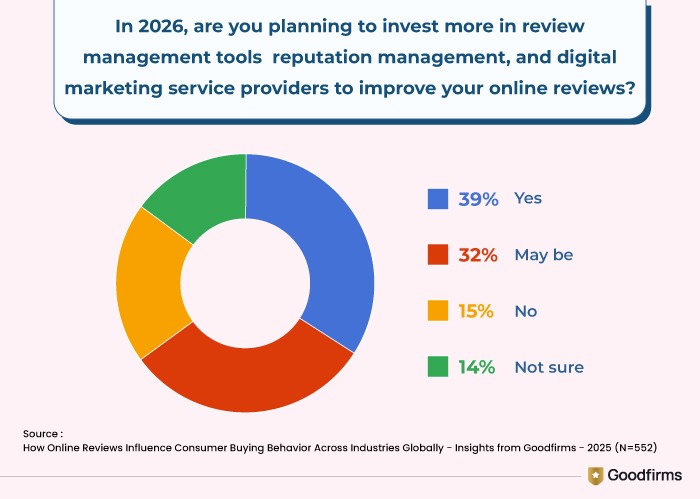
A clear majority of businesses are leaning toward strengthening their online reputation efforts, with 39% already planning increased investment and 32% still considering it. However, the sizable share of uncertainty (14%) and non-interest (15%) shows that some companies are either unsure of ROI or lack clarity on strategy. Overall, the data indicates growing recognition that review management, reputation tools, and digital marketing will play a bigger role in competitive positioning — but many organizations still need guidance on where and how to invest effectively. A reputed B2B firm like Goodfirms can help in choosing the right service provider.
Does your company use AI tools for any of the following review-related activities?
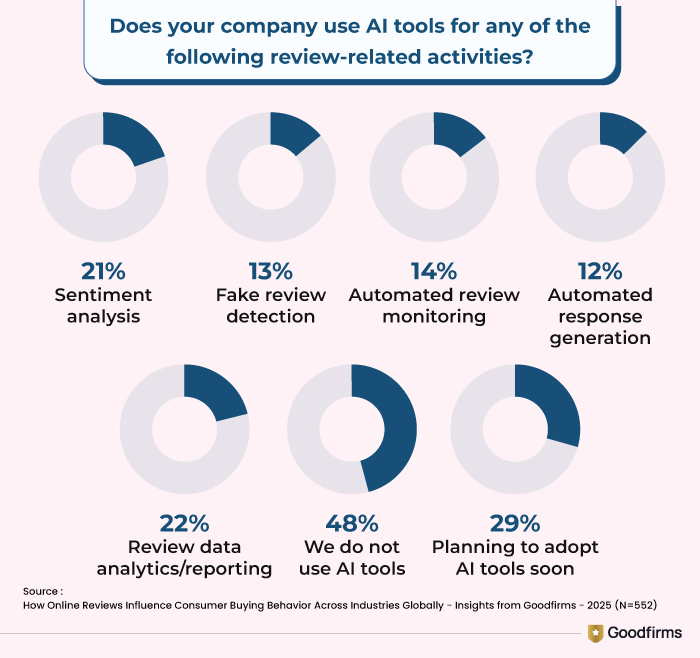
AI has already started to transform review management, but it’s still early and yet to proliferate much in the review management arena. Adoption is strongest in analytics/reporting (22%) and sentiment analysis (21%), showing that businesses primarily use AI to interpret review data rather than automate actions. Meanwhile, nearly half (48%) aren’t using AI at all, yet a notable 29% plan to adopt it soon, signaling a fast-approaching shift. Overall, the data suggests AI-driven review tools are poised to become a strategic necessity, with significant growth still ahead.
How do you intend to get online reviews for your business in the future?
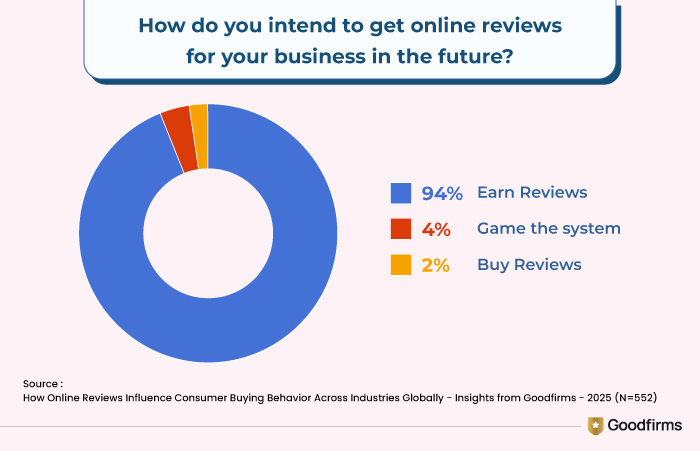
94% say their plan is to earn reviews through real customer experiences, not tricks. That tells us companies are thinking long-term — they know credibility is worth more than any quick boost.
Meanwhile, only 4% admit they might try to “game the system,” and 2% opt for buying reviews. The 2% who still say they would buy reviews may seem insignificant, but they can affect the brand. Paid reviews act like a parasite in the system: they feed off trust while slowly weakening it. When fake praise creeps in, honest businesses are put at a disadvantage, platforms lose credibility, and customers start doubting everything they read.
The fact that this behavior still exists despite stricter policies and greater awareness shows that some businesses are still tempted by shortcuts.
The Federal Trade Commission (FTC) has recently come up with a rule to prohibit fake reviews. The Commission said it will seek civil penalties for those who violate the rule. (7) The Rule also encompasses company-controlled review websites, provisions to suppress reviews, and manipulating the number of social media followers or views.
Beyond the metrics, we invited respondents to share their perspectives for a given set of open-ended questions. The following sections will discuss the same:
How to Improve Online Review Visibility?
# Fake Reviews:
What is your opinion on businesses involved in deceptive endorsements where they create, buy, sell, or use reviews that are not from actual users, are AI-generated to appear authentic, or misrepresent the actual experience of the person giving it?
“I think deceptive endorsements are extremely harmful for both customers and genuine businesses.They distort the real customer experience and create an unfair marketplace. In the long run, fake or manipulated reviews destroy trust, mislead buyers, and damage the credibility of the platform where the reviews appear. Always transparent and good feedback is important, relying on fake reviews usually fails to deliver real value.” - 10G Spectrum
“It will undermine customer trust and damage the integrity of the entire market. Such practices are unethical, harm real consumers, and often lead to long-term reputational and legal consequences.” - Aarmax Media
“Extremely negative because it undermines trust in online reviews.” - Intspirit
“This isn't a viable long-term strategy, as it's most likely to get your brand penalized. Remember that these tools also have AI to detect fake or inauthentic content, and that will lead to penalization.” - Lantern Sol
“It lowers the trust in reviews in general, but once spotted as deceptive or AI generated on a business, it will break the trust in the business.” - FAIRCO
“Reviews shape decisions and trust. When businesses misrepresent who gave the review or what the experience was they harm consumers and damage the credibility of review systems.” - Tepia
“A big ‘no’. It’s fraudulent. If your product/service can't get genuine reviews, the problem isn't your strategy, it's your product or customer experience— you should fix that first.” - WebSpero Solutions
# Incentivized Reviews:
What is your opinion on incentivized reviews where they provide compensation or other incentives to consumers on the condition that they write a review?
“I think incentivized reviews are a grey area. On one hand, I understand why businesses do it — getting customers to share feedback isn’t always easy. A small incentive can encourage people to take the time to write a review, and there’s nothing wrong with appreciating someone’s effort. For me, the key is transparency. If a business wants to offer incentives, it should make it clear that the review can be good, bad, or neutral — no strings attached. Otherwise, it becomes more like buying praise rather than collecting genuine experiences.” BBNC
“For businesses that rely on large amounts of reviews this can be critical, because otherwise people don't leave reviews.” - Creative Navy
"Incentivized reviews walk a fine ethical line. They're not inherently deceptive, but they can easily become misleading if not handled with transparency and care. Incentives can subtly influence tone, language, and rating—even if the reviewer intends to be honest. That’s why platforms like Amazon and TripAdvisor have strict policies around incentivized reviews, and regulators like the FTC require clear disclosure." - DIGITAL CONCEPTS
“Giving an incentive to the customer / consumer as a motivation may be ok. But incentivising for a positive / 5 star review is deceptive.” - Digital Mojo
“Don't think it's an issue as long as the customer isn't incentivised to leave a positive review.” - Flowd
“If the incentivized reviews have been processed by going to the legitimate process of reviewing a service or a product like a customer (going through the customer's journey), it's acceptable and can be considered as authentic.” - Macovin Web Co.
“Ethical review solicitation practices are critical to maintaining consumer confidence and demonstrating a commitment to honest, accurate representation of products and services.” - Manhattan Book Marketing
“It is cash for comment bribery, devaluing the system.” - Percept
“I view incentivized reviews with caution because they often create a conflict of interest. Even if the reviewer tries to be honest, the psychological pressure to please the person providing the reward can subconsciously bias the feedback. Based on my belief in total transparency, I prefer organic feedback.” - Remotely Philippines
“Incentivized reviews can bias opinions and should be clearly disclosed.” - TechlyCodes
“Following legal guidelines and platform policies ensures trust and avoids penalties.” - Technostacks
“Honesty and disclosure are key to keeping reviews fair and trustworthy.” - Yael Consulting
# Review Suppression:
What is your opinion on review suppression where businesses prevent or remove negative, genuine consumer reviews?
“Platforms should not allow for it. Even with a paid subscription.” - ABUZZ PTE. LTD.
“I believe suppressing genuine negative reviews is harmful and ultimately ineffective. For a company to be seen as honest, it needs to show both positive and negative feedback. Having a mix of reviews actually makes the company look more authentic and trustworthy, while also giving the business a chance to improve based on real feedback.” BEON.tech
“A trustworthy business doesn’t silence its customers; it listens, learns, and responds. Transparency builds credibility. Suppression destroys it.” - Cubic Solutions.Inc
“Review gating is illegal in the United States per the Federal Trade Commission (FTC).” - SmartSites
“Review suppression is deceptive, illegal in many jurisdictions, and damaging to brand reputation. Honest, balanced reviews—including negatives—build far more credibility and lead to stronger long-term growth.” - GTE Localize
“I think review suppression is just another form of deception that robs consumers of honest information. If a business hides real criticism, it signals they care more about appearances than accountability.” - Lifted Websites
“If a negative review is not genuine, it must be deleted. The same as a positive review.” - MATTERS
“Instead of removing the negative reviews the companies may try to solve the customer issue and convert that negative review into a positive one.” - Nexiqus
“A brand that listens, responds, and improves earns far more respect than one that hides behind a curated façade. True reputation strength is not built on perfection, but on honesty and accountability.” - ReputaForge
“Suppressing honest criticism doesn’t eliminate risk, it amplifies it. A credible business doesn’t fear bad feedback.” - Synergo Group
Original Reviews or Predictive AI Reviews?
Original reviews undoubtedly retain human voice and experiences. Predictive reviews are AI reviews or Technology Assisted Reviews (TARs) aimed at accelerating review, improving consistency, at a reduced cost. Here, machine learning, natural language processing (NLP), and Large language models (LLMs)(8) are leveraged to continuously learn and discover a brand to automatically create reviews, quickly, and more accurately with minimal manual effort. Technically, AI can generate reviews. But, ethically, it is not advisable to use AI to automate customer feedback. Using AI to generate reviews without referring with the original user’s feedback is not recommended. Yes, AI can be used to collect reviews, moderate, and analyze to gain clarity for future business decisions. Processes can be automated, but not the opinion. AI can power review intelligence and scalability, but it cannot be used to generate fake reviews.
Let us see what our business participants say on this:
What is your opinion about predictive reviews powered by AI?
“AI-generated reviews may not scale in the longer run and offer little to no value when you are building genuine brand credibility.” - ZOHO CORPORATION PVT LTD
“Predictive reviews powered by AI are an interesting development, but they should be used carefully. They can help businesses anticipate customer sentiment and improve products, but they must never replace real reviews. If AI-generated predictions are presented as actual customer experiences, it becomes misleading. Used ethically as insights, not endorsements, predictive reviews can be helpful, but transparency is key.” - Apperr Designs
“AI-powered predictive reviews could revolutionize how consumers make decisions by forecasting product satisfaction and trends.” - Ciente
“They can be useful for forecasting trends but must be clearly labeled and not mistaken for genuine user experiences.” - ECS Infotech Pvt. Ltd.
“Real experiences and reviews will only matter.” - HDWEBSOFT
“Predictive AI reviews will create significant trust challenges.” - HireWebPro Solutions
“Predictive AI reviews will be the future.” - Kevuru Games
“If a platform wants to show an “expected rating” based on historical data or similar products, that’s fine as long as it’s clearly labelled as a prediction, kept separate from actual reviews, and explained in simple language. The moment those predictions are blended into the review stream, or written in a way that sounds like a real person’s experience, it drifts into something misleading. It may not be outright fake reviews, but it can easily feel that way to a consumer.” - NGenious Solutions
“Interesting concept, but risky if it replaces real experience.” - Pagepro
“Reviews are most valuable when they reflect genuine experiences, so AI should assist insights, not fabricate them.” - StriveX Digi Solutions
“I don’t think it will be good as it will appear fake.” - webbingstone
“AI-powered predictive reviews could be useful for spotting trends, but they should never replace real human feedback.” - WP Creative
“They should only be used transparently and never as a substitute for genuine customer feedback.” - Zobi Web Solutions Private Limited
The Future of Online Reviews:
How do you foresee online reviews shaping your industry over the next 2–3 years?
“We’re moving from simple star ratings to experience-driven reviews — where clients talk about results, ROI, response time, onboarding and ongoing support. Video reviews, quick screen-recorded walkthroughs and real before/after performance metrics will start influencing decisions far more than text alone. Platforms will also get stricter about fake or manipulated reviews, making genuine client stories the real reviews.” Best Digi Success
“Over the next 2–3 years, online reviews will become far more transparent, regulated, and AI-monitored. Platforms will increasingly use advanced AI to detect fake, incentivized, or manipulated reviews, making authenticity a core priority.” CodeRower
“In the next 2-3 years, with AI search gaining more traction, reviews are going to play a super important role in discovery.” Digi-tx
“As search algorithms continue to prioritize user experience and authentic engagement, reviews will carry increasing weight in overall brand credibility. Video reviews and social proof through platforms like Google Business Profile will probably become standard expectations from clients.” - Jose Angelo Studios
“Platforms will tighten controls around authenticity due to the rise of AI-generated content.” - KitRUM
“Over the next 2–3 years, online reviews will play an even bigger role in building trust and influencing buying decisions. Consumers will rely more on verified, transparent reviews, while businesses will need to actively manage feedback and improve customer experience. Authenticity and credibility will become key differentiators in the industry.” - KP Digitally
“With AI detection improving and platforms enforcing stricter authenticity guidelines, only genuine, high-quality reviews will survive.” - Mediaofficers
“Online reviews are going to become even more important to the success and reputation of businesses in our industry. But I think there will be stronger demand for transparency and verifiable reviews, which will punish fake or manipulated feedback.” - SEEDIUM
“As consumers become more savvy, their expectations for transparency and authenticity in reviews will only grow. They’ll demand higher-quality feedback that’s not just about star ratings but also about meaningful insights.” - Snow Monkey
“Over the next 2–3 years, online reviews will become even more central to the digital services industry.” - UPQODE
“Reviews will evolve from simple ratings to data-driven narratives showcasing real-world outcomes.” - Whale Group
"Over the next 2–3 years, online reviews are likely to become more transparent, more verified, and more regulated. AI will help detect fake or manipulated reviews." - My Digital Crown
Survey Summary : Key Takeaways:
Conclusion:
Shoppers should ensure that they check only verified purchase reviews, read both positive and negative reviews, and look for common complaints before making a purchase decision. Businesses should ensure that they post only verified reviews, considering that review deletions are on the rise globally due to various reasons, including stricter enforcement, regulatory issues, incentivized reviews, risk factors, and automated moderation. (9) The age of the review also matters. Older reviews lose their value and relevancy. This can lead to trust issues and data loss when reviews are deleted. To stay ahead, businesses, from startups to established organizations, should focus on collecting new reviews and simultaneously tracking and understanding removals when moderation is automated. This constitutes better reputation management. Expert digital marketing companies specializing in reputation management will be able to guide and assist promptly, and gain insights on the latest developments shaping review visibility.
The survey findings reaffirm one message: Online reviews are not a validation from the customers, their influence in consumer buying behavior will only grow in the days to come. AI will play a huge role in bringing authenticity and transparency. We sincerely thank our research partners for their valuable time, suggestions, and inputs.
References:
- https://www.statista.com/statistics/1374773/consumer-actions-following-the-lost-of-trust-in-a-brand-usa/
- https://imcprofessional.medill.northwestern.edu/blog/what-is-brand-trust
- https://www.goodfirms.co/
- https://www.smartinsights.com/ecommerce/customer-reviews-social-proof/negative-reviews-game-changer/
- https://www.youtube.com/watch?v=RysLXx2cEyU
- https://www.pcmag.com/news/google-warns-of-review-bombing-extortion-scheme-targeting-businesses
- https://www.ftc.gov/news-events/news/press-releases/2025/12/ftc-warns-10-companies-about-possible-violations-agencys-new-consumer-review-rule
- https://www.goodfirms.co/resources/llm-applications-content-writing-seo-marketing-campaigns
- https://searchengineland.com/google-deleting-reviews-record-levels-466546