Key takeaways
- Cross-platform app development builds one app from a single codebase that runs on iOS, Android, web, and desktop.
- A basic app on both platforms costs $35,000 to $85,000 cross-platform, against $50,000 to $120,000 for two native apps.
- Add 25 to 35% for hidden costs, and plan for 20 to 30% a year in upkeep.
- Pick the framework to fit your team and check who backs it. Pick a partner on live apps, verified reviews, and code ownership.
You have an app idea. You want it on iPhone and Android. But you probably don't want to build everything twice.
That is where cross-platform app development can help you.
A shared codebase can help you launch across platforms without maintaining two completely separate products.
So, how does cross-platform development actually work? Which frameworks make sense in 2027? How much can you save compared with native development? And when does going native make more sense?
Let's break it down.
Planning an app for both iOS and Android in 2027? Compare hybrid app development companies by verified reviews and past projects before you shortlist.
What Is Cross-Platform App Development?
Cross-platform app development means building app from a shared codebase that runs on more than one operating system. Instead of writing Swift for iPhone and Kotlin for Android separately, your team writes the app once, and a framework packages it for each platform. That's the short answer to what is cross-platform mobile app development. A booking app is a good example: login, search, and payments get built once, then shipped to both stores.
You'll often see cross-platform, hybrid, and multiplatform used interchangeably, but they can refer to different approaches. Hybrid apps generally use web technologies inside a native wrapper, while frameworks such as Flutter and React Native use different approaches to share application code across platforms. Kotlin Multiplatform focuses heavily on sharing code, while Compose Multiplatform can also share UI.
The same codebase can also extend beyond mobile to web, desktop, and TV. Games are a common example, with many cross-platform game development companies delivering successful projects across multiple platforms.
Step by Step Cross-Platform App Development Process
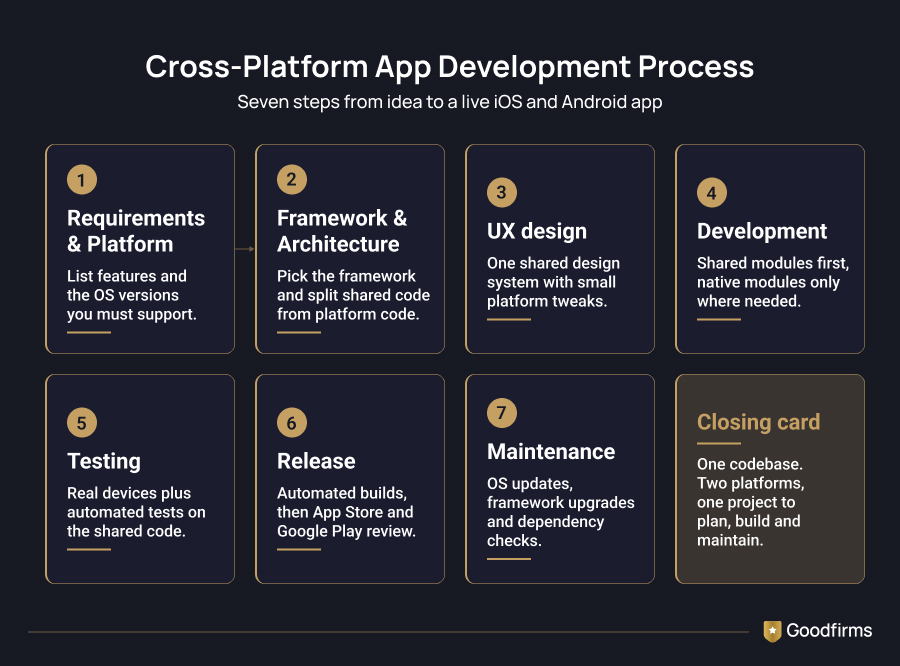
If you want the quick version of how a project runs, it goes in seven steps.
1. Requirements and platform audit
List the device features you need, like camera, GPS, and payments, and the OS versions you must support. Check early for anything that only exists on one platform.
2. Framework and architecture
Choose the framework and keep shared code separate from platform code. Picking on hype alone is the usual mistake here, so let your team's skills and the app's needs drive the decision.
3. UX design
iPhone and Android users expect different navigation and back gestures. One shared design system with small platform tweaks saves rework later.
4. Development
Build the shared modules first, then add native modules only where the framework falls short. Keeping those native pieces small makes every later update easier.
5. Testing
Test on real devices, including older and cheaper phones. Emulators miss battery drain and hardware quirks. Automated tests on the shared code catch bugs for both platforms at once.
6. Release
Set up automated builds and submit to the App Store and Google Play. Each store has its own review rules, so leave a few days of buffer before launch.
7. Maintenance
OS updates, framework upgrades, and dependency checks never stop, and they're where your yearly upkeep budget goes.
How Does Cross-Platform App Development Work Under the Hood?
The process tells you what happens when. This part covers what the framework does with your code.
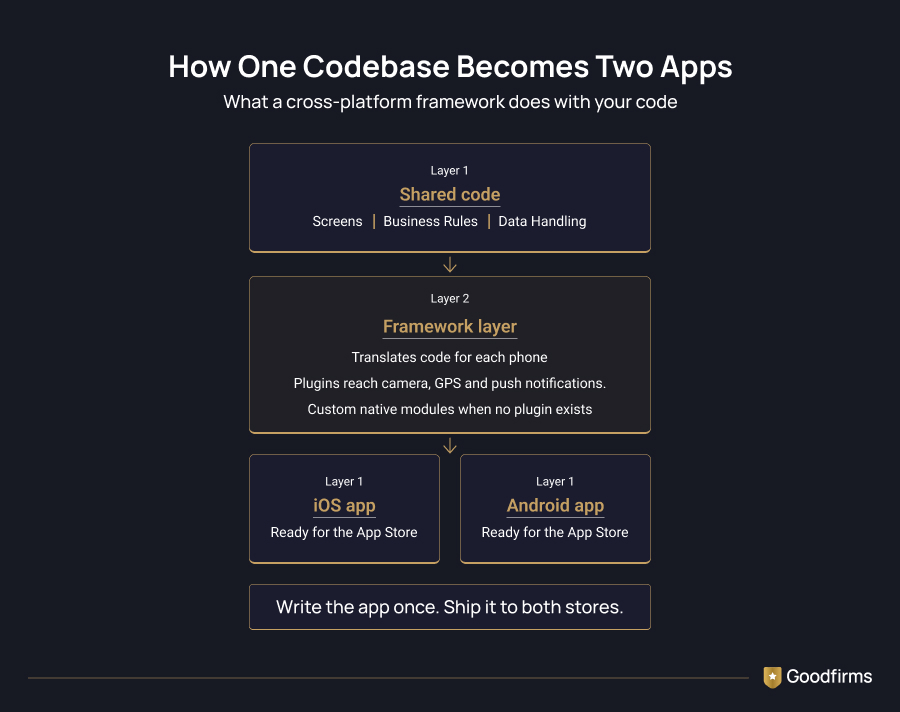
Picture three layers. Your shared code holds the screens, business rules, and data handling. A framework layer translates that code for each phone. Out the other end come two builds, one for iOS and one for Android, each ready for its own store.
Different frameworks share and render code in different ways:
- Own rendering engine. Flutter, which uses Dart, draws every button and animation itself, so the app looks identical everywhere.
- Native components through JavaScript. React Native, written in JavaScript or TypeScript, shows real native controls on each phone.
- Shared logic. Kotlin Multiplatform shares the business logic, and Compose Multiplatform can share the screens as well.
- WebView in a native shell. Ionic with Capacitor, and the older Cordova, run a web app inside a native wrapper. This is the hybrid route. .NET MAUI sits alongside these for C# teams.
- Device features and performance. The camera, GPS, and push notifications belong to the operating system, so frameworks reach them through plugins. When no plugin exists, developers write a custom native module for that feature, and the more of those you need, the more platform specific code you maintain.
For most business apps, like booking apps, marketplaces, and SaaS, users won't notice a performance gap, which is why "near-native" is the phrase you'll hear most. The gap shows up in graphics heavy apps, AR, and real time video, where every frame counts.
Expert view, Gireesh Kaushik, CTO, Grawlix: Native is the better pick when you need top tier UI components or complex features such as Bluetooth access, and when development time isn't a concern. Cross-platform can save nearly 30 to 40% of the cost, and Grawlix uses both React Native and Flutter, depending on the client. For more details listen to the podcast on cross-platform benefits and challenges.
Cross-Platform vs Native vs Hybrid vs PWA
Each route fits a different kind of app. This table shows how they compare.
|
Approach |
Native |
Cross-platform |
Hybrid |
PWA |
|---|---|---|---|---|
|
Codebase |
One per platform |
One shared |
One shared (web) |
One web app |
|
Performance |
Best |
Close to native |
Lower for heavy apps |
Browser limited |
|
Device access |
Full |
Wide, through plugins |
Through plugins |
Limited |
|
Cost |
Highest |
Lower |
Lower |
Lowest |
|
Best for |
Games, AR, deep hardware |
Most business apps |
Content apps, internal tools |
Lightweight web experiences |
Go native for graphics heavy games, advanced AR, and deep hardware use. If you're building only for Apple users, iPhone app development companies can give you the most polished result. Go cross-platform for MVPs, SaaS, marketplaces, and internal tools, where speed and budget matter most. Hybrid works for content apps and lightweight internal tools, and a PWA suits teams that only need a web experience that feels like an app. If you're unsure, start with your must-have device features. They usually settle the choice.
Top Cross-Platform App Development Frameworks for 2027
Each framework suits a different team. These are the five you'll hear about most.
1. Flutter
Flutter gives you full control over how the app looks, which is why brand heavy and animation rich apps like it. Your team writes in Dart, so developers coming from other languages need a little ramp up time. One limit to know: Flutter for web isn't the best fit for sites that depend on SEO. If you're looking for a Flutter cross platform app development company, check for live Flutter apps in their portfolio and ask who will own the source code.
2. React Native
React Native is a good fit for teams already working with JavaScript or TypeScript, supported by a large developer community. Many React Native app development companies have also delivered successful projects using the framework.
3. Kotlin Multiplatform and Compose Multiplatform
Kotlin Multiplatform shares the logic and lets each platform keep its own native screens, or share them through Compose Multiplatform. It suits teams that already know Kotlin from Android work and want to reuse that code on iOS.
4 .NET MAUI and the end of Xamarin
Microsoft ended support for Xamarin and Xamarin.Forms on May 1, 2024. Microsoft recommends moving supported Xamarin projects to .NET MAUI. MAUI is the pick for companies already working in the Microsoft stack, since developers write in C# and XAML and can target mobile and desktop from one project.
5. Ionic and Capacitor
Ionic is the web route. It fits teams of web developers, internal business tools, and content heavy apps, and it's the quickest way to see how the hybrid approach works. Expect less polish on animation heavy screens, since everything runs inside a WebView.
How to choose, and who backs the framework
Ask five things: what languages your team knows, how custom the UI needs to be, which plugins or SDKs you depend on, how much code you want to share, and how long you'll maintain the app.
If you're moving off an older framework, plan the migration early and budget for it.
Is Cross-Platform Worth It? Pros and Cons for Business Owners
Cross-platform has real trade-offs, and the right call depends on your app. Here's what you gain and what you give up, so you can weigh it against your own goals before you commit to the budget.
What you gain
- Lower cost
- Faster launch
- Easier updates
- A consistent experience
What you give up
- Heavy graphics performance
- Early access to new OS features
- Platform differences in UI
- Plugin dependence
- Native only SDKs
How Much Does Cross-Platform App Development Cost in 2027?
Every figure in this section comes from Goodfirms' 2026 survey of 267 mobile app development companies across North America, Europe, and Asia, covered in our 2026 app development cost research. Treat them as planning ranges. Your final quote depends on features, design depth, and who builds it.
Cost by app complexity
|
Type of app |
Cost range |
|---|---|
|
Basic app |
$15,000 to $40,000 |
|
Mid-level app |
$40,000 to $120,000 |
|
Advanced app |
$100,000 to $250,000+ |
|
Enterprise app |
$250,000 to $500,000+ |
Cross-platform vs native for a basic app
For a basic app on both iOS and Android, a native build costs $50,000 to $120,000. The same app in React Native or Flutter costs $35,000 to $85,000, which is a 20 to 40% saving in practice.
What moves the price
- Agencies charge $75 to $250 per hour and freelancers $25 to $150. Hiring from India or Eastern Europe can cut costs by up to 60%.
- App store fees, compliance, and marketing add 25 to 35% to the total project cost.
- Maintenance, bug fixes, and server costs add 20 to 30% of the original build every year.
Costs by platform and country
For a closer look at costs by market and platform, see our guides on iOS app development cost, app costs by platform in Australia, and app development cost in the US.
How to Choose a Cross-Platform App Development Company
A good cross-platform app development company covers discovery, design, development, testing, release, and support. Many sell cross platform app development services as one package, so you aren't juggling vendors. Before you sign, check five things:
- Can you download and use their live apps in your category?
- Do verified reviews mention communication and delivery, not just star ratings?
- Can they explain why they'd pick one framework over another for your app?
- Do you own the source code, and are the IP and security terms clear?
- Who actually builds it, and what does support cost after launch?
To build a shortlist, start with a list of mobile app development companies that have already shipped apps in your category. Narrow it down to four to six and ask each one for a proposal. If you're leaning toward the WebView route, look for teams with real hybrid experience. When you compare cross platform app development companies, check scope, timeline, team size, and what's included after launch, so you're comparing like with like.
Conclusion
Cross-platform app development comes down to one shared codebase and a framework that translates it for each platform. For most business apps, that means a 20 to 40% saving and a faster launch going into 2027. Match the framework to your team, and pick a partner who can show live apps and verified reviews.
Native still wins for graphics heavy and hardware heavy apps, so be straight with yourself about what your needs are.
Which step of the process worries you most?
Start there, and shortlist two or three partners who've done it before. A short call with each will tell you more than any brochure, and it'll show you quickly who understands your app.
FAQs - Cross Platform App Development
1. What is cross-platform app development?
It's building one app from a single codebase that runs on more than one operating system, such as iOS and Android. A framework like Flutter or React Native turns the shared code into a version for each platform, so you don't build and maintain separate apps.
2. How does cross-platform app development work?
Developers write code once. The framework then translates it for each platform by drawing the interface itself, using native components, or running a web app inside a native shell. You end up with separate iOS and Android apps built from one project.
3. Is cross-platform as good as native?
For most business apps, it's close enough that users won't notice. Native stays ahead for graphics heavy apps, AR, and features that need deep hardware access, such as Bluetooth. Choose based on what your app actually needs, and test the riskiest feature early so you know where it stands.
4. How much cheaper is cross-platform than native?
Goodfirms' survey found savings of about 20 to 40%. A basic app on both platforms costs $35,000 to $85,000 cross-platform, against $50,000 to $120,000 for two native apps. Budget for hidden costs and yearly upkeep on top.
5. Which framework is best for cross-platform apps in 2027?
There's no single winner. Flutter suits custom UI, React Native suits JavaScript teams, Kotlin Multiplatform suits Android teams, and .NET MAUI suits Microsoft stack teams. Pick the one that matches your team's skills and has strong backing.