Key takeaways
- iOS app development costs range from $25,000 for a simple app to $350,000+ for an enterprise-grade product.
- Geography is the single biggest lever on your budget — the same 600-hour project costs $54,000 in the U.S. and $12,000 in India.
- AI-assisted tools like FlutterFlow can cut development costs by up to 60%, but professional expertise remains non-negotiable for a market-ready build.
- Feature choices, design quality, backend infrastructure, and testing collectively determine where your project lands within any cost range.
- Plan for 15–25% of your original development spend annually in recurring costs — hidden expenses don't stop at launch.
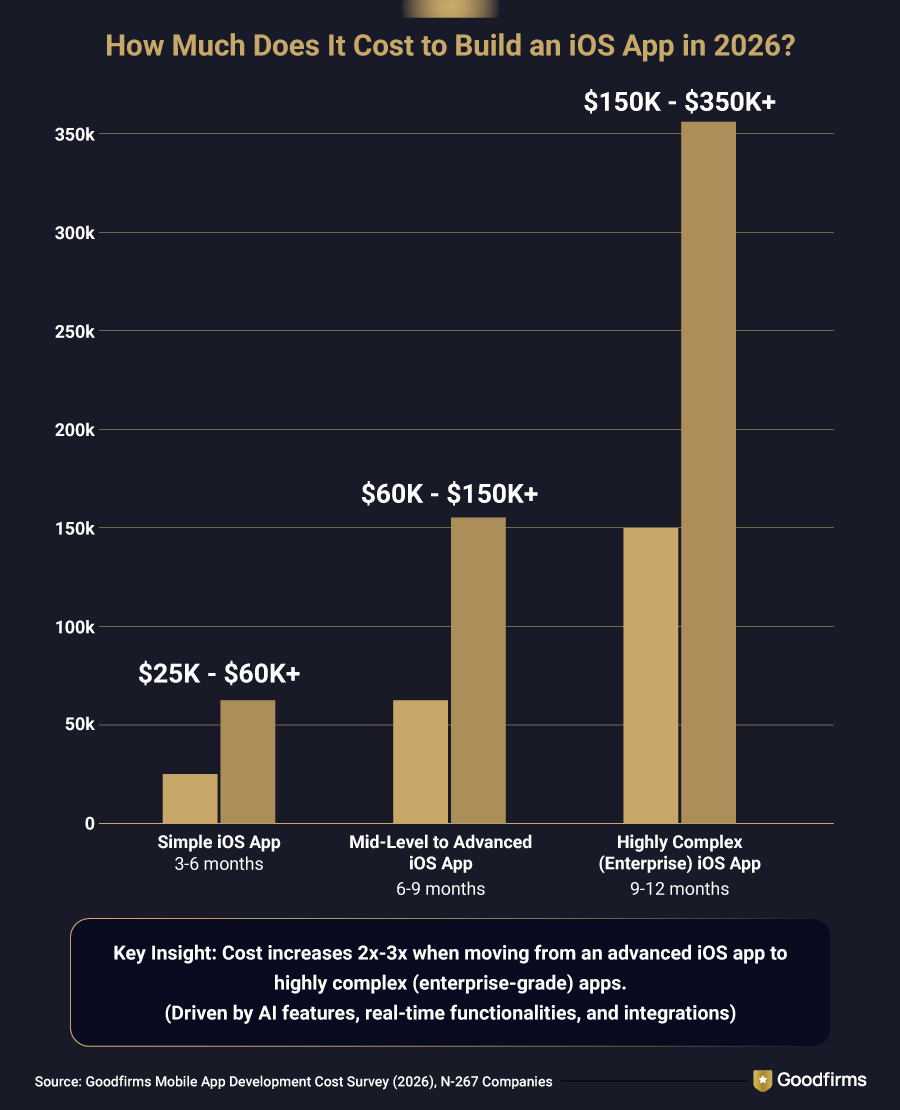
As per Goodfirms’ survey on app development costs in 2026, iOS app development costs range between $25,000 for a simple app to $350,000+ for an enterprise-grade app.
No two iOS apps are the same — and no two quotes for the same app will be either. The cost of building an iOS app shifts based on what you're building: a gaming app carries compliance and rendering requirements that a shopping app never will, and a fintech product demands security infrastructure that an education platform doesn't come close to.
Even with identical feature lists, five different iOS app developers will hand you five different numbers. Experience level, team structure, and geographical location all feed into the final quote — and knowing how each variable moves the needle is the difference between a budget that holds and one that blows past your runway.
Compare vetted iOS app development companies on Goodfirms — with real client reviews, verified pricing, and portfolios that match your project's complexity and budget.
This article will walk you through every possibility that affects the cost of your iOS app and help you plan an accurate budget for your next project. So, why waste time? Let’s quickly get started with knowing the cost of developing an iPhone app based on its complexity level.
Cost of iOS App Development by Complexity
|
App Complexity |
Development Timeline |
App Features |
Estimated Cost |
|
Simple iOS App |
3-6 Months |
Simple UI/UX design, user registration and login, basic profile management, static content pages, simple navigation and menus, basic push notifications, limited backend functionality, basic security measures |
$25,000 - $60,000+ |
|
Mid-Level to Advanced iOS App |
6-12 Months |
Highly customized UI/UX with animations, real-time chat or messaging, advanced payment features (subscriptions, wallets), AI/ML-powered features (recommendations, automation), multi-role user management, advanced analytics dashboards, integration with multiple third-party systems, offline mode and data synchronization |
$60,000 - $150,000+ |
|
Highly Complex (Enterprise) iOS App |
12-18+ Months |
Highly scalable cloud architecture, advanced security and compliance (GDPR, HIPAA, etc.), role-based access control and permission management, integration with enterprise systems (ERP, CRM, etc.), AI-driven insights and automation, high-performance data processing multi-platform support (web, mobile, APIs), continuous monitoring, logging, and DevOps automation |
$150,000 - $350,000+ |
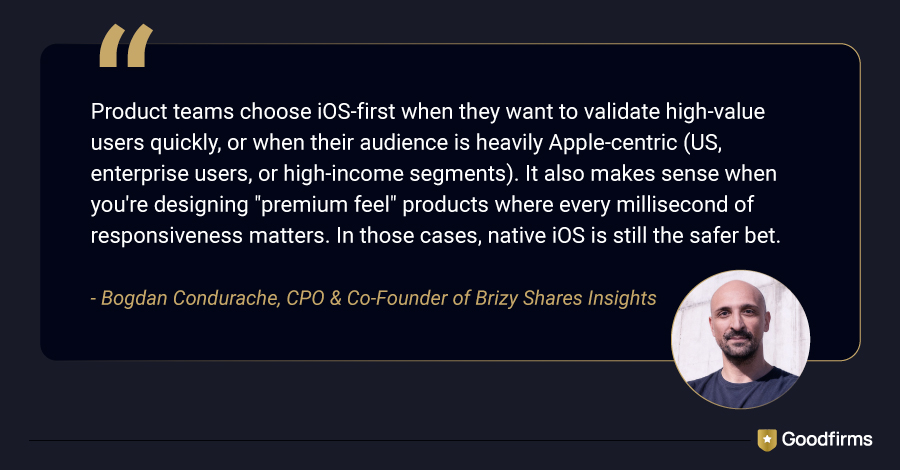
Complexity tiers tell you what a build will cost—but wait, before you make this big investment, it is important to know whether iOS is the right starting point for your specific user base. Here's how Bogdan Condurache, CPO & Co-Founder of Brizy, frames that decision for product teams weighing iOS as their starting point:
Once iOS is the right call for your product and audience, the next variable is what you're building — because category determines your baseline requirements before a single feature is added. A fintech app carries security obligations a travel app never will. A gaming app demands rendering performance in a different league from an education platform. Here's how costs break down by category.
iOS App Development Cost by Category
|
App Category |
Features |
Development Timeline |
Estimated Cost |
|
eCommerce |
Product Catalog, Shopping Cart, Payment Gateway, Order Tracking |
3-8 Months |
$30,000 - $150,000 |
|
Social Networking |
User Profiles, News Feeds, Real-Time Chat, Mobile Uploads |
5-10 Months |
$50,000 - $200,000 |
|
Fintech |
High-End Security Authentication, End-to-End Encryption, Fraud Detection, Payment Integrations |
2-10 Months |
$60,000 - $250,000 |
|
Healthcare |
Secure Patient Handling, HIPAA Compliance, Telemedicine, and Wearable Integrations |
4-15 Months |
$50,000 - $200,000 |
|
Education |
Learning Management Systems, Video Streaming, Progress Tracking |
2-12 Months |
$25,000 - $120,000 |
|
Travel |
GPS & Maps, Booking System, Third-Party APIs |
3-8 Months |
$30,000-$150,000 |
|
On-Demand Services |
Push Notifications, Dynamic Pricing, Real Time Tracking, Payment Integration |
4-8 Months |
$35,000 - $180,000 |
|
Gaming |
Gaming Alerts, Leaderboards, Real-Time Multiplayer Matching, In-app Purchases |
6-20 Months |
$30,000 - $250,000 |
The category gives you a ballpark. But knowing what each phase of development costs is what turns a ballpark into a real budget. Most clients are surprised to learn that the visible part of the app — what users see and touch — accounts for less than half the total spend. Here's where your money actually goes when you break it down by development phase.
Cost of Building an iOS App by Development Phases
|
Development Stage |
% of Total Cost |
Inclusions |
|
Discovery & Planning |
5% – 10% |
Defining the app's goals, scoping features, studying competitors, and mapping out the tech stack before a single line of code is written |
|
UI/UX Design |
15% – 20% |
Sketching screen layouts, building clickable prototypes, finalizing brand visuals, and charting how users will move through the app |
|
iOS App Development |
35% – 45% |
Building every screen users interact with, wiring up core features, and connecting third-party tools like payments, maps, or AI services |
|
Backend Development |
20% – 30% |
Setting up the server, designing the database structure, writing API logic, and configuring cloud infrastructure for data storage and security |
|
Testing & QA |
10% – 15% |
Running the app through real-world scenarios, hunting down bugs, fixing crashes, and ensuring speed and stability across different iPhone models |
|
Deployment & Launch |
5% – 10% |
Preparing App Store listing assets, passing Apple's review guidelines, and pushing the final build live for users to download |
Now that you know where each development dollar goes, a fair question follows: Can the use of AI in iOS app development shrink those numbers without shrinking the output? AI-assisted development has moved well past the hype stage in 2026, and for the right project types, it's changing the cost equation in a meaningful way.
Can AI Reduce the Cost of iOS App Development?
Yes, AI can significantly reduce the cost of iOS app development by automating repetitive tasks like UI generation, code writing, and testing — cutting development time by up to 60% compared to traditional methods. Vibe coding is a big part of this shift, where developers use AI prompts to generate functional code in real time rather than writing every line manually, compressing timelines and reducing the hours billed on straightforward development tasks.
When it comes to iOS app development, FlutterFlow is the most popular AI tool in 2026, used for building apps quickly. Its built-in AI features, such as AI Agent Builder and 200+ AI requests/month on the Growth plan, allow developers to generate screens, logic, and integrations faster — bringing professional iOS app build costs down to as little as $10,000–$100,000, compared to $25,000–$350,000+ with traditional development teams.
Here is a complete cost breakdown for iOS app development using FlutterFlow in 2026:
FlutterFlow Pricing Plans
FlutterFlow offers multiple tiers based on features, collaboration, and deployment needs:
|
Plan |
Monthly Cost |
iOS Publishing |
Best For |
|
Free(*) |
$0 |
Not Included |
Learning & prototyping |
|
Basic |
$39 |
Included |
Solo founders / MVPs |
|
Growth |
Starting from $80 |
Included |
Teams & serious builds |
|
Business |
Starting from $150 |
Included |
Agencies & large teams |
(*) Not Applicable for iOS App Development
Besides paying for a FlutterFlow package that best suits your project requirements, you also need to pay for development costs separately for a complete app build. Below is the total estimated cost of building an iOS App Using AI Builders Like FlutterFlow (platform cost + development cost).
Total Cost of Building an iOS App Using FlutterFlow
In 2026, building an iOS app using AI tools like FlutterFlow can cost you between $10,000 and $100,000+ (FlutterFlow Package Costs + Development Cost), which is much lower than the traditional iOS development costs. It is important to note that the FlutterFlow subscription itself ($0–$150/month) is a small fraction of this total — the $10,000–$100,000+ range is driven almost entirely by development hours, not platform fees. For context, a simple iOS app priced at $25,000–$60,000 under traditional development can fall to roughly $10,000–$24,000 with AI-assisted tools, reflecting the 60% time reduction. The overall pricing of building a FlutterFlow app most commonly depends on the amount of expert hours needed to complete the project, including UX/UI design, database structure and development, AI tool pricing package selected, and the level of post-launch support required.
Those FlutterFlow cost ranges ultimately trace back to one thing: the hourly rates of the people building your app. Whether you're using an AI-assisted platform or going fully custom, expert hours are the single biggest cost driver in any development project. Here's what each role on a typical iOS development team actually charges on the global market.
iOS App Development Team Size: Global Average Rate (Hourly)
|
Development Role |
Hourly Cost (Global Average Rate) |
|
iOS App Developer |
$20-$100 |
|
UI/UX Designer |
$15-$50 |
|
Scrum Master |
$50-$150 |
|
Project Manager |
$12-$40 |
|
QA Engineer |
$30-$70 |
|
Business Analyst |
$60-$150 |
Rates alone don't tell you what your project will cost — hours do. The ranges above show what each role charges per hour, but the real number that matters is how many hours each role logs across your entire build. To make that concrete, here's a sample iOS app development budget for an eCommerce app.
Sample iOS App Development Budget: A Mid-Level App (eCommerce)
To put these rates into perspective, here's what a realistic mid-level iOS app — say, an eCommerce app with product listings, cart, payment integration, and order tracking — would cost at global average rates across a 6-month timeline.
|
Development Role |
Hourly Rate (Avg) |
Estimated Hours |
Total Cost |
|
iOS App Developer |
$60/hr |
400 hrs |
$24,000 |
|
UI/UX Designer |
$32/hr |
120 hrs |
$3,840 |
|
Scrum Master |
$100/hr |
80 hrs |
$8,000 |
|
Project Manager |
$26/hr |
100 hrs |
$2,600 |
|
QA Engineer |
$50/hr |
160 hrs |
$8,000 |
|
Business Analyst |
$105/hr |
60 hrs |
$6,300 |
|
Total |
— |
920 hrs |
$52,740 |
This $52,740 total sits at the lower end of the $30,000–$150,000 range cited earlier for eCommerce apps — and toward the bottom of the broader $60,000–$150,000 mid-level complexity tier — because it uses blended global average rates rather than rates from a higher-cost market. Hire an iOS developer in New York at $150/hr, and that single line item alone jumps from $24,000 to $60,000, pushing the total past $88,000. Hire that same role through an iOS app development company in India at $20/hr, and it drops to $8,000 — a $52,000 swing on one role, same deliverable.
Understanding which roles consume the most hours and where geography drives the highest rates is how savvy buyers control their final invoice without compromising output.
That $36,000 swing on a single role isn't an anomaly — it's geography doing exactly what it always does to development budgets. The real question now is which country gives you the right balance of rate, experience, and communication for your specific project. Here's how iOS developer costs break down by country and seniority level, so you can make that call with actual numbers in front of you.
iOS Developer Hourly Costs by Geography
|
Country |
Junior iOS Developer (0-2 Years) |
Mid-Level iOS Developer (2-5 Years) |
Senior iOS Developer (5+ Years) |
|
U.S. |
$50 – $80 |
$80 – $130 |
$130 – $200+ |
|
Canada |
$45 – $70 |
$70 – $120 |
$120 – $180+ |
|
UK |
$45 – $70 |
$70 – $110 |
$110 – $170+ |
|
Germany |
$40 – $65 |
$65 – $105 |
$110 – $160+ |
|
Poland |
$25 – $40 |
$40 – $70 |
$70 – $100 |
|
Ukraine |
$20 – $35 |
$35 – $60 |
$60 – $90 |
|
Brazil |
$20 – $30 |
$30 – $55 |
$55 – $80 |
|
India |
$10 – $20 |
$20 – $40 |
$40 – $70 |
A 600-hour project done by a senior iOS app developer in the U.S. at the upper end of the senior rate band ($90/hour) can cost you around $54,000, whereas the same project done by a mid-level iOS app developer in India can cost you around $18,000 at a $30/hour rate. That’s $36,000 saved on the same deliverables — and the gap widens further at the high end of the U.S. senior range ($130–$200+/hr) or in major metros like New York, where rates climb above $150/hr.
Developer rates shift significantly depending on where you look. An iOS app developer in California or an iOS app developer in Texas operates in a completely different cost environment than an iOS developer in Poland or India — not because the quality of work differs, but because local market conditions, cost of living, and talent demand all feed into what developers reasonably charge. Knowing this going in lets you make a hiring decision that matches your budget to your project's actual risk tolerance, rather than defaulting to the nearest option. All you need to do is vet properly and choose the right experience level that suits your project best.
Experience level and geographical location of your iOS app development company shape the foundation — but what your app actually costs depends on the features you add, the design quality you invest in, the backend it runs on, and how thoroughly it's tested before launch. Here's what each of those decisions adds to your final bill.
Additional Costs That Impact Your iOS App Development Costs
Every iOS app carries costs beyond the core build — and knowing what they are before you sign a contract is what keeps your budget intact from kickoff to launch. Below are the 5 additional costs that can impact your iOS app budget.
1. iOS App Development Cost Breakdown by App Features
Here's a realistic breakdown of what individual features typically cost to build.
|
Add-On Features |
Estimated Cost |
|
Login/Authentication |
$1,000-$3,000 |
|
Push Notifications |
$1,500-$4,000 |
|
Admin Panel |
$5,000-$20,000 |
|
Real-Time Chat & Messaging |
$5,000-$15,000 |
|
GPS/Location Tracking |
$4,000-$10,000 |
|
AR/VR Capabilities (ARKit) |
$20,000-$50,000 |
|
Video Streaming |
$8,000-$25,000 |
|
Payment Gateway Integration |
$3,000-$8,000 |
|
Offline Mode |
$3,000-$8,000 |
AI features are now a competitive expectation in many categories, not a luxury. Here's what they cost to add.
2. iOS App Development Cost: AI Integrations Cost Addition
In 2026, the apps gaining traction are the ones with intelligence built in — search that learns, notifications that adapt, recommendations that actually feel relevant. AI features are now a competitive expectation in many categories, not a luxury. Here's what they cost to add.
|
Artificial Intelligence Feature |
Estimated Cost |
Common Use Case |
|
LLM / ChatGPT Integration |
$5,000-$20,000 |
Customer support bots, legal document summarizers, and AI writing assistants. |
|
AI-Powered Search |
$5,000-$15,000 |
eCommerce product search, job portals, and real estate listing filters. |
|
Generative AI UI components |
$8,000-$30,000 |
Auto-generated dashboards, dynamic form builders, personalized app layouts. |
|
Smart Push Notifications |
$8,000-$20,000 |
Abandoned cart reminders, personalized news alerts, re-engagement nudges |
|
In-App Ai Chatbot |
$5,000-$40,000 |
Banking FAQs, healthcare triage bots, and on-demand app support agents |
|
On-device AI / Core ML integration |
$15,000 – $40,000 |
Offline face unlock, real-time language translation, fitness form correction |
|
Image Recognition |
$15,000-$40,000 |
Skin disease detection, retail barcode scanning, food calorie estimation |
|
Predictive analytics dashboard |
$12,000 – $35,000 |
Sales forecasting, patient health trend monitoring, and inventory management |
|
Personalized Recommendations |
$10,000-$30,000 |
Streaming content suggestions, e-learning course recommendations, shopping feeds |
|
Voice Assistants |
$20,000-$40,000 |
Hands-free navigation apps, voice-controlled smart home apps, and healthcare voice logging |
|
AR with AI |
$30,000-$80,000 |
Virtual try-on for fashion, AR furniture placement, and real-time surgical guidance |
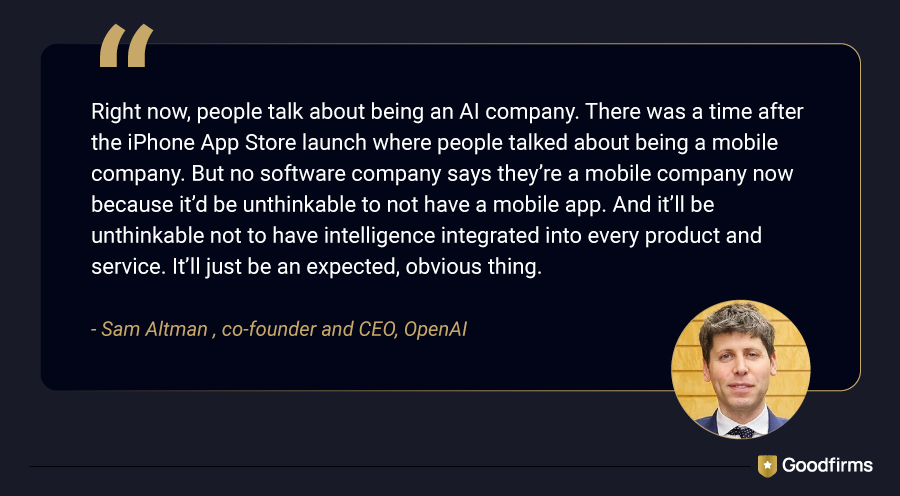
Building an iOS app in 2026 isn't just a technical decision — it's a business imperative. And the stakes of getting it right have never been higher, as Sam Altman - Co-founder and CEO of OpenAI, captures perfectly:
Features and intelligence get your app built. Design is what determines whether users stay. Good UI/UX isn't a nice-to-have anymore; it's the difference between retention and churn. Here's what it costs to do it right.
3. iOS App Development Cost Design Requirements (UI/UX)
Design is what determines whether users stay. A poorly designed app — regardless of how technically sound it is — gets deleted within the first session. Good UI/UX isn't a nice-to-have anymore; it's the difference between retention and churn. Here's what it costs to do it right.
| Process | Cost |
|
App Research Design |
$1,000-$5,000 |
|
UI Design |
$2,000-$10,000 |
|
UX Design |
$10,000-$40,000 |
|
Wireframing |
$2,000-$5,000 |
|
Animation & Illustration |
$1,000-$25,000 |
|
Branding |
$5,000-$20,000 |
Design wraps up the upfront build costs. But, your app hosting and backend scales with your success — and so does its cost. Here's what to budget for.
4. iPhone App Development Cost: Cloud Hosting/Backend Requirements
The moment your app goes live, a new set of expenses kicks in — ones that don't show up on most initial proposals. Backend infrastructure is the quietest line item in iOS development, and it scales directly with your success. The more users you attract, the more it costs to keep the experience smooth.
|
Backend Infrastructure |
Inclusions |
Monthly Cost (Recurring) |
|
Basic Backend |
User login, database, REST APIs, and push notifications. |
$150-$300 |
|
Standard Startup Backend |
Payments, social login, real-time sync, and admin panel. |
$300-$500 |
|
Media Heavy Apps |
Cloud storage, video streaming, compression, and bandwidth management. |
$800-$2,000 |
|
Global/CDN Based Apps |
Multi-region servers, CDN, load balancing, and DDoS protection. |
$200-$1000 |
Infrastructure keeps your app running. Testing is what keeps it from breaking — publicly, at the worst possible time. A single bug in production can tank your ratings. Here's what proper testing costs.
5. iOS App Development Cost: App Testing
Skipping or rushing QA is one of the most expensive mistakes an iOS project can make. A single bug that reaches production can trigger App Store reviews, spike support costs, and tank your ratings. Here's what a proper testing budget looks like.
|
Types of Test |
Average App Testing Time |
Costs |
|
UX Testing |
10-60 Hrs |
$200-$1500 |
|
Functional Testing |
50-200 Hrs |
$700-$3000 |
|
Performance Testing |
10-30 Hrs |
$150-$500 |
|
Security Testing |
50-120 Hrs |
$800-$2000 |
|
Platform & Device Testing |
10-20 Hrs |
$100-$200 |
The costs above are tied to what you build — features, design, infrastructure, and testing are all one-time investments that get your app across the finish line. What comes next is different in nature. Hidden and recurring costs aren't about building; they're about maintaining, growing, and protecting what you've already launched. And unlike development costs, they don't stop.
iOS App Development: Hidden & Recurring Costs
Most businesses treat launch day as the finish line. It isn't. Once your app goes live, ongoing costs kick in that don't always appear in initial proposals — and they run anywhere between 15–25% of your original development spend annually.
App Store Fees
Every App Store distribution requires an active Apple Developer membership — $99/year for individuals, $299/year for enterprise. Beyond that, Apple takes 15–30% of every in-app purchase or subscription, depending on your revenue tier and subscription duration. For subscription-first models, this commission compounds quietly.
Regular Updates & OS Compatibility
Apple releases a new iOS version every year, and apps that don't keep pace slip in rankings or break entirely. Staying current means rebuilding conflicting UI elements, patching post-launch bugs, and tuning performance for new hardware. Budget $5,000–$20,000 per update cycle, with most competitive apps pushing two to four meaningful updates annually.
Infrastructure & Hosting
Your backend doesn't run for free. Cloud hosting on AWS, Google Cloud, or Azure scales directly with usage — from a few hundred dollars a month for simple apps to $5,000–$20,000/month for high-traffic platforms. Factor in database management, CDNs, and push notification services on top.
Marketing & User Acquisition
A well-built app nobody knows about generates no revenue. First-year marketing — covering ASO, paid campaigns, influencer partnerships, and referral programs — realistically runs $10,000–$50,000, and significantly more in competitive categories.
Security & Compliance Audits
Annual penetration testing, code reviews, and regulatory compliance (HIPAA, GDPR, PCI DSS) run $5,000–$25,000 per year. Skipping them is a false economy — one breach costs far more.
Between the build costs, feature additions, and recurring expenses, you now have a complete picture of what iOS app development actually costs in 2026. Before you take that into vendor conversations, here are answers to the questions most businesses still have at this stage.
FAQs: iPhone App Development Costs
Do I still need a professional developer if I use FlutterFlow?
Yes — AI tools accelerate development, but professional expertise remains essential for architecture, integrations, and a market-ready final product.
Does Apple charge for app updates after launch?
Apple doesn't charge per update, but your $99/year Developer Program membership must stay active for updates to go live. The real cost of updates is developer time — typically $5,000–$20,000 per cycle, depending on scope.
How does App Store rejection impact my development cost?
A rejected app means rework — additional developer hours, redesigned flows, or compliance fixes before resubmission. Budgeting a 5–10% buffer specifically for post-submission revisions is a practical safeguard most first-time app owners overlook.
Is cross-platform development cheaper than building a native iOS app?
Generally, yes — frameworks like React Native or Flutter can reduce costs by 30–40% by sharing code across iOS and Android. The tradeoff is performance limitations on complex, hardware-dependent features that native Swift development handles more reliably.
Conclusion: Plan Your iOS App Budget Right — And Build With Confidence
Any agency quoting a number before understanding your project is either guessing or selling. What this guide has given you is the full picture — complexity tiers, development phases, feature costs, team rates by geography, AI tools that compress timelines, and recurring expenses that outlast your launch date.
The businesses that budget iOS apps successfully in 2026 treat cost planning as part of the product strategy, not an afterthought. Offshore development saves real money when managed correctly. AI features carry hidden maintenance costs. Backend infrastructure scales with your user base. Knowing this before signing anything gives you genuine leverage.
Ready to move from estimates to proposals? Goodfirms lists hundreds of vetted mobile app development companies, filterable by location, hourly rate, and industry specialization — find the right fit for your budget and build with confidence.