Mendle's founders began with a personal mission: to help people feel understood by the people closest to them. They had an app idea and needed a development partner to build it. The app had to include an Emotional Memory Engine, group conversations, and safety controls.
The founders discovered SoluLab, one of the top app development companies on Goodfirms. Its profile, client reviews, and portfolio convinced them to bring their AI app idea to the team.
SoluLab turned that idea into an emotional wellness app where people can share experiences, revisit past conversations and receive personalized reflections that support reconnection.
The partnership has continued since launch and now covers app maintenance and marketing.
Company: SoluLab Private Limited
Client: Mendle
Client Industry: AI-powered emotional wellness and relationship support
Lead Source: Goodfirms
Spokesperson: Rajat Lala, Co-founder of SoluLab
Goodfirms' Influence: 4/5
What Did Mendle's Founders Want to Build?
Mendle is an early-stage startup working in emotional wellness and relationship support. Its founders wanted individuals, families, friends, and groups to share experiences and emotional histories, then receive guidance based on everything the group had shared.
Before approaching an agency, the founders researched ChatGPT and other conversational AI to see what was possible. Mendle needed a tool that could follow a relationship over time and across several people.
The app also needed web and mobile versions, voice and text input, several languages, and notifications that users control.
What Challenges Stood in the Way?
Mendle's challenge was getting an idea ready to build. The founders had a clear vision and a list of open questions to settle before development could start.
Five questions had to be answered first:
- Product definition: How to shape a broad emotional wellness concept into clear user journeys, features, and a development roadmap.
- Persistent emotional memory: How to organize voice and text conversations into contextual memories, emotional themes, and relationship histories.
- Different perspectives: How the AI could recognize that two people remember the same event differently, without ruling either account wrong.
- Group-aware intelligence: How to support one-on-one and group conversations informed by relevant shared history.
- Trust and emotional safety: How to handle privacy, consent, sensitive personal histories, and clear limits on AI-generated guidance.
Rajat Lala, co-founder of SoluLab, sums up the challenge: "The core challenge was translating this vision into a practical, technically feasible product."
How Did Goodfirms Help Mendle Find SoluLab?
SoluLab's Goodfirms listing gave prospects a first look at its work before any call. Rajat names three parts of the profile: the company description, the client reviews, and the project portfolio.
A prospect can review SoluLab's work in AI, Generative AI, blockchain, and custom software before the first call. Rajat says people who arrive through a directory like Goodfirms usually know something about the agency already, so the first conversation can go straight to business goals and technical needs.
Rajat rates Goodfirms' influence on the decision to work with SoluLab at 4 out of 5.
SoluLab's Strengths
Rajat says SoluLab's edge is the mix of technical expertise, consulting, and end-to-end software development. The team starts by understanding what the client needs, weighing the technical options, and turning business goals into a practical build.
SoluLab works across AI and Generative AI, AI integration, blockchain, Web3, and custom software. For Mendle, that meant one team could plan the product, the technology, and its long-term upkeep together.
Rajat adds that the right fit depends on what each client values: relevant experience, technical approach, delivery model, budget, and confidence in the team.
The Pivot: Designing Around Memory and Context
The turning point came early. Mendle's idea needed context from earlier conversations, so a simple question-and-answer format fell short.
SoluLab treated the work as AI product engineering and built the solution around an Emotional Memory Engine (EME). The EME turns voice and text inputs into emotional memory objects. Each one stores a transcript, the emotional tone, relationship tags, themes, milestones, and past guidance. Later conversations, reflections, and prompts can draw on all of it.
Around the EME sit individual and group conversations, evolving emotional insights, and prompts that encourage reflection.
One design principle shaped the rest: the AI should never decide whose memory or interpretation is correct. It helps people explore different perspectives and find openings for constructive dialogue.
The founders received a product architecture, a set of functional requirements, and a phased development roadmap. In Rajat's words,
Features That Set the App Apart
Four features stand out:
- Multi-perspective understanding: when two people remember an event differently, Mendle uses the gap to start a conversation and never picks a winner.
- Group conversations: one-to-one chats, group chats, and suggestions drawn from shared history help people spot misunderstandings and each other's needs.
- Safety from day one: notifications, user control, blocking and no-contact options, silent participation, guardian controls, content safeguards, and clear limits on the platform's role went into the first set of requirements.
- A phased build: core capabilities came first, and advanced ones were planned for later releases.
All four serve one goal. Rajat Lala, co-founder of SoluLab, describes it this way:

Mendle App’s key differentiators include a persistent Emotional Memory Engine, contextual insights informed by individual and shared experiences, AI-assisted group conversations, personalized emotional reflections, and configurable safety features. Together, these capabilities were designed to help this app address a distinct use case: supporting understanding and reconnection between people, not just answering individual questions. - Rajat Lala, Co-founder, SoluLab
Budget, Timeline, and Privacy Constraints
Mendle needed conversational AI, emotional memory, voice and text processing, group insights, multiple languages, and safety features to work as one product. With a startup budget and a big vision, the team had to choose what came first.
SoluLab split the work into phases. Core features went into the MVP, and the advanced ones waited for later releases. Mendle got a working base and kept its bigger plans.
Privacy got the same attention. The app handles sensitive personal experiences, so the requirements covered consent, access controls, and safeguards for sensitive conversations. Clear disclaimers also state that Mendle does not replace licensed therapy or professional advice.
The project came in on budget, met its delivery deadline, and had no compliance failures.
Keeping the Founders Informed
Basecamp tracked the project overall, and Jira boards handled sprints and tasks. The founders had access to both. Quick questions went to Slack. Calls ran on Google Meet, and minutes followed each one, so decisions and next steps were written down.
The engagement opened with two to three meetings to understand the founders' vision, settle requirements, and agree on priorities. After that, weekly meetings and a weekly status report from the project manager covered finished features, work in progress, and what came next.
Where possible, SoluLab also shared working builds or preview links so the founders could test features and give feedback straight away.
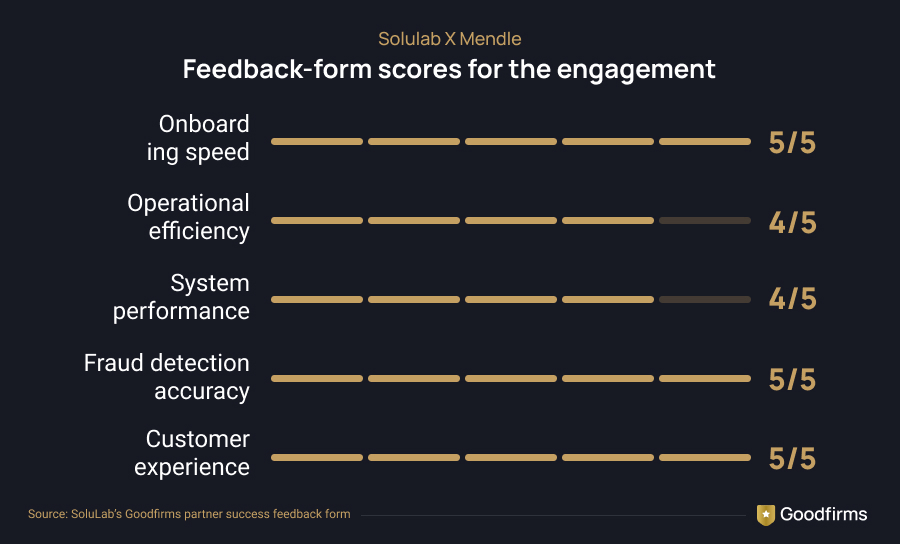
SoluLab's feedback form scores the engagement across five areas, out of 5, as shown below.
What Results Did Mendle Achieve?
SoluLab reported these results for the platform:
|
Metric |
Reported result |
|---|---|
|
Emotion-detection accuracy |
90% |
|
AI response time |
60% faster |
|
Group engagement |
70% higher |
|
Beta users onboarded |
500+ |
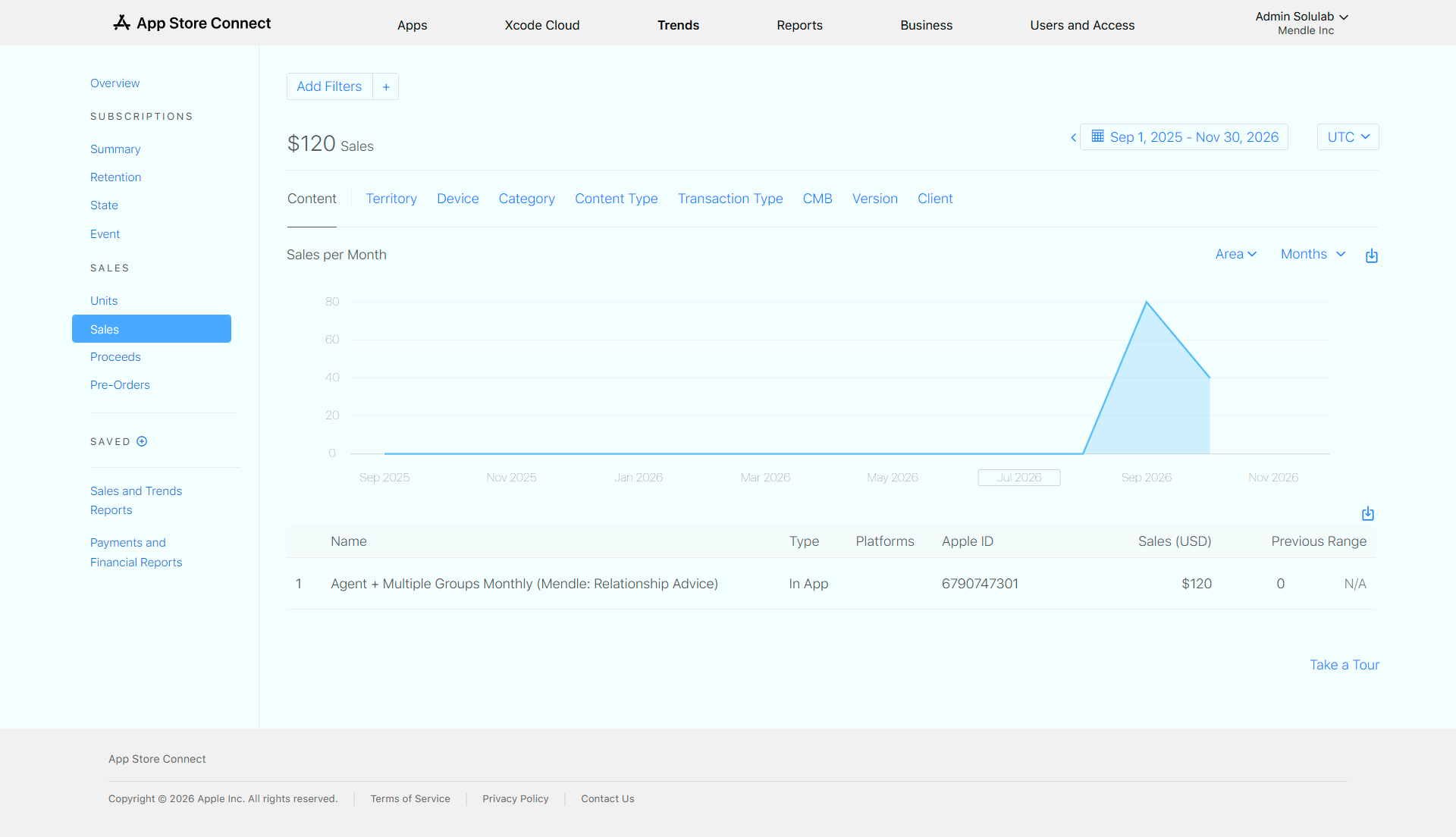
According to App Store Connect, Mendle: Relationship Advice recorded 333 app units, plus 3 units of its Agent + Multiple Groups Monthly in-app subscription, for 336 units in total, most of them in September 2026.
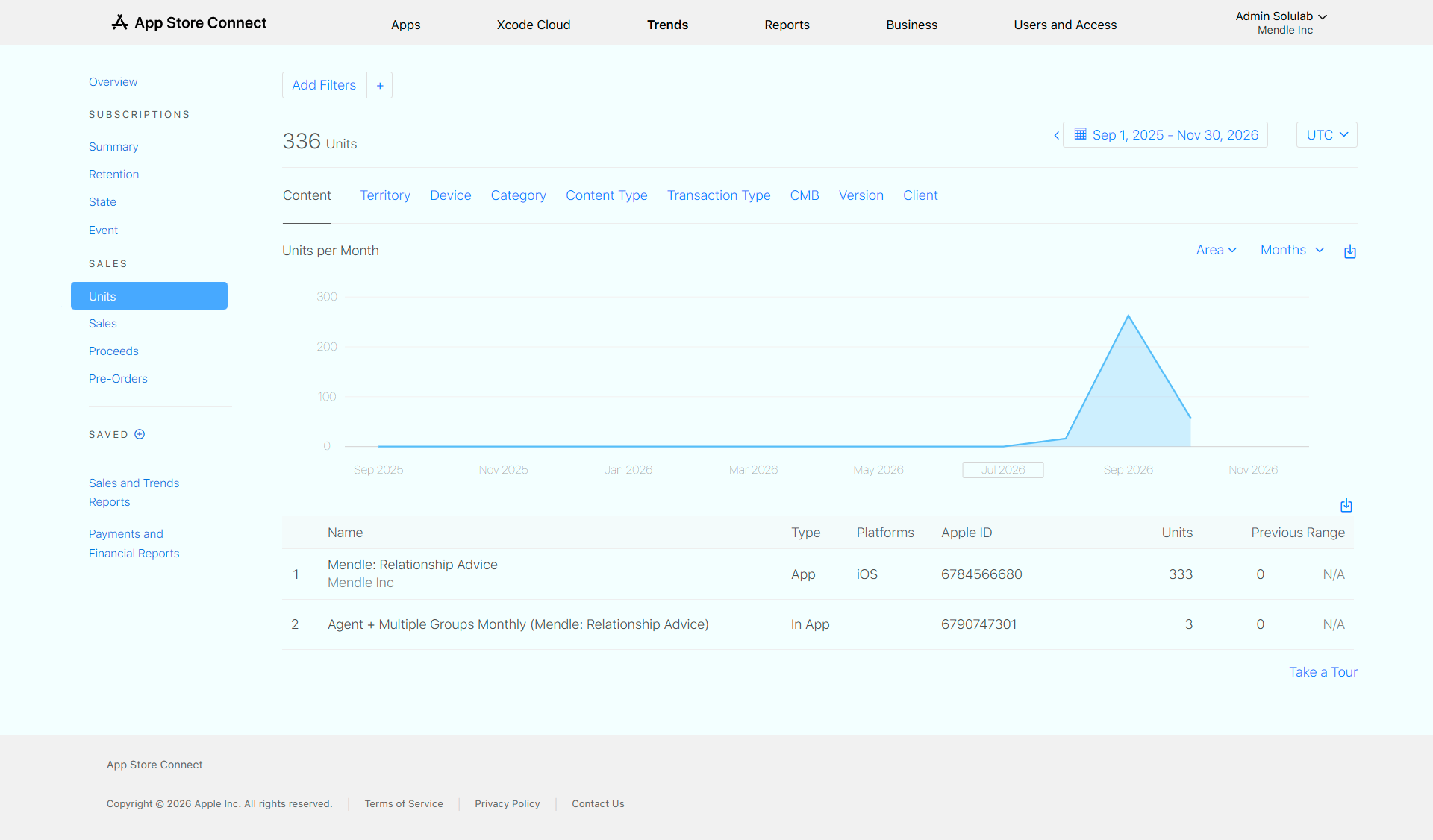
The Sales view shows $120 across September and October 2026, all from the Agent + Multiple Groups Monthly subscription. Paying users are already subscribing to the group feature, so the app has started to earn.
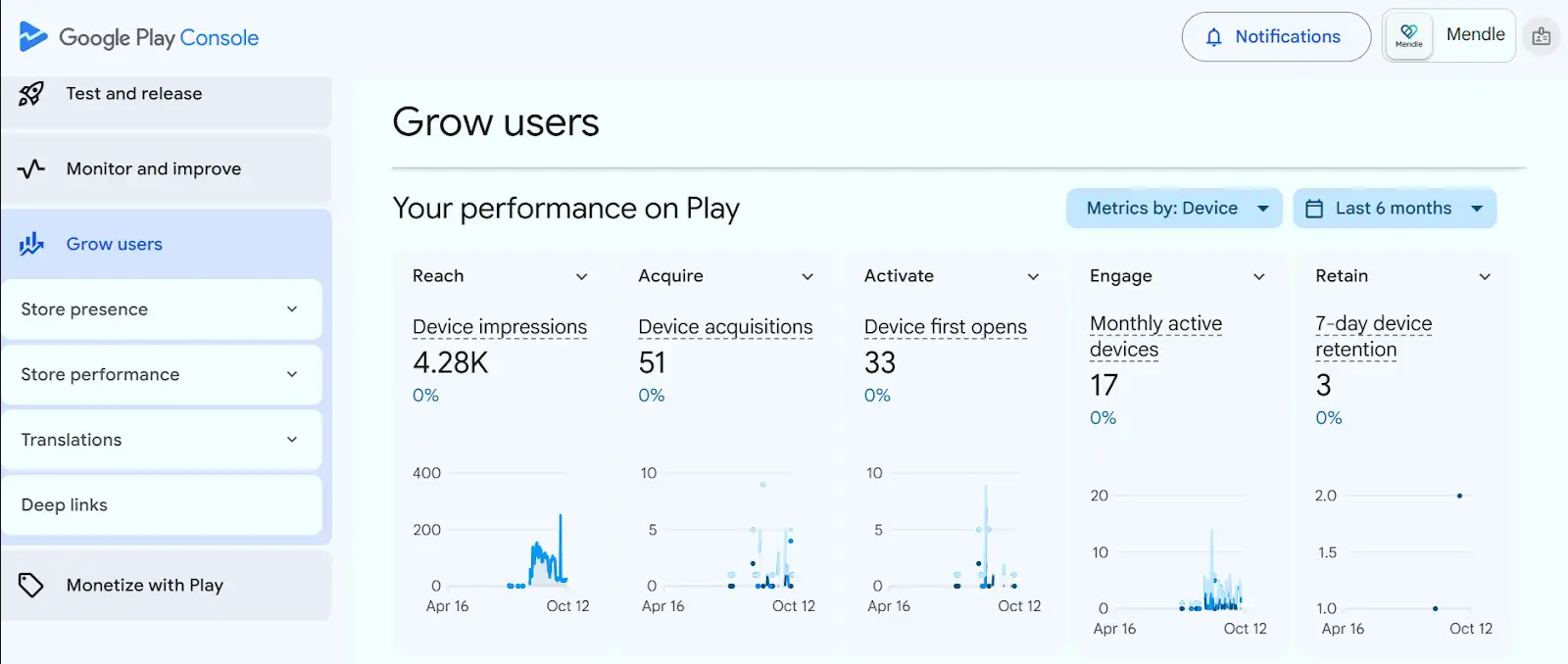
Google Play Console covers the Android side. Over six months, the app logged 4.28K device impressions, 51 device acquisitions and 33 first opens, with 17 monthly active devices.
For the founders, the project produced documented requirements, a defined architecture, and a clear path from idea to launch. For users, it offers voice and text chats, contextual prompts, and room for different perspectives. Privacy controls, permissions, and blocking options let people decide who can reach them and when.
The modular architecture, mobile and web apps, and multilingual support also give Mendle room to expand. Because it focuses on understanding between people, it sits apart from chatbots built for one user at a time.
What Do Users Say About Mendle?
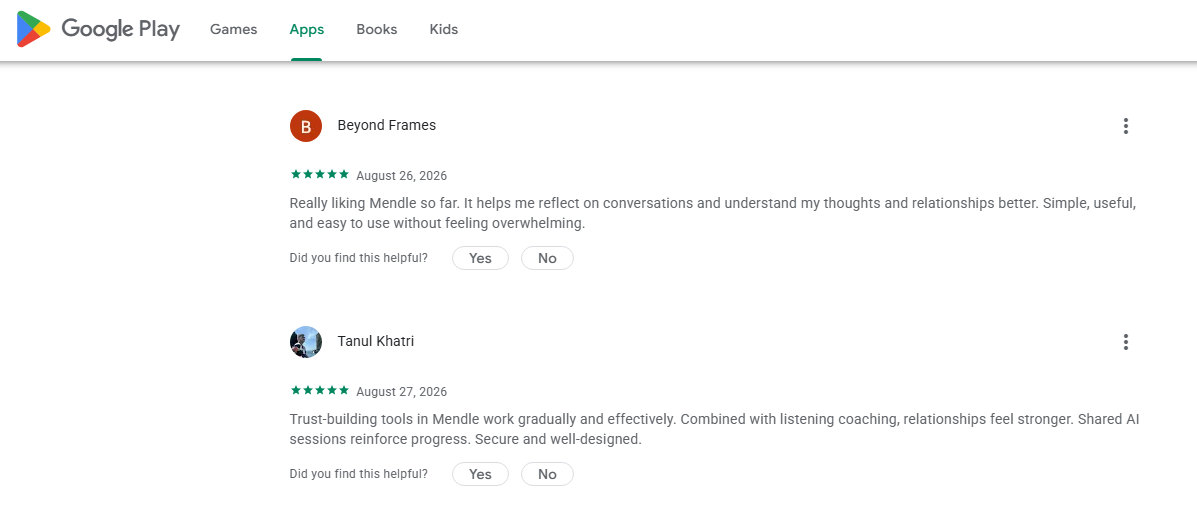
Mendle holds a 4.7 user rating on the Google Play Store, a good start for a new app. The listing describes it as an AI relationship companion for individuals, couples, families, friends, and groups. Users can chat privately with the AI coach about communication and difficult conversations, invite others into shared AI conversations with privacy protected, and spot recurring patterns through reflection insights.
(Source: Google Play)
The Partnership After Launch
After deployment, Mendle gave SoluLab an Annual Maintenance Contract (AMC) to support the app beyond launch. The relationship has since grown into app marketing, with SoluLab's marketing team running organic and paid campaigns to raise visibility and bring in users.
Rajat sums up SoluLab's approach to client relationships as technical collaboration, continued support, and services that follow the client's changing needs.
What Can Other Agencies Learn About Goodfirms Leads?
Rajat's advice to agencies is to treat a Goodfirms lead as the start of a working relationship.
- Build credibility before the first call. Keep your profile current, add relevant case studies, collect genuine reviews, and explain your expertise plainly.
- Ask business questions first. Learn the prospect's business model, users, budget, and expected outcomes before you pitch. This matters most with startups, which often need help turning an ambitious idea into a feasible MVP.
- Back claims with evidence. Share a case study that matches the prospect's actual requirements.
- Set expectations early. Agree on scope, deliverables, timeline, and who owns what, then keep clients in the loop with tracking tools, status updates, and working demos.
- Qualify the lead. Look for a clear problem, realistic expectations, a decision-maker, and a fitting budget. A well-qualified engagement with strong delivery potential, Rajat says, can be worth more than many poorly matched inquiries.
Is Your Agency Listed on Goodfirms?
A Goodfirms profile puts your reviews, portfolio, and expertise in front of buyers before they speak with your sales team. For SoluLab, that visibility led to a conversation with Mendle's founders, then to a finished app and a partnership that is still running.
Get listed on Goodfirms and put your work where clients already search for technology partners.