Key takeaways
- App development in the US ranges from $20,000 for a simple MVP to $500,000+ for an enterprise-grade platform, with hourly rates spanning $50 to $150+.
- Location moves the number as much as complexity does — California and New York average $108,000–$120,000 in developer salaries, while Texas and Florida average $104,000–$106,000.
- Industry can double your budget: a Fintech app runs $150,000–$350,000+, while an eCommerce app of similar scope costs just $50,000–$150,000.
- AI no-code tools can bring the cost of a basic build down to $300–$1,000 a year, versus $20,000+ for the same scope built traditionally.
- Feature choices add up fast: AI integrations alone can run anywhere from $10,000 for simple chat support to $1,500,000+ for a full AI-first product.
Mobile app development in the US costs anywhere from $20,000 for a simple app to $500,000 or more for an enterprise-grade platform. That spread shows up in hourly billing too: hire mobile app developers in the US, and you'll see rates anywhere from $50 an hour for lean, budget-conscious teams to $150+ an hour for senior talent at the country's top agencies, including several of the top Artificial Intelligence companies now building AI capabilities directly into mobile products.
This $20,000–$500,000 range is a useful starting point, but it's still just an estimate. For an exact number, you'd typically ask a few mobile app development companies to quote your specific project scope.
That's where budgeting gets hard: five agencies quote differently for the same project scope. Now you're back to square one, still asking the same question — how much does app development actually cost in the US in 2026?
This pricing guide is built to answer exactly that question. It breaks down what drives app development costs in the US, then compares those costs across four major US states — California, Texas, New York, and Florida — so you can budget with real numbers instead of guesswork.
Skip the guesswork — compare verified mobile app development companies on Goodfirms and get a real quote today.
Let's start with how much app development costs in the US, broken down by type.
App Development Cost in the US by Type
|
Type |
Cost Range |
Key Characteristics |
|
Simple MVP |
$20,000 – $50,000 |
• Simple UI/UX • User login/registration • Profile management • Static content pages • Basic navigation • Push notifications • Limited backend • Basic security |
|
Basic App |
$50,000 – $100,000 |
• Custom UI/UX • Email/social login • Real-time updates • Payment gateway • Segmented notifications • Third-party API integrations • Basic analytics • Search & filters |
|
Complex App |
$100,000 – $250,000 |
• Custom animated UI/UX • Real-time chat • Subscriptions/wallets • AI/ML features • Multi-role management • Advanced analytics • Multi-system integrations • Offline sync |
|
Enterprise Level / Regulated App |
$250,000 - $500,000+ |
• Scalable cloud architecture • GDPR/HIPAA compliance • Role-based access control • ERP/CRM integration • AI-driven automation • High-performance processing • Multi-platform support • DevOps & monitoring |
Complexity and location aren't the only variables that shape your budget — the industry you're building for, the technologies you choose to include, and the platform you launch on each move the price independently. Below is how those three factors break down before you get to your final number.
1. App Development Cost (By Industry)
|
Industry |
Estimated Cost |
|
E-commerce App |
$50,000 – $150,000 |
|
Fintech App |
$150,000 – $350,000+ |
|
Social Media App |
$50,000 – $500,000 |
|
Healthcare App |
$75,000 – $250,000 |
|
SaaS Mobile Application |
$80,000 – $250,000 |
|
Gaming App |
$60,000 – $250,000+ |
|
Marketplace Platform |
$100,000 – $300,000+ |
|
Enterprise Solution |
$250,000 – $500,000+ |
|
On-Demand App |
$120,000 – $300,000+ |
2. App Development Cost (By Trending Technologies)
|
Trending Technology |
Estimated Cost |
|
AI-Powered App |
$50,000 – $500,000+ |
|
IoT App |
$45,000 – $500,000+ |
|
Blockchain App |
$40,000 – $300,000+ |
|
AR/VR App |
$30,000 – $300,000+ |
|
Cloud-Powered App |
$30,000 – $300,000+ |
3. App Development Cost (By Platform Choice)
|
Platform Choice |
Simple App |
Medium-Complexity App |
Highly Complex App |
|
Android App |
$25,000-$45,000 |
$50,000-$120,000 |
$120,000-$250,000+ |
|
iOS App |
$30,000-$55,000 |
$60,000-$140,000 |
$150,000-$300,000+ |
|
Cross-Platform App (Flutter) |
$30,000-$60,000 |
$60,000-$130,000 |
$130,000-$220,000+ |
|
Cross-Platform App (React Native) |
$25,000-$50,000 |
$50,000-$110,000 |
$110,000-$190,000+ |
Platform, industry, and technology choices set your baseline — whether you're working with an iOS app developer, an Android app development company, a React Native app developer, or a Flutter app development company. But there's a fourth variable reshaping app budgets in 2026 that has nothing to do with any of them: how much of the build AI itself can handle. below is what that actually costs.
How Much Does App Development in the US Cost Using AI (No-Code Tools)?
As per Goodfirms’ Research - How Much Does It Cost to Develop an App in 2026? Full Development Cost Breakdown: AI in app development automates coding, testing, design, and maintenance, enabling many businesses to save 20-40% on costs.
Below are some tools that automate and speed up the app development process, resulting in time and cost savings.
|
AI Tool |
Starting Monthly Price |
Credits Included |
Ideally Used For |
|
Zite |
$15/month |
100 Credits/Month |
Production-grade business software |
|
Lovable |
$25/month |
100 Credits/Month |
Prototyping web apps |
|
Bolt |
$25/month |
Up to 10M tokens monthly |
Prototyping web and mobile apps |
|
Cursor |
$20/month |
$20 credit pool plus usage-based billing |
AI-assisted, context-aware coding |
|
Replit |
$18/month |
$20 of monthly credits |
Building apps, games, and interactive visualizations |
The AI software prices above are just the subscription costs of the software itself. The total cost of building apps includes developers’ hourly costs, app store fees, hosting, third-party integrations, and maintenance, which you need to consider while planning the budget.
Even with those extras factored in, the two approaches don't end up anywhere close to each other. A no-code AI builder still absorbs most of the engineering work that traditionally eats up a budget — authentication, database setup, hosting, and UI generation — leaving you with a monthly subscription and usage costs rather than a six-figure invoice. Traditional development, on the other hand, bills for every one of those pieces individually, across a team of specialists, over months of work. Once you put the two side by side, the gap looks like this:
|
Traditional app development cost |
$20,000–$500,000 |
|
App Development Cost Using AI Tools |
$300–$1,000 annually |
Note: The $300-$1000 annual cost includes only AI tools subscription costs. Whereas other costs like developers’ hourly rates, usage-based add-ons, and other overhead costs need to be calculated separately
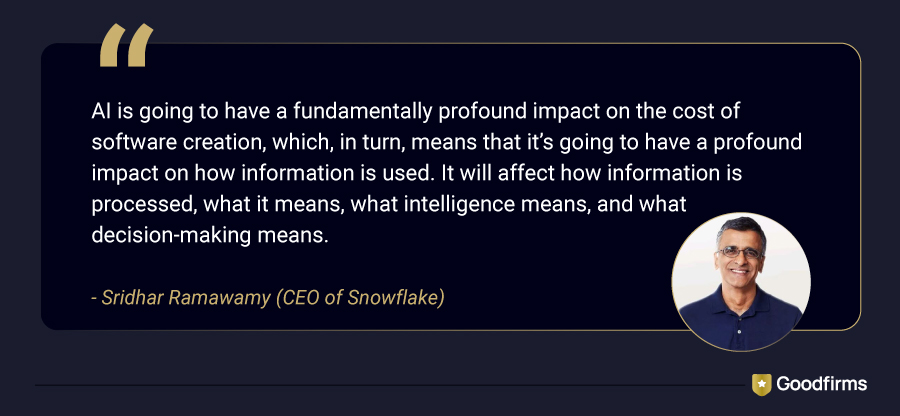
The savings mobile app development costs are just the visible edge of a much bigger shift. Sridhar Ramaswamy (CEO of Snowflake) frames where this is headed in a Podcast with McKinsey hosted by Eric Kutcher.
AI tools reshape how much a mobile app development costs. But, where your team sits still moves your total price. The state-by-state breakdown below shows how the cost can differ based on which part of the US your team is located.
App Development Cost by State: A Quick Comparison
|
State |
Simple MVP |
Basic App |
Complex App |
Enterprise Level / Regulated App |
|
California |
$20,000 – $50,000 |
$50,000 – $100,000 |
$100,000 – $250,000+ |
$250,000 - $500,000+ |
|
Texas |
$20,000 – $50,000 |
$50,000 – $100,000 |
$100,000 – $250,000+ |
$250,000 - $500,000+ |
|
New York |
$20,000 – $50,000 |
$60,000 – $120,000 |
$120,000 – $250,000+ |
$250,000 - $500,000+ |
|
Florida |
$20,000 – $40,000 |
$40,000 – $100,000 |
$100,000 – $250,000+ |
$250,000 - $500,000+ |
(Note: New York rates run higher due to compliance-heavy industry demand.)
That's what makes state-level rate data useful in a proposal conversation. Costs shift by city for three reasons:
Cost of Living: For example, mobile app developers in San Francisco or Manhattan need higher pay just to cover rent
Talent Concentration: Cities like Austin or New York pull in major employers who bid up rates for the same senior engineers
Industry Specialization: A city known for fintech or healthcare often charges a premium for that domain expertise.
As per Goodfirms’ research, the hourly cost of hiring a mobile app developer in the US ranges from $50 to $150+. What's actually driving those ranges varies by market.
App Development Cost in California
California is still the country's largest concentration of mobile engineers, which means more specialists to choose from for specialized work — AI integration, real-time data pipelines, cloud-native architecture, and hardware-adjacent work like AR and wearables.
|
Average Hourly Rate |
Average Annual Salary |
|
$51.95 |
$108,056 |
Even inside California, the cost of building an app isn't one number — it shifts city by city based on local annual salaries and hourly wages. Below are ten of California's highest-paying cities
|
City |
Annual Salary |
Hourly Wage |
|
Berkeley |
$134,064 |
$64.45 |
|
Redwood City |
$134,055 |
$64.45 |
|
Sunnyvale |
$130,261 |
$62.63 |
|
San Francisco |
$128,998 |
$62.02 |
|
Santa Clara |
$128,589 |
$61.82 |
|
Livermore |
$128,430 |
$61.75 |
|
Oakland |
$128,389 |
$61.73 |
|
San Jose |
$128,321 |
$61.69 |
|
Daly City |
$126,866 |
$60.99 |
|
Richmond |
$125,659 |
$60.41 |
Mobile app developers in Berkeley and Redwood City top the table, commanding the highest pay in the state for enterprise-grade rigor. App developers in San Francisco and Sunnyvale follow closely, blending consumer-scale product experience with Silicon Valley's core engineering density. Developers in San Jose, Santa Clara, Livermore, and Oakland cluster tightly together, each bringing hardware and IoT expertise shaped by the Valley's semiconductor and enterprise-tech roots. Daly City and Richmond round out the list as the Bay Area's more accessible entry points — still inside the same high-paying labor market, just a step below the peninsula's top rates.
Choose a mobile app development company in California when your app lives or dies on execution quality — a consumer product entering a crowded category, an AI feature that needs real technical sophistication, or a startup that needs an agency comfortable operating at venture-backed speed. It's not the state to pick if your main goal is stretching a limited budget.
App Development Cost in Texas
Texas has built the country's strongest mid-market tech corridor, anchored by Austin's rapid tech-sector growth and Dallas's deep bench of fintech and logistics engineering talent — giving you coastal-caliber execution without the coastal price tag.
|
Average Hourly Rate |
Average Annual Salary |
|
$50.96 |
$105,998 |
Even inside Texas, the cost of building an app shifts city by city based on local annual salaries and hourly wages. The highest-paying cities in Texas break down as follows:
|
City |
Annual Salary |
Hourly Wage |
|
Taylor |
$110,562 |
$53.15 |
|
Odessa |
$110,484 |
$53.12 |
|
Austin |
$108,502 |
$52.16 |
|
Dallas |
$108,357 |
$52.09 |
|
Midland |
$107,496 |
$51.68 |
|
Wichita Falls |
$106,574 |
$51.24 |
|
Harlingen |
$106,499 |
$51.20 |
|
Abilene |
$105,993 |
$50.96 |
|
Carrollton |
$105,688 |
$50.81 |
Mobile app developers in Taylor, Odessa, and West Odessa top the table, with pay lifted by West Texas's energy sector and its steady demand for specialized industrial and IoT software. App developers in Austin add Silicon Valley-caliber engineering pulled in by Oracle, Tesla, and Apple's expansions, while Dallas and Carrollton draw from the same deep corporate-campus talent pool that's made Dallas-Fort Worth a fintech and logistics stronghold. Developers in Midland and Wichita Falls track close behind, still riding the energy sector's regional demand. Harlingen and Abilene round out the list as steady, dependable options for teams that don't need big-city pricing.
Hire a mobile app development company in Texas when you want a domestic team with strong communication and complete time zone overlap, but don't need — or can't yet justify — the priciest end of the coastal rate card.
App Development Cost in New York
New York carries the deepest concentration of regulated-industry engineering talent in the country, with agencies fluent in the compliance demands of finance, healthcare, and media in a way few other states can match.
|
Average Hourly Rate |
Average Annual Salary |
|
$57.59 |
$119,786 |
Even inside New York, the cost of building an app isn't one number — it shifts city by city based on local annual salaries and hourly wages. New York's highest-paying cities for app developers compare like this in 2026:
|
City |
Annual Salary |
Hourly Wage |
|
Manhattan |
$120,836 |
$58.09 |
|
New York |
$120,561 |
$57.96 |
|
Staten Island |
$118,687 |
$57.06 |
|
Armonk |
$117,630 |
$56.55 |
|
Kew Gardens |
$115,293 |
$55.43 |
|
Corona |
$115,269 |
$55.42 |
|
Brooklyn |
$115,129 |
$55.35 |
App developers in Manhattan, New York, and New York County top the table, rates lifted by finance, media, and healthcare firms competing for the same senior engineers. Staten Island and Brooklyn track close behind, drawing on the same citywide talent pool at a slight discount. Armonk, anchored in Westchester's corporate corridor, brings enterprise software experience shaped by Fortune 500 IT work. Kew Gardens and Corona round out the list, offering strong borough-based talent without matching Manhattan's premium.
Pick a mobile app development company in New York when your app touches financial data, healthcare information, or another regulated category where getting compliance wrong is genuinely expensive.
App Development Cost in Florida
Florida has built a distinct strength around its international business ties, with a developer pool that's genuinely bilingual and experienced in cross-border, Latin-America-facing products in a way few other U.S. markets are.
|
Average Hourly Rate |
Average Annual Salary |
|
$50.13 |
$104,270 |
Even inside Florida, the cost of building an app isn't one number — it shifts city by city based on local annual salaries and hourly wages. Here are Florida's highest-paying cities for app developers, compared:
|
City |
Annual Salary |
Hourly Wage |
|
Boca Raton |
$109,611 |
$52.70 |
|
West Palm Beach |
$105,904 |
$50.92 |
|
Golden Glades |
$105,668 |
$50.80 |
|
Saint Petersburg |
$105,622 |
$50.78 |
|
Pensacola |
$105,581 |
$50.76 |
|
Sarasota |
$105,519 |
$50.73 |
|
Miami |
$104,721 |
$50.35 |
|
Fort Lauderdale |
$104,666 |
$50.32 |
|
Coral Springs |
$104,274 |
$50.13 |
Mobile app developers in Boca Raton and West Palm Beach top the list, benefiting from a concentration of financial services and wealth-management firms relocated from New York. Golden Glades, Sarasota, Miami, and Fort Lauderdale form the state's international business corridor, where bilingual talent and LatAm-market experience command a premium. Coral Springs tracks close behind on that same South Florida demand. Saint Petersburg and Pensacola round out the list with a steadier, enterprise-software sensibility built around the region's insurance, logistics, and defense-sector work.
Pick an app development company in Florida when you want strong technical work without coastal pricing — and non-negotiable if your product needs to reach a Latin American audience.
Sample App Budget: A Mid-Level App (eCommerce) Across States
Below is a realistic mid-level app — product listings, cart, payment integration, order tracking — costs across a 6-month build, using blended 2026 hourly rates from a premium state (New York) versus a value-tier state (Florida).
A rate range tells you what a market charges. It won't tell you what your invoice actually says once hours, roles, and deliverables get real. Here's what that looks like for a real project, priced out in two different states - New York and Florida, enabling you to make informed decisions.
|
Role |
Hours |
New York Rate |
New York Cost |
Florida Rate |
Florida Cost |
|
App Developer |
400 hrs |
$57/hr |
$22,800 |
$50/hr |
$20,000 |
|
UI/UX Designer |
120 hrs |
$59/hr |
$7,080 |
$40/hr |
$4,800 |
|
Project Manager |
100 hrs |
$54/hr |
$5,400 |
$37/hr |
$3,700 |
|
QA Engineer |
160 hrs |
$50/hr |
$8,000 |
$34/hr |
$5,440 |
|
Total |
780 hrs |
— |
$43,280 |
— |
$33,940 |
Same deliverable, same 780 hours — a $9,340 location tax for the state alone. That's what makes state-level rate data useful in a proposal conversation — not as a rule, but as a check against what you're actually being billed for. Complexity and hours determine the ceiling; the location tax determines where, within that ceiling, your invoice lands.
The hourly rate explains most of the state-to-state gap, but it's not the whole invoice. Feature choices, design depth, backend scale, and testing rigor all add on top of the base build. The following is what to budget for beyond the core team rate.
Additional Costs That Shape App Development Budget in the US
Hourly rate and location get you close to a real number, but they don't account for what actually goes into building the interface itself. Design and branding costs come in next.
App Design & Branding Costs
|
UI Design |
$5,000 – $35,000 |
14–90+ Hours |
|
UX Design |
$1,000 – $8,000+ |
10–120+ Hours |
|
Advanced / Branded UI/UX |
$4,000 – $50,000+ |
1–16+ Weeks |
|
Interactive UI Animations |
$800 – $60,000+ |
2–18+ Weeks |
A polished interface only works if something reliable sits behind it. Here's what powers that layer, and what it costs to build.
App Backend Development Costs
|
Backend Type |
Estimated Cost |
Build Timeline |
|
Basic Backend |
$4,000 – $15,000 |
3-5 Weeks |
|
Standard Backend |
$15,000 – $40,000 |
6-10 Weeks |
|
Advanced Backend |
$40,000 – $100,000 |
10-15 Weeks |
|
Enterprise Backend |
$75,000 – $150,000 |
16-24 Weeks |
Backend architecture handles what happens inside your app. The moment it needs to connect to payment processors, CRMs, or other outside tools, a new set of costs enters the picture.
Third-Party App Integration Costs
|
Integration Level |
Estimated Cost |
Description |
|
Basic Integrations |
$3,000 – $7,000+ |
Basic Payment Systems and Social Logins. |
|
Standard Integrations |
$7,000 – $9,000+ |
SMS Gateways, Email Services, and CRM Integrations. |
|
Advanced Integrations |
$9,000 – $25,000+ |
Real-Time Analytics Dashboards, Advanced Payment Processing, and Multiple API Integrations. |
|
Enterprise Integrations |
$25,000 – $50,000+ |
ERP, AI/ML, Blockchain, and IoT Systems Integrations. |
Third-party integrations connect your app to the tools it needs. AI integrations are a different category entirely — they change what your app can actually do, and they come with their own budget.
AI Integrations
|
Integration Level |
Inclusions |
Cost |
|
AI Features Integration |
AI chat support, Content generation, Product recommendations, Document summarization, Internal knowledge assistants, AI search, Email or report drafting tools |
$10,000–$80,000+ |
|
AI Workflow Integration |
Customer service automation, Insurance claim processing, Loan pre-qualification, Fraud detection workflows, Recruitment automation, Sales qualification, Medical document processing, Back-office workflow automation |
$80,000–$300,000+ |
|
AI Product Integration |
AI-first SaaS platforms, Industry-specific copilots, Medical diagnostic platforms, Financial analysis engines, Gaming intelligence systems, AI-powered compliance tools, Predictive analytics platforms, Custom recommendation engines |
$300,000–$1,500,000+ |
All of that functionality still needs somewhere to run. Hosting typically adds the following to the budget.
App Hosting Costs
|
Hosting Options |
Typical Monthly Cost |
Right Fit For |
|
Shared Hosting |
$2.95 – $15 |
Early-stage apps are still testing product-market fit |
|
Virtual Private Server (VPS) |
$20 – $50 |
Apps with steady, moderate traffic that are past the MVP stage |
|
Dedicated Hosting |
$50 – $200 |
High-traffic or compliance-sensitive apps that can't afford slowdowns |
Design, backend, integrations, and hosting — each has its own price tag. Put them together on a real project timeline, and here's how the spending actually breaks down stage by stage.
How Your Budget Breaks Down by Development Stage
Every app project follows the same rough spending pattern across five phases, regardless of size. This is where the money typically goes
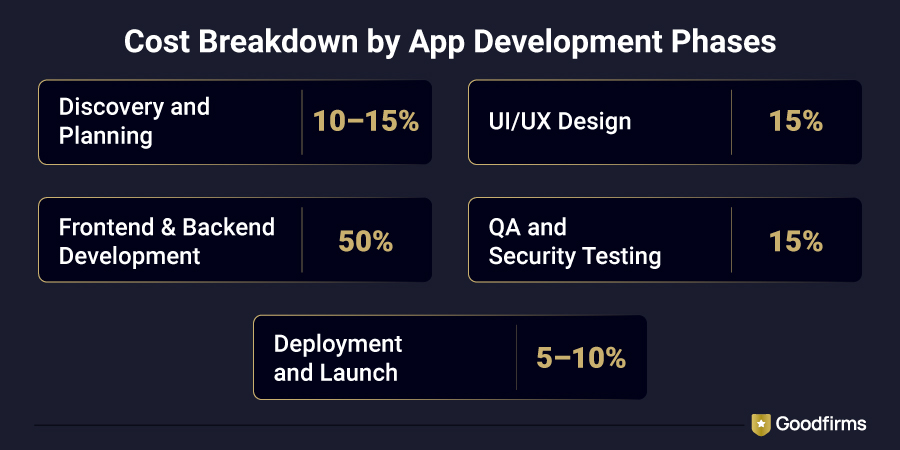
Let's understand this cost breakdown in detail.
1. Discovery and Planning (10–15%)
Analysts and architects turn the idea into technical requirements — user flows, API mapping, server design, and risk flags. Skipping this stage is the single most common reason projects hit a wall mid-build.
2. UI/UX Design (15%)
Designers move from wireframes to polished, clickable prototypes that reflect the brand and guide users naturally. Thoughtful micro-interactions here pay off directly in how long users stick around.
3. Frontend and Backend Development (50%)
Frontend and backend development is where design becomes working software — the interface on one side, servers, databases, and integrations on the other. It's the largest phase by both hours and cost, by a wide margin.
4. QA and Security Testing (15%)
Testers push the app across devices, OS versions, and network conditions while scanning for security gaps. Catching issues here is far cheaper than catching them after launch.
5. Deployment and Launch (5–10%)
The final stretch covers server setup, CDN configuration, and store submission — including clearing Apple's and Google's review and privacy requirements. It's short, but skipping steps here delays launch fast.
Discovery, design, development, QA, and launch make up the planned spend, phase by phase. What tends to get added on top of it, often after the contract is already signed, are the hidden costs below.
Hidden Costs That Push App Development Budgets Higher
Every budget accounts for design, development, and testing. Almost none account for what shows up only after the project is underway — costs that rarely appear in an initial quote, yet routinely reshape the final one.
App Security and Compliance
Meeting standards like HIPAA or GDPR means building in encryption, secure authentication, and proper data handling from the start, not bolting it on later.
Estimated Cost: $10,000–$50,000+, depending on how sensitive the data is.
Mobile App Backend and Server Infrastructure
Apps that need to scale require a database, cloud hosting, and server architecture built to handle real usage, not just a demo.
Estimated Cost: $5,000–$40,000+.
App Store Submission
Developer account fees, platform guideline compliance, and the possibility of rejection and rework all add friction at the finish line.
Estimated Cost: $500–$5,000+.
Performance Tuning
Apps handling heavy traffic, real-time data, or multiple device types need dedicated optimization work to stay fast and stable.
Estimated Costs: $5,000–$30,000+
Third-party Licensing
Paid APIs, libraries, and software subscriptions used during development often become recurring costs.
Estimated Cost: $1,000–$20,000+/Year
App User Testing and Iteration
Gathering real user feedback and refining the product based on it adds development cycles, usually, but tends to produce a noticeably better final app.
Estimated Cost: $3,000–$25,000
None of these show up on a simple cost calculator, which is exactly why they catch first-time founders off guard.
Complexity tiers, state pricing, and hidden costs make up the complete picture. Here are the questions that usually follow once it's time to act on it.
FAQs: App Development Costs in the US
Does using AI tools during development actually lower the final cost?
Yes, but the savings show up mainly on production work — coding, testing, and boilerplate generation — not on judgment calls like architecture decisions, security hardening, or compliance sign-off. AI tools speed up the hours your team bills, so a project that would've taken 400 developer-hours might take 300, but someone still has to make the calls a model can't own. That's why realistic savings run 10–25% of total build cost, not the 50%+ some vendors pitch. Budget for AI-assisted development, not AI-replaced development.
Is hiring a freelancer cheaper than an agency?
Usually, yes. Hiring US freelance mobile developers often costs 20–40% below equivalent agency rates, since you're not paying for account management, project coordination, or bench overhead layered on top of the developer's time. The tradeoff shows up in ownership, not price: you become the project manager, chasing timelines, resolving scope questions, and coordinating any additional specialists yourself. For a well-scoped MVP with a hands-on founder, that tradeoff often pays off. For a multi-role, multi-month build, an agency's coordination usually earns its premium back.
Fixed-price, hourly, or milestone billing — which is better?
Fixed-price works best for a clearly scoped MVP where requirements won't shift mid-build — you know the cost upfront, but any change order renegotiates the whole contract. Hourly billing fits projects likely to evolve, since it absorbs new requirements without a formal amendment, though it puts the burden on you to track hours against output. Milestone-based billing splits the difference: you pay as defined chunks of work ship, which protects your budget without locking in every detail before development starts.
Does my app's industry change the cost?
Yes, significantly. Fintech and healthcare apps carry compliance overhead — HIPAA, PCI-DSS, SOC 2, audit trails — that a generic utility app simply doesn't need, and that overhead pushes rates 30–40% above what you'd pay for the same seniority level elsewhere. E-commerce and content apps sit closer to baseline pricing since they carry fewer regulatory requirements. If your industry is regulated, budget for compliance work as its own line item, not a rounding error on the quote.
Does a faster timeline cost more?
Generally, yes. Compressing a build usually means putting more developers on the same codebase in parallel, and each additional person adds coordination overhead — code reviews, merge conflicts, and handoff meetings — on top of their hourly rate. Doubling your team rarely halves your timeline; it's common to see a 30–40% schedule cut cost 50%+ more than the original quote. If budget matters more than speed, a smaller team on a longer timeline is usually the better trade
Conclusion: Ready to Plan Your App Development Budget?
App development cost in the US is no longer a fixed price tag decided upfront. It's a continual investment shaped by complexity, the location tax, feature choices, and the ongoing work that comes after launch.
Businesses that prioritize clear scope, a realistic complexity tier, and the right state or team fit for their software development needs will get better value than those chasing the lowest quote or overbuilding features too early. Location matters, but so does matching your platform decision, design depth, and testing rigor to what your app actually needs to succeed.
Whether you're building a lean MVP or an enterprise-grade platform, the real advantage comes from aligning budget, team location, and technology choices with your long-term business goals and quality preferred from day one.
|
Note: All figures in this guide are estimates drawn from publicly available salary and market data as of 2026. Actual project costs vary by agency, scope, and negotiation, and figures across sections may not reconcile to the decimal — treat every range as directional guidance for budgeting, not a fixed quote. |