Key takeaways
- Legacy application modernization gives businesses lower operating costs, stronger security, and the ability to ship features faster.
- The right modernization strategy depends on the application, as rehosting, refactoring, rearchitecting, rebuilding, and replacing are each suited to different situations.
- The legacy modernization market grew 16.2% in a single year, from $22.17 billion in 2025 to $25.76 billion in 2026.
- AI-powered modernization, platform engineering, and continuous upgrades are shaping the next phase of legacy application modernization.
- A modernization partner with real industry experience and a phased methodology reduces risk and delivers better long-term results.
Nobody sets out to build a legacy system. It just happens that software that once felt modern slowly becomes something your team is afraid to touch. Though it still works, it just doesn't help anymore.
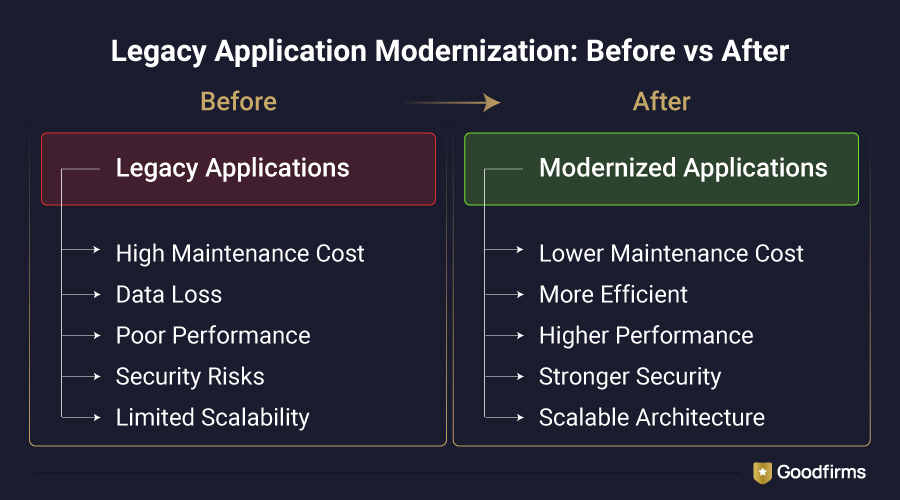
The longer it stays untouched, the more it costs. Maintenance bills go way too high. Releases take longer. Every year adds a little more risk that nobody gets around to fixing.
That's exactly what legacy application modernization fixes. Not always a full rebuild, just the right level of change for what the application actually needs.
Ready to modernize? Compare vetted Legacy Application Modernization Companies on Goodfirms before you start.
What Is Legacy Application Modernization?
Legacy application modernization is the process of transforming outdated software applications into modern, scalable, and secure systems by upgrading their architecture, technology, and infrastructure while preserving critical business functionality.
Legacy applications often rely on outdated technologies, leading to challenges such as technical debt, limited scalability, and higher maintenance costs. Organizations adopt legacy application modernization to improve performance, enhance security, and align applications with modern business needs.
It enables enterprises to leverage technologies such as cloud-native applications, API modernization, and AI-assisted code modernization to build future-ready systems.
Legacy Modernization vs Cloud Migration vs Digital Transformation
Legacy modernization, cloud migration, and digital transformation are often used interchangeably, but they operate at three different levels of scope.
|
Term |
What it Changes |
Scope |
|---|---|---|
|
Legacy Application Modernization |
The application's code, architecture, or platform |
One Application |
|
Cloud Migration |
Where the application runs, not necessarily how it's built |
One application's environment |
|
Digital Transformation |
How the entire business operates, using technology as the enabler |
The Whole Organization |
These usually overlap rather than compete. Cloud migration is often the first step in a modernization project, and modernization itself is typically one part of a larger digital transformation effort.
Legacy Application Modernization Strategies - The 7 Rs Framework
Modernization decisions come down to how much of an existing application is worth keeping. The 7 Rs framework gives IT teams seven paths to choose from, so each application in the portfolio gets the right level of change rather than following a single approach for all rebuilds.
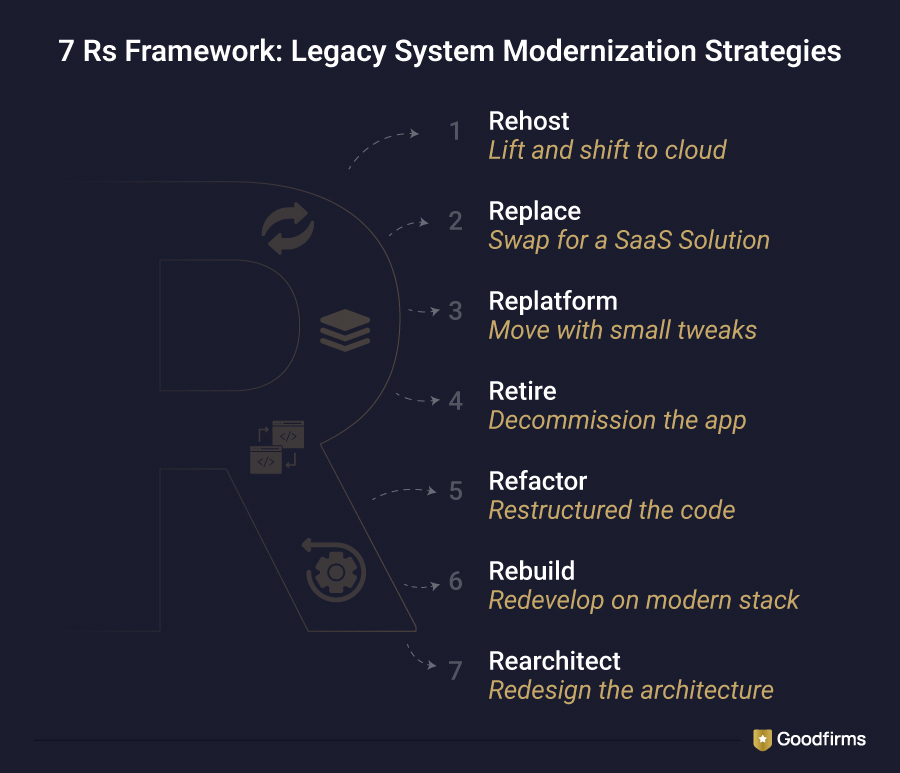
- Rehost moves the app to the cloud without changing the code. It's the fastest and lowest-risk way to modernize, and it's usually the first option teams try when a system just needs cheaper or more reliable infrastructure.
- Replatform moves the app to the cloud with minor changes, such as switching the database, to improve performance. It goes beyond rehosting without requiring a full redesign of the application.
- Refactoring cleans up the app's code without changing what it does. This reduces technical debt and makes the application easier and safer to maintain going forward.
- Rearchitecting redesigns the app's structure, often turning it into microservices for better scalability. This is typically reserved for applications that are important to the business and are starting to hit real performance limits.
- Rebuild recreates the app from scratch using modern technology, while keeping the same business logic. The application ends up technically new, but it still does what it always did for the business.
- Replace retires the app and switches to a commercial or SaaS product instead. This usually makes sense when the app isn't doing anything unique enough to justify continued investment.
- Retire shuts the app down completely once it no longer serves a business purpose. Sometimes the right decision isn't to modernize at all, but simply to let the application go.
Most enterprises don't adopt a single legacy application modernization strategy across their entire portfolio. A typical enterprise application modernization effort ends up mixing two or three of these approaches, based on each app's business value and risk tolerance.
How to Choose the Right Legacy Application Modernization Strategy
Not every application requires the same modernization approach. Use the decision matrix below to determine which of the 7 Rs best aligns with your application's business value, technical condition, and modernization goals.
|
Strategy |
Best For |
Cost |
Complexity |
Time |
|---|---|---|---|---|
|
Rehost |
Quick cloud migration |
Low |
Low |
Weeks |
|
Replatform |
Better cloud performance |
Low-Medium |
Medium |
Weeks-Months |
|
Refactor |
Reducing technical debt |
Medium |
Medium |
Months |
|
Rearchitect |
Scalability |
High |
High |
Months |
|
Rebuild |
Outdated applications |
Very high |
Very High |
Months-Year+ |
|
Replace |
SaaS alternatives exist |
Medium-High |
Medium |
Months |
|
Retire |
No business value |
Low |
Low |
Days-Weeks |
The general rule of thumb is that cost and complexity increase the further you move from a simple rehost, so it's worth being honest about whether an application actually needs that level of change before committing to it. A stable system that just needs to run somewhere cheaper doesn't need to be re-architected. A business-critical platform buckling under real scalability limits usually can't be fixed with a rehost, no matter how tempting the lower price tag is.
Most enterprise modernization initiatives use a combination of these strategies across their application portfolio. High-value applications may be rearchitected or rebuilt, while lower-priority systems are often rehosted, replaced, or retired based on business needs.
Why Legacy Application Modernization Matters in 2026?
Legacy application modernization matters in 2026 because outdated systems now cost more to run, secure, and scale than most businesses can justify. The gap between what old infrastructure can handle and what modern operations demand continues to widen.
- Growing technical debt: The longer an application stays untouched, the more expensive and risky it becomes to fix later.
- Rising maintenance costs: Keeping old systems running quietly consumes IT budgets that could be allocated to new development.
- AI readiness: Legacy architectures rarely support the real-time data access that Generative AI tools need, keeping businesses locked out of AI-driven workflows.
- Cybersecurity threats: Older systems miss vendor patches, making them easier targets as threats continue to evolve.
- Regulatory compliance: Compliance frameworks increasingly expect real-time auditability that legacy infrastructure often can't deliver.
- Faster innovation cycles: Businesses on modern architecture ship features in weeks; legacy-bound teams are often stuck measuring in months.
The trend backs this up: the legacy modernization market grew 16.2% in a single year, from $22.17 billion in 2025 to $25.76 billion in 2026, driven largely by rising maintenance costs and tightening compliance demands
Common Signs When Your Legacy Application Needs Modernization
A legacy application usually showcases its need for modernization through slower performance, rising maintenance costs, and growing security gaps, well before it fails outright. Most teams don't notice these signs individually until they add up.
Frequent downtime
Outages are happening more often, and each one takes longer to diagnose and fix, usually because the system has grown too complex for anyone to fully understand or rectify.
Slow performance
Pages, workflows, and processes that once felt fine begin to lag, especially under load, as the underlying infrastructure struggles to keep pace with demand.
High maintenance costs
A growing share of the IT budget goes toward simply keeping the application alive, leaving little left over for improvements or new development.
Security vulnerabilities
Missed patches, unsupported components, and outdated frameworks make the app an easier target and harder to defend once something does go wrong.
Difficult integrations
Connecting the app to newer tools or platforms takes far more work than it should, especially without dedicated API management software in place to handle it.
Long release cycles
Small changes take weeks instead of days, largely because no one is fully confident that a change won't break something else in the system.
If two or three of these sound familiar, it's usually not a maintenance problem anymore; it's a modernization one.
Step-by-Step Legacy Application Modernization Process
A legacy application modernization process moves through nine stages, from initial assessment to continuous monitoring, rather than being a single, one-time overhaul.
Assess the Current Application Landscape
Before making any changes, teams need to map out what each application actually does, how it's built, and which systems and workflows depend on it, so that every subsequent decision is based on real data rather than guesswork.
Define Business Objectives
Modernization only delivers value when it's tied to a specific outcome, lower operating costs, better uptime, or readiness for AI-driven workflows, rather than being treated as change for its own sake.
Prioritize Applications
Not every application in the portfolio needs to be modernized at once. Ranking each one by business impact and risk ensures that the highest-value systems get attention first, rather than whichever ones happen to be easiest.
Select the Right Modernization Strategy
Once priorities are set, teams match each application to one of the 7 Rs based on its condition and importance. A stable system might just need rehosting, while a business-critical one may require a full rearchitecture.
Choose the Technology Stack
Deciding on the cloud platform, frameworks, and supporting tools matters as much as the migration itself, since the right stack determines how well the application scales and performs long after launch.
Migrate Data and Applications
This becomes especially important for content-driven platforms, where businesses often need a structured CMS migration strategy to move data, preserve functionality, and avoid disruptions during modernization.
Test and Validate
Every phase needs to be checked against performance, security, and compliance benchmarks before the next phase begins, so issues are caught early rather than surfacing after the application is already live.
Deploy and Optimize
Once the application goes live, teams should fine-tune performance and resource usage based on actual production usage, rather than relying on pre-launch assumptions.
Monitor and Continuously Improve
Modernization doesn't end at deployment. Ongoing monitoring helps catch new bottlenecks early and keeps the application aligned with business needs that will inevitably continue to evolve over time.
How Much Does Legacy Application Modernization Cost?
Most legacy application modernization programs cost between $450,000 and $2.3 million, averaging around $1.5 million, though the cost depends on which of the 7 Rs you're actually doing.
Cost by Modernization Strategy
A rehost is one of the cheapest 7 Rs of legacy modernization, usually $20,000 to $150,000, since nothing about the code changes. However, a rebuild sits at the opposite extreme, one of the most expensive, often $400,000 or more, because you're essentially building the application again from scratch. Refactoring and rearchitecting fall somewhere in between, typically $150,000 to $5 million, depending on how much of the system needs restructuring.
|
Strategy |
Typical Cost Range |
Timeline |
|---|---|---|
|
Rehost |
$20,000 – $150,000 |
1-3 months |
|
Replatform |
$75,000 – $250,000 |
1-6 months |
|
Refactor |
$150,000 – $1,000,000+ |
6-18 months |
|
Rebuild / Rearchitect |
$400,000 – $5M+ |
12-24+months |
|
Replace |
$50,000 – $400,000+ |
3-12 months |
Note: These are indicative 2026 planning ranges compiled from current industry cost estimates. Actual legacy application modernization costs vary based on application complexity, codebase condition, integrations, data migration, security and compliance requirements, team location, testing scope, and the selected modernization strategy.
Mainframe and COBOL work breaks this pattern entirely. Specialized talent is scarce enough that those projects often run $1 million to $20 million, regardless of scope.
Cost by Application Size
A small internal tool with no real dependencies could be modernized for well under $250,000. A core banking platform or ERP system with dozens of integrations can cost eight figures, no matter which of the 7 Rs you pick, and estimating the application's footprint matters as much as the technical approach.
The Role of AI in Reducing Costs
Enterprises using AI for mainframe modernization have reported 30-40% lower costs than traditional approaches, largely because AI handles the code analysis and dependency mapping that once consumed months of specialist time.
Hidden Costs That Add to the Budget
Expect hidden line items to add another 30-45% to the initial development quote. The usual culprits:
- Dual running: Hosting, securing, and maintaining the old system while the new one is being built.
- Data migration complexity: Extracting, cleaning, and validating years of unstructured or poorly documented legacy data.
- Integration debt: Rebuilding fragile custom APIs so peripheral systems don't break at cutover.
- Cloud cost overruns: Poorly configured lift-and-shift migrations often cause temporary spikes in cloud subscription costs.
Best Practices for Legacy Application Modernization
The best legacy application modernization practices tie every technical decision to a measurable business outcome, rather than to newer technology for its own sake.
- Start with business goals: Every legacy software modernization initiative should trace back to a measurable objective, not just the desire to use newer technology.
- Perform an application portfolio assessment: A full assessment identifies which systems in the portfolio most need modernization, based on risk and business value.
- Adopt incremental modernization: Rolling out changes in phases, rather than a single big-bang migration, reduces downtime and keeps risk manageable.
- Build API-first architectures: Designing around APIs makes it easier to integrate modernized applications with other systems. A strong API strategy improves scalability, interoperability, and connectivity, making API integration essential for modernization.
- Embrace DevSecOps: Baking security into the development pipeline alongside CI/CD keeps modernized applications compliant rather than exposed. Many enterprises engage DevOps consulting firms to help standardize this across their portfolios.
- Automated testing: Automated testing software pipelines catch regressions early, which matters most when migrating a large, complex enterprise architecture.
- Plan for scalability: Software scalability needs to be a design requirement from day one, not an afterthought once the application hits its first bottleneck.
- Ensure governance and compliance: Clear governance keeps application modernization efforts aligned with regulatory requirements, especially in regulated industries.
- Invest in employee training: Teams need to understand the new architecture, or the organization ends up right back where it started.
- Measure success using KPIs: Tracking uptime, deployment speed, and cost savings shows whether the modernized-legacy-applications effort is actually paying off.
Tools and Technologies Used in Legacy Application Modernization
The right toolset depends on the modernization strategy chosen, but most enterprise efforts draw from a common set of categories:
|
Category |
Common Tools |
|---|---|
|
Cloud Platforms |
AWS, Azure, Google Cloud |
|
Containers & Orchestration |
Docker & Kubernetes |
|
CI/CD & DevOps |
Jenkins, GitHub Actions, GitLab CI |
|
Infrastructure as Code |
Terraform, Ansible |
|
Monitoring & Observability |
Prometheus, Grafana, Datadog |
|
AI-Assisted Modernization |
GitHub Copilot, Amazon Q Developer, Gemini Code Assist |
|
Integration & APIs |
MuleSoft, Kong, Apigee |
Each technology category supports a different stage of the modernization journey:
- Cloud platforms provide the scalable infrastructure needed to host modernized applications.
- Containers and orchestration make applications portable and easier to deploy across environments.
- CI/CD and DevOps tools automate software delivery, enabling faster and more reliable releases.
- Infrastructure as Code (IaC) ensures environments can be provisioned consistently and repeatedly.
- Monitoring and observability tools help teams detect performance issues and maintain application reliability after deployment.
- AI-assisted modernization tools accelerate code analysis, documentation, refactoring, and migration planning.
- API and integration platforms connect modernized applications with legacy systems, third-party services, and cloud applications.
Most enterprises don't rely on a single vendor across all of these; the stack usually gets assembled based on the application's target architecture and existing cloud commitments. Businesses evaluating partners for this work can compare vendors using Goodfirms' list of mobile application development companies, a useful starting point for shortlisting based on real client reviews.
AI's Role in Legacy Application Modernization
AI is transforming legacy application modernization by automating code analysis, accelerating migration tasks, and helping organizations modernize applications more quickly and accurately. Rather than replacing developers, AI supports better decision-making throughout the modernization process.
AI-assisted code modernization can analyze legacy code, identify dependencies, generate documentation, and recommend opportunities for application refactoring. This helps teams understand complex systems before starting legacy application migration.
During legacy-to-cloud migration, AI can suggest migration paths, detect compatibility issues, and optimize workloads for cloud-native applications. It also improves software quality by generating test cases and identifying potential risks early in the development cycle.
While AI speeds up enterprise application modernization, it cannot replace human expertise. Architects and developers are still essential for evaluating business requirements, compliance, security, and long-term technology decisions.
How Does AI Support Legacy Application Modernization?
|
AI Capability |
Business Value |
|---|---|
|
AI-assisted code analysis |
Identifies legacy code issues and dependencies faster |
|
Automated documentation |
Creates technical documentation for complex applications |
|
Dependency mapping |
Reveals relationships between applications, services, and databases |
|
AI code refactoring |
Recommends cleaner, more maintainable code structures |
|
Test case generation |
Automates software testing and improves code quality |
|
Migration recommendations |
Suggests suitable modernization and cloud migration approaches |
|
Risk prediction |
Detects security, compatibility, and performance risks before deployment |
Challenges of Legacy Application Modernization and How to Overcome Them
The biggest challenges in legacy application modernization are technical debt, data migration risk, and organizational resistance, each of which can be addressed with the right planning rather than just more budget.
|
Challenges |
How to Overcome Them |
|---|---|
|
Technical Debt |
Start with a thorough application assessment before touching any code |
|
Budget Constraints |
Modernize incrementally instead of attempting one large-scale overhaul |
|
Downtime Risk |
Migrate in phases so issues surface early, not during a single cutover |
|
Skill Shortages |
Upskill internal teams and bring in experienced modernization partners |
|
Data migration risk |
Plan migrations carefully, with validation at every stage |
|
Compliance gaps |
Build security and compliance into the architecture from the start, often with input from cybersecurity companies |
|
Legacy integrations |
Use API-led approaches so old and new systems connect cleanly |
|
Organizational resistance |
Manage change deliberately, with clear communication on what's changing and why |
Most of these challenges aren't really technical; they're planning gaps. Enterprises that treat modernization as a phased program rather than a single project tend to run into fewer problems.
Legacy Application Modernization Across Different Industries
|
Industries |
Key Modernization Priorities |
|---|---|
|
Financial Services |
Regulatory compliance, fraud prevention, core banking modernization, high availability |
|
Healthcare |
HIPAA/GDPR compliance, EHR modernization, interoperability, patient data security |
|
Retail & eCommerce |
Omnichannel integration, inventory synchronization, personalization, scalability during peak demand |
|
Manufacturing |
ERP modernization, IoT integration, predictive maintenance, supply chain visibility |
While the core modernization principles remain the same, implementation priorities vary significantly across industries. Choosing a modernization partner with domain expertise can help address industry-specific compliance, integration, and operational challenges more effectively.
How to Choose the Right Legacy Application Modernization Company
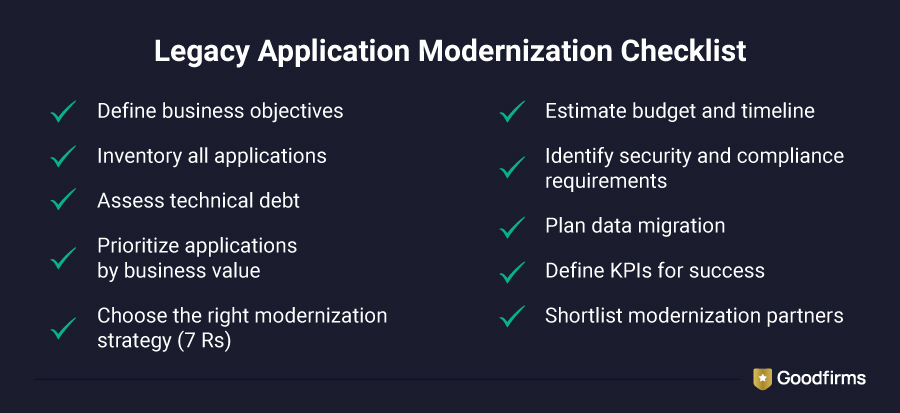
Choosing the right legacy application modernization company comes down to verified industry experience, technical depth, and a transparent, phased methodology, not just the lowest quote.
Industry Experience
A partner who has already modernized applications in your specific industry understands the compliance requirements, operational constraints, and typical failure points you're likely to run into, instead of learning them for the first time on your project and passing that learning curve on to you.
Technology Expertise
Look for hands-on experience across cloud platforms, microservices, containerization, and AI-assisted modernization tools, not just one legacy stack. Many enterprises vet cloud consulting companies with proven modernization case studies before signing on.
Modernization Methodology
A credible partner should be able to walk you through a clear, phased methodology, ideally built around a structured framework like the 7 Rs, rather than pushing a generic, one-size-fits-all rebuild regardless of what your assessment actually shows.
Security and Compliance Track Record
Ask for concrete evidence of past work that met relevant regulatory standards, particularly if your systems handle sensitive data or operate in a regulated industry where a compliance gap can carry real financial and legal consequences.
Case Studies and Client Reviews
Verified case studies and genuine client feedback reveal how a company performs under real-world project pressure, missed timelines, scope changes, and unexpected technical issues, rather than what it claims in a polished sales pitch.
Pricing Transparency and Support
Understand not just the upfront project cost, but also what post-launch support actually looks like, since modernization work rarely ends cleanly at deployment and the quality of ongoing support varies widely between vendors.
Future Trends in Legacy Application Modernization (2026 and Beyond)
The next phase of legacy application modernization is being shaped by AI-powered modernization, platform engineering, and a shift toward continuous, rather than one-time, upgrades.
- AI-powered modernization: Generative AI for legacy applications is moving beyond code suggestions into full AI code refactoring, handling dependency mapping and migration recommendations that used to take teams weeks. Many enterprises now rely on specialized AI development companies to execute this at scale.
- Agentic AI for software engineering: It's starting to handle multi-step modernization tasks with less human oversight, with AI agent builders pointing toward more intelligent application modernization over time.
- Platform engineering: Enterprises are building internal developer platforms to standardize the deployment of modernized applications, reducing repetitive setup work across teams.
- Composable applications: Rather than monolithic rebuilds, businesses are assembling modernized systems from interchangeable, purpose-built components that are easier to update individually.
- Event-driven architecture: Event-driven design is becoming the default for real-time data needs, replacing older batch-processing patterns still common in legacy systems.
- Hyperautomation: Combining AI, RPA (Robotic Process Automation), and process mining is helping eliminate manual work that has slowed down large-scale enterprise digital transformation efforts.
- Security-first modernization: Mobile App Security practices are increasingly built into modernization from day one, rather than added as a final step before launch.
Together, these trends suggest that legacy code modernization is becoming a continuous digital transformation strategy rather than a project with a fixed end date.
FAQs - Legacy Application Modernization
What is legacy application modernization?
Legacy application modernization is the process of updating outdated software, its code, architecture, or platform to meet current business, security, and performance needs. It can range from a simple cloud move to a full rebuild, depending on the application's condition.
What are the 7 Rs of application modernization?
The 7 Rs are Rehost, Replatform, Refactor, Rearchitect, Rebuild, Replace, and Retire. Each represents a different level of change, enabling enterprises to match the right strategy to each application rather than applying a single approach across the entire portfolio.
What is the difference between legacy modernization and cloud migration?
Cloud migration moves an application to a new environment without necessarily changing its architecture. Legacy application modernization goes further, changing the application itself, its code or structure, to make it genuinely fit current business needs, not just relocating it.
How much does legacy application modernization cost?
Legacy application modernization typically costs between $25,000 for a basic migration and $2 million or more for large-scale enterprise transformations, with most programs falling between $450,000 and $2.3 million. Budgets often run over this range because technical debt discovered mid-project tends to add unplanned costs.
What are the challenges of legacy modernization?
The most common challenges are technical debt, data migration risk, integration complexity, and organizational resistance to change. Most of these are planning gaps rather than technical limitations and are manageable through phased, incremental modernization.
When should an enterprise modernize legacy applications?
An enterprise should consider modernization when maintenance costs keep climbing, security vulnerabilities increase, or the application can no longer integrate with modern cloud tools and APIs without extensive custom work.
Conclusion
Legacy systems rarely announce that they've become a problem. They just quietly get slower, more expensive, and harder to trust, until one day the business realizes it's been working around its own software instead of building on it.
Modernization isn't about chasing what's new for its own sake. It's about giving your applications room to keep up with where the business is actually headed. Some systems just need a fresh home. Others need to be rethought from the ground up. Either way, the goal is to stick with the software that works for you, not against you.
The businesses that get this right treat it as a decision, not a delay. And those who partner with the right custom software development companies tend to find that decision much easier.