Key takeaways
- Go isn't just for niche use cases: 55% of developers already build APIs with it, and over a third use it for cloud infrastructure work.
- Speed and concurrency aren't the only wins. Go compiles into a single binary, so deployment is no longer a headache.
- Learning Go isn't the hard part; the real friction lies in writing idiomatic code and finding modules that developers actually trust.
- Hiring Go developers isn't fixed-price either; expect $25 to $160+ an hour, or $2,000 to $25,000+ for a full project, depending on scope.
If you're building a backend that needs to handle real traffic without breaking down, Go is worth a serious look, and it's exactly why Golang backend development has become such a popular choice among growing companies.
It's fast, built for concurrency, and already powers the infrastructure behind companies like Uber, PayPal, and Netflix. Docker and Kubernetes, two of the most widely used tools in cloud infrastructure today, are both built entirely in Go.
This guide covers everything you actually need to know: why Go works so well for backend systems, where it shines in real projects, and the best practices teams use to build with it right.
If you're ready to bring Go into your own project, browsing Golang development companies on Goodfirms is a great place to start comparing real teams and reviews.
What Is Golang Backend Development?
Golang, or Go, is an open-source programming language developed by Google to handle concurrent or heavy workloads without slowing down or becoming overly complex. It's compiled and statically typed, which means fewer surprises once your code is actually running in production.
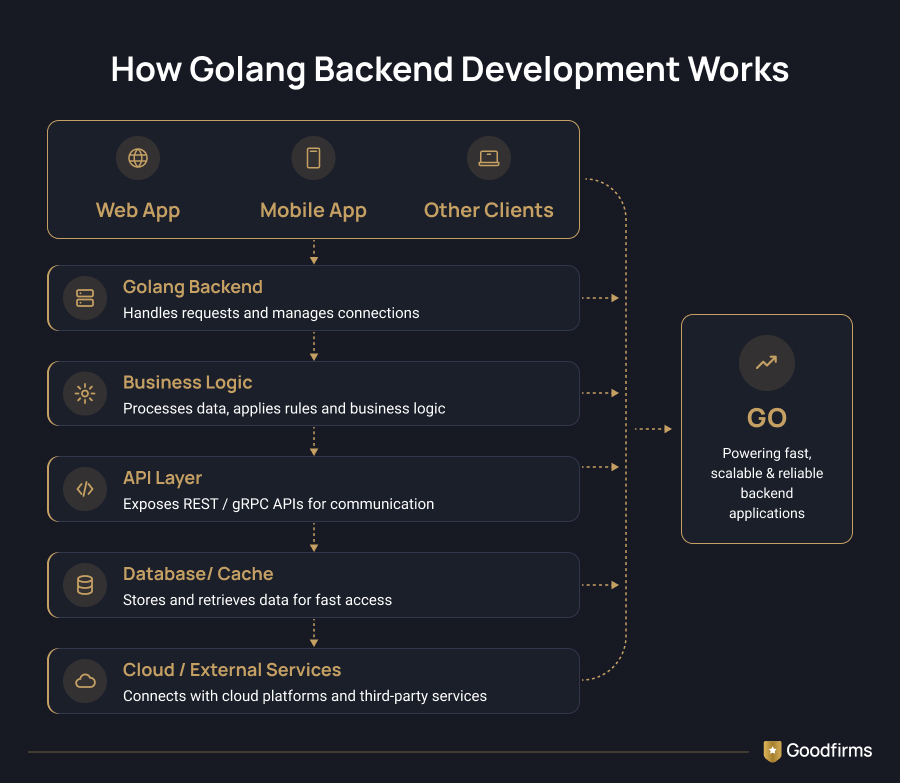
Golang backend development is simply using Go to build the server-side of your software, the part that runs your business logic, talks to the database, checks permissions, and keeps everything connected behind the scenes. If you have ever wondered what's actually happening when an app processes a payment or loads your dashboard instantly, that's the backend at work, and Go is built to do exactly that well.
That's not just a claim, either. Go's 2025 Developer Survey found that 55% of developers now build both CLIs and API services with the language, and over a third use it for cloud infrastructure tooling, making it one of the more trusted choices for backend work today. The survey also reported 91% overall satisfaction among respondents, although writing idiomatic Go and finding trustworthy third-party modules remained notable challenges.
Why Is Golang Good for Backend Development?
Golang is a popular language built to solve real backend problems, including speed, concurrency, and code that doesn’t break as a team grows, while still scaling over time. Here are some reasons why Golang is the right choice for people.
High Performance and Fast Execution
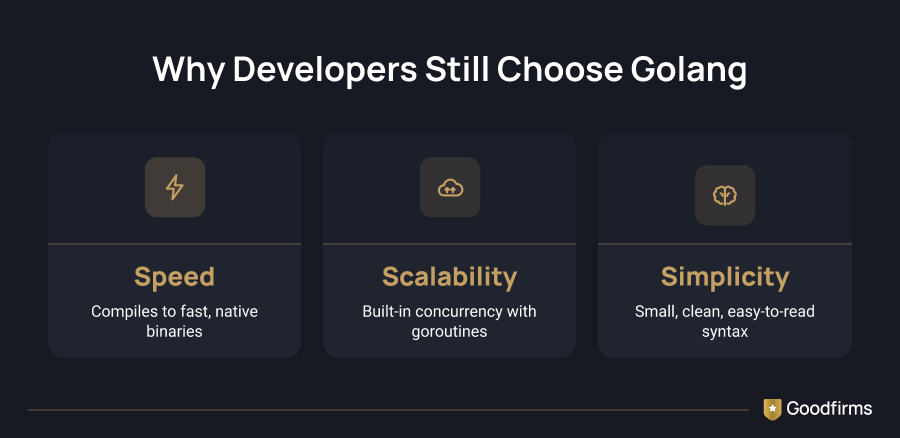
Go compiles directly to machine code rather than running through an interpreter, so there's nothing between your code and the hardware. In practice, that shows up as backends that stay fast even when traffic spikes, without needing to throw extra servers at the problem.
Built-In Concurrency
This is probably the feature Go is best known for. Goroutines make it cheap to run thousands of tasks at once, and channels give you a clean way to pass data between them without the usual threading mess. Golang easily handles features such as real-time processing, parallel API calls, and background jobs.
Simple and Maintainable Code
Golang's syntax is deliberately small. There aren't ten ways to write the same thing, which sounds minor until you're the third developer trying to understand someone else's code six months later. Teams tend to onboard new engineers faster because there's less to disagree about in the first place.
Easy Deployment
Golang provides easy deployment, as it compiles to a single binary with nothing else to install alongside it. Drop it into a container, push it to a cloud server, done. No dependency conflicts, no "works on my machine" arguments.
Strong Support for Scalable Systems
APIs, microservices, and distributed systems are among the most important use cases for Golang, which is why many software development companies use it for scalable backend projects. It's become the default for cloud-native backends, mostly because it scales without requiring a rewrite once traffic actually arrives.
Reliable Developer Tooling
Go provides all those features that other languages need plugins for. It provides everything from the start, including testing, formatting, and catching common mistakes before they hit production. It also has a standard library solid enough that teams often skip third-party packages entirely for basic tasks.
That said, Go isn't friction-free. Go's own 2025 Developer Survey found 5,379 respondents with 91% overall satisfaction, but the top complaints were writing idiomatic Go (33%) and finding trustworthy third-party modules (26%). Worth knowing going in, especially if your team is new to the language.
Rob Pike, co-creator of Go and former Google engineer, explained that Go was designed with the practical needs of software engineering in mind, helping teams build software that remains productive and scalable as systems grow.

Go is more about software engineering than programming language research.
Golang Backend Development Use Cases
Golang backend development is commonly used for REST (Representational State Transfer) and gRPC APIs, microservices, cloud-native applications, real-time systems, enterprise backend platforms, and developer tooling. Here's a closer look at each, with real examples of companies using Go in production.
REST and gRPC APIs
Go is one of the most common languages for building REST and gRPC APIs because its standard library handles HTTP natively, so you don't need a heavy framework to get started. gRPC is just as natural a fit, since Google built Go and Protocol Buffers side by side, which is part of why Golang gRPC development has become common for services that need fast, strongly typed communication between systems.
Microservices
Go is widely used for microservices because it compiles to small, fast-starting binaries with a low memory footprint, exactly what a system split into dozens of independent services needs. Uber has also adopted Go extensively across its backend infrastructure. The company initially relied heavily on Python and Node.js, but later introduced Go for performance-critical services and began replacing parts of its Python stack with Go. Uber has even used Go alongside Node.js for real-time systems that process rider and driver activity and support matching.
Cloud-Native Applications
Go is a core language of the cloud-native ecosystem. Docker and Kubernetes are both written in it. When a language ends up powering the tools that run the cloud itself, it helps explain why many cloud computing companies use Golang to build scalable infrastructure and applications.
Real-Time and High-Traffic Systems
Go handles real-time and high-traffic systems well because its concurrency model is built to manage thousands of simultaneous requests without slowing down. PayPal runs a large chunk of its infrastructure this way, with over 100 Go developers maintaining systems that can't afford downtime. Stream, which powers activity feeds and chat for roughly 500 million users, is built on Go for the same reason.
Enterprise Backend Systems
Enterprises use Go to build internal platforms, business-critical APIs, and integrations that connect different systems and services. Its performance, concurrency, and maintainability make it well-suited for backend environments that must remain reliable as applications and teams scale. Capital One, for example, uses Go for its Credit Offers API, while 1Password has built parts of its backend infrastructure with Go to support the reliability and security requirements of its password management platform.
Developer and Infrastructure Tools
Go is widely used to build developer and infrastructure tools that support backend and cloud-native environments. Its compiled, portable binaries make Go applications easy to distribute and deploy across different systems. Alibaba’s PouchContainer, an enterprise-grade container engine built with Go, is an example of how Go can be used to build infrastructure that supports containerized and distributed applications at scale.
Golang Backend Technology Stack
A typical Golang backend stack is lighter than most, since Go's standard library already covers a lot of what other languages need external packages for.
|
Layer |
Common Go Technologies |
|---|---|
|
Language |
Go/Golang |
|
API |
REST, gRPC |
|
Frameworks |
Gin, Echo, Fiber |
|
Database |
PostgreSQL, MySQL, MongoDB |
|
Cache |
Redis |
|
Messaging |
Kafka |
|
Containers |
Docker |
|
Orchestration |
Kubernetes |
|
Cloud |
AWS, GCP, Azure |
|
Testing |
Go's built-in testing package |
Most Go teams don't reach for a framework right away. The standard library's net/http package can handle routing, middleware, and request handling well enough for many production APIs on its own. Frameworks like Gin, Echo, and Fiber come into play once a project needs more structure, faster routing, built-in middleware chains, or cleaner request validation, but they're an addition, not a requirement.
The rest of the stack looks familiar to anyone who's built backends before. PostgreSQL and MySQL cover relational data, MongoDB handles document-based needs, and Redis sits in front for caching and session storage. For anything event-driven or high-throughput, Kafka is often the go-to choice for message queues. And since Docker and Kubernetes are themselves written in Go, container-based deployment feels less like an integration and more like a natural extension of the language.
Golang Backend Development Best Practices
Getting a Go backend right comes down to writing idiomatic code, structuring projects sensibly, and building in security, testing, and observability from the start. Here's what that looks like in practice.
Follow Idiomatic Go
Idiomatic Go means writing code the way the language expects it to be written: simple, explicit, and consistent with how the broader Go community structures things. Teams that skip this early tend to end up with codebases where every developer has their own style, making onboarding and code review far harder than they need to be.
Structure Projects for Maintainability
A maintainable Go project separates handlers, services, repositories, and models rather than dumping everything into a single package. There's no single "correct" folder structure Go enforces, and that's intentional; the point is to keep responsibilities separated so the codebase stays readable as it grows, not to match someone else's template exactly.
Use Concurrency Carefully
Concurrency in Go should solve a real problem, not get used because goroutines are easy to spin up. Reaching for concurrency everywhere, even where a task runs fine sequentially, tends to introduce bugs that are much harder to track down than the performance problem it was meant to solve.
Build Secure APIs
A secure Go API handles authentication, authorization, and input validation as standard practice, not an afterthought bolted on before launch. Rate limiting and proper secrets management matter just as much, as many real-world breaches trace back to a hardcoded key or an endpoint nobody thought to lock down.
Test and Benchmark Backend Services
Reliable Go backends lean on a mix of unit tests, integration tests, and benchmarks, making software testing companies useful when teams need specialized QA support beyond manual testing. Automated testing catches regressions early, and benchmarking helps teams see the actual cost of a change rather than guessing at performance.
Use Observability
Observability means having logging, metrics, tracing, and error monitoring in place before something breaks, not after. Without it, teams end up debugging production issues by blind guessing what happened instead of tracing exactly where and why a request failed.
Containerize and Automate Deployment
Deploying Go backends usually means packaging them into containers and automating the release process through CI/CD, making DevOps companies a useful partner for teams managing deployments at scale. So every deployment follows the same steps, rather than relying on manual work. This pairs naturally with Kubernetes for teams running things at scale, though smaller setups can get by with a simpler pipeline.
Golang Backend Development vs Other Backend Technologies
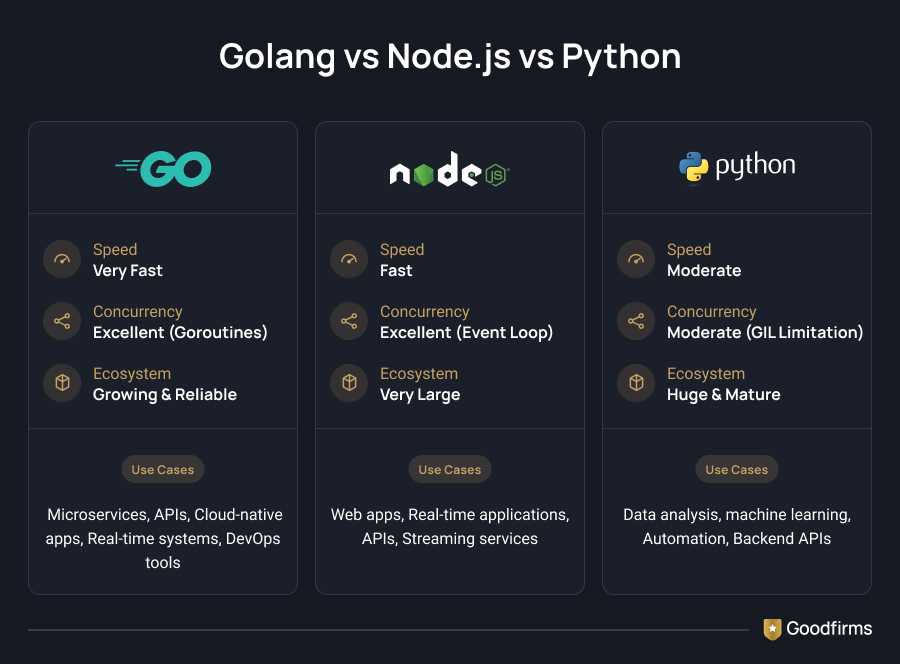
Golang backend development is generally faster and more concurrency-friendly than Node.js development, though the right choice still depends on the project. Here's how the three stack up on the factors that actually matter for backend work.
|
Factor |
Golang |
Node.js |
Python |
|---|---|---|---|
|
Performance |
High |
High |
Moderate |
|
Concurrency |
Strong |
Strong |
More limited for CPU-bound work |
|
API development |
Excellent |
Excellent |
Excellent |
|
Microservices |
Excellent |
Excellent |
Strong |
|
Learning curve |
Moderate |
Moderate |
Relatively Easy |
|
Cloud-native workloads |
Excellent |
Strong |
Strong |
When Should You Choose Golang?
- Your project needs high concurrency, with multiple processes running at once without slowing down.
- You need scalable APIs that can handle growing traffic without a major rework down the line.
- You're building microservices that communicate constantly, and Go's low overhead keeps communication efficient.
- You need a cloud-native backend that can handle traffic spikes without falling over.
- Your team is already deep in JavaScript and wants to share code between frontend and backend, in which case Node.js still holds its own.
- If your project leans on data science or machine learning, or you're a small team that needs to move fast, Python developers can be a practical choice because of the language's simpler learning curve.
How to Choose a Golang Backend Development Company?
The right Golang backend development company should have proven Go experience, strong API and microservices expertise, a track record of cloud-native projects, solid security practices, relevant industry experience, and reliable post-launch support. Here's what to actually look for before signing on.
Proven Go Backend Experience
Ask for real examples of backend systems they've built in Golang, not just a mention of the language on their tech stack page. A team that's shipped multiple Go backends will have opinions on structure and trade-offs that a team that's only dabbled usually won't.
API and Microservices Expertise
Since so much of Golang backend development revolves around REST and gRPC APIs and microservices, the company should be able to speak specifically to how they've designed and scaled those systems, not just that they've "worked with APIs" before.
Cloud-Native and DevOps Capability
Look for hands-on experience with Docker, Kubernetes, and CI/CD pipelines. This is where a lot of Golang development services either shine or fall short once a project moves past the demo stage into something that has to run reliably in production.
Security and Testing Discipline
A good Golang development company treats authentication, input validation, and automated testing as standard practice, not extras they add on only if a client asks. It's a fair signal of how seriously they take the backend once it's live.
Relevant Industry Experience
A team that's already worked in your industry tends to spot problems faster, since they've likely run into similar constraints, compliance requirements, traffic patterns, and integration quirks specific to your space before.
Post-Development Support
Support after launch matters just as much as the build itself. Go backends still need monitoring, updates, and the occasional fix long after the initial project wraps up, so it's worth confirming what that looks like upfront.
FAQs - Golang Backend Development
What frameworks are used for Golang backend development?
The most commonly used frameworks are Gin, Echo, and Fiber, though Go's standard library alone often handles REST API development, Golang web development, and other backend needs without requiring a framework at all.
Is Golang suitable for enterprise applications?
Yes. Golang enterprise development is a strong fit for large-scale systems because of its reliability, ease of deployment, and support for scalable backend architecture, distributed systems, and secure API development.
Is Golang suitable for microservices?
Yes. Go's small binary size, fast startup, and low memory footprint make it a strong fit for Golang microservices development, where independent services need to scale separately within cloud-native applications and distributed architectures.
Why is Golang good for backend development?
Go is fast, compiles to a single binary, and has built-in concurrency through goroutines, making it well-suited for high-performance backend systems, scalable Golang applications, and distributed systems that need to handle heavy traffic reliably.
Is Golang better than Node.js for backend development?
Neither is universally better. Golang generally handles CPU-intensive, highly concurrent workloads more efficiently, making it a strong choice for Golang backend development services, while Node.js suits teams already built around JavaScript.
How much does Golang backend development cost?
Golang backend development costs vary based on project complexity, developer experience, location, and hiring model. Remote Go developers can cost around $15–$65 per hour in India and $60–$160 per hour in the US. For complete backend projects, the total cost depends on features, integrations, architecture, and development time. (Source)
Final Words
Golang's appeal comes down to a simple combination: real performance, built-in concurrency, and deployment that doesn't fight you at every step. That's why it keeps showing up in APIs, microservices, and cloud-native systems built to actually hold up under load.
None of that matters without the right team behind it, though. The difference between a backend that scales smoothly and one that buckles under its first traffic spike usually comes down to who built it.
If your project also has a mobile-facing side, it's worth pairing that backend work with experienced mobile app development companies who can build the front end to match so performance holds up end-to-end, not just on the server.