Key takeaways
-
White label software development enables a business to rebrand and sell a pre-built product under its own name, cutting both cost and time.
-
Since the same platform serves multiple businesses, issues surface and get fixed faster than in a new custom build — businesses inherit proven technology, not a product still working out its first bugs.
-
The right choice comes down to fit: white label for speed and standard needs; custom for proprietary or compliance-heavy workflows.
White label software development is the practice of one company building a product that another company rebrands, customizes, and sells under its own name.
The original provider typically manages the underlying technology, including development, updates, and maintenance, while the business using the software focuses on branding, marketing, sales, and customer relationships.
Depending on the agreement, the software can be presented entirely under the reseller’s brand, including its logo, colors, domain, and other customer-facing elements. This allows businesses to offer a software product without having to build and maintain the entire platform themselves.
The rest of this blog covers how the white label process works, its benefits, common types, and what to weigh before choosing a partner.
Not sure which white label partner fits your build? Browse Goodfirms-verified white label software development companies, complete with client reviews, hourly rates, and team sizes, and shortlist yours in minutes.
How White Label Software Development Works
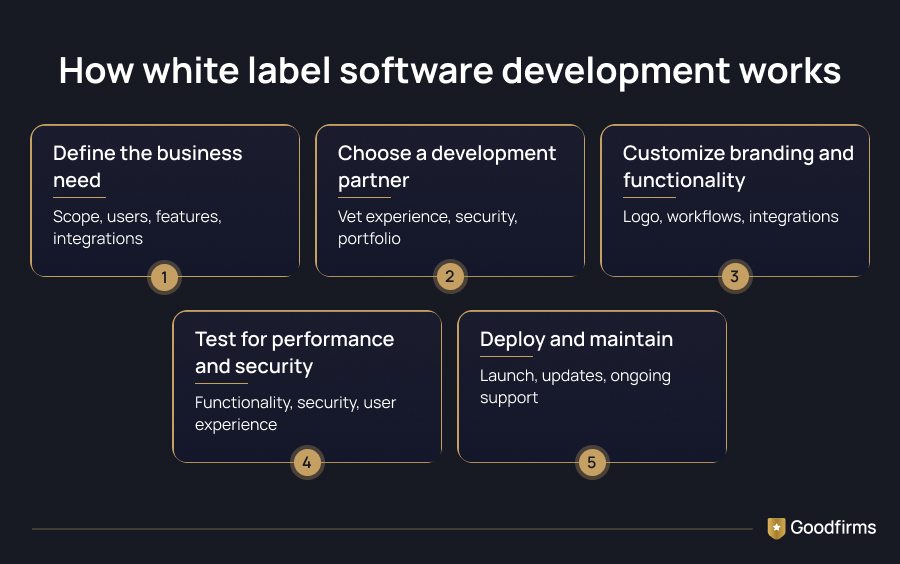
Generally, there are five stages to the development process, though the order can shift depending on whether you're starting with an existing white label product or commissioning one from scratch.
1. Define the business need
The process usually begins by defining the business requirement. This means getting specific about what the software needs to do, who will use it, what problem it should solve, which features are essential, how many users the business expects to have, what integrations are required, and how much control the business wants over the customer experience.
2. Choose a development partner
The next step involves choosing a partner that goes beyond pricing and product demos — weigh their industry experience, technical capabilities, security, support, scalability, and integration options against past work. Shortlist a few, and request detailed proposals before deciding.
If you're weighing options beyond white-label specialists, Goodfirms' software development companies page is a good place to compare providers more broadly by hourly rate, team size, and portfolio.
3. Customize the branding and functionality
After selecting a provider, the software can be customized to match your brand. This may include your logo, colors, fonts, domain, login screen, customer emails, reports, dashboards, and other visible elements.
More advanced implementations can involve custom workflows, APIs, third-party integrations, user roles, reporting systems, and specialized functionality. The goal is to make the software feel like a natural part of your business rather than an unrelated third-party product.
Integration plays an important role here. Most businesses already use CRMs, payment gateways, accounting platforms, marketing tools, communication systems, or customer portals. A white label platform should ideally connect with these systems so your teams do not have to manage everything separately. Goodfirms' guide to API integration in 2026 covers common types and how to plan one with a development partner.
4. Test for performance and security
Before launch, the software should be thoroughly tested because the product will carry your brand name. Quality assurance matters as much as it does for a fully custom build. Businesses should check functionality, usability, security, performance, integrations, user permissions, payments, notifications, and the overall customer journey.
5. Deploy and maintain
Once everything is ready, the platform can be launched under the business's brand. The development partner typically continues to handle updates and infrastructure, while businesses focus on selling and growing the client base. Maintenance terms should be included in the contract before launch, not negotiated after something breaks. Customers may access it via a website, a custom domain, a mobile application, or a customer portal, depending on the product.
The process does not end at launch. Software needs regular updates, security improvements, bug fixes, monitoring, backups, and maintenance. One of the main benefits of working with a white label provider is that much of this technical responsibility can be retained by the provider. However, businesses should confirm exactly what is included in the agreement.
The five-step process explains what white labeling involves — but the reason so many businesses choose it comes down to what it saves them.
Key Benefits of White Label Software
Enterprises are choosing white label solutions for more than just convenience. It offers them a practical way to introduce technology-driven services without incurring the full cost and complexity of building a product from scratch. Over time, it can become an important part of the company’s growth strategy rather than just another technology investment.
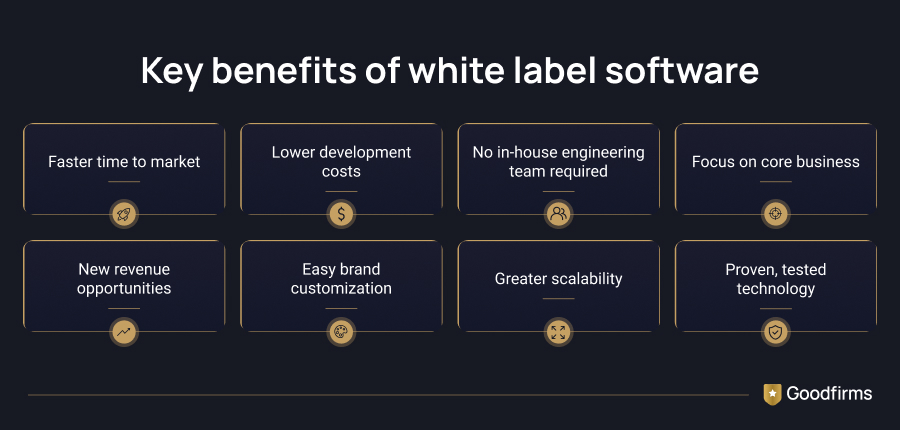
Some of the key benefits include:
1. Faster time to market
With the core software already developed, businesses can launch their branded solution much sooner than they could with a product built from scratch. It reduces the time and resources spent on coding, testing, and debugging. Thus, businesses can enter the market quickly and start generating revenue faster.
2. Lower development costs
White label solutions can reduce the need for a large in-house development team and eliminate many expenses associated with building core functionality from scratch. It spreads that cost across every business that licenses the same platform, which is why the setup fee is usually a fraction of a custom build's price tag.
3. No in-house engineering team required
With white label software, a business doesn't need its own developers to offer a tech product — the development partner already has the team to build and maintain it. That's a real advantage right now, since finding tech talent has become challenging: 72% of employers worldwide say they're struggling to fill open roles, according to ManpowerGroup's 2026 Global Talent Shortage Survey.
4. Focus on core business
By outsourcing much of the technology development and maintenance, businesses can spend more time on sales, marketing, customer service, and industry-specific expertise. Reputable platforms are also architected to support multiple brands simultaneously, so the same infrastructure can scale to serve significantly more clients without a rebuild.
5. New revenue opportunities
Offering a branded software product generates recurring revenue that wasn't previously part of the business model. Many providers support multiple monetization paths on the same platform — flat subscriptions, per-user pricing, or revenue sharing with the original developer. Businesses can add software subscriptions or technology-enabled services to their existing offerings, creating additional and potentially recurring revenue streams.
6. Easy brand customization
White label software can be customized with a business logo, colors, domain, interface design, email addresses, and select features. Although the software is developed by another company, customization makes it look and feel like a product built specifically for that business. That consistency creates a seamless brand experience for customers while helping businesses maintain a distinct presence in the market.
7. Greater scalability
Established white label platforms support growing numbers of users, so businesses can expand without rebuilding the system from scratch. Businesses can add new offerings without in-house development — a marketing agency can offer a branded CRM, or a consultancy can add a training portal, without hiring engineers. As the client base grows, the platform scales accordingly.
8. Proven, tested technology
Because the same underlying platform serves many businesses, bugs surface and are fixed faster than they would in a brand-new custom build with a single user base. Businesses inherit a product that's already been through real-world use, not one still working out its first edge cases.
These benefits vary depending on the type of software being white-labeled, so it helps to look at where this model is most commonly used.
Types of White Label Software Development Solutions
White label arrangements show up across nearly every software category, but a handful of types come up most often.
1. E-commerce platforms
A ready-built online store system — product catalogs, shopping carts, payment acceptance, and customer engagement tools — that a business rebrands and resells to merchants who want a storefront without commissioning one from scratch. This enables a reseller to offer online stores to multiple merchants off the same underlying platform, cutting both build time and hosting overhead.
2. Payment gateways and fintech platforms
Rather than building payment or banking infrastructure in-house, a business can license an existing payment, banking, or crypto wallet system and present it under its own brand — so clients transact without knowing a third party built it. This is especially common among neobanks and fintech startups that need compliance-heavy backend systems already built and tested. Galileo, for instance, powers the card-issuing and account infrastructure behind neobanks like Monzo and Wise, while Marqeta's white labeled card programs sit behind consumer apps from DoorDash and Klarna — in both cases, the end customer interacts only with the front-facing brand. Goodfirms' neobank development page is a good starting point for comparing providers.
3. CRM software
A pre-built CRM system that a consulting firm or agency can rebrand and hand off to clients as a ready-made solution, without spending months developing one internally. The client gets a fully functional CRM under a name they recognize, while the actual engineering and updates stay with the original developer.
4. Project management tools
Scheduling, task-tracking, and collaboration tools, licensed and rebranded so a company can offer a project management application under its own name instead of pointing clients to a third-party tool. This is especially useful for consultancies and agencies that want project visibility to feel like part of their own service, not an outside add-on.
5. Mobile apps
A fully built app — a fitness tracker, booking tool, or loyalty app — that gets customized with a business's branding, feature tweaks, and app store listing before being sold or offered to that business's own customers. This route lets a business launch under its own name in the app stores without carrying the cost of building an app from scratch. Goodfirms' comprehensive guide to white label apps breaks down typical costs and trade-offs if you want to go deeper on this route specifically.
Most providers specialize in just one or two of these categories, so it's worth confirming a provider's track record in the specific solution type being evaluated before signing on.
The software type directly affects the overall development cost.
How Much Does White Label Software Development Cost?
The cost of white label software development depends on the level of customization, integrations, platform complexity, and ongoing support. A basic rebranding project can cost a few thousand dollars, while a more complex white-label platform with custom features and integrations can require a significantly larger investment.
|
White Label Software Type |
Estimated Cost |
Typical Timeline |
|---|---|---|
|
Basic SaaS rebranding |
$5,000–$15,000 |
2–6 weeks |
|
Moderate customization |
$15,000–$50,000 |
1–3 months |
|
Advanced white-label platform |
$50,000–$150,000 |
3–6 months |
|
Complex enterprise platform |
$150,000–$500,000+ |
6–12+ months |
Costs can increase further when projects require custom integrations, advanced security, compliance, multi-tenant architecture, or ongoing development and support. These figures should be treated as industry estimates rather than fixed prices, since providers use different pricing and licensing models.
Cost is one factor; comparing white label and custom development clarifies the broader trade-offs.
White Label vs Custom Software Development: The Difference
White label software and custom development serve different purposes.
A white label solution starts with an existing product that can be customized within the provider’s capabilities. Starting with an existing platform can shorten the time to market and reduce the amount of development work required.
With custom development, the product is built around a business’s specific requirements, providing control over the architecture, design, features, workflows, integrations, and overall user experience. However, it requires more time, money, technical expertise, and ongoing management.
|
Factor |
White label software |
Custom software development |
|---|---|---|
|
Ownership |
Licensed or resold, the underlying code is usually owned by the original developer |
Fully owned by the commissioning business |
|
Timeline |
Weeks to a few months |
Several months to over a year, depending on the scope |
|
Cost |
Lower upfront; often subscription or licensing-based |
Higher upfront; billed for full engineering effort |
|
Customization |
Branding plus configurable features within the platform's limits |
Unlimited, built entirely around specific requirements |
|
Maintenance |
Handled by the development partner, including updates and support |
Falls on the commissioning business, in-house or outsourced |
|
Best for |
Agencies, resellers, and businesses that need to launch quickly |
Companies with unique workflows that off-the-shelf software can't support |
|
Examples |
CRM systems, analytics dashboards, e-commerce storefronts |
ERP systems, healthcare compliance platforms |
When to choose which approach:
White label software: This can be a good option when your requirements are relatively standard, and your priority is speed.
Custom software: This may be more appropriate when your business depends on proprietary technology or highly specialized functionality.
There is also a hybrid approach. A business can use white label software for standard features while developing its own proprietary functionality on top of the platform. This can provide a balance between speed and differentiation.
The white label vs. custom comparison clarifies the trade-offs — and a few are worth examining more closely before signing anything.
Challenges to Consider Before Choosing a White Label Partner
White label software has its fair share of challenges, worth weighing honestly before signing a contract.
1. Limited differentiation
If multiple competitors license the same underlying platform, a business's "unique" product might look and function almost identically to others under different branding.
2. Dependency on the provider's roadmap
Businesses don't have control over the product's technical direction. If the provider pivots, discontinues a feature, or changes pricing, the business will have to bear the impact.
3. Customization ceilings
Most platforms allow branding and moderate configuration, but generally won't accommodate deeply unique workflows the way a custom build would.
4. Data and compliance responsibility
Even though the provider builds the software, businesses collect customer data. Contracts should clearly state who's responsible for security and regulatory compliance.
Weighing those challenges upfront is exactly what separates a smooth white label rollout from a frustrating one, starting with who you choose to work with.
How to Choose the Right White Label Development Partner
Before choosing a provider, ask these key questions:
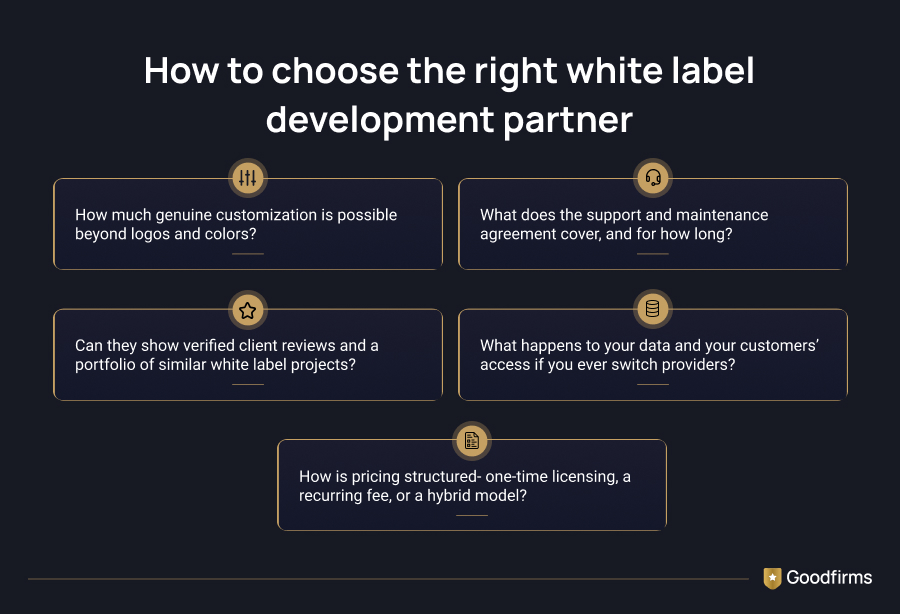
Comparing providers side by side on verified rate cards and reviews makes this process considerably less guess-driven. Goodfirms has verified 143 white label software development companies, with a $37/hr median rate and a 4.9-star median client rating — useful benchmarks to weigh any quote against.
Getting these answers before signing can help you avoid common problems later.
Concluding Remarks
White label software development allows businesses to offer polished technology under their own name without reinventing the wheel. It won't fit every situation, especially where deep customization is non-negotiable. Still, for agencies and resellers looking to expand quickly, it's one of the more practical ways to compete without investing in engineering. The partner you choose matters as much as the platform itself, because you’ll be relying on them for the long haul — so vet them properly.
FAQs- White Label Software Development
Is white label software the same as SaaS?
No. SaaS describes how software is delivered, typically via the internet and often on a subscription model. White labeling refers to software being branded and sold by another company. A SaaS product can be white labeled, but the two concepts are different.
Can white label software be customized?
Yes. The level of customization depends on the provider. Some solutions support only branding changes, while others allow custom domains, dashboards, workflows, integrations, APIs, user roles, and additional functionality.
Is white label software cheaper than custom development?
It can be, particularly because the core software has already been developed. However, customization, integrations, licensing, support, and infrastructure can increase the total cost. Businesses should compare the total cost of ownership rather than only the initial price.
Is white label software suitable for startups?
Yes. Startups can use white label software to launch faster, validate an idea, attract early customers, and generate revenue before making a larger investment in custom development.
What is the biggest disadvantage of white label software?
The biggest disadvantage is reduced control over the underlying technology. Your business may depend on the provider for infrastructure, updates, security, support, and certain product decisions. This makes provider selection and contractual terms extremely important.


.jpg)