Key takeaways
- Express.js remains one of the most widely used Node.js web frameworks, supported by a mature ecosystem and extensive production adoption.
- Development costs typically range from $8,000 for a simple REST API to $70,000 for a complex, enterprise-grade backend.
- Express.js scales through proven patterns — clustering, load balancing, caching, and microservices — not special-case tricks.
- The framework's minimalism is best suited to SaaS platforms, API-first products, and teams that need to ship and iterate quickly.
- Most Express.js projects that struggle didn't fail because of the framework — they skipped structure, security planning, or monitoring from day one
A backend can look fine in development and still become the reason a product slows down, costs more to maintain, or struggles under real traffic. For businesses choosing a backend framework, the decision is not simply about which technology developers prefer—it is about development cost, scalability, security, and how quickly the product needs to evolve.
Web development companies that already work with Node.js often choose Express.js because it adds routing and middleware without imposing a rigid application architecture.
Popularity alone doesn't explain Express.js's continued adoption. The real value lies in how much it costs, how effectively it can scale as real users and traffic increase, and which types of businesses benefit most from its flexibility, mature ecosystem, and lightweight architecture.
Not sure where to start? Explore top-rated Express.js development companies on Goodfirms, backed by real client reviews and proven project history.
This guide explains how businesses can decide whether Express.js is the right backend, what they should budget for development, what to expect from a development partner, and how to plan for production-scale growth.
Express.js Backend Development: What Does It Mean?
Express.js is a lightweight web application framework that runs on top of Node.js. In 2009, engineer Ryan Dahl (a software engineer) released Node.js, a runtime environment that let developers write server-side code in JavaScript - the language browsers use for client-side scripting. Node.js handles the low-level plumbing — the event loop, non-blocking I/O, and the HTTP module. Express.js sits above that layer and turns dozens of lines of routing and middleware boilerplate into a handful of readable function calls.
TJ Holowaychuk (a well-known name in the open source world) built Express in 2010, borrowing its philosophy from Sinatra, the minimalist Ruby framework. That minimalism is the point: Express doesn't force a folder structure, an ORM, or an authentication pattern onto a project.

The Express philosophy is to provide small, robust tooling for HTTP servers.
A software developer picks its own database driver — MongoDB, PostgreSQL, MySQL — its own templating engine, and its own middleware stack, then wires them together through Express's routing system.
Express.js backend development, in practice, means building the API layer, the authentication logic, the database queries, and the server-side business rules that a mobile app, a web frontend, or a partner integration all call into. It's the backbone of the MEAN, MERN, and MEVN stacks, and it remains the default answer to "how do we build the server side" for a large share of JavaScript-first engineering teams.
Express.js is not the only Node.js framework available. Fastify and NestJS make different architectural trade-offs.
Where Does Express.js Rank Among Backend Frameworks?
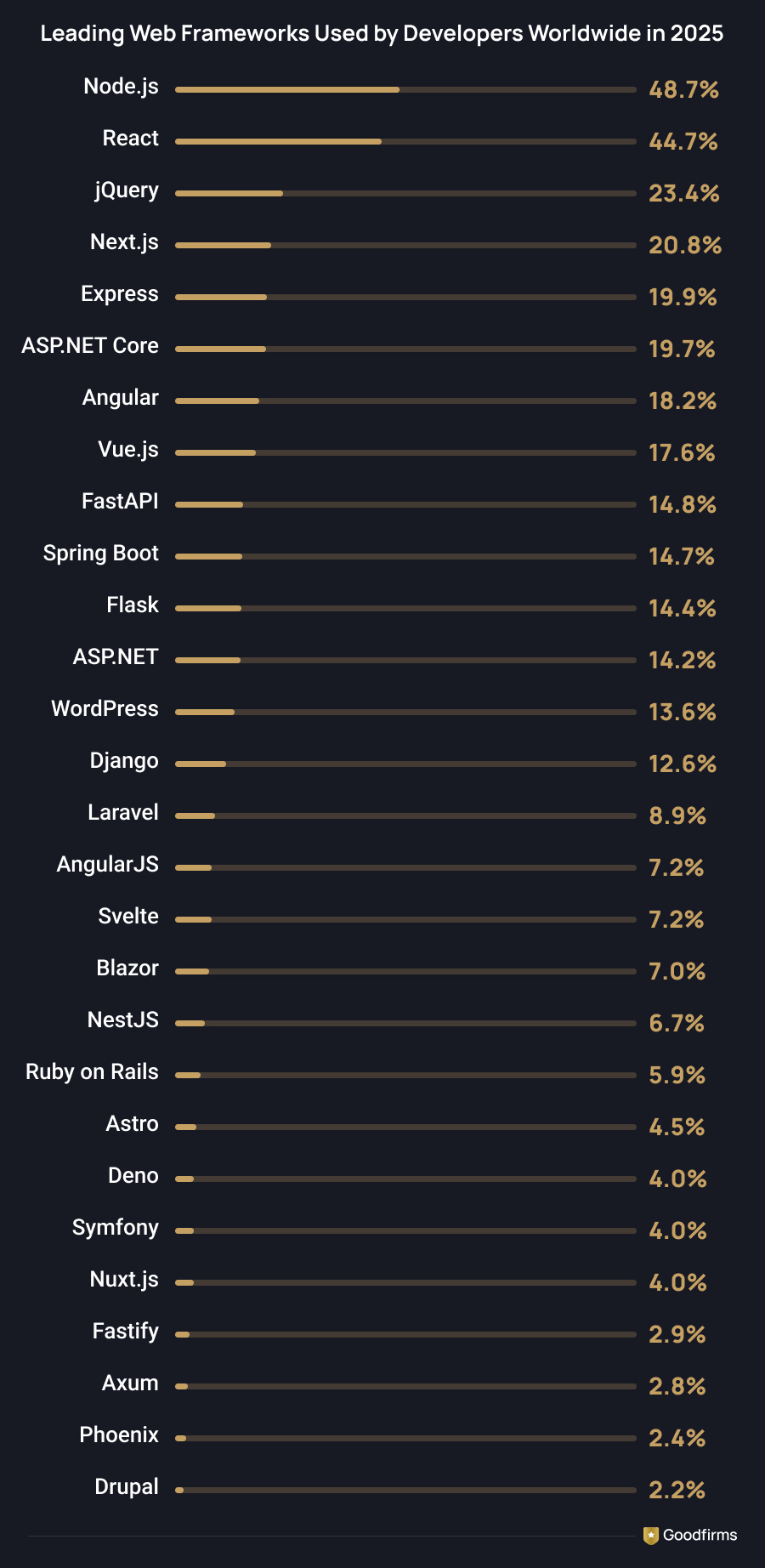
Express.js has been around since 2010, long enough that newer frameworks — Fastify, NestJS, Hono — now compete for the same projects. Despite that competition, as per a recent report, Express stands out as one of the most popular frameworks among developers worldwide, with a 19.9% share of respondents reported to be using it. Its strong adoption reflects its reputation as a lightweight, flexible, and reliable framework for building web applications and APIs. Despite the growing number of Node.js frameworks, Express continues to be a widely preferred choice for backend development.
Express.js vs NestJS vs Fastify: Which One Costs Less to Build and Scale?
As per Node.js statistics 2026, more than 70% of Node.js developers rely on frameworks such as Express, NestJS, or Fastify. The same report says that Express remains the most widely used Node.js framework, powering millions of active applications. Let’s compare these frameworks to determine which one would suit your project the best.
|
Aspect |
Express.js |
NestJS |
Fastify |
|---|---|---|---|
|
Philosophy |
Minimalist, unopinionated |
Opinionated, modular architecture |
Performance-first, schema-driven |
|
Built on |
Node.js directly |
Express by default (Fastify adapter available) |
Node.js directly |
|
TypeScript support |
Added via @types/express, not native |
Native and central to the framework |
Strong, near-native type inference |
|
Structure |
None — teams define their own conventions |
Enforced: controllers, providers, modules |
Minimal, plugin-based |
|
Validation |
Manual or third-party (Joi, Zod) |
Built-in via DTOs and class-validator |
Built-in JSON Schema validation |
|
Throughput |
Solid for most workloads |
Matches its underlying adapter (Express or Fastify) |
Consistently the fastest of the three in benchmarks |
|
Learning curve |
Shortest |
Steepest (DI, decorators, modules) |
Moderate — similar to Express, plus schemas |
|
Ecosystem maturity |
Largest and most mature |
Growing quickly, NestJS-specific packages |
Smaller, but active with official plugins |
|
Best fit |
Small teams, prototypes, simple APIs |
Large teams, enterprise SaaS, microservices |
High-throughput or latency-sensitive services |
|
Relative Dev Cost |
Lowest - minimal setup, fastest to ship |
Highest - steeper learning curve, adds engineering hours |
Moderate -similar to Express plus schema overhead |
Once the technical trade-offs are clear, the next question most businesses ask is a practical one: what does actually building on Express.js cost, and how does that number change based on project scope.
How Much Does Express.js Backend Development Cost in 2026?
According to a recent Goodfirms Survey - Custom Software Development Cost 2026, the cost of building software generally ranges from $30,000 to $200,000. This cost can vary depending on the required features and the tech stack chosen.
Express.js Backend Development Cost by Complexity
When it comes to building an Express.js backend for a software, it can range from $8,000 to $70,000 depending on the type and complexity of the project. Below is the detailed breakdown of the Express.js backend development cost.
|
Project Size and Complexity |
Description |
Estimated Cost |
|---|---|---|
|
Simple REST API or Backend Module |
Backend That Includes Features: A Handful of Endpoints, Basic CRUD Operations, and Minimal Third-Party Dependencies |
$8,000 to $15,000 |
|
MVP backend with features like |
Software that Includes Features: Authentication, Database Integration, and Third-Party Services, etc. |
$15,000 and $30,000 |
|
Complex Projects |
Backends for: SaaS Platforms, Marketplaces, Fintechs, etc. |
$30,000 to $70,000 |
If your software development or web/mobile app development project requires ongoing development and maintenance, it would be better if you hire an Express.js developer on an hourly basis. Goodfirms vetted list of Express.js development companies usually charge around $25-$149/hour. Besides project complexity, the hourly cost of an Express.js developer also depends on their geographical location.
Express.js Developers’ Hourly Cost
Express.js developers in the United States show an average rate of around $80-$150/hour, while equally qualified and skilled Express.js developers in India charge $18-$45/hour.
|
Geographical Locations |
Estimated Hourly Cost |
|---|---|
|
U.S. |
$80 to $150 |
|
Western Europe (Austria, Belgium, France, Germany) |
$60 to $120 |
|
Eastern Europe (Poland, Romania, Ukraine) |
$35 to $70 |
|
South Asia (India, Pakistan, Bangladesh) |
$18 to $45 |
|
Southeast Asia (Thailand, Philippines, Vietnam) |
$20 to $40 |
Goodfirms’ Key Insight: These rates are broadly consistent with what Node.js development companies charge overall, since Express.js expertise is typically bundled into standard Node.js service offerings rather than priced separately.
What Does Express.js Backend Development Cost Mean for a Business?
For budgeting purposes, Express.js backend projects are easier to evaluate by separating four cost drivers: API complexity, integration count, security requirements, and expected traffic. A CRUD API with five endpoints may require relatively little backend work, while a payment platform with authentication, third-party integrations, audit requirements, monitoring, and high availability can require several times the engineering effort even when both projects use Express.js.
The important budgeting lesson is that Express.js itself is rarely the dominant cost. Engineering scope is. Businesses should therefore evaluate a backend quote by architecture, integrations, security controls, testing, deployment and post-launch support—not by the framework name alone.
A budget range means little without understanding what a business actually gets in return for that spend — and that's where knowing what business benefits Express.js delivers becomes significant.
What Are the Business Benefits of Express.js Backend Development?
Express.js delivers business value when its technical advantages reduce development time, simplify hiring, support rapid iteration, or lower the effort required to build and maintain APIs.
- Faster time to market: Express's minimal setup means a working API can go from zero to a deployed endpoint in hours, not weeks — critical for startups validating a product before a funding round closes.
- Lower development cost: A smaller, simpler codebase means fewer engineering hours per feature, less time spent wiring up boilerplate, and a shorter path from a feature request to a shipped release — savings that compound over the life of a product.
- One language across the stack: Teams using React, Vue, or Angular on the frontend can write backend logic in the same language — the exact efficiency gain PayPal cited when it unified its browser and server teams around JavaScript.
- Access to the NPM ecosystem: Express.js backend development inherits Node's package registry, giving teams pre-built solutions for authentication (Passport.js), validation (Joi), rate limiting, and logging instead of writing that infrastructure from scratch.
- Easier hiring and onboarding: JavaScript remains one of the most widely known languages among working developers, which shortens hiring timelines and reduces the ramp-up period for engineers joining an existing Express codebase.
- Real-time application support: Paired with Socket.io or WebSockets, Express.js can support live chat, notifications and collaborative features without requiring a separate application framework.
Cost savings and faster time to market matter most when a software evolves with time. The scalability question starts when production traffic increases.
How Does Express.js Backend Development Scale?
Scalability isn't something Express.js does by accident — it's a pattern the framework was built to support. Express.js pairs naturally with the scaling techniques that take a Node.js application from a single server to production traffic at a global scale.
Clustering and Worker Threads
Node's cluster module lets an Express application spawn one worker process per CPU core, with each worker running its own instance of the app behind a shared load balancer. Process managers like PM2 automate this, restarting crashed workers automatically and distributing incoming requests across every available core instead of leaving three of a server's four cores idle.
Horizontal Scaling and Load Balancing
When an Express application is designed to be stateless and session data is stored in Redis or another shared data store, businesses can run identical application instances across multiple servers or containers, with Nginx, HAProxy, or a cloud load balancer distributing traffic between them. This is the same horizontal-scaling model popular OTT platforms rely on to serve its global audience, spreading identical application instances across multiple regions so no single server becomes a bottleneck.
Caching and Database Optimization
Most Express applications hit their first real bottleneck at the database layer, not the application layer. Adding Redis for session storage and frequently-read data, combined with database indexing and connection pooling, typically resolves this before a team needs to consider more complex architectural changes. PayPal has pointed to this same combination — caching, connection pooling, and a unified JavaScript stack — as central to how its engineering teams keep response times low across high-volume payment flows.
Microservices and API Gateways
Large Express deployments rarely stay monolithic once traffic grows. Splitting a single Express app into smaller services — one for authentication, one for payments, one for search — behind an API gateway lets each piece scale independently and lets separate teams own separate codebases without stepping on each other's deploys. This kind of modularity, paired with Node's mature module ecosystem, is a big part of why large-scale platforms build their data access layers on the same architecture.
Clustering, load balancing, caching and service decomposition are standard Node.js scaling patterns. Express.js can use each of them without requiring a proprietary scaling mechanism. Express.js is particularly useful for SaaS platforms, e-commerce APIs, real-time applications, media platforms and internal services.
What Are the Real-World Use Cases of Express.js?
Express.js shows up across nearly every industry running a Node.js backend, but a handful of use cases account for most of that adoption.
SaaS Platforms and Multi-Tenant Applications
Subscription software with a dashboard, a billing system, and dozens of integrations is close to Express's ideal use case: an API-first product that needs to ship new features weekly. Express's minimal footprint keeps a growing SaaS codebase from accumulating the kind of framework overhead that slows down a five-year-old monolith.
E-Commerce and Payment Processing APIs
Checkout flows need low latency and the ability to talk to multiple external services — payment gateways, inventory systems, shipping APIs — without any single slow call blocking the rest of the request. Express.js can work well for I/O-heavy APIs because it runs on Node.js's event-driven, non-blocking I/O model. The actual performance of a payment or checkout API still depends on database queries, external service latency, connection management, caching, and application architecture.
Real-Time Applications
Chat platforms, live dashboards, collaborative editing tools, and stock or sports tracking apps all depend on constant two-way communication between server and client. Express paired with Socket.io handles this natively, maintaining thousands of open connections without spinning up a new process for each one.
Content and Media Platforms
Streaming services, news sites, and media-heavy platforms use Express to serve API responses fast while handing off actual media delivery to a CDN. Netflix's own use of Node.js for server-side rendering is a well-known example of this pattern running in production at scale.
Internal Tools and Microservices
Not every Express deployment is customer-facing. Internal admin dashboards, reporting tools, and the individual services inside a larger microservices architecture are frequently built on Express precisely because they don't need a heavyweight framework — just a fast, reliable way to expose an internal API to other systems.
Every use case above assumes Express.js gets implemented correctly. In practice, a lot of projects stumble on the same handful of avoidable mistakes.
Where Do Express.js Projects Usually Go Wrong?
Skipping Structure Entirely
Express's minimalism is a feature, not permission to skip a folder structure, error-handling convention, or code review process — teams that skip this end up with an unmaintainable codebase within a year.
Ignoring Dependency Security
The NPM ecosystem that makes Express so productive also means a project can quietly accumulate dozens of outdated, unpatched packages if nobody runs regular dependency audits.
Building The Monolith: Too Far
Waiting too long to split a growing Express application into services makes the eventual migration far more disruptive than doing it earlier, while splitting too early adds coordination overhead a small team doesn't need yet.
Underestimating Monitoring
An API that performs well in testing can still degrade in production without anyone noticing, which is why tools like New Relic or Datadog belong in the deployment plan from day one, not added after the first outage.
Avoiding these pitfalls comes down to execution, and execution usually comes down to who's actually building the backend. That makes the choice of development partner just as important as the framework itself.
How Do You Choose the Right Express.js Development Partner?
Choosing between an in-house Express.js team and an outsourced development partner comes down to how core the backend is to a business's product. A fintech company shipping proprietary trading logic on Express probably wants that expertise in-house long-term; a retailer needing a fast, well-built inventory API might get more value from an outside team that has built the same thing a dozen times before.
- Production track record, not just demos: Ask for evidence that a candidate team's Express applications are still running, still performing, and still being maintained a year after launch — not a portfolio of prototypes that never shipped.
- Verified reviews over polished case studies: A case study rarely discloses whether a project quietly stalled after launch. Checking verified client reviews on Goodfirms' curated list of Express.js Development Companies closes that gap before a contract gets signed.
- Comfort with Express's minimalism: A strong partner should explain clearly when Express is the right call and when NestJS, Fastify, or a different stack entirely would serve the project better — a vague, everything-is-fine answer here is a red flag.
- Clear post-launch support: Node.js dependencies and security patches move fast enough that a partner disappearing after deployment leaves a business exposed within months, not years.
Goodfirms’ Key Insight: If you're evaluating an Express.js development partner, compare production experience, verified client reviews, technical architecture, security practices, scaling experience and post-launch support—not just hourly rates.
Before choosing a development partner, businesses should also consider these important questions that tend to come up before a business moves ahead.
FAQs About Express.js Backend Development
The following covers what most businesses ask once they've worked through the details above.
Is Express.js still relevant in 2026, or has it been replaced by newer frameworks?
Express.js remains the most widely used Node.js framework despite competition from Fastify and NestJS, largely because of its mature ecosystem and the sheer volume of existing production code built on it. Newer frameworks tend to win specific use cases — Fastify for raw throughput, NestJS for large enterprise teams — rather than replacing Express outright.
Is Express.js free to use, and are there any licensing costs?
Express.js is open-source and released under the MIT License, meaning there’s no licensing fee to use it in a commercial product. Businesses can use, modify, and distribute it without paying framework licensing costs. The expenses discussed earlier in this guide come primarily from development, customization, infrastructure, testing, deployment, and ongoing maintenance rather than from Express.js itself.
Do I need Express.js if I'm already using Node.js?
Node.js alone can handle HTTP requests, but doing so requires writing routing, middleware, and request-parsing logic from scratch. Express.js sits on top of Node.js specifically to remove that boilerplate, which is why the two are almost always used together in production rather than Node.js being used raw.
Can Express.js be used with TypeScript?
Yes, though not natively. TypeScript support comes through the @types/express package rather than being built into the framework itself, unlike NestJS, where TypeScript is central to the architecture. Teams that want strict typing can still use TypeScript with Express effectively, although it requires additional configuration and setup compared with TypeScript-first frameworks.
How long does it typically take to build an Express.js backend?
Timelines scale with the complexity tiers already covered under cost — a simple REST API can be functional in a few weeks, an MVP backend with authentication and third-party integrations typically takes one to three months, and a complex SaaS or fintech backend can run four to six months or longer, depending on compliance and integration requirements.
Does Express.js work well with React, Vue, or Angular frontends?
Yes, Express.js is frontend-agnostic and commonly works with React, Vue, and Angular, which is why it appears in the MERN, MEVN, and MEAN stacks. The frontend framework does not fundamentally change how the Express backend is structured; however, it can influence API requirements, data formats, authentication flows, and how the backend communicates with the client application.
Is Express.js secure enough for handling sensitive data like payments or healthcare records?
Express.js itself doesn't include built-in security features — that responsibility falls to the development team through middleware like Helmet, rate limiters, input validation libraries, and proper session handling. This is why the "Ignoring Dependency Security" pitfall covered earlier matters more for Express projects than for frameworks with more built-in guardrails.
What happens if a business outgrows Express.js — is migrating away difficult?
Because Express doesn't enforce a specific project structure, a well-organized Express codebase can often be migrated to a more structured framework like NestJS incrementally, service by service, rather than requiring a full rewrite. Poorly structured Express apps — the kind the "Skipping Structure Entirely" pitfall warns about — are the ones that make migration painful.
How do I know if my business needs a dedicated Express.js developer versus a full-stack generalist?
Small projects with straightforward CRUD operations are usually well suited to a full-stack generalist. However, when a project involves complex authentication, high-traffic scaling, or multiple external integrations, hiring a developer with specific Express.js and Node.js scaling experience can justify the added cost through stronger architecture, performance optimization, security, and long-term maintainability.
The strongest Express.js use cases are businesses that value rapid development, API flexibility, and incremental scaling.
Bottom Line: Where Express.js Backend Development Actually Pays Off
Express.js delivers the most value when a product benefits from a lightweight, flexible backend architecture. It is a perfect choice when a SaaS product requires shipping features weekly, an API-first business that can't afford a six-week setup cycle, or a software development company that needs to ship, measure, and iterate faster than a heavier framework would allow. When that alignment is right, Express.js turns into one of the fastest, most cost-effective ways to get a backend into production.
Successful Express.js projects depend on aligning the framework with realistic traffic expectations, security requirements, application complexity, and the development team's technical expertise.
Express.js remains a strong option when businesses need a flexible backend that can evolve with their product. Its value comes from combining a mature ecosystem with a lightweight architecture and the ability to scale through established infrastructure patterns.