Key takeaways
- The most commonly cited hidden costs of cloud computing are data egress, idle resources, cross-AZ/inter-region transfers, usage-based infrastructure charges, and costs due to poor governance.
- Cloud waste often stems from architectural and resource management decisions, not just provider pricing — Flexera's 2026 report puts estimated waste at 29% of cloud spend.
- 17% of organizations exceeded their public cloud budgets last year, a gap that compounds fast for large enterprises spending $5M+ a month.
- Businesses can reduce hidden cloud costs through tagging, lifecycle automation, architecture reviews, cost monitoring, and regular audits.
Hidden cloud costs are expenses that are easy to overlook when planning or managing a cloud environment. Common examples include data egress, cross-region and cross-AZ data transfer, idle resources, usage-based charges, and unnecessary infrastructure. Poor cost visibility and governance can make these expenses harder to identify and control.
Hidden Cloud Costs at a Glance
|
Hidden cost |
What causes it |
Why it matters |
|---|---|---|
|
Data egress |
Moving data out of a cloud environment |
High-volume transfers can become expensive |
|
Idle resources |
Unused or oversized infrastructure |
Businesses pay for capacity they don't use |
|
Cross-AZ/inter-region transfer |
Distributed architectures and data movement |
Network traffic can add recurring costs |
|
Usage-based charges |
API requests, storage operations, IPv4, NAT, etc. |
Small per-unit charges can accumulate |
|
Poor governance |
Lack of ownership, tagging, and monitoring |
Makes unnecessary spending difficult to identify |
Hidden costs of cloud computing are catching more businesses off guard than the pricing pages suggest. Flexera's 2026 State of the Cloud Report found organizations exceeded public cloud budgets by 17% last year, a gap that adds up fast for the 76% of large enterprises spending over $5 million a month. Pay-as-you-go was supposed to prevent this, but it only works if you know exactly what you're using — and 29% of cloud spend still goes to waste — the first rise in five years — as AI workloads add costs that teams aren't tracking yet. Here are the five hidden costs businesses most often run into.
Want to make sure your cloud spend stays predictable from day one? Explore cloud computing companies on Goodfirms to find the right partner.
So, where do these unexpected costs actually come from?
What Are the Hidden Costs of Cloud Computing?
Though cloud platforms and management tools offer better visibility into spending, some costs can still be difficult to predict. Every major provider publishes its pricing for data transfer, storage operations, and idle capacity — these charges aren't secret. They are clearly outlined in pricing models, but businesses may overlook them when planning their overall cloud infrastructure costs.
To run a business successfully in a cloud-driven world, enterprises must look beyond the obvious benefits and consider the often-overlooked costs. The first step is understanding where these hidden expenses can arise. Here are five common hidden costs of cloud computing that businesses should keep in mind:
1. Data Egress Fees: The Cost of Moving Data Out of the Cloud
Businesses tend to focus on how much data they store in the cloud. When data moves between regions, availability zones, cloud services, or external networks, additional data-transfer charges may apply, depending on the provider and architecture. These charges, commonly known as data egress fees, generally go unnoticed until the monthly cloud bill arrives.
AWS, Azure, and Google Cloud all charge for outbound internet traffic. At lower usage tiers, common internet egress rates range from $0.087 to $0.12 per GB, though the exact amount depends on the provider, region, destination, service, and how much you're moving.
AWS charges around $0.09/GB, Azure around $0.087/GB, and Google Cloud around $0.12/GB on its Premium tier (though its Standard tier can undercut both, at roughly $0.085/GB). For a closer look at how pricing compares beyond egress, readers can explore Goodfirms’ breakdown of Cloud Computing Costs in 2026: AWS, Azure & Google Cloud Pricing Compared.
The headline egress rate isn't always the only cost to consider. Surcharges, such as NAT Gateway processing fees (around $0.045/GB), can push costs even higher for teams routing significant traffic through NAT Gateways.
These charges seem like a small expense at first, until you consider how much data modern applications can transfer. A nightly backup sent to another region, an API delivering content to users across different parts of the world, or a data pipeline sending information to an external analytics platform—all of these add up as egress charges. Each request may cost very little individually. But when you add up thousands or millions of requests over a month, the cost can become substantial. Often, it exceeds the cost of the computing resources involved.
The problem is partly built into the way cloud pricing works. Free ingress and expensive egress make it costly to leave a provider once your data lives there, which is part of why regulators have started paying attention. Planning the right architecture right from the start can save businesses from expensive charges later.
The EU Data Act entered its transition period in September 2025 and will ban cloud switching and data egress charges outright starting in January 2027 — regulators have taken notice of a cost businesses had long overlooked.
2. Idle and Overprovisioned Cloud Resources
Not every hidden cloud cost comes from a fee you didn't know about. Sometimes it's simply money spent on infrastructure that isn't actually used. According to Flexera's 2026 State of the Cloud Report, organizations estimate that 29% of their cloud infrastructure and platform spending is wasted. This comes after five consecutive years in which cloud waste had been declining.

Cloud is maturing, and visibility across technology is increasing.
The report points to the growing use of AI workloads and newer cloud services as reasons for this increase. At the same time, FinOps teams are still adapting their processes to track newer cloud services and control costs effectively.
In real-world use, this waste can be as simple as development environments running over the weekend, test databases that nobody remembers to shut down, or compute instances sized for peak demand but sitting mostly idle for much of the month. These costs don't appear as a separate line item on the bill. They're included in the overall compute and storage charges, which makes them easy to overlook unless someone regularly checks whether the resources being paid for are actually needed.
3. Cross-AZ and Inter-Region Transfer Charges
Even data moving inside a provider’s own network incurs cost. Traffic between availability zones within the same region and between regions is typically billed separately from internet egress—usually at a lower per-gigabyte rate—depending on the cloud provider, service, and architecture.
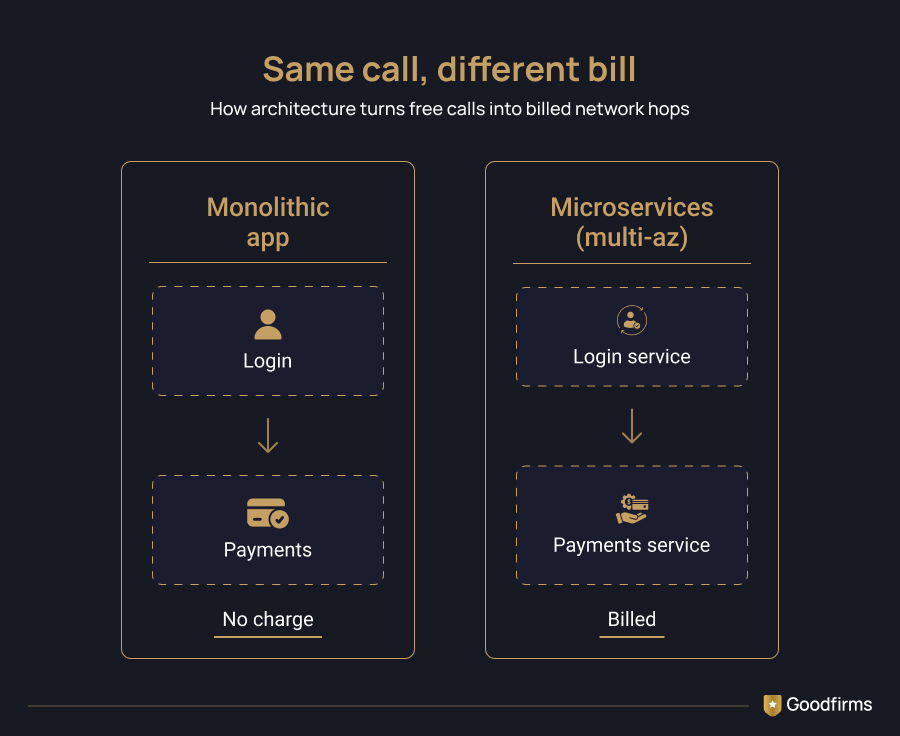
This becomes particularly important when applications move from monolithic to distributed architectures, as internal communication can become billable network traffic. Roughly 46% of backend developers now work with microservices, and 77% use at least one cloud-native technology such as containers or serverless tools — meaning internal calls that used to be free are increasingly traveling over the network and showing up on the bill.
The main goal of teams designing highly available multi-AZ architectures is to balance resilience, performance, and network costs. Mapping data flows and identifying high-volume service-to-service communication early can help businesses avoid unnecessary transfer charges.
Teams working with DevOps consulting & services companies can also review these network patterns as part of their architecture planning, helping to balance reliability requirements against ongoing data transfer costs.
4. Usage-Based Cloud Charges and Infrastructure Costs
Cloud bills can also include smaller usage-based and infrastructure charges that are easy to overlook. Public IPv4 addresses, API requests, storage operations, NAT gateways, load balancers, and other metered services can each add relatively small amounts to a monthly bill. Individually, these charges may seem insignificant, but at scale, they can become a meaningful part of cloud spending.
As global IPv4 address scarcity has increased, providers have begun charging for what used to be bundled in. AWS, for instance, introduced an hourly charge for public IPv4 addresses in February 2024 (and still in effect today) — a cost that simply didn't exist before and that catches teams off guard if their architecture assigns a public IP to every instance by default rather than only where one is actually needed. AWS consulting companies can help audit exactly this kind of default-configuration waste before it shows up on the bill.
Next comes API and request-based billing. Cloud providers may charge for storage operations such as reads, writes, list operations, and deletes, in addition to storage capacity.
Automated backup jobs, monitoring tools, and application integrations can generate thousands or even millions of these requests without anyone noticing. Each request may cost only a fraction of a cent, but those small charges can add up quickly over time.
5. Poor Cloud Governance and Cost Visibility
Though poor governance isn't a cloud charge in itself, it can lead to hidden costs. When there is no clear ownership of resources, teams may create instances, backups, or test environments without tracking who is responsible for them. Over time, this can lead to unused resources, rising costs, and poor visibility into cloud spending.
For example, a development team may create a cloud environment for a short-term project and forget to shut it down once the project is over. Without clear ownership or regular reviews, that environment can continue generating charges month after month.
Simple measures such as resource tagging, budgets, spending alerts, defined ownership, and regular reviews can make a big difference. Clear governance helps businesses understand where their cloud budget is going, who is responsible for each resource, and whether that spending supports an actual business need.
Cloud providers do not necessarily hide these costs. The real challenge is understanding how individual charges relate to how a business has built and uses its cloud environment.
Why Cloud Costs Are So Difficult to Track
None of these costs is hidden in the sense that providers keep them secret. Every major cloud provider publishes pricing for egress, cross-region data transfer, IP addresses, and API requests. However, these costs are spread across different billing categories, making it difficult for businesses to get a clear picture of their overall cloud infrastructure spending.
A networking cost review might uncover egress charges buried under a general "EC2" or "Compute" line item on the invoice, with no obvious connection to the architectural decision that caused them.
Layer AI workloads on top of this, and the problem compounds. Training and inference jobs move large volumes of data, spin up short-lived compute at unpredictable scale, and often get provisioned quickly under deadline pressure — the exact conditions under which tagging and cost attribution tend to get skipped. These factors can make cloud waste harder to control, particularly as businesses adopt more AI workloads.
How AI Workloads Can Increase Cloud Costs
AI workloads can significantly increase costs because they often require substantial compute, storage, and data movement. Compute resources can become a major expense when applications scale or run continuously, while large datasets and backups increase storage and processing costs. Moving data between services, availability zones, or regions can also add transfer charges.
Costs also come from temporary compute, high request volumes, monitoring and logging, and other usage-based services. Since demand keeps fluctuating, teams overprovision to cover spikes or get caught off guard by them. Without monitoring and cost controls in place, these factors can contribute to unnecessary cloud expenditure.
Having understood these cost drivers, the next step is to estimate how much they are actually adding to the cloud bill.
How to Estimate Hidden Cloud Costs
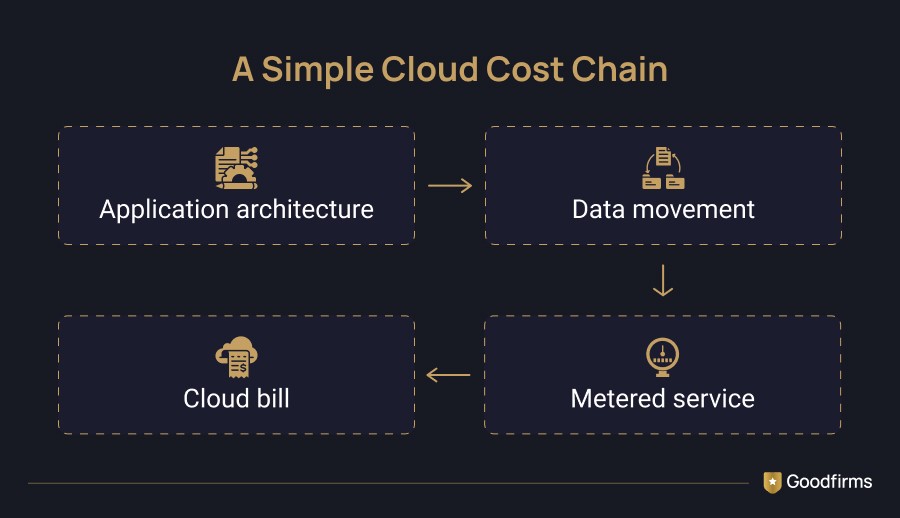
Businesses don't need a complex FinOps system to start identifying hidden cloud costs. A simple review of five areas can provide a useful estimate of where additional spending is coming from:
1. Identify the Cost-Generating Activity
Determine what is actually creating the charge—for example, data leaving a region, a resource running idle, or an application making API calls.
2. Find the Billing Metric
Identify what the cloud provider measures: GB transferred, resource-hours, requests, operations, or another usage unit.
3. Apply the Unit Price
Multiply measured usage by the applicable rate: estimated cost = usage × unit price.
4. Trace the Cost to its Source
Track the charge back to whatever caused it — the application, service, workload, team, or architectural decision behind it.
5. Look for Recurring or Unnecessary Usage
Last, figure out whether the cost is necessary, recurring, or avoidable — through rightsizing, better data placement, or just cutting resources nobody's using anymore.
Once businesses understand where hidden costs come from and how to estimate them, the next step is putting processes in place to prevent unnecessary spending.
How Businesses Can Take Control of Cloud Costs
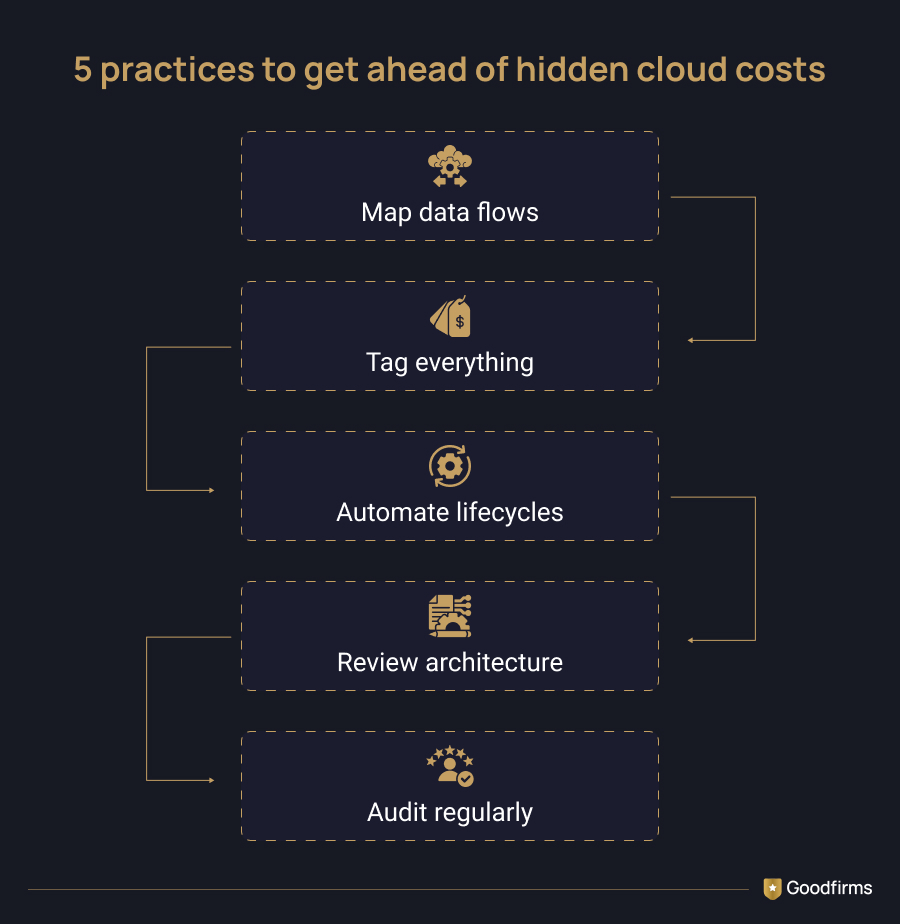
A few practices consistently reduce how often these costs turn into surprises:
1. Map Data Flows before you Build
It is important to understand where your data will move before an application goes live. Check whether data will travel between regions, availability zones, or to the public internet, and find out what those transfers will cost. Planning this early can help you avoid unnecessary network charges later.
2. Enforce Tagging from Day One
Untagged resources can make cloud waste difficult to track. Every resource should be tagged to a team, project, or environment to ensure clear ownership. This makes it easier to identify resources that are no longer needed and remove them before they continue generating costs.
3. Automate Resource Lifecycles
Development and testing environments don't always need to run around the clock. Set up resource shutdowns at night and on weekends, and automatic expiration dates for temporary workloads. These simple measures can prevent businesses from paying for resources they aren't actively using.
4. Review Architecture, not just Pricing
A cloud setup that was affordable two years ago may not be the most cost-effective option today. As your application grows, your traffic, storage needs, and cloud prices can change. Depending on your workload, it may be worth comparing public cloud computing companies and private cloud computing companies to see which model fits best.
Choosing a cheaper computing option does not always reduce your overall bill. For example, you may save money on compute but end up paying more to move data between availability zones or to send data outside the cloud.
For teams using containers across multiple availability zones,DevOps companies for Kubernetes services can help review the setup and identify where unnecessary network costs may be coming from. Before making changes, ask a simple question: Does this data really need to move outside the zone, region, or cloud network?
Looking at the entire architecture, rather than focusing only on individual prices, can help businesses avoid unexpected costs.
5. Run Regular Cost Audits
Don't wait until the cloud bill becomes unexpectedly high to investigate. Quarterly reviews can help identify idle resources, unused storage, and unexpected networking charges. Regular audits also make it easier to spot spending patterns that may otherwise go unnoticed.
Managing hidden cloud costs is an ongoing process. With the right visibility and regular reviews, businesses can keep these expenses from becoming recurring surprises.
Final Thoughts
Cloud computing has great potential, but costs can be difficult to control when they are spread across data transfer, idle resources, usage-based charges, and infrastructure services. As these costs are disconnected from the architecture decisions that created them, they become difficult to see. Businesses that build cost visibility into their cloud strategy from the start — through tagging, architecture reviews, lifecycle automation, and regular audits — can control spending, avoid unnecessary waste, and keep cloud costs predictable as they scale.
FAQs- About Hidden Cloud Costs
What are the hidden costs of cloud computing?
Hidden cloud costs are expenses that are easy to overlook, such as data transfer, idle resources, API requests, public IP addresses, and cross-region traffic.
What is a cloud data egress fee?
A data egress fee is a charge for moving data out of a cloud provider's network, such as sending it to another region, service, or the public internet. Rates generally run $0.087–$0.12/GB depending on the provider.
Why do microservices cost more than monolithic apps for the same workload?
Calls between services in a monolith run within a single process and incur no cost. Once those services are split across availability zones for reliability, the same calls travel over the network and get billed as cross-AZ transfer.
How can businesses reduce hidden cloud costs?
By tagging resources, automating shutdowns, reviewing architecture, monitoring data transfers, and conducting regular cost audits, businesses can reduce hidden cloud costs.
Does cloud governance reduce cloud spending?
Yes. Good cloud governance establishes clear ownership, spending controls, tagging standards, and regular reviews, making it easier to identify and eliminate unnecessary spending.