Key takeaways
- MVP development can cost $5,000 to $250,000+ in 2026, depending on product complexity, features, platforms, integrations, technology, and team location.
- A simple MVP may cost $5,000 to $15,000, while a standard MVP can fall between $15,000 and $50,000.
- AI can reduce development time and cost.
- Keep around 10 to 20% of your development budget as a post-launch buffer rather than spending it all before the MVP goes live.
- The best way to control MVP cost is to build the smallest product that can answer your biggest business question.
If you are here looking for that one number that will convince your soul that your MVP will be done within that budget, then, my friend, you are delusional.
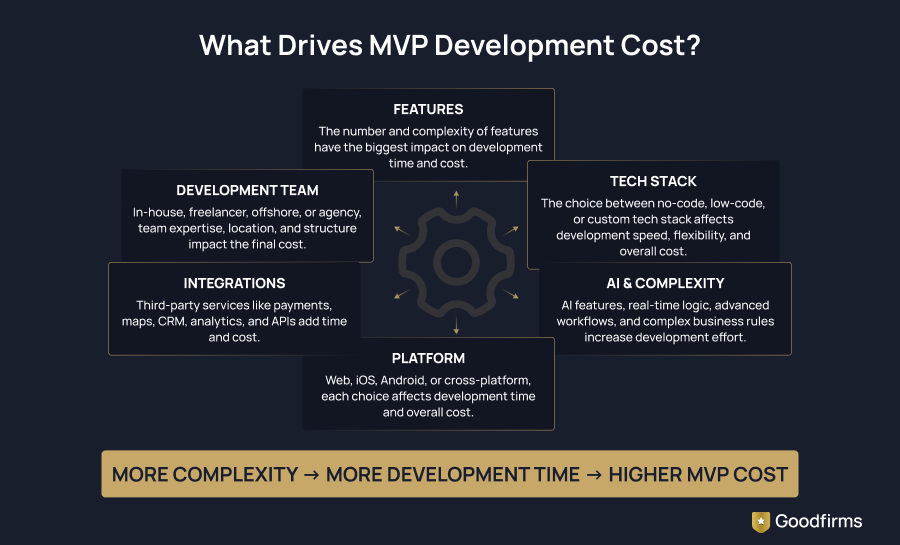
No blog can give you a single exact number because your MVP development cost won't be the same as someone else's. You have your own features, users, platforms, integrations, and business requirements. All of these things change the cost.
What we can do is get you close to your number.
This blog will help you sort out all the factors you need to consider before setting an MVP development budget. We will break down the numbers one by one while explaining what changes the cost and, more importantly, why it changes.
So, without further ado, let's get started.
Compare verified MVP development companies on Goodfirms based on reviews, hourly rates, expertise, portfolios, and client feedback, and find a team that fits your product and budget.
Quick Answer to What Does an MVP Cost in 2026?
The MVP development cost in 2026 can start at around $5,000 and go up to $250,000 or more.
Yes, the range can be this wide.
If you are testing one core feature on one platform, $5,000 may be enough to get your MVP out. But if you are building an enterprise product with multiple integrations, strict security requirements, complex workflows, or compliance requirements, you can easily move into six figures.
The same goes for the timeline. A simple MVP can be ready in a few weeks. A complex one can take several months.
Here is a practical estimate to start with:
|
MVP Type |
Estimated Cost |
Estimated Timeline |
|---|---|---|
|
Simple |
$5,000 to $15,000 |
2 to 4 weeks |
|
Standard |
$15,000 to $50,000 |
3 to 6 weeks |
|
Complex |
$50,000 to $150,000 |
6 to 12 weeks |
|
Enterprise/Compliance-Heavy |
$80,000 to $250,000+ |
12 to 20 weeks |
Don't treat these numbers as a quote. They are a starting point.
A simple-looking product can become expensive because of one difficult feature. A product with 20 screens can sometimes cost less than one with five screens if those five screens involve complicated business logic, real-time processing, payments, or third-party systems.
And if you think you can skip this whole budget discussion by building your MVP with AI, stay tuned. We will get to that, too.
|
Goodfirms Tip: Never skip discovery just because you want to start development quickly. The hours spent figuring out what you actually need can save weeks of development later. |
MVP Development Cost by Tech Stack and Features
Now let's get into the part you actually came here for: what makes the MVP cost go up or down?
For example, you can build a mobile MVP separately for iOS and Android using native technologies. If you are leaning toward Flutter, you can compare Flutter app development companies based on their experience, reviews, rates, and portfolios. The same approach applies if you are considering React Native. Compare React Native developers before deciding who should build the MVP.
Native vs. Cross-Platform Development
Want an iOS app and an Android app?
You have two main choices.
Build them separately with native technologies, or use a cross-platform framework such as Flutter or React Native.
With native development, you are essentially maintaining two codebases. That usually means more development work and, therefore, a higher initial budget.
Cross-platform development lets developers reuse a large portion of the code across platforms. This can reduce development time when your MVP does not require platform-specific functionality.
For an MVP, that can be a pretty big deal.
That said, native development can make sense when your product depends heavily on device-specific capabilities, advanced animations, high-performance processing, or platform-specific experiences.
Brainstorm and finalize your platform. Once you have decided, find the best Flutter app development companies, React Native development companies, Android development companies, and iOS development companies.
No-Code/Low-Code vs. Custom Code
This is another decision that can make your initial MVP budget look very different.
If your product has straightforward workflows, forms, dashboards, databases, and basic automation, no-code or low-code tools can get you to market much faster.
You may spend a few thousand dollars rather than tens of thousands on a custom build.
Some current 2026 estimates put no-code MVPs in the $5,000 to $20,000 range, depending on the product and level of customization.
You can also compare low-code and no-code development companies before deciding whether a custom build is necessary.
If you already know you need a highly customized platform with complex requirements, custom development may save you pain later.
Third-Party Integrations
Here is a feature that looks innocent on a proposal:
For example, payment integration.
A payment gateway may involve payment processing, failed transactions, refunds, webhooks, transaction records, security checks, and different user states.
The same applies to other integrations.
You may want:
- Google Maps
- Stripe or another payment gateway
- Email and SMS services
- Social login
- CRM systems
- Accounting software
- Analytics platforms
- Cloud storage
- AI APIs
That is why two MVPs with the same number of screens can have completely different budgets.
One may be a straightforward CRUD application.
The other may be talking to six external systems.
Real-time integrations can cost even more because the application may need continuous synchronization, webhooks, event handling, and additional error handling.
AI-Powered Features
Adding AI to your MVP does not automatically make it expensive.
A product that uses your private documents, retrieval, embeddings, evaluation, access controls, usage limits, and human review can be complex.
If AI is a major part of your MVP, you can also compare AI development companies with experience building AI-powered software.
For example, a basic AI writing assistant may simply send a prompt to an LLM and display the response.
A legal document assistant may need document ingestion, chunking, embeddings, retrieval, permissions, citations, model selection, evaluation, logging, and guardrails.
That is why AI features can add anywhere from a relatively small amount to a very large amount to your MVP budget. Current 2026 estimates for AI-assisted MVPs range widely depending on whether the product is simply using an API or requires RAG, custom data pipelines, evaluations, and enterprise controls.
Feature Complexity Matters More Than Feature Count
This is where many founders get their MVP budget wrong.
They count features. But the development team counts the work behind those features.
A login screen may take relatively little effort.
A role-based authentication system with social login, two-factor authentication, account recovery, permissions, and admin controls is a different story.
So don't ask:
“How much does a 20-feature MVP cost?”
Ask:
“What does each feature need to do?”
That gives you a much better estimate.
MVP Development Cost by Team Composition and Region
Now let's talk about the people building your MVP.
Cost by Team Role
A MVP development team may include:
|
Role |
What They Handle |
|---|---|
|
Product Manager |
Requirements, priorities, roadmap, coordination |
|
UI/UX Designer |
User flows, wireframes, interface design |
|
Frontend Developer |
Web or mobile interface |
|
Backend Developer |
APIs, database, business logic |
|
QA Engineer |
Functional, device, browser, and regression testing |
|
DevOps Engineer |
Cloud, deployment, infrastructure, monitoring |
|
Project Manager |
Communication, schedules, delivery tracking |
For a small MVP, one person may cover multiple responsibilities. A senior full-stack developer may handle frontend and backend work. A designer may work part-time. A DevOps engineer may come in only when the infrastructure needs to be set up.
MVP Developers Charges by Region
Location has a direct impact on hourly rates.
Here is a rough 2026 range:
|
Region |
Approx. Hourly Rate |
|---|---|
|
US / Canada |
$80 to $150+ |
|
Western Europe |
$60 to $120 |
|
Eastern Europe |
$40 to $80 |
|
Latin America |
$30 to $75 |
|
India / Southeast Asia |
$25 to $55 |
These are planning ranges rather than fixed market prices. Actual rates vary based on experience, specialization, company type, and project requirements. Some sources show higher rates for senior engineers, especially in North America and Western Europe.
Offshore Teams Can Reduce MVP Cost
Hiring an offshore or nearshore development team can reduce the cost considerably, especially if you are working with a team from a lower-cost region.
Look at:
- Relevant product experience
- Technical seniority
- Communication
- Time-zone overlap
- Portfolio
- QA process
- Security practices
- Post-launch support
- Contract terms
- Ownership of source code
Hidden and Recurring MVP Costs You Should Not Ignore
Let's look at the costs that often get ignored during the initial budget discussion.
Hosting and Infrastructure
Depending on your product, you may pay for:
- Cloud hosting
- Database
- File storage
- CDN
- Serverless functions
- Monitoring
- Backups
- Domain
- SSL
- Email services
A basic MVP can start with relatively low infrastructure costs.
Then your users arrive. Your database gets bigger. Your traffic increases. You need more storage. Your API usage grows. The bill grows with it.
That is a good problem to have, but you still need to budget for it.
Third-Party API and Platform Fees
Your development team may integrate a third-party service, but that does not mean the service is free.
- Payment gateways may charge per transaction.
- Maps APIs may charge based on usage.
- Email and SMS providers may charge based on volume.
- AI APIs can charge based on usage, tokens, or model consumption.
Maintenance and Bug Fixes
Your MVP will have bugs.
Even if your development team is excellent.
Some will appear immediately. Others will show up only after users start doing things you never thought they would do.
You may also need:
- Security updates
- OS compatibility updates
- Dependency updates
- Server maintenance
- Performance fixes
- Bug fixes
- Small feature changes
One recent 2026 cost guide suggests keeping 15–20% of the initial build cost aside for post-launch stabilization and maintenance.
Security and Compliance
If you handle sensitive data, you may need additional work around:
- Data encryption
- Access controls
- Audit logs
- Secure authentication
- Data retention
- Compliance requirements
- Security testing
- Infrastructure controls
How to Reduce MVP Development Cost
Now we get to the part every founder wants. How do I bring the number down without building garbage?
1. Build One Core Workflow
Your MVP should answer one important question.
If it is trying to answer ten questions at once, it probably isn't an MVP anymore.
Strip the product down to the workflow that matters most.
2. Don't Build Features Just Because Competitors Have Them
Your competitor has a loyalty program?
Great.
Does your MVP need one?
Probably not.
Your competitor has AI recommendations?
Cool.
Do you need them to test your own product hypothesis?
If not, move them to the backlog.
You are not building your competitor's product.
You are testing yours.
3. Start With One Platform
If your idea can be validated on the web, don't automatically build web, iOS, and Android on day one.
Get the product in front of users first.
Then let user behavior tell you where you need to go next.
4. Use Existing Tools Where They Make Sense
Don't build your own payment system when a proven payment gateway already exists.
Don't build your own authentication system just because you can.
Don't build a custom analytics dashboard if an existing tool gives you what you need.
Your MVP is not the time to reinvent everything.
5. Use AI, But Keep Human Review
AI can reduce development time for many tasks, especially prototyping, code generation, documentation, testing, and debugging.
Use it.
6. Keep a Buffer
This one is boring.
But It is also useful.
Requirements change. Bugs appear. APIs behave differently than expected. Users ask for something you didn't plan for. Keep some money aside for the things you cannot predict.
7. Don't Compress the Timeline for No Reason
Want your 12-week MVP in six weeks?
That may be possible.
It may also require more developers working in parallel, which can increase the cost and create coordination overhead.
If you need the MVP quickly because of a real market deadline, that's one thing. But just don’t run for the sake of it.
How to Choose the Right MVP Development Agency
So you have decided to work with an MVP development company.
Now comes the part that can save you thousands of dollars or cost you thousands of dollars.
Choosing the right agency.
You need a team that understands what an MVP is supposed to do.
A good MVP development company should help you cut unnecessary features, question assumptions, explain technical trade-offs, and tell you when something does not belong in version one.
You can explore Goodfirms' curated list of MVP Development agencies with verified reviews and relevant experience.
Conclusion: Your MVP Budget Should Start With What You Need to Prove
The biggest mistake you can make with an MVP is treating it like a smaller version of your final product.
It isn't.
Your final product may have 50 features.
Your MVP may need five.
Your final product may support three platforms.
Your MVP may need one.
Your final product may eventually serve a million users.
Your MVP may only need to prove that the first 100 people want it.
That is the whole point.
So before you ask an MVP development company, “How much will it cost?”, ask yourself a different question:
“What do I need this MVP to prove?”
Once you know that, deciding what to build becomes easier.
And once the scope becomes clearer, your budget becomes much easier to estimate too.
If you are looking for an MVP development partner, Goodfirms can help you compare verified MVP development companies based on reviews, hourly rates, expertise, and portfolios.
Start with the smallest product that can give you an answer. Then spend more when the answer tells you to.
FAQs - MVP Development Cost
How much does it cost to build an MVP in 2026?
MVP development can cost anywhere from $5,000 to $250,000+ in 2026, depending on the product's complexity, features, platforms, technology, integrations, team location, and compliance requirements. A simple MVP may fall around $5,000 to $15,000, while a standard MVP can cost $15,000 to $50,000. Complex and enterprise MVPs can reach $50,000 to $250,000 or more. The best way to get a realistic estimate is to define the core features, target platform, technical requirements, and user workflow before requesting a development quote.
What factors affect MVP development cost the most?
Feature complexity, development team, technology stack, platform, integrations, and project scope have the biggest impact on MVP development cost. A simple login feature costs far less than a role-based authentication system with two-factor authentication and multiple permissions. Building one platform can also cost less than building separate native iOS and Android apps. AI features, real-time functionality, payment systems, and compliance requirements can increase the budget further. Your location and hiring model also matter because developer rates vary significantly across regions.
Can AI tools reduce MVP development cost?
Yes, AI tools can reduce the time and development effort required for many MVP projects. Tools such as Cursor, Claude, Replit, and Lovable can help with code generation, prototyping, debugging, testing, and documentation. However, AI does not remove the need for experienced developers. Someone still needs to review the generated code, make architecture decisions, test edge cases, protect user data, and prepare the product for real users. AI can make development faster, but using it without proper engineering review can create technical problems that cost more to fix later.
Is it cheaper to build an MVP with a freelancer or an agency?
A freelancer can cost less upfront, while an MVP development agency usually provides a larger team and a wider range of services. A freelancer may be a good fit for a simple MVP with limited technical requirements, especially if you already have product and design expertise. An agency can make more sense when you need discovery, UI/UX, frontend and backend development, QA, DevOps, and project management. Don't compare only hourly rates. Compare the complete scope, experience, communication, support, and what is included in each proposal.
How long does it take to build an MVP?
A simple MVP can take around 2 to 4 weeks, while a standard MVP may take 3 to 6 weeks. More complex products can take 6 to 12 weeks, and enterprise or compliance-heavy MVPs can take 12 to 20 weeks or more. The timeline depends on features, number of platforms, integrations, design requirements, team size, testing, and approval cycles. Adding developers does not always cut the timeline in half because some tasks need to happen in sequence. A realistic scope and clear requirements usually have a bigger effect on delivery time than simply adding more people.
Should I build an MVP for iOS, Android, or both?
Start with the platform that gives you the fastest and most useful validation. If your target users are primarily on iOS, an iOS MVP may be enough to test the concept. If you need both platforms, cross-platform frameworks such as Flutter and React Native can reduce duplicate development work. Native development can still make sense when your product depends on platform-specific functionality or high performance. Don't build two apps simply because you eventually want two apps. Build the platform you need to answer your first business question.
What is the difference between an MVP and a prototype?
A prototype demonstrates how a product could work, while an MVP is a working product that can be used to test the actual idea with real users. A prototype may consist of clickable screens with little or no working backend. An MVP usually includes enough real functionality for users to perform the core task the product promises to solve. You may use a prototype to test usability and presentation before investing in development. If your goal is to test actual usage, demand, payments, or retention, you will usually need a functional MVP.
How much does it cost to maintain an MVP after launch?
A practical starting point is to keep around 10–20% of the initial development budget available for early post-launch maintenance and changes. A $50,000 MVP, for example, could require a $5,000–$10,000 reserve for bug fixes, security updates, performance improvements, infrastructure changes, and early feature adjustments. Your actual cost depends on the product and usage. You may also have recurring expenses for hosting, databases, third-party APIs, AI models, payment processing, analytics, and other services. These costs can increase as your user base grows.
Can I build an MVP without hiring developers?
Yes, if your product is simple enough to be built with no-code, low-code, or AI-assisted tools. This can work well for validating an idea, testing a workflow, creating an internal tool, or building an early prototype. The approach becomes harder when you need complex business logic, custom integrations, advanced security, high performance, or large-scale usage. You should also consider what happens if your MVP succeeds. A tool that is perfect for testing an idea may not be the right foundation for the product you eventually need to scale.
How do I choose the right MVP development company?
Look for an MVP development company that understands your product, has relevant experience, offers clear pricing, and is willing to challenge your scope. Review its portfolio, client feedback, technical expertise, communication process, development methodology, and post-launch support. Ask who will actually work on your project and what happens if the scope changes. Also confirm source-code ownership and access to important accounts. The right agency should not simply agree to every feature you request. It should help you decide what needs to be built now and what can wait.