Key takeaways
- A single US-based manual QA tester typically earns $72,000–$79,000/year, while automation-focused QA roles range from $73,000–$116,000/year depending on specialization.
- India QA hourly rates run $15–$35/hr for manual testing and $20–$50/hr for automation — compared to $60–$100+/hr and $70–$120+/hr respectively in the US
- A dedicated 3-person QA team in India costs ~$10,000/month — the US equivalent runs $30,000–$45,000/month for the same headcount
- The global outsourced testing market is growing at 10.8% CAGR, and automation testing at 14.5% CAGR — both growing at roughly twice the rate of the overall testing market at 7.2% CAGR
Multiple software quality studies estimate that bugs found in production may cost roughly 30x more to fix than defects identified during development, and that ratio has not improved despite years of tooling investment. What has changed is the cost structure of finding those bugs before they ship. In 2026, three models define how engineering teams approach that problem: Outsourcing to India, US-based in-house QA teams, and automated testing infrastructure. Each has a different cost architecture, risk profile, and ceiling on what it can realistically deliver.
This guide breaks down:
- In-house software testing costs in the US
- Outsourced QA pricing in India
- Automation testing costs across both markets
- Hidden operational expenses
- Current market growth trends
- Which testing model makes the most financial sense in 2026
You can evaluate verified Software Testing Companies by region, specialization, and client outcomes at Goodfirms' QA and testing firms listing, which provides independently reviewed data across testing companies globally.
The Market Behind the Decision: CAGR Data for 2026 and Beyond
Before comparing costs, it's worth understanding where each model sits in the broader market trajectory. The numbers tell a clear story about where the industry is heading.
According to the ThinkSys QA Trends Report 2026, the global software testing market is projected to grow from USD 55.8 billion in 2024 to USD 112.5 billion by 2034 at a 7.2% CAGR. The outsourced testing segment alone is set to grow from USD 39.93 billion in 2026 to USD 101.48 billion by 2035 at a 10.8% CAGR. Automation testing tools and services are growing even faster — from USD 28.1 billion in 2023 to USD 55.2 billion by 2028 at a 14.5% CAGR.
| Segment | 2026 Market Size | Projected Size | CAGR | Source |
|---|---|---|---|---|
| Global Software Testing Market | USD 55.8B (2024) | USD 112.5B (2034) | 7.2% | ThinkSys QA Trends Report 2026 |
| Outsourced Testing | USD 39.93B (2026) | USD 101.48B (2035) | 10.8% | ThinkSys QA Trends Report 2026 |
| Automation Testing Tools & Services | USD 28.1B (2023) | USD 55.2B (2028) | 14.5% | ThinkSys QA Trends Report 2026 |
| India Outsourced Testing Market | USD 2.58B (2024) | USD 11.1B (2035) | 14.19% | Market Research Future via Vervali 2026 |
These growth rates matter for one reason: where the market is allocating budget tells you which model is gaining ground — and which one is becoming the expensive outlier. The cost breakdown below shows why.
Automation testing is growing at roughly twice the rate of the broader software testing market, while India’s outsourced testing sector continues to outpace global outsourcing growth. These are structural shifts, not temporary trends.
Software testing spans multiple methodologies and layers, each contributing differently to cost and effort across in-house, outsourced, and automation models. A detailed breakdown of these software testing types helps clarify why pricing structures vary so widely.
In-House Software Testing Costs in the US (2026)
Building an internal QA team in the United States gives you the deepest product knowledge, the tightest development integration, and the fastest feedback loops on complex issues. It also comes with a cost structure that scales poorly with variable release demand.
-
Manual Tester Salaries — US
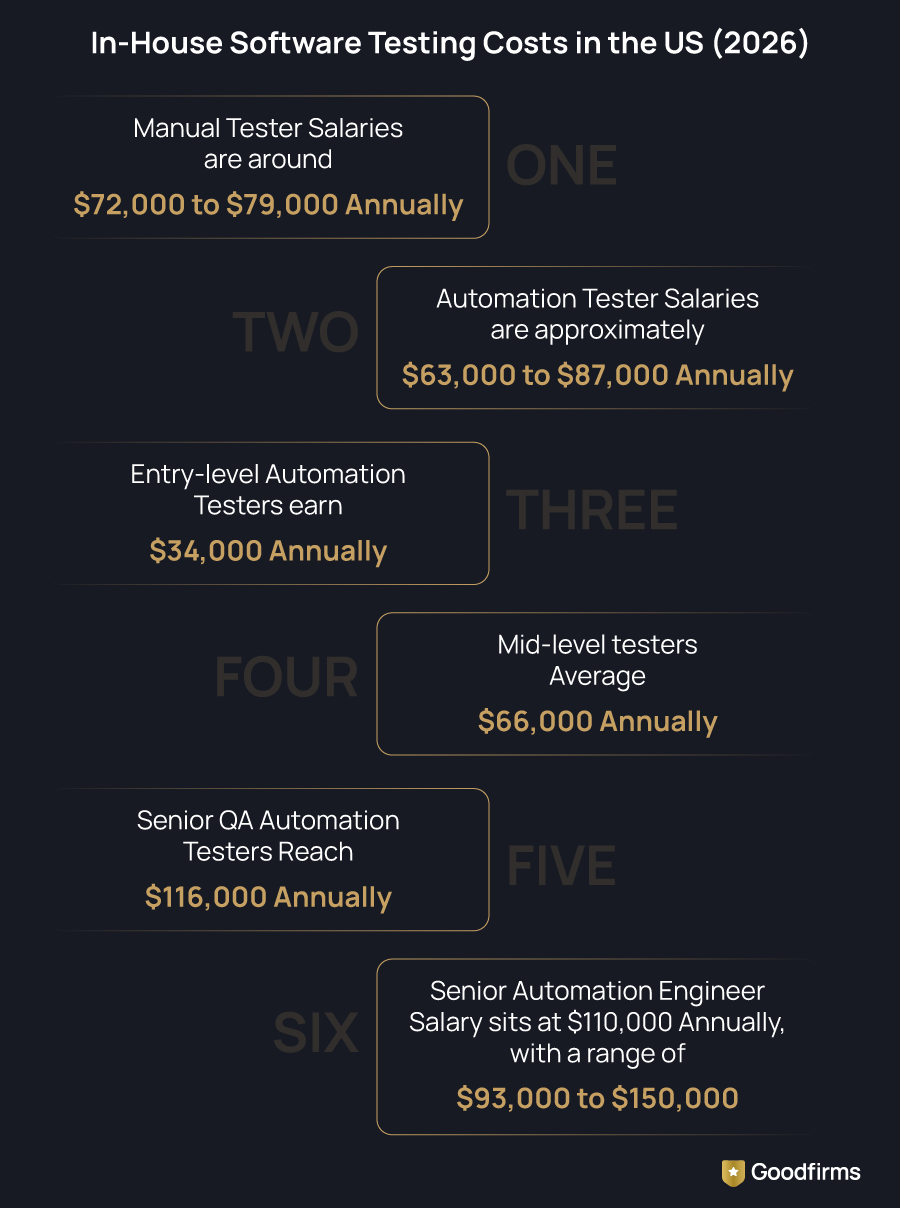
According to SpinCareer, the average salary of manual testers in the USA is around $72,000 to $79,000 annually.
-
Automation Tester Salaries — US
According to SyntaxTechs, citing Bureau of Labor Statistics data, the average automation tester salary in the USA is approximately $73,000 per year, with a range of $63,000 to $87,000.
- Entry-level automation testers earn $34,000
- Mid-level testers average $66,000
- Senior QA automation testers reach $116,000
The average test automation engineer salary — a more senior, engineering-led role — sits at $110,000 per year, with a range of $93,000 to $150,000.
The Average Manual Testing Salaries in the Most Prominent Cities of the US: 2026
US city-level variation in software testing salaries is significant:
| US City | Average Annual Salary |
|---|---|
| San Jose, CA | $86,675 |
| San Francisco, CA | $85,726 |
| Oakland, CA | $83,919 |
| New York, NY | $79,122 |
| Stamford, CT | $77,934 |
| Boston, MA | $76,360 |
| Seattle, WA | $75,962 |
| Los Angeles, CA | $75,927 |
| Washington, DC | $75,673 |
| San Diego, CA | $74,154 |
Source: Salary.com 2026 Manual QA Tester Salary Data
-
Software Testing In-House Cost: US (2026)
Salaries are only the starting point. Add benefits, employer payroll taxes, equipment, and management overhead — typically a 1.3x multiplier — and the fully loaded annual cost per in-house QA engineer runs:
-
Fully Loaded In-House Cost: US (2026)
| Role | Base Salary | Fully Loaded Cost (1.3x) |
| Automation Tester | $73,000 | ~$94,900 |
| Test Automation Engineer | $110,000 | ~$143,000 |
| Senior Automation Tester | $116,000 | ~$150,800 |
Software Testing Outsourcing QA Costs: India (2026)
India is the dominant destination for QA outsourcing. The country produces over one million IT graduates annually, creating a talent pipeline that supports scale without proportional cost inflation. Indian salaries are projected to grow by 9% in 2026. This represents measured growth from 8.9% in 2025.
Software Testing Outsourcing Hourly Rates by Role — India (2026)
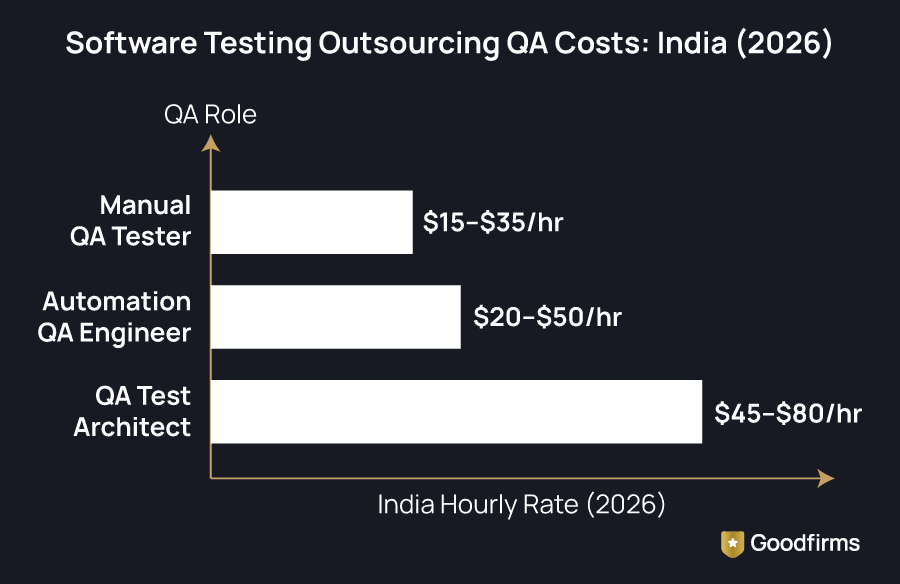
QA outsourcing to India costs between $15 and $80 per hour in 2026, depending on role seniority, city, and engagement model. A manual QA tester typically bills $15–$35/hr, an automation engineer $20–$50/hr, and a test architect $45–$80/hr.
India QA hourly rates typically range from $15–$35 per hour for manual testing and $20–$50 per hour for automation testing, compared to $60–$100+ per hour for manual and $70–$120+ per hour for automation testing in the United States.
| QA Role | India Rate (2026) | US Equivalent Rate |
|---|---|---|
| Manual QA Tester | $15–$35/hr | $60–$100+/hr |
| Automation QA Engineer | $20–$50/hr | $70–$120+/hr |
| QA Test Architect | $45–$80/hr | $120–$180+/hr |
Sources: Vervali — QA Outsourcing India Cost 2026
Higher-end India rates generally reflect senior automation architects, niche domain expertise, or enterprise consulting engagements rather than standard execution-focused QA staffing.
The Average Manual Testing Salaries by City — India (2026)
India city-level variation in software testing salaries is significant:
| Indian City | Average QA Salary (INR/yr) |
|---|---|
| Hyderabad | ₹662,000 |
| Bangalore | ₹615,000 |
| Pune | ₹601,000 |
| Chennai | ₹534,000 |
| Delhi NCR | ₹486,000 |
Source: 2026 data via Vervali
Dedicated Software Testing Outsourcing Team Monthly Costs — India (2026)
A three-person dedicated QA team in India costs approximately $10,000 per month, while a five-person team costs approximately $16,000 per month, depending on tester seniority and specialization. Comparable US teams can range from $30,000–$45,000 monthly.
| Team Size | India Range | USA Range |
|---|---|---|
| 3-person team (monthly) | ~$10,000 | ~$30,000-$45,000 |
| 5-person team (monthly) | ~$16,000 | ~$50,000-$75,000 |
Source: Appsierra 2026 data via Vervali
Automation Testing Costs: US vs India (2026)
Automated testing doesn't eliminate the need for human QA. It changes the economics of repetitive, regression-heavy work so that human testers — wherever they are based — can focus on exploratory and edge case coverage that automation can't handle well.
A growing number of organizations are now adopting automation testing through specialized top automation testing companies rather than building full in-house frameworks. These providers leverage widely used automation stacks such as Selenium and Appium, along with CI/CD-integrated testing practices, to improve release speed and reliability.
Automation Engineer Labor Cost: US vs India
| Role | US Annual Cost (Base) | India Hourly Rate |
|---|---|---|
| Automation QA Engineer | $73,000–$87,000 | $20–$50/hr |
| Test Automation Engineer | $93,000–$150,000 | $30–$60/hr |
| Senior Automation Tester | $116,000 | $45–$80/hr |
Sources: SyntaxTechs — Automation Tester Salary USA; Vervali — India QA Outsourcing Rates 2026
Goodfirms Insight: Automation setup costs are mainly driven by engineer salaries, not tools. US-based teams are significantly more expensive, while India offers a more cost-efficient option with similar tooling and skilled talent.
Software Testing Outsource vs In-House vs Automation: Full Cost Comparison
According to Global Tech Dev's 2026 analysis, outsourcing can deliver up to 60% lower costs than maintaining an in-house team, with the flexibility of a pay-per-use model and instant access to specialized testing capabilities that most in-house teams cannot build cost-effectively.
| Factor | India Outsourced | US In-House | Automated (US Engineer) | Automated (India Engineer) |
|---|---|---|---|---|
| Estimated annual cost per QA resource | $31,000–$104,000/yr | $73,000–$87,000/yr | $93,000/yr + tooling | $42,000 - $96,000/yr + tooling |
| Dedicated team (3–5 people) | $120,000–$192,000/yr | $360,000–$900,000/yr depending on team size and seniority | Varies | Varies |
| Scaling speed | Days to weeks | 90–120 days (hiring) | Weeks (build time) | Weeks (build time) |
| Product context depth | Requires onboarding | Highest | Not applicable | Not applicable |
| Specialist coverage | On-demand | Requires additional hires | Tool-dependent | Tool-dependent |
| Cost structure | Variable | Fixed | Semi-fixed | Semi-fixed |
| Cost saving vs. the US in-house | 60–72% lower | Baseline | Depends on volume | Highest combined saving |
Sources: QASource via Vervali 2026; Global Tech Dev 2026; SyntaxTechs
Goodfirms recently interviewed Taras Oleksyn, AQA Team Lead at TestFort, where he shared insights on the growing importance of automated testing in modern software development. The discussion highlights how automation improves speed, accuracy, and release efficiency while playing a key role in Agile and DevOps workflows. It also notes that successful implementation depends on balancing automation with manual testing based on project needs.
If you have approved a QA budget that looked reasonable on paper and watched it expand by some percentage before the first release, the hidden costs section below is where that money went.
Software Testing Hidden Costs That Change the Calculation
The published hourly rate or annual salary is never the full number. Three hidden costs consistently close the gap between the headline comparison and the real budget impact.
- Ramp time: US in-house hires typically take 90–120 days to reach full productive contribution — paid at full loaded cost throughout. India outsourced teams on board in weeks, but documentation requirements and knowledge transfer add 10–15% to early-project billing, according to Pangea’s pricing guide.
- Tool licensing: Automated testing tools may not be included in a vendor’s hourly rate. Investing in cloud testing platforms, CI/CD pipeline tools, and defect management systems can significantly increase overall testing costs, whether teams operate in-house in the US or through outsourced automation partners.
- Automation maintenance: Test suites break as applications evolve. UI changes, API updates, and refactoring all require test updates. Maintenance typically consumes half of an automation engineer's time — a cost that applies to both markets, though significantly cheaper with India-based engineers.
Which Software Testing Model Works for Your Business in 2026: Outsource vs In-House vs Automation
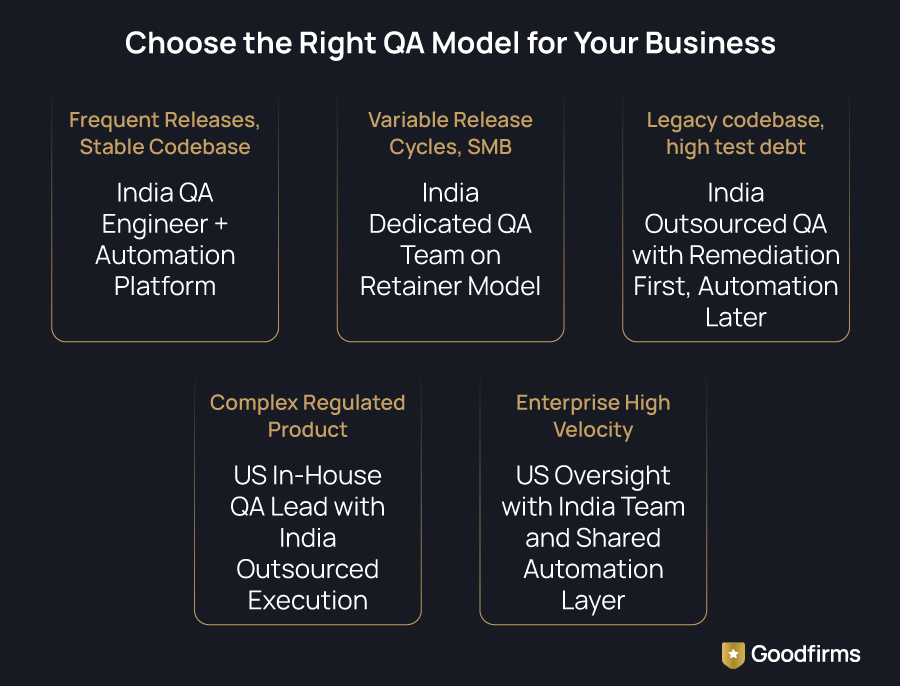
| Your Situation | Recommended Model |
|---|---|
| Early-stage, limited budget, US market | India outsourced (project-based) |
| Frequent releases, stable codebase | Automation (India engineer + SaaS platform) |
| Complex regulated product (healthcare, fintech) | US in-house QA lead + India outsourced execution |
| Variable release cycles, SMB | India dedicated team retainer |
| Enterprise, high velocity | US oversight + India team + shared automation layer |
| Legacy codebase, high test debt | India outsourced remediation first, then automation |
According to GlobalTech Dev's 2026 analysis, 54% of organizations now use outsourced testing services to supplement or replace in-house QA — up from 42% just three years prior — with cost reduction, access to automation expertise, and faster delivery cited as the top drivers.
The most cost-effective model for most mid-size teams in 2026 is a combination: an India-based outsourced team for execution volume and specialist coverage, a shared SaaS automation platform for regression testing, and US-based internal oversight for product strategy and critical path decisions. This structure captures the 60–72% cost saving on execution labor while maintaining the product depth that external teams can't develop quickly.
For verified QA testing companies with published rates and client reviews, Goodfirms software testing company directory provides independently reviewed data across US and India-based providers — filtered by service type, minimum project size, and client-verified outcomes.
FAQs: Software Testing Outsource vs In-House vs Automation Cost
How much does in-house QA testing cost in the US in 2026?
A single US-based QA engineer typically costs $73,000–$87,000 annually, depending on role seniority, benefits, and overhead. A functional team of three to five engineers costs $30,000-$75,000/month, before tooling and infrastructure.
How much does outsourcing QA to India cost in 2026?
Outsourcing QA to India costs $15–$35/hr for manual QA, $20–$50/hr for automation engineers, and $45–$80/hr for test architects, depending on role seniority and city.A three-engineer outsourced QA team in India typically costs around $10,000–$24,000/month, depending on seniority and specialization, while a five-engineer team generally ranges from $15,000–$40,000/month before tooling and infrastructure.
Is automation testing cheaper in India than in the US?
The SaaS platform costs are identical globally. The savings come entirely from engineering compensation. An India-based automation engineer typically bills $20–$50/hr (~$41,000–$104,000 annually at full-time utilization), compared to US-based automation tester salaries averaging $73,000–$87,000 annually before overhead.
What is the CAGR for automation testing in 2026?
The automation testing tools and services segment is growing at 14.5% CAGR from USD 28.1 billion in 2023 to USD 55.2 billion by 2028, making it the fastest-growing segment of the software testing market.
What is the CAGR for outsourced software testing in 2026?
The global outsourced software testing market is growing at 10.8% CAGR from USD 39.93 billion in 2026 to USD 101.48 billion by 2035. India's outsourced testing market specifically is growing at 14.19% CAGR from USD 2.58 billion in 2024 to USD 11.1 billion by 2035.
Conclusion:
The cost comparison between India outsourcing, in-house US QA, and automation is no longer theoretical — the data is specific, the savings are verified, and the market growth figures confirm where the industry is allocating budget. The right combination depends on your release cycle, your regulatory context, and how much product knowledge you need to retain internally. For most mid-size engineering teams in 2026, the numbers point to the same structure: India-based execution, shared automation tooling, and US-based strategic oversight. That combination captures the cost savings without giving up the product depth.
Reference links for software testing cost:
1. ThinkSys QA Trends Report 2026
2. Vervali India QA Outsourcing Cost Guide 2026
3. Salary.com 2026 Manual QA Tester Salary Data
4. Vervali — QA Outsourcing India Cost 2026
5. 2026 data via Vervali
6. Appsierra 2026 data
7. Vervali — India QA Outsourcing Rates 2026
9. QASource via Vervali 2026