Python is the go-to programming language for AI and ML projects because of its demonstrable efficacy.
Its syntax reads like plain English, making it easier for Python developers of different skill levels to work with. Plus, it’s powered by a rich collection of open-source libraries packed with pre-built functionalities, further easing the AI and ML development and controlling costs.
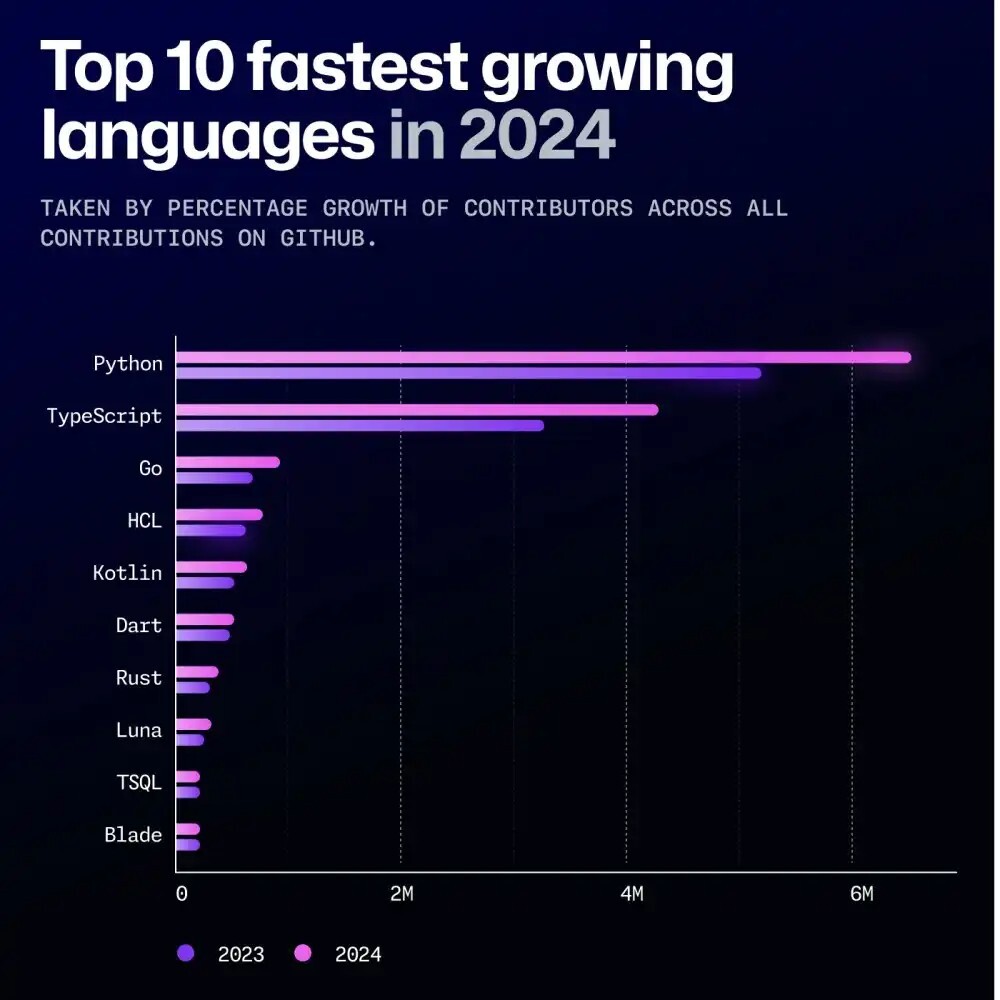
So, if you think about it, Python is the spark igniting AI and ML projects globally. According to a GitHub report, Python is among the top 10 fastest-growing languages 2024.
In this blog, we’ll explore why Python remains the go-to language for AI and ML development and how it outperforms other programming languages.
Before We Explore Python's Pluses Here’s A Quick Look at AI’s Impact on Business
- The global AI market might reach approximately $391 billion in 2025
-
83% of top businesses use AI in business strategies, specifically for business communication through automated emails and chatbots.
- 78% of businesses use machine learning (ML), data analysis, and AI tools to ensure data accuracy.
- Netflix makes $1 billion annually via automated personalized recommendations
- 38% of medical practitioners use computers as part of their diagnosis.
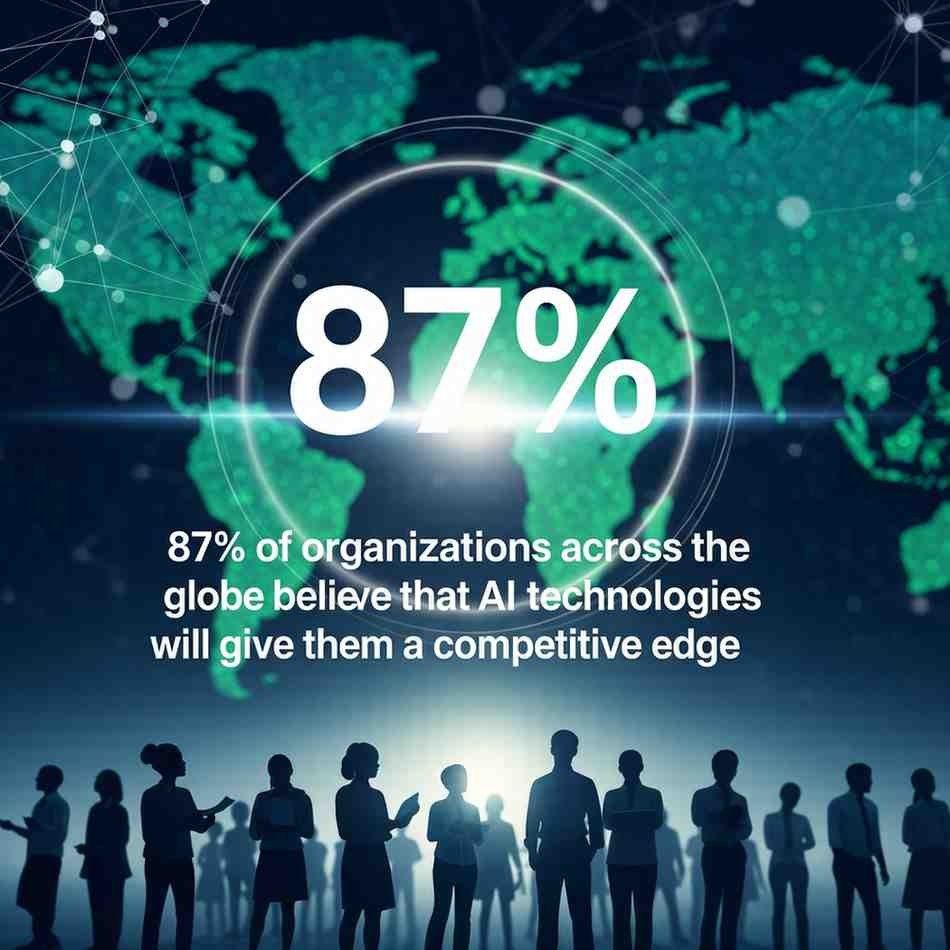
- 87% of organizations across the globe believe that AI technologies will give them a competitive edge.
These stats reflect how AI and ML rapidly take over the business world, translating into massive demand for Python Developers skilled in the AI tech stack.
Here’s a list of industry verticals where AI technology is contributing significantly.
Industry Verticals that Leverage AI Technology
AI technology is making a significant contribution across sectors, including retail and marketing, manufacturing, insurance, banking, telecom, healthcare, and more.
|
Industry |
Baseline |
Additional AI Contribution |
|
Accommodation and Food Services |
$1.5 trillion |
$489 billion |
|
Agriculture, Forestry, and Fishing |
$554 billion |
$215 billion |
|
Arts, Entertainment, and Recreation |
$453 billion |
$87 billion |
|
Construction |
$2.76 trillion |
$520 billion |
|
Education |
$1.06 trillion |
$109 billion |
|
Financial Services |
$3.42 trillion |
$1.15 trillion |
|
Healthcare |
$2.26 trillion |
$461 billion |
|
Information and Communication |
$3.72 trillion |
$951 billion |
|
Manufacturing |
$8.4 trillion |
$3.78 trillion |
|
Other Services |
$535 billion |
$95 billion |
|
Professional Services |
$7.47 trillion |
$1.85 trillion |
|
Public Services |
$3.99 trillion |
$939 billion |
|
Social Services |
$1.08 trillion |
$216 billion |
|
Transportation and Storage |
$2.13 trillion |
$744 billion |
|
Utilities |
$962 billion |
$304 billion |
|
Wholesale and Retail |
$6.18 trillion |
$2.23 trillion |
With AI’s deep penetration into these different industries, it’s evident that Python developers' roles will significantly expand in the future.
Benefits of Hiring Python Developers for AI and ML Projects
Among many other benefits, Python’s growing influence in AI and ML projects can be attributed to its general scripting language, which developers of all skills can easily understand and make changes when required, extensive libraries, and cost-effectiveness. Here’s a list of AI software solutions on Goodfirms that you can pair with Python development to build scalable AI products.
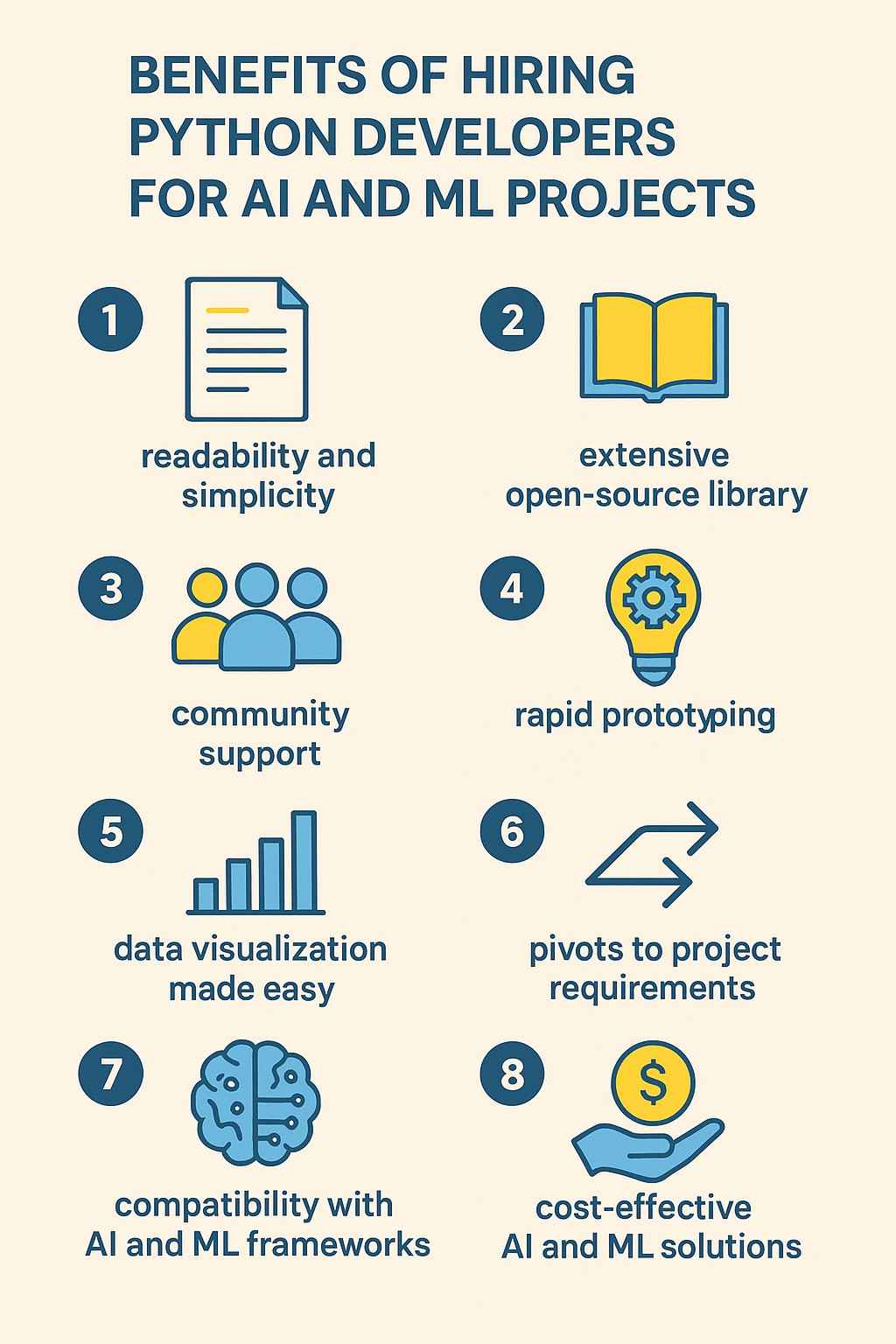
#1. Readability and Simplicity
As it turns out, AI and ML projects are inherently complex, comprising complex algorithms and intricate data structures. Python, on the other hand, offers code simplicity. The syntax is akin to plain English, helping developers quickly comprehend, collaborate, and modify each other’s code if necessary.
Why Code Simplicity is Crucial in the AI Era
- Faster onboarding of new developers
- Lower coding errors due to code simplicity
- Quicker iterations when testing multiple AI models
Code simplicity boosts collaborations. Whether your AI team is working from Toronto, Tokyo, or California, Python’s code simplicity allows smoother handovers that reduce onboarding time.
Case Study: Google’s DeepMind researchers use Python for rapid prototyping, which enables them to progress from concept to testable model in fewer days rather than months or weeks.
#2. Extensive Open-source Library
You don’t have to write the code from scratch with Python's rich library ecosystem. These are ready-made, optimized tools for almost all tasks that can help with data preprocessing, model training, and evaluation functions. Since these prebuilt components reduce development time, developers can focus on building complex AI systems that improve the quality of AI and ML projects.
Core AI Libraries
NumPy (Numerical Python) is an essential open-source library in Python for numerical and scientific computing tasks. It supports mathematical functions for various operations, including linear algebra operations, random number generation, statistical operations, and more.
Pandas: A data manipulation and analysis library that offers powerful data structures for data cleaning, analysis, manipulation, and simplifying data for ML models.
Scikit-learn: A complete machine-learning library for classification, clustering, regression, and more. It’s an ideal option for building and training machine learning models.
TensorFlow: Developed by Google, this deep learning open-source framework is widely used for training and deploying scalable deep learning models.
PyTorch: Reputed for its flexibility and dynamic computational graph.
Keras: An API that simplifies neural network creation, often running on top of TensorFlow or other backends.
#3. Community Support
Python’s growing influence in AI and machine learning is attributed mainly to a strong and active community of developers and enthusiasts, considered the largest in the tech world. This community lends immense support through tutorials, documentation, forums, and more to help developers troubleshoot and succeed in their machine learning projects. The community is among the trusted and future-proof choices for AI and ML advancements.
Community Power:
Stack Overflow: Thousands of Python-tagged AI/ML questions answered.
GitHub: Millions of AI/ML repos in Python.
Kaggle: AI competitions where Python is the dominant language.
#4. Rapid Prototyping
Python runs on fewer lines of code than languages such as Java or C++ and is backed by ready-made libraries that help with rapid prototyping and experimentation.
Python's concise, structured approach allows developers to write complex code in a shorter period without sacrificing quality. Also, it helps with debugging and maintenance, which is especially beneficial in long-term projects.
Case Study: Airbnb built a flexible pricing model in Python to adjust nightly rates. From ideation to creation of a functional prototype, it took weeks. The model boosted host earnings and improved booking rates.
Why Speed Matters:
- AI startups can look for investors faster
- Enterprises can roll out market-fit products faster
- Competitive advantage in emerging AI niches
#5. Data Visualization Made Easy
Data visualization is crucial in AI and machine learning projects as developers need to understand how a machine learning model performs before sharing the results with stakeholders. Python’s visualization tools, such as Matplotlib, Seaborn, and Plotly, make data analysis intuitive and accessible. Using these tools, developers can generate detailed charts, graphs, and plots to visualize data patterns, which in turn helps them measure the performance of AI models. Easy data analysis and presentation simplifies communication with stakeholders and decision-making during development.
#6. Pivots to Project Requirements
Python supports multiple programming models, including procedural, object-oriented, and functional, helping developers address AI and machine learning issues in a way that best suits the project. For instance, object-oriented principles can more effectively manage complexities in large AI systems, while functional programming can generate more structured, testable code for specific data transformations. Python’s capability to combine paradigms or shift from one model to another makes it a highly versatile tool that accommodates different projects' needs and developer preferences.
#7. Compatibility with AI and ML Frameworks
Python seamlessly integrates with central AI and machine learning frameworks such as PyTorch, Keras, and NumPy libraries, making it an ideal choice for these fields. These libraries equip developers with various tools to build, train, and deploy advanced AI models, making Python the go-to language for researchers and engineers in AI and ML projects.
#8. Cost-effective AI and ML Solutions
Python is an open-source language that doesn’t require licensing costs. It is a cost-efficient option for AI and ML projects, specifically for startups and businesses working on limited budgets. Python’s large and active community contributes to the vast ecosystem of free and open-source tools and libraries, further reducing costs.
Additionally, Python code's readability and maintainability make it a viable option. It is easier to understand and modify, reducing the need for extensive documentation and maintenance, which can result in significant cost savings in the long run.
Real-World Applications of Python in AI and ML
Thanks to its extensive libraries, frameworks, and ease of use, Python is the preferred programming language for AI and ML apps.
Key Real-World Applications:
Healthcare
Python-based AI/ML models help healthcare practitioners with personalized treatment plans, drug discovery, early cancer and heart conditions detection, disease diagnosis, and more.
Finance
Python-based AI/ML apps include forecast apps for market trends, risk management, credit scoring, fraud detection, algorithmic trading, and more.
Retail and E-commerce
Python enables demand forecasting, inventory management, customer segmentation, improving customer experiences through AI-powered bots, and more.
Computer Vision
Python is used in facial recognition systems, object detection, image classification, and automated video surveillance for security and crime prevention, autonomous vehicles, and more.
Natural Language Processing (NLP)
Powers apps such as sentiment analysis, text summarization, language translation, virtual assistants, and more.
Robotics
Python is used to develop intelligent robotic systems, often integrated with the Robot Operating System, which enables it to control robots.
Recommendation Systems
OTT platforms leverage Python to offer personalized content recommendations, user behavior analysis, and enhance streaming quality.
Predictive Analytics
Applied across diverse industries for forecasting trends, predicting outcomes, and maximizing operational efficiency.
For businesses considering AI integration, Goodfirms’ AI software use cases across industries will help you adopt Python and AI to your business advantage.
Python Vs Other Programming Languages
Is Python better than Java, R, or C++?
Python vs. R: R is ideal for statistical analysis and data visualization, but because of its strong libraries, Python is best for scalable AI-powered products.
Python vs. C++: C++ is a high-performance language that is undoubtedly fast. But it’s complex, which makes debugging and rapid iteration a task. Python’s code simplicity ensures faster debugging and iteration without compromising performance.
Python vs. Java: Java is ideal for enterprise software but unsuitable for AI development. Its wordy syntax slows iterations, while Python’s clean code allows faster prototyping.
Python is the clear winner for AI applications, such as recommendation engines, customer service automation, and predictive analytics.
Crucial Skills to Look for While Hiring Python Developers for AI and ML Projects
When hiring Python AI developers, look for professionals who can handle end-to-end development, from ideation to prototyping to deployment.
Key skills to look for when hiring Python developers to manage your AI development projects:
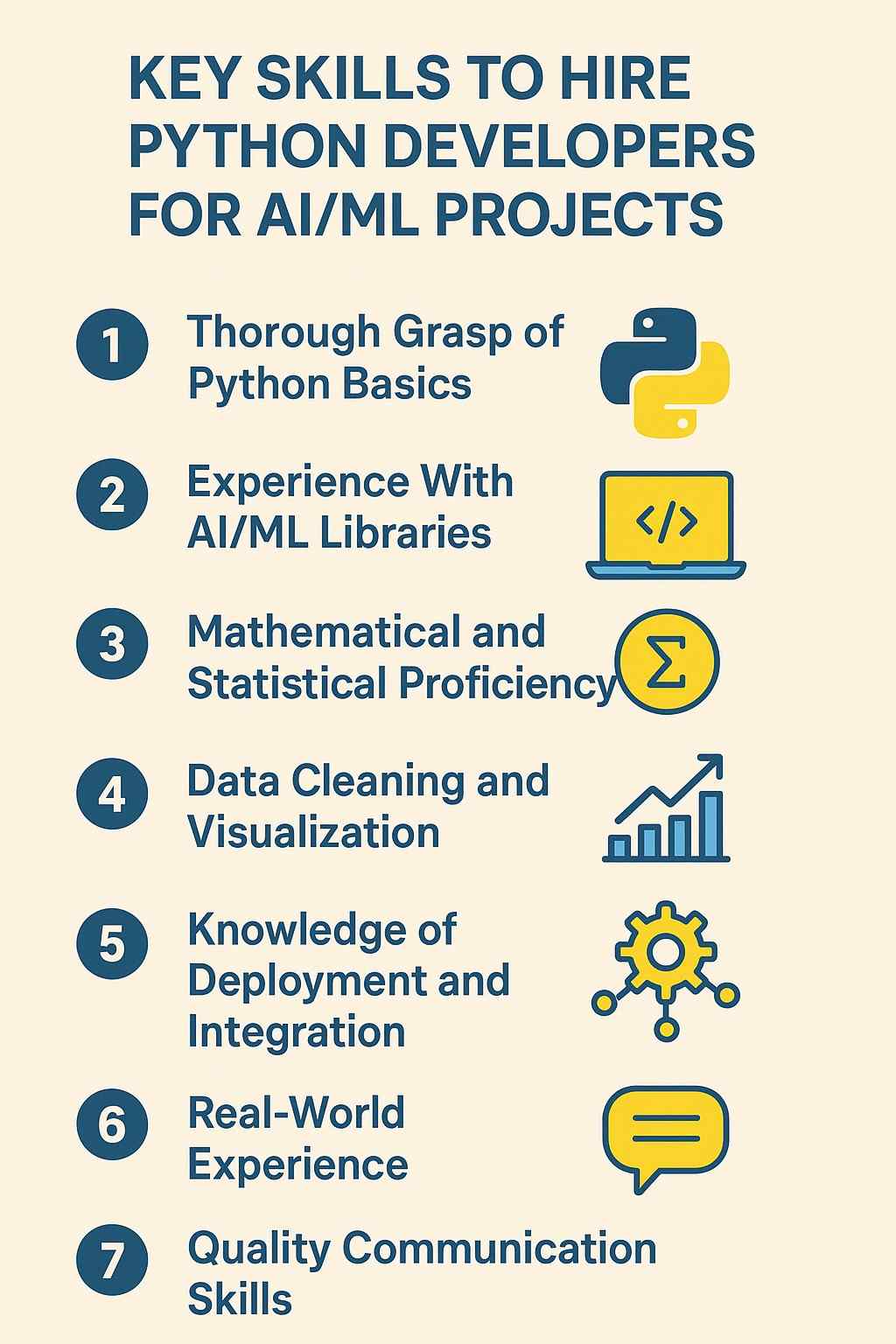
#1. Thorough Grasp of Python Basics
The developer should have a proper understanding of Python basics, which include object-oriented programming, data structures, error handling, and scripting. Knowledge of these basic concepts enables clean coding.
#2. Experience With AI/ML Libraries
Hands-on experience with Python libraries such as TensorFlow, Scikit-learn, PyTorch, and more for building AI/ML models. Also, knowledge of core programming concepts and familiarity wth Pandas, NumPy, and Matplotlib for data analysis and visualization.
#3. Mathematical and Statistical Proficiency
To design robust algorithms, the potential Python developer should have a solid grasp of statistical modeling, calculus, probability, and algebra.
#4. Data Cleaning and Visualization
Python developers should have a solid understanding of tools like Seaborn, Pandas, and NumPy, which will help them with data cleaning, transformation, and visualization.
#5. Knowledge of Deployment and Integration
A deeper understanding of deploying models such as FastAPI, Django, Flask, and cloud platforms such as Azure, GCP, and AWS. Hiring developers with this expertise will help businesses roll out machine learning models into real-world applications.
#6. Real-World Experience
Python developers you plan to hire should have experience in Kaggle competitions. In addition, they should have contributed to open-source or industry projects. Such experience will help them address AI problems related to data structures, supervised learning, etc.
#7. Quality Communication Skills
Quality communication skills help developers collaborate with cross-functional teams, such as data scientists, business analysts, and engineers. They also help the developer communicate technical concepts to non-technical stakeholders.
Cost of Hiring Python Developers from India, Ukraine, and the U.S.
Before selecting where to hire your Python developers, determine your project goals and budget. This will help you choose the required tech stack and whether to hire developers from cost-effective destinations such as India, Pakistan, Bangladesh, or Nepal, or whether you can afford to spend a bit more on US and UK developers to ensure complete control over the development process.
Whatever the case, Goodfirms has listed Python developers from across the globe. You can choose developers based on country or cost by using Goodfirms’ location and hourly rate filter.
By choosing India from the location filter, you will find developers from India who offer development services at $12 - $50 per hour. Eastern European nations like Ukraine, Poland, and Romania developers will charge around $25 - $80 per hour. US and UK-based developers will charge significantly higher, between $50-$150 per hour.
| Countries | Cost of hiring Python Developers |
| India | $12 to $50 per hour |
| Ukraine | $25 to $80 per hour |
| U.S. | $50 to $150 per hour |

The Future of AI is in Python
Warming up to Python is crucial for the success of your AI and ML projects in the future. And with a sharp increase in AI usage predicted in the future, chances of more sophisticated use cases may rise, such as
Self-Learning AI – AI systems that can train independently using Python-based frameworks.
Autonomous Robotics – Independently operated robots that could be controlled by Python-based deep learning models.
AI Ethics & Explainability – Python tools will be crucial in making AI more transparent, fair, and accountable.
New Python AI libraries: Hugging Face Transformers and PyCaret will expand possibilities within the AI and ML framework.
Integration of Python in Quantum Computing: Leveraging Python-based ecosystems such as Qiskit (IBM) and PyQuil (Rigetti), developers can tap into unprecedented computational power to build quantum-enhanced AI solutions in drug discovery, finance, and cybersecurity, resulting in scalable and potentially cost-efficient breakthroughs in the future.
Integration of Python in real-time learning for IoT: Python’s power in real-time machine learning on IoT edge devices, enabling AI to work efficiently on wearables, sensors, and smart systems.
Python-Powered NLP Technologies: Python, with its NLP libraries and transformer-based models like GPT and BERT, will help strengthen customer loyalty and enhance brand reputation via personalized, human-like interactions through chatbots, translations, and sentiment analysis.
Increased Demand for Seasoned Python Developers: There will be an increase in demand for developerswith the know-how of the latest Python technologies to handle the growing complexity of AI-driven applications.
Wrapping up
If your business is interested in building profitable AI solutions faster, hiring AI-skilled Python developers would be the smartest decision. Powered by powerful libraries, community support and simple code, Python will continue to be AI and ML solutions language of choice.