Key takeaways
- Crypto custody software is a distinct category from wallets, built around compliance, insurance, and multi-party approval workflows.
- Most platforms price on a quote basis tied to assets under custody; only a couple offer public pricing.
- The right fit depends on buyer profile, jurisdiction, and compliance needs — not just feature count.
- Institutional demand continues to grow, with more than 70% of institutional investors increasing or planning to increase their digital asset allocations.
Institutions now hold an estimated $953.5 billion in digital assets under custody in 2026, and the software market that secures this value is growing just as fast. The crypto custody provider market is projected to expand from $3.0 billion in 2025 to $30 billion by 2035.
But that scale of trust comes with a catch. A hedge fund, exchange, or corporate treasury managing millions in crypto needs infrastructure built for regulatory compliance, multi-party approvals, insurance backing, and audit trails — not just a private key and a mobile app. That's the gap crypto custody software fills.
Every business has its own custody requirements, whether it’s the assets being managed, regulatory obligations, or the scale of operations. This blog walks through the key factors to consider when comparing custody platforms, so you can find one that works for your business.
For a fuller list of custody platforms with filterable features, pricing models, and deployment options, browse Goodfirms' custody management software listing.
First, let's look at the key features that matter most in crypto custody software.
Features of Crypto Custody Software
Before comparing crypto custody platforms, it’s important to understand the features that matter most for institutional asset protection. The following 15 capabilities form the basis of the feature score used in the comparison table below.
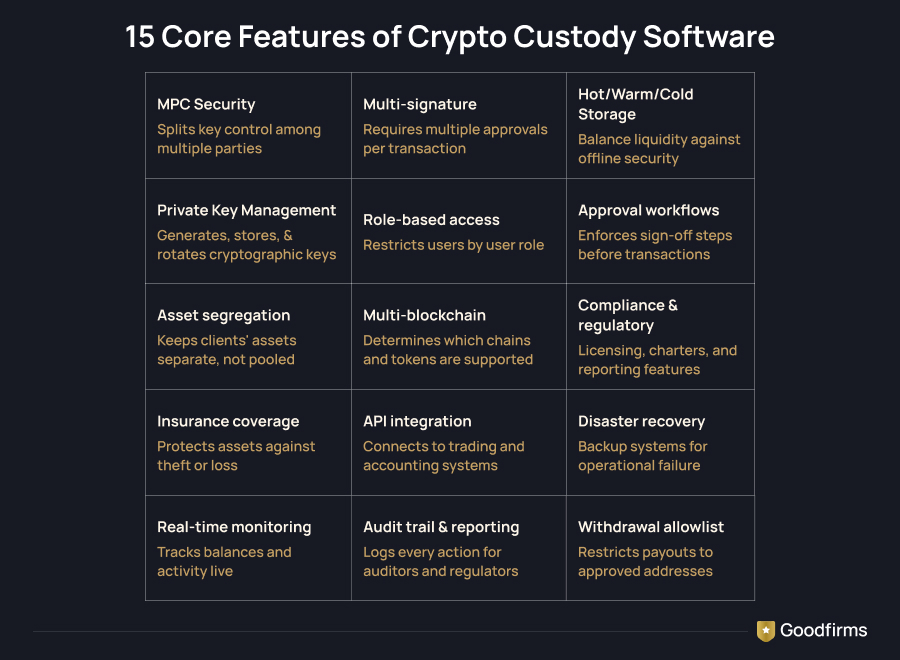
1. Multi-party computation (MPC) security — splits private key control among multiple parties, so no single point of compromise can expose the full key.
2. Multi-signature wallet support — requires multiple approvals before a transaction executes, reducing the risk that a single bad actor or a compromised credential can move funds.
3. Hot, warm & cold storage architecture — balances liquidity against security by keeping some assets instantly accessible and the bulk in offline, harder-to-reach storage. As crypto hacks continue rising, you can get a detailed understanding in this blog post: Crypto Hacks are on the Rise: Cold Wallets Are Your Best Bet.
4. Private key management — how the platform generates, stores, and rotates the cryptographic keys that control asset access.
5. Role-based access control (RBAC) — restricts what each user or team can see and do within the platform, based on their role.
6. Transaction approval workflows — enforce sign-off steps before transactions go through, useful for organizations with compliance or treasury approval chains.
7. Asset segregation — keeping each client's assets separate rather than commingled — matters for both security and regulatory reporting.
8. Multi-blockchain support — determines which chains and tokens the platform can actually custody; a mismatch here rules out a vendor regardless of other strengths.
9. Compliance & regulatory support — built-in tools or certifications (licensing, trust charters, reporting features) that help institutions meet jurisdictional requirements.
10. Insurance coverage — protects custodied assets against theft or loss, though coverage terms and limits vary significantly by vendor.
11. API integration & connectivity — how easily the platform connects to trading systems, accounting tools, or internal infrastructure.
12. Disaster recovery & backup systems — protect against operational failure, not just theft, ensuring access to funds if a system or facility goes down.
13. Real-time asset monitoring — continuously tracks balances and transaction activity across wallets, so unusual movements or exposure changes surface immediately rather than at the next audit.
14. Audit trail & reporting — logs every action taken on the platform in a way that satisfies auditors and regulators and allows reconstruction of exactly what happened and who approved it.
15. Withdrawal allowlisting & limits — restrict outgoing transactions to pre-approved addresses and caps, so funds can't be moved to an unrecognized destination even if a credential is compromised.
Goodfirms Insight: Feature count alone shouldn't determine your choice of crypto custody software. Look beyond the checklist to understand how each capability is implemented, particularly in key areas such as security, access controls, transaction approvals, compliance, and disaster recovery. Also, verify qualified custodian status and HSM certifications, such as FIPS 140-2 Level 3, when they are relevant to your regulatory and security requirements.
Keeping these features in mind, here’s how the leading crypto custody platforms compare.
Crypto Custody Software Comparison Table
The comparison below brings pricing, feature coverage, standout capabilities, and institutional fit into one view. This makes it easier to narrow down the platforms worth exploring further.
|
Provider |
Feature score |
Standout feature |
Regulatory / compliance strength |
Best for |
|---|---|---|---|---|
|
Ledger Enterprise |
13/15 |
Hardware key protection |
SOC 2 Type 2; pursuing ISO 27001, ISO 22301, and CSPN V4 |
Hardware-backed institutional custody |
|
Zodia Custody |
13/15 |
Bank-backed institutional trust |
FCA registered; backed by Standard Chartered, SBI Group, Northern Trust, and NAB |
Bank-backed institutional custody |
|
Komainu |
13/15 |
Institutional-grade resilience |
FCA-registered (UK); also regulated/licensed in Jersey (JFSC), UAE (VARA), and Italy (OAM) |
Banks and asset managers seeking dedicated institutional infrastructure |
|
Gemini Custody |
15/15 |
Full feature coverage |
NYDFS-regulated NY State Trust Company; qualified custodian with $125M digital asset insurance; SOC 2 Type 2, ISO 27001 certified |
Institutions wanting broad custody functionality |
|
Taurus |
13/15 |
Enterprise infrastructure at scale |
FINMA-regulated (Switzerland), Cyprus SEC-licensed (license 465/26); ISAE 3402 Type II, ISO 27001, FIPS 140-2 Level 3, CMTA DACS certified |
Large financial institutions operating in regulated markets |
|
Anchorage Digital |
10/15 |
Regulated digital bank charter |
OCC federal bank charter (first crypto company to receive one, 2021); 2022 AML/KYC consent order lifted by OCC in August 2025. Singapore entity MAS-licensed. Not FDIC, SIPC, or SDIC insured. |
Institutions prioritizing regulatory oversight |
|
Fireblocks |
11/15 |
MPC-based asset security |
SOC 2 Type II, SOC 1 Type II, ISO 27001/27017/27018/22301, and C4 CCSS QSP Level 3 |
Custody combined with a broader digital-asset infrastructure |
|
Coinbase Custody / Prime |
- |
Large institutional ecosystem |
NYDFS-regulated NY trust company (CCTC); qualified custodian under Investment Advisers Act of 1940. SOC 1/SOC 2 Type II (Deloitte & Touche); custodian for 8 of 11 spot Bitcoin ETF mandates. |
Institutions wanting custody integrated with trading and staking |
|
BitGo |
- |
Multi-signature security |
OCC-chartered national trust bank (BitGo Bank & Trust); also NYDFS-regulated (NY), MAS-licensed (Singapore), BaFin MiCAR-licensed (EU), VARA-licensed (UAE), FINMA-supervised (Switzerland). Not FDIC or SIPC insured |
Institutions prioritizing a long security track record |
|
Copper |
11/15 |
Off-exchange settlement |
Swiss FINMA-overseen (VQF); $500M Aon-brokered insurance; SOC 2/ISO 27001 aligned |
Institutions needing custody plus prime brokerage services |
Feature scores reflect coverage across 15 core custody capabilities tracked on Goodfirms' custody management software listing. Platforms such as Coinbase Custody and BitGo weren't scored because their exact coverage of capabilities isn't publicly documented.
Most institutional custody providers don’t list fixed prices. The cost usually depends on factors such as the assets being held, where the business operates, and the level of service required. Fireblocks is one of the exceptions, with a flat monthly rate, while BitGo generally charges based on the amount of assets held in custody.
Goodfirms Insight: Most scored vendors cluster between 13 and 15 out of 15, showing that feature breadth alone no longer creates much separation. The bigger differences lie in the infrastructure behind those features—whether that means a banking charter, hardware security expertise, or a strong regulatory footprint.
Finextra points out in its coverage of institutional custody frameworks that digital assets won't keep growing until custody matches the bank-grade reliability people have trusted in traditional finance for decades. That trust is already paying off — over 70% of institutional investors have increased or plan to increase their digital asset allocations.
Let’s dive deeper into the top crypto custody platforms and what makes each one stand out.
Top Crypto Custody Software Platforms
Here's what sets each platform apart and who it's built for.
1. Ledger Enterprise — Best for hardware-backed custody
Why choose it: Ledger Enterprise brings Ledger’s hardware-security approach to institutional custody. Its key differentiator is hardware-backed protection combined with cold-storage capabilities rather than relying entirely on software-based key management.
Consider it if: Your security team prefers hardware-based key protection and offline custody for institutional digital assets.
Standout feature: Hardware key protection
Feature score: 13/15
Certifications: SOC 2 Type 2; pursuing ISO 27001, ISO 22301, and CSPN V4.
What to verify: Confirm whether its supported chains, approval workflows, deployment model, and compliance capabilities match your institution’s requirements before shortlisting it.
2. Zodia Custody— Best for bank-backed institutional custody
Why choose it: Zodia Custody stands out because of its traditional-finance backing. Standard Chartered, SBI Group, Northern Trust, and National Australia Bank give the platform a banking connection that can matter to institutions evaluating counterparty and regulatory credibility.
Consider it if: Banking pedigree and regulatory oversight carry significant weight in your custody selection process.
Standout feature: Bank-backed institutional trust
Feature score: 13/15
Regulatory credentials: Registered with the FCA
What to verify: Check which regulatory permissions apply specifically to your jurisdiction and the assets or custody services you plan to use.
3. Komainu — Best for dedicated institutional custody
Why choose it: Komainu is focused on digital-asset infrastructure for financial institutions, with an emphasis on security, resilience, and institutional-grade protection.
Consider it if: You are a bank, asset manager, or similar institution looking for a dedicated custody partner rather than a broader retail-oriented crypto ecosystem.
Standout feature: Institutional-grade resilience
Feature score: 13/15
Certifications/regulatory credentials: Komainu (UK) Limited is registered with the FCA. Its subsidiaries are also regulated in Jersey (Jersey Financial Services Commission, VASP), the UAE (Dubai VARA, VASP for custody and staking), and Italy (OAM registration)
What to verify: Insurance coverage details and specific security certifications (e.g., SOC 2, ISO) aren't listed on Komainu's site — confirm directly with the vendor if these matter for your due diligence
4. Gemini Custody — Best for broad feature coverage
Why choose it: Gemini Custody, offered by Gemini, a NASDAQ-listed company, has the strongest feature coverage among the vendors currently scored in the comparison, supporting all 15 capabilities tracked by Goodfirms. This gives institutions both regulatory transparency and comprehensive functionality in one place.
Consider it if: You want broad custody functionality and value the additional corporate transparency associated with a publicly listed parent company.
Standout feature: Full feature coverage
Feature score: 15/15
Regulatory/compliance strength: Regulated as a New York State Trust Company; NYDFS-licensed fiduciary and qualified custodian under NY Banking Law. Holds $125M in digital asset insurance ($25M hot wallet, $100M cold storage) and has completed SOC 2 Type 2 and ISO 27001 certification.
What to verify: Confirm current insurance limits and coverage exclusions directly with Gemini, as these figures are dated (March 2024) and may have changed
5. Taurus — Best for enterprise digital-asset infrastructure
Why choose it: Taurus is positioned as a broader enterprise digital-asset infrastructure rather than a narrow custody product. It holds more than 50% market share in Switzerland, one of the most competitive digital-asset markets globally, and serves systemic, investment, crypto, and private banks worldwide
Consider it if: You are a large financial institution that needs enterprise-scale infrastructure and places significant weight on experience in regulated banking markets.
Standout feature: Enterprise infrastructure at scale
Feature score: 13/15
Certifications / regulatory credentials: Taurus S.A. is regulated by Switzerland's FINMA and a member of esisuisse; Taurus (Europe) Ltd is licensed by the Cyprus Securities and Exchange Commission (license no. 465/26). Certified to ISAE 3402 Type II, ISO 27001, FIPS 140-2 Level 3, and CMTA DACS.
What to verify: Confirm insurance coverage details directly with Taurus, as this isn't published on their security or regulatory pages
6. Anchorage Digital — Best for regulatory standing
Why choose it: Anchorage Digital operates Anchorage Digital Bank N.A., the first federally chartered crypto bank in the U.S., while its broader platform also covers staking, trading, governance, and settlement. Anchorage differentiates itself through its regulated banking structure.
Consider it if: Regulatory oversight and a U.S. federal bank charter are high priorities in your vendor due diligence process.
Standout feature: Regulated digital bank charter
Feature score: 10/15
Regulatory /security credentials: OCC federal bank charter (first crypto-native company to receive one, granted in2021); Singapore entity licensed by the Monetary Authority of Singapore; HSM-based custody. A 2022 OCC consent order related to AML/KYC controls was officially lifted in August 2025. Anchorage Digital is not SEC-registered and does not offer securities trading. Custodied assets are not FDIC, SIPC, or SDIC insured.
What to verify: Confirm the current SOC 2 or equivalent security certification status directly with Anchorage, as this isn't published on their regulatory leadership page. Also, determine whether its 10/15 feature coverage includes all capabilities your treasury, compliance, and security teams consider mandatory
7. Fireblocks — Best for custody plus digital-asset infrastructure
Why choose it: Fireblocks goes beyond custody. The platform combines MPC-based security with infrastructure for areas such as payments, settlement, stablecoins, and tokenization.
Consider it if: Custody is only one component of a broader digital-asset operation, and you want to consolidate multiple workflows with a single infrastructure provider.
Standout feature: MPC-based asset security
Feature score: 11/15
Certifications: SOC 2 Type II (zero material findings, audited by Ernst & Young), SOC 1 Type II, ISO 27001/27017/27018/22301, and C4 CCSS QSP Level 3 — Fireblocks was the first company in the world to achieve this certification.
What to verify: Whether Fireblocks' broader infrastructure (payments, settlement, tokenization) is actually needed, or whether a narrower custody-only platform would be simpler and more cost-effective for your use case.
8. Coinbase Custody— Best for custody plus trading and staking
Why choose it: Coinbase’s institutional custody offering sits inside Coinbase Prime, allowing institutions to combine custody with trading and staking instead of managing those services across separate platforms.
Consider it if: Your organization already operates within the Coinbase ecosystem or wants trading, staking, and custody on a single institutional platform.
Standout feature: Large institutional ecosystem
Feature score: Not scored
Certifications / regulatory credentials: NYDFS-regulated NY trust company (CCTC); qualified custodian under Investment Advisers Act of 1940. SOC 1/SOC 2 Type II (Deloitte & Touche); custodian for 8 of 11 spot Bitcoin ETF mandates.
What to verify: Confirm current cyber insurance coverage details directly with Coinbase, as no public dollar figure is disclosed (unlike Gemini's stated $125M). Also, verify Coinbase Prime's coverage against the 15-feature custody matrix, since it currently isn't scored, and confirm whether the "Custody Only" tier changes pricing or feature access compared to the full Prime bundle.
9. BitGo — Best for an established security track record
Why choose it: BitGo has a long history in institutional digital asset custody and is closely associated with multisignature wallet technology. Its public-company status also provides institutional buyers with greater corporate disclosure than many private providers offer.
Consider it if: Security history, multi-signature architecture, and provider longevity are central to your selection criteria.
Standout feature: Multi-signature security
Feature score: Not scored
Security / corporate credentials: OCC-chartered national trust bank (BitGo Bank & Trust); also NYDFS-regulated (NY), MAS-licensed (Singapore), BaFin MiCAR-licensed (EU), VARA-licensed (UAE), FINMA-supervised (Switzerland). Not FDIC or SIPC insured.
What to verify: Confirm BitGo's current SOC 2 or equivalent security certification status directly with the vendor, as this wasn't listed on their public licenses or security pages. Also, confirm whether the OCC charter changes the fee structure or account terms compared to BitGo's prior custody arrangement, given this is a recent transition (December 2025).

Institutions want infrastructure they can diligence, underwrite, and trust over long time horizons.
Certifications: HSM-backed signing infrastructure (SOC 2 status not publicly confirmed)
Pricing: Assets-under-custody fee (percentage-based, contact vendor for rates)
10. Copper— Best for custody plus prime brokerage
Why choose it: Copper differentiates itself by combining custody with prime brokerage, collateral management, and off-exchange settlement capabilities.
Consider it if: Your institution actively trades digital assets and wants custody to work alongside collateral and prime-brokerage operations rather than functioning as an isolated storage service.
Standout feature: Off-exchange settlement
Feature score: 11/15
Certifications / regulatory credentials: Copper Markets (Switzerland) AG, VQF-registered financial intermediary under Swiss FINMA oversight; $500M Specie insurance (Aon-brokered, A+ rated insurer); aligns with SOC 2 and ISO 27001 frameworks
What to verify: Whether Copper's SOC 2/ISO 27001 alignment reflects formal certification or an internal framework, since this isn't stated explicitly on their site — confirm directly with the vendor before citing it as a certification.
Now that you've seen all the options, here's how to actually narrow them down.
How to Choose the Right Platform
Matching a custody platform to your organization comes down to a few practical checks:
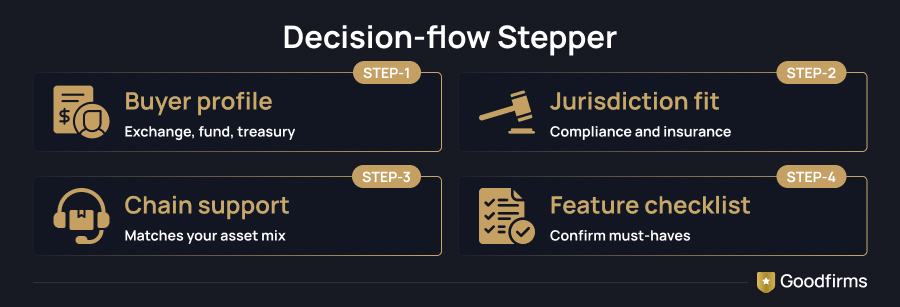
Match custody type to your buyer profile
An exchange processing large volumes of transactions will have very different requirements from a company treasury holding assets for the long term or a fund managing client money with strict reporting requirements. If treasury management is the main priority, it may also be worth comparing crypto treasury management software options on Goodfirms.
Look at compliance and insurance requirements in your jurisdiction
Regulatory requirements vary by country and region, so the credentials that matter most will depend on where your business operates. A federal charter, FCA registration, or BaFin license may be particularly relevant, depending on your location and the rules your organization must follow.
Make sure the platform supports the assets you actually hold
Strong security doesn't help much if the platform doesn't support the blockchains and assets your organization uses. Before choosing a provider, check that its supported networks match your current holdings and any assets you expect to add.
Compare the platforms against your operational requirements
Use the feature matrix as a starting point, but prioritize the capabilities your compliance, treasury, security, and operations teams actually require.
Weighing these checks against your own requirements is what separates a shortlist from a final decision.
Final Thoughts
Institutional crypto custody has come a long way from the early days of managing private keys in-house and piecing together security measures. The platforms covered here approach custody differently, but they all aim to solve the same problem: helping institutions hold digital assets in ways that meet the expectations of compliance teams, boards, and auditors.
Ultimately, the right choice depends on what matters most to your organization. Before making a decision, there is one question worth asking: Can this platform withstand the due diligence your organization must conduct before trusting it with real assets?
A few common questions come up before institutions commit to a platform.
FAQs- Crypto Custody Software Comparison
Is crypto custody software the same as a crypto wallet?
No. A crypto wallet is generally used to manage private keys and transactions, often for individual or self-custody use. Crypto custody software is designed for institutions and typically includes features such as multi-party approvals, insurance, compliance controls, and detailed audit trails that standard wallets may not provide.
What is MPC in crypto custody?
Multi-party computation (MPC) is a security method that distributes control over a private key among multiple devices or parties. This means that if a device or credential is compromised, it can't be used on its own to approve a transaction or move funds.
How much does crypto custody software cost?
Pricing mostly comes down to a quote, based on how much you're custodying, where you operate, and the service level you need. A few platforms break from that — Fireblocks publishes a flat monthly rate, and BitGo charges a percentage of the assets it holds for you instead of a subscription fee.
Do custody platforms offer insurance?
Most do, but coverage varies a lot from one vendor to the next — what's covered, how much, and under what conditions. You should not take it at face value; instead, ask the vendor directly for specifics before you rely on it.
What's the difference between MPC and multi-signature security?
MPC divides control of a private key between multiple parties or devices, so the full key is never stored in one place. Multisig uses multiple separate keys and requires a set number of them to approve a transaction. MPC can be used across different blockchains, while multisig depends on whether the blockchain supports it.