Key takeaways
- The best data center management software depends on your biggest operational challenge, whether that's asset visibility, infrastructure monitoring, or energy efficiency.
- A platform that your team can deploy and use effectively often delivers more value than a feature-rich solution with a long implementation cycle.
- Energy and cooling optimization are becoming core evaluation criteria for modern data center operators.
- Before signing a contract, validate vendor claims through customer reviews, implementation feedback, and real-world deployment experiences.
Modern data centers are becoming harder to manage. IT teams are dealing with hybrid infrastructure, rising energy costs, denser racks, edge deployments, and growing sustainability requirements. At the same time, operations teams are expected to support more assets without adding more staff.
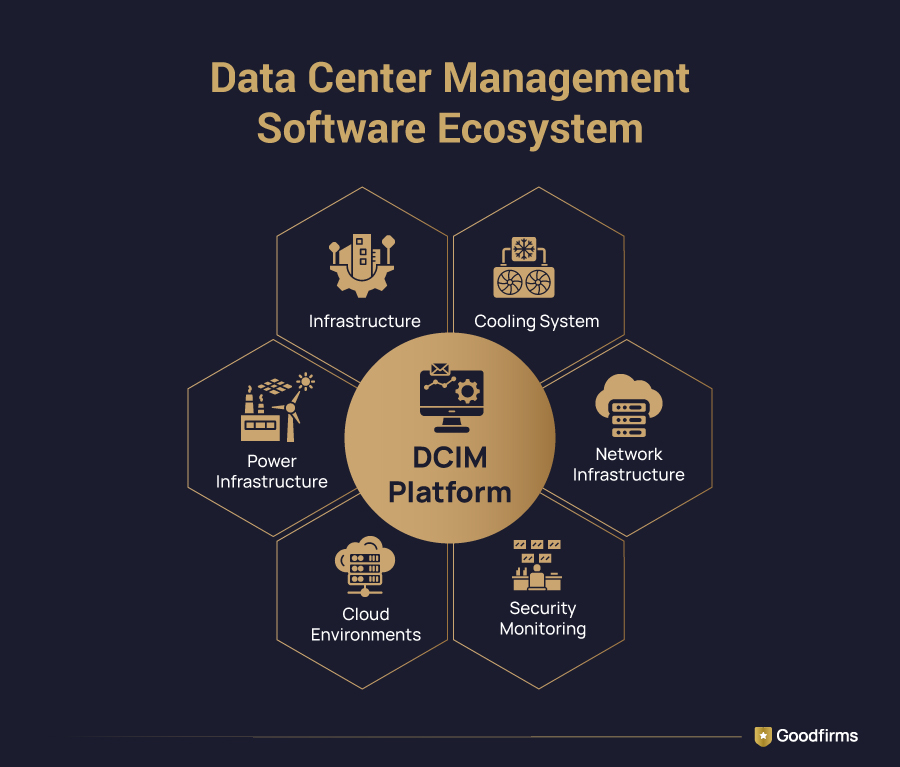
Many organizations are responding by adopting data center management software. These data center management tools help track assets, monitor capacity, measure power consumption, improve cooling efficiency, and maintain visibility across the entire infrastructure from a single dashboard.
The challenge is that not all platforms solve the same problem. Some are designed for physical data center operations and capacity planning. Others focus on infrastructure monitoring across cloud and on-premise environments. A few specialize in energy optimization and can deliver meaningful cost savings, yet they are often overlooked during vendor evaluations.
In this guide, we review the best data center management software available in 2026. You will learn where each platform performs best, where it falls short, and which environments it is most suitable for.
Before committing to a DCIM platform, compare verified reviews, feature comparisons, and vendor ratings on Goodfirms to identify the solution that best fits your infrastructure, budget, and growth plans.
How We Selected These 10 Platforms
We evaluated 40+ data center management solutions listed on Goodfirms to build this shortlist.
Every platform was assessed across five criteria: verified client reviews from real deployments, feature depth across core DCIM capabilities, pricing transparency, deployment flexibility across cloud and on-premise environments, and suitability across different buyer types from infrastructure operators to sustainability-focused teams.
Platforms with strong review volume but limited real-world deployment evidence were excluded. The goal was a shortlist that reflects how buyers actually evaluate and use these tools, not just how vendors describe them.
Quick Comparison: 10 Best Data Center Management Platforms
The solutions below include traditional DCIM software, infrastructure monitoring platforms, and specialized infrastructure management software designed for modern data center environments.
The solutions below include traditional DCIM software, infrastructure monitoring platforms, and specialized infrastructure management software designed for modern data center environments.
| Software | Best for | Deployment | Starting Price | Key Strength |
|---|---|---|---|---|
| Sunbird DCIM | Full DCIM, mid-to-large data centers | Cloud/on-premise | $5.50/node/month | Visualization & asset tracking |
| Nlyte | Enterprise asset governance | Hybrid | From $20/year | Asset lifecycle & ITSM integration |
| Device42 | Hybrid IT discovery + DCIM | Cloud/on-premise/SaaS | From $20/user/year | Auto-discovery across physical & cloud |
| ManageEngine OpManager | SMB/mid-market monitoring | Cloud/on-premise | $95 [10 devices] | Broad monitoring at a competitive price |
| Site24x7 | Distributed/hybrid monitoring | Cloud | From $9/month | Unified cloud + infrastructure monitoring |
| Hyperview | Coloction & hybrid environment | SaaS | $3/asset/year | Fastest deployment; transparent pricing |
| Datadog | Cloud-native observability | SaaS | From $15/host/month | Deep integrations; APM + infra in one |
| Ekkosense | Energy & cooling optimization | SaaS | Request Quote | AI-driven cooling savings |
| FNT Software | Documentation-heavy enterprise | Hybrid | Request Quote | Digital twin + cable management |
| Schneider EcoStruxure IT | Distributed & Schneider environments | Cloud-first | Request Quote | Remote monitoring; strong power analytics |
Which Data Center Management Software Is Best?
The most successful deployments focus on preventing issues before they affect operations. Organizations adopting proactive data center management practices often prioritize monitoring, capacity forecasting, and asset visibility when evaluating DCIM platforms.
There is no single best data center management software solution. The right data center management software application depends on what is costing your team the most: asset visibility gaps, unplanned downtime, rising energy bills, or an inability to scale monitoring across multiple sites.
Here are the quick answers:
Best overall DCIM platform → Sunbird DCIM
Best for enterprise asset governance → Nlyte
Best for hybrid IT discovery → Device42
Best for energy optimization → EkkoSense
Best cloud-native DCIM → Hyperview
Best value for monitoring-focused teams → ManageEngine OpManager
Best for cloud-heavy environments → Datadog
Goodfirms Insight: The biggest mistake buyers make is selecting a DCIM platform based on feature count rather than operational priorities. Organizations focused on asset visibility, infrastructure monitoring, and energy optimization often require entirely different solutions. Teams that identify their primary challenge before evaluating vendors typically achieve faster implementation, stronger adoption, and better long-term ROI.
Top 10 Data Center Management Software Reviewed
1. Sunbird DCIM
Best for: Mid-sized and large data centers that need complete DCIM software capabilities without a lengthy implementation process.
Sunbird DCIM earns the top position because it solves the problem most buyers actually have. Infrastructure teams need a reliable way to track assets, monitor power, and environmental conditions. They want to plan capacity and understand what's happening inside the data center without spending months configuring the platform itself.
That balance is surprisingly difficult to find.
The platform is particularly strong when managing growth. As rack density increases and infrastructure becomes more distributed, maintaining an accurate inventory often becomes a challenge. Sunbird's visualization tools make it easier to understand where assets are located, what resources are available, and where capacity constraints are beginning to emerge.
2. Nlyte
Best for: Large enterprises that need rigorous asset governance, compliance controls, and lifecycle management across multiple facilities.
Nlyte has been a serious player in the DCIM market for years, and its reputation largely comes from one area: control.
The platform offers deep asset lifecycle management capabilities, workflow automation, capacity planning, and integrations with systems such as ServiceNow. Organizations managing thousands of assets across multiple facilities often appreciate the level of structure Nlyte brings to daily operations.
Nlyte is one of the few platforms on this list built for environments where infrastructure governance is treated as a business requirement and not an operational preference.
3. Device42
Best for: Organizations managing hybrid infrastructure across physical, virtual, and cloud environments that require advanced infrastructure management software and asset visibility.
Instead of focusing exclusively on physical infrastructure, Device42 provides visibility across interconnected environments. Asset discovery, dependency mapping, IP address management, and infrastructure documentation all work together to create a more complete operational picture.
One feature that consistently attracts attention is dependency mapping. When teams need to understand how applications, servers, storage systems, and network resources connect, visual dependency relationships become extremely valuable.
This helps with migration planning, troubleshooting, capacity analysis, and risk assessment.
Device42 also benefits from strong discovery capabilities. Keeping infrastructure inventories current is one of the most frustrating operational challenges for many organizations. Automated discovery reduces some of that burden.
4. Hyperview
Best for: Teams looking for cloud-native DCIM software without the deployment burden of legacy platforms.
Built as a SaaS platform, Hyperview offers a more modern deployment experience while still delivering many of the capabilities organizations expect from DCIM software. Asset management, capacity tracking, rack visualization, monitoring, and reporting are accessible through a browser-based interface without requiring dedicated on-premises infrastructure.
That simplicity has helped Hyperview gain traction among colocation providers, managed service providers, and organizations that prefer operational flexibility.
The user experience is another differentiator. Hyperview feels noticeably more modern than many legacy alternatives, which reduces training requirements and accelerates adoption.
5. Schneider Electric EcoStruxure IT
Best for: Organizations that want stronger visibility into power infrastructure, energy usage, and distributed facility operations.
Schneider Electric provides centralized monitoring across geographically distributed environments. It helps teams identify issues before it impacts any ongoing service.
Organizations already using Schneider Electric or APC equipment often gain additional value because of tighter hardware integration and richer telemetry.
Energy management is another area where EcoStruxure stands out. Rising electricity costs have pushed efficiency higher on the priority list for many operators. Detailed power analytics help identify opportunities for optimization and support sustainability initiatives.
6. ManageEngine OpManager
Best for: Mid-sized IT teams that need broad infrastructure visibility without enterprise-level complexity or pricing.
ManageEngine OpManager combines network and server monitoring, performance analytics, alerting, and reporting into a package accessible to smaller teams. Setup is easy as it comes with detailed documentation. Most administrators can become productive without lengthy training programs.
Many dedicated DCIM solutions require substantial upfront investment. OpManager offers a more approachable entry point while still providing meaningful operational visibility.
7. Datadog
Best for: Cloud-heavy organizations that need deep observability across applications, infrastructure, and services.
Datadog’s greatest strength is visibility across complex environments. Infrastructure monitoring, application performance monitoring, log management, security monitoring, cloud cost visibility, and analytics all operate within a connected ecosystem.
Teams can move from an application alert to the underlying infrastructure metrics and supporting logs without switching platforms.
Datadog also benefits from one of the largest integration libraries in the industry. Connecting cloud services, databases, containers, orchestration platforms, and third-party tools is generally straightforward.
8. Site24x7
Best for: Distributed organizations that need infrastructure, application, and cloud monitoring from a single platform.
Site24x7 covers servers, networks, cloud services, websites, applications, databases, and end-user experience monitoring through a unified interface. It eliminates the need to manage multiple specialized tools.
Smaller IT teams appreciate being able to monitor critical infrastructure without dedicating weeks to implementation projects. The interface is approachable, reporting is practical, and alert management is mature enough for most operational requirements.
Site24x7 also benefits from predictable entry-level pricing, making it attractive for organizations that want visibility without committing to enterprise-scale contracts.
9. EkkoSense
Best for: Organizations focused on reducing cooling costs and improving data center energy efficiency.
EkkoSense focuses on helping operators understand how energy moves through the data center and where efficiency improvements can be achieved. That specialization makes it one of the most unique products on this list.
Rather than competing directly with comprehensive DCIM platforms, EkkoSense concentrates on thermal performance, cooling optimization, airflow management, and energy efficiency analysis.
Its 3D visualization capabilities provide detailed insight into temperature distribution throughout facilities. Infrastructure teams can identify hotspots, inefficient cooling patterns, and opportunities to improve utilization.
10. FNT Software
Best for: Large enterprises and telecommunications organizations that require detailed infrastructure documentation and digital twin capabilities.
FNT Software helps create a structured representation of infrastructure assets and their relationships. Teams can model dependencies, analyze impacts before making changes, and maintain a more accurate understanding of the environment.
Cable management, connectivity documentation, service mapping, and asset relationships are particularly strong areas.
Organizations looking for a lightweight monitoring solution will likely find FNT excessive. The platform delivers the most value when infrastructure complexity justifies the investment.
Goodfirms Insight: Modern data center management is shifting from reactive monitoring to proactive operations. Leading organizations now use DCIM software not only to identify infrastructure issues but also to forecast capacity requirements, optimize energy consumption, and prevent downtime before service disruptions occur.
Which Type of Buyer are You?
Most buyers fall into one of three categories, and understanding your requirements is one of the most important data center management best practices before evaluating vendors.
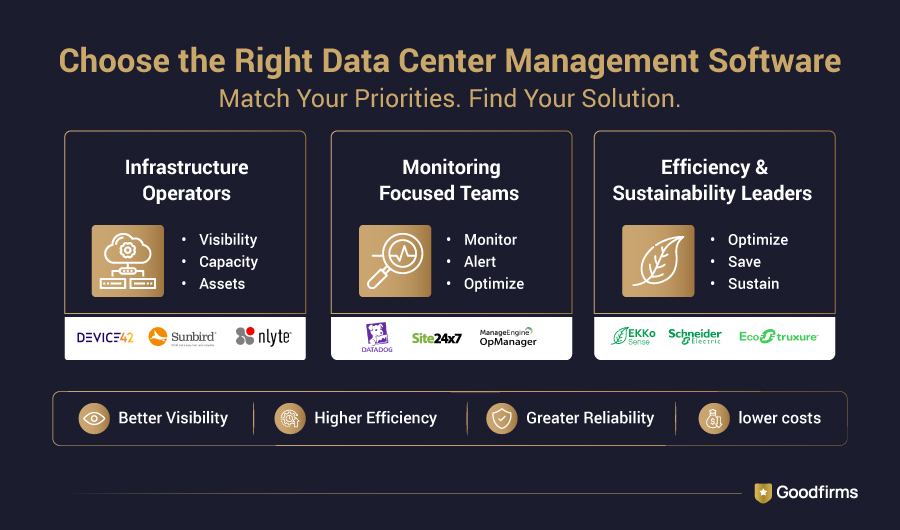
Buyer Type 1 — Infrastructure Operators
Your primary need is asset visibility, rack utilization, and capacity planning. You are managing a physical data center and need to know what you have, where it is, how much power it is drawing, and when you will run out of capacity.
Best fit: Sunbird DCIM, Nlyte, Device42, Hyperview
Buyer Type 2 — Monitoring-Focused IT Teams
Your primary need is server health, network monitoring, real-time alerting, and cloud infrastructure visibility. Your environment is distributed, hybrid, or cloud-heavy, and you need observability more than physical asset management.
Best fit: ManageEngine OpManager, Site24x7, Datadog
Buyer Type 3 — Efficiency and Sustainability Leaders
Your primary need is cooling optimization, power consumption visibility, PUE improvement, and ESG-ready reporting. Energy cost and sustainability targets are driving the platform decision more than asset count.
Best fit: EkkoSense, Schneider EcoStruxure IT
FAQs - Data Center Management Software
What is a Data Center Management Software?
Data center management software is a centralized platform that helps organizations monitor and manage servers, storage, networking equipment, power systems, cooling infrastructure, and other data center assets from a single interface.
How long does it typically take to migrate from one DCIM platform to another?
Four to eight weeks for a mid-size environment — if your asset data is clean. The bottleneck is almost never the software; it is data quality. Budget two to three times longer for the data cleansing than the actual migration.
What should we actually test during a free trial?
Import a real sample of your asset data and see how the platform handles inconsistencies. Run the integration your team needs: ITSM, network monitoring, or BMS in your own environment. Then contact support with a real technical question and time the response.
Can data center management software help reduce operational costs?
Yes. These platforms help identify unused assets, power inefficiencies, cooling issues, and capacity bottlenecks. Better visibility often leads to lower energy consumption, improved resource utilization, and fewer manual management tasks.
What is the biggest mistake organizations make when selecting a DCIM platform?
Many organizations choose software based on feature count rather than operational needs. A platform that aligns with your infrastructure size, team capabilities, and growth plans usually delivers more value than the one with the longest list of features.
Should organizations choose a cloud-based or on-premise DCIM solution?
Cloud-based platforms are easier to deploy, maintain, and scale, making them suitable for most modern environments. On-premise solutions may be preferred by organizations with strict security, compliance, or data residency requirements.
Which integrations are most important in data center management software?
The most valuable integrations are typically with IT service management (ITSM) tools, monitoring platforms, building management systems (BMS), and asset management software. These integrations reduce manual work and provide a more complete view of infrastructure operations.
The Right Tool for Your Environment
The best data center management software is the one that solves the operational problem costing your team the most time, money, or risk today, and not the one with the longest feature list or the highest review volume.
Run the Visibility–Efficiency–Governance check first. Match your buyer type to the right platform category. Then verify pricing models, implementation requirements, and post-sale support quality against real deployment reviews before you commit.
Goodfirms' data center management software category includes verified reviews filterable by company size, deployment environment, and industry, so you can find what works for team.


