


Do you know why NOC and Network engineers spend their time and efforts on monitoring the IT infrastructure? Well, if you know, you probably have an idea that network monitoring is the backbone of addressing challenges like overloaded routers, slow traffic, component failure, server failure, or network connection issues.
Network monitoring a few years back was different from the modern day requirements. So, this blog is aimed at helping businesses understand network monitoring in today’s context, and to prepare for 2026 with advanced network monitoring and management tips.
What is Network Monitoring?
Network monitoring is a critical IT process of keeping a watch on the network devices and tools, their operations, and other activities to manage the performance and availability in real-time. With the assistance of network monitoring tools, businesses can manage their infrastructure effectively and address system failures with real-time notification alerts. Modern day network monitoring and management solutions are packed with features to help businesses effectively monitor distributed network environments.
Benefits of Network Monitoring Tools
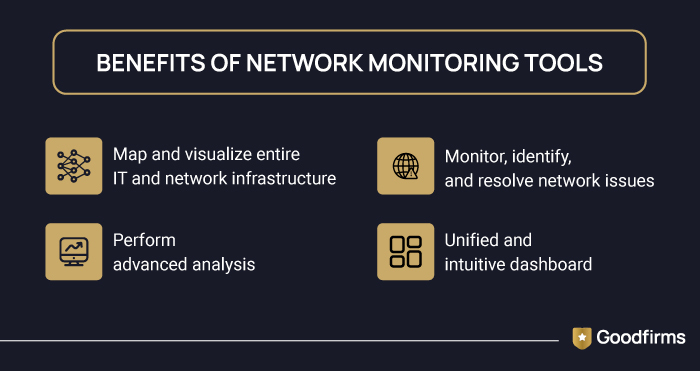
The biggest benefit of network monitoring for businesses is improved visibility of the IT infrastructure in real-time. With a clear snapshot of every device and connection across the organization, IT teams can monitor how data flows and quickly identify issues before they escalate into major problems.
Automating network monitoring and proactively managing saves a lot of time for IT staff in today’s complex IT landscape. Instead of constantly reacting to emergencies, teams can focus on projects that add real value to the business.
New-generation network monitoring tools also provide early warnings when certain parts of the network are getting overloaded, allowing for upgrades or added capacity before any disruption occurs.
By comparing network traffic to usual patterns, monitoring solutions help businesses identify unusual spikes—whether from increased demand or more serious threats, such as cyberattacks—so potential issues are flagged immediately. Typically, network monitoring software are used for the following activities;
- Map and visualize the organization’s entire IT and network infrastructure.
- Monitor, identify, and resolve network issues in a continuous manner.
- Perform advanced analysis with tools for root cause analysis when incidents arise.
- Access to a unified dashboard featuring intuitive visualization and in-depth reporting capabilities.
The present era of network monitoring has evolved with advanced tools integrated with AI, automation, and analytics features that can boost the operational efficiency of IT infrastructure. The early days of on-premise network setup are now advanced with cloud server, hybrid, and multi-cloud network operations. Therefore, the majority of companies now look for cost-effective solutions for servers, and cloud is one of the best options that has attracted a greater number of IT firms.
Network performance monitoring tools backed by Artificial Intelligence enable anomaly detection and logical troubleshooting steps with automation for IT administrators to quickly address potential threats and filter out logs with severities like low, medium, high, and critical. It also helps in identifying false positives based on previously found patterns, saving time to address monitoring issues that matter the most.
The global network monitoring market is likely to touch $3.8 billion by 2031. With the AI-powered tech revolution, it is essential for businesses to grab the opportunity to invest in the right tools to help them stay ahead and be competitive in the modern era.
To have an uninterrupted IT operation in 2026, businesses should be able to monitor network performance with;
- Real-time visibility
- Performance optimization
- Proactive identification of network issues
Here, Goodfirms has come up with the most trending networking monitoring strategies and tips for 2026:
Top Network Monitoring Tips for 2026
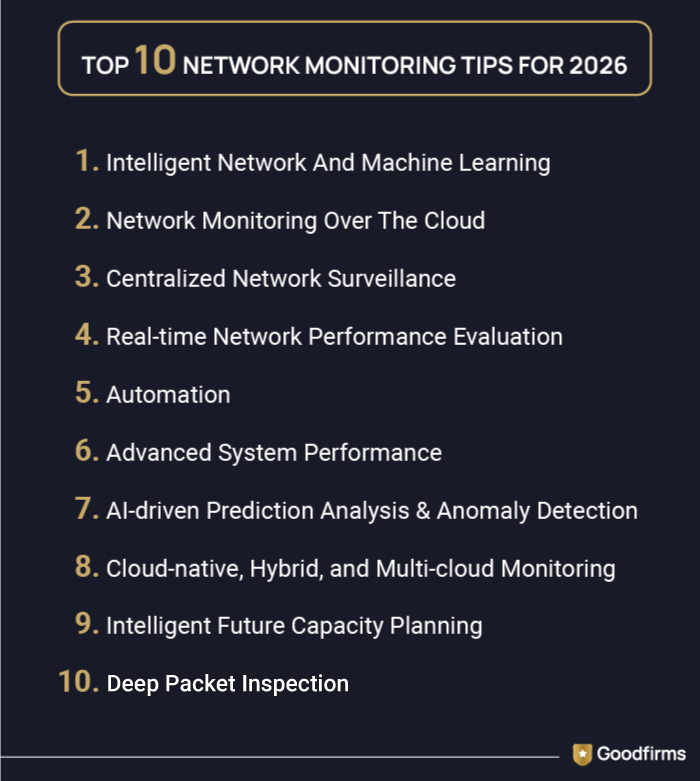
1. Intelligent Network and Machine Learning
Remotely manageable and automatically adjustable broadband node and amplifier devices and management software is the concept of an intelligent network. Analyzing network data, identifying patterns, and making predictions to automate tasks with the assistance of algorithms is machine learning in the network.
The traditional methods of monitoring and responding to abnormal behavior and patterns seem outdated in this rapidly growing tech era. Network intelligence enables the performance-driven side of monitoring with real-time diagnosis, machine learning, and previous patterns to highlight risks in the network.
Pro Tip: Divide network monitoring segmentation into
1). Traffic flow monitoring – to identify bottlenecks and troubleshoot connectivity
2). SNMP-based monitoring – fetch details from routers, switches, and servers
3). Active Network Monitoring – keep watch on pinging and traceroute.
2. Network Monitoring Over the Cloud
Cloud-based operations like applications, activities, and resources are supervised by the cloud-native monitoring tool by collecting data of metrics, logs, and traces to ensure performance, availability, and efficiency.
On-premise server, hybrid cloud, and multi-cloud monitoring requires a one-stop solution that enables active watch on IT activities. A centralized network monitoring observability tool that keeps watch on network devices allows data insights into overall activities. The market size of cloud monitoring is expected to grow to USD 9.37 billion by 2030 at a Compound Annual Growth Rate of 21.4% from 2025 to 2030.
Pro Tip: Make sure that your monitoring tool is compatible with numerous cloud-native platform solutions, including AWS CloudWatch, Azure Monitor, and Google Cloud Operations Suite, to get data insights on a single dashboard.
3. Centralized Network Surveillance
Observability of network devices, logs, system performance, uptime, downtime, etc., in the network from a specific location with a single tool dashboard to manage running operations is centralized network surveillance. Port 161 of Simple Network Management Protocol (SNMP) is responsible for the centralized observation of networking devices, tools, technologies, and configurations. Sending Internet Control Message Protocol (ICMP) and traceroute messages to the server only to find out that the server is responding, operational, and there are no issues detected enhances the performance of the IT infrastructure.
Organizations with on-premise servers and looking to shift towards hybrid cloud can benefit from centralized surveillance of the infrastructure via monitoring tools. Any outages, downtime, and performance can be addressed with a quick solution due to the central point of monitoring activities. This way, organizations benefit from avoiding costly downtime and resolving issues quickly to ensure performance, availability, and efficiency.
Pro Tip: Utilize centralized tools with the 5 Ps model of predict, prevent, plan, participate, and perform to observe and manage network resources.
4. Real-time network performance evaluation
Finding out the health, and performance insights of operational network devices in real-time by updating hardware and software that are found outdated, appropriate router placement, and reducing network congestion.
5G expansion has enabled high speed of IT operations, and 6G technology on its way makes it challenging to capture packets in real-time. With advanced monitoring tools that analyze key metrics like bandwidth usage, response time, and loss of packets, businesses can analyze the overall performance of the network.
Pro Tip: Utilizing advanced monitoring tools like PAESSLER PRTG and ManageEngine OpManager enable smart monitoring sensor technology via simple management network protocol (SNMP), Secure Shell (SSH), Windows Management Instrumentation (WMI), bandwidth via packet sniffing, etc.
5. Automation
Network performance automation software provides configuration, management, and operations enabling proficiency and reducing human error. Command-line instructions in the software with API-based automation enable network device configuration in the IT infrastructure.
Network Automation comes with affordable operating costs, and is reliable. A report by datacenterdynamics stated that two-third of downtime is caused by human errors, and automation is the prime solution to limit disruptions.
Pro Tip: Invest in automation software backed by AI technology to avoid network errors like downtime and misconfigurations in your data centers.
6. Advanced System Performance
The count score in which CPU, Memory, Storage, and Processors to achieve desired goals rapidly by eliminating unnecessary background processes, junk file cleaning, and automating tasks to enhance performance.
Systems and network devices shutting down without any reason leads to packet loss and interrupts business operations. Therefore, keeping a check on the health and performance of CPU, Memory, Disk, NIC Card, and ARP is notably important.
Pro Tip: Strategically update & upgrade your hardware and software to eliminate unnecessary trash in your system and enhance maximum proficiency.
7. AI-driven Prediction Analysis & Anomaly Detection
Unusual behavior and patterns in IT infrastructure detection enable efficiency and productivity by finding operational issues and resolving them faster. Also, predicting the future of the network via historical data and previously found patterns with modern tools & technologies assists in operational efficiency.
By discovering anomaly, it becomes straightforward to identify unknown challenges, and robust prediction data insights help in addressing issues and preparing strategies accordingly.
Pro Tip: Follow the 3 SIGMA rule (the 68-95-99.7 rule) statistical guideline of anomaly detection and quality control.
8. Cloud Native, Hybrid, And Multi-Cloud Monitoring
The process of observing logs, metrics, and any other cloud resources and web applications used can be supervised through native cloud monitoring tools or else any specified centralized monitoring tool. Designing, developing, and deploying applications on the cloud requires keeping watch on containers and microservices with advanced tools and technologies to ensure operational efficiency in the cloud native network environment. Hybrid Cloud requires the best of both on-premises or dedicated private cloud and one or more public cloud providers to deploy applications. Whereas, in multi-cloud applications, they can be deployed in more than one public cloud, such as AWS, Azure, and Google Cloud Platform.
Pro Tip: Use a centralized integrated network management tool to gain all the data insights of your network in one place.
9. Intelligent Future Capacity Planning
Network Devices require regular upgrades, updates, and patches to eliminate unwanted disruptions. Tracking the demand, and forecasting the growth will help in intelligently planning the future capacity of networking devices. Any unpredicted traffic will be difficult to handle. A clear strategy and planning for scalability is key to efficient network monitoring in 2026. Old and outdated systems need to be replaced. A strategic and intelligent approach is required to plan the future IT capacity, and to budget accordingly. Updates and upgrades enable smooth operations, while capacity planning discovers current capacity, traffic distribution, real-time usage, throughput and latency, shortfalls, and gaps in the data transfer across the network.
Pro Tip: Utilizing advanced monitoring tools can help manage workload imbalances with the assistance of real-time data that helps in proactively adjusting resource allocation.
10. Deep Packet Inspection
Conducting the inspection of a packet before it enters the network for security purposes by the firewall devices. In the DPI method, the firewall not only examines and analyzes headers of the packets but also the content they carry to ensure deep inspection for proficiency and security. With the DPI method, organizations can reduce mean time to knowledge (MTTK), which results in increasing mean time to resolution (MTTR), and it also prevents sensitive data leakage by identifying unauthorized transfer.
Pro Tip: Utilize SSL & TLS to ensure that data packets are being inspected fully with their entire content and not just by the header details for quality control.
Pro Tip for Building Smart and Future-Ready IT Infrastructure
To build a smart, sustainable IT infrastructure, organizations must prioritize agility, resilience, and security, and use automation and emerging technologies, such as artificial intelligence. Follow the steps given below;
- Define goals that align with both immediate priorities and long-term strategic visions.
- Audit existing systems to identify inefficiencies, performance bottlenecks, and areas for improvement.
- Design infrastructure to support business expansion, evolving workloads, and emerging technologies.
- Deploy automation and artificial intelligence (AI) to drive predictive analytics, automate configuration, detect anomalies, and enable self-healing systems.
- Integrate edge computing and IoT ecosystems to accelerate localized, data-driven decision-making.
- Embrace cloud technologies.
- Implement a Zero-Trust security framework by mandating multi-factor authentication and real-time identity evaluation.
- Update systems frequently, conduct regular audits of vulnerabilities, and perform penetration testing to identify and mitigate potential threats.
- Establish and test disaster recovery and backup protocols to guarantee operational continuity.
- Upskill and retrain IT teams continually to keep pace with technological advancements and evolving methodologies.
The secret of network monitoring that no one shares
Monitoring network devices and reacting to alerts is not enough for an IT organization; responsible IT firms need to implement a strategic approach and plans to be prepared for uncertain challenges, trends, and market volatility.
Efficient network monitoring is vital for uninterrupted IT performance. IT firms are required to follow best practices and need to create robust strategies to safeguard the network from downtime.
Network Monitoring tools backed by Artificial Intelligence enable IT administrators to quickly address potential threats and filter out logs with severity levels low, medium, high, and critical. It also helps in identifying false positives based on previously found patterns, saving time to address monitoring issues that matter the most.
Moreover, the concept of AI-backed Self-healing networks can patch itself with automation in case it gets injured, which makes network monitoring with AI a robust solution.
Key Takeaways
- Maintain a single, clear view of all technology—across cloud, hybrid, and on-premises systems—as you increase cloud usage and support remote employees.
- Building on this need for visibility, apply AI, automation, and machine learning to monitor networks, catch early warnings, and prevent downtime before it reaches users.
- With improved monitoring capabilities leveraging new-gen network monitoring and management tools, and by adopting zero-trust security models, security and performance monitoring can be managed in tandem. This helps IT teams quickly spot the difference between routine network hiccups and serious security problems.
- New age network tools are easy for businesses to customize, upgrade, and integrate with their existing technology.
- Focus is on balancing new technology with strict regulations.
Conclusion
In 2026, monitoring network devices, configuration, tools, and technologies in IT infrastructure requires robust strategies. Advanced tips, techniques, and tactics discussed here will help to stay ahead and competitive in the upcoming days. An AI-driven approach to supervising the network activities can help in proactively addressing challenges and optimizing overall performance.


