Key takeaways
- The important roles of PAM in iGaming go far beyond account creation — every player action, payment, and compliance decision runs through it.
- The global gaming market is projected to grow from USD 360.43 billion in 2025 to USD 1,091.40 billion by 2034 — making PAM a consequential infrastructure decision for any operator.
- A vendor with a strong PAM will answer every due diligence question directly. One that cannot is showing you something important.
You often come across the term Player Account Management (PAM) if you run an online casino or sportsbook. Most operators treat it as just another back-office tool — something that handles registrations and keeps records. They think it comes bundled with the platform.
That is where the real problem starts.
PAM is not a feature. It is the control layer through which your entire operation runs. PAM's decisions in the background drive everything the player sees. And once you are locked into it, changing anything becomes harder than expected.
According to Fortune Business Insights, the global gaming market stood at USD 360.43 billion in 2025 and is expected to grow to USD 1,091.40 billion by 2034, driven by a CAGR of 13.10% between 2026 and 2034. That growth underscores the important roles of PAM in iGaming, extending beyond account creation and having long-term consequences for operators' infrastructure decisions.

This blog breaks down those roles, why each matters, and what to look for when choosing the right PAM for your operation.
Your PAM decision starts here. Goodfirms has reviewed and listed the leading Player Account Management providers andiGaming & Casino platforms. Filter by features, operator reviews, and regional coverage — and find the right fit before you sign anything.
Why is PAM Important in iGaming?
Ask most operators what a PAM platform does, and they'll start with player registrations. Ask what stops working when the PAM goes down, and the answer gets a lot longer: payments, wallets, bonuses, compliance checks, responsible gambling controls, and player access can all be affected.
That's because PAM sits at the center of nearly every operational process in an iGaming business. Every player action flows through it—from account creation and identity verification to wallet top-ups, bet placement, bonus redemption, and withdrawals.
In recent years, the iGaming industry has become more complex. Operators now face stricter compliance requirements, fragmented licensing frameworks across jurisdictions, growing fraud risks, and rising expectations for personalized player experiences.
All of this has made PAM even more important. It affects revenue, regulatory approval, market entry speed, and player retention.
The right PAM does more than keep things running. Here is what operators actually gain from it.
What do Operators Gain From a Strong PAM System?
A well-built PAM gives operators a measurable edge across five areas that directly affect revenue, compliance, and growth.
- Faster, cleaner onboarding — Automated KYC and risk-based verification get players into the platform quickly without creating compliance gaps.
- Lower fraud exposure — Real-time behavioral monitoring and dynamic risk scoring catch bonus abuse, multi-accounting, and payment fraud before they cost you money.
- Retention campaigns that actually work — A strong bonus engine and deep player segmentation give your CRM team the tools to run personalized campaigns, not just broadcast generic offers.
- Multi-market growth without rebuilding — Native jurisdiction configuration means entering a new regulated market is an operational decision, not a development project.
- Compliance you can prove — Every KYC check, AML alert, and responsible gaming intervention is logged, time-stamped, and audit-ready — so when a regulator asks, you have the answer.
Before picking the right one, you first need to understand what PAM actually does day to day.
What are the Important Roles of PAM in iGaming?
Behind every smooth player experience is a PAM system doing quiet, critical work. These are the roles that make it the most important infrastructure decision an iGaming operator makes.
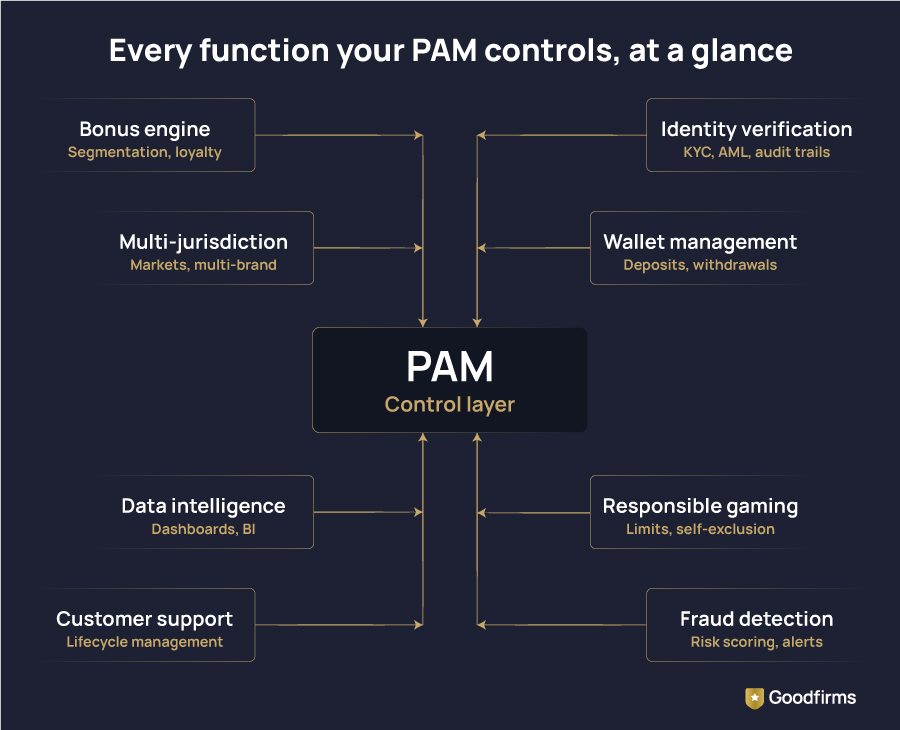
1. Identity Verification and Compliance
When a player signs up, PAM triggers identity verification workflows, checks documents against KYC databases, screens names against sanctions lists, and confirms in real time whether the player is from a restricted jurisdiction.
If there are too many manual steps, players may leave before they deposit. If there are too few steps, compliance exposure can increase. Stronger PAM systems adjust verification intensity based on risk level, deposit size, and jurisdiction. AML monitoring runs in parallel from the start. It records device fingerprints, IP addresses, and registration behavior as a baseline for all future activity.
Operators who cannot demonstrate systematic, documented compliance processes may face fines, license suspensions, and reputational damage.
Regulatory frameworks such as UKGC and FATF-aligned AML standards require operators to maintain complete, time-stamped audit trails covering onboarding, transactions, and player activity. Without this level of traceability, compliance obligations cannot be fully demonstrated.
Under the UKGC’s License Conditions and Codes of Practice (LCCP), licensed operators are required to provide the Gambling Commission with accurate records of gambling activity, customer interactions, and compliance checks - on request and without delay. PAM makes this possible by logging every action automatically.
Source: UKGC LCCP, Section 15 - Information requirements
If a PAM locks you to a single KYC provider and that provider fails to meet a new regulatory requirement, switching it out may require platform-level development work. That is an operational risk that often gets overlooked during the sales process.
Regulatory reality:
Regulators expect operators to maintain full audit trails. PAM makes this possible by logging every compliance action.
2. Wallet Management and Payment Processing
Once a player's account is verified, they usually make a deposit and start playing. This is where PAM's wallet management system becomes important. It tracks deposits, withdrawals, bonus credits, bets, and refunds, and automatically updates account balances.
During major sporting events or busy tournament periods, thousands of transactions can occur simultaneously. A PAM system that cannot handle that load can cause delayed payments, failed withdrawals, and balance discrepancies. Players will then feel frustrated because the experience is poor.
PAM supports multiple currencies and connects to a range of payment providers. It can reroute transactions to alternative methods when the preferred option is unavailable. For withdrawals that require additional checks, the system can automatically flag them for review.
When operators enter new markets, payment flexibility is key. Players are used to local payment methods they already know and trust. A PAM system that supports a wide range of payment options provides a smoother player experience.
Operational impact:
Even a small delay in withdrawals can significantly reduce player trust and retention.
3. Responsible Gaming Controls
Responsible gaming has moved from a best practice to a legal requirement in most regulated markets. PAM is the system that enables those controls.
Deposit limits, session time reminders, reality checks, self-exclusion programs, and cooling-off periods — these features all live inside PAM.
When a player hits a deposit limit they set, PAM enforces it. When a player requests self-exclusion, PAM applies it across every channel and logs the action for regulatory audit purposes.
Responsible gaming tools vary widely across PAM providers. Basic systems offer standard limits but require manual setup for each market. More advanced systems let operators set different rules per region automatically — so a UK player gets UKGC-compliant controls while players elsewhere get what their local rules require — without a development request each time.
Leading PAM systems have built-in intervention logic. If a player's deposit frequency, session length, or loss patterns match indicators of problem gambling, the system triggers a responsible gaming prompt without waiting for manual review.
Compliance reality:
The strength of gaming controls depends entirely on how well PAM enforces them
4. Bonus Engine and Player Retention
The bonus engine inside your PAM determines what kinds of promotions you can actually run. Basic systems handle welcome bonuses and free spins with standard wagering requirements.
If your CRM team wants to send a targeted offer to players who haven't deposited in 14 days — filtered by preferred game type and with a custom wagering requirement — the PAM's bonus engine needs to handle that out of the box, without a development request every time.
PAM collects rich behavioral data, including which games players prefer, when they typically play, how they respond to different offer types, and their average deposit amounts.
A PAM with strong segmentation capability turns that data into actionable audience groups. A PAM with weak segmentation leaves your retention team broadcasting generic promotions to your entire player base and wondering why conversion rates are low.
Loyalty programs extend the same logic. Tiered VIP systems, points accumulation, milestone rewards — all of these require PAM to track player behavior over time and apply the right logic to the right accounts automatically. Manual management of loyalty at any meaningful scale is simply not viable.
Business impact:
The strength of PAM directly determines how advanced your CRM strategy can be.
5. Fraud Detection and Risk Management
Fraud prevention is a constant challenge in iGaming.
PAM helps detect:
- Bonus abuse
- Multi-accounting
- Identity fraud
- Payment fraud
- Betting anomalies
- Chip dumping
- Card fraud
- Gnoming
PAM monitors for all of them by analyzing player behavior against established baselines and flagging accounts that deviate in suspicious ways. It uses device fingerprinting, IP tracking, behavioral analysis, and risk scoring to identify problems before they escalate.
When a player opens a second account on the same device, PAM recognizes it. When a group of accounts shows coordinated betting patterns consistent with chip dumping, PAM signals it for review.
Risk scoring in most modern PAM systems runs without waiting for a human analyst to notice something is off. Each account is assigned a dynamic score based on live behavior, and when that score crosses a set threshold, the system triggers an alert or takes an automated action. This is important for operators running at scale, as manually reviewing every flagged account is not possible.
The fraud layer also ties directly into compliance. Suspicious activity reports, required under AML rules in most jurisdictions, are easier to produce when PAM has already flagged and documented the relevant behavior.
Risk insight:
Advanced PAM systems shift fraud detection from reactive to proactive
6. Multi-Jurisdiction and Multi-Brand Management
PAM enables operators to run across multiple markets without rebuilding their entire operations for each one.
Each jurisdiction has its own set of requirements — geo-restrictions, tax handling, responsible gaming controls, reporting standards, and payment method limitations. A PAM that manages these natively lets operators configure each market independently from a single control layer, rather than maintaining separate technical environments for every region.
For operators running multiple brands, PAM provides the infrastructure to manage each brand's player base independently while sharing core infrastructure. Player data remains isolated per brand, while compliance, payments, and day-to-day operations can be managed from a single place.
This is where the difference between bundled and standalone PAM becomes most visible. A bundled PAM built for a single-market operator will reveal its limitations the moment you try to expand. Adding a new market means raising development tickets for jurisdiction rules, getting vendor approval for new payment methods, and waiting on support for compliance changes — all of which slow growth and push up costs.
Scaling reality:
Without PAM, expanding into new markets often requires rebuilding core systems.
7. Data Management and Business Intelligence
When a player interacts with a platform, it generates data. PAM stores this data. How well you can access and use it determines how intelligently your operation runs.
The reporting and analytics layer built on that data enables operators to make informed decisions about product, marketing, and operations.
Real-time dashboards that show active player counts, live transaction volume, and current compliance flags help operations teams respond quickly to problems.
Historical data analysis supports strategic decisions about which markets to expand into, which game categories are driving retention, and where responsible gaming interventions are most needed.
Player data generated through your PAM belongs to your operation — but whether you can actually access it cleanly, export it fully, and take it with you if you change vendors depends entirely on the contractual terms you agreed to when you signed up.
Operators who have migrated platforms consistently report that data portability limitations were the biggest friction point. It is worth asking about this before you need it.
Operator truth:
Operators can’t optimize what they can’t measure.
8. Customer Support and Player Lifecycle Management
When a player contacts the support team about a missing withdrawal or a bonus that didn't credit, the agent needs instant access to that player's full account history. The quality of the PAM interface directly affects how quickly and accurately support agents can resolve issues.
PAM monitors a player’s journey — new, active, lapsed, or at-risk — and makes that context available to your CRM and support teams. A player who hasn't logged in for 30 days gets a different message than one who logged in yesterday. A player showing early signs of problem gambling receives a responsible gaming prompt, not a bonus offer.
When the PAM and CRM connection is clean, teams can act on player data in real time. When it isn't, they're making decisions on outdated information.
Operational dependency:
PAM is only as useful as the data it surfaces.
Once you understand what PAM does, the next step is evaluating which software actually delivers on these roles. The table below gives you a starting point.
Which PAM Software is best for iGaming Operators?
There is no universal “best PAM system.” The right choice depends on scale, region, product strategy, and regulatory complexity.
Below is a simplified industry comparison of widely used PAM providers.
|
PAM Provider |
Best For |
Key Strengths |
|---|---|---|
|
EveryMatrix (GamMatrix) |
Large-scale operators |
Modular architecture, high-volume wallet, AML tools, multi-currency support |
|
Soft2Bet PAM |
Retention-focused brands |
MEGA gamification, CRM, bonus engine |
|
Pragmatic Solutions |
Regulated multi-market operators |
Open API, multi-brand support, built-in KYC/AML, jurisdiction configuration |
|
GR8 Tech |
Sportsbook + casino operators |
High-volume infrastructure, crypto-ready wallet, no-code compliance flows |
|
Bragg Gaming PAM |
New market entrants |
Omnichannel PAM, casino-sportsbook support, integration with turnkey iGaming platform |
|
Playtech PAM+ |
Tier-1 regulated operators |
Omnichannel platform, single-wallet architecture, advanced CRM, turnkey operator support |
But choosing a provider is only half the decision. The bigger question is which model you choose.
Bundled vs Standalone PAM: Which is Right for Your Operation?
A bundled PAM comes pre-packaged with your gaming platform. A standalone PAM is purchased separately and connected to your platform and other tools independently.
For a single-market launch, you can go live faster with a bundled PAM that requires less integration work.
The issue isn’t bundled PAM itself. Once you're locked in, switching providers or making changes can be costly and slow- a dynamic we cover in detail in our guide on how bundled PAM creates vendor lock-in. So before signing, ask the vendor questions about flexibility, data ownership, and how easy it is to leave if needed.
These are standard due diligence questions for any infrastructure decision. A vendor with a strong PAM will answer them directly. One with a weak PAM will deflect.
Bundled vs Standalone PAM: A Quick Comparison
|
Factor |
Bundled PAM |
Standalone PAM |
|
Best for |
Single market, early-stage operators |
Multi-jurisdiction, multi-brand operations |
|
Time to launch |
Faster — less integration work upfront |
Slower — more evaluation and setup required |
|
Compliance flexibility |
Limited — tied to vendor's tooling |
Full — operator controls their own stack |
|
Data ownership |
Depends on vendor contract terms |
Negotiated independently, higher portability |
|
Migration risk |
Higher — lock-in builds over time |
Lower — terms set before dependency grows |
|
Jurisdiction support |
May need vendor help per market |
Configurable independently per market |
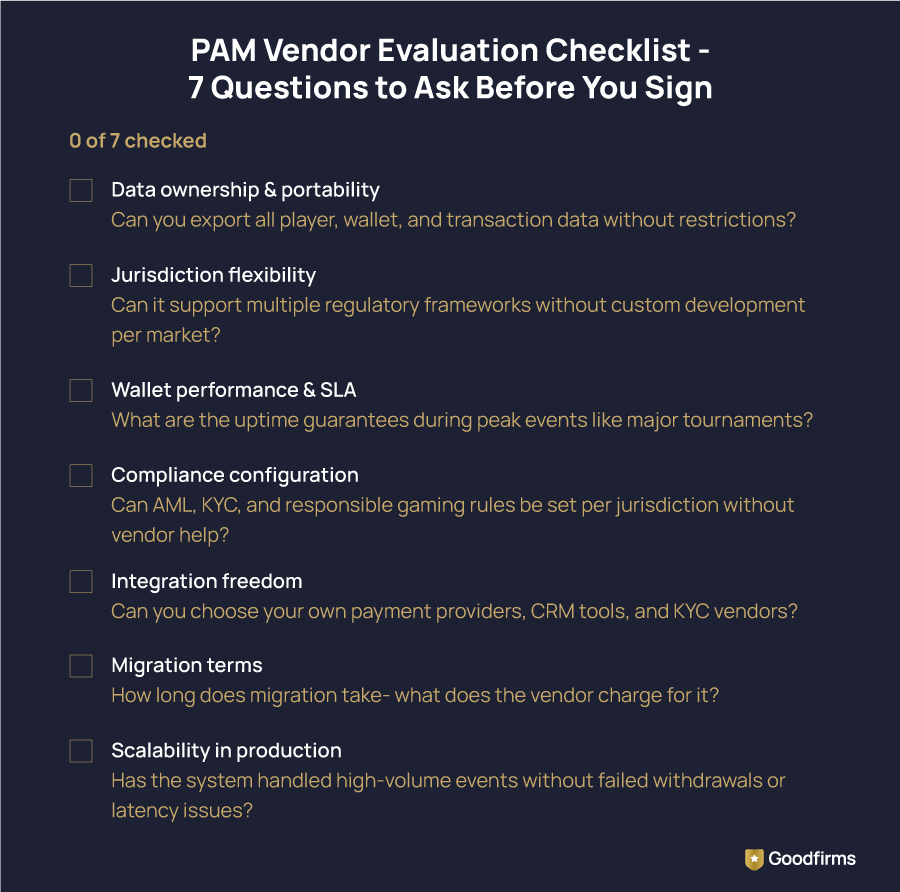
PAM Vendor Evaluation Checklist — 7 Questions to Ask Before You Sign
Here's a practical checklist to use when evaluating PAM vendors:
Why is Choosing the Right PAM a Strategic Decision?
Most operators don't think seriously about PAM until something goes wrong — and by then, fixing it costs far more than getting it right from the start would have.
The important roles of PAM in iGaming go far beyond registrations and record-keeping. The player who deposits for the first time, the high-value customer your retention team is trying to keep, the compliance officer preparing for a regulatory review — they all depend on the same system working the way it should. That is not a back-office function. That is the core of how your business runs.
FAQs - Important Roles of PAM in iGaming
What is PAM in iGaming?
PAM stands for Player Account Management. It is the central control layer of any online gaming or sportsbook platform. It manages everything from player registration and identity verification to payments, bonuses, compliance, and responsible gaming controls.
Why is PAM important for online casino operators?
PAM determines how efficiently your platform runs, how effectively you retain players, and how consistently you meet regulatory obligations. Without a robust PAM, scaling into new markets, running personalized campaigns, and maintaining compliance audit trails all become significantly harder.
What is the difference between bundled and standalone PAM?
A bundled PAM comes with your platform. It is quicker to set up but gives you less control over your data, compliance tools, and exit terms. You have to choose and contract a standalone PAM separately, which gives you more flexibility but requires more upfront work to evaluate and integrate.
How does PAM support responsible gaming?
PAM enforces player-set limits, applies self-exclusion rules across all channels, monitors behavioral patterns for signs of problem gambling, and logs every intervention for regulatory audit purposes. Advanced systems trigger automated responsible gaming prompts based on behavioral indicators before a player reaches a crisis point.
Can PAM handle multiple jurisdictions and brands?
The best PAM systems can. They allow operators to configure different jurisdiction rule sets, responsible gaming controls, payment methods, and reporting standards from a central management layer, without requiring separate technical environments for each market.
What should operators ask PAM vendors before signing?
Ask specifically about data portability terms, KYC provider flexibility, jurisdiction configuration autonomy, wallet SLAs, migration processes, and whether migration support is included in the contract or billed separately. Strong vendors will answer these directly. Weak ones will not.