Key takeaways
- Most iGaming operators never consciously choose their PAM. Their platform vendor chooses it for them. By the time the consequences show up, the operator is already dependent on a system they never evaluated
- PAM is not a feature set. It is the control layer that every player action, compliance decision, and retention tool runs through.
- Data ownership is contractual, not automatic. You own your data is not the same as having clean, unconditional access to it on termination
- Compliance tooling tied to your vendor's preferred providers means you need your vendor's cooperation and budget to meet your own regulatory obligations.
- Migration is where bundled PAM costs show up. The gap between what vendors promise and what migration actually involves is the most consistent theme in post-launch operator reviews.
- Bundled PAM is not always wrong. It is wrong to accept it without reading the data portability clause, the wallet SLA, and the migration terms.
iGaming PAM software sits at the center of every online casino operation, but most operators don’t actually choose it. It comes bundled with the platform, accepted by default, and rarely questioned until something breaks.
That’s where the real problem starts. Because PAM is not just another feature in your stack. It controls player data, payments, compliance workflows, and how your business runs day to day. And once you are locked into it, changing anything becomes harder than expected.
This guide breaks down what iGaming PAM software really does and how to evaluate it properly before you sign anything.
What is iGaming PAM Software and What Does It Actually Control?
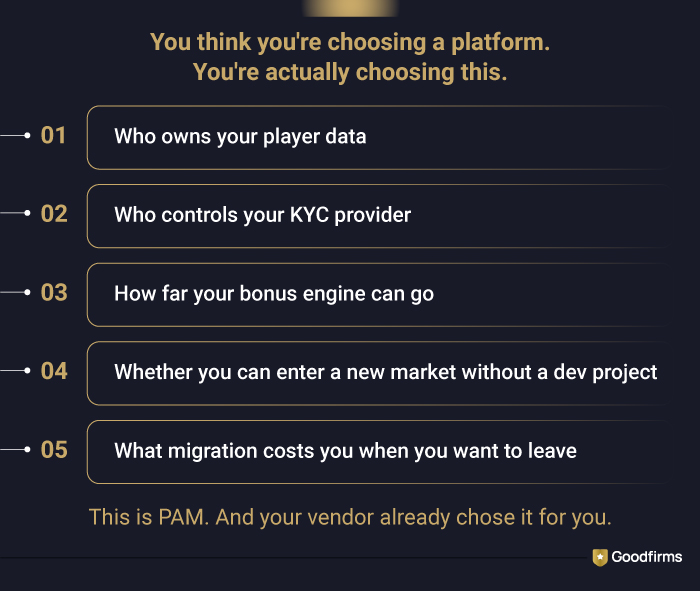
iGaming PAM software is the control layer that every player action, compliance decision, and retention tool runs through. It is not just a feature set, but the operational foundation of your entire platform.
Ask any vendor to define player account management iGaming, and you will get the standard list: player registration, login, wallet management, KYC, AML, bonuses, reporting, etc.
This list describes what iGaming PAM software handles. It doesn't describe what PAM is as it is not a feature set but a control layer.
Every player action inside iGaming PAM software, like deposits, withdrawals, game sessions, bonus triggers, compliance checks, etc passes through it. Every tool your team uses to support, retain, and manage players depends on the data it manages. If your iGaming payment solution provider changes, PAM handles the transaction logic. If you expand to a new market, PAM enforces the jurisdiction rules. If your marketing team wants to personalise promotions, PAM decides how far they can actually go.
iGaming PAM software quietly defines how the platform operates every single day. Find the best iGaming PAM software vendor and compare verified vendors, capabilities, and real operator reviews on Goodfirms to understand how different iGaming PAM systems perform in real-world scenarios.
Why Bundled iGaming PAM Software Creates Vendor Lock-In
Bundled PAM creates vendor lock-in because it ties your data, compliance tooling, and migration terms to a single provider. Vendors bundle iGaming PAM software because it simplifies their sales process and deepens the commercial relationship. But it can create a structural problem. Three realities tend to surface too late.
Data ownership in iGaming PAM software is not guaranteed by default
Inside iGaming PAM software, player identity, balance history, transaction records, and behavioural data are generated by your operation but stored inside your vendor's infrastructure. Whether you can export all of it in a usable format, without a fee, under any termination scenario.
Compliance dependencies inside an iGaming back office platform
iGaming back office platform compliance tooling, like KYC integrations, AML triggers, responsible gaming controls, etc., is often tied to third-party providers chosen by your vendor. You may not know which KYC provider your PAM runs on, or whether you can substitute it if a regulator requires a different one, or if the pricing becomes uncompetitive. Swapping a KYC software provider mid-operation, when you don't control that integration, you may require paltform level development. And for that you need help from casino game development companies.
Why iGaming PAM software migration is never as simple as promised
Vendors describe migration in optimistic terms during sales: seamless transfers, no downtime, minimal friction. Operators who have been through platform migrations describe it differently. It almost always traces back to PAM: data portability limitations, undocumented business logic that didn't transfer, or migration support that turned out to be billable separately.
How to Choose iGaming PAM Software (Six Things That Actually Matter)
Most vendors will show you feature lists. What you need to understand is how to choose iGaming PAM based on how it behaves under pressure, at scale, and over time. These are evaluation criteria, each with specific questions to ask, because the question matters as much as the answer.
1. Data ownership and portability in iGaming PAM software
This is the first thing to get clarity on when evaluating iGaming PAM software. It is also the area where the gap between verbal assurance and contractual reality is widest. Player identity, full transaction history, behavioural data, bonus usage logs, compliance audit trails: can all of it be exported in a structured, machine-readable format, without a fee, under any termination scenario?
Ask for the specific contractual clause, not a general assurance. Ask about format, timeline, cost, and whether any data categories are excluded.
Ask: "Can we see the exact data portability clause in the standard contract, including which data categories are covered and which are excluded?"
2. Compliance tooling and KYC flexibility in PAM software for online casinos
Is the KYC and AML layer built natively into the PAM, or does it depend on a third-party integration? Neither approach is wrong, but you need to know which providers are involved, who controls the commercial relationship with those providers, and whether you can substitute a different KYC or AML software provider if you need to.
In iGaming PAM software, compliance requirements are not static. New regulations, new markets, and new cost structures all of these may require compliance tooling changes mid-operation. If you don't control that integration, you are dependent on your vendor's timeline and your vendor's pricing to make changes that are legally required of you.
Ask: "Which KYC and AML providers does your PAM integrate with, and can we substitute our own provider if we need to?"
3. Jurisdiction flexibility across iGaming back office platforms
Expanding into new markets sounds straightforward until compliance comes into play. Different jurisdictions require geo-restrictions, specific responsible gaming features like time-outs, deposit limits, reality checks, self-exclusion programmes, different reporting standards, and different tax handling. Your PAM software online casino should handle these without requiring major development work every time you enter a new region.
Ask: "If we need to adjust responsible gaming settings for a specific jurisdiction, like adding a new reality check interval, can we do that ourselves, or does it require development work from your team?"
4. Scalability of iGaming PAM software under real transaction load
Every iGaming PAM software vendor claims scalability. What matters is how the system behaves during peak load, high deposit volumes during major sporting events, sudden spikes in active users, and bulk KYC processing. These are not edge cases in iGaming. They happen regularly.
Get the SLA specifically for wallet and transaction processing. A platform can be technically up while its wallet layer degrades under high concurrent transaction volume. Ask what the compensation mechanism is if the wallet SLA is breached. A vendor with confidence in their iGaming PAM software will have a specific answer. One without confidence will give you a general uptime percentage and change the subject.
Ask: "What is your documented SLA specifically for wallet and transaction processing, and what is the compensation mechanism if that SLA is breached?"
5. Bonus engine depth in player account management iGaming systems
Basic iGaming PAM software systems handle simple promotions. Stronger player account management iGaming allows genuine player segmentation, like behaviour-based triggers, multi-condition campaigns, and real-time personalisation at the individual level.
The difference determines whether your iGaming CRM software and retention team can actually execute their plans, or whether they spend their time working around system limitations.
Ask: "Can we run a personalised bonus campaign targeting players who haven't deposited in 14 days, with a specific offer based on their historical game category — entirely through the PAM's bonus engine, without custom development?"
6. Migration guarantee in iGaming PAM software contracts
In iGaming PAM software contracts, this is the area most operators don’t think about. Ask your data migration company: what migration look like if you leave? What data formats are supported? Is there a structured, documented process, or is it handled case by case? What downtime should you expect? Is migration support included in your contract, or billed separately?
Ask: "Can you show us your standard migration SLA, including data formats supported, timeline, expected downtime, and whether migration support is included in our contract or billed additionally?"
Operators who have gone through platform migrations consistently report that data extraction and undocumented business logic are the biggest friction points.
Not sure which vendors meet these criteria? Goodfirms' verified iGaming platform directory includes operator reviews that speak directly to PAM performance, migration experience, and compliance flexibility.
Common Mistakes Operators Make When Implementing iGaming PAM Software
Choosing the right iGaming PAM software is only part of the decision. Many operational issues show up during implementation, not evaluation. These mistakes are common, and they are usually avoidable.
1. Treating PAM as a plug-and-play system
iGaming PAM software is often presented as a ready-to-use solution, but in reality, it requires careful configuration across payments, compliance, and player lifecycle workflows. Without proper setup, even a strong system can behave like a limiting one.
2. Not validating real-world data flows
Operators tend to focus on features during demos but overlook how data actually moves between systems. Transaction logs, bonus logic, KYC triggers, and reporting pipelines should be tested under realistic scenarios before going live.
3. Ignoring migration planning until it’s too late
Migration is often treated as a future problem. In practice, how your PAM stores and structures data today directly affects how easy it is to move later. Decisions made at the implementation stage define your exit flexibility.
4. Overlooking dependency on third-party integrations
Payments, KYC providers, fraud detection software, and CRM are all connected through PAM. If these integrations are tightly controlled by the vendor, you inherit long-term dependency without realizing it during setup.
5. Underestimating operational load and edge cases
Peak traffic, bulk withdrawals, bonus abuse scenarios, and regulatory edge cases expose system limitations quickly. Testing only standard workflows creates a false sense of confidence before launch.
6. Leaving internal teams out of the evaluation
PAM decisions are often made at leadership level, but operational teams, especially compliance, support, and CRM, are the ones who use it daily. Not involving them early leads to friction post-launch.
Standalone vs Bundled iGaming PAM Software: Which Model Works Better
Not every operator needs a standalone PAM from day one. Bundled is not always the wrong choice. The question is whether you are making a conscious decision or simply accepting a default. Choosing between bundled and standalone iGaming PAM software depends on how much control you want over your platform and data.
| Parameters | Bundled PAM | Standalone / Independently Evaluated PAM |
|---|---|---|
| Best for | Early-stage, single market, speed-to-launch priority. | Multi-jurisdiction, multi-brand, high transaction volume. |
| Compliance | Straightforward requirements, limited customisation. | Complex, market-specific requirements, full configurability. |
| Data control | Dependent on vendor contract terms. | Negotiated independently, higher portability. |
| Migration risk | Higher. Lock-in accumulates over time. | Lower. Terms established before dependency builds. |
| Time to launch | Faster. Less integration work. | Slower. More evaluation and negotiation upfront. |
Red Flags in iGaming PAM Software Vendors You Should Not Ignore
How a vendor talks about their iGaming back office platform and what they don't say reveals more than any feature list.
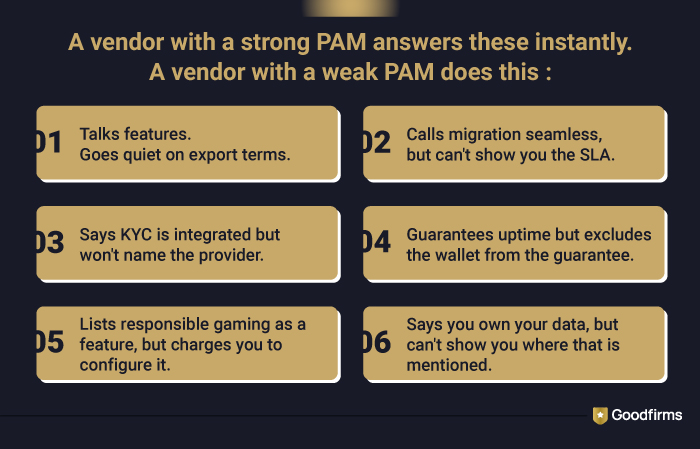
Watch for these signals
- They describe PAM features fluently but go vague or redirect when you ask specifically about data portability terms and what data export looks like in practice.
- Migration is described as seamless with no SLA attached, no documented process, and no reference to how long previous migrations have actually taken for comparable operators.
- KYC and AML tooling is described as integrated, but the vendor cannot name the underlying provider or confirm whether you can substitute a different provider at your own discretion.
- Uptime guarantees apply to the platform as a whole but not to wallet or transaction processing specifically. When you ask for the distinction in writing, the conversation slows down.
- Responsible gaming controls are listed as features but cannot be configured independently per jurisdiction. Adjustments require a development ticket routed through the vendor's team.
- When asked about data ownership under contract termination, the answer references standard industry practice rather than the specific contractual terms that govern your agreement.
- Strong systems come with clear, direct answers. Weak ones come with workarounds, deferrals, and assurances that something can be arranged.
Frequently Asked Questions Before Choosing iGaming PAM Software
Bring these into the actual vendor conversation, not as a hostile interrogation, but as a reasonable evaluation from a buyer who understands what they are purchasing. Vendors with strong PAM will welcome them. Vendors with weak PAM will hedge.
Is the iGaming PAM software proprietary or third-party?
The answer determines who controls the product roadmap. If it's a third-party system, pricing, architecture, or feature priorities can affect your operation without your input and without your vendor's ability to change it quickly.
Who owns player data and how the export actually works?
Ask for the specific contractual clause. Ask about format, timeline, cost, and whether any data categories, particularly behavioural data and compliance logs, are excluded from the standard export. "You own your data" is not the same as having clean, unconditional access to it.
What SLA covers wallet and transaction processing?
This is distinct from general platform uptime. A degraded wallet under peak load is one of the most commercially damaging PAM failures an operator can experience. Get this SLA in writing as a separate commitment, not folded into a general availability percentage.
Can you switch KYC or AML providers without friction?
If locked in, ask who controls the commercial relationship with that provider and what happens if the provider changes its pricing, coverage, or regulatory standing. Your compliance obligations don't pause while your vendor renegotiates with their supplier.
How the iGaming PAM software handles multi-jurisdiction compliance?
The answer tells you how much operational autonomy you will actually have as a regulated operator. If every jurisdiction configuration requires a development ticket, budget for it and ask how long those tickets typically take to action.
Why iGaming PAM Software Is a Strategic Decision
The scale of the iGaming industry makes this decision more than just a technical choice. According to Grand View Research, the global online gaming market is projected to grow to USD 237,922.4 million by 2030, which means higher transaction volumes, stricter compliance requirements, and more complex player lifecycles. At that scale, the systems you choose today directly shape how your business operates tomorrow.
iGaming PAM software determines how easily you can adapt to new markets, how efficiently you can manage risk, and how much control you retain over your own data and operations. These are not edge considerations. They are central to long-term performance.
Operators who treat PAM as a default platform component often discover its limitations too late. Those who evaluate it as a strategic layer tend to build systems that scale with fewer constraints. The difference is not in features, but in how early the right questions are asked and how clearly the trade-offs are understood.