Key takeaways
- The global iGaming software solutions market is expected to generate over $170 billion in platform-specific revenue by the end of 2026, driven by regulatory expansion across LatAm, North America, and Southeast Asia.
- A modern best iGaming platform combines PAM, game aggregation, compliance automation, payment infrastructure, and AI-driven retention, all in a modular, API-first stack.
- The top iGaming platform providers 2026 include SOFTSWISS, EveryMatrix, Playtech, Pragmatic Solutions, Digitain, and Soft2Bet, each excelling in different operator segments.
- Platform selection criteria must include uptime SLAs (99.9%+), compliance readiness, integration speed, payment coverage, and verifiable client outcomes.
- iGaming platform development has decisively shifted from monolithic builds to microservice-based, cloud-native architectures.
The $170 Billion Infrastructure Race Nobody Can Afford to Lose
In this heavily tech-driven day and age, launching an online casino or sportsbook without the right platforms to support it is the fastest route to irrelevance. The operators who succeed today aren't just the ones with good games and bonuses; they're the ones who turn player data into retention engines, who move faster in new markets, and who make infrastructure decisions before a competitor has opened a spreadsheet.
The worldwide iGaming and casino sector is growing rapidly, rewarding decisive infrastructure decisions. Licensing is more complex. Players' expectations have increased. Regulators are faster. The platform you select in 2026 is more than just a technology contract; it is a growth thesis.
This guide covers the six providers shaping the landscape right now, why they were selected, and what operators need to know before signing anything.
Don’t rely on vendor claims, shortlist verified iGaming casino platforms on Goodfirms, and compare real operator performance
What Is iGaming Platform?
The fundamental technological framework that drives an online gambling business from start to finish is known as an iGaming platform. In a single operational environment, it usually consists of the Player Account Management -PAM system, game aggregation layer, payment processing hub, CRM and bonus engine, analytics dashboards, and tools for regulatory compliance.
Think of it as the operating system of an online gambling company. Game content, branding, and marketing efforts are all on top of it, but without a strong platform underneath, none of it operates consistently at scale, particularly across several regulated regions.
Account management is only one aspect of the best iGaming platform available today. From onboarding and identity verification to real-time campaign triggers, fraud monitoring, responsible gaming restrictions, and cross-jurisdiction compliance reporting, it manages the whole player lifecycle.
Goodfirms Insight: Whether you're evaluating casino platform providers or sportsbook software vendors, partnering with platforms that embed KYC and AML automation at the infrastructure level results in up to 40% faster time-to-market in newly regulated jurisdictions, turning compliance from a cost center into a competitive edge.
Types of iGaming Platform Providers: What's the Difference?
Not all iGaming platform providers are built the same. Before comparing vendors, it's important to understand the different types of providers in the market — because choosing the wrong category entirely is a far costlier mistake than choosing the wrong vendor within the right one.
|
Provider Type |
What They Offer |
Best For |
Examples |
|
Full-Stack iGaming Platform |
Casino + sportsbook + PAM + payments in one system |
Operators wanting an all-in-one solution |
Playtech, BetConstruct, EveryMatrix |
|
Casino Software Provider |
Game content, slots, live dealer, RNG titles |
Operators focused on casino verticals |
Evolution, Microgaming, Pragmatic Play |
|
Sportsbook Software Provider |
Odds management, live betting, event feeds |
Sports-first platforms |
Kambi, Altenar, Digitain |
|
White-Label / Turnkey Provider |
Ready-to-launch platform with licensing support |
New entrants launching quickly |
SoftSwiss, Soft2Bet, NuxGame |
|
Game Aggregator |
Single API access to thousands of games |
Platforms integrating multi-vendor content |
EveryMatrix CasinoEngine, SoftSwiss Game Aggregator |
|
Crypto iGaming Platform |
Blockchain-native, crypto wallets, provably fair |
Crypto-first casino operators |
SoftSwiss, LimeUp, EvaCodes |
Top iGaming Platform Providers 2026
Not every platform is built for every operator. The six Casino, Sportsbook & igaming Platform providers are compared below and represent the leading choices across distinct segments in 2026, from full-stack ecosystems to PAM-specialist tools to gamification-led engagement engines.
The table below gives you a fast snapshot of where each provider stands before you dive into the details.
|
Provider |
Founded |
Key Strength |
Game Library |
Uptime SLA |
Best For |
|
SOFTSWISS |
2009 |
Full ecosystem integration |
40,000+ titles, 300+ studios |
99.999% |
Mid-to-large operators needing end-to-end stack |
|
EveryMatrix |
2008 |
Modular, multi-brand flexibility |
27,800+ titles, 317 suppliers |
99.98% |
Multi-brand operators across regulated markets |
|
Playtech |
1999 |
Omnichannel enterprise scale |
1,000+ games, 180+ licensees |
Enterprise SLA |
Enterprise operators, omnichannel retail+digital |
|
Pragmatic Solutions |
2014 |
PAM-first, compliance-driven |
Third-party via 250+ APIs |
99.998% |
Regulated market operators needing best-of-breed PAM |
|
Digitain |
~2000 |
Sportsbook depth + payments |
180,000+ monthly live events |
99.9%+ |
Sportsbook-led operators in Europe, LatAm, Africa |
|
Soft2Bet |
2016 |
Gamification and retention |
12,500+ games, 1M+ live events/yr |
99.9%+ |
Operators targeting younger, engagement-driven players |
1. SOFTSWISS
With its headquarters located in Poland, Malta, and Georgia, SOFTSWISS was founded in 2009 and has developed one of the most extensive iGaming ecosystems available. Over 1,400 iGaming brands are active in the SOFTSWISS client network's software ecosystem.
A single API is used by their integrated suite, which includes the Casino Platform, Sportsbook, Game Aggregator (more than 40,000 titles from more than 300 studios), Jackpot Aggregator, and Affiliate management.
What sets them apart: The depth of the ecosystem is matched by client satisfaction data, an 8.3/10 platform score, and 9/10 for the Game Aggregator, reported directly from client surveys.
Best for: Mid-to-large operators seeking a tightly integrated, compliance-ready ecosystem with crypto-native capabilities and fintech-grade reliability.
2. EveryMatrix
Founded in 2008, EveryMatrix Ltd. is a B2B provider of iGaming software with its headquarters located in Malta. It provides online gaming platforms, products, and software to state-owned or private lotteries, sportsbook operators, and online casinos. The company now employs more than 1,500 people in 16 locations worldwide.
Their product suite is built on true modularity: GamMatrix manages player accounts and wallets, OddsMatrix powers the sportsbook, MoneyMatrix provides a PCI-DSS-certified payment gateway that connects to more than 250 payment methods, and CasinoEngine aggregates more than 27,800 online casino games from 317 suppliers through a single API.
What sets them apart: Tier-1 lottery clients, including Norsk Tipping, OPAP, and Veikkaus, demonstrate compliance credibility at the highest level of regulated market scrutiny.
Best for: Operators running multiple brands across regulated markets who need modular independence without sacrificing integration quality.
3. Playtech
In addition to providing casino, sports, poker, bingo, and live dealer platforms to more than 180 licensees in more than 40 regulated jurisdictions, Playtech is a publicly traded B2B software firm that acts as the technological foundation for operators such as bet365, William Hill, OPAP, and Flutter brands. Playtech was founded in 1999 and employs more than 5,900 people in 19 countries.
In order to free up operator teams to concentrate on the player experience, Playtech is launching operational AI agents in 2026. These agents will apply AI to player support, CRM, KYC, AML, payments, and risk management in an optimized, automated manner.
What sets them apart: The only provider on this list that is publicly traded (FTSE 250), offering corporate transparency and regulatory accountability that private competitors cannot match.
Best for: Enterprise operators entering multiple regulated jurisdictions simultaneously, or those with existing retail operations who need a unified omnichannel infrastructure.
4. Pragmatic Solutions
Founded in 2014, Pragmatic Solutions takes a deliberately focused approach: they build best-in-class Player Account Management technology and nothing else. The company boasts a fully API-based platform with over 250 APIs for operators to integrate third-party products for payment processing, games integration, and customer retention.
Live deployments span the UK, Italy, Romania, Ontario, Brazil, and Curaçao. In 2025, they won Best iGaming Technology, Platform Provider of the Year, and Best Customer Service, a clean sweep that reflects genuine operator satisfaction.
What sets them apart: Their B2B-only focus means zero commercial conflict with operators, a meaningful distinction in an industry where some platform vendors also run competing B2C brands.
Best for: Operators in highly regulated markets who need a flexible, best-of-breed PAM without vendor lock-in or the complexity of a monolithic full-stack provider.
5. Digitain
With Sportsbook, Casino, Bonus Engine, CRM, and Affiliate Solutions designed for quantifiable outcomes, Digitain offers a comprehensive iGaming platform solution that covers 180,000+ live monthly events and 4,000+ markets, supported by a team of more than 1,300 traders and risk managers.
With more than 5,000 specialists worldwide and more than 25 years of experience in the iGaming sector, their Centrivo iGaming Platform and Paydrom payment gateway comprise a tightly integrated stack. They process €12 billion in handling annually across 35 regulated markets. The platform supports complete omnichannel delivery across online, mobile, and physical betting terminals.
What sets them apart: The in-house Paydrom gateway, integrating 60+ payment providers and 600+ methods, eliminates a critical third-party dependency that can create friction in high-volume payment environments.
Best for: Operators where sportsbook is the primary revenue driver, particularly those targeting Europe, LatAm, Africa, and Asian markets simultaneously.
6. Soft2Bet
In less than ten years from its founding in Malta in 2016, Soft2Bet has grown from a startup to a worldwide iGaming operator and B2B platform supplier. With support from a €50 million innovation fund, the company grew revenue by 88% and EBITDA by 96% in 2025. Their platform offers access to more than 12,500 games from hundreds of providers and covers more than one million live events per year across 19 licenses in 16 countries.
In addition to ambitions to double growth and penetrate at least five new regulated territories, including Alberta, Canada, and the US, the 2026 roadmap calls for the introduction of new MEGA engines, MEGA Round, MEGA Rally, and MEGA Island.
What sets them apart: MEGA is the only gamification engine of its kind to win Product Launch of the Year at the Global Gaming Awards EMEA 2025, with real data backing real engagement outcomes, not just product marketing.
Best for: Operators targeting younger, engagement-driven demographics where gamification can meaningfully extend session time and lifetime player value.
Goodfirms Insight: The global iGaming platform market is projected to cross $170 billion by the end of 2026, yet operators who choose the wrong platform technology report average time-to-market delays of 6–9 months, directly costing revenue in competitive regulatory windows.
Key iGaming Platform Trends Operators Should Know in 2026
- AI-Powered Personalization — Platforms are using AI to predict player churn, automate bonus targeting, and enforce responsible gaming limits dynamically.
- Crypto & Web3 Integration — Beyond payments, blockchain is being used for provably fair gaming, NFT-based loyalty programs, and decentralized casino infrastructure.
- Sweepstakes Casino Software — A fast-growing segment in the US market, where sweepstakes mechanics allow legal operation in non-regulated states.
- LatAm Market Expansion — Brazil's regulated market opening in 2025 has triggered aggressive expansion by providers like SoftSwiss, Kambi, and BetConstruct in Latin America.
- Gamification as Standard — Platforms like Soft2Bet's MEGA system (winner of Global Gaming Awards 2026 "Product Launch of the Year") show that gamification — leaderboards, missions, collectibles — is becoming a standard retention tool, not a differentiator.
- Compliance as Competitive Advantage — As US, UK, and Brazilian frameworks tighten, providers with pre-built compliance tools for multiple jurisdictions hold a clear edge.
How to Benchmark iGaming Platform Performance?
Choosing a provider is one decision. Verifying that they deliver what the contract promises is an entirely separate one. Here is how operators should measure igaming platform providers' performance in 2026:
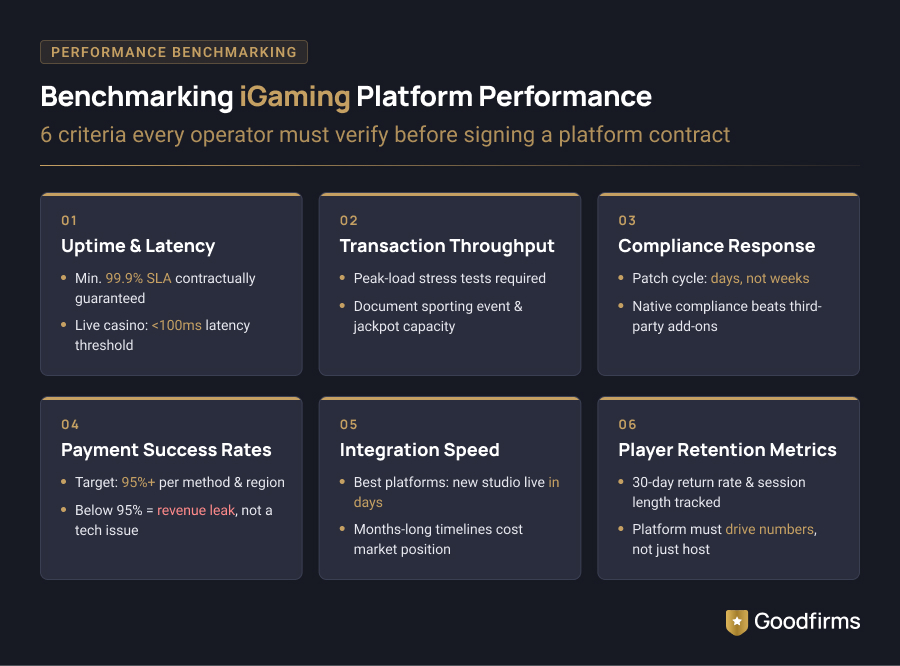
Uptime and Latency: Set a minimum contractual SLA of 99.9%. For live betting and live casino, latency under 100ms separates smooth gameplay from player churn. Request historical uptime logs, not just claimed figures.
Transaction Throughput: Can the platform sustain performance during peak events, major sporting fixtures, jackpot triggers, and promotional surges? Stress-test documentation and load-capacity reports should be provided as standard due diligence, not upon request.
Compliance Response Speed: When a new regulatory requirement is published, how quickly does the platform ship a compliant update? Those relying on third-party compliance additions can take weeks, and in regulated markets, that gap is a licensing risk. Operators who separately implement iGaming compliance tooling should ensure it integrates cleanly with their core platform without creating workflow gaps.
Payment Success Rates: Track deposit and withdrawal success rates by payment method and region. A platform with transaction success below 95% is not a technology problem; it is a revenue leak and, in most cases, a player trust problem that compounds over time.
Integration Speed: How long does it take to go live with a new game studio, payment gateway, or market localization? The strongest platforms in 2026 deploy new integrations in days. Anything measured in months is costing you competitive positioning.
Player Retention Metrics: Benchmark 30-day return rates, average session length, and bonus redemption rates against industry norms. A quality platform actively contributes to these numbers through intelligent triggers and personalization; it doesn't just passively host the product.
Goodfirm Insight: Platforms with 99.9%+ uptime improve player retention by reducing downtime-related churn and ensuring a consistent gameplay experience.
How Goodfirms Helps Operators Make Smarter Platform Decisions
With hundreds of game development vendors competing for iGaming operator attention, knowing who to trust is genuinely difficult. That's where Goodfirms changes the equation.
Goodfirms is a trusted B2B ratings and review platform that helps businesses identify top-rated igaming platform providers. We have independently verified companies' presence and a systematic research methodology, which gives operators direct access to real-world performance data, not vendor pitch decks.
Every provider listed on Goodfirms is evaluated on documented expertise, verified project history, and market presence. For an operator narrowing down a platform shortlist, that means:
- Verified comparisons - evaluate providers side by side on capability, compliance record, and specialization, all in one place.
- Honest operator reviews - read anonymous experiences from real gambling businesses that have run these platforms in live, regulated environments.
- Category-level precision - whether you need a full-stack platform, a standalone game aggregator, or a dedicated player account management software, Goodfirms filters to your exact need.
- Faster decisions - backed by peer validation and independent research rather than sales-cycle promises.
Millions of businesses globally trust Goodfirms to navigate high-stakes technology decisions. For iGaming operators in competitive, fast-moving markets, trust infrastructure matters enormously.
How We Selected These Six iGaming Platform Providers
This is not a paid list. Every provider below was evaluated against the same framework, the same methodology that any serious operator should apply when building a shortlist. Here is exactly what drove the selection:
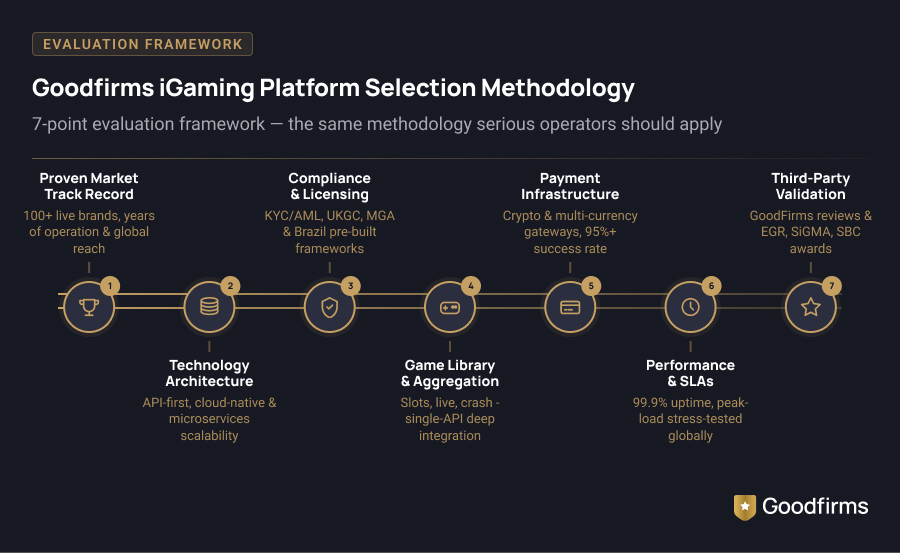
1. Proven Market Track Record - Each provider was assessed on years in operation, number of active live brands, geographic markets covered, and verifiable client outcomes. Vendors running 100+ live operations across multiple regulated jurisdictions carry a weight of evidence that vendor claims alone cannot match.
2. Technology Architecture - The priority is given to API first, microservices-based platforms, Cloud- native infrastructure, containerized deployment, modular components, and more to allow operators to scale, integrate, and iterate without rebuilding from the start. It is a critical operational advantage.
3. Compliance and Licensing Infrastructure - Providers with pre-built regulatory frameworks for major jurisdictions, UKGC, MGA, Ontario, Brazil, Romania, Italy, and embedded KYC/AML tooling scored significantly higher. Compliance lag costs real money and kills market entry windows. Goodfirms also lists specialized KYC software and AML software for operators who need dedicated compliance tooling running alongside their core platform.
4. Game Library and Aggregation Capability - The breadth of integrated content, studios, game verticals (slots, live, sportsbook, crash, virtuals), and aggregation quality was evaluated. Depth of integration matters as much as volume; a well-structured aggregation layer reduces technical debt significantly.
5. Payment Infrastructure - Multi-currency support, regional payment method coverage, crypto readiness, and transaction success rates were factored in. A platform that struggles to process payments reliably in your target market costs revenue daily.
6. Performance SLAs and Operational Support- Publicly available uptime data, stress-test documentation, and 24/7 support models were reviewed. For live betting and live casino verticals, anything below 99.9% uptime is a direct commercial risk.
7. Industry Recognition and Third-Party Validation - Awards from credible bodies like EGR B2B Awards, Global Gaming Awards, SiGMA, SBC Awards, and verified operator reviews on platforms like Goodfirms were used as corroborating signals, not primary determinants.
iGaming Platform Cost Breakdown (2026)
The right platform model depends on your launch timeline, target markets, and long-term differentiation strategy. Here is what operators can expect to invest across deployment types.
| Platform Model | Estimated Cost (USD) | What's Included |
| White-Label Platform | $10,000 – $50,000 | Pre-built front-end, basic PAM, licensed game content, fast launch |
| Turnkey Solution | $50,000 – $500,000 | Full platform setup, payment integration, compliance tooling, branding |
| Custom Enterprise Build | $1,000,000+ | Proprietary architecture, multi-jurisdiction compliance, dedicated infrastructure |
| PAM-Only Integration | $20,000 – $150,000 | Standalone player account management layered onto existing stack |
| Sportsbook-Only Platform | $30,000 – $200,000 | Odds engine, live betting feeds, risk management, market coverage |
Costs vary significantly based on jurisdiction count, payment method coverage, game library size, and ongoing licensing fees. Always request itemized proposals from shortlisted vendors.
Conclusion
The iGaming industry in 2026 is not forgiving of average infrastructure. Regulatory complexity is rising, player expectations are higher than ever, and the technology gap between the best and the rest is widening every quarter.
The six igaming platform providers covered in this guide, SOFTSWISS, EveryMatrix, Playtech, Pragmatic Solutions, Digitain, and Soft2Bet, represent the range of what serious operators have available in 2026. Each excels in a distinct area: ecosystem depth, modular flexibility, omnichannel scale, PAM precision, sportsbook power, or gamification-led engagement. The right choice depends entirely on your operational model, target markets, and growth roadmap.
What doesn't change is the need to verify those choices with real evidence rather than vendor promises. Goodfirms gives operators the infrastructure to do exactly that, verified reviews, independent research, and transparent comparison data across 80,000+ client experiences, all in one place.
Frequently Asked Questions (FAQs)
1. What is an iGaming platform?
An iGaming platform is the core technology infrastructure powering an online gambling operation, managing player accounts, game delivery, payments, compliance, and retention tools in a unified, scalable system.
2. How do the top iGaming platform providers in 2026 differ from each other?
Each provider serves a different operator profile. SOFTSWISS suits ecosystem-level operators. EveryMatrix excels in multi-brand, modular flexibility; Playtech powers enterprise omnichannel operations; Pragmatic Solutions specializes in PAM-first, compliance-driven builds; Digitain leads for sportsbook-centric operators; and Soft2Bet differentiates through its award-winning MEGA gamification engine.
3. What should I look for in the best iGaming platform provider?
Prioritize uptime guarantees (99.9%+), API-first modular architecture, embedded compliance tooling (KYC/AML), payment method coverage in your target markets, proven experience in your relevant regulated jurisdictions, and verifiable client satisfaction data.
4. How much does it cost to develop an iGaming platform?
White-label deployments start from approximately $10,000–$50,000. Full turnkey solutions range from $50,000 to $500,000+. Custom enterprise builds with proprietary compliance frameworks can exceed $1 million. The right model depends on your time-to-market requirement, budget, and long-term differentiation strategy.
5. How can Goodfirms help me choose the right iGaming platform provider?
Goodfirms independently collects and verifies client reviews for iGaming platform providers, giving operators access to real-world performance data rather than marketing materials. You can compare providers by specialization, client satisfaction, and market focus, all backed by a research methodology that eliminates vendor bias.
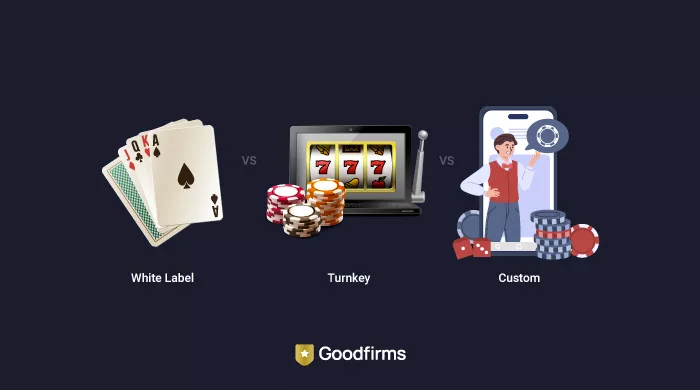
6. What is the difference between a white-label and a turnkey iGaming platform?
A white-label platform gives operators a ready-made, branded front-end built on a shared infrastructure, fast to launch but limited in customization. A turnkey solution delivers a fully configured, operator-specific platform including payments, compliance, and back-office tools, offering more control at a higher cost and longer setup time. Enterprise operators with proprietary requirements typically go further with custom builds.