Key takeaways
- White Label: Fastest launch (2–4 weeks) with low cost but limited control
and ongoing revenue share - Turnkey: Full ownership with no revenue share, but you manage licensing, compliance, and operations
- Custom: Complete control and flexibility, but the highest cost, longest timeline, and technical effort
- Cost Spectrum: $22k–$55k for white label, $110k–$550k+ for turnkey, & $275k+ for custom development
- Choose based on your budget and long-term ownership goals.
Most iGaming businesses fail before they ever acquire their first player, not because of poor marketing or a weak game library, but because of a decision made weeks before launch that most founders treat as a formality.
Your platform model.
It sounds like a technical choice. It isn't. It determines how much of every dollar you actually keep, whether you own the data you spend years building, which markets you're legally permitted to enter, and whether you'll have any leverage at all if the business outgrows its infrastructure.
Get it right, and you have a foundation worth scaling.
Get it wrong, and you'll spend the next two years paying for it, literally, through revenue share agreements that quietly transfer a third of your gross earnings to someone else's business, every single month.
The iGaming industry in 2026 is more competitive than it has ever been. Margins are thinner. Regulation is tighter. Player acquisition costs have climbed. In that environment, the structural economics of your business matter more than they ever did, and nothing shapes those economics more fundamentally than whether you're operating on a white label platform you don't own, a turnkey solution built for you, or a fully custom platform built from scratch.
This isn't a comparison written by a vendor trying to sell you one of the three. It's a framework for figuring out which model actually fits your situation, based on your capital, your timeline, and how much of the platform you're genuinely ready to own and operate. The right answer exists. It just isn't the same for everyone.
Before the detail, here's the comparison most operators want to see first — then we'll break down what the numbers actually mean for your situation
Don’t Risk It—Choose from Trusted iGaming Platforms on Goodfirms
iGaming Platform Comparison: White Label vs Turnkey vs Custom Comparison at a Glance
Before diving into the details, here's the iGaming platform comparison most casino operators want to see first.
| Features |
White Label |
Turnkey |
Custom |
|
Best for |
Fast market entry, low capital |
Full ownership, faster than custom |
Unique product, large budget |
|
Time to launch |
2–4 weeks |
1–3 months |
6–18 months |
|
Upfront cost |
$22k–$55k (€20k–€50k) |
$110k–$550k+ (€100k–€500k+) |
$275k+ (€250k+) |
|
Platform ownership |
Provider owns it |
You own it |
You own it |
|
Revenue share |
20–50% of GGR to the provider |
None |
None |
|
License included |
Usually yes |
You source your own |
You source your own |
|
Customization |
Limited |
High |
Unlimited |
These ranges are indicative; actual figures vary by provider, jurisdiction, and scope. Use them as a starting framework, not a final budget.
White Label vs Turnkey vs Custom Casino Platform
-
White Label: Best for startups needing a fast and low-cost launch
-
Turnkey: Best for businesses wanting control without building from scratch
-
Custom: Best for enterprises focused on scalability, branding, and long-term ROI
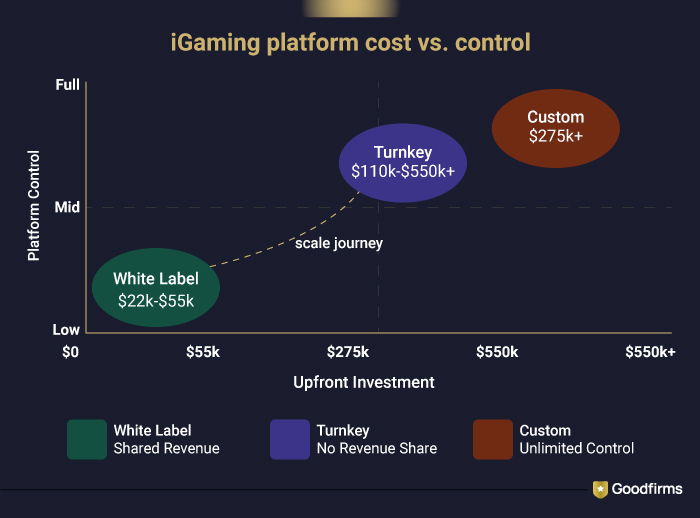
Let's understand each platform one by one.
Each platform model below is explained plainly, what you handle, what the provider handles, and who it's truly right for. Plus, the hybrid approach most casino operators use to scale efficiently, something vendors rarely mention.
White Label Casino Platform: Fast Launch, Shared Revenue
A white label casino software solution is a pre-built, licensed iGaming product that you brand as your own. The underlying technology, game integrations, payment infrastructure, and often the operating license all belong to the provider. You handle the brand, the marketing, and the players.
- Launch speed: 2–4 weeks
- Upfront cost: $22k–$55k (€20k–€50k)
- Revenue share: 20–50% of GGR
- Platform ownership: Provider owns it
- Customization: Limited
What the provider handles: Platform technology, game aggregation (often offering hundreds or thousands of titles from established providers with no separate contracts required), payment processing, compliance infrastructure, and, in most cases, the operating license itself. Most white label providers can have you live within two to four weeks.
What you handle: Brand, player acquisition, customer service, and in many cases, deposits and withdrawals through the provider's system.
What vendors won't tell you: The revenue share is the real cost here. Expect to give up somewhere between 20% and 50% of your gross gaming revenue (GGR) under a white label agreement, every month, for as long as you operate on that platform. At low volumes, that's manageable. At scale, it's significant.
You also own the brand, not the platform. Any new feature, integration, or technical improvement you want depends entirely on the provider's roadmap and priorities, not yours. Migrating away from the platform later is possible, but complex.
Who it's actually right for: Casino operators with limited starting capital who want to validate a market before committing to full platform ownership. Think of it as a launchpad, not a long-term home.
Pros:
- Fastest way to launch
- Minimal technical effort
- Low upfront cost
Cons:
- Revenue sharing reduces profits
- Limited scalability
- Dependency on the provider
Turnkey Casino Platform: Full Ownership, Faster Than Custom
A turnkey casino solution is a production-ready platform built specifically for you, with full ownership transferring to the casino operator upon delivery. Unlike white label, you're not licensing someone else's infrastructure; you own the codebase, the platform logic, and crucially, the player data.
There's no revenue share. No shared infrastructure. No dependency on a provider's development timeline.
This matters more than it might seem at the early stages. Player data is one of the most valuable assets an iGaming business accumulates over time. Knowing that it lives in your infrastructure, not a shared environment controlled by a third party, changes how you think about growth, valuation, and eventual exit options. This distinction is at the heart of the white label vs turnkey casino platform decision for most game operators.
- Launch speed: 1–3 months
- Upfront cost:$110k–$550k+ (€100k–€500k+)
- Revenue share: None
- Platform ownership: You own it
- Customization:High
What the provider handles: Design and development of the full platform, game integrations, back-office systems, and technical handover. Timelines typically run between one and three months, depending on the scope.
What you handle: Everything else. Licensing is your responsibility,which is a challenge upfront but gives you flexibility to pursue the jurisdictions that matter to your business model. Payment solutions, hosting, and compliance tooling also need to be sourced independently.
What vendors won't tell you: Turnkey platforms don't come bundled with all the operational components a complete casino deployment requires. Unlike white label, where the provider packages most of this together, a turnkey setup means you're assembling the stack yourself outside the core platform. That's not necessarily a problem, but it's work game entrepreneurs often underestimate when comparing costs alone.
Who it's actually right for: Casino operators with three to six months of runway, a clear go-to-market strategy, and the willingness to handle licensing and compliance independently in exchange for full long-term control.
Pros:
- Balanced cost and control
- Faster than custom development
- Ownership of the platform
Cons:
- Higher upfront cost than white label
- Limited compared to full custom
Custom Casino Development: Full Flexibility, High Investment
Custom casino development means building your platform entirely from scratch, no pre-built codebase, no inherited architecture, no constraints from a third-party provider's technical decisions. You get unlimited flexibility. You also take on unlimited responsibility.
This is the highest-cost, longest-timeline option among all online casino platform models, typically viable only for large, well-capitalized organizations with the internal resources to support a multi-year development and maintenance cycle. Build timelines can range from six months to eighteen months or longer, depending on complexity.
- Launch speed: 6–18 months
- Upfront cost: $275k+ (€250k+)
- Revenue share: None
- Platform ownership: You own it
- Customization: Unlimited
What you handle: Everything. Platform architecture, game integrations, compliance infrastructure, payment systems, hosting, security, and after launch, a permanent engineering team to maintain and iterate on it all. The launch cost is just the beginning, not the total cost.
What vendors won't tell you: The game operators who struggle most with custom development are those who treat the initial build budget as the full cost. Custom platforms require ongoing investment in engineering. That's not a reason to avoid this model, but it is a reason to be clear-eyed about what you're committing to.
Who it's actually right for: Large casino operators building a genuinely differentiated product, or entering a market with regulatory requirements so specific that no off-the-shelf platform can meet them. If you're in that category, custom development isn't just viable, it may be the only path that actually works.
Pros:
- Full control and flexibility
- Best long-term ROI
- Unique brand identity
Cons:
- High cost
- Longer development time
- Requires technical expertise
White Label vs Turnkey vs Custom: Detailed Comparison Table
|
Feature |
White Label |
Turnkey |
Custom |
|
Time to Market |
Very Fast |
Medium |
Slow |
|
Initial Cost |
Low |
Medium |
High |
|
Long-term ROI |
Low |
Medium |
High |
|
Customization |
Limited |
Moderate |
Full |
|
Ownership |
No |
Yes |
Yes |
|
Scalability |
Limited |
Good |
Excellent |
Total Cost Over 3 Years
|
Model |
Year 1 Cost |
Year 3 Cost |
Insight |
|
White Label |
Low |
High |
Revenue share increases the cost over time |
|
Turnkey |
Medium |
Medium |
Balanced investment |
|
Custom |
High |
Lower overall |
Best ROI long-term |
While white label looks cheaper initially, it often becomes the most expensive option over time due to revenue sharing.
Technical Architecture Comparison Matrix: At a Glance
Below is a comparative breakdown across the three platform tiers to cross-reference against your deployment timelines, software development budgets, and required operational control.
| Feature Metric | White Label Model | Turnkey Infrastructure | Custom Platform Build |
| Averaged Launch Window | 30 to 60 Days | 3 to 6 Months | 12 to 18 Months |
| Estimated Initial Capital | $20K – $50K | $50K – $150K | $500K – $2M+ |
| Average Revenue Share | 15% – 25% GGR | 5% – 15% GGR | 0% (Full Profit Margin) |
| Licensing Obligation | Covered by Provider | Operator Must Procure | Operator Must Procure |
| Game Integration Path | Limited to Provider Stack | Provider Aggregator Layer | Direct Studio Contracts / Open API |
| Data Ownership | Vendor Restricted | Full Operator Access | Complete Proprietary IP Control |
The Hybrid Path — Start Smart, Scale Smart
Here's a real-world pattern that almost no vendor mentions when discussing white label vs turnkey vs custom iGaming options: start with white label to test the market, generate revenue, and build an understanding of your audience. Then migrate to a turnkey platform once the business justifies the investment.
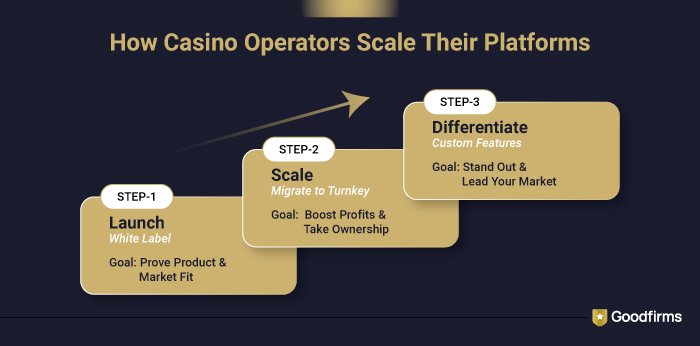
This is the most common trajectory in iGaming, and it's a sensible one. White label lowers the barrier to entry. Turnkey gives you the ownership and margin structure you need to scale profitably.
The migration itself isn't painless; moving player accounts, game histories, and payment records from a white label environment to your own platform takes planning and the right technical partner. Casino operators consistently report that it was the smartest decision they made. The key is planning the transition before you're forced into it, not afterward.
Which Casino Platform Should You Choose?
- Startups & MVPs → White Label
- Growing Businesses → Turnkey
- Large Enterprises → Custom Development
When NOT to Choose Each Model
- Avoid White Label if you plan to scale aggressively or want full control
- Avoid Turnkey if you need highly unique features or innovation
- Avoid Custom if your budget is limited or you need quick market entry
Why don't vendors mention it? Because it means you'll eventually leave their platform. A provider selling white label has no incentive to tell you that a turnkey migration after 18 months might be the right move.
Goodfirms doesn't sell platforms, so we can say it directly. Now that you have a clearer picture of how to move forward, here are the questions to ask your vendor before choosing a model.
Thinking about which iGaming platform model fits your business? Browse Goodfirm's iGaming solutions to shortlist and compare vendors.
Choosing the Right Model: A Long-Term Ownership Perspective
To pull it all together, here's how each online casino platform model looks through the lens of long-term business ownership, not just the initial launch checklist.
- Best for beginners → White Label
- Best balance of cost & control → Turnkey
- Best for long-term growth → Custom
The right choice depends on your business stage and growth strategy, not just budget
White label is fast and affordable upfront. It's the right entry point for casino operators with limited capital or those testing a new market. The trade-offs include ongoing revenue share, limited control, and an eventual migration if the business grows. Treat it as a starting point.
Turnkey is the most practical option for game operators who are ready to own their platform but lack the resources, budget, or expertise to build from scratch. The upfront cost is higher, but you keep all your revenue, own all your data, and aren't dependent on anyone else's roadmap.
Custom development is genuinely the right answer for a specific subset of casino operators, those building something sufficiently differentiated that an off-the-shelf solution will always be a limitation. Don't be talked out of it if that's your situation. But be clear about the ongoing commitment it requires.
5 Questions to Ask Before Choosing Your iGaming Platform Model
Knowing how to choose an iGaming platform comes down to asking the questions vendors either bury or leave out entirely. Here are the five that matter most.
1. Do you own your player data?
Under a white label agreement, the answer is often no, or at least, not fully. The provider typically holds the data within their infrastructure. With a turnkey solution or custom development, you own it entirely. This matters enormously if you ever plan to exit, migrate, or sell the business. Player data is an asset. Know whether you actually have it.
2. What happens if your provider shuts down or gets acquired?
White label casino operators carry the most exposure here. Your entire operation runs on infrastructure you don't own or control. Provider insolvency, acquisition, or a change in commercial terms can create serious operational risk. Understand what your agreement says about business continuity before you sign.
3. What does the revenue share actually cost you at scale?
Run the numbers. At $1M in GGR, a 30% revenue share means $300,000 in annual revenue to the provider. At $5M, that's $1.5M annually. Game entrepreneurs who compare upfront costs without accounting for cumulative revenue share over three to five years often get this wrong. The turnkey may look expensive upfront. It rarely is at scale.
4. In which jurisdictions do you actually operate?
White label licenses are commonly sub-licenses under the provider's master license. That limits the markets you can legally serve. If your growth strategy depends on entering specific jurisdictions, MGA, UKGC, Isle of Man, verify upfront whether the white label agreement supports that, or whether you'll eventually need your own license regardless.
5. What is your exit strategy?
Migrating away from a white label platform is complex. Player data, game histories, payment records, and sometimes the player accounts themselves may be tied to the provider's infrastructure. Before you commit, understand what migration looks like in practice. Some casino operators who haven't asked this question have found themselves effectively locked in.
How Goodfirms Helps You Choose the Right iGaming Platform
Every competing article on this topic is written by a vendor selling one of these three models. That creates a fundamental conflict: they're explaining your options while trying to sell you theirs.
Goodfirms doesn't sell iGaming platforms. We list and evaluate the companies that do.
That means you can use Goodfirms to compare white label, turnkey, and custom development vendors, with verified listings across all three models and the ability to request quotes without any sales pitch attached. If you're still deciding which path fits your situation and want to compare options without commercial noise, that's exactly what the Goodfirms iGaming Solutions page is built for.
Final Word
There's no single right answer in the white label vs turnkey casino platform debate. There's only the right answer for your situation, based on your capital, your timeline, and how much ownership you're actually ready to take on.
The casino operators who make this decision well are the ones who ask hard questions before they sign anything: about data ownership, revenue share at scale, license restrictions, and what migration looks like if they outgrow the platform.
That's the framework. Use it