Key takeaways
- Data engineers now spend 37% of their time on AI projects, up from 19% in 2023.
- Seven AI capabilities are separating modern vendors from legacy ones, that is, from automated pipeline generation to predictive maintenance and vector database integration.
- AI doesn't fix bad data, but AI makes a good data foundation faster and more scalable
- The best data engineering teams in 2026 should also understand AI/ML pipeline integration, prompt engineering for data tools, vector storage, and governance at scale.
- Human judgment stays in the loop as AI handles the volume, the repetition, and the speed. Humans still own the context, the governance decisions, and the architecture.
Data engineers now spend 37% of their time on AI projects. Two years ago, it was 19%.
This means businesses need to be doubly careful about what they feed into AI pipelines, because AI models are only as good as the data pipelines that feed them. Bad pipelines, slow pipelines, or pipelines built for a pre-AI world don't just limit your data team — they limit every AI investment your business makes on top of them.
Here's what's changed, and what it means for your business.
Looking for AI service providers with data engineering capabilities? Goodfirms lists and reviews verified vendors across AI and data engineering.
Why AI Has Become a Core Part of Modern Data Engineering
There's a reason data teams are spending more time on AI than ever before. According to MIT Technology Review, the share of time data engineers spend on AI projects has nearly doubled, that is from 19% in 2023 to 37% in 2025. It has become a structural shift.
The numbers behind it are just as telling: the global data engineering market is projected to reach USD 105.40 billion in 2026, according to market research, with AI-powered workloads as one of the primary drivers. Meanwhile, Gartner predicts that AI-enhanced workflows will reduce manual data management intervention by nearly 60% by 2027.
So what changed? A few things happened at once:
AI models got hungry: Large language models and ML systems require clean, well-structured, and continuously updated data to work at all. That pressure flows directly back to data engineering. You can't have smart AI without smart pipelines.
Data volumes have become unmanageable: Businesses are dealing with more data sources, faster update cycles, and stricter compliance requirements than ever. Human-only data management can't keep up.
The cost of bad data becomes visible: when AI makes a business decision based on stale or broken data, the mistake becomes traceable and expensive. AI in data engineering is about efficiency and reducing operational risk.
For SMBs and mid-market IT buyers, this means vendor selection now includes a new question: Does this data engineering partner use AI, or are they still doing it manually?
9 AI Capabilities Reshaping Data Engineering in 2026
Here, you can check out what AI features are trending and how they are helping companies.
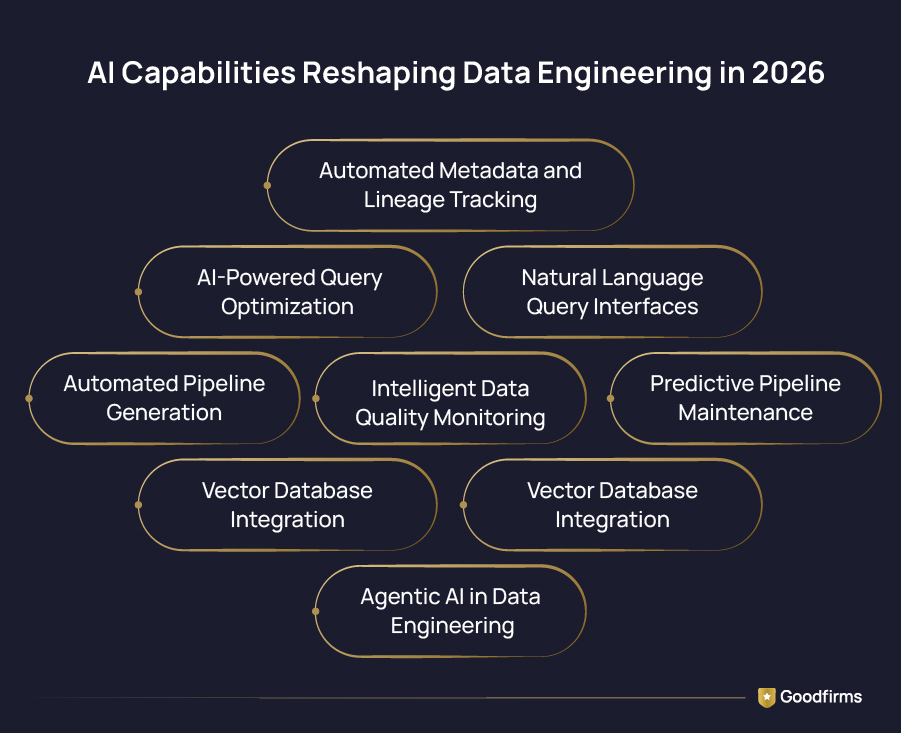
1. Automated Pipeline Generation
AI tools can now generate, test, and deploy data pipelines based on natural language instructions or schema inputs. What used to take a week of engineering can happen in hours. For businesses with lean technical teams, this is significant — it means faster time-to-insight without adding headcount.
2. Intelligent Data Quality Monitoring
Instead of static validation rules, AI continuously monitors data distributions, flags anomalies, and adjusts thresholds based on historical patterns. It catches issues instantly before they reach dashboards or analytics tools.
3. Automated Metadata and Lineage Tracking
AI can now extract and maintain data lineage across complex transformation pipelines automatically. This matters for compliance, debugging, and governance — three areas where manual documentation usually breaks down.
4. Natural Language Query Interfaces
Business users can query data warehouses in plain English. This reduces the bottleneck on data engineers for basic reporting and frees them for higher-value infrastructure work. It also bridges the gap between technical and non-technical teams.
The next three capabilities are where many organizations still lag behind—and where the gap between AI-native data engineering teams and traditional providers is becoming most visible.
5. AI-Powered Query Optimization
Database queries that previously needed manual tuning can now be auto-optimized in real time. The result is lower compute costs and faster query response times — particularly valuable in cloud environments where every second of processing time has a price.
6. Predictive Pipeline Maintenance
AI models can predict when a pipeline is likely to fail based on upstream data changes, schema drift, or resource constraints. This moves teams from reactive firefighting to proactive management.
7. Vector Database Integration
By 2026, vector databases will have moved from niche ML tools to core infrastructure. Any business building RAG-based AI applications, semantic search, or recommendation systems needs data engineers who understand how to design and operate vector storage and relational databases.
8. Agentic AI in Data Engineering
Agentic AI systems now autonomously plan, execute, and self-correct data workflows — without human intervention at each step. In 2026, they handle schema discovery, pipeline repair, and anomaly resolution end-to-end, cutting engineering overhead significantly.
9. Real-Time Data Pipelines
Batch processing is giving way to streaming-first architecture. Real-time pipelines powered by tools like Apache Kafka and Flink now deliver data in milliseconds — enabling live fraud detection, dynamic pricing, and instant personalization at production scale.
Challenges and Limitations of AI in Data Engineering 2026
AI in data engineering is genuinely powerful. It's also genuinely imperfect — and businesses that go in without understanding the limitations often end up frustrated.
1. Data quality is still your problem first
AI can monitor data quality, but it can't fix fundamentally broken data sources. If your upstream systems produce inconsistent or incomplete records, no amount of AI tooling will make up for it.
2. Skill gaps are real and widening
The World Economic Forum's Future of Jobs Report 2025 lists AI and big data as the fastest-growing skill areas. That demand is outpacing supply. Hiring data engineers who understand both traditional pipeline work and AI tooling is harder and more expensive than it was two years ago.
3. Vendor lock-in risks
Many AI-powered data platforms bundle proprietary automation that's hard to migrate away from. When evaluating vendors, it's worth asking: can we take our pipelines elsewhere if we switch platforms?
4. Explainability gaps
When an AI-driven pipeline makes a decision — say, dropping a data source or flagging a record — it's not always obvious why. In regulated industries like finance or healthcare, that lack of explainability can create audit problems.
5. Cost unpredictability in cloud environments
AI-powered workloads in the cloud can be expensive and hard to forecast. Auto-scaling features that optimize performance can also generate surprise bills if not properly governed.
Understanding these tradeoffs is part of responsible vendor evaluation. You can compare AI software costs and features here on Goodfirms to make a more informed decision.
Data Engineering Skills You Need in 2026
Here's a simple test: ask your current data engineering provider how they use prompt engineering, vector databases, or AI-assisted monitoring in production environments. If the answer is vague, that's a warning sign.
If you are working with a data engineering team — in-house or outsourced — here's what competency looks like in 2026.
The baseline has not gone away; you still need it, like SQL, Python, data modeling, and pipeline architecture, which are still foundational. But the required skill set has expanded considerably.
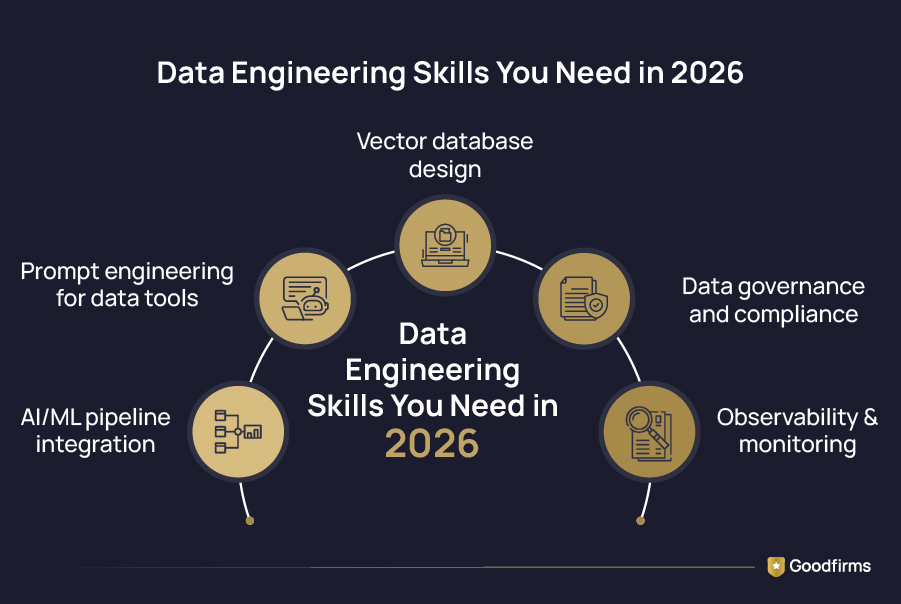
AI/ML pipeline integration: It's important to understand how to connect data infrastructure to model training and inference workflows, and BI dashboards.
Prompt engineering for data tools: If you are using AI copilots like GitHub Copilot, Databricks Assistant, or Snowflake Cortex effectively requires knowing how to write good prompts for data-specific tasks.
Vector database design: It’s equally vital to know structuring and optimizing storage for unstructured data and embedding models.
Data governance and compliance: As AI pipelines process more sensitive data automatically, governance skills become essential as they are a core engineering competency.
Observability and monitoring: It establishes systems that monitor pipelines, detect drift, and alert teams before failures cascade.
For businesses evaluating vendors or building internal teams, this skill checklist is a useful screening tool. An agency that can only deliver traditional ETL pipelines in 2026 is only solving part of your problem.
Industry Use Cases of AI in Data Engineering
Goodfirms Insight (2026): Organizations increasingly prioritize vendors that combine AI-native data engineering capabilities with strong governance frameworks, reflecting growing demand for scalable and trustworthy AI infrastructure.
Across industries, businesses are applying AI in data engineering in specific, measurable ways.
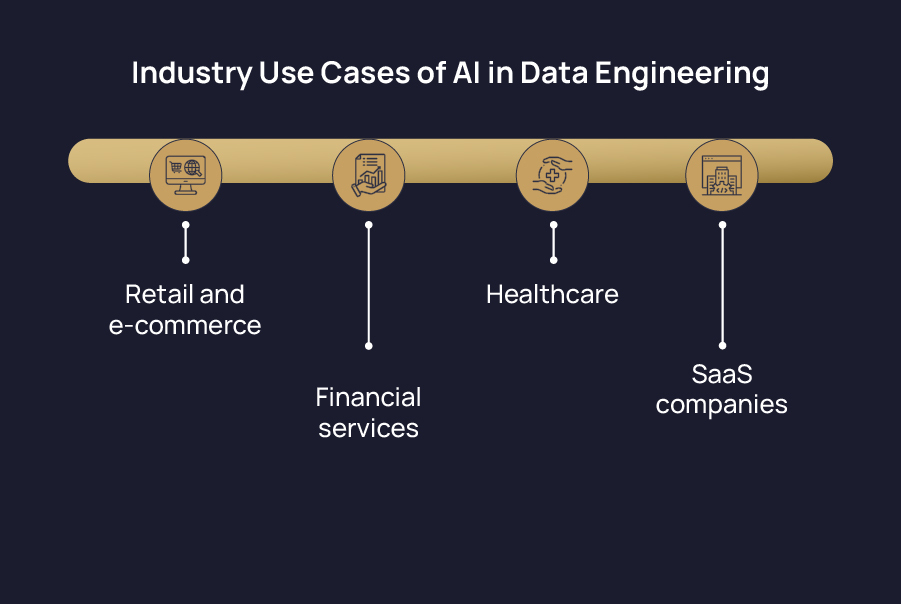
Retail and e-commerce
Organizations are using AI-powered pipelines to unify customer data from web, mobile, and in-store sources in near real time. This feeds recommendation engines and personalization systems that have a direct line to revenue. The challenge they consistently hit is data freshness — getting from raw event to usable insight in minutes rather than hours.
Financial services
Firms are applying AI to transaction data pipelines for real-time fraud detection. The engineering work here involves managing extremely high-volume, low-latency pipelines where false positives and false negatives both have financial consequences. AI-assisted anomaly detection has reduced manual review queues at several institutions.
Healthcare
Organizations are using AI to consolidate patient data from EMR systems, lab systems, and wearables. The data engineering challenge is significant — data arrives in different formats, on different schedules, and with different governance requirements. AI tooling helps with schema mapping and compliance tagging at a scale that manual processes can't match.
SaaS companies
They are using AI in their data engineering to build what's increasingly called "data products" — governed, packaged datasets made available through APIs and managed like products with ownership, documentation, and service-level expectations. This shifts data engineering from a service function to a revenue-enabling capability.
These examples share a common thread: the businesses seeing results are not using AI as a shortcut. They are using it to handle scale and complexity that human-only teams genuinely can't manage. Explore how AI is reshaping business workflows across industries through Goodfirms research.
Future Outlook: Human-Led, AI-Assisted Data Engineering
By 2026, more than 80% of organizations are expected to use generative AI APIs or AI copilots. Yet AI will not replace human judgment in data engineering. Instead, it will automate repetitive tasks while shifting engineers toward governance, architecture, and business-context decisions.
The routine work — writing boilerplate pipeline code, manual data profiling, basic schema mapping — is becoming increasingly automated. Over 80% of organizations are projected to adopt generative AI APIs or Copilot solutions by 2026, compared to less than 5% just three years ago. That adoption is already happening.
What AI is not reliably doing is understanding your business context, deciding what data matters, making governance calls, designing systems that will hold up under regulatory scrutiny, and building trust between data producers and data consumers across an organization. Those remain distinctly human responsibilities.
The teams and vendors that are pulling ahead in 2026 are the ones who have accepted this division of labor clearly. They are not debating whether to use AI. They are deciding which parts of the workflow AI should own and which parts need human judgment.
For businesses selecting data engineering partners, this is the right question to bring to vendor conversations: "Do you use AI?" but "where do humans stay in the loop?"
How to Choose the Right AI Data Engineering Partner
If you're evaluating vendors or planning to bring in outside help, here's a practical checklist:
- Do they have demonstrated experience with AI-powered pipeline tools (not just traditional ETL)?
- Can they show examples of AI-assisted data quality monitoring in production?
- Do they understand your industry's data governance and compliance requirements?
- What's their approach to vendor lock-in — can you migrate pipelines if needed?
- How do they handle model drift or schema drift in automated pipelines?
- Can they integrate with your existing cloud infrastructure or data warehouse?
Goodfirms has 80,000+ verified reviews across AI and data engineering service providers, making it one of the most reliable places to compare options before committing.
FAQs: AI in Data Engineering 2026
What is AI in data engineering?
AI in data engineering refers to the use of machine learning, automation, and generative AI tools to design, manage, and optimize data pipelines, quality monitoring, metadata handling, and infrastructure. In 2026, it covers everything from automated pipeline generation to natural language query interfaces and predictive maintenance.
How is AI changing data engineering roles in 2026?
AI is automating routine pipeline tasks, which shifts the data engineer's focus toward higher-level decisions — architecture design, governance, AI/ML integration, and data product development. The role is becoming more strategic, not disappearing. MIT Technology Review data shows that data engineers now spend 37% of their time on AI projects, up from 19% in 2023.
What AI tools are commonly used in data engineering?
Popular tools in 2026 include Databricks with AI assistant features, Snowflake Cortex, dbt with AI-assisted documentation, Apache Airflow with ML pipeline integrations, and cloud-native AI services from AWS, GCP, and Azure. Vector databases like Pinecone and Weaviate are also increasingly core infrastructure.
Should small businesses invest in AI-driven data engineering?
Yes, if they're dealing with growing data volumes, multiple data sources, or planning to use AI in customer-facing products. The barrier to entry has lowered significantly — cloud platforms offer AI data tools without requiring large in-house teams. The key is choosing the right vendor.
What are the biggest risks of AI in data engineering?
The main risks are data quality dependency (AI tools don't fix bad source data), vendor lock-in from proprietary platforms, skill gaps in hiring, cost unpredictability in cloud environments, and governance/explainability challenges in regulated industries.
How do I evaluate a data engineering vendor's AI capabilities?
Ask specifically about: automated pipeline generation, AI-assisted data quality monitoring, metadata automation, vector database support, and how their team stays in the loop on AI-generated decisions. Request case studies that show measurable outcomes — not just feature lists.
What's the ROI of AI-Assisted Data Engineering?
The ROI typically comes from reduced manual effort, faster pipeline deployment, improved data quality, lower cloud optimization costs, and quicker access to business insights. Organizations often see value through increased engineering productivity and fewer operational disruptions.
Conclusion
AI in data engineering is not a wave that's coming — it's already here, and most businesses are somewhere in the middle of navigating it, some are ahead, many are catching up, and a few are still hoping it doesn't affect them. The honest truth is that the fundamentals have not changed: good decisions still need good data. What's changed is the scale at which that's now possible, and the cost of falling behind. If you are evaluating partners, building a team, or just trying to understand where your data infrastructure stands, start with the right questions, and the answers will tell you more than any feature list.