Key takeaways
- AI adoption is nearly universal, but scaled, measurable value is rare — consulting exists to close that specific gap.
- Cost isn't fixed by scope alone; data readiness, integration depth, and geography swing quotes by 2–3x for the same deliverable.
- Engagements succeed or fail in the first month, based on whether the KPI, scope, and data audit happened before the pilot, not after.
- The highest returns usually come from unglamorous back-office automation, not the customer-facing AI that gets funded first.
- Choosing the right partner matters more than choosing the right model — verified production experience beats a polished case study every time.
Artificial intelligence has moved from an experimental budget line to a board-level mandate. Organizations across industries now partner with leading AI companies to build solutions that automate workflows, improve customer experiences, reduce operational costs, unlock new revenue streams, and stay competitive.
Goodfirms' 2025 survey on AI in the workplace found that 86.5% of employees now use AI at work — a rate that would have been unthinkable in most industries just a few years ago.
But here is the catch - high adoption doesn't mean AI is paying off everywhere. A gap is becoming common between AI investments that create measurable value and those that quietly turn into a financial burden.
Yes, that is true. As the MIT NANDA study says, that 95% of enterprise generative AI pilots produce no measurable financial gains.
Closing this gap takes more than enthusiasm; it requires the help of the best AI consultants who can determine whether a six-figure AI investment is worth it or not.
Don't leave that six-figure bet to guesswork — compare the best AI consulting companies on Goodfirms and shortlist a partner with real production experience in minutes.
This guide covers what AI consulting services actually cost in 2026, what a good engagement includes at every stage, and what separates a consulting partner who moves a pilot into production from one who leaves a slide deck behind and an invoice.
What Do AI Consulting Services Actually Cover?
AI consulting services are the paid, outside expertise businesses hire to figure out where AI fits in their operations, evaluate whether the data and infrastructure exist to support it, and either build the solution or guide an internal team through building it. It's the layer between "we should probably do something with AI" and a system that runs in production without someone monitoring it around the clock.
A full-scope engagement typically moves through four types of work:
- Strategic Assessment: where AI creates measurable value versus where it's a distraction
- Data and Infrastructure Readiness: confirming the systems and data quality needed to actually support AI are in place
- Model Selection and Implementation: choosing and building the right AI approach for the use case at hand
- Change Management: to get the people who'll use the system to actually use it
Few AI consultancies are equally strong across all four, which is precisely why matching the vendor to the stage of work matters as much as matching them to the industry.
That's the mechanics. The more useful question is why so many businesses that were building software just fine on their own are suddenly hiring outside AI help.
Why Are Businesses Hiring AI Consultants in 2026?
Worldwide spending on AI is forecast to hit $2.59 trillion in 2026, a 47 percent jump from 2025, according to Gartner’s most recent forecast — and the firm expects that figure to climb past $3.3 trillion by 2027.
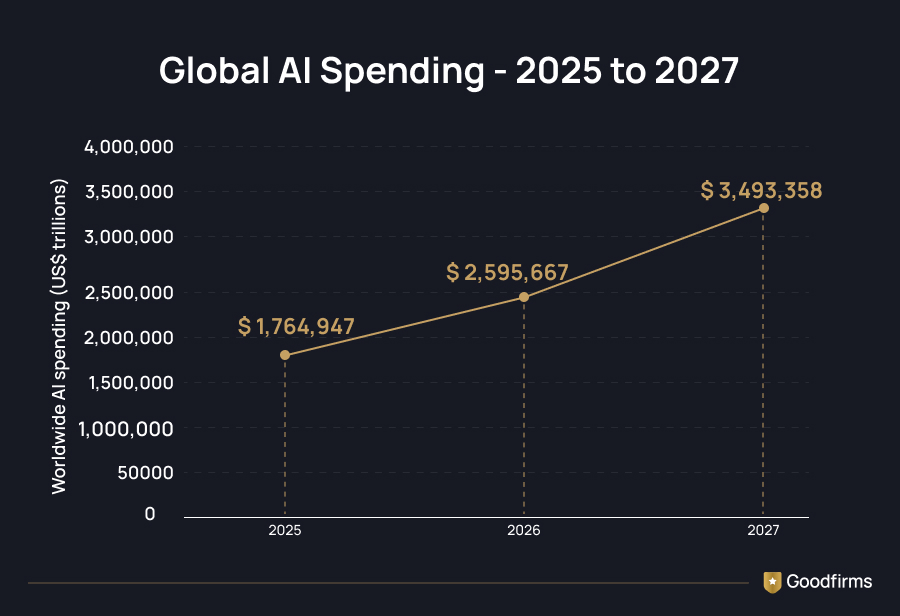
That capital isn't chasing hype anymore; it's chasing a growing belief among business leaders that AI isn't just another tech upgrade, but a shift on the scale of the internet or the cloud. Marc Benioff, chair, CEO, and co-founder of Salesforce, puts it plainly:

Artificial intelligence and generative AI may be the most important technology of any lifetime.
When the leader of a company built on enterprise software calls AI the most important technology of any lifetime, "wait and see" stops being a viable strategy. The numbers below back up the urgency:
88% of organizations now use AI in at least one business function, up from 55% two years earlier, yet only 7% say AI is fully scaled across the enterprise, according to McKinsey's State of AI research 2025.
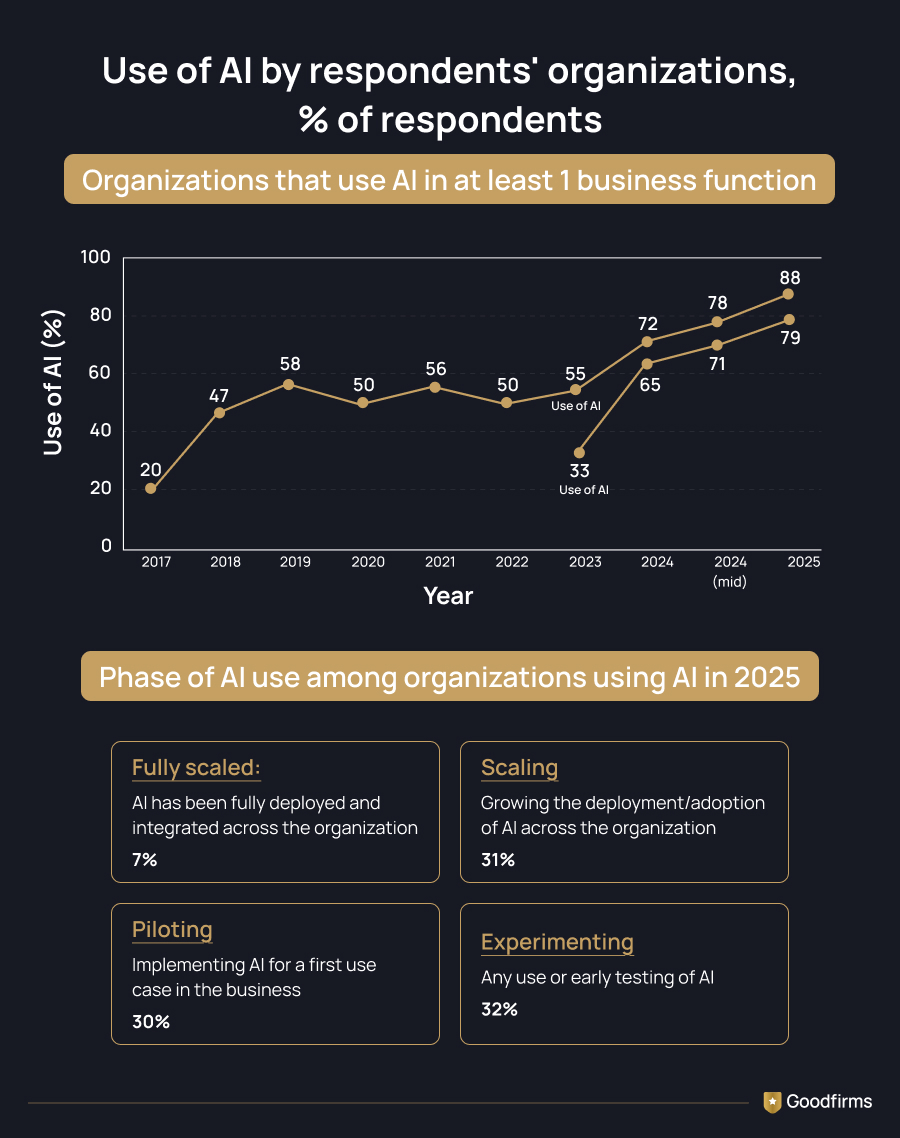
That 88%-to-7% gap is the whole argument for hiring AI consultants. AI adoption is easy, but turning it into something that actually moves the business is where most companies get stuck on their own. AI consultants exist precisely to close that gap. It is the key role area of AI consultants to execute the structured process, provide technical judgment, and implement change management that separates a business running one AI pilot from one running AI at scale.
AI is now standard practice in software development, not an edge case. As per Goodfirms’Custom Software Development Cost Survey 2026, 90.6% of software companies use AI tools across their development lifecycle, and 61% expect it to cut project budgets by 10–25%, per GoodFirms' Custom Software Development Cost Survey 2026.
The demand is real and growing fast. What it costs to act on it is the next question.
How Much Do AI Consulting Services Cost in 2026?
As a starting benchmark, most engagements fall somewhere between $5,000 for a narrow assessment and $500,000+ for a full multi-system rollout, with the biggest cost swings driven by data readiness, integration complexity, and how many legacy systems the AI needs to talk to.
|
Business Size |
Estimated Cost |
What This Budget Covers |
|
Small Business |
$5,000-$25,000 |
Typically covers a diagnostic review, a prioritized AI roadmap, or a single automation, like a chatbot or workflow bot. |
|
Medium- Sized Business |
$25,000-$150,000 |
Usually funds a functioning pilot with real system integration — think an AI agent, a document-search (RAG) setup, or a forecasting model. |
|
Enterprise-Level Business |
$150,000-$500,000 |
Generally spans a phased, multi-system deployment complete with governance frameworks and organization-wide change management. |
AI Consulting Cost by Engagement Type
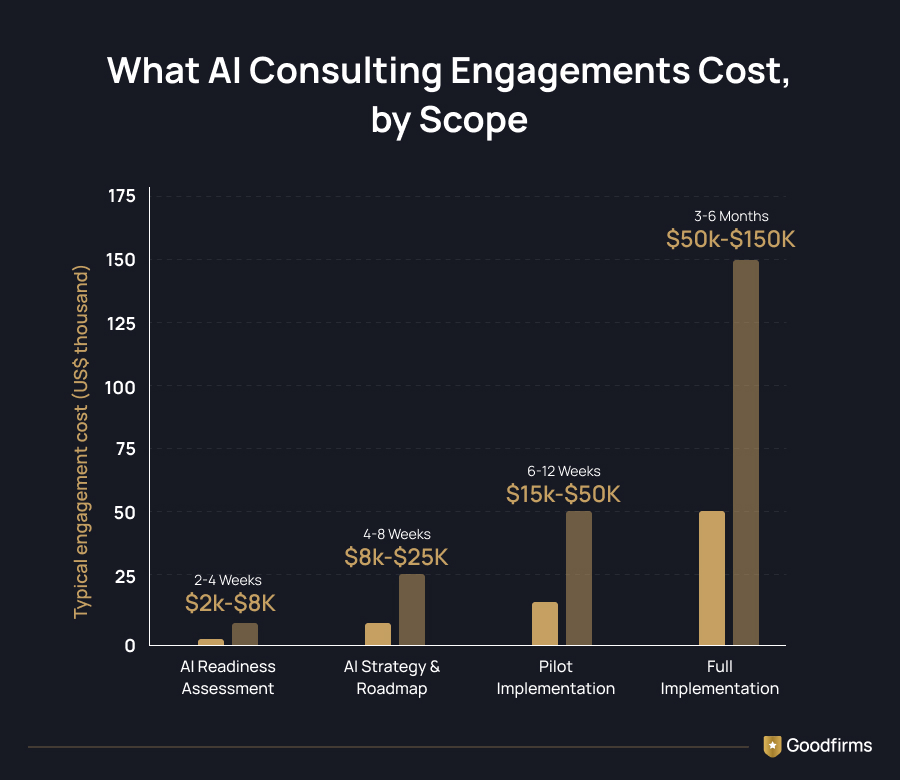
Scope is the single biggest lever on price. A narrow discovery engagement and a full enterprise rollout aren't the same purchase wearing different price tags — they involve different teams, different timelines, and fundamentally different risks. The breakdown below reflects that: costs climb steeply once a project moves from advisory work into something that has to run reliably in production.
AI Consulting Cost by Hourly, Monthly Retainer, and Outcome-Based Model
Not every engagement is priced by scope. Many businesses hire AI consultants hourly or on retainer, especially for ongoing strategy work or ad hoc technical guidance.
|
Expertise Level |
Typical Range |
Best Suited For |
|
AI-First Agencies |
$22-$50/hr |
Budget-conscious builds, offshore development support |
|
Solo Experts |
$80-$200/hr |
Scoped technical work, niche or specialized expertise |
|
Hourly (boutique firm) |
$150–$300/hr |
Short audits, technical workshops, ad hoc advisory |
|
Hourly (senior / Big-4 specialist) |
$300–$600/hr |
Regulatory-heavy industries, board-level strategy |
|
Monthly retainer (Junior - 3 to 5 Years Experience) |
$5,000/mo |
Ongoing tactical support, day-to-day implementation help |
|
Monthly retainer (Senior - 15+ Years Experience) |
$15,000/mo |
Fractional AI leadership, ongoing MLOps support |
|
Outcome-based / revenue share |
10–25% of measured savings or revenue lift |
Mature organizations with clean baseline data |
These figures explain what a project might cost, but not why one company's quote lands so far from another's. That gap usually comes down to a handful of variables a consultant will weigh before ever putting a number on paper.
Which Factors Drive the Cost of AI Consulting Services?
None of these moves the needle in isolation — it's usually a mix of the following that pushes a quote up or down.
- Data readiness — a business with clean, centralized, well-labeled data pays significantly less than one where a consultant has to spend the first six weeks untangling spreadsheets and disconnected systems.
- Build versus buy — customizing an existing AI platform costs a fraction of training or fine-tuning a model from scratch.
- Regulatory exposure — healthcare, finance, and other regulated industries add governance, audit trails, and compliance work that a low-risk internal tool never needs.
- Integration depth — a standalone pilot is cheap; wiring that same system into five legacy platforms is where budgets usually double.
- Talent tier — a boutique specialist and a Big-4 firm can quote wildly different rates for comparable deliverables, and the gap doesn't always track with quality.
- Geographical region — AI consulting companies in the US or Western Europe typically charge two to three times more than an AI consulting company in India, having an equally skilled team offering identical deliverables.
A number on a quote only tells you what you're spending — the real question is what you get back for it, and that's exactly where AI consulting starts to earn its cost.
Why Paying for AI Consulting Is Worth It
Building AI capability alone is possible, but hiring AI consultants or outsourcing AI consulting services makes success far more likely. Here's why paying for AI consulting is worth it.
- It shortens the expensive trial-and-error phase. An AI consultant who has already solved the data-pipeline problem your team is about to hit for the first time saves months, not days.
- It brings outcome discipline. AI Consultants who've run dozens of engagements know how to define a measurable KPI before a pilot starts, rather than discovering after launch that nobody agreed on what "success" meant.
- It reduces the risk of repeating a mistake that's playing out industry-wide. A large share of enterprise AI spending right now is delivering close to zero measurable return, and the businesses avoiding that outcome are mostly the ones that had a structured partnership with an experienced AI consulting company guiding the rollout rather than figuring it out alone.
- It builds internal capability instead of dependency. A professional AI consulting partner documents decisions and trains an internal team to maintain what gets built, rather than leaving the business locked into permanent outside support.
- It catches governance gaps early. Bias testing, data privacy, and model monitoring are far cheaper to design in from day one than to retrofit after a compliance issue surfaces.
Hiring an AI consultant makes sense only when the right steps are followed in this engagement. Here's what that structure typically looks like.
How Does a Successful AI Consulting Engagement Actually Work?
Below are the steps to follow to make the most out of a successful AI consulting engagement.
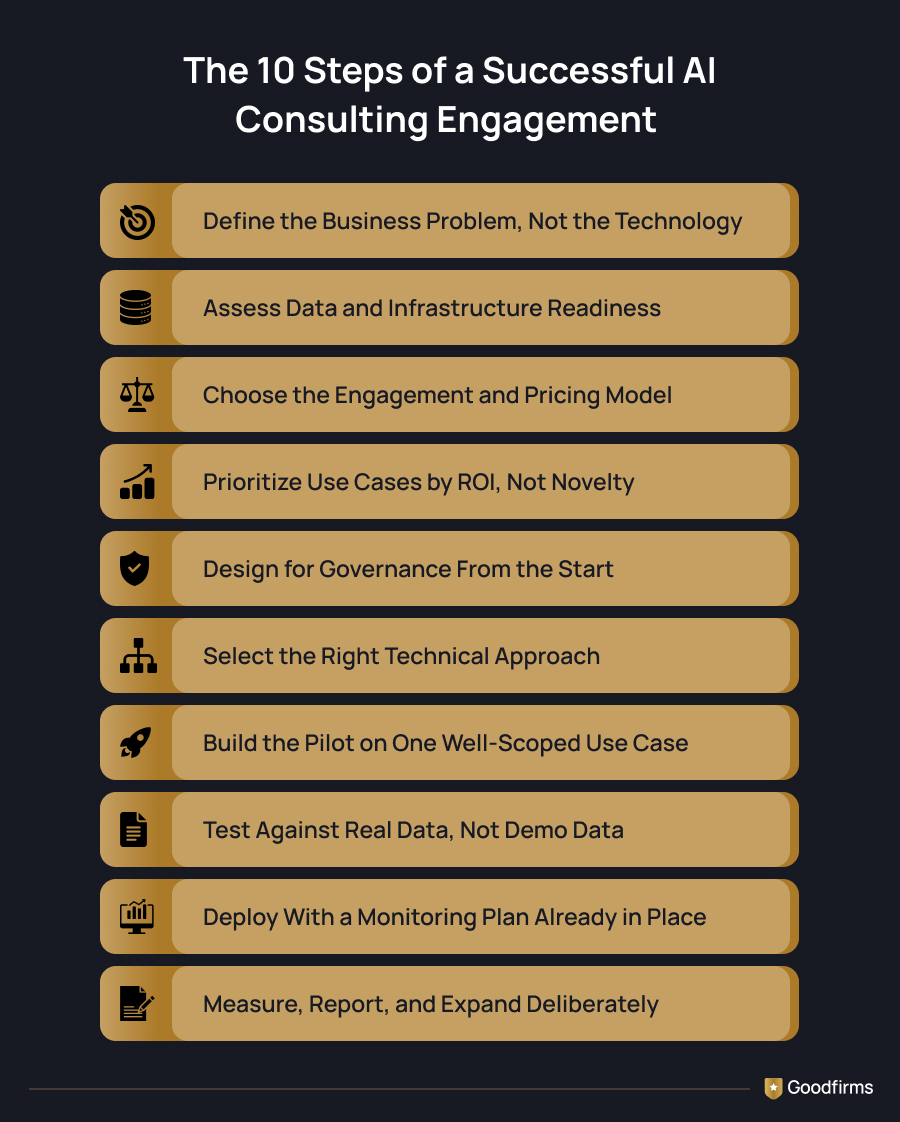
Let's have a look at each step in detail.
Step 1: Define the Business Problem, Not the Technology
The engagements that stall almost always started with "we need an AI strategy" instead of a specific, measurable business problem. A consultant worth the fee will push back on vague briefs and insist on naming the metric the project needs to move before any model gets chosen.
Step 2: Assess Data and Infrastructure Readiness
This is the step most businesses underestimate. AI is only as good as the data behind it, and an AI consultant's first real job is often uncovering how fragmented, duplicated, or simply missing that data is — before it becomes an expensive mid-project surprise.
Step 3: Choose the Engagement and Pricing Model
Hourly, retainer, fixed-fee, or outcome-based — this decision shapes how incentives align for the rest of the project. A fixed-fee model rewards a consultant for finishing efficiently; an hourly model can quietly reward the opposite unless scope is locked down early.
Step 4: Prioritize Use Cases by ROI, Not Novelty
Every business has a list of AI ideas. The ones worth funding first are high-volume, well-understood processes like document processing, support ticket triage, demand forecasting, etc. Research consistently finds the biggest measurable returns in back-office efficiency, not customer-facing novelty.
Step 5: Design for Governance From the Start
Bias testing, data privacy controls, human-in-the-loop review for high-stakes decisions, and a clear audit trail all need to be part of the architecture, not a checklist added before a compliance review. Retrofitting governance into a live system is dramatically more disruptive than building it in from day one.
Step 6: Select the Right Technical Approach
Model strategy
- Off-the-shelf APIs (OpenAI, Anthropic, Google) for most business use cases — fastest to deploy, lowest upfront cost
- Fine-tuned open-source models where data sensitivity or cost-at-scale rules out an external API
- Custom-trained models only where a business's data genuinely can't be matched by an existing model — a smaller share of real-world projects than most vendors admit
Infrastructure
- Cloud platforms (AWS, Azure, Google Cloud) for compute and hosting, chosen based on where the business's existing data already lives
- Vector databases and retrieval-augmented generation (RAG) pipelines, which let a model reference a business's own documents without retraining it
- Monitoring and observability tooling, since a model's accuracy can quietly drift months after launch without anyone noticing
Step 7: Build the Pilot on One Well-Scoped Use Case
Trying to transform five departments simultaneously is how a promising AI budget quietly turns into wasted spend. The engagements that succeed almost always start narrow, prove value on one process, and expand only once that value is measured and real.
Step 8: Test Against Real Data, Not Demo Data
A model that performs beautifully on a curated demo dataset and falls apart on messy production data is one of the most common — and most avoidable — failure points. Testing needs to happen on the actual data the system will see in production, including edge cases.
Step 9: Deploy With a Monitoring Plan Already in Place
Launch isn't the finish line; it's where drift, edge cases, and unexpected user behavior start showing up. A deployment plan without a monitoring and retraining schedule attached is an incomplete deployment plan.
Step 10: Measure, Report, and Expand Deliberately
The businesses that scale successfully treat the first production win as a template, not a one-off. They document what worked, then apply the same rigor — data readiness check, narrow scope, clear KPI — to the next use case instead of skipping straight to a bigger, riskier one.
A platform that works today can still fall behind if the AI consulting expert ignores the latest trends.
AI Consulting Trends Worth Watching in 2026
The market's changing quickly, and a few shifts are already shaping how AI consulting projects get planned and priced this year.
- Agentic AI is moving from pilot to production — Gartner expects task-specific AI agents to appear in 40% of enterprise applications by the end of 2026, up from under 5% at the start of the year. Consultants are increasingly being hired specifically to scope and govern these systems.
- Outcome-based pricing is gaining ground on hourly billing — more clients are asking consultants to tie a meaningful share of their fee to measured business results rather than hours logged.
- Vendor consolidation is speeding up — enterprises are narrowing from multiple pilot vendors down to one or two proven partners once a use case clears the pilot stage.
- RAG and retrieval architecture are becoming the default, not a specialized add-on, since most businesses need a model that references their own data rather than one retrained from scratch.
- AI governance roles are professionalizing — dedicated AI compliance and risk positions are among the fastest-growing hires tied to enterprise AI programs.
Following the right trends helps a consulting engagement stay relevant, but the harder test comes after the pilot succeeds and the business tries to scale it.
What Does It Take to Scale an AI Pilot Successfully?
A small share of AI pilots go on to deliver real value — the rest fade out quietly. What separates the two usually comes down to a handful of decisions made early.
- Pick systems that learn from feedback over time rather than static tools that perform the same on day 300 as they did on day one. This is consistently the single biggest differentiator between the pilots that scale and the ones that don't.
- Fund back-office automation before customer-facing novelty — a lot of AI budgets still lean toward sales and marketing pilots that look impressive but rarely move the needle, while the quieter operational wins are where the real savings show up.
- Keep an external partner involved past the pilot stage rather than handing a proof-of-concept to an internal team that wasn't part of building it — teams that combine outside expertise with internal ownership tend to succeed at a much higher rate than internal-only handoffs.
- Track a narrow set of KPIs on a dashboard that the business actually checks, not a quarterly report that surfaces problems months after they started.
Even a well-scoped pilot can still fail for reasons that have nothing to do with the technology.
Common Mistakes That Sink AI Consulting Engagements
Most AI projects fall apart for the same handful of common mistakes, as given below:
Skipping the Data Audit
Committing to a model or vendor before anyone has honestly assessed data quality is the single most common reason AI budgets balloon mid-project. What looked like a 10-week build turns into a 20-week data-cleanup project with an AI feature bolted on the end.
Treating the Pilot as the Finish Line
A proof-of-concept that works in a controlled demo isn't a production system. Businesses that declare victory at the pilot stage are usually the ones re-explaining to their board a year later why the "successful" AI project never shipped.
Chasing the Flashiest Use Case First
Generative chatbots and customer-facing AI get funded first because they're visible in a board meeting. The results tend to be blunt: those are disproportionately the projects with the least measured return, while unglamorous back-office automation quietly delivers the real numbers.
Ignoring Change Management
The best model in the world fails if the people expected to use it weren't involved in designing the workflow around it. Consultants who skip stakeholder buy-in are building a technically correct system that nobody adopts.
Underbudgeting for What Comes After Launch
Models drift. APIs change. Retraining has a cost. A business that budgets only for the build and not for 15–25% of that cost annually in ongoing monitoring and maintenance is planning for a launch, not a working system.
A clean engagement is a good start, but the numbers that follow are what actually prove it worked.
How Do You Measure Whether AI Consulting Delivered Real Value?
Adoption numbers and glowing pilot demos look good in a deck, but they don't tell a business whether the investment paid off. Track these instead:
- EBIT (Earnings Before Interest and Taxes) or cost impact tied to the specific use case: This single metric tends to be the strongest predictor of which organizations keep scaling AI successfully.
- Model accuracy drift over time: a model that was 94% accurate at launch and quietly slides to 81% six months later is a maintenance failure, not a technology failure, and it's catchable with basic monitoring.
- Adoption rate among intended users: a technically flawless system nobody uses didn't deliver value, no matter how well it scored in testing.
- Time from pilot to production: The businesses that scale AI pilots successfully tend to move meaningfully faster than those that stall out, because they define success criteria before starting instead of after.
- Cost per outcome versus the pre-AI baseline: the only number that actually settles whether the engagement was worth what it cost.
Two of these — EBIT impact and adoption rate — are worth remembering on their own, because everything else on this list is a leading indicator for one of those two.
A platform hitting those numbers rarely gets there without partnering with the right AI consulting company from day one.
How to Choose the Right AI Consulting Company?
The right partner depends less on brand name and more on how well their strengths line up with what your project actually needs.
Proven Experience With Production Systems, Not Just Pilots
Plenty of firms can demo a working prototype. Far fewer can show a system they built that's still running, still accurate, and still delivering value a year after launch. Ask directly for that evidence, not a slide about capabilities.
Technical Depth in the Approach Your Project Actually Needs
A partner should speak fluently about the difference between fine-tuning and retrieval-augmented generation, and about when a custom-trained model is actually justified versus when it's a way to inflate the invoice. Vague, buzzword-heavy answers here are a red flag worth taking seriously.
Verified Client History, Not Just Case Studies
A polished case study rarely discloses whether a "successful AI deployment" is still running six months later or was quietly shelved. Checking verified reviews on Goodfirms' list of top AI consulting companies closes that gap before a contract gets signed.
A Realistic Point of View on What AI Can't Do Yet
The strongest signal of a trustworthy AI consultant is often what they talk you out of. A firm that agrees with every idea in the room is optimizing for the sale, not the outcome.
Built-In Governance Expertise
Ask directly how the firm handles bias testing, data privacy, and audit trails for regulated use cases. A hesitant or vague answer here is a preview of what a compliance review will look like after launch.
Real Post-Launch Support
AI systems need monitoring and retraining long after deployment day. A consultant who disappears once the model ships leaves a business exposed the first time performance drifts in production, which happens to nearly every deployed model eventually.
Clear Knowledge Transfer
Insist on documentation and a structured handoff process if the goal is eventual internal ownership — otherwise, even minor future changes stay locked behind that one vendor indefinitely. Comparing options across Goodfirms' list for the top artificial intelligence companies is a reasonable way to benchmark what "clear knowledge transfer" looks like across multiple vendors before signing anything.
That's the full picture from the first conversation to a system still running months later. A few quick answers to what comes up next.
FAQs About AI Consulting Services
Below are some questions that come up often enough to deserve direct answers.
How long does a typical AI consulting engagement take?
A focused readiness assessment or strategy roadmap usually takes 2 to 8 weeks. A pilot or proof-of-concept for one well-defined use case runs 6 to 12 weeks. Full implementation into production typically takes 3 to 9 months, and enterprise-wide transformation across multiple workflows can extend past a year, especially where regulatory review or multi-system integration is involved.
Do small businesses actually need AI consulting, or is it only for enterprises?
Small businesses often benefit the most from a short, scoped engagement, because a consultant can quickly identify the one or two highest-value use cases instead of a business spending months experimenting on its own. A $5,000–$25,000 readiness assessment is far cheaper than a failed six-month internal build.
What's the difference between an AI consultant and an AI development agency?
A consultant primarily advises on strategy, readiness, and vendor or model selection, while a development agency typically builds and ships the actual system. Many firms now do both, but it's worth clarifying upfront which one you're hiring, since the pricing models and deliverables differ significantly.
Can an AI consulting engagement fail even with a good consultant?
Yes — MIT's research found that internal readiness, not consultant quality, is the more common point of failure. A business without clean data, a clear success metric, or stakeholder buy-in can still stall a project even with strong outside help, which is why the readiness assessment step matters as much as the build itself.
How much should ongoing AI maintenance cost after the initial project?
Budget roughly 15 to 25% of the original build cost per year for monitoring, retraining, and maintenance at moderate usage levels, rising higher if the system handles high transaction volumes or operates in a regulated industry with frequent audit requirements.
Is outcome-based pricing actually better than hourly billing for AI consulting?
It depends on how measurable the outcome is. Outcome-based pricing works well when a business has clean baseline data to measure against — cost savings, revenue lift, time saved. For exploratory strategy work where the scope genuinely can't be defined upfront, hourly billing is often the more honest arrangement for both sides.
Bottom Line: AI Consulting Services Are a Bet on Doing It Right the First Time
The organizations that get real value from AI didn't get there with a bigger budget or a flashier model. They got there by treating AI consulting services as a structured discipline — narrow scope, real data readiness, a measurable KPI defined before the pilot started, and a partner who stayed involved past the demo. Every mistake in this guide is avoidable, and every one of them is common precisely because it's easier to skip the unglamorous groundwork than to do it.
Whether the next step is a readiness assessment, a pilot budget, or shortlisting a partner from Goodfirms' software development companies with verified production experience, the decisions made in the engagement's first month are the ones hardest to undo six months in. Get those right, and AI consulting stops being a gamble — and starts being the reason your business ends up among the ones that actually see AI pay off.