Key takeaways:
- AI customer service ROI is measured by business outcomes, not just automation.
- The biggest returns come from improving productivity and customer experience.
- A strong knowledge base is the foundation of every successful AI implementation.
- AI delivers the highest ROI when combined with skilled human support and continuous optimization.
- Businesses that treat AI as a long-term strategy consistently outperform those chasing quick cost savings.
AI has helped organizations improve customer satisfaction and agent productivity, but the financial returns depend on much more than simply adding a chatbot to a website. Factors like implementation strategy, knowledge management, workflow design, and human oversight all influence whether AI becomes a business asset or an expensive experiment.
The momentum behind AI adoption certainly reflects growing confidence. Most service leaders are already convinced AI will pay off. Salesforce's State of Service report puts the number at 83% who say AI will help their organizations serve customers better, and 79% who say it will help agents do their jobs more effectively.
Spending is set to climb fast too. Gartner predicts more than 50% of customer service organizations will double their technology spend by 2028, and AI will account for a major share of that increase.
These numbers show that businesses are betting heavily on AI. The real challenge now is proving that those investments translate into meaningful business outcomes.
In this article, we will examine what the latest research says about AI's financial and operational impact on customer service.
Choosing the right AI development partner is just as important as choosing the right technology. Explore Goodfirms' curated list of the best AI development companies to compare verified service providers, client reviews, portfolios, pricing, and expertise.
What Does the ROI of AI in Customer Service Mean?
When people talk about AI ROI, they often focus on one metric: cost savings. While reducing support costs is important, it tells only part of the story.
The ROI of AI in customer service measures the overall value an organization gains compared to what it spends on implementing, maintaining, and improving AI solutions.
The standard ROI formula is:
ROI = (net profit - investment cost) / investment cost × 100
The challenge is that not every benefit appears immediately on a balance sheet. Some returns are easy to quantify, while others have a longer-term impact on customer loyalty and operational efficiency.
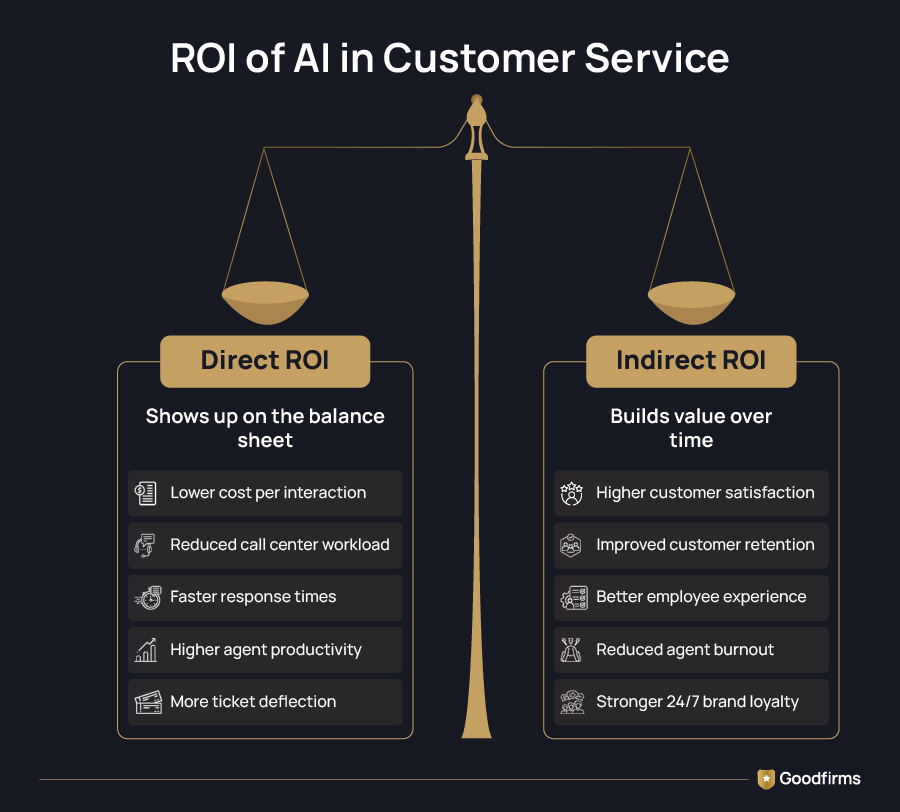
Direct ROI
Direct returns are the easiest to measure because they affect operational expenses.
These include:
- Lower cost per customer interaction
- Reduced call center workload
- Faster response and resolution times
- Higher agent productivity
- Increased ticket deflection through self-service
Indirect ROI
Some of AI's biggest business benefits are less obvious but equally valuable.
These include:
- Higher customer satisfaction (CSAT)
- Improved customer retention
- Better employee experience
- Reduced agent burnout
- Stronger brand loyalty through consistent 24/7 support
This distinction is important because businesses that evaluate AI only through labor cost reductions may overlook gains in productivity and customer experience that create far greater value over time.
The State of AI in Customer Service: What the Data Shows
AI has moved well beyond experimental chatbot projects. It is becoming a core part of how customer service teams operate.
Salesforce reports that 82% of service professionals say customer expectations are higher than they used to be, putting increasing pressure on support teams to deliver faster, more personalized experiences.
Meeting those expectations isn't easy with traditional support models alone. That's one reason organizations continue investing in AI-powered service tools.
The same report found that 85% of service organizations are either using or evaluating agentic AI, making it one of the fastest-growing technology priorities in customer support.
However, higher adoption doesn't automatically translate into immediate financial returns.
In fact, Gartner cautions that organizations should avoid assuming AI will instantly reduce customer service costs. The research firm predicts that the cost per resolution for generative AI-powered customer service could exceed that of offshore human agents by 2030 as businesses invest in better models, governance, and infrastructure.
AI is still valuable here. Businesses just need to evaluate ROI more broadly than payroll savings alone.
The strongest returns often come from combining AI with skilled human agents, redesigning service workflows, and continuously improving AI performance rather than expecting automation to replace support teams overnight.
Where AI Is Delivering Measurable ROI
Once AI moves beyond a pilot project, the next question is simple: Where does the return actually come from?
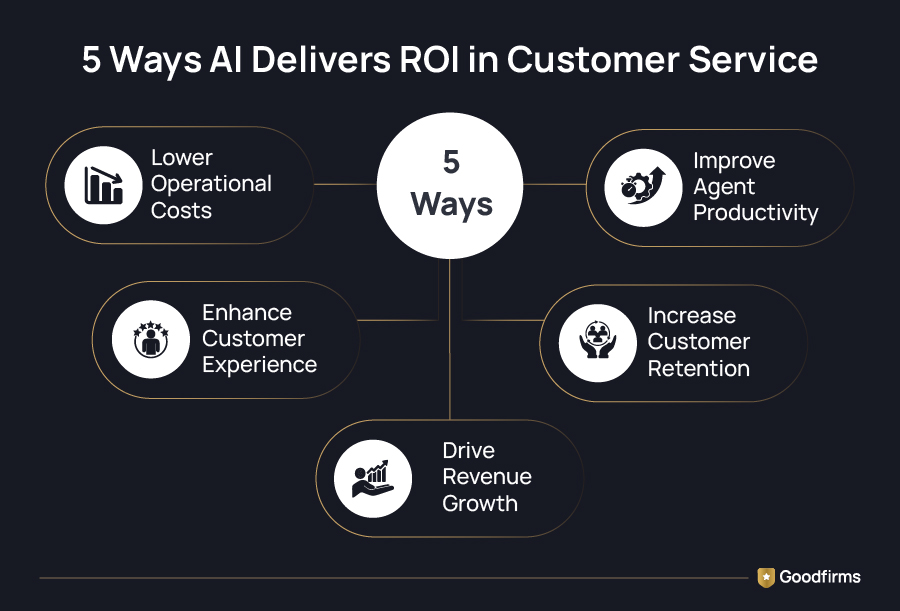
Contrary to popular belief, the biggest gains don't always come from reducing headcount. The strongest ROI often comes from helping support teams work more efficiently, resolving customer issues faster, and improving service quality at scale.
Here are the areas where organizations are seeing the most measurable returns.
1. Lower Support Costs Through Intelligent Automation
Customer service teams spend a significant portion of their time handling repetitive questions like order tracking, password resets, account updates, and refund requests. These interactions are ideal candidates for AI automation.
By 2029, Gartner expects agentic AI to autonomously resolve 80% of common customer service issues without any human involvement, cutting operational costs by as much as 30%.
Automating these high-volume requests allows businesses to scale customer support without hiring additional agents. It also enables human teams to focus on complex conversations that require judgment, empathy, or technical expertise.
2. Higher Agent Productivity Without Increasing Headcount
One of AI's biggest advantages is its ability to assist human agents in real time.
Instead of searching through documentation or manually summarizing conversations, agents can use AI to retrieve relevant knowledge, draft responses, summarize tickets, and recommend the next best action.
Salesforce found that 79% of service decision-makers believe AI helps agents work more efficiently, while 81% say it helps them serve customers faster.
These improvements compound over time. When agents spend less time on repetitive administrative work, they can handle more customer interactions during the same shift while maintaining quality.
3. Faster Response and Resolution Times
AI helps reduce waiting times by answering straightforward questions instantly and routing more complex issues to the right human agent.
According to Zendesk's CX Trends Report, 72% of customers expect immediate service, and 70% expect anyone they interact with to have full context of previous interactions.
Meeting these expectations manually becomes increasingly difficult as support volumes grow.
AI addresses this challenge by providing instant responses, retrieving customer history, and recommending relevant solutions before an agent even joins the conversation.
The result is shorter response times, quicker resolutions, and a smoother customer experience.
4. Better Customer Satisfaction Drives Long-Term ROI
Customers value quick, accurate, and consistent support. AI helps deliver all three by reducing wait times, ensuring agents have relevant information, and providing 24/7 assistance for routine inquiries.
Salesforce reports that 90% of service organizations using AI say it helps improve customer satisfaction.
Higher customer satisfaction contributes to stronger retention, increased customer lifetime value, and more positive brand perception. While these outcomes may be harder to quantify than payroll savings, they often generate significantly greater business value over time.
5. AI Creates Value Beyond the Contact Center
Every customer interaction generates valuable data about product issues, feature requests, buying intent, and recurring pain points.
AI can analyze these conversations at scale, uncover trends, and surface insights for product, sales, and marketing teams.
This broader use of AI increases the overall return on investment because the same technology supports multiple departments instead of serving only customer support.
When AI Doesn't Deliver ROI
Headlines about companies saving millions with AI are easy to find. The quieter stories, the ones about businesses that spent heavily and got very little back, rarely make it to the front page.
Usually it comes down to implementation, not the technology itself. Organizations that treat AI as a plug-and-play replacement for customer service tend to end up disappointed. The ones that invest in quality data, well-defined workflows, and real human oversight are far more likely to see sustainable returns.
Here's where most AI initiatives actually go wrong.
Poor Knowledge Quality
AI can only work with what it's given. Feed it outdated articles, inconsistent documentation, or gaps in coverage, and it will confidently hand customers the wrong answer. Trust erodes fast after that. Tickets escalate, and agents end up spending extra time cleaning up mistakes AI should never have made in the first place.
Before any AI deployment, audit the knowledge base first. In a lot of cases, that content foundation ends up mattering more to ROI than which AI model you picked.
Automating the Wrong Conversations
Password resets, order tracking, account updates, these are the easy wins for automation. Complaints, technical troubleshooting, anything emotionally charged? Those still need a human on the other end.
Try to automate everything anyway, and customer satisfaction usually drops. Nobody wants to be stuck in a conversation with a bot that can't actually solve their problem.
Measuring Cost Instead of Value
Lower support costs feel like a win, but they can't be the only metric that matters. Swap out human agents for AI and payroll drops, sure. But if satisfaction and retention drop with it, those short-term savings get eaten up by long-term revenue losses fast.
A better lens is a balanced one: operational, financial, and customer experience metrics together, not cost in isolation.
Ignoring Human-AI Collaboration
The goal was never to eliminate the customer service team. It's to redefine what agents actually spend their time on. Let AI handle the repetitive stuff, and free up agents for the complex conversations, the relationship-building, the problem-solving that actually needs a person.
Businesses that get this pairing right consistently outperform the ones betting everything on automation alone.
Hidden Costs That Can Reduce AI ROI
Some of the most common hidden costs include:
|
Cost Category |
Why It Matters |
|---|---|
|
Knowledge base improvement |
AI requires accurate, structured, and regularly updated content. |
|
System integration |
Connecting AI with CRM, ticketing systems, and internal tools often requires significant development work. |
|
Employee training |
Agents need training to collaborate effectively with AI systems. |
|
Ongoing optimization |
AI models require regular testing, prompt refinement, and performance monitoring. |
|
Governance and security |
Businesses must establish policies for data privacy, compliance, and responsible AI usage. |
These investments don't necessarily reduce ROI. They improve AI's long-term performance and help businesses avoid costly implementation mistakes.
A Practical AI ROI Scorecard
Rather than focusing on a single percentage, evaluate AI using a balanced scorecard.
|
KPI |
Why It Matters |
Indicates Positive ROI When... |
|---|---|---|
|
Cost per ticket |
Measures operational efficiency |
Cost decreases without reducing service quality |
|
Average Handle Time |
Tracks agent productivity |
Agents resolve issues faster while maintaining accuracy |
|
Ticket deflection rate |
Measures automation success |
AI resolves more routine inquiries independently |
|
CSAT |
Reflects customer experience |
Satisfaction improves or remains stable after AI adoption |
|
First Contact Resolution |
Indicates service effectiveness |
More issues are resolved during the first interaction |
|
Agent productivity |
Measures workforce efficiency |
Agents handle more complex work without increasing workload |
|
Customer retention |
Reflects long-term business value |
More customers stay with the business over time |
No single KPI tells the complete story. The strongest ROI comes from improving several of these metrics simultaneously.
Five Questions to Ask Before Investing in AI
Businesses that achieve measurable ROI usually start with a clear understanding of their support operations and customer needs. Answering these questions early helps organizations avoid costly implementation mistakes and set realistic expectations for AI performance.
1. How many support requests are repetitive?
If a large share of your tickets involve common questions, AI has more opportunities to create value through automation.
2. Is your knowledge base accurate and up to date?
Even the most advanced AI systems rely on quality information. Outdated documentation leads to inaccurate responses and poor customer experiences.
3. Which conversations should always involve a human?
Not every issue should be automated. Define clear escalation paths for situations requiring empathy, technical expertise, or complex decision-making.
4. Which KPIs will define success?
Don't wait until after implementation to decide how you'll measure ROI. Establish baseline metrics for costs, productivity, response times, and customer satisfaction before deploying AI.
5. Are you prepared to continuously improve your AI?
AI isn't a one-time project. Regular monitoring, testing, prompt refinement, and knowledge updates are essential to maintaining accuracy and maximizing long-term value.
What Data Really Shows
Real ROI shows up in faster support, higher customer satisfaction, more productive agents, and lower operating costs, all without the customer experience taking a hit anywhere along the way.
And the data backs this up. AI is already helping organizations hit those goals. But the businesses seeing the biggest returns aren't just the ones with the flashiest AI tools. They're the ones that got the foundations right first: clean knowledge bases, workflows that actually make sense, solid governance, and a habit of continuously fine-tuning what they've built.
Don't expect costs to drop overnight, though. Customer service software, integrations, training, governance, optimization, all of that takes investment upfront, and the financial payoff usually shows up later than people hope.
More automation isn't automatically better either. Hand off a conversation that needed empathy or real judgment to a bot, and satisfaction drops, escalations climb, and you've lost more than you saved.
Which is really the point. AI works best as backup for your agents, not a replacement for them. The businesses getting real value out of this aren't chasing full automation. They're building AI around the support operations they already have, deciding upfront where a human needs to stay in the loop, and setting their KPIs before any contract gets signed. That's the difference between companies seeing actual returns and the ones still wondering where the payoff went.