Key takeaways
- Generative AI in healthcare is already live at named institutions like Stanford, Mayo Clinic, and Zuckerberg SFG, not stuck in pilot studies.
- Every credible example pairs a specific, verifiable number with a clinician who still makes the final call.
- The market's growing fast, but the real differentiator is proof, not hype: a named institution, a peer-reviewed study, a specific number.
Generative AI in healthcare generates clinical documentation, medical images, treatment plans, and research insights, rather than simply analyzing existing data. Stanford Health Care and Mayo Clinic are already putting it to work: reducing documentation time, improving diagnostic imaging, and tailoring treatment to a patient's genetic profile.
Numbers back that up. Generative AI in healthcare stood at USD 3.3 billion in 2025, and estimates already put it at USD 4.7 billion in 2026. The market is expected to hit USD 39.8 billion by 2035, growing at a CAGR of 26.7%.
This blog covers exactly how generative AI is being applied across healthcare today, real examples from named hospitals and health systems, and what's expected next.
Ready to build with generative AI? Compare vetted generative AI companies on Goodfirms based on verified reviews, pricing, and healthcare expertise.
What is Generative AI in Healthcare?
Traditional AI in healthcare is built to spot patterns. It flags an abnormal lab value, predicts who's likely to be readmitted, and sorts patients into risk tiers. Useful work, but it's all built on existing data.
Generative AI does something else—it creates new things: new clinical notes, new medical images, new treatment plans that weren't there before. That's the difference, and it's why generative AI can get more personal and more precise than a system built only to recognize what it's already seen.
At its core, it runs on advanced machine learning capabilities — the kind of work machine learning companies specialize in, such as large language models (LLMs) for text, generative adversarial networks (GANs) or diffusion models for images, and foundation models trained on genomic or clinical data. In practice, that means a model can draft a clinical note from a conversation, generate a synthetic MRI slice to train another algorithm, or suggest a treatment plan based on a patient's genetic markers.
The distinction matters because it changes what the technology can be used for. A predictive model tells you something is likely to happen. A generative model can draft the report, the image, or the plan itself, with a clinician reviewing and approving the output before it becomes part of a patient's care.
It also helps to know that these models don't operate in isolation. Most healthcare generative AI tools are trained on top of existing electronic health record systems, imaging archives, or genomic databases.
The value comes from how well a model is fine-tuned on relevant clinical data and how tightly it's integrated into a clinician's actual workflow, not just how advanced the underlying architecture is. Choosing the right partner for this kind of build matters just as much as the model itself — a shortlist of vetted AI development companies on Goodfirms, compared by expertise, pricing, and reviews, is often where that decision starts. For healthcare specifically, narrowing that shortlist to healthcare AI companies makes the comparison more relevant.
That's the theory. Here's where it actually shows up in practice.
How is Generative AI used in Healthcare? (Applications)
Before getting into specific organizations, it helps to understand the broad categories that generative AI in healthcare falls into. These are the umbrella use cases; the next section breaks down named, verified examples for each one.
- Clinical documentation and administrative work: drafting notes, summarizing patient histories, and reducing time spent on charting.
- Medical imaging and diagnostics: enhancing scan quality, interpreting CT and MRI volumes, and flagging findings for radiologist review.
- Personalized treatment planning: using a patient's genetics, history, and lifestyle to put together a course of care suited to them.
- Population health management: flagging patients at risk of a preventable event, such as a hospital readmission, in advance.
- Drug discovery and research: simulating molecular behavior and summarizing research literature to speed up early-stage development.
Each of these categories sounds promising on paper. What actually separates a strong generative AI healthcare strategy from a shaky one is whether there's a named, verifiable organization behind the claim, not just a market forecast or a vendor's marketing page. That's what the next section digs into.
It's also worth noting that these categories overlap in practice. A single tool, like an ambient documentation assistant, might also feed structured data into a population health dashboard down the line. Healthcare systems rarely adopt generative AI as one isolated feature; it tends to spread once the first use case proves out.
That's the overview. Now, for a look at those actually doing this work, with results you can check.
What are Real-World Examples of Generative AI in Healthcare? (Use cases)
Here are five verified, independently sourced examples of generative AI in healthcare, one for each of the application categories mentioned above.
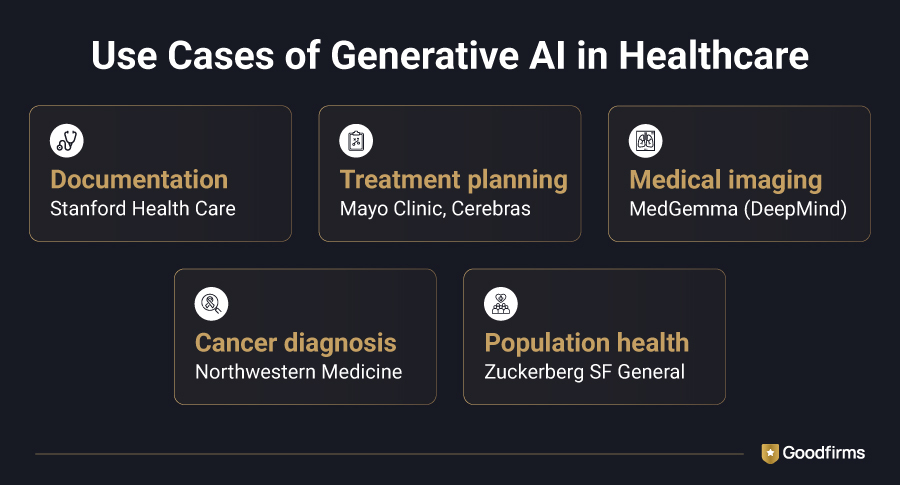
1. How is Generative AI reducing the burden of Clinical Documentation? (Stanford Health Care)
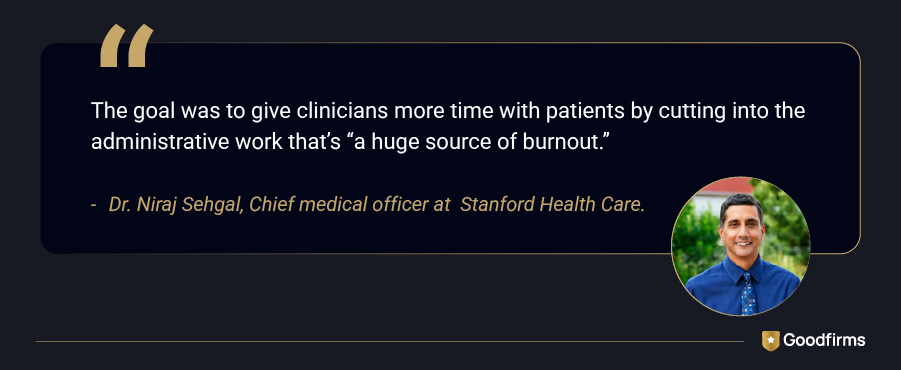
Stanford Health Care started using Nuance's DAX Copilot, a listening tool that sits in on patient visits and automatically writes clinical notes. In an early survey of Stanford clinicians, 96% said it was easy to use, and 78% said it sped up their notetaking. About two-thirds said it saved them time overall.
The real story isn't the tool itself — it's what a doctor can do with an extra twenty minutes per visit. That's twenty more minutes looking at the patient instead of typing into a screen. By the time Stanford rolled it out system-wide, over 200 other organizations were already using DAX Copilot, so this wasn't a one-off result — other health systems were seeing the same thing. Tools like this are typically built and refined by specialized healthcare app developers, who design them to sit quietly inside a clinician's existing workflow rather than adding another system to manage.
By May 2026, Stanford had generated more than 1 million clinical notes with the tool, with over 1,600 clinicians using it daily — proof that this had moved well past the pilot stage.
2. How is Generative AI improving Medical Imaging Analysis? (Google DeepMind's MedGemma)
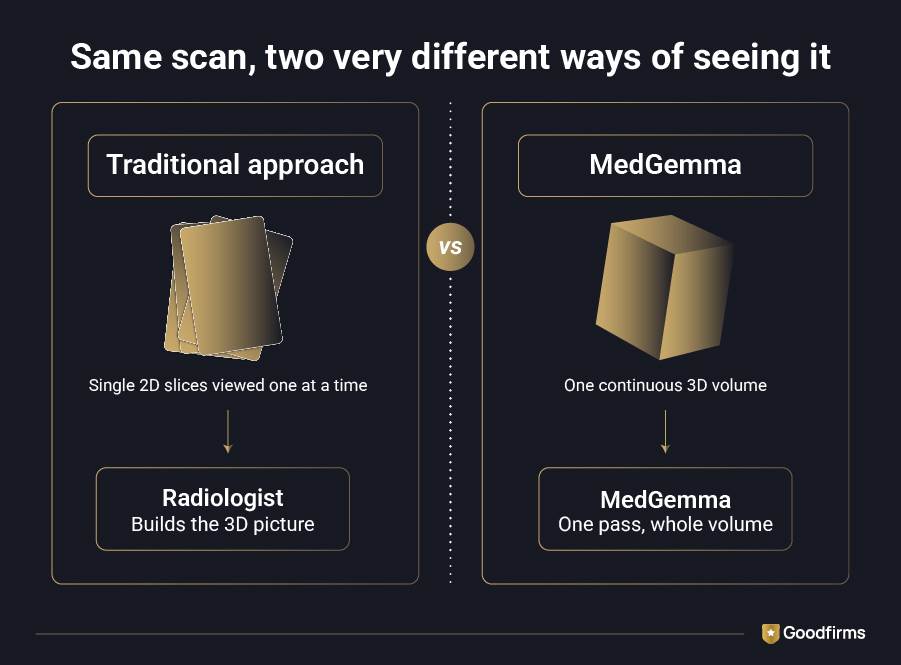
Google DeepMind's MedGemma 1.5 is an open medical foundation model that can interpret full 3D CT and MRI volumes instead of just single 2D slices. It also compares a patient's current chest X-ray with prior scans to flag changes over time, pinpoints anatomical findings using bounding boxes, and extracts structured data from messy lab reports and electronic health records.
What makes this one worth watching is that it's open and developer-facing. Rather than a single hospital's pilot, it's a foundation other health tech companies can build on, which tends to accelerate adoption across the industry. Because MedGemma is distributed through Hugging Face and Google Cloud's Vertex AI, smaller health tech startups can access the same underlying imaging capabilities as larger, better-funded health systems, without having to train a model from scratch.
That kind of accessibility is also why many hospitals now partner with experienced healthcare software development companies to integrate these imaging models into their existing systems rather than building the infrastructure in-house.
3. How is Generative AI personalizing Treatment Plans? (Mayo Clinic and Cerebras)
Mayo Clinic partnered with Cerebras Systems to build a genomic foundation model trained on patient exome data alongside the public human reference genome. The model is designed to predict how an individual patient will likely respond to different treatments, starting with rheumatoid arthritis.
Benchmark results reported by Cerebras show accuracies ranging from 68% to 100% for rheumatoid arthritis prediction tasks, 96% for cancer predisposition prediction, and 83% for cardiovascular phenotype prediction. Instead of a patient cycling through several medications over months to find one that works, a model like this narrows the options before treatment even begins.
4. How is Generative AI speeding up Breast Cancer Diagnosis? (Google Health and Northwestern Medicine)
Google Health and Northwestern Medicine ran a clinical study where an investigational AI model reviews mammograms and flags the ones showing a higher likelihood of breast cancer for immediate radiologist review. If further imaging is needed, the patient can often receive it the same day rather than waiting days or weeks for a callback.
Every mammogram in the study still gets reviewed by a radiologist. The AI's role is purely to reorder the queue, so the most urgent cases are seen first, which is a good example of augmenting a clinician's workflow rather than replacing their judgment.
5. How is Generative AI supporting Population Health Management? (Zuckerberg San Francisco General Hospital)
Zuckerberg San Francisco General Hospital, a safety-net hospital in UCSF's system, implemented a predictive AI algorithm embedded directly in its electronic health record to flag patients at the highest risk of 30-day readmission for heart failure. A population health team then used those flags to proactively manage high-risk patients across both inpatient and outpatient care.
The results, published in a peer-reviewed study, are hard to ignore. Over the study period, heart failure readmission rates dropped from 27.9% before implementation to 23.9% after. A longstanding gap in readmission rates between Black and African American patients and the general patient population was eliminated. All-cause mortality also declined in the post-implementation period, and the health system retained USD 7.2 million in at-risk pay-for-performance funding over that same period, against a $1 million cost to build the tool.
This example matters for reasons that go beyond the numbers. Safety-net hospitals typically operate with tighter budgets and fewer staff than large academic medical centers. A result like this shows that generative and predictive AI tools don't benefit only well-funded institutions when they're implemented thoughtfully.
The above five examples are not hypothetical. Each one is associated with a named hospital, health system, or research lab, with results published in a peer-reviewed journal or reported directly by the program's organization. That's a much higher bar than a typical vendor case study — a named institution, a peer-reviewed study, and a specific number, not a general statement about "measurable gains”.
Goodfirms Take — The Number is the Differentiator, not the AI.
Strip away the model names and vendor branding from these five examples, and the same thing is doing the real work each time: a published, checkable number. Stanford didn't just say DAX Copilot "improves documentation" — it published a 78% figure a journalist or competitor could go verify. Zuckerberg SFG didn't say its tool "reduces readmissions"—it reported a 27.9%-23.9% reduction in a peer-reviewed journal, with a dollar figure attached.
That's a habit worth stealing, regardless of what you're evaluating. Almost every generative AI healthcare vendor will tell you their tool "improves outcomes" or "saves clinician time." Almost none of them will give you a number you can take to a second source to check. The five examples in this guide all make that bar. Most vendor pitches you'll sit through this year won't.
So here's a practical filter, if you're the one being pitched to: ask the vendor for the specific number, the specific institution, and the publication date. If any one of those three is missing, or hedges into "internal data shows" or "early results suggest," you're looking at a marketing claim wearing a research citation's clothes. It doesn't mean the tool is bad. It means you haven't actually verified anything yet.
Every example in this guide already passed that test before you read it. The real value of the Goodfirms Take isn't the checklist itself — it's remembering to run it on the next vendor pitch you sit through, before you believe a word of it.
Pull those five examples apart, and the same handful of benefits keep showing up. Here's what they add up to.
What are the Benefits of Generative AI in Healthcare?
Generative AI in healthcare isn't a future promise anymore — it's already showing up in measurable results at real hospitals. Here's what it's actually delivering, based on reported outcomes rather than projections.
1. Less Time Spent on Documentation
Ambient scribes like Nuance's DAX Copilot sit in on patient visits and automatically draft clinical notes. At Stanford Health Care, 96% of clinicians found it easy to use, and 78% said it sped up their notetaking. The bigger win isn't the software — it's what a doctor does with the twenty minutes they get back per visit: look at the patient instead of a screen.
2. More Accurate Diagnoses
Imaging models like Google DeepMind's MedGemma can read a full 3D CT or MRI scan at once, instead of piecing it together slice by slice. It can also compare a patient's current scan with past scans to flag changes over time and extract structured data from messy lab reports. Because it's open and developer-facing, smaller health-tech companies can build on the same imaging capability as larger, better-funded hospitals.
3. Personalized Treatment Plans
Mayo Clinic partnered with Cerebras Systems to train a genomic model on real patient data, using the public human reference genome as a baseline for comparison. Instead of a patient cycling through treatments to see what sticks, models like this narrow the field from the start based on their genetic makeup.
4. Fewer Hospital Readmissions
At Zuckerberg San Francisco General Hospital, a predictive tool built into the electronic health record flagged patients at high risk of readmission, enabling a care team to step in early. Readmission rates dropped from 27.9% to 23.9%, a longstanding racial gap in readmissions disappeared, and mortality declined, too. Notably, this happened at a safety-net hospital with a tighter budget than most academic medical centers — proof this isn't only a big-budget advantage.
5. Real Financial Impact
The Zuckerberg SFG results weren't just clinical — the hospital also retained $7.2 million in at-risk, performance-based funding by hitting its targets, against a $1 million cost to build the tool.
None of that comes free, though. Here's where it can still go wrong.
What are the Challenges and Risks of Generative AI in Healthcare?
Adoption still comes with real trade-offs, and it's worth naming them plainly.
- Hallucinated or fabricated outputs: generative models can produce confident-sounding but incorrect information, which is why every example above still keeps a clinician in the review loop.
- Data privacy: training and running these models often require access to sensitive patient data, raising real questions about compliance with HIPAA and GDPR.
- Bias in training data: a model trained on a narrow patient population may perform worse for groups it wasn't trained on, thereby widening rather than closing care gaps.
- Regulatory uncertainty: agencies, including the FDA and the European Medicines Agency, are still actively shaping how these tools get approved and monitored.
The organizations that are getting real value from generative AI in healthcare aren't ignoring these risks. Many rely on dedicated compliance software to build oversight directly into the workflow, a common thread across all the examples in this guide.
A useful gut check before adopting any generative AI healthcare tool: ask what happens when the model is wrong. If there's a clear answer, meaning a clinician reviews the output, a fallback process kicks in, or an audit trail exists, that's a sign the tool was built with real clinical use in mind rather than as a proof of concept.
Here's where the technology is headed anyway.
What is the Future of Generative AI in Healthcare?
A few directions are becoming clear as adoption matures.
- Agentic AI: the next step past drafting a note or flagging a scan. These systems could handle small tasks on their own — booking a follow-up, updating a record — but always inside boundaries a clinician sets.
- Deeper integration with wearables and devices: monitors and wearables start feeding real-time data straight into generative models, so problems get caught earlier.
- Tighter regulation: expect clearer frameworks from the FDA, the European Medicines Agency, and other regulators as adoption scales, which should help separate genuinely validated tools from unproven ones.
The organizations ahead of this curve right now are treating generative AI as a tool that supports clinical judgment, not as one that replaces it.
None of this means generative AI will run healthcare on its own anytime soon, and that's probably a good thing. The examples in this guide all share a similar shape: a specific problem, a named organization willing to test a solution, and a clinician still making the final call. That pattern is likely to hold even as the underlying models get more capable.
Put all of that together, and here's the shape it's taking.
Concluding Remarks
Generative AI in healthcare is no longer a pilot-stage story. Stanford, Mayo Clinic, Google Health, and Zuckerberg SFG are already running it in daily practice, with a clinician making the final call in every case. Expect that pattern to continue as more hospitals and departments adopt these tools — the technology will keep getting faster, but people will still be the ones making the decisions.
FAQs- Generative AI in Healthcare
What is Generative AI in Healthcare?
Generative AI in healthcare generates new clinical content rather than just sorting or predicting from what's already there — think documentation, medical images, or treatment recommendations. Under the hood, that usually means large language models, GANs, diffusion models, or genomic foundation models.
Is Generative AI Safe to Use in Healthcare Settings?
It can be, provided a clinician reviews and approves the output before it affects patient care. Every verified example in this guide, from Stanford's DAX Copilot to Mayo Clinic's genomic model, keeps a human reviewer in the loop rather than letting the AI act unsupervised.
What's the Difference Between Generative AI and Predictive AI in Healthcare?
Predictive AI uses existing data to forecast what's likely to happen — say, the odds of a hospital readmission. Generative AI, on the other hand, builds something new: a draft clinical note, a synthetic medical image, or a treatment recommendation tailored to one patient. Many tools, such as population health platforms, use both at once.
Which Hospitals are already using Generative AI?
Stanford Health Care, Mayo Clinic, Zuckerberg San Francisco General Hospital, and Northwestern Medicine have all put generative AI to work, with public, verified results to show for it — Stanford in documentation, Mayo Clinic in genomics, Zuckerberg SFG in population health, and Northwestern in diagnostic imaging.
How much is the Generative AI in Healthcare Market worth?
The generative AI in healthcare market was valued at USD 3.3 billion in 2025 and is projected to reach USD 4.7 billion in 2026, growing to USD 39.8 billion by 2035 at a CAGR of 26.7%.
Can Generative AI replace Doctors or Radiologists?
Short answer: no. Look at any of the examples in this guide — breast cancer screening, genomic treatment matching, all of it — and a physician or radiologist is still the one signing off. What generative AI actually does is speed things up. It sorts cases by urgency, drafts paperwork, and presents options to a doctor faster than they'd get there on their own. Diagnoses and treatment calls stay with a person.
What Industries or Departments benefit most from Generative AI in healthcare?
Radiology and medical imaging, clinical documentation, population health management, and genomics-driven treatment planning currently show the strongest, most verifiable results. Administrative functions like claims processing and scheduling are also seeing fast adoption, largely because the risk of an incorrect output is lower than in direct clinical decision-making.