Key takeaways
- Segmentation is grouping your audience. Targeting is picking which groups actually get money spent on them.
- It starts with data. CRM records, pixel tracking, your customer list. Not with choosing ad interests.
- There are four common types of segments (demographic, behavioral, interest, intent), and each one does something different.
- Not every segment you build is worth running ads to. Size and value matter more than how clever it looks.
- This isn't a one-time thing. Leave a segment untouched for a few months, and it starts targeting the wrong people.
81% of consumers ignore irrelevant marketing messages. That is because you are reaching the wrong audience. Even with a good product, a strong ad, and a healthy advertising budget, you'd still struggle to get results.
That is where audience segmentation and targeting come in. If you are working with a social media agency, understanding this process helps you see what should happen to your audience data before your ad budget starts getting spent.
Audience segmentation only works when the data, strategy, targeting, and ongoing optimization are handled properly. If you're looking for a partner to take that work off your team's plate, explore Goodfirms' list of vetted social media marketing companies.
What is audience segmentation and targeting?
Segmentation is sorting your audience into smaller groups based on stuff they have in common: age, what they bought, what they clicked. Targeting is picking which of those groups you are actually going to spend money reaching, and how you talk to them.
So, if you run the same exact ad to every single one of them, it won’t work. The segmentation part got done, but the targeting part never really happened. An ideal way to do it is to properly use the groups to make different calls, different messages for each one, different budgets, sometimes a totally different platform, based on what's converting.
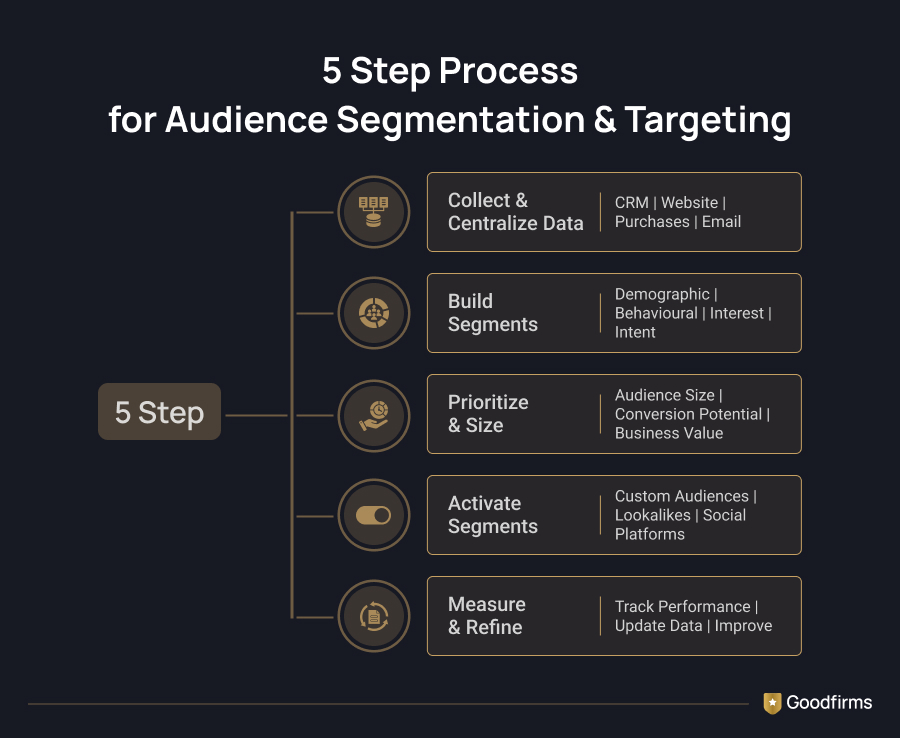
Step 1: Collecting and centralizing your audience data
Not the most exciting step, but it's the one that decides how good everything after it turns out.
Start with first-party data. Your CRM, email list, past purchases, and loyalty program, if you have one. This is the most useful data you have because it came from people who have already interacted with your service or product.
Then pixels and tags. Meta Pixel, LinkedIn's Insight Tag, TikTok's pixel, whatever. They track what visitors do, then feed it back to the ad platform.
If your audience data sits across multiple channels, a digital marketing company can help connect those signals before campaigns are activated.
Step 2: Building segments (demographic, behavioral, interest, intent)
Once your data's in one spot, it's time for segmentation.
Age, gender, income, job title, company size, and location. Fast to set up, but not very precise by itself. Still helpful as a first cut, especially in B2B, where job title often lines up with who has budget power. But it won't tell you who's ready to buy today.
Behavioral is built on what people did, not who they are. Pages they looked at, what they bought, emails opened, carts left behind, and how often they open your app. This tends to be a better signal than demographics because it's actual behavior, not a guess about someone based on their profile.
Interest segments come from what people engage with on a platform. Meta and TikTok are good at this since they collect so much engagement data. These work well earlier in the funnel, when you are just trying to reach people who fit a rough profile, even though they haven't shown real buying signals yet.
Intent segments are usually the smallest group, but the one worth the most. Built off signals that someone's close to buying, search terms, comparison pages, demo requests, coming back to the same product page again and again.
Step 3: Prioritizing and sizing your segments
Something a lot of people don't expect going in: not every segment you build is actually worth targeting. Some are too small. Some just look interesting but don't tie back to revenue at all.
Size comes first. Platforms need enough people in a segment to actually optimize delivery. A segment with a few hundred people in it is too small for Meta or LinkedIn to do anything useful with; there's not enough signal for the algorithm to learn from.
Once size checks out, then it's about value. This is where a decent agency actually ranks the segments instead of treating them all the same, looking at things like conversion rate, order value, lifetime value. A small segment with high intent might deserve more budget per person than a much bigger one that barely converts.
This is also where you should hear some honesty about tradeoffs. Go wide, and you get more reach but weaker relevance. Go narrow, and it's the opposite. It just depends on what the campaign's supposed to do.
Step 4: Activating segments across social platforms
Activation is where the segmentation work finally turns into actual ad spend. It's pushing your finished segments into Meta Ads Manager, LinkedIn Campaign Manager, TikTok Ads Manager, whatever platform the campaign's running on.
Custom audiences come straight from your own data. An email list you upload, people your pixel tracked, app users. These tend to convert best because they already know who you are.
Lookalike audiences work differently. You give the platform a seed group, maybe your top 10% of customers by value, and it goes and finds new people who look similar based on its own modeling. This is basically how most brands grow past their current customer list without just going broad and hoping something sticks.
The same audience segments can also inform paid search campaigns, which is where working with a PPC agency can make sense.
Each platform's a little different too. LinkedIn leans on job title and company data, which makes it good for B2B intent segments. Meta's lookalike modeling is probably the most developed out of the major platforms right now. TikTok's audience tools are newer and usually work better paired with interest and behavior data than used alone. You can also hire TikTok marketing agency to manage your TikTok account and gain more attraction.
Step 5: Measuring, refreshing, and refining segments
This whole thing isn't a build-once job. People switch jobs. Buying teams change. What looked like strong intent six months back might not mean anything now.
A good process has an actual review schedule built in, monthly for consumer stuff that moves fast, quarterly for longer B2B sales cycles, where someone checks how segments are actually performing instead of just glancing at reach numbers.
Refreshing means putting new data in, checking if the old definitions still make sense, and dropping the segments that aren't working anymore. If I'm honest, this loop is probably the biggest difference between an agency that's actually running a process and one that set things up once and forgot about it.
What should a good agency deliver at each stage?
If you are comparing a few providers, here's a rough way to check their work at each stage, and what to watch out for.
At the data stage, you should see a proper audit, what first-party data exists, how pixels are set up, what's connected to the CRM, plus an actual privacy plan.
At the segment-building stage, you want a map covering all four types, demographic, behavioral, interest, intent, each with a reason behind it.
At the prioritization stage, expect sizing numbers and a ranking tied to actual value, not just size.
At activation, you want documented custom and lookalike audiences on each platform, with notes on what data built each lookalike.
And at the measurement stage, look for a stated review schedule and reporting that ties back to actual outcomes, not just reach and impressions.
If a provider can walk you through these five stages with real detail instead of buzzwords, that's a solid sign. You can also compare vetted social media marketing companies on Goodfirms if you want to see how different providers stack up against this.
FAQs - Audience Segmentation and Targeting
What is the difference between audience segmentation and targeting?
Segmentation groups your audience by shared traits or behavior. Targeting is deciding which of those groups actually gets budget. Segmentation comes first, targeting is built on top of it.
How long does the segmentation process take?
A first build usually takes two to four weeks, depending on how much first-party data you already have and how many platforms need connecting. After that, it's just part of running campaigns, not a separate project.
How much audience data do you need to start?
No fixed number, but platforms generally need tens of thousands of people in a segment to run ads efficiently. If your first-party data is thin, most agencies lean on interest and lookalike segments while your own data catches up.
Should I do audience segmentation in-house or hire an agency?
Depends if someone on your team can actually connect your CRM, pixel data, and ad accounts, and has the time to check segment performance regularly. Plenty of small businesses start in-house with basic demographic and custom-audience targeting, then bring in a marketing agency once behavioral and intent segments need to be layered in properly.