Key takeaways
- Next.js leads server-side framework usage at 20.8% (Stack Overflow, 2025), driven by the App Router, Server Components, and Vercel's edge integration.
- Next.js rates vary sharply by experience, region, and hiring model — $25/hour or $150/hour can both be the right call, depending on the project.
- Hidden costs and the App Router learning curve usually push real project costs by 20–30%.
Search "Next.js developer cost" and you'll find contradictions. One source says $25 an hour is standard. Another says nothing under $150 is worth hiring. A recruiter quotes $120,000 a year like it's gospel, while software development companies give you a flat project fee that matches none of the above. Here's the twist: none of them is lying. They're each describing a real slice of a market that has split into tiers.
That split exists because Next.js isn't a niche skill anymore — it's the framework most developers are already reaching for.
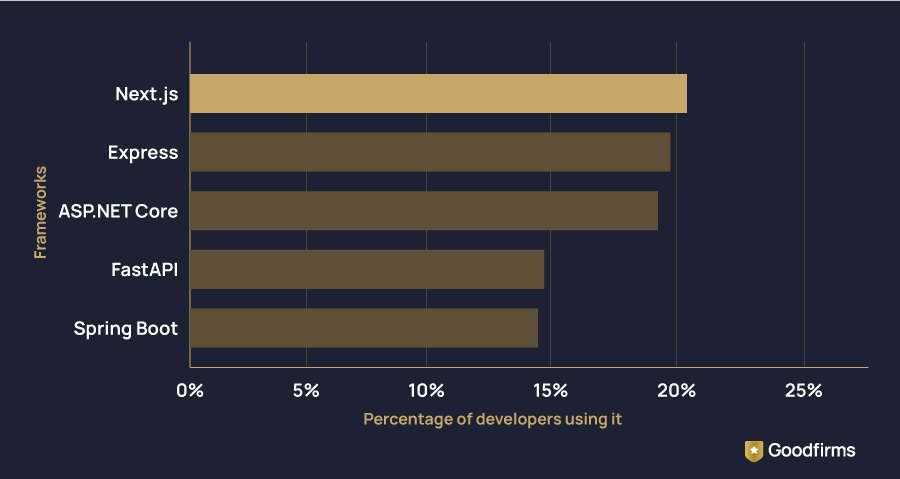
Source: Stack Overflow Developer Survey 2025
The real world tells the same story — hundreds of thousands of production sites run on Next.js today, including Amazon, IBM, and Siemens.
Features like the App Router, Server Components, and tight Vercel integration have pushed it well past "just another React framework"—and that's driving up rates for anyone who can prove real production experience with it.
This blog breaks down what you'll actually pay in 2026, using current market data from freelance platforms, staffing agencies, and salary benchmarking sites, so you can budget with real numbers rather than guesswork.
Next.js is everywhere — real App Router and Server Components expertise isn't. Compare vetted NextJS development companies on Goodfirms — verified reviews, real portfolios, transparent pricing.
Let's start with the number that actually matters: what you'll pay, broken down by experience level.
How much do Next.js Developers charge by Experience Level?
The average Next.js developer costs between $20 and $150+ per hour in 2026, depending on experience, region, and hiring model.
Here’s a breakdown of global rates by seniority, based on current freelance and contracting data.
|
Experience level |
Years of experience |
Typical hourly rate (USD) |
|---|---|---|
|
Junior |
0–2 years |
$20 – $50 |
|
Mid-level |
2–5 years |
$45 – $90 |
|
Senior |
5–8 years |
$90 – $150 |
|
Lead / Architect |
8+ years |
$100 – $160+ |
You can hire a junior developer if you need a small feature or simple pages. Senior developers cost more because they bring less hand-holding and extra review time. For standard product work, mid-level developers are usually the best fit because they can own a feature end-to-end without constant supervision. Senior and lead-level engineers cost more per hour, but they typically ship faster with fewer defects, which often makes them cheaper overall on anything beyond a small project.
Experience only tells half the story. Where that developer is based can shift the price just as much, if not more.
How much does a Next.js Developer cost by Region?
Where your developer is based has a greater impact on price than almost any other factor. Here's a realistic regional breakdown for a mid- to senior-level Next.js developer in 2026.
|
Region |
Hourly rate (USD) |
Notes |
|---|---|---|
|
North America (US / Canada) |
$60 – $150+ |
Widest range in the market; contract data shows senior medians closer to $80/hr, with marketplace asking rates running higher |
|
Western Europe (UK / Germany) |
$55 – $120 |
Comparable seniority to North America at a moderate discount; premium specialists (App Router, edge deployment) sit at the top of this range |
|
Eastern Europe (Poland / Ukraine) |
$30 – $90 |
Strong technical depth at mid-range cost; contract data trends toward the lower half of this range, marketplace listings toward the upper half |
|
Latin America (Brazil / Mexico / Argentina) |
$30 – $65 |
Tighter rate variance than other regions; strong timezone overlap with US clients |
|
India / South Asia |
$15 – $60 |
Widest talent pool and widest rate spread; junior rates can run lower than other regions, with senior rates scaling up to the range's upper end |
India is the focus here, since it accounts for a large share of Next.js hiring today.
Junior developers there typically run $15–$25 an hour, mid-level developers $25–$40, seniors $40–$55, and lead-level engineers or architects $50–$60.
That's roughly 55–65% cheaper than the equivalent US payroll hire, before benefits, payroll taxes, and recruitment overhead, which typically add another 25–35% to base salary.
Hourly rates are useful for budgeting time, but most businesses want one thing: what will the whole project cost?
How much does a Full Next.js Project cost?
The whole project cost depends heavily on the scope. Here’s the breakdown.
|
Project type |
Typical cost range |
What's included |
|---|---|---|
|
Marketing or brochure site |
$15,000 – $35,000 |
Static pages, basic CMS, SEO optimization |
|
Custom web application |
$35,000 – $75,000 |
User authentication, database integration, and admin panel |
|
E-commerce platform |
$60,000 – $120,000 |
Product catalog, payment gateway, and inventory management |
|
SaaS product or complex platform |
$100,000 – $250,000+ |
Advanced features, scalability, security, custom APIs |
If your project is closer to the e-commerce end, it's worth comparing eCommerce development companies directly, since platform choice and integration complexity can shift that range significantly.
For top-tier companies, the same applies to Software as a Service (SaaS) companies, where pricing and specialization vary widely at that scale.
If you're building an MVP to validate an idea before raising funding or committing to a full build, it's worth starting with the smallest possible version. If you're not sure where to start, this blog on how to build a successful Minimum Viable Product walks through the process in more detail.
Most agencies and dedicated teams can provide a separate quote for the MVP rather than pricing the whole project upfront. This keeps your early costs predictable while you're still figuring out what the product really needs.
What Factors affect the Cost of hiring a Next.js Developer?
Now that you've seen the numbers, it's worth understanding what actually drives them. Five factors explain most of that range.

1. Experience level
A developer who has only used Next.js on a personal or portfolio project for a year charges less than one who has shipped it in real production work. That gap comes down to what experience teaches: how to handle complex features, troubleshoot hydration errors, and ship applications that hold up under real traffic. Senior developers price that know-how into their rate.
2. Geography
Developers may have the same skill level, but costs can be two or three times as much in San Francisco as in Bangalore or Warsaw. The difference is due to the local cost of living, currency strength, and market demand in each region.
3. Engagement model
Different hiring models, such as freelancers, staffing agencies, dedicated offshore teams, and in-house hires, carry different cost and risk profiles. Though a freelancer may be the cheapest per hour, they do not provide backup if they disappear mid-project. Agencies charge more, sure — but you're also paying for the project management and QA that come baked into how they work.
4. Project complexity
A contact-form marketing site and a multi-tenant SaaS dashboard with logins, a custom database layer, and live data syncing aren't in the same universe of effort. More complexity means more hours, and specialized skills — like edge middleware or handling Server Actions at scale — cost extra too.
5. Technical depth required
Developers who can design how an entire app handles data — not just add pages to an existing site — charge more. This includes knowing when a page should load on the server versus in the browser, how to keep cached content fresh, and how to deploy for fast load times worldwide. This kind of expertise, especially with Next.js's newer App Router, typically adds $10–$15 an hour over developers who've only worked with basic page setups.
Of these five factors, experience level and engagement model matter most in practice. That brings us to the next decision: how you want to bring that developer on board.
Should You Hire a Freelancer, an Agency, a Dedicated Team, or an In-house Developer?
The next step is deciding how to actually bring someone on board. Each hiring option balances cost and risk differently.
Freelance platforms
Sites such as Upwork list Next.js and broader JavaScript talent starting at $15–$35 an hour, rising to $150+ for vetted senior talent. Freelancers work well for narrow, well-defined tasks, but you take on the risk of managing quality and continuity yourself. If a freelancer leaves mid-project, there's usually no built-in replacement.
Staff augmentation
These providers pre-vet developers and slot them into your existing team, typically at $35–$80 an hour. They are often more cost-effective than sourcing directly from freelance marketplaces, since the pre-vetting saves you time on screening. Expect faster onboarding, NDA and IP handling taken care of, and usually a replacement guarantee if the fit isn't right.
Agencies
They provide a full team of developers, project management, and QA, typically billing $75–$200 an hour and charging a 20–50% premium over freelance rates. That premium buys continuity: the project keeps moving even if one team member leaves, and someone else handles quality control. If you're weighing agencies more broadly rather than Next.js specialists specifically, Goodfirms list of top web development companies is a good starting point for comparison.
Dedicated offshore development teams
For larger, standalone projects that will run for six months or longer, comparing staff augmentation, dedicated teams, or outsourcing can help you determine which hiring model best fits. A small, dedicated team – a few developers plus a project manager and QA – typically costs $8,000–$25,000 a month in cost-effective offshore regions, rising for larger teams or Western-based talent.
In-house hires
Full-time salaries vary widely by country, and estimates differ significantly across sources. A US-based Next.js developer typically costs between $100,000 and $160,000+ per year in salary alone, before benefits and overhead. However, some contract-based salary data puts this figure closer to $75,000–$120,000 for mid-to-senior talent, so treat this as a working estimate rather than a fixed number.
Canada trends somewhat lower, roughly $80,000–$130,000+, though data here is thinner and less consistent. The UK typically runs £55,000–£90,000+, and Western Europe €50,000–€85,000+. Eastern Europe is considerably cheaper, generally in the $30,000–$60,000+ range. In-house hiring makes the most sense when you need long-term product ownership and someone embedded in your company culture for years, not months, regardless of where that person is based.
|
Hiring Option |
Typical Cost |
Best For |
|---|---|---|
|
Freelancer |
$15–$150+/hour |
Small features, bug fixes, short-term work |
|
Staff Augmentation |
$35–$80/hour |
Extending an existing development team |
|
Agency |
$75–$200/hour |
End-to-end project delivery with PM and QA |
|
Dedicated Offshore Team |
$8,000–$25,000/month |
Medium-to-large projects requiring multiple developers |
|
In-house Developer |
$100,000–$160,000+/year (US) |
Long-term product ownership and internal expertise |
As a general rule, working with staff augmentation companies is usually the cheaper way to get vetted talent. Agencies cost more, but they include project management and continuity, which is worth the extra cost once a project grows beyond a quick fix.
The quoted rate is rarely the real number. A $75/hour agency quote looks straightforward on paper, but once project management, QA, and the ramp-up time a new developer needs to learn your codebase are factored in, the true cost typically lands 20–30% above the quoted rate. Budgeting against the hourly number alone is the fastest way to blow past your first-quarter estimate.
Here's where that extra 20–30% usually comes from.
What Hidden Costs Should You Budget for?
The developer's hourly rate or project quote is rarely the entire bill. There are a few hidden costs that first-time hirers are unaware of.
-
Project management and QA: agencies typically bundle a project manager and a quality assurance tester, which adds roughly 15–25% to the base development cost.
-
Hosting and infrastructure: Next.js apps need a hosting platform — often Vercel or a similar edge-friendly host — plus database and API costs that scale with traffic.
-
Post-launch maintenance: bug fixes, dependency updates, and browser compatibility work typically run 15–25% of the original build cost annually.
-
Design and third-party integrations: custom UI work, payment gateways, CMS integrations, and analytics tooling all add hours beyond the core build.
-
Onboarding and ramp-up time: even a strong senior developer needs a few days to understand your codebase and conventions before shipping at full speed.
None of these costs is avoidable if you want a stable, maintainable product. Building them into your budget upfront prevents an unpleasant surprise three months after launch.
With a realistic budget in place, the next challenge is making sure you actually pick the right person or team for it.
How to Choose the Right Next.js Developer for Your Budget
Price shouldn't be the only filter. A cheap hourly rate that leads to rework, security gaps, or a codebase nobody else can maintain costs far more in the long run than paying a bit extra upfront for someone who gets it right the first time.
A few things worth checking before you commit to any developer or team:
- You should ask for real App Router and Server Component experience, not just general React or older Pages Router work. Both require entirely different skills.
- Ask to see actual production projects, not tutorials or portfolio pieces built on the side.
- You must confirm they're comfortable with TypeScript, since it's a baseline requirement at the senior level, not a bonus.
- Ask how they handle data fetching, caching, and revalidation, too — this is usually where junior developers stumble.
- If you're hiring offshore, clarify communication expectations and time zone overlap before signing anything.
Check verified reviews and delivery history first when you compare agencies rather than individual freelancers. Goodfirms' list of Next.js development companies is a research-backed reviews and ratings resource, with each company evaluated on real client feedback, portfolio evidence, and transparent pricing.
You can shortlist a team based on real delivery history rather than self-reported claims.
Even with a solid shortlist in hand, it's worth knowing where most businesses trip up before you sign anything.
What Mistakes Do Businesses Make When Budgeting for a Next.js Hire?
Even with the numbers above in hand, many businesses still make mistakes by overpaying or underdelivering on a Next.js project. They fall prey to the following patterns.
- Chasing the lowest hourly rate without checking real production experience. A $20/hour developer who has only built tutorial projects can end up costing more when you factor in all the rework.
“A cheaper hourly rate can cost more overall if it comes with slower delivery or more rework.”
Jan Hesters, ReactSquad's CTO - Assuming Next.js and React skills are the same thing. A developer who's strong at React but has never worked with the App Router, Server Components, or edge deployment will still need extra time to catch up speed — time you probably didn't plan for in your budget. If your project is closer to a component-level React build than a full Next.js app, it’s worth comparing React.js Development Companies separately, since the skill sets diverge more than most job posts suggest.
- Skipping a paid technical test. Reviewing a resume and a GitHub profile isn't enough. A short, paid task — even two or three hours — tells you far more about how someone actually debugs and structures code.
- Forgetting to budget for maintenance. Teams pour effort into planning the build, then get blindsided by the ongoing bill for updates, security patches, and browser compatibility fixes.
- Underestimating the timezone and communication overhead. A developer at a great rate in a distant timezone can slow a project down if there's little daily overlap for reviews and quick decisions.
-
A common hiring mistake, as seen across Goodfirms-reviewed Next.js agencies, is underestimating how long the App Router transition takes, even for genuinely skilled teams. It's rarely a skills gap in the traditional sense — it's a mismatch between how long a business budgets for onboarding and how long the switch to Server Components actually takes in practice, which is where most Next.js project timelines quietly slip.
Avoiding these mistakes matters more for your final cost than saving a few dollars on the hourly rate.
Final ThoughtsThere's no single right answer to what it costs to hire a Next.js developer — it depends entirely on the scope of your project, the seniority you need, and where in the world your developer sits. You need to match the engagement model to the job's size. A quick fix doesn't need a dedicated team. On similar terms, you do not give a multi-year SaaS product to a freelancer just because you had the lowest rate on a marketplace listing.
You need to clearly define your project's scope, get a few quotes across different regions and engagement models, and weigh the hourly rate against the total cost of getting the work done right the first time. That's the number that actually matters.
FAQs- Cost to Hire a Next.js developer in 2026What is the average cost to hire a Next.js developer in 2026?
Rates for Next.js developers in 2026 range from $20–$150 per hour, driven mainly by experience level and location. Mid-level developers worldwide charge an average of $45–$90 an hour, while senior engineers in North America often bill $90–$150 or higher. Budgets of a full project instead start around $10,000 for a simple marketing site and climb past $150,000 for a complex SaaS build.
Is it cheaper to hire a Next.js developer from India?Yes. Hourly rates in India run $15–$60, depending on seniority, versus $60–$150+ for the same experience level in North America. That gap amounts to roughly 55–65% in savings compared to a US-based hire, and cities with established tech talent pools deliver that without cutting into technical depth.
Should I hire a freelancer or an agency for a Next.js project?Freelancers work well for small, well-defined tasks, such as bug fixes or adding a single feature. Agencies cost 20–50% more, but that extra spend buys project management, quality assurance, and continuity if a team member leaves — a safer bet for anything larger or longer-running.
How much does a full Next.js website or web app cost?A simple marketing site runs $15,000–$35,000. Add authentication, a database layer, and an admin panel for a custom web application, and you're looking at $35,000–$75,000. E-commerce platforms with payment gateways and inventory management run $60,000–$120,000. A full SaaS product or a complex platform with advanced features and custom APIs can reach $100,000, and sometimes well beyond $250,000.
What skills should a good Next.js developer have in 2026?A good Next.js developer must have thorough knowledge of Core React, App Router, and React Server Components. Past that, a Next.js developer should know TypeScript well, handle data fetching, cache revalidation without hand-holding, and understand Server Actions for forms. They should also have real deployment experience on edge platforms like Vercel. Testing experience with tools like Playwright or Vitest is a helpful additional signal of production-readiness.
Are there hidden costs beyond the developer's hourly rate?Yes. If you're working with an agency, budget an extra 15–25% for project management and QA, plus another 15–25% of the build cost each year for post-launch maintenance and updates. Hosting, third-party integrations, and design work usually get billed separately from core development, too. Testing experience with tools like Playwright or Vitest is a helpful additional signal of production-readiness.