Key takeaways
- Core development eats the largest share of the budget. Wallet infrastructure, blockchain monitoring, the exchange rate engine, and security architecture together can run $30,000 to $150,000 or more on their own.
- KYC, AML, licensing, and security audits add $15,000 to $50,000 before a single live transaction happens.
- Most gateways take 4 to 9 months to launch, depending on how many jurisdictions and blockchains you are supporting at once.
- Budget 15% to 25% of your build cost every year for maintenance. Blockchain protocols change, security patches don't stop, and neither does regulatory oversight.
A cryptocurrency payment gateway can cost $40,000 to $300,000+ to develop. The range is wide because the final cost isn't determined by a single feature. It is the combined impact of your blockchain choices, wallet infrastructure, payment engine, security requirements, KYC and AML compliance, third-party integrations, and the level of customization your business needs.
This guide goes beyond the headline figure. It breaks down the cost of each development phase, explains what you are paying for, and highlights the biggest factors that influence your budget. So, if you are planning an MVP or an enterprise-grade platform, you will leave with a realistic understanding of what your investment could look like.
Goodfirms tracks 100+ vendors across 20 + categories for exactly this build, wallet providers, custody, compliance, the works. Browse the cryptocurrency payment gateway vendor stack here.
What a Cryptocurrency Payment Gateway Costs
If you want to understand the build process itself before you get into numbers, our guide on how to create a crypto payment gateway walks through the same four phases from an engineering angle.
Here is a quick table to give you an overall idea on how much it costs to build a cryptocurrency payment gateway.
|
Development type |
Estimated cost |
Timeline |
|
White-label solution |
$15,000 – $30,000 |
2 to 4 weeks |
|
MVP / Starter gateway |
$40,000 – $80,000 |
4 to 6 months |
|
Mid-market solution |
$80,000 – $150,000 |
4 to 6 months |
|
Enterprise cryptocurrency payment gateway |
$150,000 – $300,000+ |
9+ months |
Let's learn about four main phases of cryptocurrency development, what they include, how much they cost, and how long they take.
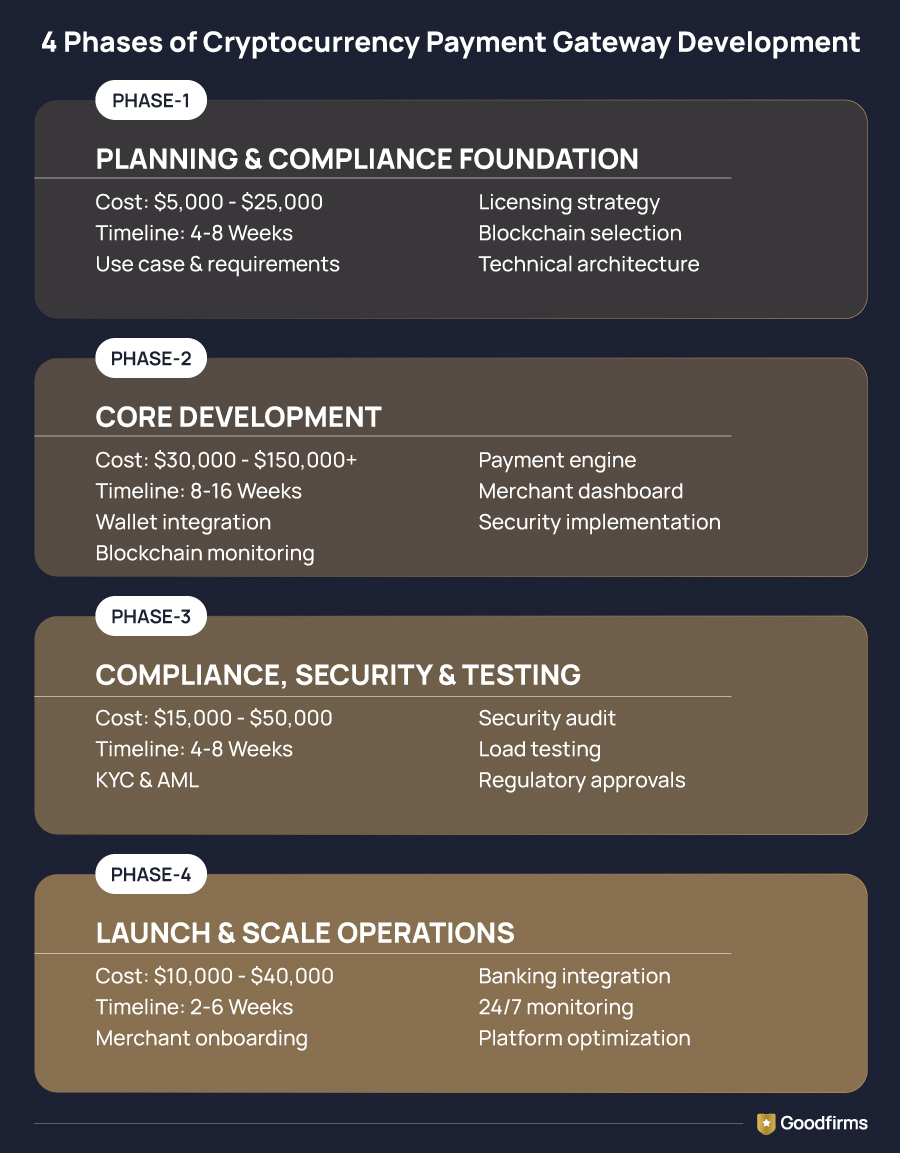
Phase 1: Planning and Compliance Foundation ($5,000 to $25,000)
The most important step and foundation of your project is phase 1, where you plan and consult with experts on which technology to choose, the licensing requirements, and everything you need to legally establish your business.
Most businesses think that they need to spend when the development starts. Well, that is not true. This step will decide the future of your business. So make sure you dont leave any page unturned and consult the best in town.
Estimated Timeline: 4 to 8 weeks
Market research and use case definition ($500-$5,000)
The team identifies your target users, supported payment flows, settlement model, and the cryptocurrencies your gateway will accept. At this point, you can choose to purchase a white-label cryptocurrency payment gateway software or build your own.
Jurisdiction and licensing strategy ($2,000-$8,000)
This is often the largest expense in the planning phase. Compliance experts review the countries where the gateway will operate, identify licensing requirements, and determine the KYC and AML obligations that apply to your business model. Working through jurisdiction strategy is easier with the right help. Browse the regulatory compliance consulting firms directory who specialize in exactly this kind of multi-market licensing review.
Blockchain and cryptocurrency selection ($1,000-$4,000)
Choosing the right blockchain networks affects transaction speed, fees, scalability, and future maintenance. The cost depends on how many networks you plan to support and whether you will accept only cryptocurrencies or include stablecoins and automatic fiat conversion as well. Compare vendors on Goodfirms' blockchain development companies directory to see who has actually shipped multi-chain payment infrastructure before you commit to one.
Technical architecture planning ($1,000-$5,000)
Architects design how the payment gateway will connect wallets, blockchain nodes, merchant systems, settlement services, and security controls. Projects that require high availability, multi-chain support, or enterprise integrations usually need more planning before development starts.
Vendor and technology partner evaluation ($500-$4,000)
Many businesses rely on external providers for custody services, blockchain infrastructure, compliance verification, or payment processing. Comparing vendors, evaluating pricing, reviewing security standards, and selecting the right technology partners adds to the planning budget but can prevent costly changes later.
Phase 2: Core Development ($30,000 to $150,000+)
This is where your cryptocurrency payment gateway starts taking shape. Developers build the wallet infrastructure, connect blockchain networks, develop payment processing logic, and create the merchant-facing dashboard. Since this phase includes most of the engineering effort, it also accounts for the largest share of the development budget.
Wallet and custody integration ($8,000-$30,000)
The gateway needs a secure way to generate wallet addresses, receive payments, and store digital assets. Developers integrate hot and cold wallet infrastructure, implement key management, and configure transaction signing. Supporting multiple cryptocurrencies or using third-party custody providers increases both development time and integration complexity. For a closer look at custodial versus non-custodial models and what each one costs, our crypto wallet development cost guide breaks down the same wallet infrastructure decisions in more depth.
Blockchain node and transaction monitoring ($6,000-$25,000)
Every incoming payment must be detected, verified, and confirmed before the transaction is marked as complete. This requires connecting blockchain nodes, monitoring mempool activity, validating confirmations, and handling failed or delayed transactions.
Exchange rate and crypto-to-fiat conversion engine ($5,000-$20,000)
Merchants often prefer receiving payouts in their local currency instead of cryptocurrency. This module fetches live market prices, locks exchange rates during checkout, calculates conversion values, and manages price fluctuations.
Merchant dashboard and API development ($8,000-$35,000)
The dashboard allows merchants to track payments, issue refunds, download reports, manage API keys, and configure settlement preferences. At the same time, developers build APIs and SDKs that let businesses integrate the payment gateway with websites, mobile apps, or eCommerce platforms.
Security architecture implementation ($5,000-$40,000)
Security isn't a feature that's added at the end. It's built throughout development. This includes encrypting sensitive data, protecting APIs, implementing rate limiting, separating hot and cold wallets, and defending the platform against attacks such as DDoS and unauthorized access.
Phase 3: Compliance, Security, and Testing ($15,000 to $50,000)
Your payment gateway may be feature-complete by this stage, but it's still not ready for production. Before processing live transactions, the platform needs to pass security assessments, meet regulatory requirements, and prove it can handle real-world traffic. Many businesses underestimate this phase, yet it's often where costly issues surface and get fixed before launch.
Estimated Timeline: 4 to 8 weeks
KYC and AML integration ($4,000-$12,000)
Identity verification is a core requirement for most regulated crypto payment gateways. This step involves integrating KYC and AML providers, configuring onboarding workflows, screening users against sanctions lists, and setting up transaction monitoring. The final cost depends on the number of verification checks, supported countries, and the compliance provider you choose.
Penetration testing and security audit ($5,000-$15,000)
A third-party security audit helps uncover vulnerabilities before attackers do. Security specialists review wallet infrastructure, APIs, authentication systems, and transaction workflows while performing penetration tests to identify weaknesses. If your gateway uses smart contracts, those contracts usually require a separate audit, adding to the overall budget. Goodfirms' fintech cybersecurity companies directory lists firms that specialize in penetration testing and wallet security audits for exactly this kind of pre-launch review.
Load and transaction flow testing ($2,000-$8,000)
A payment gateway should perform just as reliably during peak traffic as it does during internal testing. QA engineers simulate thousands of concurrent transactions, measure confirmation times, test failover scenarios, and verify settlement accuracy. Explore top software testing companies that can help you find QA partners experienced in validating transaction flows and load capacity before real funds are involved.
Regulatory filing and license submission ($4,000-$15,000)
Once compliance requirements have been met, businesses can begin submitting applications for licenses and registrations in their target markets. Costs vary depending on the jurisdiction, the complexity of the business model, and the professional services required to prepare the documentation.
Phase 4: Launch and Operations ($10,000 to $40,000, plus 15% to 25% annually)
The final phase focuses on moving your gateway from a test environment into production. Beyond deploying the platform, you will need to onboard merchants, connect banking infrastructure, establish monitoring systems, and prepare customer support. A smooth rollout reduces operational issues and helps merchants start accepting cryptocurrency payments with confidence.
Estimated Timeline: 2 to 6 weeks for the initial launch
Merchant onboarding and implementation ($2,000-$8,000)
Launching a payment gateway isn't just about turning the platform on. Merchants need API documentation, technical assistance, sandbox testing, and support during their first live transactions.
Banking and fiat settlement integration ($3,000-$15,000)
Many businesses want the flexibility to receive payouts directly into their bank accounts instead of holding cryptocurrency. This requires integrating banking partners or Banking-as-a-Service providers, configuring settlement workflows, and validating payout processes.
Monitoring and support setup ($2,000-$7,000)
Continuous monitoring helps detect failed payments, delayed confirmations, suspicious activity, and infrastructure issues before they affect merchants. This phase also includes setting up alerting systems, operational dashboards, logging tools, and customer support processes to ensure the platform remains reliable after launch.
Post-launch optimization ($3,000-$10,000)
The first few weeks after launch provide valuable insights into how merchants and customers interact with the gateway. Development teams analyze transaction data, resolve performance bottlenecks, improve checkout flows, and prioritize new blockchain integrations based on actual usage.
Annual Maintenance (15% to 25% of Development Cost)
Most cryptocurrency payment gateways require an annual maintenance budget equal to 15% to 25% of the initial development cost. This covers routine software updates, security patches, bug fixes, server and database optimization, blockchain protocol upgrades, API maintenance, and compatibility updates for third-party integrations. It also includes performance monitoring, infrastructure improvements, feature enhancements, and technical support to keep the platform secure, compliant, and reliable as transaction volumes grow.
8 Ways to Keep Cryptocurrency Payment Gateway Development Costs Under Control
Reducing costs doesn't mean compromising quality. It means investing in the right areas and avoiding unnecessary work early in the project.
1. Start with an MVP
Launch with the features merchants need most, such as wallet integration, payment processing, and basic settlements. Advanced reporting, analytics, loyalty programs, and support for additional blockchains can be introduced after validating market demand.
2. Limit blockchain support initially
Every blockchain requires separate wallet integration, transaction monitoring, testing, and maintenance. Supporting Bitcoin, Ethereum, and one or two stablecoins is often enough for an initial release. If stablecoin support is on your roadmap, Goodfirms' stablecoin infrastructure directory is a good starting point for issuance, redemption, and reserve management providers.
3. Use trusted third-party services
Building your own custody solution, KYC platform, or fraud detection engine can significantly increase development costs. Integrating established providers is usually faster, less expensive, and easier to maintain.
4. Define requirements before development begins
Changing settlement logic, merchant workflows, or supported cryptocurrencies midway through development often leads to expensive rework. Spending more time during the planning phase usually reduces the overall project cost.
5. Automate compliance where possible
Modern KYC, AML, and transaction monitoring platforms reduce manual reviews and help your operations team handle more merchants without growing at the same pace.
6. Build with future expansion in mind
Even if you are launching with a single blockchain, your architecture should make it easier to add more networks later. A scalable foundation costs less than redesigning the platform after launch.
7. Choose an experienced development partner
A team with experience building crypto payment platforms is more likely to anticipate integration challenges, security risks, and compliance requirements. That reduces delays and avoids costly mistakes. Explore cryptocurrency website development companies and filter by portfolio, verified reviews, and hourly rate, which makes it easier to shortlist a partner with real payment gateway experience.
8. Allocate a contingency budget
Unexpected API changes, regulatory updates, and integration issues are common in blockchain projects. Setting aside 10% to 15% of your development budget gives you room to handle these without disrupting the project.
FAQs - Cryptocurrency Payment Gateway Development Cost
How much does cryptocurrency payment gateway development cost?
$40,000 to $300,000+, depending on supported cryptocurrencies, wallet architecture, security features, compliance requirements, integrations, and the custom nature of the build.
How long does it take to build a cryptocurrency payment gateway?
A basic MVP takes 4 to 6 months. A fully customized, enterprise-grade platform can run 9 months or longer.
What's the most expensive part of building one?
Core platform development, hands down. Wallet infrastructure, blockchain integrations, payment processing, dashboards, APIs, and security architecture together make up the largest share of the budget.
How much does it cost to maintain a cryptocurrency payment gateway?
Plan on 15% to 25% of your initial development cost every year, covering infrastructure, security updates, blockchain upgrades, monitoring, and ongoing compliance.
Ready to Budget Your Cryptocurrency Payment Gateway?
If you are ready, start by defining the cryptocurrencies and blockchains you actually need, the markets you plan to enter, your settlement model, and the compliance requirements that come with them. Then separate your launch essentials from features that can wait. This gives you a much clearer budget before you approach development partners.
The next step is finding a team that has worked with blockchain payments, wallet integrations, security, and regulatory requirements before. Goodfirms can help you compare cryptocurrency payment gateway development companies based on their services, portfolios, client reviews, industry experience, and hourly rates. Shortlist providers that fit your scope, discuss the four development phases with them, and request detailed estimates before making your final choice. A well-planned budget paired with the right development partner can save you from expensive rework later.