Key takeaways
- Crypto payment gateways have crossed from early-adopter infrastructure into mainstream fintech, a $2.39 billion market in 2026, growing at 19.2%CAGR toward $4.07 billion by 2029.
- The most expensive mistake in gateway development isn't building the wrong feature; it's choosing the wrong approach. White-label starts at $15,000 and ships in weeks; custom enterprise builds run $300,000+ and take 9+ months.
- Stablecoins have displaced Bitcoin as the default settlement currency; USDT, USDC, and FDUSD now carry 82% of all crypto gateway transaction volume globally.
- Compliance built in from day one costs a fraction of compliance retrofitted after launch, and with MiCA live and only 40 of 138 jurisdictions meeting FATF standards, there is no low-risk version of skipping it.
- 77% of millennials want to pay with digital assets, and 45% of merchants already report faster settlements after switching, adoption is now a two-sided pull, not a one-sided push.
In 2026, if your business doesn’t have a crypto payment gateway strategy, you’re not just missing a trend — you may already be leaving measurable revenue on the table. The market is valued at $2.39 billion this year, more than double what it was just three years ago. Over 741 million people worldwide now own cryptocurrency, and merchants who’ve made the switch report faster settlements, zero chargebacks, and a direct line to a new generation of global buyers.
But “accepting crypto” is the easy part. Building the infrastructure to do it reliably, securely, and in compliance with regulations across 160+ countries? That’s where things get real — and where most businesses either overspend, underengineer, or both.
This guide covers exactly that: how to create a crypto payment gateway from the ground up, what it actually costs in 2026, and which development companies have the verified credentials to build it right.
Already past the research phase? Browse verified best cryptocurrency payment gayeway software, filtered by rates and portfolio depth
What Is a Crypto Payment Gateway?
A crypto payment gateway is the infrastructure layer that sits between your customer's crypto wallet and your merchant account. When a buyer pays in Bitcoin or USDT, the gateway validates the transaction on-chain, converts it if needed, and settles the amount, all in seconds.
Unlike traditional payment processors, cryptocurrency exchange platforms operate on blockchain rails. That means no banks, no intermediaries, no chargebacks, and borderless reach by default. It also means settlement is irreversible, which eliminates fraud risk from chargebacks entirely. Still confused by the heavy wording? Let us simplify it for you.
How Does a Crypto Payment Gateway Work?
A crypto payment gateway works by intercepting a buyer's payment intent, routing it through the blockchain network for validation, and delivering the confirmed funds to the merchant, either in the original cryptocurrency or automatically converted to fiat.
The process is in 4 steps:
- Customers initiate a payment from their crypto wallet (Bitcoin, ETH, USDT, etc.)
- The gateway generates a unique payment address and monitors the blockchain in real time.
- The blockchain network validates and confirms the transaction
- Funds settle to the merchant, either in crypto or auto-converted to fiat
This four-step cycle completes in seconds for the end user. Behind the scenes, it requires a payment API, wallet architecture, blockchain node connections, exchange rate management, and a settlement engine working in sync. How much of that you build yourself, versus licensing or outsourcing, is the first real decision every gateway project has to make.
Build vs Buy — What's Right for Your Business in 2026?
Before you write a single line of code, answer this honestly: Does your business need a fully custom-built gateway, or would a white-label crypto payment gateway or third-party integration serve you just as well?
This isn't a philosophical question; it directly determines your timeline, budget, and risk exposure.
|
Factor |
Build from Scratch |
White-Label Gateway |
Third-Party Integration |
|---|---|---|---|
|
Cost |
$40K–$300K+ |
$20K–$100K |
$0–$5K/mo (SaaS) |
|
Time to Launch |
4–12 months |
6–12 weeks |
1–5 days |
|
Customization |
Full control |
Moderate |
Minimal |
|
Compliance Ownership |
You own it entirely |
Provider handles base layer |
Fully managed |
|
Best For |
Fintechs, enterprises |
Mid-market, growing e-commerce |
Startups, MVPs |
The honest answer: if you're a fintech, global marketplace, or enterprise that needs full control over data, branding, fee structures, and compliance infrastructure, build. If you're a mid-size e-commerce business that needs to accept cryptocurrency payments in the next 90 days, white-label is faster and cheaper without sacrificing reliability.
5 Common Mistakes to Avoid Before You Start
Most gateway projects that fail do so because of decisions made in the first two weeks — not the last two months. Here’s what to watch for:
- Underestimating compliance timelines - KYC/AML isn’t a sprint item — regulatory approvals in the EU and US alone can take 3–6 months. Teams that treat compliance as an afterthought routinely rebuild.
- Adding too many chains at launch - Every additional blockchain means more node infrastructure, more maintenance, and more edge cases. Start with one or two chains with proven transaction demand.
- Skipping a sandbox environment - Launching without a proper merchant test environment leads to production failures during onboarding — and lost merchant trust that’s hard to recover.
- Weak webhook reliability - Delayed or missed webhooks mean merchants don’t get payment confirmations. Under load, even a 3-second delay cascades into support tickets and chargebacks.
-
Building exchange rate logic in-house too early - Slippage tolerance errors and rate-lock edge cases cost merchants real money. Third-party exchange APIs are more reliable for an initial build
How to Create a Crypto Payment Gateway — Step by Step
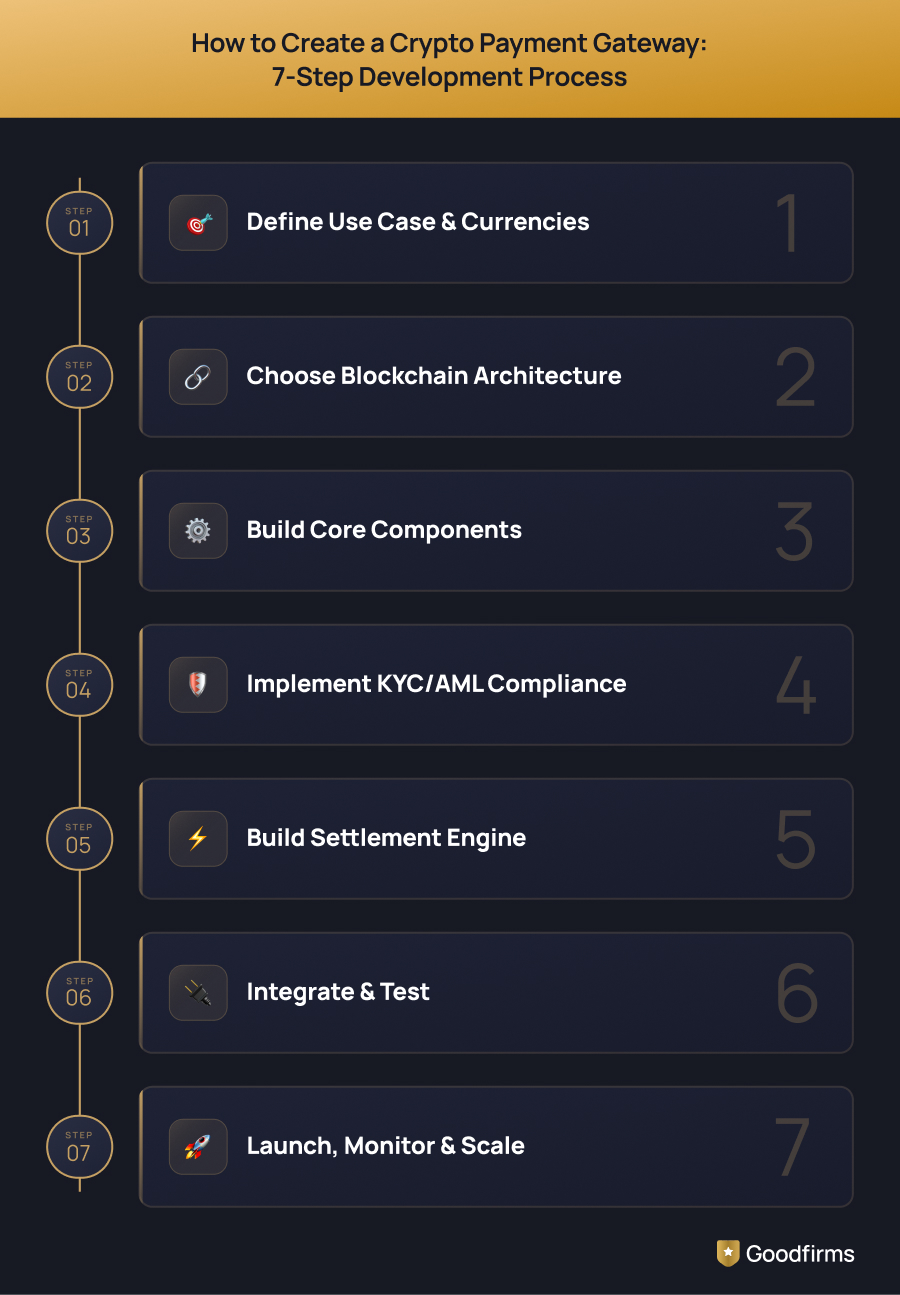
Building a crypto payment gateway isn't a single development task; it's a sequence of interdependent decisions, each one constraining what comes next.
The seven steps below follow the order they need to be built in, not the order that feels most comfortable. Follow them in sequence.
Step 1: Define Your Use Case and Supported Currencies
What problem are you actually solving? A Bitcoin payment gateway for a retail brand looks architecturally different from a stablecoin payment gateway designed for cross-border B2B settlements. Before touching infrastructure, nail down:
- Which cryptocurrencies will you support at launch? (Bitcoin, ETH, USDT, USDC, XRP, Solana?)
- Will you offer automatic crypto-to-fiat conversion, or settle in crypto directly?
- Are you serving merchants, end consumers, or operating as infrastructure for other platforms?
Here's a data point worth building around: stablecoins now represent 82% of all crypto gateway transactions globally, according to CoinLaw's 2026 analysis. USDT alone accounts for 33% of stablecoin transaction volume. If USDT/USDC support isn't in your Day 1 roadmap, you're already misaligned with where the market actually transacts.
Step 2: Choose Your Blockchain Architecture
Your blockchain infrastructure is your foundation, and unlike application-layer decisions, architectural choices made here are expensive to undo.
Key decisions at this stage:
- Chain selection: Bitcoin commands 42% of all gateway transactions; Ethereum follows at 25%, powered by smart contracts and DeFi programmability. Solana offers high throughput and low fees. Or go multi-chain from day one.
- Node management: Run your own full nodes or use a managed node provider like Alchemy, QuickNode, or Infura?
- Smart contracts: Required if you want programmable payments, escrow logic, subscription automation, or DeFi-native settlement flows
Step 3: Build the Core Components
A production-grade crypto payment gateway is not a single application; it's a suite of tightly integrated modules. Cut any one of these, and you introduce risk.
Essential modules:
- Payment API — The core engine. Processes transaction requests, monitors wallet addresses, and returns real-time payment status to merchants. A well-documented crypto payment gateway API is also critical for merchant integrations; it should expose endpoints for payment creation, status polling, and webhook registration as a minimum.
- Wallet integration — HD wallet generation, multi-sig support for treasury operations. Teams building this layer can find verified cryptocurrency wallet development specialists to help with prior wallet builds.
- Exchange rate engine — Real-time crypto-to-fiat pricing with slippage tolerance controls and rate-lock windows for merchant checkout stability
- Merchant dashboard — Transaction history, settlement controls, multi-user access, analytics, and refund management
- Webhook & notification system — Real-time alerts on payment received, confirmation, failure, or delay; critical for merchant UX
- Security layer — AES-256 encryption, DDoS mitigation, rate limiting, IP allowlisting, and cold/hot wallet separation for fund custody
Step 4: Implement KYC/AML Compliance
This is where most development teams underestimate scope, and where regulators are paying the closest attention.
In 2026, regulatory pressure has intensified on every front. The EU's MiCA regulation is reshaping how crypto payment gateways register and operate across Europe, with transitional provisions expiring in July 2026. The U.S. Travel Rule applies to crypto transmittals at or above $3,000, requiring originator and beneficiary data to travel with every transaction.
Globally, only 40 of 138 assessed jurisdictions currently meet FATF's "largely compliant" standard for crypto regulation, according to FATF's April 2025 assessment.
What your compliance stack needs:
- KYC verification — Identity checks at merchant onboarding and, depending on jurisdiction, at end-user level
- AML screening — Ongoing transaction monitoring, real-time sanctions screening against OFAC, EU, and UN lists
- SAR reporting — In the U.S., suspicious crypto transactions above $5,000 trigger mandatory Suspicious Activity Report obligations
- Third-party acceleration — Integrating compliance APIs from Chainalysis, Sumsub, or ComplyAdvantage can cut compliance build time from months to weeks
Step 5: Build the Settlement and Conversion Engine
Settlement is how your merchants actually get paid, and it's one of the most underspecced components in early-stage gateway builds.
You have two primary settlement models:
- Crypto settlement — Merchant receives BTC, ETH, USDT, or another token directly into their designated wallet. Simpler to build; requires the merchant to manage crypto price exposure.
- Fiat settlement — Gateway auto-converts crypto at the point of payment confirmation; merchant receives USD, EUR, or GBP via daily bank transfer. More complex to build, but it's what most enterprise clients actually want.
For most B2B and enterprise use cases, build for fiat settlement with daily bank payouts as your default path. Crypto-to-fiat conversion APIs from providers like Fireblocks or B2BinPay can realistically save 3–6 months of development time while delivering institutional-grade reliability.
Step 6: Integrate and Test — Rigorously
Testing a payment gateway is not optional, abbreviated, or something you "clean up post-launch." It's where you discover that your webhook delivery has a 3-second delay under load, or that your exchange rate lock has an edge case that costs merchants money.
Testing checklist before launch:
- Unit tests covering every API endpoint and edge case
- Blockchain integration tests on public testnets (Ethereum Sepolia, Bitcoin testnet)
- Load testing — can your infrastructure handle 10,000 concurrent transactions without degradation?
- Penetration testing — mandatory before any real funds flow through the system.
- Merchant sandbox environment — let beta merchants test full end-to-end flows before going live.
Step 7: Launch, Monitor, and Scale
Post-launch operations surprise most teams. The product is live, and now the real infrastructure work begins.
What you need on day one of production:
- Real-time transaction monitoring dashboards with failure alerting
- Automated escalation workflows for stuck or delayed transactions
- Multi-chain routing logic as you expand currency support
- Scheduled compliance reviews tied to regulatory calendar (MiCA deadlines, FATF guidance updates)
- Merchant support tooling, because when payments fail, merchants expect immediate answers
Goodfirms Insight:Teams that integrate KYC/AML into their gateway architecture from day one spend significantly less on remediation than those that add it post-build. Treat compliance as infrastructure—and commit 25–30% of your development budget to security from day one.
The Real Cost of Building a Crypto Payment Gateway in 2026
Let's talk numbers without the hand-waving.
Development cost for a crypto payment gateway in 2026 falls between $40,000 and $300,000+, depending on what you're building, where you're building it, and how much compliance complexity your target markets require.
According to Galaxy Weblinks' February 2026 cost analysis, the range reflects genuine scope differences, not arbitrary pricing.
|
Tier |
Cost Range |
Timeline |
What You Get |
|---|---|---|---|
|
White-Label / Clone |
$15,000–$30,000 |
2–4 weeks |
Branded UI on pre-built infrastructure; fastest to market |
|
MVP / Starter Build |
$40,000–$80,000 |
4–6 months |
Wallet integration, payment API, basic dashboard, foundational security |
|
Growth / Mid-Market |
$80,000–$150,000 |
4–6 months |
Multi-currency, crypto-to-fiat conversion, stronger encryption, webhooks |
|
Enterprise / Full-Scale |
$150,000–$300,000+ |
9+ months |
Custom compliance stack, multi-chain routing, AI fraud detection, dedicated support |
What drives cost up:
- Number of blockchains and tokens supported at launch
- KYC/AML complexity across regulatory jurisdictions
- Custom AI/ML fraud detection vs. third-party APIs
- 24/7 SLA infrastructure and redundancy architecture
- Mobile app development is running in parallel with web development
How to control cost without cutting corners:
- Launch with one or two chains, validate real transaction demand, then expand
- Use battle-tested third-party APIs for KYC, exchange rates, and blockchain data; the reliability is often better than a first-iteration build.
- Hire a specialized blockchain firm rather than a generalist agency; compliance scope is almost always underestimated by teams without direct payment gateway experience, and that gap shows up as costly rework when it's least convenient. The top payment processing companies with fintech track records will save more in avoided mistakes than they cost in hourly rates.
Which Industries Benefit Most from Crypto Payment Gateways?
A crypto gateway isn’t one-size-fits-all. The use case determines your architecture, the currencies you prioritize, and the compliance obligations you face.
|
Industry |
Primary Benefit |
Key Consideration |
|
Global E-commerce |
Eliminate currency conversion friction on cross-border orders |
Multi-currency support; fiat settlement preferred |
|
SaaS / Subscriptions |
Programmable recurring payments via smart contracts |
Stablecoin rails reduce volatility risk |
|
Gaming & NFTs |
Microtransactions with near-zero fees on Layer-2 |
Lightning Network or Solana for high-throughput |
|
B2B / Cross-border |
60% faster settlement vs. SWIFT; no FX conversion fees |
XRP and stablecoins dominate; AML complexity is higher |
|
Freelance / Gig Economy |
Instant global payouts without bank account requirements |
Useful in unbanked markets (MENA, Africa, SE Asia) |
|
Fintech / Neobanks |
White-label gateway as a revenue stream for merchants |
Full compliance stack required from day one |
Goodfirms Insights: The State of Fintech Infrastructure in 2026
The 2026 fintech landscape is defined by what Goodfirms research describes as "distributed, event-driven, and highly regulated systems." Blockchain's role has matured well beyond cryptocurrency speculation; enterprises are now deploying it to create tamper-proof financial records and smart contracts that trigger payments automatically when pre-set conditions are met.
A concrete marker of how far this has come: tokenized Real World Assets (RWAs) hit $20 billion in early 2026, representing real institutional capital now flowing through blockchain-native rails.
For payment gateway builders, this isn't just background context, it signals that the infrastructure you build today may serve a much broader financial ecosystem than you initially designed for. Traditional financial institutions are integrating blockchain settlement, and the addressable market is expanding beyond crypto-native merchants into mainstream finance.

Top Crypto Payment Gateway Development Companies in 2026
Choosing the right development partner matters as much as your architecture decisions. A technically capable firm that doesn't understand compliance will cost you more in remediation than they saved you in hourly rates.
Company |
Best For |
Core Strength |
Key Capability |
Limitation to Know |
Ideal Use Case |
|---|---|---|---|---|---|
| Speed | Scalable fintech infrastructure | High-performance backend systems | API-first architecture, custom payment systems | Not crypto-native by default | Enterprises building high-scale payment platforms |
| Nadcab Labs | Multi-chain crypto gateways | Blockchain ecosystem expertise | Multi-chain integration, wallet + exchange systems | May require external compliance layer | Crypto-native platforms, Web3 businesses |
| Bates Group | Regulatory compliance | Financial risk & AML expertise | KYC/AML strategy, regulatory advisory | Not a development company | Fintechs operating in regulated markets (EU/US) |
| Microblink | Identity verification (KYC) | AI-powered onboarding | Document scanning, user verification APIs | Only covers KYC layer, not full gateway | Fast onboarding + compliance automation |
| ChainUP | Exchange-grade infrastructure | Institutional crypto systems | Liquidity integration, asset management, trading infra | Complex for small/MVP projects | Large-scale crypto platforms, exchanges |
How the Right Team Is Actually Structured
Most businesses start with one assumption: a single development partner can handle everything, infrastructure, compliance, onboarding, and settlement. That assumption rarely survives contact with a production system.
The teams that ship reliable gateways don't look for one vendor that does everything adequately. They stack specialists:
|
Layer |
What It Covers |
Who Handles It |
|---|---|---|
|
Infrastructure |
API architecture, payment engine, backend systems |
Speed / Nadcab Labs |
|
Compliance |
KYC/AML strategy, regulatory advisory, FATF/MiCA |
Bates Group |
|
KYC / Onboarding |
Identity verification, document scanning, user APIs |
Microblink |
|
Liquidity & Exchange |
Asset management, liquidity integration, trading infra |
ChainUP |
Goodfirms Insight- Modular system design is standard fintech practice, not an advanced strategy. It improves flexibility, simplifies vendor replacement, and prevents the full rebuilds that happen when a single generalist partner underdelivers on one critical layer.
Where Teams Get This Wrong
The instinct is to minimize vendors and simplify. In payment systems, that instinct tends to backfire. A single partner overpromising on compliance and underdelivering on settlement is one of the most common reasons gateway projects get rebuilt 12 months after launch, at significantly higher cost than if the layers had been separated from the start.
Early vendor decisions carry long-term cost implications. Compliance and settlement complexity are consistently the two areas where initial estimates prove most wrong, and they're also the two areas where getting it wrong is most expensive to fix.
Decision Snapshot
Not every business needs all five layers from day one. Use this as a starting filter:
|
If your priority is… |
Start with… |
|
Custom payment infrastructure |
Speed |
|
Multi-chain crypto payments |
Nadcab Labs |
|
Regulatory compliance strategy |
Bates Group |
|
KYC and identity verification |
Microblink |
|
Exchange-scale liquidity |
ChainUP |
You're not choosing the best company. You're choosing the right combination of capabilities, and making sure compliance, transaction processing, and settlement are all addressed before the first line of code is written, not after the first production incident.
5 Trends Shaping Crypto Payment Gateways Right Now
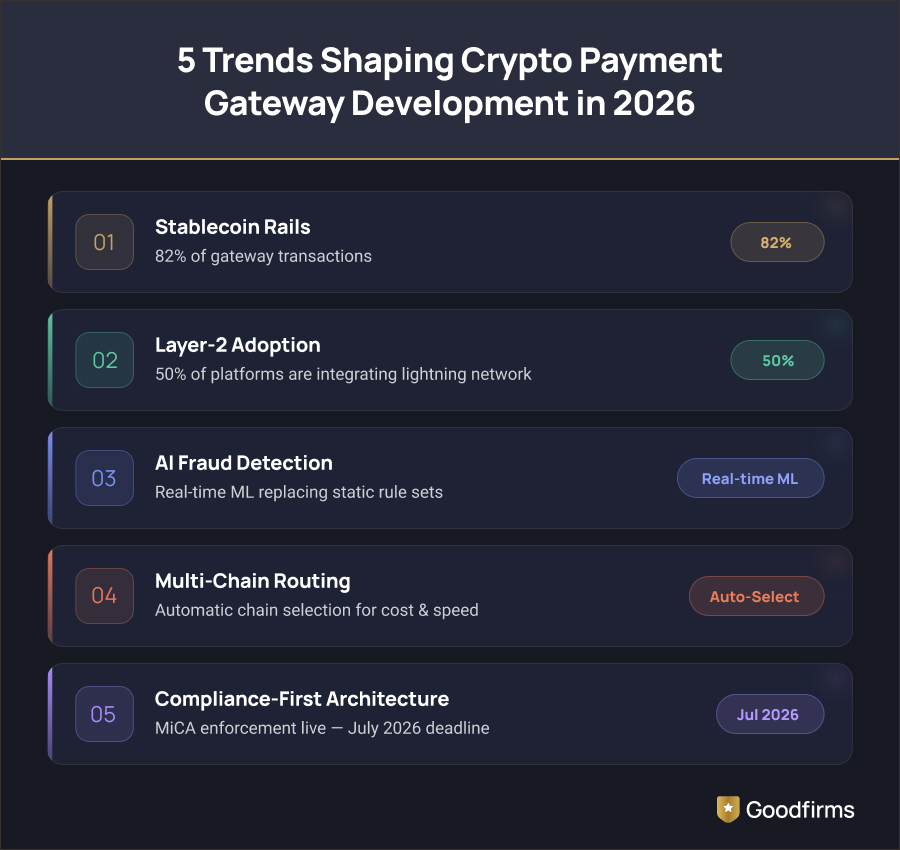
The 2026 gateway is not the 2023 gateway. Here's what's driving the next wave of cryptocurrency payment gateway development.
1. Stablecoin rails are the new default.
With 82% of gateway transactions now flowing through stablecoins, USDT and USDC have become the operational backbone of crypto commerce. Tether's market cap stands at $184 billion as of March 2026, per CoinLaw. Any gateway built in 2026 should treat stablecoin support as primary infrastructure, not an add-on.
2. Layer-2 is moving from optional to expected.
Roughly 50% of crypto payment platforms are now supporting or actively integrating the Lightning Network, according to SQ Magazine's 2026 analysis. As Bitcoin transaction fees fluctuate, Layer-2 rails offer the speed and cost predictability that merchant-facing gateways require.
3. AI-powered fraud detection is replacing static rule sets.
Leading gateway providers are deploying machine learning models that flag suspicious transaction patterns in real time, without adding friction to legitimate payments. Static rule sets can't keep pace with evolving fraud vectors; ML-driven detection adapts continuously.
4. Multi-chain routing is becoming table stakes.
Top-tier gateways now route each transaction through the optimal chain automatically, balancing cost and speed in real time. Building this routing logic from day one avoids a costly rebuild when you expand from two chains to seven.
5. Compliance-first architecture is no longer optional.
MiCA's transitional provisions expire in July 2026. The EU's new Anti-Money Laundering Authority has flagged crypto as a top laundering risk. In the U.K., Coinbase's payments arm was fined £3.5 million for compliance failures. Build compliance at the architecture level, not as a feature, not as a sprint item, but as the foundation.
Should You Build a Crypto Payment Gateway in 2026?
The case has never been stronger. A market growing at nearly 20% CAGR toward $4 billion by 2029. Cross-border transactions surged 60% in 2025 as crypto gateways eliminated currency conversion friction. A merchant base where 39% already accept or are actively evaluating crypto. And a buyer generation,77% of millennials showing active interest in crypto payments, per CoinLaw, are looking for merchants who meet them where they transact.
The infrastructure you build today will either hold weight as your transaction volume scales, or it will crack at exactly the moment it matters most. A gateway that works for 100 transactions a day is not the same as one that works for 100,000, and the difference lives entirely in the architectural decisions made in the first few sprints. Build for where you're going, not just where you are.
FAQs
1. How long does it take to build a crypto payment gateway from scratch?
A minimum viable product with basic wallet integration, a payment API, and a merchant dashboard typically takes 4–6 months with a specialized blockchain firm. A full enterprise build with multi-chain routing, custom KYC/AML compliance, and AI-powered fraud detection can take 9 months or longer. White-label alternatives compress this to 2–6 weeks, making them a strong choice for businesses that need to accept cryptocurrency payments quickly without waiting for a custom build.
2. What is the cost of crypto payment gateway development in 2026?
Development costs range from $15,000 for a white-label or clone-script solution to $300,000+ for an enterprise-grade, multi-chain gateway with a custom compliance stack. Most growing businesses land in the $40,000–$150,000 range for a well-scoped MVP or mid-market build. The biggest cost drivers are the number of blockchains supported, KYC/AML complexity, and whether you need custom fraud detection or can use third-party APIs.
3. Do I need KYC/AML compliance for a crypto payment gateway?
The EU's MiCA regulation, the U.S. Travel Rule (applicable at $3,000+), and FATF guidelines all create mandatory obligations for crypto payment gateway operators. Failing to build compliance infrastructure from the start is not a cost-saving decision; it's a liability. Teams that retrofit compliance after launch consistently spend more than those that build it in from the start. Providers like Chainalysis, Sumsub, and ComplyAdvantage offer APIs that significantly accelerate your KYC/AML build.
4. What cryptocurrencies should a payment gateway support in 2026?
Bitcoin holds 42% of gateway transaction share; Ethereum accounts for 25%, driven by DeFi and smart contract payments. Beyond that, XRP is strong for cross-border B2B transactions, and Solana is increasingly popular for high-throughput, low-fee use cases. If you're building a stablecoin payment gateway specifically, prioritize USDT, USDC, and FDUSD; they account for the vast majority of merchant-facing settlement volume in 2026.
5. Should I build a crypto payment gateway or use an existing one?
Suppose you need full control over data, branding, fee structures, and compliance build. If you need to get live within weeks or your transaction volumes don't yet justify a full cryptocurrency payment gateway integration, use a white-label or third-party solution first, validate demand, then build. Most successful payment infrastructure companies started with a white-label layer, gained real transaction data, and rebuilt with custom architecture once they had product-market confirmation.