Five separate service categories. Five sets of inspection steps. Five different ways of tracking work, updating customers, and filing reports — all of them were mutually exclusive affairs. None of them connected to each other. That was the operating challenge for a property inspection and maintenance business before SDLC built Equity Builders CRM for them.
The client found their development partner, SDLC, on Goodfirms. They read their profile and found that it exactly matched their requirements. SDLC’s client-focused project positioning, portfolio, and track record in SaaS and field-service platforms answered enough questions upfront that their first conversation with SDLC moved straight to their actual problem.
The result: Equity builders CRM software - a single platform managing roofing, plumbing, HVAC, electrical, and general property inspections — with a web dashboard for admins, mobile execution tools for inspectors, customer-facing request tracking, and live sync across every role. Manual coordination dropped by up to 70%.
Company: SDLC Corp
Lead Source: Goodfirms
Client Industry: PropTech / Field Services
Services Covered: Roofing · HVAC · Plumbing · Electrical · General
Platform Built: Equity Builders CRM
Spokesperson: Sanket Pahurkar
Goodfirms Score: 5 / 5 on Lead Influence
What SDLC Delivered - Equity Builders CRM
Before this project, the client was running five different inspection services without a system to bring them together. Twelve weeks later, they had one. Here's what it looked like.
60–70% |
Real-Time |
1 Platform |
|---|---|---|
| Reduction in Manual Workflows | Field Sync Across All Users | 5 Service Verticals Unified |
Operational Outcomes
- Up to 60–70% reduction in manual workflows — fragmented tools replaced by one connected platform
- Faster inspection assignment through digital job allocation between admins and field inspectors
- Improved field productivity — inspectors update progress, notes, images, and reports via mobile
- Faster reporting cycles — inspection reports easier to prepare, review, and track
- Better operational visibility — dashboard tracking of active jobs, pending reports, and field activity
- Consistent workflows across all five service categories
The Problem Before the Build
The client was working a lot harder than they needed to. Roofing, plumbing, HVAC, electrical, and general property inspection — five service lines, each with its own process, none of them sharing a system. Every job created coordination issues. Every update had to be manually approved.
| Business Challenges | Technical Challenges |
|---|---|
| Disconnected systems for leads, assignments, reports, and updates | No configurable workflow engine for multi-service inspection steps |
| Manual inspector scheduling and admin coordination | No unified web + mobile access model |
| Zero real-time field visibility for managers | No real-time data sync between inspectors, admins, and customers |
| Inconsistent workflows across service categories | No role-based dashboard and permission model |
| Customers had no transparency into service status | No scalable multi-service SaaS architecture |
| Every new service vertical added more manual overhead | Architecture would have blocked future service expansion |
The effect showed up everywhere. This meant jobs took longer to assign, reports came back late or incomplete, and managers were constantly chasing updates. And every time they added a new service line, the overhead got worse — not better.
The Goodfirms Factor
The client didn't come through a warm introduction. They typed a search query, found SDLC Corp on Goodfirms, and spent time on the profile before ever clicking contact. They went through the services, looked at past work, and figured out whether this team actually understood what they needed.
By the time they reached out, most of the usual first-call agenda was already handled. Less 'who are you', more 'here's our problem.' That's a different kind of starting point.
| Profile Element | What It Communicated to the Client |
|---|---|
| Portfolio & Case Studies | Demonstrated SaaS architecture experience and ability to deliver field-service platforms end-to-end |
| Reviews & Ratings | Reduced perceived delivery risk across complex, multi-stakeholder software projects |
| Service Positioning | Showed that SDLC Corp understood both CRM workflows and mobile-enabled business platforms — not just generic dev capacity |
| Keyword Discoverability | Profile appeared in search at exactly the right moment in the client's evaluation process |
"The Goodfirms lead experience was more qualified and intent-driven compared to generic cold inquiries. The client had already reviewed our profile, portfolio, and service background before reaching out. This made the first conversation more focused on project goals, platform architecture, and business outcomes." — Sanket Pahurkar, SDLC Corp
What SDLC Corp Actually Built
Calling it a CRM undersells it. Equity Builders CRM is closer to a field operations system — built from scratch to handle the full job lifecycle across five service types, on web and mobile, for four different kinds of users.
- Web-based admin dashboard for centralized control of leads, assignments, inspectors, reports, and service status
- Customer mobile app for service request creation and real-time status tracking
Inspector mobile app for job access, checklist completion, image uploads, notes, and report submission
- Configurable inspection workflows adapted per service category (roofing, HVAC, plumbing, electrical, general)
- Role-based access and separate experiences for admins, inspectors, customers, and service managers
- Real-time synchronization across all user roles, inspection records, and field activity
- Scalable SaaS architecture designed to support new services, users, and product enhancements without rework
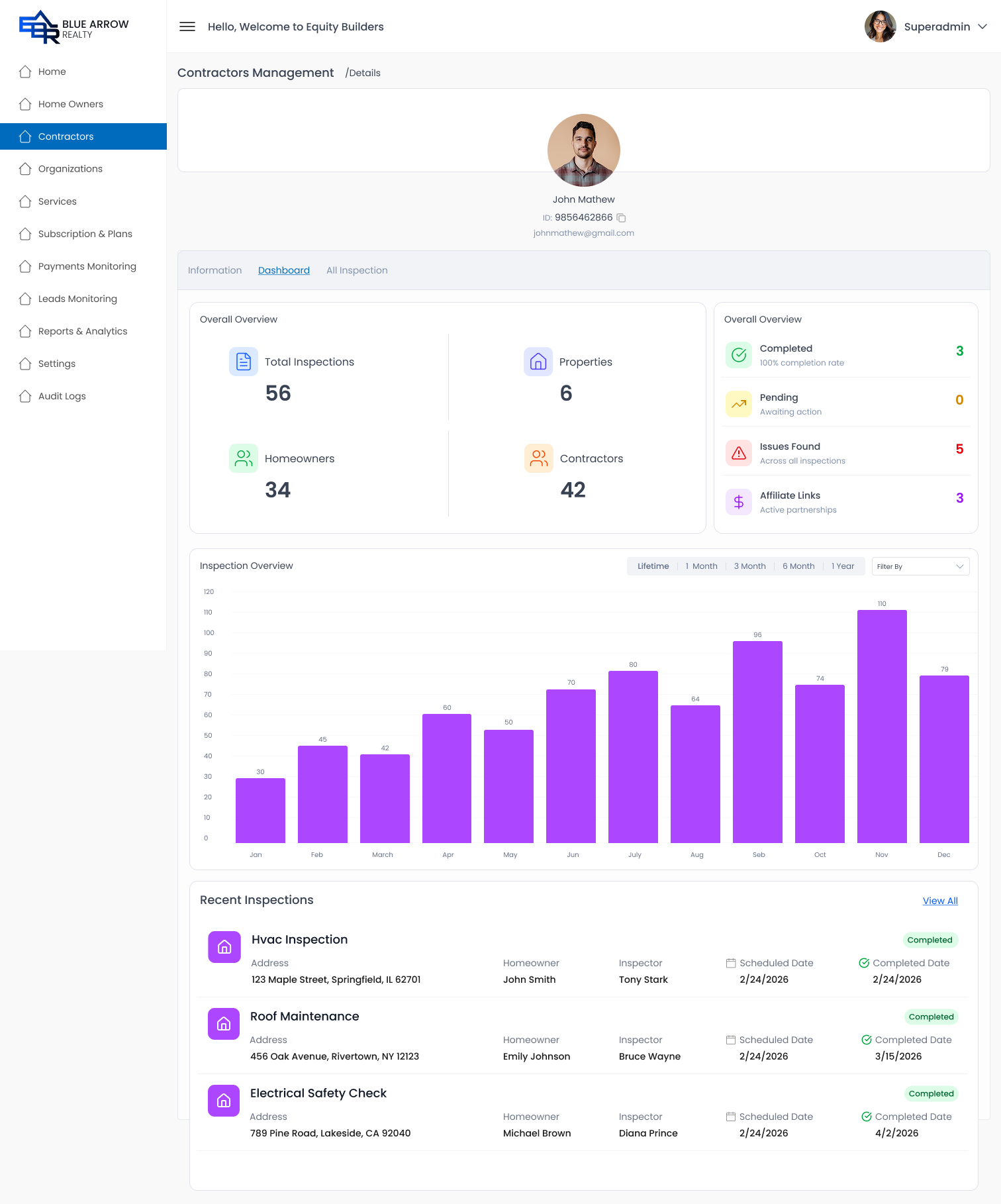
Equity Builders CRM — Contractor Performance Dashboard showing inspection overview, KPIs, and recent activity
Open the dashboard, and everything is visible at once: active inspections, properties, homeowners, contractor assignments, what's completed, what's pending, and where issues have been flagged. The bar chart tracks monthly inspection volume across the year. The Recent Inspections panel shows each job's live status — inspector, homeowner, scheduled date, and completion — all in a single row.
Why Off-the-Shelf Failed the Test
During the early discovery work, something became clear pretty quickly: this wasn't really a CRM problem.
A standard CRM would have given the client a cleaner way to manage contacts. But roofing inspections don't follow the same steps as HVAC checks. Plumbing work gets filed differently from electrical. Each service had its own flow, its own checklist, its own reporting needs. A packaged tool could organize the data — it couldn't manage the actual work.
"Instead of forcing the project into a conventional build path, our team shifted to a more customized architecture and delivery model. We focused on aligning technical decisions with the client's operational goals, prioritizing flexibility, maintainability, and long-term scalability from the start." — Sanket Pahurkar, SDLC Corp
That's what pushed the build toward a purpose-built platform. And that architectural decision is what made the 70% workflow reduction possible.
Constraints and How They Were Solved
Every project has constraints. This one had several that needed to be designed around from day one — not patched in later.
| Constraint | How SDLC Corp Resolved It |
|---|---|
| Multi-service workflow complexity | Built configurable inspection workflows per service category — one architecture, five operational modes. |
| User-role complexity | Designed separate web and mobile experiences for admins, inspectors, customers, and managers — all role-gated. |
| Scalability requirements | Architected a SaaS foundation that supports new services, users, and enhancements without platform rebuilds. |
| Operational simplicity | Kept user journeys focused on real tasks — request creation, assignment, inspection, reporting, follow-up — regardless of underlying complexity. |
How the Project Stayed on Track
One thing that stood out for the client throughout: they always knew where things stood, thanks to SDLC’s team structure and review sessions.
Every major product decision — how workflows would differ per service type, how roles and permissions would work, how the mobile and web sides would connect — got validated against how the business actually ran. And not just against a specification document.
The Day-to-Day Difference
Before the platform, nobody had a single place to see what was happening. Managers had to chase updates. Inspectors got job details over the phone, sometimes without everything they needed. Customers called to ask where their service request stood. Admin teams spent most of the day coordinating rather than managing.
After launch, each role had a purpose-built view of exactly what they needed. Managers opened one dashboard and saw everything — what was active, who was assigned, what was still pending, and where something had gone wrong. Inspectors picked up their jobs from their phones, completed checklists on site, added photos, and submitted reports before leaving. Customers tracked their own requests. Admin teams finally got to do actual management work instead of being the communication layer between everyone else.
"The client knew the project was being handled by a team that understood both the technical complexity and the business context — which made the entire process feel more predictable, transparent, and manageable." — Sanket Pahurkar, SDLC Corp
From Project to Partnership
Going live was a milestone, not a finish line. The client didn't want a vendor who shipped something and moved on — they wanted a team that would keep building with them. That's where the relationship settled: ongoing enhancements, new service category support, workflow refinements as the business changes.
What they have now is something most field-service businesses of their size don't. A purpose-built platform, designed around their actual operations, covering five service types from one place. For a property inspection and maintenance business, that would have naturally meant hiring an in-house engineering team or paying for enterprise software that wasn't built for their industry. However, neither of those options made sense to them.
However, collaboration with SDLC ensured the client achieved what they wanted, and at the same time, they were willing to be there for them at all times.
For Agencies on Goodfirms
Sanket is clear about what Goodfirms actually did here. It created the conditions for a real conversation to happen. The client came in already having done their research — portfolio reviewed, service positioning read, past work considered. By the time they sent that first message, a lot of the trust-building was already done.
The profile didn't just create visibility. It created credibility — before anyone at SDLC Corp said a word.
The call just had to confirm what the profile had already established.
Sanket's Advice to Other Agencies
- Build a profile that answers real questions — service categories, portfolio, and case studies should reflect actual client problems, not just a capabilities list
- Open with their situation, not your credentials — reference their industry, the workflow gaps you would expect, and how you would approach the build
- Bring evidence into the first conversation — relevant project examples, architecture decisions, delivery timelines, and outcome data from comparable engagements
- Think through their platform out loud — discuss integration risks, scalability decisions, and what makes their use case technically distinct
- Put it in writing after the call — a scoped technical approach or phased roadmap gives the client something concrete to share with stakeholders internally
Is Your Agency Listed on Goodfirms?
SDLC Corp showed up in that search result because the profile was built to be relevant — specific services, real project work, positioning that spoke directly to what field-service and SaaS clients are actually looking for. The client found it, spent time on it, and reached out already confident. The first conversation didn't have to start from zero.
That's what a well-built Goodfirms profile does. It doesn't replace the sales process — it does a big part of the trust-building before that process even begins.
If you're a field-service, property inspection, or SaaS business looking for a development partner who can build a platform around how your operations actually work, browse verified agencies at the Goodfirms Custom Software Development listing page.
If you're an agency that wants to be found the same way SDLC Corp was, get listed on Goodfirms today.