Key takeaways
- The dating app sector generated $6 billion in revenue in 2024, with projections suggesting the market will reach $8.9 billion by 2030 — making it one of the most lucrative spaces for app entrepreneurs today.
- Must-have dating app features include user registration, location-based matching, swipe mechanism, real-time chat, push notifications, and safety tools — with video dating, voice notes, and AI matching as differentiators.
- The ideal dating app tech stack combines React Native or Flutter, Node.js, PostgreSQL, Redis, Socket.IO, WebRTC, and JWT plus OAuth 2.0 for a scalable, secure, and real-time experience.
- Dating app development costs range from $15,000–$50,000 for an MVP to $100,000–$300,000+ for a full-featured platform, with ongoing monthly costs of $15,000–$70,000+ post-launch.
- AI is transforming dating apps through smarter matching, fake profile detection, photo verification, content moderation, and churn prediction — making apps safer and more personalized.
- Dating apps monetize primarily through freemium subscriptions and in-app purchases, with additional revenue from advertising, premium badges, and event-based ticketing.
- A well-built dating app MVP takes 5–7 months to launch — and long-term success depends on user trust, community building, and retention more than technology alone.
For anyone planning a dating app development idea, wondering whether the window has closed, the good news is - it hasn't.
Surprisingly, the dating app industry is booming and shows no signs of slowing down.
Ready to build your dating app? Explore the top mobile app development companies on Goodfirms, thoroughly vetted for you.
As per the Dating Apps Report 2025, the dating app sector generated around $6 billion in revenue in 2024, with projections suggesting the market could reach $8.9 billion by 2030.
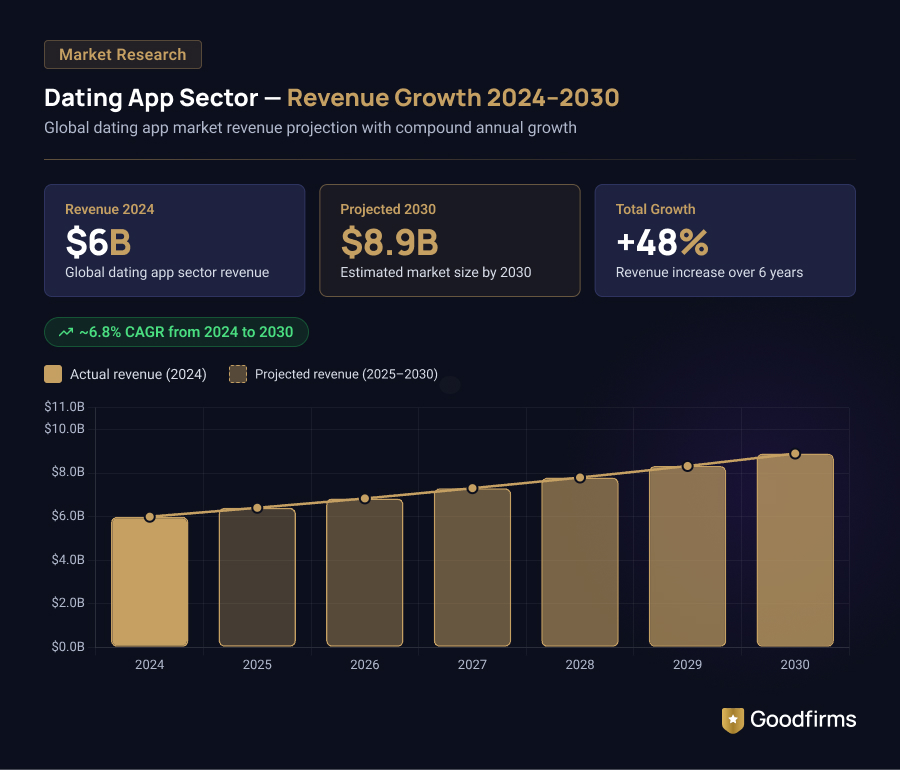
Therefore, it's no wonder that entrepreneurs and startups are eyeing this space more than ever.
This guide is going to walk you through everything you need to know about how to build a dating app, from ideation to launch and beyond.
Whether you're a startup founder with a fresh idea, a product manager looking to expand, or a developer curious about what it takes to build the next Tinder or Bumble, you're in the right place. Let's dig into what you need to figure out first while planning your dating app.
How to Build a Dating App: What You Need to Figure Out First
Before a single line of code of your dating app gets written, you need to be crystal clear on the following aspects.
Who is your target audience? This isn't just about age or gender — it's about understanding your users deeply. Are they looking for serious relationships or casual connections? Are they part of a specific community that existing apps ignore?
What problem are you solving? The best apps don't just copy what's out there. They solve a real frustration. Maybe people are tired of ghosting. Maybe they want voice-first interactions instead of swiping. Maybe they want better privacy controls. Find the pain point and build around it.
What's your business model? Dating app monetization needs to be figured out early because it affects everything from your feature set to your user experience. We'll get into monetization models in detail a bit later.
Once you're clear on these questions, you can move into the actual dating app features and technical planning. Skipping this phase is one of the most common mistakes early-stage founders make, which can prove to be expensive in the long run.
Think of this planning stage as your foundation. The success of all the decisions you make next for your dating app project, like features, tech stack, and monetization strategy, would depend on your foundation planning. Get it right, and the decisions that follow become a lot easier. Get it wrong, and you'll find yourself rebuilding things three months into development, wondering where it all went wrong.
So once you've got your audience defined, your problem statement locked in, and a rough monetization direction in mind, the next step is figuring out what to actually build. And that means features of your dating app.
Dating App Features: Separating the Must-Haves From the Nice-to-Haves
It's tempting to look at what Tinder or Hinge has built and try to replicate its exact features. But that approach usually leads to a bloated product that does a lot of things averagely instead of a few things brilliantly. The features you choose to build are really a statement about what your app stands for. Get the right dating app features, and users will love your platform. Get it wrong, and no amount of marketing spend can make it revenue-generating. So let's break down must-have features that you need to genuinely include in your platform and some nice-to-have features that you can layer in once you've got some traction.
Core Features (Must-Have Dating App Features That Users Expect From Day One)
Below are the must-have dating app features that you need to consider:
User Registration and Profile Creation: This sounds obvious, but how you handle onboarding matters a lot. Social login (Google, Apple, Facebook) reduces friction. Asking users to fill in profile prompts rather than just uploading photos creates richer, more authentic profiles. Think about what data actually helps your matching algorithm, and only ask for that.
Location-Based Matching: Almost every dating app uses geolocation to show users people nearby. You'll need to integrate a maps API (Google Maps or Mapbox) and let users set their preferred distance radius.
Swipe or Match Mechanism: This is your core interaction loop. Tinder popularized the swipe, but it doesn't have to be your model. Some apps use like/pass buttons, others use compatibility scores, and some even use timed conversations to create urgency. Whatever mechanism you choose, it needs to feel effortless.
Real-Time Chat: Once two people match, they need a way to talk. Real-time messaging with read receipts, typing indicators, emoji support, and image sharing is the baseline expectation now. You'll want to use WebSockets (a communication protocol) or BaaS platforms like Firebase to make this feel instant.
Push Notifications: Match notifications, message alerts, profile likes — these drive re-engagement. Don't underestimate the power of push notifications. A well-timed push notification is the difference between a user who comes back and one who forgets your app exists.
Safety and Reporting Tools: This is non-negotiable. Facilitating block and report profiles, photo verification, and content moderation are table stakes in today's dating app development landscape. Users need to feel safe, and regulators are increasingly paying attention to this.
Advanced Features (Nice-to-Have Dating App Features That Can Set You Apart)
Video Profiles and Video Dating: The pandemic normalized video calls for dating, and users haven't gone back. Short video profiles and in-app video calls add a layer of authenticity that photos can't match.
Personality Quizzes and Compatibility Scores: Apps like Hinge and OkCupid have leaned into this heavily. The more data you gather about user preferences and personality, the better your matching can get.
Voice Notes: This is a growing trend. Voice notes in messaging feel more personal than text and help people show their personality before meeting in person.
Activity Feeds and Icebreakers: Giving users a reason to interact beyond a simple "Hey" message dramatically improves conversation rates. Prompt-based profiles (like Hinge's) are a great example of this.
Once you have decided which dating app features to include, the conversation naturally shifts from what you're building to how you're going to build it. Your tech stack is essentially the engine under the hood. Users cannot see the tech stack used, but they absolutely feel it every time the app loads fast, matches refresh instantly, or a message is delivered without delay. Getting this right from the start saves you from painful and costly rewrites down the road.
What tech stack does a dating app need?
Now we're getting into the technical meat of things. Your dating app tech stack will depend on your budget, your team's expertise, and how scalable you need to be from day one.
Here's a realistic breakdown of what most modern dating apps are built with:
Dating App Tech Stack for Frontend Development
- Cross-Platform App development: React Native or Flutter
- iOS App Development (Native): Swift
- Android App Development (Native): Kotlin
Key takeaway: Most startups go with React Native or Flutter to save development time and cost. If you're targeting a more premium audience and want a truly native experience, investing in separate iOS and Android codebases makes sense later.
Dating App Tech Stack for Backend Development
- Node.js with Express is popular for real-time apps because of its event-driven architecture
- Python with Django or FastAPI if your team prefers Python
- Go is increasingly popular for high-performance backends
Key takeaway:For most dating apps, Node.js with Express is the backend of choice — it's battle-tested, developer-friendly, and purpose-built for the kind of real-time interactions dating apps rely on. Python with Django or FastAPI is a strong alternative, especially if you're planning to lean heavily into AI and machine learning features down the line. Go is a more advanced pick, best suited for teams that know they'll be handling massive user loads from early on.
Database for Dating App
- PostgreSQL for relational data (user profiles, matches, preferences)
- Redis for caching and session management
- MongoDB for more flexible schema structures
- Elasticsearch for fast, filterable search across user profiles
Key takeaway: You can start with PostgreSQL for your core data and Redis for speed, and you'll cover 80% of what your dating app needs in its early stages. MongoDB is worth considering if your profile structure is complex or likely to change frequently, and Elasticsearch becomes essential the moment your users start complaining that search feels slow or inaccurate. Build lean first, and add layers as the need arises.
Tech Stack For Enabling Real-Time Communication on Dating App
- Socket.IO with Node.js) or Firebase Realtime Database for live chat
- WebRTC for video calling
Key takeaway: Socket.IO with Node.js is the most popular choice for live chat, giving you fine-grained control over your messaging infrastructure, while Firebase is the faster, low-maintenance alternative if your team wants to skip the backend heavy-lifting. For video calling, WebRTC is the only real option for video calling.
Dating App Tech Stack for Media Storage
- AWS S3 or Google Cloud Storage for profile photos and videos
- A CDN (like Cloudfront) to deliver media fast globally
Key takeaway:For media storage, AWS S3 and Google Cloud Storage are both excellent choices — reliable, scalable, and built to handle the kind of photo and video volume a growing dating app generates. The real difference comes down to your existing cloud setup and your team's familiarity with the platform. Either way, pairing your storage solution with a CDN like CloudFront is non-negotiable, as it ensures consistent speed across geographic regions.
Dating App Tech Stack for Authentication
- JWT tokens for session management
- OAuth 2.0 for social login
- Twilio for phone number verification (important for safety)
Key takeaway:JWT tokens handle session management cleanly and efficiently, OAuth 2.0 makes social login with Google or Apple feel effortless, and Twilio's phone verification adds a critical layer of identity confirmation that significantly reduces fake accounts and bots. Together, these three form an authentication stack that's both user-friendly and genuinely secure.
AI and Matching
- Python-based ML models for recommendation engines
- AWS SageMaker or Google Vertex AI if you're going heavy on machine learning
Key takeaway: Python-based ML models are the natural starting point for building recommendation engines — the language has the richest ecosystem of machine learning libraries and the largest community of ML developers to draw from. If your matching logic grows beyond what your own infrastructure can handle, AWS SageMaker and Google Vertex AI are the obvious next step — managed platforms that take the operational complexity off your plate so your team can focus on improving the models.
This might look like a lot, but you don't need all of it on day one. Start lean, validate your concept, and scale your infrastructure as you grow. And as you do grow, there's one layer of your tech stack that's worth thinking about early, even if you don't build it immediately — and that's AI. Because the dating apps that are pulling ahead right now aren't just better designed or better marketed, they're smarter. Let's talk about what that actually looks like.
AI Dating App Development: The Future Is Already Here
If there's one trend that's reshaping dating app development right now, it's artificial intelligence. And not in a gimmicky way — AI is genuinely making dating apps smarter, safer, and more personalized.
Here's how AI is being used in modern dating apps:
Smarter Matching Algorithms
Traditional matching was based on simple filters — age, distance, and interests. AI-powered matching goes much deeper, learning from user behavior (who you swipe on, how long you look at profiles, what kinds of conversation starters work) to continuously improve recommendations. The more someone uses the app, the better it gets at finding compatible people for them.
Photo Verification and Fake Profile Detection
Catfishing is one of the biggest trust issues in online dating. AI-powered facial recognition and liveness detection can verify that a user's photos are genuine. Computer vision models can also flag suspicious profiles automatically, reducing the load on human moderators.
Conversation Assistance
Some apps are experimenting with AI-generated icebreakers or even suggesting replies based on the conversation context. Done well, this can help shy users feel more confident. Done poorly, it feels creepy — so tread carefully here.
Content Moderation
AI can automatically detect and remove inappropriate photos, hate speech, and harassment in messages — something that would be impossible to scale with human reviewers alone.
Churn Prediction and Re-engagement
Machine learning models can predict which users are about to stop using the app and trigger targeted re-engagement campaigns before they churn.
If you're serious about building a competitive AI dating app, investing in a solid data pipeline and ML infrastructure from early on will pay dividends later. And speaking of investing, all of this naturally leads to the question that's probably been sitting at the back of your mind since you started reading. How much does building a dating app actually cost? Having a great idea, a solid feature plan, and a clear tech stack only matters if you can realistically fund it. Let's break down the numbers honestly.
Dating App Development Cost: What Should You Actually Budget?
Building a dating app typically costs $15,000–$50,000 for an MVP and $100,000–$300,000+ for a full-featured platform. However, the exact cost isn’t easy to predict, as it depends on several factors, such as app features, tech stack, app development team size and location, and more.
But let's have a look at some real ranges to plan your budget.
| App Size | Approximate Cost | Features |
| MVP (Minimum Viable Product | $15,000 to $50,000 | Registration, profile creation, swiping, matching, and chat. |
| Mid-Tier App | $40,000 to $120,000 | MVP features + AI matching, geolocation, video/audio calls, advanced filters, subscription monetization, and content moderation, besides everything that MVP includes. |
| Full-Featured App | $100,000 and $300,000+ | Mid-tier App features + Custom AI models, face verification, multi-language support, scalable cloud infrastructure, and enterprise- grade security. |
Key takeaway:You can budget somewhere between $30,000 and $80,000 for a solid MVP, and $100,000 to $300,000+ if you're going full-featured from day one. But whichever route you take, make sure every dollar is tied to a feature your users actually need. The most expensive mistake in dating app development isn't overspending — it's spending on the features that aren’t required. It is always suggested to start with the MVP development, prove it works, then build out from there.
These dating app development costs are really just the beginning of the financial picture. Once your app is live, a whole new set of costs kicks in — quieter ones that don't show up in your initial budget but add up faster than most founders expect. Before you finalize your financial plan, make sure you've accounted for what it actually costs to keep the lights on.
Dating App Development Ongoing Costs
| Type of Cost | Details |
| Maintenance and Updates | 15 - 20% of initial development costs. |
| Server and infrastructure | $500–$5,000/month can scale when the number of app users increases. |
| Third-party APIs (maps, SMS, video) | $200–$2,000/month |
| App store fees | $99/Year for Apple Store and $25 one-time charges for Google Play Store. |
| Content Moderation | $500-$3000/month as dating apps are highly prone to fake profiles, scams, and abuse. |
| Compliance Updates | $3,000-$30,000 for complying with Privacy laws like GDPR and CCPA. |
| Marketing | $15,000-$70,000+/month depending on your user base and marketing strategies. |
| Customer Support | $2,000 to $6,000/month in your early stages, scaling up as your user base and ticket volume grow. |
For a more comprehensive cost breakdown backed by industry data, Goodfirms has put together an in-depth research piece on app development costs in 2026 that's well worth a read before you finalize your budget.
Now, spending $100,000 or more building an app might sound daunting — but it looks a lot less scary when you have a solid monetization strategy sitting behind it. That's where monetization comes in, and dating apps happen to have some of the most battle-tested revenue models in the consumer app world.
Dating App Monetization: How Do You Actually Make Money?
Building the app is half the battle. Making money from it is the other half. Let's look at the most proven dating app monetization models.
Freemium + Premium Subscriptions
This is the most popular model and for good reason — it works. The core app is free, but a premium subscription (think Tinder Gold or Bumble Boost) unlocks additional features like unlimited swipes, seeing who liked you, profile boosts, and read receipts. Subscriptions are recurring revenue, which investors love.
In-App Purchases (Virtual Currency and Boosts)
Some users don't want a full subscription — they just want a one-time boost. Selling "Super Likes," profile boosts, or virtual gifts as one-off purchases captures this segment. These also convert well because the commitment is lower.
Advertising
Free tier users can be monetized through carefully placed ads. This works better once you have significant scale (hundreds of thousands of daily active users). Intrusive ads kill user experience, so be careful here.
Premium Verification Badges
Charging for a verified profile badge — which signals authenticity — has worked for some apps. It appeals to users who are serious about finding connections and want to stand out.
Event-Based Revenue
Some apps host virtual or in-person speed dating events and charge a ticket fee. This works particularly well for niche communities and creates a memorable brand touchpoint.
Key takeaway: The best strategy is usually a combination of freemium subscriptions and in-app purchases. Start there and expand as you understand your user base better.
So you know what you're building, you know what it'll cost, and you know how you'll make money from it. At this point, the only question left is — when does it actually go live? This is where a lot of founders hit a wall, because the gap between "we have a plan" and "the app is in the app store" is bigger than most people anticipate. Let's walk through what a realistic development process looks like from kickoff to launch day.
Getting to Launch: Your Timeline to Create a Dating App From Scratch
Every dating app owner wants to move fast — but rushing a dating app to launch without a clear development process is one of the most expensive mistakes you can make. Users form opinions about your app in the first few minutes, and a buggy or incomplete experience at launch is incredibly hard to recover from. Getting the process right and giving each stage the time it deserves is what sets successful launches apart from forgettable ones.
Here's a realistic timeline for a MVP level dating app that can give you a basic idea about how long it will take your dating app to get into the market.
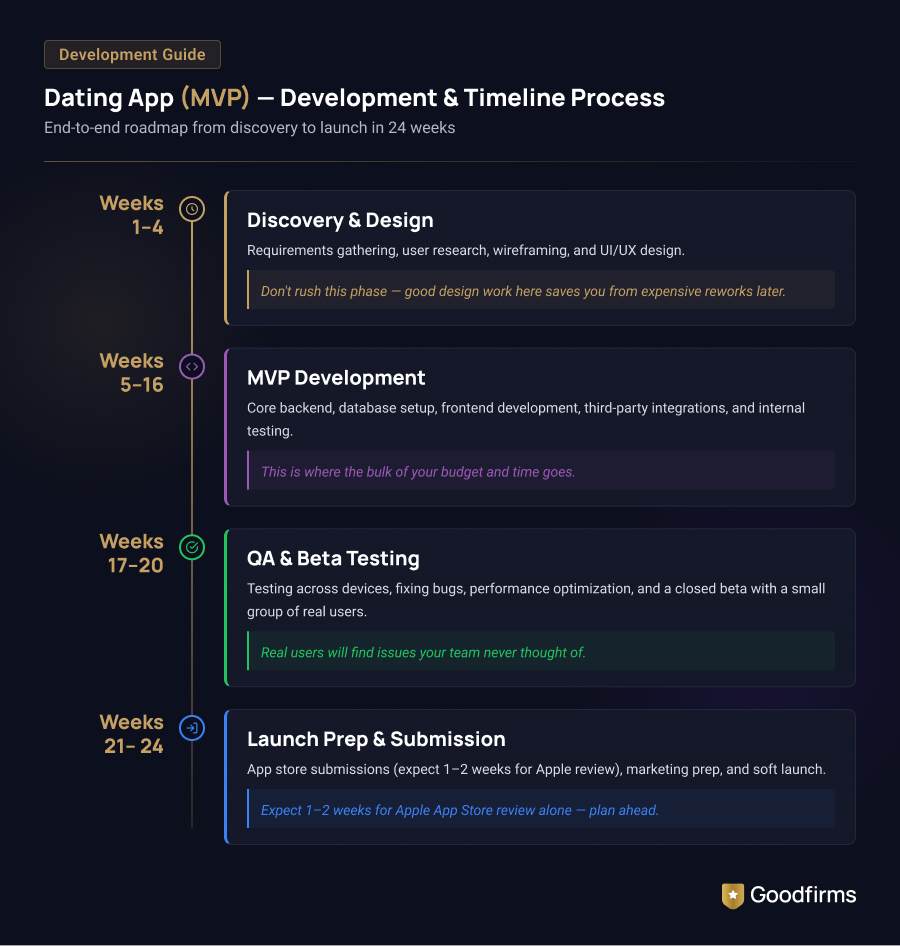
So realistically, you're looking at 5–7 months from kickoff to launch for a well-built MVP. Anyone promising you a full-featured dating app in 6 weeks is either cutting serious corners or setting you up for disappointment. Launch day, as exciting as it is, is really just the starting gun. What happens in the weeks and months after launch — how users respond, whether they stay, whether they tell their friends — is what truly determines whether your app has a future. So let's talk about what actually makes a dating app succeed.
What Makes a Dating App Actually Succeed?
When founders talk about dating app development, the conversation almost always gravitates toward features, tech stacks, and development costs. And while all of that matters, it misses the deeper truth about what actually makes dating apps succeed long term, and that is - trust and community.
Building trust and community takes time, consistency, and genuine care for your users. But once built, they are hard to replicate. In an industry where switching costs are low and attention spans are short, trust and community are the only aspects that make a dating app actually succeed. Below are some tactics that can help you make your dating app win against competitors.
Safety builds loyalty: Users who feel safe using your app will stay and recommend it to friends. Invest in verification, moderation, and clear community guidelines from day one.
Retention beats acquisition: It's cheaper to keep a user than to acquire a new one. Focus on features that bring people back — daily prompts, notifications about profile views, match recommendations — rather than just pouring money into paid acquisition.
Word of mouth is your best marketing: Dating apps live and die by their reputation in specific communities. If your app becomes known as the go-to place for a particular group (professionals, outdoors enthusiasts, pet owners), that community will grow organically.
Iterate fast based on real data: Your assumptions about what users want will often be wrong. Build analytics in from the start, watch how users actually behave, and keep improving.
Finally, Your Dating App Development Starts Now!
Dating app development is genuinely one of the more complex and rewarding product challenges out there. You're not just building software — you're building an environment where real human connections happen. That's a big responsibility, and honestly, it's an even bigger opportunity.
The good news is that everything you need to succeed is now mapped out in front of you. You know how to build a dating app, which features to prioritize, which tech stack to choose, how AI can give you a competitive edge, what it'll cost to build and run, how to make money from it, and what it actually takes to win long term. That's more clarity than most founders have when they start.
The market rewards apps that are focused, safe, and genuinely useful to a specific community. You don't need to beat Tinder at its own game — you just need to serve your audience better than anyone else does. That's a much more winnable battle than it sounds.
So take what you've learned here, go back to the planning questions we started with — who are you building for, what problem are you solving, and how will you make money — and start there. Whether you need developers or one of the top UI/UX design agencies to shape how your app looks and feels, the right partners can bridge the gap between a great plan and a great product. Everything else will follow. The next great dating app is out there waiting to be built, and it just might be yours.