Key takeaways
- The global mHealth apps market is projected to reach $45.14 billion in 2026 and grow to $113.2 billion by 2034 at a CAGR of 11.80%.
- Digital health app development costs range from $40,000 for a basic MVP to $300,000+ for a full-featured, compliance-heavy platform.
- HIPAA-compliant app development adds 20–30% to total project costs but is legally required for any app that handles protected health information.
- Telemedicine, EHR/EMR, and remote patient monitoring are the three highest-demand categories in healthcare mobile app development right now.
- Annual maintenance runs 15–25% of your initial development budget. Most founders underestimate this.
- Over 275 million patient records were exposed in 2024. Security architecture is a business decision, not a technical footnote.
Healthcare app development is one of the fastest-growing segments in tech. The global digital health market is projected to grow from $491.62 billion in 2026 to $2.35 trillion by 2034. Within that, mHealth apps sit at the center of patient interactions, expected to reach $113.2 billion by 2034. Today, around 47% of the U.S. population already uses at least one health app.
So demand is not the problem.
The real challenge is building a healthcare app that is compliant, integrated, and reliable in a highly regulated ecosystem. Healthcare app development comes with strict compliance requirements, complex integrations, and high stakes.
This guide breaks down what it actually takes to build a healthcare app in 2026, from types and features to process and real costs.
Browse top healthcare app development companies to build a applications that follows strict compliance and have best user experience.
Types of Healthcare Apps: Getting Clear on What You Are Building
This is the most important question to answer before anything else. The type of app you are building determines your compliance obligations, architecture decisions, timeline, and budget. You can browse the list of top healthcare software development companies on Goodfirms to build your tech.
Patient-Facing Apps
These are built for end users. Appointment booking, symptom checkers, medication reminders, personal health dashboards, and chronic disease tracking. The bar for healthcare web design is high. If the app isn't intuitive within the first session, users will not use it. Also, the users will be of varied ages and backgrounds. The interface should be easy enough for everyone to use.
Telemedicine App Development
The telemedicine software market is arguably the hottest sub-category right now. The global telemedicine market is projected to grow from $104.6 billion in 2024 to $298 billion by 2028. These apps need real-time video, secure messaging, digital prescriptions, scheduling, and insurance verification. All of it has to work within a compliant infrastructure, making it expensive.
EHR/EMR App Development
This is the provider side of the equation. EHR and EMR apps manage clinical documentation, lab results, imaging data, and treatment history. They need to integrate deeply with existing hospital systems and conform to interoperability standards like HL7 FHIR.
Mental Health Apps
Mental health software development is one of the fastest-growing segments. The market is expected to reach USD 113.2 billion by 2034, increasing at a CAGR of 11.80% from USD 45.14 billion in 2026. These apps typically include therapy scheduling, mood tracking, CBT modules, and crisis resources.
Remote Patient Monitoring (RPM) Apps
RPM apps connect wearables and IoT devices to cloud platforms so providers can track vitals outside clinical settings. It's a category that hospitals are increasingly investing in to reduce readmissions and manage chronic conditions more proactively.
Wellness and Fitness Apps
General wellness apps don't typically handle protected health information (PHI), so there's no strict compliance required. That makes them faster and cheaper to build. But they are also the most competitive category, as demand for personal fitness coaching and training programs is increasing. Hence, differentiation and uniqueness will matter more.
Healthcare App Features That Matter in 2026
Not every feature belongs in every app. But across mHealth app development every healthcare app developer should know certain capabilities that is no more optional. Here's what the market is actually asking for.
The Baseline Features
User authentication and role-based access are mandatory compliance requirements. Improper access control is one of the most common causes of HIPAA violations, especially when patient, provider, and admin roles are not clearly separated at the system level.
Appointment scheduling and notifications reduce no-shows and take administrative pressure off staff. It's one of the first things patients look for.
In-app secure messaging is how care teams and patients communicate within a compliant environment.
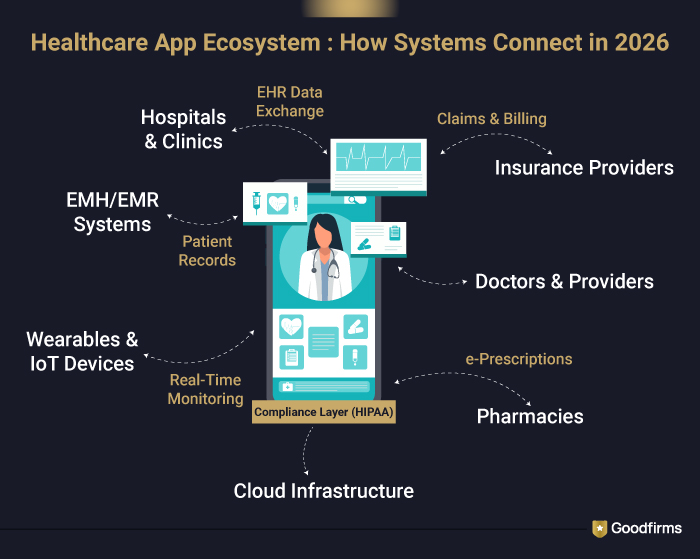
EHR/EMR integration is increasingly expected even in patient-facing apps. Patients want access to their records. Providers need clinical data at the point of care. FHIR-compliant APIs are the standard mechanism here. Without integration, your app becomes a disconnected tool.
Payment processing in healthcare adds another layer of compliance and coordination. It involves insurance workflows, eligibility checks, and the secure handling of financial data.
Advanced Features Worth Investing In
AI-powered triage and diagnostics is moving fast. The AI in healthcare market is expected to hit $208.2 billion by 2030. Features like symptom analysis, risk stratification, and clinical decision support are appearing in more apps, and they're becoming a competitive differentiator.
Wearable and IoT integration lets apps pull real-time data from blood pressure monitors, continuous glucose devices, and cardiac rhythm trackers. If you're in the RPM space, this isn't advanced; it's required.
Telehealth video infrastructure needs high-definition video, STUN/TURN support for firewall traversal, and a HIPAA-compliant media pipeline. Teams building telemedicine features often underestimate the infrastructure complexity here.
Multilingual support and accessibility is both an ADA compliance consideration and a practical requirement for serving diverse patient populations. It's not a stretch goal anymore.
The right feature set comes from your use case and your users, not from copying what competitors have built.
Healthcare App Development Process to Build a Scalable App
Healthcare mobile app development follows a more rigorous process than standard consumer apps. Each phase has compliance and security dimensions baked in. Skipping steps doesn't save time. It just moves the problems later, where they cost more to fix.
Phase 1: Discovery and Requirements
Defines the problem, users, compliance scope, and integrations. This phase gives clarity on cost and scope.
Phase 2: UX/UI Design
Focuses on patient and provider usability. In healthcare web design companies play a huge role in decisions that impact user speed and reduce the risk of user errors.
Phase 3: Architecture and Tech Stack
Establishes infrastructure, data flow, and compliance-ready systems. Early choices here decide how to build a healthcare app that can scale and integrate later.
Phase 4: Development and Integration
Core features are built alongside system integrations. Most project delays happen here due to API dependencies and external system constraints. You need healthcare web development companies that are experts in this field and follow strict timelines.
Phase 5: Compliance Validation and Security Testing
Ensures the app meets regulatory and security standards. Identifying gaps at this stage avoids expensive fixes after launch.
Phase 6: Launch and Ongoing Maintenance
Covers deployment, updates, and monitoring. Long-term costs and performance stability are largely defined by this phase.
HIPAA Compliant App Development
HIPAA is the constraint that shapes everything in healthcare app development.
Who Actually Needs HIPAA Compliance?
Any app that creates, receives, stores, or transmits Protected Health Information (PHI) on behalf of a covered entity needs to comply. You can find top regulatory compliance consulting firms with verified reviews in your surroundings on Goodfirms.
The Four Rules That Shape Your Build
- The Privacy Rule governs who can access PHI and under what conditions.
- The Security Rule requires technical safeguards like encryption, access controls, and audit logging.
- The Breach Notification Rule requires notifying affected individuals within 60 days of a confirmed breach.
- The Omnibus Rule extends HIPAA obligations to Business Associates, so any third-party vendor handling PHI needs a signed BAA.
Healthcare App Development Cost in 2026
Cost plays a huge role in defining how well and how far you can take your app. Smart planning gives you room to improve the app with best features and give your customers the best experience. Let’s discuss the numbers you should know before you jump in.
By Complexity Level
|
App Complexity |
What's Included |
Estimated Cost |
|
Basic MVP |
Symptom checker, wellness tracker, appointment booking |
$40,000 – $80,000 |
|
Mid-Level App |
Telemedicine features, medication management, EHR integration |
$80,000 – $150,000 |
|
Enterprise Platform |
AI, real-time data, multi-system integration, compliance hardening |
$250,000 – $400,000+ |
By App Type
|
App Type |
Estimated Cost |
Key Cost Drivers |
|
Telemedicine |
$80,000 – $300,000 |
Video infrastructure, EHR write-back, state-level compliance |
|
Enterprise Telemedicine |
$300,000 – $400,000+ |
Clinical documentation, payer eligibility, multi-clinic routing |
|
Mental Health |
$60,000 – $120,000 |
Privacy architecture, clinical credibility, therapy integrations |
|
EHR/EMR |
$150,000+ |
Clinical workflows, proprietary APIs, hospital system integrations |
The Costs Most Teams Don't Plan For
This is where budgets usually break. Development cost is just one part of what you're actually spending.
HIPAA Compliance
- Adds 20–30% to your total development cost when built correctly from day one
- Retrofitting it post-launch costs significantly more in both time and money
- Implementation alone typically runs $15,000–$50,000. That covers risk assessment, encryption setup, audit logging, and policy documentation.
Annual Maintenance
- Budget 15–25% of your initial development cost every year
- Covers security patches, bug fixes, platform updates, and compliance monitoring
- Annual maintenance contracts for healthcare apps typically run $15,000–$75,000, depending on platform size
Cloud Infrastructure
- Ongoing monthly cost, not a one-time build expense
- Runs $100–$5,000 per month, depending on user volume, data storage, and real-time features like video
Security Penetration Testing
- Required before launch, recommended annually
- Adds 2–4 weeks to your pre-launch timeline
- Budget for it upfront — it's not optional in healthcare
EHR Integrations
- Connecting to a system like Epic or Cerner can add $15,000–$80,000 per system
- Cost depends on integration depth, data bidirectionality, and compliance testing involved
Ways to Keep Costs in Check
Here are some smart structural decisions that reduce spend without cutting corners.
- Go cross-platform first. React Native or Flutter can cut total spend by 30–40% compared to building separate native iOS and Android apps. Works well for most healthcare app categories.
- Start with an MVP. Build core features first, phase the rest based on actual user feedback. Reduces upfront spend and gets you to market faster.
- Front-load compliance. Building HIPAA compliance from day one is cheaper than retrofitting it. HIPAA non-compliance penalties range from $100 to $50,000 per violation.
- Phase your integrations. Add EHR connections based on actual user needs, not assumptions. Each integration is a meaningful cost and timeline addition.
What's Shifting in Healthcare App Development Right Now
A few things are genuinely changing how teams plan and budget healthcare in 2026.
AI is no longer optional for competitive products. Clinical decision support, ambient documentation, and diagnostic assistance are features buyers are starting to expect. The future of patient care and health management is AI in healthcare apps. They bring new compliance obligations around model governance and how PHI moves through AI pipelines. It's not a plug-and-play addition.
So if you're planning a build in 2026, the right order of operations is: define your compliance obligations first, then your feature set, then your budget. Not the other way around.
And if you need to find the right team to build it, your next step should be to find the top healthcare app development companies listed on Goodfirms. The list is good when you want to compare companies and get actual feedback about the company from real verified reviews.