Key takeaways
- Casino game app development in 2026 ranges from $30K to $722K+ — a 20x gap driven by features and approach.
- Licensing alone can cost $35K to $934K in year one — sometimes more than the build itself.
- Compliance isn't an add-on: expect $45K–$160K upfront and $47K–$226.5K every year after.
- Your dev team's location can shift costs by 5x — $25–$50/hr in South Asia vs. $100–$200/hr in North America.
- Most operators underestimate post-launch costs by 40–60% — budget for $10K–$80K/month and 18 months of runway.
- Marketing routinely costs 2–3x your dev budget — but AI tools can cut development time by up to 30%.
The casino game app development cost in 2026 ranges from $30,000 for a basic card game to $722,000+ for a customized enterprise-level online casino, with a multi-market platform that includes live dealers, AI-driven personalization, and high-level compliance systems.
Yes, the range is very wide, and what sits between those two numbers is a long list of decisions you make — pertaining to the development approach applied, the features and complexity of the casino game app, tech stack, and platforms you choose, the geographical location of the mobile app development companies you partner with, and more. That gap isn't random — it's the difference between a market test and a fully regulated multi-market platform, and knowing which one you're building before you budget is the most important decision in this guide.
This pricing guide breaks those decisions down, puts verifiable numbers behind each one, and gives you a realistic picture of what casino game app development actually costs in 2026 — before you commit to a budget.
But before the numbers, one question worth answering first: Is 2026 even the right time to build a casino game app?
Is 2026 the Right Time to Build a Casino Game App?
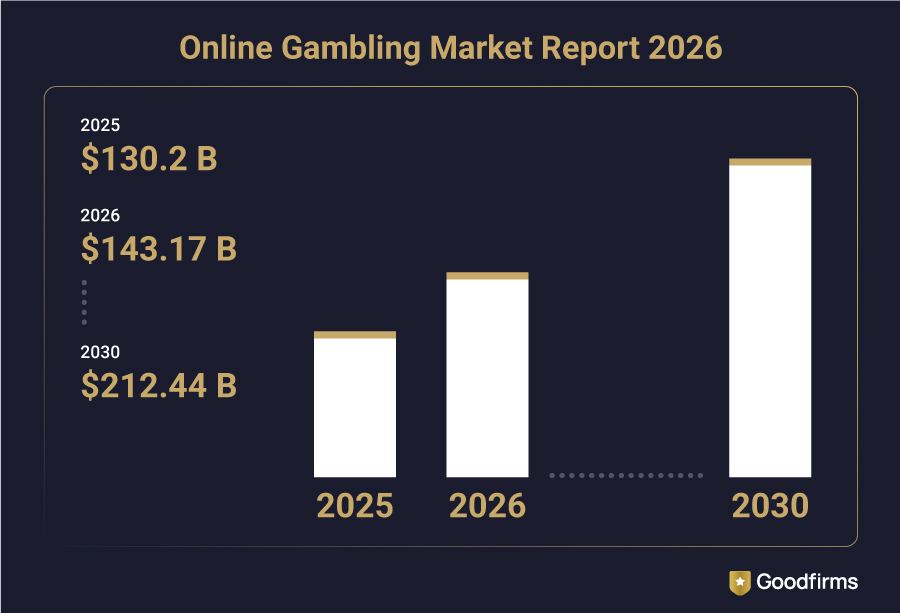
As per The Business Research Company , online gambling generated over $130.2 billion in global revenue in 2025 and is tracking toward $143 billion by the end of 2026 and is likely to grow to $212.44 billion by 2030, growing at a CAGR of 10.4%. The window for early, well-capitalized entry is narrowing — not because the market is slowing, but because it is maturing.
Also, according to Goodfirms' research on online gaming trends and opportunities , games accounted for 67% of total app revenue, further validating the sector's dominance in the app economy.
The opportunity is real. The build cost is what turns it from a market observation into a business decision — and that starts with complexity level and development approach.
Let's start this pricing guide with the numbers that matter most: estimated development costs by development approach and app complexity level.
1. Basic Casino / Card Game App Cost ($30,000 – $500,000)
At this level, development covers core game mechanics, a clean interface, and limited features — ideal for market testing before committing to a full build. The table below shows the cost of a basic casino game app by development approach.
|
Development Approach |
Estimated Development Cost |
Estimated Year One Operations |
Launch Timeline |
Differentiating Factors |
|---|---|---|---|---|
|
White Label |
$30K-$90K+ |
$8K-$24K |
2 – 4 weeks |
Pre-built game logic, shared infrastructure, minimal branding; fastest to market but lowest differentiation. |
|
Turnkey |
$80K–$180K+ |
$30K-$84K |
4 – 6 weeks |
Branded interface layered over a proven, ready-to-run backend; balanced speed and ownership. |
|
Custom |
$200K-$500K+ |
$54K-$144K |
2 – 4 months |
Built from scratch across game mechanics, UI, and wallet systems; longer timeline, full IP ownership. |
2. Mid-Tier Casino Game App Development Cost ($63,000-$586,000)
At this level, wallet integration, multiple games, user accounts, and iGaming payment solutions come into play. The table below shows the cost of a mid-level casino game app by development approach.
|
Development Approach |
Estimated Development Cost |
Estimated Year One Operations |
Launch Timeline |
Differentiating Factors |
|---|---|---|---|---|
|
White Label |
$63K-$176K+ |
$13K-$36K |
4 – 8 weeks |
Uses pre-integrated systems but limits promotional flexibility. |
|
Turnkey |
$113K-$266K+ |
$35K-$96K |
6 – 10 weeks |
Adds branded back-office management and configurable bonus logic. |
|
Custom |
$233K-$586K+ |
$59K-$156K |
4 – 6 months |
Enables owning your player data and building your own retention logic. |
3. Enterprise-Level Online Casino App Development Cost ($111,000 – $722,000)
At this tier, the compliance stack is the foundation — not an add-on. Payment approvals, identity verification, and certified randomness all have to be built in, not bolted on after launch. The table below shows the cost of a full-scale online casino app by development approach.
|
Development Approach |
Estimated Development Cost |
Estimated Year One Operations |
Launch Timeline |
Differentiating Factors |
|---|---|---|---|---|
|
White Label |
$111K-$312K+ |
$20K-$54K |
4 – 12 weeks |
Fastest route to a live real-money product, but your platform, infrastructure, and game lobby are shared with other operators on the same system. |
|
Turnkey |
$161K-$402K+ |
$42K-$114K |
8 – 16 weeks |
Full brand ownership with an independently configurable cashier, compliance layer, and back-office. |
|
Custom |
$281K-$722K+ |
$66K-$174K |
6 – 12 months |
Complete control over wallet logic, bonus engine, and player data. |
Complexity sets the floor. The development approach sets the ceiling. Here's how to choose the right one
How to Choose the Right Casino Game App Development Approach?
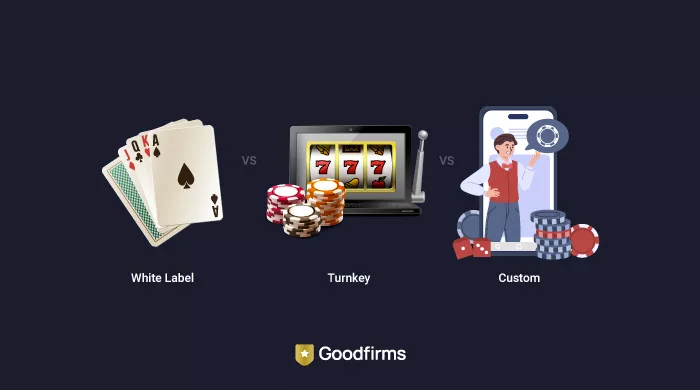
White label, turnkey, and custom development all produce a working casino — but they produce different businesses. The decision you make here determines whether you own the platform, operate it, or rent it
Choose White Label if you're testing a new market, working with a lean budget, and need to go live fast. It's the lowest-cost entry point, but what you save upfront you trade in differentiation, data ownership, and long-term flexibility.
Choose Turnkey if you want a fully branded product with configurable back-office tools, your own compliance layer, and room to scale — without carrying the full weight of custom engineering. Most mid-sized operators entering regulated markets land here for good reason.
Choose Custom if owning the technology is part of the business model itself. Full platform ownership — including your player data, your bonus engine, and your wallet infrastructure — comes at a higher cost and longer timeline.
One question cuts through the noise faster than any feature comparison: do you need to own the technology, or just operate it?
The answer to that single question points directly to the right development approach for your casino game app.
You can also go through - White Label vs Turnkey vs Custom iGaming Platform: Cost & Control (2026) to make informed decisions regarding choosing a development approach.
These figures give you a reliable range by complexity and approach, but a range alone doesn't tell you where the money actually goes. Breaking costs down by development stage gives a clearer picture of how budget gets allocated across a typical casino game app development project — and helps you spot where scope decisions have the biggest cost impact.
Casino Game App Cost Breakdown by Development Stage
Assuming that your casino game app development project is $200K, here's how a typical casino game app build distributes spend across each phase.
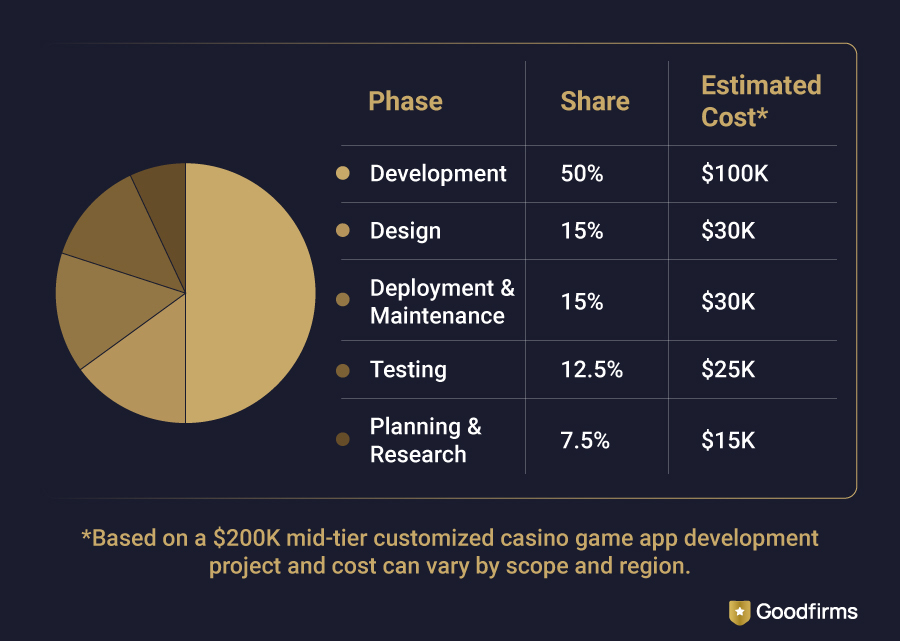
These figures cover the full build cycle, from initial setup through to deployment and post-launch maintenance. What it doesn’t include is iGaming licensing .
After deciding on your casino game app's complexity level and development approach, and breaking down the costs by phase, the next decision is which jurisdictions you will launch your casino app in. This decision is important because licensing is mandatory, and the licensing cost accounts for a major share of the total cost of launching your casino game app in the market.
Casino Game App Licensing Costs in 2026: Jurisdiction-Specific Cost Comparison
Development cost is only part of what it takes to launch a real-money casino game app. The license to operate legally is a separate — and often larger — line item. Licensing costs vary dramatically by jurisdiction, and getting the market selection wrong at this stage costs far more in rework than it saves on paper.
Here's what businesses are actually paying in 2026 for casino game app licensing.
|
Jurisdiction |
First Year Estimated Licensing Cost |
|---|---|
|
Malta (MGA): |
$366,324-$564,023 |
|
Curaçao |
$195,000-$315,000 |
|
Gibraltar |
$667,765-$934,871 |
|
UK (UKGC) |
$12,000-$32,000 |
|
Anjouan/Tobique |
$35,000 |
|
United States |
$150,000 |
The cost estimates above tell you what to budget by complexity level, development approach, licensing jurisdiction, and development stage. What they don't tell you is why the same feature set can cost three times more depending on a handful of critical decisions made early in the build.
Casino Game App Development Cost in 2026: Key Factors That Impact the Costs
Every number in this guide traces back to one or more of the factors below. Understanding them before you scope your project is what separates a budget that holds from one that quietly doubles between the planning stage and launch.
1. Game Type and Mechanics
The single largest driver of development cost isn't graphics or platform choice — it's what the game has to do in real time. A basic three-reel slot with fixed paylines demands minimal server coordination. A multiplayer poker platform with tournament brackets, live leaderboards, and real-time chat requires significantly more infrastructure. Live dealer games add physical production costs that most purely digital projects don't carry.
|
Game Type and Mechanics |
Estimated Development Costs |
|---|---|
|
Slot Game (Classic, Video, Progressive) |
$30,000-$250,000 |
|
Table Games (Blackjack, Roulette, Baccarat, Craps) |
$15,000 – $50,000 |
|
Poker and Multiplayer Card Games |
$5,000 - $80,000 |
|
Sports Betting |
$5,000 - $100,000 |
2. Techstack Used: Unity vs Unreal Engine
Both engines can power a casino game, but they price, perform, and scale differently — and the wrong choice for your game type adds cost without adding value.
|
Point of Difference |
Unity |
Unreal |
|---|---|---|
|
Engine |
Free Upto $200K Revenue Per Year, then $2K-$4K |
Free Upto $1M Revenue Per Year, then 5% Royalty on Gross Revenue |
|
Asset Store Costs |
$1K-$10K |
$1K-$10K |
|
Development Time |
Faster for 2D Games and Mobile Games |
Reduces Environment Creation Time |
|
Developers’ Rates |
$20-$120+/Hour |
$30-$160+/Hour |
3. Cost by Casino Business Model in 2026
Not all casino apps are built the same way — and not all of them are built for the same purpose. The business model you choose shapes your entire tech stack, compliance scope, and budget from day one.
|
Business Model |
Cost |
Description |
|---|---|---|
|
Crypto Casino Platform Cost |
$80,000 – $200,000 |
An online casino that processes wagers, deposits, and withdrawals exclusively or primarily through cryptocurrencies like Bitcoin, Ethereum, or stablecoins — operating without traditional banking infrastructure. |
|
Sweepstakes Casino Cost (USA Focus) |
$60,000 – $150,000 |
A free-to-play gaming platform that uses two virtual currencies — one purchasable, one earnable free — to simulate real casino gameplay legally in states where real-money gambling remains prohibited. |
|
Live Dealer Casino Development Cost |
$150,000 – $400,000+ |
An online casino format where real human dealers host table games — blackjack, roulette, baccarat — from a physical studio, streamed live to players via video in real time. |
4. Platform Choice: iOS, Android, or Both
Platform choice is one of the earliest budget decisions in casino app development — and one of the most consequential. The same game built for Android, iOS, or both through a cross-platform framework carries meaningfully different cost structures, timelines, compliance considerations, and long-term maintenance obligations. Here's what each path actually looks like in 2026.
|
Platform Choice |
Estimated Development Cost |
Description |
|---|---|---|
|
$5,000 – $20,000 |
High-value player targeting, US/UK/AU markets |
|
|
$5,000 – $20,000 |
Budget-first operators, emerging market entry |
|
|
Native App Development (iOS and Android Separate Apps) |
$15,000 – $40,000+ |
Operators require separate apps for different platforms. |
|
Cross-Platform App Development(Flutter, React Native) |
$8,000 – $25,000 |
Operators wanting a fast dual-platform launch |
Precisely, for operators focused on emerging markets and budget-first launches, Android game development offers the broadest reach at a comparable build cost of $5,000–$20,000.
5. Geographical Location of the Casino Gaming App Development Team
Where your team of gaming app developers sits on a map shapes what the final invoice looks like as much as what the app actually does. The same casino game — same feature set, same compliance scope, same platform — can cost three to five times more when it comes to partnering with game developers in the U.S. rather than game developers in India . That gap isn't a quality gap. It's a labor market gap, and understanding it is one of the most practical ways to bring development costs into a range that works.
Regional development rates vary, but lower hourly costs do not replace the need for geolocation compliance software expertise and certification planning. That caveat matters in iGaming more than most software categories — a low hourly rate from a studio without casino-specific compliance experience adds rework cost that quickly erases the initial saving.
Here's how costs, hourly rates, and developer salaries break down across every major hiring region in 2026.
Game Developers’ Hourly Rates in Different Regions
|
Region |
Junior developer |
Intermediate developer |
Senior developer |
|---|---|---|---|
|
North America (US, Canada) |
$35–$60 |
$60–$100 |
$100–$200 |
|
Central Europe |
$32 – $50 |
$36 – $70 |
$45 – $80 |
|
Eastern Europe (Poland, Ukraine, Romania) |
$22 – $31 |
$27 – $40 |
$30 – $59 |
|
Latin America (Brazil, Argentina) |
$28 – $55 |
$27 – $60 |
$32 – $65 |
|
South Asia (India, Bangladesh, Pakistan) |
$21 – $30 |
$22 – $35 |
$25 – $50 |
|
Southeast Asia (Vietnam, Philippines, Singapore) |
$20 – $25 |
$25 – $30 |
$24 – $33 |
Goodfirms lists 180+ verified iGaming development studios , with quoted hourly rates ranging from $25–$150/hour.
Game Developers’ Salaries in Different Regions
|
Country |
Annual Salary |
|---|---|
|
U.S. |
$75,000-$260,000+ |
|
Canada |
$48,000-$90,000+ |
|
UK |
$38,000-$140,000+ |
|
Germany |
$45,000-$113,000+ |
|
France |
$35,000-$92,000+ |
|
Poland |
$27,000-$197,000+ |
|
Japan |
$27,000-$170,000+ |
|
China |
$28,000-$170,000+ |
|
India |
$5,000-$9,000+ |
6. UI/UX Design
Design is the phase that sets first impressions and player retention patterns. Wireframes, prototypes, lobby navigation flows, and mobile-first layouts are all built here. Standard screen layouts sit at the affordable end of the design budget — custom interfaces, animated game assets, and interactive elements are where costs start moving up. Below are the estimated costs when it comes
|
UI/UX Design Tasks |
Estimated Cost |
|---|---|
|
Wireframing & Prototyping |
$500 – $3,000 |
|
Custom UI Design |
$2,000 – $8,000 |
|
Game UI & Animations |
$3,000 – $10,000 |
|
UX Optimization & Testing |
$1,500 – $5,000 |
7. Security and Compliance
This is the variable most budget projections underweight. Licensing and regulatory compliance add around $5,000-$50,000 to the total cost of a casino game app development project, and in 2026, stricter requirements in key markets, including the UK, Netherlands, and Ontario, have increased certification timelines and costs compared to previous years. Whimsy Games' analysis .
|
Category |
One-Time (Build) |
Annual (Ongoing) |
|---|---|---|
|
KYC/AML integration and tools |
$15,000 – $50,000 |
$22,000 – $90,000 |
|
SSL/TLS encryption |
$5,000 – $20,000 |
$3,000 – $16,500 |
|
PCI DSS compliance |
$10,000 – $30,000 |
$11,000 – $80,000 |
|
RNG Certification |
$5,000 – $20,000 |
$3,000 – $10,000 |
|
GDPR/Data Privacy |
$5,000 – $20,000 |
$8,000 – $30,000 |
|
Total estimate |
$45,000 – $160,000 |
$47,000 – $226,500/year |
You can select one from iGaming Compliance & Certification Providers to make this process easier and affordable for your casino game app development project in 2026.
Your casino game app development invoice covers the build. It doesn't cover what keeps the platform running, growing, and compliant after launch. Knowing these hidden costs can help you launch a profitable casino game app platform in 2026.
Casino Game App Development Costs in 2026: Hidden Costs
The development invoice is what most operators budget for. The hidden costs are what most operators are surprised by. Hidden costs in casino game development can match or exceed development costs themselves — covering licensing, payments, marketing, and maintenance lines that never appear in the initial quote. Here is what sits beneath every headline development figure in 2026.
Most operators discover these lines when the invoice arrives — not when the budget is being set. If you have ever been told 'the development cost is fixed' and then watched the total number climb past it, this section is what was missing from that conversation.
1. Platform Fees and Revenue Share
Every distribution channel takes a cut — and in casino game development, those cuts stack.
- App Store (Apple) / Google Play: 30% of all in-app revenue is standard. Apple reduces this to 15% for the first $1M annually under its Small Business Program.
- White-label platform fees: White-label providers typically charge $15,000-$150,000 one-time onboarding fees.
- Monthly platform hosting and SLA fees: Vendors charge monthly or quarterly platform fees for hosting, SLAs, updates, and support — commonly running $5,000–$50,000 per month depending on traffic, data volumes, and service levels.
- Game provider revenue share: Game provider revenue share is the largest ongoing variable — it scales directly with Gross Gaming Revenue (GGR), meaning a successful casino pays significantly more here than an early-stage one. Operators who underestimate this line consistently run into cash flow problems in months six through eighteen.
2. Server and Infrastructure Costs
A casino app that can't handle peak concurrent sessions loses players and revenue simultaneously. Infrastructure is a non-negotiable ongoing cost from day one.
- Multiplayer and game servers: $5,000–$50,000/month, depending on concurrent user volume
- Database and backend hosting: $1,000–$10,000/month
- CDN for asset delivery: $500–$5,000/month
- Analytics and crash reporting tools: $500–$3,000/month
Ongoing costs include server hosting and maintenance, license renewal, revenue share, salaries, marketing and player retention, continuous software updates, bug fixes, new feature implementation, data protection, and transaction commissions — and if one-time costs seem high, these recurring costs represent the true iceberg beneath the surface.
3. Bug Fixes and Customer Support
Shipping the app is the start of the cost curve, not the end of it.
- Bug fixes and ongoing updates: 20–30% of the original development budget annually
- Community and player management staff: $40,000–$100,000/year for dedicated roles
- Customer support per agent: $3–$10/hour
Operators that budget only for the visible software invoice discover the real costs too late — a safe launch budget includes reserve capital for payment float, compliance overhead, support, marketing tests, and the inevitable rework that appears after real traffic starts hitting the stack.
4. Marketing and Player Acquisition (Often 2–3x the Development Cost)
Player acquisition in competitive casino markets is expensive — and systematically underbudgeted by first-time operators.
- Mobile user acquisition cost per install: $3–$10/install
- Influencer and affiliate campaigns: $10,000–$500,000 depending on reach and jurisdiction
- PR and media outreach: $20,000–$100,000
- App Store Optimization (ASO): $5,000–$20,000/month
After launch, costs shift from setup to operating pressure: platform fees, support, payments, risk, CRM, retention tools, affiliate commissions, and media spend. Operators that focus only on launch cost often ignore the monthly burn that decides whether the business survives its first year.
5. Localization
Entering a new market isn't just a compliance exercise — it's a content production exercise that carries its own cost line.
- Translation: $0.10–$0.20 per word
- Voice acting per language: $10,000–$50,000
- Cultural adaptation per market: $5,000–$20,000
Multi-language and multi-currency support increases cost with every new market added. Each new language and payment provider adds expenses for integration, testing, and fees, and planning localization from the start is cheaper. Done later, the cost can rise by 2–6%.
Every cost category above can be reduced — some significantly — with the right decisions made early enough in the process. Here's how to save on casino game app development costs in 2026.
How to Save on Casino Game Development Costs in 2026?
The most expensive casino apps aren't the ones with the most features — they're the ones that built those features in the wrong order.
Start with an MVP. A focused first build with one game type, one payment method, and one jurisdiction costs a fraction of a full-scale launch — and tells you what players actually want before you spend on what you assumed they would.
Reuse certified components. RNG engines, KYC workflows, and payment gateway integrations don't need to be built from scratch. There are pre-certified KYC software and AML software available that can help you cut down your compliance overheads.
Get jurisdiction selection right early. Licensing the wrong market and rebuilding for another one later costs significantly more than researching the right fit before a single line of code is written.
Hire for compliance experience, not just hourly rate. A lower-cost studio without iGaming-specific expertise will hit compliance walls mid-build. The rework cost consistently exceeds the savings.
Phase your feature roadmap. Live dealers, AI personalization, and multi-currency wallets are high-value additions — but adding them post-launch on a stable base costs far less than building them into version one simultaneously.
Use AI-Powered Tools. Artificial Intelligence in game development automates game logic, generates assets, detects bugs, and streamlines testing—significantly cutting development time and labor costs for casino game apps.
AI reduces costs more than businesses think. We have found that code-generation products can reduce development times by as much as 30% and that automated testing tools can find bugs more than five times as fast as before. Design teams are able to iterate on early ideas without spending weeks on them. - Panayot Kalinov (Senior Software Developer at Casinoreviews.net )
| Find the right casino platform and vendors for your build — browse Goodfirms' vetted iGaming & casino platform recipe specially curated for you. |
How to Find the Right Casino Game App Development Company?
Cost, quality, and compliance — in casino game development, you need all three, and the top casino game development companies are strong in one or two at best. The operators who find the right casino game development company aren't the ones who compromised on the weakest filter. They're the ones who knew the criteria to look for before signing anything.
Check their iGaming portfolio specifically. General app development experience doesn't transfer cleanly to casino builds. Look for studios that have shipped real-money platforms — not just gaming apps — and can prove compliance experience: certified RNG, working KYC flows, and live payment integrations in production, not just in scope documents.
Ask about compliance before you ask about cost. Any studio that can't speak fluently about AML workflows, licensing requirements, and responsible gambling tools in your target jurisdiction is a risk, regardless of their hourly rate.
Verify their post-launch track record. Building a casino app is the easy part. Keeping it stable, compliant, and updated across regulatory changes is where most studios fall short. Ask for client references specifically from the maintenance phase, not just the launch.
Prioritize communication structure over company size. A mid-sized studio with a dedicated compliance lead and clear escalation paths will outperform a large agency that treats your project as one of fifty.
The Best iGaming Platform Providers don't just build your casino game app — they keep it out of regulatory trouble long after launch.
Still have questions? These FAQs with straightforward answers might help.
FAQs: Casino Game Development Cost in 2026
Below are the questions most gaming operators ask — answered without the runaround.
How long does it take to develop a casino game app from scratch?
Timeline depends on what you're building. A basic card game can go live in 6–10 weeks. A mid-tier platform with wallet integration and multiple games typically takes 3–5 months. A fully compliant, real-money casino app with live dealer features and multi-jurisdiction licensing realistically requires 9–14 months from first brief to live deployment.
For more information, you can also go through iGaming Platform Development: A Practical Launch Guide for 2026 .
Can I build a real-money casino app without a gambling license?
No. Operating a real-money casino app without a valid gaming license is illegal in every regulated market. Even soft-launch environments for internal testing often require provisional licensing in stricter jurisdictions like the UK and Malta. Skipping this step doesn't save money — it triggers fines, app store removals, and payment processor bans that cost far more than the license itself.
What payment methods should a casino app support in 2026?
At minimum: credit/debit cards, e-wallets (PayPal, Skrill, Neteller), and bank transfers. Crypto payment integration — Bitcoin, Ethereum, stablecoins — is now standard for operators targeting non-traditional markets. Each new payment method adds integration, testing, and ongoing transaction fee overhead. Budget $15,000–$40,000 for a complete multi-method payment stack, excluding monthly processing fees.
Does building a casino app require a dedicated QA and testing phase?
Yes, and it's non-negotiable for real-money platforms. Casino app QA covers RNG fairness validation, payment flow stress testing, security penetration testing, and compliance checks — none of which overlap with standard software QA. Budget 15–20% of your total development cost for testing alone. Skipping or compressing this phase is the most common cause of costly post-launch failures.
What is the ongoing monthly cost of running a casino game app after launch?
Ongoing monthly costs typically run $10,000–$80,000+, depending on traffic and market scope. This covers server infrastructure, game provider revenue share, payment processing fees, customer support staffing, compliance monitoring, and software updates. Most operators underestimate this figure by 40–60% when planning their initial budget. Plan for at least 18 months of operating runway before projecting profitability. (https://sdlccorp.com/post/how-much-does-it-cost-to-develop-casino-software/)
Cost of Casino Game App Development Project in 2026: What to Do Next
The numbers in this guide give you a realistic budget foundation — but a number alone doesn't build a profitable casino platform. Your development approach, jurisdiction, tech stack, and partner selection determine whether that budget holds or doubles quietly before launch. Operators who get this right also invest early in retention infrastructure, including top iGaming CRM software , to convert acquisition spend into long-term player value. Start with the right decisions, and the costs take care of themselves.