Key takeaways
- TikTok marketing for brands runs on three channels: organic content, creator partnerships, and paid ads, each playing a different role in growth.
- A real strategy means setting goals, researching your audience via TikTok's own search data, building content pillars, and then layering in paid ads once organic works.
- TikTok marketing budgets scale in real tiers, from $1,000 a month for testing to $20,000+ for a full growth channel, and each tier realistically covers more than just a bigger version of the last one.
- Hiring an agency makes sense once you're ready for paid campaigns or lack the in-house bandwidth to track the platform's constant changes.
- TikTok's ad tools and features keep evolving, so brands that check TikTok ads news regularly stay ahead of those that set a strategy once and never revisit it.
While researching this topic, we came across an astonishing fact: nearly half of Americans now say they've used TikTok as a search engine. Among Gen Z, that number climbs to almost two-thirds.
Currently, TikTok is processing well over 140 billion searches a year, which means people aren't just scrolling for entertainment; they're actively looking for products, reviews, and recommendations, just as they do on Google. So, the point is:
TikTok is no longer just a dance-trends app; it’s become a discovery channel brands can't afford to ignore.
This means if your brand isn't showing up there, well then, it's a problem because someone else is.
This guide is built specifically for brands trying to figure out where TikTok actually fits into the marketing mix, what it realistically costs, and how to build a strategy that doesn't rely on one lucky viral video.
Not sure where to start, or don't have the bandwidth to run this in-house? Browse verified TikTok marketing agencies, compare reviews, pricing, and portfolios before you commit.
What is TikTok Marketing for Brands?
TikTok marketing, for a brand, comes down to using TikTok, through organic content, creator or influencer partnerships, and paid ads, to build awareness, grow an audience, and push outcomes like traffic, leads, or sales. This new kind of marketing sits under the broader umbrella of social media marketing, but honestly, it plays by its own rules.
TikTok has its own algorithm and the way people actually behave on it; none of that maps cleanly onto Instagram or Facebook, so treating it the same way rarely works.
Unlike a lot of traditional brand advertising, TikTok marketing leans hard on short, native feeling videos. The platform rewards authenticity and watch time over polish, which is exactly why brands that treat TikTok like a smaller version of their Instagram feed tend to fall flat here.
Why TikTok Works Well for Brands Specifically
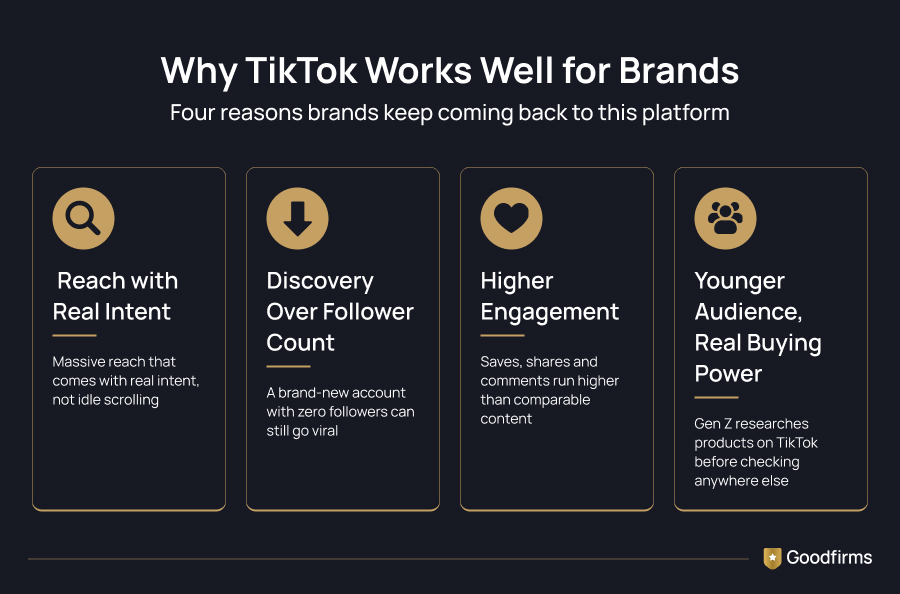
There are some good reasons that keep coming up whenever brands talk about why this platform delivers for them. First of all, TikTok’s reach is massive, and it comes with real intent behind it, and that's not just idle scrolling. The algorithm also favors discovery over follower count, so a brand-new account with zero followers can still go viral, which is honestly a nice bit of leveling for smaller brands going up against bigger budgets.
Secondly, engagement, such as saves, shares, and comments, tends to run higher here than on comparable content elsewhere. And the audience skews younger, with real buying power; many of them research products on TikTok before checking anywhere else.
Is TikTok good for B2B brands, not just consumer-facing ones? It's less obvious, but it's growing. Founder-led content, behind-the-scenes clips, and quick educational videos are working for B2B brands willing to loosen up a little compared to how formal they'd usually be on LinkedIn.
TikTok Shop: the marketplace layer brands can't ignore
TikTok is no longer just a content platform; it has become a shopping destination too. Products get linked directly inside videos and livestreams, so the gap between someone discovering your brand and actually buying from it has gotten a lot shorter.
TikTok Shop sales are projected to cross $20 billion in 2026, which is a big enough number that brands still treating TikTok as a pure awareness play are probably leaving money on the table. It's part of why more brands are now working with ecommerce digital marketing agencies that already know how to integrate TikTok Shop into a broader strategy rather than treating it as a bolt-on.
How the Algorithm Decides What a Brand's Content Gets Seen
TikTok decides what to show people based on watch time, completion rate, shares, saves, and how closely a video's keywords, captions, and on-screen text line up with what people are actually searching for. That last part matters more now than it used to.
In 2026, TikTok weighs keywords in captions, spoken audio, and on-screen text more heavily than hashtags, so a brand optimizing only with hashtags and skipping a clear topical keyword is going to struggle to show up in search, even if the video does fine in the For You feed.
How to build a TikTok marketing strategy for your brand
A strong TikTok marketing strategy is essential, whether you are a small business or a much bigger brand; it follows a similar shape underneath, just with different budgets and team sizes behind it.
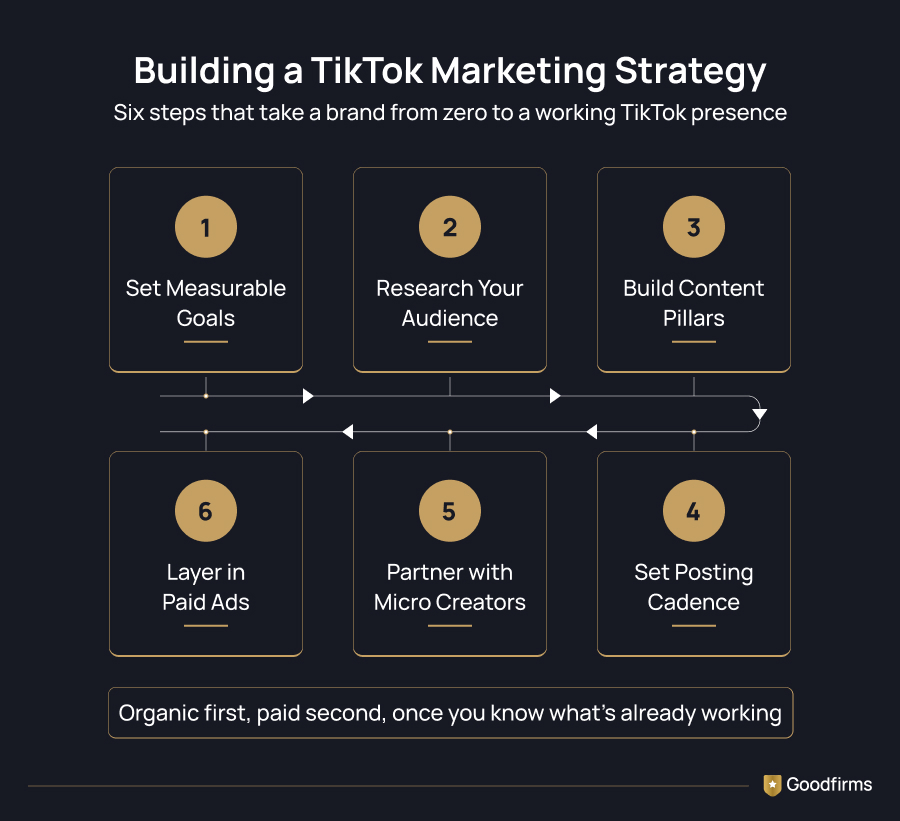
- Set measurable goals first. Decide upfront whether you're chasing awareness, community growth, traffic, or direct sales, because each one changes what you measure and what content gets priority. For awareness, track reach and video views; for engagement, look at watch time, shares, saves, and comments; and for performance campaigns, focus on clicks, conversions, cost per acquisition, and ROAS.
- Know your audience before you post, not after. Spend time in TikTok's Creator Search Insights and Creative Center to see what people are actually searching for, and where demand exists without much competition yet. A lot of brands skip this, and it shows in their growth.
- Build around content pillars, not one-off videos. Pick three or four themes you can consistently create around: product education, behind the scenes, trend participation with your own spin, or customer stories. Consistency beats a single viral hit that never repeats.
- Post three to seven times a week. Fewer posts with genuinely strong hooks beat frequent, low-effort ones every time.
- Start affiliate and creator partnerships small. If you're figuring out how to succeed in TikTok affiliate marketing, partner with a handful of micro-creators whose audiences actually match your product, give them creative freedom, and track who drives real conversions before scaling. Brands working with content marketing agencies often fold this straight into their broader content calendar rather than running it separately.
- Layer in paid ads once organic is working. TikTok's Search Ads Campaign lets you target keywords people are actively searching for, which converts better than broad targeting alone. Brands running app install campaigns alongside content often bring in mobile app marketing agencies for that piece specifically.
- Study what's already working. Founder-led storytelling builds trust faster than polished corporate content. Fast trend participation with your own twist beats copying a week late. Reposted customer reviews and unboxings, with permission, often beat brand-made ads outright. TikTok Shop integration is shortening the path from discovery to purchase, aligning with the digital marketing strategies more brands are leaning on as social platforms become shopping destinations.
In Goodfirms' own research on social media marketing, 27.1% of surveyed businesses post content daily, while another 29.3% post on alternate days. There isn't one correct cadence for every brand; what matters more is picking a rhythm your team can actually sustain without dropping content quality.
How Much Does TikTok Marketing Cost for Brands?
TikTok marketing costs vary widely depending on whether you're creating content in-house, working with creators, running paid campaigns, or handing the entire channel to an agency. The figures below are broad planning ranges rather than fixed industry rates; actual costs shift based on content volume, creator size, production requirements, campaign objectives, agency scope, and ad spend.
What Can You Do With Different Tiktok Marketing Budgets?
Instead of jumping straight to a rate card, it helps to see what a brand can realistically pull off at different spending levels.
|
Monthly budget |
What it can realistically cover |
Best suited to |
|---|---|---|
|
$1,000 |
Lean organic content plus testing a few creator collaborations |
Brands testing TikTok |
|
$5,000 |
Consistent content, micro-creators, and small paid tests |
Brands building a repeatable presence |
|
$10,000 |
Regular content, multiple creators, and meaningful paid campaigns |
Brands ready to scale |
|
$20,000+ |
Full content strategy, creator program, substantial paid media, and optimization |
Brands treating TikTok as a major acquisition channel |
$1,000 a month: test before you scale
- At this level, the goal isn't to dominate TikTok; it's to figure out whether your audience responds to the channel and which content deserves more investment.
- A realistic split looks something like $400 to $600 on basic video production, $200 to $400 on one or two micro-creator tests, and $100 to $200 on tools or a bit of paid promotion.
- Don't try to cover twenty content types here; pick two or three pillars, publish consistently, and use the first month or two to see which hooks and formats actually land.
- Best for startups and brands testing TikTok for the first time, expect learning and validation, not scale.
$5,000 a month: build a repeatable content engine
- This is where a brand gets real room to test. A typical split might put around $2,000 into content, $1,500 into creator partnerships, and $1,500 into paid testing, alongside regular short-form video and some community management.
- The shift here is that you're no longer asking whether TikTok can work for your brand; you're figuring out which content and audiences actually produce results, testing creative angles, creator audiences, and calls to action instead of leaning on organic reach alone.
- Best for established SMBs that already know TikTok has potential.
$10,000 a month: scale what's working
- At this point, TikTok starts looking less like an experiment and more like a real acquisition channel.
- A possible split, $3,000 on content production, $2,000 on creator partnerships, $4,000 on paid advertising, and $1,000 on analytics and optimization, though the exact mix depends on the business.
- An ecommerce brand usually leans harder into paid media, while a B2B company tends to spend more on expert-led content.
- At this budget, you can run multiple creative and audience tests at once, repurpose your best creator content into paid campaigns, and optimize for conversions instead of views.
- Best for brands with proven product-market fit that want TikTok to contribute measurable traffic, leads, or sales.
$20,000+ a month: treat TikTok as a major growth channel
- Past this point, you're not testing TikTok anymore; you're running a full channel operation around it, a dedicated content pipeline, multiple creator partnerships, TikTok Shop or affiliate activity, meaningful paid media, and ongoing creative testing and reporting.
- Many brands at this level work with an agency handling strategy, content, creators, paid media, and reporting together rather than piecing it out.
- Worth remembering, though, $20,000 doesn't automatically outperform $5,000; more budget only helps once the creative, targeting, offer, and conversion process are already working.
- Best for larger brands that have already validated TikTok as a real acquisition or commerce channel.
Where Does the Money Actually Go?
The ladder above shows what a given budget can achieve. This table flips the lens and breaks the same spend down by approach instead, so you can see roughly what each channel, content, creators, or ads tends to cost on its own.
|
Approach |
Typical monthly cost |
Best for |
|---|---|---|
|
DIY organic content |
$0 to $1,000 |
Small brands testing the waters |
|
Micro-influencer partnerships |
$500 to $5,000 |
Brands wanting authentic reach |
|
TikTok ads, self-managed |
$1,000 to $10,000+ in ad spend |
Brands scaling proven content |
|
Full agency partnership |
$2,500 to $20,000+ in agency fees |
Brands wanting end-to-end management |
These costs aren't directly interchangeable. Creator fees and agency fees pay for services or content, while TikTok ad spend goes straight to the platform. A brand working with an agency may end up paying a management fee and running a separate advertising budget on top of it, and that distinction matters once you're actually setting one.
Agency and creator costs are only one part of the picture. If you're running TikTok ads yourself, the platform sets minimum campaign and ad group budgets, but those minimums shouldn't be confused with what brands typically spend to see meaningful results. TikTok's own platform minimum sits at $20 a day at the ad group level and $50 a day at the campaign level. Beyond that floor, CPM and CPC vary a fair amount by industry, audience, campaign objective, competition, and creative performance, so published benchmarks are worth treating as directional rather than guaranteed.
TikTok marketing services pricing from agencies usually depends on scope, too, whether it's content creation only, full paid ads management, or a combined package. If you're comparing TikTok marketing packages, ask upfront what's actually included, since some quotes cover production only and quietly leave ad spend out of the number entirely.
What Factors Affect TikTok Marketing Costs?
A few factors move these numbers more than people expect:
- Content volume. One or two videos a week costs considerably less than daily production.
- Production quality. Smartphone-led creator content and studio-produced campaigns sit at very different price points.
- Creator size. Micro-creators generally cost less than celebrity or macro influencers.
- Paid media. Ad spend runs separately from most agency management fees.
- TikTok Shop. Commerce campaigns can add creator commissions and extra management costs on top.
- Agency scope. Strategy-only, content-only, paid media, and full-service packages all land at different price points.
- Industry. Competitive sectors usually need more testing and higher media budgets to see results.
The right budget isn't necessarily the biggest one. A $5,000 monthly budget backed by a clear content strategy, strong creative, and disciplined testing can outperform a $20,000 budget spent before a brand understands what its audience actually responds to.
Should Your Brand Hire a TikTok Marketing Agency?
Not every brand needs one, to be clear. If your team already has someone comfortable enough in front of a camera and a bit of time to spare each week, you can get pretty far organically on your own. But it starts making sense to bring in a TikTok marketing company once your brand doesn't have in-house video talent, is ready to run paid campaigns, and needs someone who actually understands TikTok's ad platform, or just doesn't have the bandwidth to keep tracking algorithm changes on top of everything else.
If you're evaluating a social media marketing agency for this, look past the portfolio for a minute and check client reviews, response times, and whether they've genuinely run TikTok Shop or Search Ads campaigns for brands like yours, not just Instagram reels repurposed and dropped onto TikTok.
TikTok Marketing Changes Brands Should Watch in 2026
TikTok ads news moves fast, and a few shifts are genuinely worth tracking this year. Automatic Search Placement now lets feed ad campaigns show up directly in TikTok's search results based on relevance and budget, not just the For You feed. TikTok's own reporting tools now separate "keywords," what advertisers choose, from "search terms," what users actually type, which changes how granular brands can get with targeting.
Staying on top of this isn't really optional for a brand serious about the channel. A strategy that worked six months ago can quietly stop performing today if the algorithm's priorities have shifted underneath it, and a lot of brands only notice once the numbers have already dipped. If your team wants a broader read on where digital marketing is heading this year, beyond just TikTok, Goodfirms' piece on modern digital marketing practices is worth a look, too.
Conclusion
Look, TikTok marketing in 2026 isn't something you can dabble in for a month and walk away from if it doesn't immediately work. It rewards brands that treat it like a real, ongoing channel, clear goals, content built around a few pillars you can actually keep up with, and an honest look at what the platform's own search and engagement data is telling you instead of just guessing and hoping.
Whether your brand handles all of this in-house or brings in outside help through a creator partnership or a full agency, the ones actually seeing results are showing up consistently and adjusting as TikTok keeps changing its algorithm, ad tools, and shopping features under everyone's feet. Start small if you need to, that's fine, but start with an actual plan instead of just a posting schedule and a hope that something sticks.
FAQs - TikTok Marketing
1. What is TikTok marketing?
TikTok marketing is the use of the platform, through organic content, creator partnerships, and paid ads, to build brand awareness and drive real business outcomes. For most brands, it isn't just one of these working alone; it's the three working together over time. Brands that lean on only one channel usually plateau faster than those that blend all three.
2. How to use TikTok for business marketing?
Start with a content plan built around what your audience is actually searching for, post consistently around a few core themes, and layer in paid ads once you can clearly see which organic content is resonating. Skipping straight to ads before you know what works organically usually just burns budget faster.
3. What are some useful TikTok marketing statistics for 2026?
TikTok now processes over 140 billion searches a year, and roughly half of American users say they've used it as a search engine, a figure that climbs closer to two-thirds among Gen Z specifically. TikTok Shop sales are also projected to cross $20 billion this year, which says a lot about where the platform is heading.
4. Is TikTok marketing different from Instagram marketing for brands?
Yes, in a fairly meaningful way. TikTok rewards native, less polished content and search style discovery, while Instagram still leans more heavily on visual polish and existing follower relationships. That difference alone means a strategy built for one rarely transfers well to the other.
5. Is TikTok good for ecommerce brands specifically?
Very much so, especially with TikTok Shop making it possible to link products directly inside videos and livestreams, which is shortening the path from a viewer discovering a product to actually buying it. More ecommerce brands are treating it as a primary sales channel now, not just a discovery tool on the side.