Key takeaways
- WhatsApp marketing costs range from $0.0118 per message in India to $0.14+ per message in Germany and the Netherlands, with most small businesses spending $85-$1,800+ per month, depending on where their contacts are located.
- Message category moves the price as much as the country does; a US marketing template costs $0.025, over 7 times the $0.0034 utility rate for the same recipient.
- The 24-hour WhatsApp service window no longer means free messaging as of October 1, 2026; service and utility messages sent within the window are billed at the same $0.0034–$0.055 rate as templates, depending on the market.
- BSP markup adds a second layer on top of Meta's rate; flat fees run $0.002–$0.015 per message, percentage markups run 10-30%, and subscriptions run $ 20- $ 500+ a month.
- Hidden costs like template rejections, currency conversion (1-3% of spend), and extra agent seats ($12-$70+/user) can quietly add 10-20% to your total bill.
WhatsApp marketing costs vary by message category, recipient country, and the WhatsApp Business Solution Provider (BSP) you use. With Meta's October 2026 pricing changes, understanding the difference between marketing, utility, authentication, and service messages is more important than ever.
This guide breaks down each of these factors and presents specific figures to help you estimate your own WhatsApp marketing budget.
2026 pricing update: This guide reflects Meta's WhatsApp Business Platform pricing changes effective October 1, 2026, including updated charges for service and utility messages.
So, let's start with the most basic question first: Is WhatsApp marketing even free to begin with?
Is WhatsApp Business Free?
WhatsApp for Business is free to some extent, depending on the product you are using. If you are a small business using the WhatsApp Business App, it’s completely free and comes with no pricing model. However, the moment you shift to the WhatsApp Business API, you're billed per message, and this is the version most growing businesses actually use for bulk messaging, automation, and CRM integration. Even the WhatsApp API cost can be zero, depending on how you are interacting.
So, the honest answer is that the WhatsApp Business App is free, but even the API cost can be reduced by following a well-designed conversational flow.
Let's have a look at how these two WhatsApp products compare.
WhatsApp Business products and their pricing model
|
Factors |
WhatsApp Business App |
WhatsApp Business API |
|---|---|---|
|
Cost |
Free |
Usage-based, per delivered message |
|
Best for |
Small businesses, solo operators |
Growing to enterprise-scale businesses |
|
Broadcast Limit |
256 contacts |
Unlimited (tier-based) |
|
Automation |
Basic auto-replies only |
Chatbots, workflows, CRM integration |
|
Access |
Direct download |
Through a Business Solution Provider (BSP) |
The free WhatsApp app works perfectly well for small businesses that send a limited number of messages a day. But once you need automation, multi-agent support, or a CRM connection, you can shift towards the API, where Meta charges you per message. That’s the version this WhatsApp marketing pricing guide focuses on.
Skip the guesswork, compare verified WhatsApp marketing agencies on Goodfirms and get a real quote today.
How Much Does WhatsApp Business API Cost?
WhatsApp marketing API costs range from roughly $0.0118 per message in India to $0.14+ per message in Germany and the Netherlands, and around $0.025 per message in the US. Meta calculates these prices per delivered message, not per conversation. Meanwhile, the WhatsApp API cost you pay depends on two factors: the message category and the recipient's country.
However, that per-message number is only part of the bill. Still, most businesses don't connect to the WhatsApp Cloud API directly; they go through a Business Solution Provider (BSP), which adds its own platform fee on top of Meta's rate. So, in such cases, the final WhatsApp Business API cost is Meta's per-message charge plus your BSP's markup.
This is why two businesses sending the same number of messages can end up with very different invoices, and why "how much does a WhatsApp marketing platform cost?" doesn't have a single flat answer.
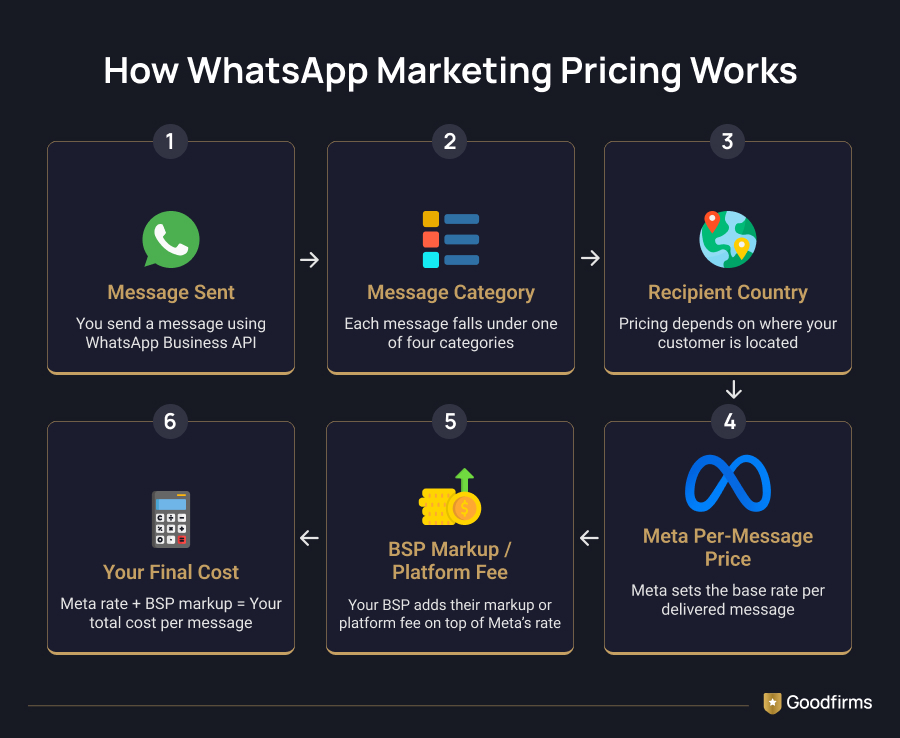
Let's break down exactly what drives that number, starting with message categories.
WhatsApp Marketing Cost by Message Type
Every message sent by businesses via WhatsApp Business API falls into one of the four categories listed below, and these categories also help determine an estimate of your WhatsApp marketing cost per message.
|
Category |
What It's For |
Approximate Cost (US) |
|---|---|---|
|
Marketing |
Promotions, offers, re-engagement campaigns |
$0.0250 per message, no volume discount |
|
Utility |
Order confirmations, shipping updates, appointment reminders |
$0.0034 per message, free inside a service window |
|
Authentication |
OTPs, login codes, verification |
$0.0034 per message, charged even inside a service window |
|
Service |
Replies within 24 hours of a customer messaging first |
Free |
(Source)
Marketing messages are one of the most expensive among all four categories, and they never get a volume discount, no matter how many messages you send in a month. Shipping-related messages are considered a utility. However, the same message with a discount code attached becomes marketing.
For instance Your order #1234 has shipped" is utility. Your order shipped; here's 10% off on your next one, is marketing. Those little differences in the words in each line are the difference between $0.0034 and $0.025 per message.
This is where WhatsApp marketing charges catch businesses off guard. A template that reads like a plain notification but reminds the customer to buy something extra gets billed at the marketing rate, not the utility rate, even inside the same conversation.
So, before you calculate your monthly WhatsApp Business charges, it’s important to know which category each of your message templates actually falls into. Now, let's look at how these WhatsApp marketing rates vary by country.
WhatsApp Marketing Cost by Country (2026 Rate Table in USD)
WhatsApp marketing costs vary by country based on requirements. Meta sets rates based on the recipient's country code, not on where your business is based, and the cost gap between these markets is very high. A marketing message in India costs a fraction of a cent, while the same message to Germany can run over $0.13. This is also where Meta WhatsApp marketing message costs in India stand out as among the lowest globally.
|
Country |
Marketing (per message) |
Utility (per message) |
Authentication (per message) |
Marketing : Utility Ratio |
|---|---|---|---|---|
|
United States |
$0.025 |
$0.034 |
$0.034 |
0.74x |
|
United Kingdom |
$0.0635 |
$0.0220 |
$0.0220 |
2.89x |
|
Brazil |
$0.0625 |
$0.0068 |
$0.0068 |
9.19x |
|
Germany |
$0.1365 |
$0.0550 |
$0.0550 |
2.48x |
|
Netherlands |
0.1597 |
$0.0500 |
$0.0500 |
3.19x |
|
India |
$0.0118 |
$0.0014 |
$0.0014 |
8.43x |
(Source)
A few things stand out here. Germany and the Netherlands are the most expensive markets on this list. A single marketing message in the Netherlands costs roughly 13.5 times as much as the same message in India. Brazil has the widest marketing-to-utility gap, which means getting the category wrong there is especially expensive.
However, rates are billed in the recipient's currency, so a US business sending to a German number pays the German rate, not the US rate. This catches cross-border senders off guard more often than it should, especially for businesses running bulk WhatsApp messaging cost calculations across multiple markets at once.
Meta updates its WhatsApp Cloud API pricing periodically, so always check the current rate card before budgeting for a large campaign. If you're comparing providers before committing to one, the best WhatsApp Business API providers can help you see which platforms actually pass these Meta rates through transparently.
Now that you know what a single message costs, let's look at what your WhatsApp bulk message price adds up to across a real contact list
WhatsApp Free Messaging Windows
Businesses are not required to pay a cost for every message they send. WhatsApp offers two types of free message windows that can help you reduce your WhatsApp marketing cost per month if used strategically.
The 24-hour service window: The moment a customer first messages your business, a 24-hour window opens, but it no longer means free messaging. Marketing and authentication templates have always been charged here. Utility templates and service messages (non-template replies) used to be free in this window, but as of October 1, 2026, both are now billed at the same per-message rate as utility and authentication messages in that market, with no volume discounts specifically for service messages. Businesses need an active payment method on file with Meta to ensure these messages continue to be delivered without interruption.
The 72-hour Click-to-WhatsApp window: If a customer starts a conversation by clicking a Facebook or Instagram ad that opens WhatsApp, you get a longer 72-hour free window to respond, rather than the standard 24 hours. During this free window, all messages, including marketing and automation templates, are also free. This is the one genuinely free window across the board, and it's wider than most businesses realize.
So, does WhatsApp charge per message? Not always; if you fall within the 72-hour Click-to-WhatsApp window, everything is free, but messages are charged within the 24-hour window.
What Does Meta Business Agent Cost?
Meta Business Agent (MBA) is Meta's own AI auto-reply feature, launched on August 1, 2026, and it's billed differently from everything else on this list, based on tokens rather than by message.
Its standard rate is a flat $2.00 per 1 million tokens, applied globally regardless of country. In practice, one MBA (Meta Business Agent) message typically consumes 20,000-25,000 tokens, which works out to roughly 4-5 cents (USD) per message. A quick answer like "what time do you open?" costs less; a longer, multi-turn troubleshooting exchange costs more, since it consumes more tokens.
|
Interaction Type |
Example |
Estimated Cost |
|---|---|---|
|
Simple Inquiry |
What time do you open? |
16-20 cents (across the full exchange) |
|
Complex Interaction |
Multi-step Troubleshooting |
40-50 cents (across the full exchange) |
This MBA cost classification matters to you if you're deciding between Meta's built-in AI and a third-party chatbot connected through your BSP. Meta's own comparison, based on Brazil pricing, puts it in context: a lower-complexity third-party AI service message runs about 2-3 cents, a higher-complexity one runs 9-10 cents, and MBA sits in between at roughly 4-5 cents (USD). Unlike third-party AI messages, MBA charges apply even inside the 72-hour free entry point window; they're never free.
Now that you know every layer that makes up your bill categories, countries, free windows, and MBA, let's put it together into a realistic monthly budget.
How Much Does WhatsApp Marketing Cost for 1,000–50,000 Contacts?
The formula behind every WhatsApp marketing bill is simple: Total Cost = Number of Messages × Per-Message Rate. The country and category determine the rate; your list size determines how many times that rate is multiplied.
Here's what that looks like for a single monthly marketing campaign sent once to your full contact list, comparing a low-cost market (US) against a high-cost market (Germany):
|
List Size |
Message Sent |
US Rate |
US Cost |
Germany Rate |
Germany Cost |
|---|---|---|---|---|---|
|
1,000 contacts |
1,000 |
$0.025 |
$25 |
$0.1365 |
$136.50 |
|
10,000 contacts |
10,000 |
$0.025 |
$250 |
$0.1365 |
$1,365 |
|
50,000 contacts |
50,000 |
$0.025 |
$1,250 |
$0.1365 |
$6,825 |
(Source)
Getting a marketing message delivered is the easy part of the budget; what happens after someone replies is where costs quietly multiply. Volodymyr Lebedenko, Head of Marketing & SEO at HostZealot, has seen this play out directly.

Sending 50,000 messages is easy to budget. Processing the 5,000 people who reply is where the economics can change.
This is Meta's cost alone. In this given cost, be sure to add a typical BSP platform fee, commonly $0.005-$0.01 per message on top, and a 10,000-contact monthly campaign in the US moves from $250 to somewhere between $300-$350, while the same list in Germany moves from $1,365 to roughly $1,415-$1,465.
So, how much does a WhatsApp marketing platform cost per month in practice? For a small business sending one campaign to 1,000-10,000 contacts, expect to spend somewhere between $85 and $1,800+, depending almost entirely on which countries your contacts are in. That range narrows fast once you know your actual list's geography, which is exactly why the country table earlier in this guide matters more than any single "average" number.
This is still just the Meta-plus-BSP layer. Let's look next at how BSP markup models differ from one provider to the next.
WhatsApp BSP and Platform Fees
Meta's per-message rate is only half your bill. Most businesses connect through a Business Solution Provider (BSP), and each BSP adds its own markup, which is why two providers quoting "the same Meta rate" can still send very different invoices.
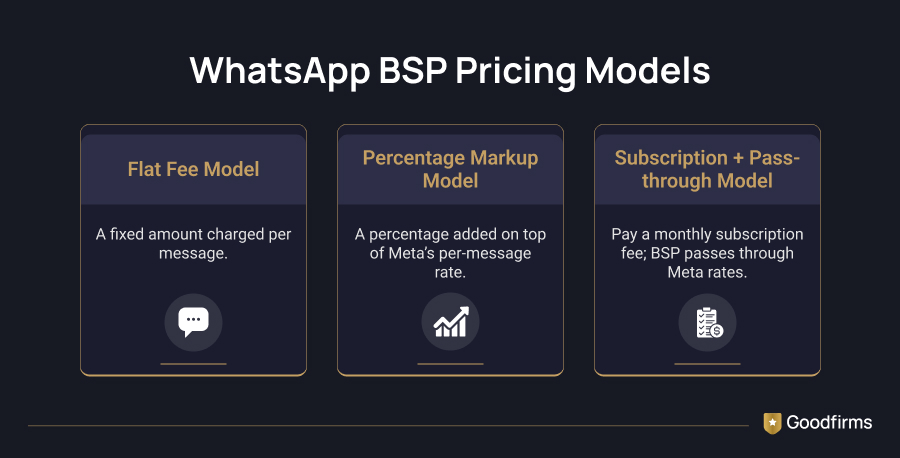
BSPs typically charge using one of three models shown here:
|
Markup Models |
How it Works |
Typical Range |
|---|---|---|
|
Flat per-message fee |
Fixed amount added to every message |
$0.002 - $0.015 per message |
|
Percentage markup |
A percentage added on top of Meta's rate |
10% - 30% of Meta's cost |
|
Subscription + passthrough |
Flat monthly fee, Meta's rate passed through at cost |
$20 – $500+/month |
Flat fees are predictable but add up fast at high volume. Percentage markups scale with your spend. Subscriptions often work out to be the cheapest option for high-volume senders, but they usually come with a monthly minimum.
So, before comparing WhatsApp marketing software pricing across providers, check which of these three models each one uses. Next, let's look at how these fees play out across some of the most widely used tools.
WhatsApp Marketing Tools and Pricing
Here's how some of the most widely used WhatsApp marketing platforms price their plans, verified against their current rate cards:
|
Tool |
Starting Price |
Pricing Model |
|---|---|---|
|
Wati |
$31.49/month |
Subscription + Meta rate pass-through |
|
AiSensy |
₹1,500/month (~$18) |
Subscription + Meta rate pass-through (free plan also available) |
|
Zoko |
$49/month |
Subscription + Markup on all conversations: $0.015 per conversation |
|
Interakt |
$10.52/month |
Subscription + markup on Meta's rate |
|
Twilio |
Pay-as-you-go |
Percentage markup on Meta's rate |
|
Gupshup |
Custom quote |
Percentage markup on Meta's rate, strong presence in India and Southeast Asia |
Most of these operate on a subscription-plus-passthrough model, meaning the monthly fee covers the platform itself, while Meta's per-message rate is billed separately at cost. AiSensy also offers a free tier with basic features. Twilio and Gupshup price based on usage rather than a flat plan, which better suits businesses with unpredictable or seasonal send volumes.
Before picking one, confirm exactly which model applies. The advertised starting price rarely includes Meta's charges, which scale with your list size.
Next, let's look at what else, beyond category and country, affects your total cost.
What Affects WhatsApp Marketing Costs?
Message category and country set your estimated base rate for WhatsApp marketing costs, but several other variables determine how much you actually need to pay each month.
- Contact List Size: The larger your contact list, the higher your total spending will be, since each delivered message is billed individually. Simply, a longer list will lead to more messages, which always turns into higher bills.
- Category Mix: A campaign highly targeted on marketing messages costs businesses far more than one that relies on utility messages and in-window replies. The category you choose makes a much bigger difference in cost than the message itself.
- Recipient Location: Sending a message to someone in Germany or the Netherlands costs several times as much as sending to India or the US, purely based on where your contacts live. Your audience's location can move your bill more than your message volume does.
- Message Quality Rating: WhatsApp lowers your sending limits if too many recipients block or report your messages, forcing you to send in smaller batches over a longer period. A poor quality rating slows your campaigns down and can push you into higher-tier sending limits.
- Automation and AI Usage: Chatbots, Meta Business Agent, and marketing automation software can add their own charges on top of standard message costs, whether billed by your BSP, software provider, or Meta directly. More automation means more moving parts on your bill, not fewer.
The cost of WhatsApp marketing increasingly depends on more than message volume. As businesses adopt AI-powered automation, the quality of the customer experience also becomes an important consideration. James Detmer, Director of Product at Meta, highlights this shift.

AI agents are only as powerful as the businesses behind them. The real differentiator is not the technology itself but how well your agent reflects your brand, your products, and the experience you want customers to have.
So, before you finalize a budget, it's worth checking where you stand on each of these five. They usually explain the difference between a $250-a-month plan and a $1,500 one better than any single per-message rate does. Next, let's look at the costs that don't appear on any rate card.
Hidden WhatsApp Marketing Costs
Beyond Meta's rate card and your BSP's subscription, there are a few costs that tend to come up only after you've already committed to a platform.
Template rejection delays
Every utility or marketing template needs Meta’s approval, as a poorly worded template gets bounced back more often than you’d expect. Each rejection means waiting, resubmitting, and editing again on the endpoint before a sale begins.
Template rejections look like a minor delay on paper, but the real cost shows up in lost momentum. Roy Danino, Co-founder of Lachi Media, has watched this hit a client's lead flow directly.

A home services client once lost a full week of lead flow because their utility template was rejected due to a formatting issue we could not predict. The message fee is the cheapest part of the whole funnel.
Quality rating drops
Too many blocks or reports on your account, and WhatsApp quietly lowers how many messages you're allowed to send at once. Your campaign doesn't stop; it just slows to a crawl, stretched across days instead of hours.
Currency conversion fees
If your billing currency doesn't match your business's home currency, your card issuer or BSP often adds a small conversion markup of 1-3% that you won't see listed upfront.
Contract lock-ins
Some BSPs require a minimum term before you sign up, and leaving early can mean losing unused credits or incurring an exit fee. Worth reading the fine print before, not after.
Creative and content cost
A plain text template is free to design. One with an image, video, or carousel is usually not included in your subscription and can cost $50-$500+ per campaign.
Extra agent seats
Most plans include a handful of team seats and start charging $12-$70+ per user once you scale past that — an easy line item to miss until your support team grows.
How to Choose a WhatsApp Marketing Platform
With so many BSPs offering similar features at different price points, picking the right one comes down to a few practical checks.
- Check the pricing model first: Determine whether it's flat markup, percentage markup, or subscription-plus-passthrough, and know which one you're signing up for before comparing starting prices across providers.
- Ask for the full rate card, not just the plan price: The subscription fee is rarely the whole story; the final cost includes other charges as well, so ensure you get the per-message rates by category and country before you commit.
- Match features to what you'll actually use: A platform filled with advanced automation is considered a complete waste of your spend if your business only needs simple broadcast campaigns.
- Confirm template approval support: Some BSPs actively help you get templates approved faster; others leave you to figure it out with Meta directly.
- Look at the agent seat limit: If your support team is growing, check the cost of extra seats before you're locked into a plan that charges more per user than expected.
- Ask about contract terms upfront: Understand the minimum commitment and exit terms before signing, not after you want to switch.
- Compare the quality of support, not just the price: A cheaper platform with slow support can cost you more in delayed campaigns than a slightly pricier one with responsive support.
- Test before you scale: Most BSPs offer a free trial or a low-cost entry tier; take advantage of these to confirm whether the platform is a good fit before committing to volume.
So, before you sign anything, run your expected monthly message volume and category mix through at least two or three providers. The "cheapest" one on paper isn't always the cheapest one on your actual bill.
How to Reduce WhatsApp Marketing Costs
Running WhatsApp campaigns at scale is a major line item for growing businesses, and managing that spend effectively is essential to keeping customer engagement affordable as your list grows. Businesses can also work with social media marketing companies to coordinate WhatsApp campaigns with their broader social media strategy. Discover these smart, proven cost-saving tips for WhatsApp marketing that help businesses and marketers maximize reach while minimizing spend.
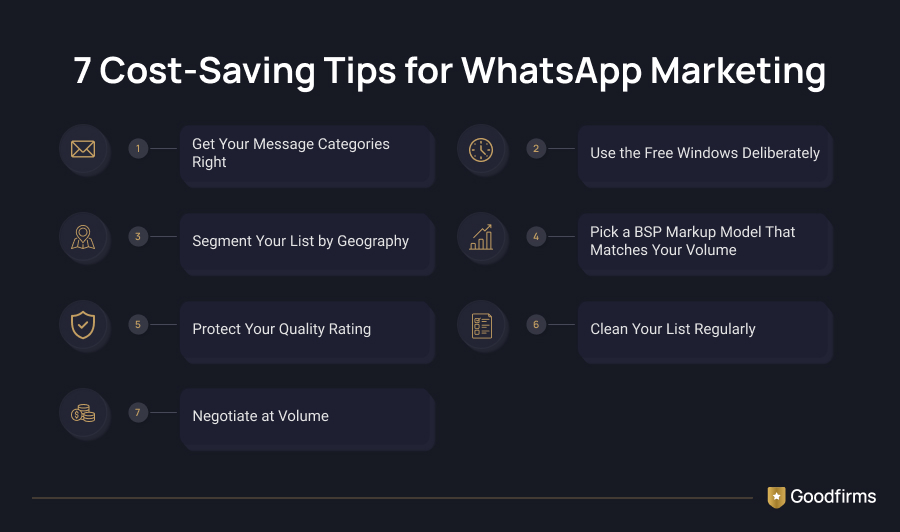
Let's take a closer and more detailed look at these cost-saving tips.
- Get Your Message Categories Right: Marketing templates cost significantly more than utility ones. If a message is a genuine order update or reminder, make sure it's categorized as utility, not marketing.
- Use the Free Windows Deliberately: Manage your replies and follow-ups to land within the 24-hour service window or the 72-hour CTWA window whenever possible, rather than sending a fresh template that gets billed.
- Segment Your List by Geography: Since country rates vary so widely, avoid blasting the same campaign to your entire list at once if a large chunk of it sits in a high-cost market like Germany or the Netherlands.
- Pick a BSP Markup Model That Matches Your Volume: Flat per-message fees work well at low volume; a subscription-plus-passthrough model usually pays off once you're sending at scale.
- Protect Your Quality Rating: Keep opt-outs easy and avoid over-messaging the same contacts. A dropped quality rating slows your sends and stretches campaigns out longer than they need to be.
- Clean Your List Regularly: Removing inactive or unengaged contacts means you're not paying to message people who were never going to convert.
- Negotiate at Volume: Once you're sending tens of thousands of messages a month, most BSPs, and even Meta's volume tiers, are open to better rates; ask before assuming the listed price is final.
None of these tips require switching platforms or cutting your campaign reach — they're about paying only for what you actually need to pay for, not sending less. Before wrapping up, here are a few practical questions people often ask when budgeting for WhatsApp marketing.
FAQs: WhatsApp Marketing Cost
Do I need a BSP to use WhatsApp Business API, or can I pay Meta directly?
You can connect straight to Meta's Cloud API and skip BSP markup altogether, but then you're on the hook for managing templates, webhooks, and integrations yourself. A BSP costs a bit more per message, but it gives you a shared inbox, chatbot tools, and built-in support. For most businesses, that convenience is worth paying for. If you have a technical team and send high volumes, going direct usually works out cheaper.
Is WhatsApp Business API free to use?
No. The regular WhatsApp Business app is free, but it only lets you message 256 contacts at a time and has no real automation. WhatsApp Business API pricing kicks in the moment you need to send at scale; you're billed per message, based on category and the country you're sending to.
How much does WhatsApp charge per message?
It ranges from about $0.0118 in India to $0.14 or more in Germany and the Netherlands. Marketing messages cost the most. Utility and authentication messages cost less. And service messages sent inside the 24-hour window, or anything sent inside the 72-hour Click-to-WhatsApp window, don't cost anything at all.
Can small businesses afford WhatsApp marketing?
For most, yes. A campaign to 1,000-10,000 contacts usually costs $85-$1,800+ a month, and where your contacts live makes the biggest difference. If most of your list is in India or similar lower-cost markets, you're looking at a genuinely low-cost WhatsApp marketing setup; a Europe-heavy list costs several times more for the same number of messages.
Is there a monthly minimum on WhatsApp Business API?
Meta itself has no minimum; you only pay for what you send. But most BSPs charge their own monthly subscription on top, so you could still owe something even in a month you barely use WhatsApp. Worth checking before you sign up.
Final Words
WhatsApp marketing costs can never be given as a fixed number for everyone; they vary by message category, recipient country, free windows, and how well you manage your quality rating. The same 10,000-contact campaign can cost $250 for one business or $1,800 for another, depending almost entirely on where your audience lives.
Businesses that categorize templates correctly, use free windows deliberately, and pick a BSP model that matches their actual volume consistently spend less than those chasing the lowest advertised price. If automation is a big part of your spend, browsing top chatbot development companies can help you find a team that keeps your process more cost-efficient rather than bloated.
Meta updates its rates periodically, and BSP pricing shifts even more often, so consider the figures in this guide as a strong estimate, and confirm current rates before finalizing a campaign budget.